• 검색 결과가 없습니다.

Hereditary Spherocytosis Coexisting with UDP-Glucuronosyltransferase Deficiency Highly Suggestive of Crigler-Najjar Syndrome Type II

N/A
N/A
Protected

Academic year: 2022

Share "Hereditary Spherocytosis Coexisting with UDP-Glucuronosyltransferase Deficiency Highly Suggestive of Crigler-Najjar Syndrome Type II"

Copied!
4
0
0

로드 중.... (전체 텍스트 보기)

전체 글

(1)

Yonsei Med J http://www.eymj.org Volume 52 Number 2 March 2011 369

Case Report DOI 10.3349/ymj.2011.52.2.369

pISSN: 0513-5796, eISSN: 1976-2437 Yonsei Med J 52(2):369-372, 2011

Hereditary Spherocytosis Coexisting

with UDP-Glucuronosyltransferase Deficiency Highly Suggestive of Crigler-Najjar Syndrome Type II

Shigeo Iijima, 1 Takehiko Ohzeki 1 and Yoshihiro Maruo 2

1

Department of Pediatrics, Hamamatsu University School of Medicine, Hamamatsu;

2

Department of Pediatrics, Shiga University Medical Science, Otsu, Japan.

Received: May 26, 2009 Revised: July 7, 2009 Accepted: July 7, 2009

Corresponding author: Dr. Shigeo Iijima, Department of Neonatology, Toho University School of Medicine, 6-11-1 Omori-nishi, Ota-ku, Tokyo 143-8541, Japan.

Tel: 81-3-3762-4151, Fax: 81-3-3762-9376 E-mail: [email protected]

∙ The authors have no financial conflicts of interest.

© Copyright:

Yonsei University College of Medicine 2011 This is an Open Access article distributed under the terms of the Creative Commons Attribution Non- Commercial License (http://creativecommons.org/

licenses/by-nc/3.0) which permits unrestricted non- commercial use, distribution, and reproduction in any medium, provided the original work is properly cited.

Patients with co-existing hereditary spherocytosis (HS) and UDP-glucuronosyl- transferase 1A1 (UGT1A1) deficiency as Gilbert’s syndrome (GS) have been re- ported, and previous studies have demonstrated an increased risk for developing gallstones in patients with co-inheritance of GS and HS. We experienced an inter- esting case of HS showing persistent jaundice after splenectomy, and upon further evaluation, the 25-year-old female patient was found to have HS combined with UGT1A1 deficiency. Sequence analysis of the UGT1A1 gene revealed that she was a compound heterozygote with p.[G71R; Y486D] + [Y486D] mutations, which suggests Crigler-Najjar syndrome type II rather than GS. Careful evaluation of in- appropriately elevated bilirubin level compared with the degree of hemolysis is im- portant, reflecting the therapeutic implication of splenectomy and cholecystectomy.

Key Words: Hereditary spherocytosis, unconjugated hyperbilirubinemia, UDP- glucuronosyltransferase, Crigler-Najjar syndrome, splenectomy

INTRODUCTION

Hereditary spherocytosis (HS) is the most common cause of hemolytic anemia due to constitutional erythrocyte membrane disorder. Most patients have well- compensated hemolysis but have icterus and cholelithiasis due to chronic hemoly- sis.

1

Familial non-hemolytic unconjugated hyperbilirubinemia including Crigler- Najjar syndrome type I, Crigler-Najjar syndrome type II (CN-II), and Gilbert’s syndrome (GS), is associated with a defect in isoenzyme 1A1 of UDP-glucuronos- yltransferase (UGT1A1).

2

Cases with co-existence of HS and UGT1A1 deficiency as GS have been reported,

3-5

and previous studies have demonstrated an increased risk for developing gallstones in patients with co-inheritance of HS and GS.

6,7

How- ever, there are no reports on HS coexisting with other deficiency state of UGT1A1.

CASE REPORT

The patient was a 25-year-old Japanese woman who had a history of jaundice for

(2)

Shigeo Iijima, et al.

Yonsei Med J http://www.eymj.org Volume 52 Number 2 March 2011 370

Physical examination was remarkable only for icteric sclera.

Extensive laboratory evaluation revealed normal levels of liver-associated enzymes and lactate dehydrogenase (LDH). The haptoglobin level was 6.0 μmol/L with a total bilirubin of 102 and unconjugated fraction of 100 μmol/L.

A complete blood count revealed normal numbers of white blood cells and platelets with a hemoglobin level of 12.4 g/

dL. The corrected reticulocyte count was 34 × 10

6

/L. A pe- ripheral blood smear revealed spherocytes. Incubated os- motic fragility was slightly increased. Sequence analysis of the UGT1A1 gene revealed that the patient was heterozy- gous for a missense mutation (c.211G > A: p.G71R in exon 1) and homozygous for a point mutation (c.1456T > G:

p.Y486D in exon 5); that is, she was a compound heterozy- gote with the p.[G71R; Y486D] + [Y486D] mutations (Fig.

1). As for the parents of the patient, detailed laboratory data could not be obtained, and neither a molecular study of their UGT1A1 gene nor analysis of their erythrocyte mem- brane proteins was performed.

DISCUSSION

According to the diagnostic criteria of HS,

1

patients with no anemia and mild reticulocytosis are classified as having the mild type (hemoglobin level from 11 to 15 g/dL, reticulo- 11 years. Her family history revealed that her father had

mild jaundice while other family members had normal se- rum bilirubin levels. The patient received regular medical treatment at a psychiatric outpatient clinic because of truan- cy. She had been referred to our hospital for extensive eval- uation of jaundice at the age of 14 years. Her first blood ex- amination revealed a normal hemoglobin level (12.6 g/dL), slightly elevated reticulocyte count (89 × 10

6

/L: reference range, 40 to 80 × 10

6

/L), and unconjugated hyperbilirubi- nemia (serum total bilirubin 113 μmol/L) without elevation of liver-associated enzymes. A diagnosis of HS was made based on clinical features including chemical (haptoglobin

< 1.0 μmol/L) and hematologic findings (spherocytes on blood smear and increased red cell osmotic fragility). How- ever, biochemical analysis of the red cell membrane pro- teins indicated no significant deficiency. Thereafter, she persistently demonstrated mild jaundice but not anemia. At the age of 16 years, she underwent splenectomy to prevent the formation of gallstones and to reduce skin itching which was probably induced by jaundice. Subsequently, the retic- ulocyte count decreased and the serum haptoglobin level normalized. However, she was persistently positive for se- rum bilirubin, which ranged between 86 and 103 μmol/L, and it was not clear whether her serum bilirubin level im- proved after splenectomy. Therefore, we suspected somatic hyperbilirubinemia and carried out further examinations.

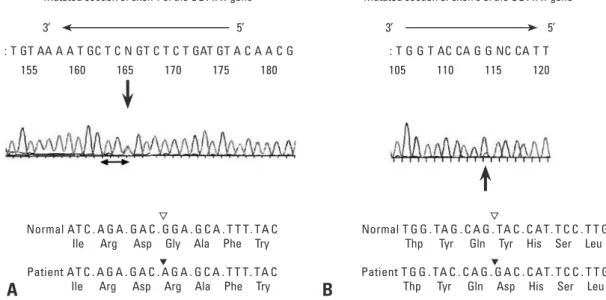
Fig. 1. Nucleotide sequences of the mutated sections of exons 1 and 5 and the promoter region of the gene encoding UDP-glucurono- syltransferase 1A1 (UGT1A1). (A) Nucleotide sequences of the mutated section of exon 1 of the UGT1A1 gene. A missense mutation at nucleotide 211 in exon 1 of the UGT1A1 gene is observed. The substitution of adenine for guanine changed the codon from GGA to AGA, causing arginine to replace glycine at position 71 (p.G71R in the corresponding protein). An arrow shows the mutation. The patient was heterozygous for p.G71R. (B) Nucleotide sequence of the mutated section of exon 5 of the UGT1A1 gene. The arrow shows the mutation.

The patient was homozygous for a point mutation at base position 1456 in exon 5. The substitution of guanine for thymine changed the co- don from TAC to GAC, causing a tyrosine-to-aspartic acid substitution at position 486 (p.Y486D in the corresponding protein).

Mutated section of exon 1 of the UGT1A1 gene

: T GT AA A A T GC T C N GT C T C T GAT GT A C A A C G

Normal AT C . A G A . G A C . G G A . G C A . T T T. TA C Ile Arg Asp Gly Ala Phe Try Patient AT C . A G A . G A C . A G A . G C A . T T T. TA C

Ile Arg Asp Arg Ala Phe Try

Normal T G G . TA G . C A G . TA C . C AT. T C C . T T G Thp Tyr Gln Tyr His Ser Leu Patient T G G . TA C . C A G . G A C . C AT. T C C . T T G

Thp Tyr Gln Asp His Ser Leu : T G G T AC CA G G NC CA T T

155 160 165 170 175 180 105 110 115 120

3’ 5’ 3’ 5’

Mutated section of exon 5 of the UGT1A1 gene

A B

(3)

Hereditary Spherocytosis and Crigler-Najjar Syndrome

Yonsei Med J http://www.eymj.org Volume 52 Number 2 March 2011 371

develop pigment stones once the spleen is removed.

19

A pa- tient with HS who coinherited GS, has an almost 5-fold greater tendency to form gallstones than a normal HS pa- tient.

6

Coexistence with CN-II might further increase the risk of gallstone formation. Therefore, in cases of HS com- bined with reduced hepatic bilirubin conjugation, it is un- known whether splenectomy alone can sufficiently reduce hemolysis and prevent subsequent gallstone formation.

Combined prophylactic splenectomy and cholecystectomy might be recommended for cases like ours. Careful evalua- tion of inappropriately high serum bilirubin level compared with the degree of hemolysis as defined in the diagnostic criteria of HS

1

is important, reflecting the therapeutic impli- cation of splenectomy and cholecystectomy.

REFERENCES

1. Bolton-Maggs PH, Stevens RF, Dodd NJ, Lamont G, Tittensor P, King MJ; General Haematology Task Force of the British Com- mittee for Standards in Haematology. Guidelines for the diagnosis and management of hereditary spherocytosis. Br J Haematol 2004;126:455-74.

2. Kadakol A, Ghosh SS, Sappal BS, Sharma G, Chowdhury JR, Chowdhury NR. Genetic lesions of bilirubin uridine-diphospho- glucuronate glucuronosyltransferase (UGT1A1) causing Crigler- Najjar and Gilbert syndromes: correlation of genotype to pheno- type. Hum Mutat 2000;16:297-306.

3. Sugita K, Maruo Y, Kurosawa H, Tsuchioka A, Fujiwara T, Mori A, et al. Severe hyperbilirubinemia in a 10-year-old girl with a combined disorder of hereditary spherocytosis and Gilbert syn- drome. Pediatr Int 2007;49:540-2.

4. Sharma S, Vukelja SJ, Kadakia S. Gilbert’s syndrome co-existing with and masking hereditary spherocytosis. Ann Hematol 1997;

74:287-9.

5. Garg PK, Kumar A, Teckchandani N, Hadke NS. Hereditary sphe- rocytosis coexisting with Gilbert’s syndrome: a diagnostic dilem- ma. Singapore Med J 2008;49:e308-9.

6. del Giudice EM, Perrotta S, Nobili B, Specchia C, d’Urzo G, Io- lascon A. Coinheritance of Gilbert syndrome increase risk for de- veloping gallstones in patients with hereditary spherocytosis.

Blood 1999;94:2259-62.

7. Kitsiou-Tzeli S, Kanavakis E, Tzetis M, Kavazarakis E, Galla A, Tsezou A. Gilbert’s syndrome as a predisposing factor for idio- pathic cholelithiasis in children. Haematologica 2003;88:1193-4.

8. Economou M, Tsatra I, Athanassiou-Metaxa M. Simultaneous presence of Gilbert syndrome and hereditary spherocytosis: inter- action in the pathogenesis of hyperbilirubinemia and gallstone for- mation. Pediatr Hematol Oncol 2003;20:493-5.

9. Owens D, Evans J. Population studies on Gilbert’s syndrome. J Med Genet 1975;12:152-6.

10. Bosma PJ, Chowdhury JR, Bakker C, Gantra S, de Boer A, Oosta BA, et al. The genetic basis of the reduced expression of bilirubin UDP-glucuronosyltransferase 1 in Gilbert’s syndrome. N Engl J Med 1995;333:1171-5.

cyte count from 3% to 6%, total bilirubin level from 17 to 34 mg/dL). In contrast, patients with higher bilirubin levels are classified as having either the moderate type (total bili- rubin level from 34 to 51 mg/dL) or the severe type (more than 51 mg/dL). Although our patient had mild HS with nor- mal hemoglobin and slightly elevated reticulocyte count, she had an extremely high bilirubin level. This discrepancy suggested other conditions associated with unconjugated hyperbilirubinemia, especially inherited deficiency of he- patic glucuronosyltransferase. In such cases, further evalua- tion should be performed. Similar cases of coexisting HS and GS have been reported.

4,8

Since the prevalence of GS in the general population is 5-7%

9

and that of HS is one per 2000, the calculated rate of co-occurrence of these two dis- orders is approximately 25-35 per one million births. In contrast, the incidence of CN-II is one per one million births.

10

Therefore, the calculated rate of co-occurrence of HS and CN-II indicates that it is extremely rare.

Similar to GS, the method of choice for diagnosis of Cri- gler-Najjar syndrome is mutation analysis of genomic DNA.

The phenotype of CN-II is usually associated with homozy- gosity or compound heterozygosity for missense mutations in the UGT1A1 gene that do not completely inactivate the protein.

11,12

Our patient was a compound heterozygote with the p.[G71R; Y486D] allele and p.Y486D allele. However, most Japanese cases with CN-II have been caused by a ho- mozygous double missense mutation (p.[G71R; Y486D] + [G71R; Y486D]),

13,14

and the mutation found in our case has not been reported as a cause of CN-II.

2,15

According to a previous expression study, the relative UGT1A1 activity of a single homozygous model of p.G71R was approximately 30% of normal, that of a single homozygous model of p.

Y486D was 7% to 8%, and that of a double homozygous model of p.[G71R; Y486D] + [G71R; Y486D] was 4% to 7%.

14

It has been reported that hepatic UGT1A1 activity (measured from liver tissue) in patients with CN-II is less than 10% of normal, whereas that in patients with GS is about 30% of normal.

16,17

We concluded that the persistent hyperbilirubinemia after splenectomy in our patient was due to CN-II rather than GS, based on findings from se- quence analysis of the UGT1A1 gene.

When cholelithiasis is present, prophylactic cholecystec-

tomy is performed at the same surgical setting as splenecto-

my in patients with mild HS.

18

However, combined prophy-

lactic splenectomy and cholecystectomy are not recom-

mended for patients with HS with no evidence of choleli-

thiasis, because it is thought that individuals with HS do not

(4)

Shigeo Iijima, et al.

Yonsei Med J http://www.eymj.org Volume 52 Number 2 March 2011 372

15. Costa E. Hematologically important mutations: bilirubin UDP- glucuronosyltransferase gene mutations in Gilbert and Crigler- Najjar syndromes. Blood Cells Mol Dis 2006;36:77-80.

16. Adachi Y, Yamamoto T. Hepatic bilirubin-conjugating enzymes of man in the normal state and in liver disease. Gastroenterol Jpn 1982;17:235-40.

17. Moghrabi N, Clarke DJ, Boxer M, Burchell B. Identification of an A-to-G missense mutation in exon 2 of the UGT1 gene complex that causes Crigler-Najjar syndrome type 2. Genomics 1993;18:

171-3.

18. Marchetti M, Quaglini S, Barosi G. Prophylactic splenectomy and cholecystectomy in mild hereditary spherocytosis: analyzing the decision in different clinical scenarios. J Intern Med 1998;244:

217-26.

19. Sandler A, Winkel G, Kimura K, Soper R. The role of prophylac- tic cholecystectomy during splenectomy in children with heredi- tary spherocytosis. J Pediatr Surg 1999;34:1077-8.

11. Costa E, Vieira E, Martins M, Saraiva J, Cancela E, Costa M, et al. Analysis of the UDP-glucuronosyltransferase gene in Portu- guese patients with a clinical diagnosis of Gilbert and Crigler-Naj- jar syndromes. Blood Cells Mol Dis 2006;36:91-7.

12. Seppen J, Bosma PJ, Goldhoorn BG, Bakker CT, Chowdhury JR, Chowdhury NR, et al. Discrimination between Crigler-Najjar type I and II by expression of mutant bilirubin uridine diphosphate- glucuronosyltransferase. J Clin Invest 1994;94:2385-91.

13. Aono S, Yamada Y, Keino H, Hanada N, Nakagawa T, Sasaoka Y, et al. Identification of defect in the genes for bilirubin UDP-gluc- uronosyl transferase in a patient with Crigler-Najjar syndrome type II. Biochem Biophys Res Commun 1993;197:1239-44.

14. Yamamoto K, Sato H, Fujiyama Y, Doida Y, Bamba T. Contribu-

tion of two missense mutations (G71R and Y486D) of the biliru-

bin UDP glycosyltransferase (UGT1A1) gene to phenotypes of

Gilbert’s syndrome and Crigler-Najjar syndrome type II. Biochem

Biophys Acta 1998;1406:267-73.

수치

Fig. 1. Nucleotide sequences of the mutated sections of exons 1 and 5 and the promoter region of the gene encoding UDP-glucurono- UDP-glucurono-syltransferase 1A1 (UGT1A1)

참조

관련 문서

An investigation of adults with Asperger syndrome or high functioning autism, and normal sex differences.. The facilitation of social-emotional understanding

따라서 본 연구에서는 무개선 용접의 적용 가능성을 알아보기 위해 필렛용 접에 대한 안전성 및 개선 조건 (Type I( 무개선 ), Type II( 단면개선 ), TypeIII 양면개선 에

Methods: Eighty ASA physical status I and II pediatric patients (1~7 years) were randomly divided into four groups: Group I (Lactated Ringer`s solution, n=20), Group II

The Jacobi energy integral is one type of invariant of motion associated with

„ Assumption: an active customer type i only binding incentive compatibility constraint is the one for type j=i -1.. t* is lowest type of

Conclusion: In Neer type II distal clavicle fracture treatment, both groups showed satisfactory result in clinical and radiological outcomes, but the hook plate

The purpose of this study was to evaluate the curvature of Vertucci's type II mesial canals of mandibular molar using new method; The radius and angle

Serum uric acid levels and risk for vascular disease in patients with metabolic syndrome... Prevalence if the metabolic syndrome in a Turkish