Reverse Total Shoulder Replacement for an Enchondroma with Concomitant Rotator Cuff Tear Arthropathy: A Case Report
Bong-Ju Park, Ki-Yong An , Yong-Suk Choi
Department of Orthopedic Surgery, Gwangju Veterans Hospital, Gwangju, Korea
Enchondromas generally occur in the hand and uncommonly in the long bones. Because enchondromas are usually asymptomatic, most are discovered during diagnostic radiology for another disease. Here, we describe a case of enchondroma in the right humerus in a 79-year-old female patient with concomitant rotator cuff tear arthropathy. The patient was initially hospitalized for prolonged pain and pseudoparalysis of the right shoulder. The condition, which was histologically confirmed as an enchondroma in the proximal humerus, was treated with curettage and reverse total shoulder arthroplasty. In this case report, we present a rare case of an enchondroma with combined rotator cuff tear arthropathy.
(Clin Shoulder Elbow 2017;20(2):100-104)
Key Words: Humerus; Enchondroma; Rotator cuff tear arthropathy; Total shoulder replacement Clinics in Shoulder and Elbow Vol. 20, No. 2, June, 2017
https://doi.org/10.5397/cise.2017.20.2.100
Received January 4, 2017. Revised February 27, 2017. Accepted March 1, 2017.
Correspondence to: Ki-Yong An
Department of Orthopedic Surgery, Gwangju Veterans Hospital, 99 Cheomdanwolbong-ro, Gwangsan-gu, Gwangju 62284, Korea Tel: +82-62-602-6162, Fax: +82-62-602-6164, E-mail: [email protected]
IRB approval (No. 2016-11-1).
Financial support: None. Conflict of interests: None.
Enchondromas, or simply chondromas, consist of intramedul- lary mature hyaline cartilage. Commonly found in the hand, only 7% of enchondromas occur in the long bones.1) In particular, en- chondromas occurring in the humerus is usually asymptomatic, making its timely diagnosis a difficult task. Rather, they are often
coincidentally discovered during diagnostic examination for an- other disease. But with technological advancements in medical devices, such as magnetic resonance imaging (MRI), the diag- nosis of asymptomatic humeral enchondromas has improved.
Elderly patients with asymptomatic enchondromas are generally
A B
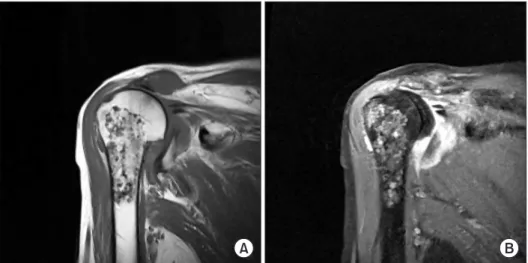
Fig. 1. Both images reveal a partial thick- ness tear of the right supraspinatus tendon (radiographs were taken 4 years ago). (A) T1-weighted coronal plane image shows a lobulating, coutoured lesion displaying low signal intensity in the proximal humerus.
(B) T2-weighted coronal plane image shows mixed signal intensity where the multifocal dark signals denote areas of calcification.
treated conservatively through vigilant surveillance. However, in this case report, we describe a rare case of an enchondroma with concomitant massive rotator cuff tear in an elderly patient, for which we carried out surgical treatment. To the best of our knowledge, this case report describes the first ever case of an enchondroma with concomittant rotator cuff tear arthropathy and its clinical outcomes after reverse total shoulder arthroplasty.
Case Report
A 79-year-old female patient was hospitalized for pain in the right shoulder that began a decade ago in the absence of particular trauma. Prior to this visit, the patient had been hos- pitalized for the same reason and had received diagnostic MRI for a suspected rotator cuff tear; diagnostic MRI revealed an enchondroma with concomitant partial tear of the rotator cuff
(Fig. 1). For this condition, she had received conservative treat- ment and was later lost to follow-up. Four years on, the patient was re-hospitalized for exacerbated pain and motion restriction.
Clinical examination of the patient’s right shoulder revealed a visual analogue scale for pain (pVAS) of 5 points and a Korean shoulder score (KSS) of 26 points. Upon physical examination of the patient, we observed signs of pseudo-paralysis and impinge- ment syndrome. However, we did not observe symptoms such as pain in the proximal humerus.
Findings of plain radiography showed radiopaque signals and spotty calcification at the right proximal humerus, but not supe- rior displacement of the humerus (Fig. 2). Further, we observed an intramedullary lobular mass with dimensions 2.7×6.5×2.5 cm, which exhibited a low-to-intermediate signal intensity on T1-weighted images and an intermediate-to-high signal intensity on T2-weighted images. Radiological findings revealed a com- plete supraspinatus tendon tear and medial displacement of the humerus that had not been there in previous MRI findings. In comparison, we found that the growth of the mass was minimal
Fig. 2. Anteroposterior preoperative radiograph of the right humerus reveals a radiopaque lesion and spotted calcificacion at the proximal side.
A B
Fig. 3. Both images depict a complete tear and medial retraction of the right supra- spinatus tendon. (A) T1-weighted coronal plane image shows a lobulating, coutoured lesion in the proximal humerus, displaying low signal intensity. (B) T2-weighted coronal plane image shows mixed signal intensity where the multifocal dark signals denote areas of calcification.
Fig. 4. Intraoperative image of the proximal humerus enchondroma after re- section of the humeral head (arrow).
over the four years (Fig. 3). At the time of hospitalization, the patient complained of persistent pain and restricted range of motion of the right shoulder. We carried out surgical treatment of the patient’s enchondroma, using curettage and reverse total shoulder arthroplasty, because the patient had a concomitant massive rotator cuff tear. Additionally, to exclude the possibility of malignant changes such as the development of a secondary chondrosarcoma, we performed histological examination of the intraoperatively excised mass.
The surgery was performed using the deltoid-pectoral ap- proach, with the patient under general anesthesia and in Fowler’s position. After the proximal humerus was sufficiently exposed, we located the anatomical position of the neck and made an incision, aiming for a humeral retroversion of 20° with respect to the forearm. The incision was made using a humeral incision guide. The enchondroma was indeed confirmed to
be situated at the proximal humerus (Fig. 4) and was excised through curettage and reaming, after which a provisional hu- meral stem was inserted. Next, we inserted a plate at the scapula glenoid, connected the humeral stem to a provisional polyeth- ylene insert, and then performed the reduction. To determine the thickness of the polyethylene insert, we also tested whether applying force on the deltoid and its conjoined tendons or ex- ternally rotating the shoulder induces dislocation and whether applying axial force on the humerus creates tension. After, we dislocated the upper extremity and removed the provisional implants. We hooked a non-bioabsorbable suture onto a pre- drilled hole at the humeral minor tuberosity and then implanted the permanent long stem (Aequalis-Reversed II® long stem 6.5×150 mm; Tornier SAS, Montbonnot-Saint-Martin, France) and the polyethylene insert with cementation. After testing for Fig. 5. Immediately postoperative radio- graph shows the reverse total shoulder pros- thesis with bone cementation.
Fig. 6. Microscopic pathology illustrates cartilaginous hypocellular areas without pleomorphism H&E stain (1:40) (arrow), a lobular growth pattern, and a matrix with a ground-glass basophilic appearance.
Fig. 7. Radiograph taken at the 6-month follow-up.
joint stability, we sutured the subscapularis tendon and the an- terior soft tissue (Fig. 5). Subsequent histological examination re- vealed that the mass was a benign enchondroma (Fig. 6). At the final 6-month follow-up, we found that the physical parameters of the patient had improved: the patients showed a flexion of 160°, an abduction of 140°, and an internal rotation to the 5th lumbar spine. Likewise, clinical parameters were improved: the pVAS decreased to 1 point and the KSS increased to 75 points.
Radiographic findings were not suggestive of complications such as scapular notching (Fig. 7).
Discussion
Enchondromas are benign bone tumors that usually occur in the short bones, such as the hand and foot, consisting of abnor- mally differentiated intramedullary hyaline cartilage.1) Radiologi- cally, the pathology appears as a round, contoured shape that is radiolucent and shows evidence of cortical thinning. On T1- weighted imaging, it shows an intermediate signal intensity and on T2-weighted imaging, a high signal intensity.2) Histologically, they are found as intramedullary hyaline cartilage cells.1)
Enchondromas are difficult to differentiate from central Grade 1 chondrosarcomas through MRI alone. Intramedullary chondrosarcomas require surgical intervention, and a localiza- tion in the axial skeleton and size larger than 4 cm have been shown to be predictors of malignancy.3,4) The 5-year survival rate of low grade chondrosarcomas is around 85% to 100%, and the local recurrence rate associated with plain curettage has been reported to be around 50% to 92%. Recently, treatment ap- proaches have employed extended intralesional curettage with various adjuvant treatments such as cryosurgery, phenol, alcohol, and bone cement.5-8)
Asymptomatic enchondromas of small sizes are generally treated conservatively. But those larger than 3 to 4 cm, at risk of pathological fractures, or with more severe symptoms are treated operatively. In general, either plain curettage9) or cancel- lous bone grafting following curettage is performed.10) Because these approaches are often associated with complications, such as recurrence, the tissue of interest is thoroughly removed either endoscopically or using phenol or CO2 lasers as adjuvants to cu- rettage and as preventative measures against recurrence.
The deficit resulting from the excised lesion is compensated using autografts, allografts,10) or cementation using bioceramic material, such as hydroxyapatite, tricalcium phosphate, and cal- cium sulfate,10) or bone cement.
In this case report, we performed the surgical treatment in advance of the histological examination. Although in principal the treatment should not precede histological examination, un- less for low grade chondrosarcomas, because the lesion did not show changes in size or malignancy radiologically with respect to four years ago, we performed a one-stage curettage and reverse
total shoulder arthroplasty without histological scrutiny. A frozen section was not taken; rather, the biopsy was performed on an intraoperatively obtained tissue.
A deep pathological lesion would mean that the standard stem length, used for total arthroplasty of massive rotator cuff tears following curettage, is too short. This mismatch in stem length can lead to complications such as loosening of the prosthesis or prosthesis-induced fractures. To prevent such complications, in this study we filled the area of curettage with consolidating bone cement and inserted a longer than normal stem prosthesis (Aequalis-Reversed II® long stem 6.5×150 mm;
Tornier SAS). The bone cement was not used for the purposes of an adjuvant.
At a similar period, we had treated a 57-year-old male pa- tient for an enchondroma of the proximal humerus, using curet- tage and allografting. However, only three days of the operation, we observed a fracture at the site of curettage in the absence of any trauma. Deducing that the proximal humerus could be weakened with curettage, we inserted a longer than nor- mal stem prosthesis in the humerus as a prophylactic measure against postoperative fractures around the artificial joint for the latter case.
We report a case of an enchondroma with concomitant rota- tor cuff tear, treated using reverse total shoulder arthroplasty with a long humeral stem implant and bone cement, following curet- tage. To the best of our knowledge, we are the first to report the clinical outcomes of this kind of treatment for enchondromas with concomitant rotator cuff arthropathy.
References
1. Unni KK. Dahlin’s bone tumors: general aspects and data on 11,087 cases. 5th ed. Philadelphia: Lippincott-Raven; 1996.
22-45.
2. Flemming DJ, Murphey MD. Enchondroma and chondrosar- coma. Semin Musculoskelet Radiol. 2000;4(1):59-71.
3. Geirnaerdt MJ, Hermans J, Bloem JL, et al. Usefulness of radi- ography in differentiating enchondroma from central grade 1 chondrosarcoma. AJR Am J Roentgenol. 1997;169(4):1097- 104.
4. Murphey MD, Flemming DJ, Boyea SR, Bojescul JA, Sweet DE, Temple HT. Enchondroma versus chondrosarcoma in the appendicular skeleton: differentiating features. Radiographics.
1998;18(5):1213-37; quiz 1244-5.
5. Ozaki T, Lindner N, Hillmann A, Rödl R, Blasius S, Winkel- mann W. Influence of intralesional surgery on treatment out- come of chondrosarcoma. Cancer. 1996;77(7):1292-7.
6. Di Giorgio L, Touloupakis G, Vitullo F, Sodano L, Mastantuono M, Villani C. Intralesional curettage, with phenol and cement as adjuvants, for low-grade intramedullary chondrosarcoma of the long bones. Acta Orthop Belg. 2011;77(5):666-9.
7. Meftah M, Schult P, Henshaw RM. Long-term results of intra- lesional curettage and cryosurgery for treatment of low-grade chondrosarcoma. J Bone Joint Surg Am. 2013;95(15):1358- 64.
8. Verdegaal SH, Brouwers HF, van Zwet EW, Hogendoorn PC, Taminiau AH. Low-grade chondrosarcoma of long bones treated with intralesional curettage followed by application of phenol, ethanol, and bone-grafting. J Bone Joint Surg Am 2012;94(13):1201-7.
9. Shin KH, Moon ES, Hahn SB, Kang ES. Enchondroma of a digit treated by curettage only. J Korean Orthop Assoc.
2004;39(1):44-9.
10. Bahk WJ, Kim NH, Park KS, Kim JY. Clinical and radiographic outcomes of simple curettage and graft using allogenic bone or bone substitute for enchondroma involving short tubular bone of the hand and foot. J Korean Orthop Assoc. 2016;51(1):85- 90.