• 검색 결과가 없습니다.

Successful Graft Recovery from Thrombotic Acute Kidney Injury in a Kidney Transplant Patient with Antiphospholipid Syndrome

N/A
N/A
Protected

Academic year: 2021

Share "Successful Graft Recovery from Thrombotic Acute Kidney Injury in a Kidney Transplant Patient with Antiphospholipid Syndrome"

Copied!
4
0
0

로드 중.... (전체 텍스트 보기)

전체 글

(1)

J Korean Soc Transplant | www.ksot.org 128 September 2013 | Volume 27 | Issue 3 Correspondence:Beom Seok Kim, Division of Nephrology,

Department of Internal Medicine, Yonsei Univer- sity College of Medicine, 50 Yonsei-ro, Seodae- mun-gu, Seoul 120-749, Korea

Tel: +82-2-2228-1969, Fax: +82-2-393-6884 E-mail: [email protected]

Received : April 14, 2013, Revised : July 16, 2013, Accepted : August 7, 2013

J Korean Soc Transplant | 2013;27:128-131 | http://dx.doi.org/10.4285/jkstn.2013.27.3.128

Case Report

Successful Graft Recovery from Thrombotic Acute Kidney Injury in a Kidney Transplant Patient with Antiphospholipid Syndrome

Younjeong Choi, M.D.

1

, Hyewon Lee, M.D.

1

, Yujung Yun, M.D.

1

, Youngki Lee, M.D.

1

, Eudong Hwang, M.D.

1

, Hyeonjoo Jeong, Ph.D.

2

and Beom Seok Kim, Ph.D.

1

Departments of Internal Medicine

1

and Pathology

2

, Yonsei University College of Medicine, Seoul, Korea

Antiphospholipid syndrome nephropathy (APSN) is well documented in the literature as the renal involvement of the antiphospholipid syndrome (APS). A review of literature also shows that among antiphospholipid antibodies, lupus anticoagulant (LA) positivity is recognized as the strongest risk factor for APSN. In addition, APSN is also known to be associated with a poor functional outcome in the first posttransplant year. Therefore, it is a general belief that renal transplantation may be life threatening in APS patients. Furthermore, the presence of LA at the time of transplantation is particularly associated with a high rate of allograft APSN and the consequent poor transplantation outcomes. Here, we report the case that thrombotic acute kidney injury due to APSN after kidney transplantation can be successfully treated if anticoagulation therapy is timely applied with a prompt diagnosis.

Key Words: Antiphospholipid syndrome nephropathy, Antiphospholipid syndrome, Antiphospholipid antibodies, Lupus coagulation inhibitor, Kidney transplantation

중심 단어: 항인지질 증후군성 신증, 항인지질항체 증후군, 항인지질항체, 루프스 항응고인자, 신장이식

Introduction

The antiphospholipid syndrome (APS) describes a clinical entity with recurrent thrombosis, fetal loss and the presence of antiphospholipid antibodies (APAs)(1).

Antiphospholipid syndrome nephropathy (APSN) is the renal involvement of the APS(2). The most frequently observed pathologic lesions are the thrombotic micro- angiopathy (TMA), characterized by the fibrin thrombi in glomeruli and/or arterioles in the absence of vas- cular immune deposits or inflammatory cells and more chronic vascular lesions such as fibrous intimal hyper- plasia (FIH) of interlobular arteries, and focal cortical atrophy (FCA)(2,3). APSN is usually associated with grave functional outcome in the first posttransplant year(4). So renal transplantation may be life-threat-

ening in APS patients, and the presence of lupus anti- coagulant (LA) at the time of transplantation is asso- ciated with a high rate of allograft APSN and poor transplantation outcome(3,4). Here we introduce the case that thrombotic acute kindey injury from APSN after kidney transplantation can be successfully treated if anticoagulation therapy is timely applied with prompt diagnosis.

Case Report

A 25-year-old woman was diagnosed lupus nephritis

(class IV) in 2004. Despite of recurrent immunosu-

ppressive treatment (steroid, cyclophosphamide, ritux-

imab, and mycophenolate), her renal function had

been decreased. Finally she was diagnosed end-stage

renal disease and started hemodialysis from December

2010. Kidney transplantation was planned and while

doing the preoperative evaluation right atrium myx-

oma was suspected in transesophageal echocardiog-

raphy on May 16, 2011. Removal via submammarial

incision was conducted and organizing thrombus was

found, thus coumadinization was started (Fig. 1). She

(2)

Younjeong Choi, et al: Successful Graft Recovery from Thrombotic AKI in a KT Patient with APS

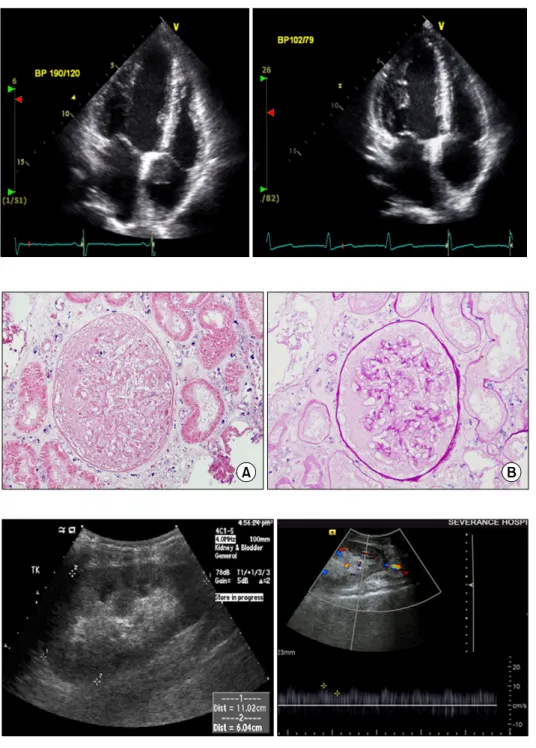
J Korean Soc Transplant | www.ksot.org 129 September 2013 | Volume 27 | Issue 3 Fig. 2. The biopsy slide of trans- planted kidney showing cortical necrosis, focal (postoperative day 8) (A, HE stain, ×120; B, PAS stain,

×120).

Fig. 3. Sonography of transplanted kidney (postoperative day 15). The transplanted kidney size was 11.4 cm. The echogenicity of the cortex was increased and blood flow was decreased. The resistive index of upper, mid, and lower pole was 0.56.

Fig. 1. Echocardiogram showing right atrium thrombus. After re- moval via submammrial incision, thrombus was disappeared.

was hospitalized on September 3, 2011, had heparin 5,000 unit subcutaneous injection daily for 3 days and stopped the day before the operation. On September 7, 2011 (day 0) she had living-related kidney trans- plantation from her cousin. Immumosuppressive ther- apy consisted of prednisolone, mycophenolate, and tacrolimus. Heparin 5,000 unit subcutaneous injection daily was started again on day 2. Doppler Ultrasono- graphy on the graft proceeded on day 3, and cortical echogenicity was in normal range. But serum crea-

tinine (sCr) level was elevated continuously (5.16 mg/dL). Empirical steroid pulse therapy for acute re- jection was done on day 3. In the Doppler ultra- sonography on day 7, echogenicity of cortex slightly increased as well as the blood flow to the graft de- creased. So graft biopsy was performed on day 8.

Two-third of renal cortex showed ischemic necrosis

and the remaining parenchyma showed tubular ne-

crosis and interstitial edema (Fig. 2). APA was ana-

lyzed: LA (+), anticardiolipin antibody (aCL) immunog-

(3)

Younjeong Choi, et al: Successful Graft Recovery from Thrombotic AKI in a KT Patient with APS

J Korean Soc Transplant | www.ksot.org 130 September 2013 | Volume 27 | Issue 3 Fig. 5. Sonography of transplanted kidney (postoperative day 3 months). The transplanted kidney size was 11.8 cm. The echogenicity of the cortex was normal and there was no hydronephrosis was no hydronephrosis or fluid collection. The resistive index of upper, mid, and lower pole was 0.60∼0.64.

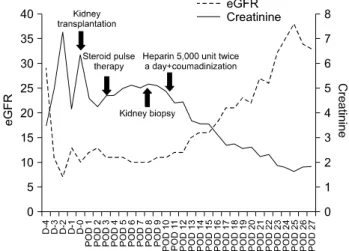
Fig. 4. Change of renal function. After anticoagulation therapy was started the transplanted kidney function was improved.

Abbreviations: eGFR, epidermal growth factor receptor; POD, postoperative day.

lobulin M (IgM) (-), aCL IgG (-), anti-β2GP1(aβ2GP1) IgG (-), and aβ2GP1 IgM (-). With the diagnosis of APSN, anticoagulation therapy was continued. From day 10, 5,000 unit of heparin was subcutaneously in- jected twice a day. Since then, sCr decreased con- tinuously. In the Doppler ultrasonography on day 15, echogenicity of allograft cortex still increased, however the blood flow to the graft was improved (Fig. 3).

Heparin was changed to coumadin with target pro- thrombin time international normalized ratio 2∼3.

Finally on day 25 sCr was decreased to 1.64 mg/dL (Fig. 4). After 12 weeks, LA was weak positive and

sCr was 1.28 mg/dL. Doppler ultrasonography per- formed 3 months after transplantation showed the nor- mal echogenicity of the cortex and improved blood flow (Fig. 5). She takes coumadin currently without additional complications.

Discussion

The manifestations of APSN are the renal artery thrombosis/stenosis, renal infarction, hypertension, re- nal vein thrombosis, end-stage renal disease, increased allograft vascular thrombosis, some types of glomerular disease, and a small vessel vaso-occlusive nephrop- athy(2). The most frequently observed pathologic le- sions are the TMA, characterized by the fibrin thrombi in glomeruli and/or arterioles in the absence of vas- cular immune deposits or inflammatory cells and more chronic vascular lesions such as FIH of interlobular ar- teries, and FCA(2,3).

In APSN, APAs are directed against phospholipid-

protein complexes and include LA, IgG or IgM aCL,

and IgG or IgM aβ2GPI(1,2). Antibodies should be

demonstrable on at least two occasions separated by

12 weeks(1). These antibodies may be associated with

connective tissue diseases such as systemic lupus er-

ythematosus (secondary APS) or be found in isolation

(primary APS)(5). However, the most recent interna-

tional consensus statement on classification criteria for

APS advises against this terminology because the clin-

(4)

Younjeong Choi, et al: Successful Graft Recovery from Thrombotic AKI in a KT Patient with APS

J Korean Soc Transplant | www.ksot.org 131 September 2013 | Volume 27 | Issue 3

ical consequences in both groups appear to be the same(5).

Among APAs, LA positivity is recognized as the strongest risk factor for APSN(2). And APSN is asso- ciated with grave functional outcome in the first post- transplant year(4). So renal transplantation may be life-threatening in APS patients, and the presence of LA at the time of transplantation is associated with a high rate of allograft APSN and poor transplantation outcome(3,4).

In this case, the APA status had not been worked up before the kidney transplantation. Although throm- bus was not found in the pathology, evidence of vas- cular obstruction and decreased blood flow from Doppler ultrasonography suggested the high proba- bility of thrombotic lesion. Considering the previous history of atrial thrombus and the serologic evidence, we concluded that APS involved the grafted kidney in this case. The improved blood flow of the grafted kid- ney after 3 months with continuous anticoagulation therapy also suggested the APSN. APSN is usually as- sociated with a catastrophic functional outcome in the first posttransplant year(5). However in our case, renal function was improved dramatically with the appro- priate anticoagulation therapy after the early detection of allograft APSN. Our experience suggests that kidney transplantation can be performed successfully in APS patients if timely anticoagulation therapy is performed.

However, there are no recommendations on immedi- ate postoperative thromboprophylaxis after kidney tran-

splantation(6-8). Guideline recommendations and stand- ardized protocols for the use of anticoagulation after kidney transplantation in APS patients should be de- veloped.

REFERENCES

1) Sangle NA, Smock KJ. Antiphospholipid antibody synd- rome. Arch Pathol Lab Med 2011;135:1092-6.

2) Uthman I, Khamashta M. Antiphospholipid syndrome and the kidneys. Semin Arthritis Rheum 2006;35:360-7.

3) Hadaya K, Ferrari-Lacraz S, Fumeaux D, Boehlen F, Toso C, Moll S, et al. Eculizumab in acute recurrence of throm- botic microangiopathy after renal transplantation. Am J Transplant 2011;11:2523-7.

4) Canaud G, Bienaimé F, Noël LH, Royal V, Alyanakian MA, Dautzenberg MD, et al. Severe vascular lesions and poor functional outcome in kidney transplant recipients with lupus anticoagulant antibodies. Am J Transplant 2010;

10:2051-60.

5) Tektonidou MG, Sotsiou F, Nakopoulou L, Vlachoyia- nnopoulos PG, Moutsopoulos HM. Antiphospholipid syn- drome nephropathy in patients with systemic lupus eryth- ematosus and antiphospholipid antibodies: prevalence, clin- ical associations, and long-term outcome. Arthritis Rheum 2004;50:2569-79.

6) Dolff S, Berden JH, Bijl M. Treatment of lupus nephritis.

Expert Rev Clin Immunol 2010;6:901-11.

7) Ripert T, Menard J, Schoepen Y, N'Guyen P, Rieu P, Brandt B, et al. Anticoagulation after renal transplantation:

a multicenter survey on clinical practice. Prog Urol 2009;

19:186-91.

8) Rubenwolf P, Lopau K, Gerharz EW, Heidbreder E,

Riedmiller H. Antiphospholipid antibody syndrome: a pri-

ori a contraindication to kidney transplantation? Aktuelle

Urol 2007;38:132-6.

수치

Fig. 3. Sonography of transplanted kidney (postoperative day 15). The transplanted kidney  size was 11.4  cm
Fig. 4. Change of renal function. After anticoagulation therapy was  started  the  transplanted  kidney  function  was  improved

참조

관련 문서

Based the above study results, balance relaxation therapy is considered a therapy that can help the body recover its flexibility if there is an imbalance

We evaluated the general characteristics, mechanism of injury, Revised Trauma Score(RTS), Injury Severity Score(ISS), Trauma Injury Severity Score(TRISS). More men

Alternative splicing; 그림은 하나의 유전자가 다양한 splicing을 통하여 multiple mRNA를 만드는 것을 보여준다.. WT1 유전자 (돌연변이가 생기면 kidney tumor를

P.( Kidney

Long-term outcome after an early invasive versus selective invasive treatment strategy in patients with non.ST-elevation acute coronary syndrome and elevated

Chronic kidney disease (partial update): Early identification and management of chronic kidney disease in adults in primary and secondary care (Clinical

Adopting ISS 16+as severe injury criteria, the collision speed(  ) making the reduced injury equal to induced injury is estimated as 32.5km/h. The airbag deployment rate

• In itself, this decline poses little danger however it renders the aging kidney more vulnerable to acquired insults (volume depletion, nephrotoxins, contrast dye). •