• 검색 결과가 없습니다.

The Effect of Postoperative Korean Traditional Medicine for the of Proximal Humeral Fracture: A Case Report

N/A
N/A
Protected

Academic year: 2021

Share "The Effect of Postoperative Korean Traditional Medicine for the of Proximal Humeral Fracture: A Case Report"

Copied!
5
0
0

로드 중.... (전체 텍스트 보기)

전체 글

(1)

The purpose of this case study is to examine the effects of Korean traditional medicine in the postoperative treatment of proximal humeral fracture. The patient with postoperative pain following proximal humeral fracture surgery was treated with Korean traditional medicine including acupuncture cupping therapy and herbal medicine in hospital for 67 days. The effects of the treatment were evaluated using the Numerical Rate Scale (NRS), Range Of Motion (ROM), and Shoulder Pain and Disability Index (SPADI). As a result of treatment, the NRS score was reduced from 7 to 3, the ROM was improved (on average by 21%), SPADI was reduced from 93 to 25.9. This study proposes that Korean traditional medicine may be effective in postoperative treatment for proximal humeral fracture.

©2019 Korean Acupuncture & Moxibustion Medicine Society. This is an open access article under the CC BY- NC-ND license (http://creativecommons.org/licenses/by-nc-nd/4.0/).

Article history:

Submitted: November 14, 2018 Revised: January 2, 2019 Accepted: January 25, 2019 Keywords:

proximal humeral fracture, postoperative pain, Internal Fracture Fixation, Korean traditional medicine

https://doi.org/10.13045/jar.2018.00360 pISSN 2586-288X eISSN 2586-2898

Case Report

The Effect of Postoperative Korean Traditional Medicine for the of Proximal Humeral Fracture: A Case Report

Hyun Il Go, Hangyul Choi, Jieun Hong, Nam geun Cho *

Department of Acupuncture & Moxibustion Medicine, College of Oriental Medicine, Wonkwang University, Iksan, Korea

ABSTRACT

Journal of Acupuncture Research

Journal homepage: http://www.e-jar.org

Introduction

The proximal part of the humerus anatomically consists of the humeral head, the greater tuberosity, the lesser tuberosity and the shaft of the humerus [1]. This is articulated with the scapula to form the glenohumeral joint, which allows the largest range of shoulder movement. Generally, a fracture of the proximal humerus indicates that the fracture has occurred above the proximal third of the humerus which includes the humeral head, the greater tuberosity, the lesser tuberosity and the shaft the of upper humerus [2]. These fractures account for approximately 6% of all fractures in the body [3] and are the third most common fracture in elderly people following wrist and hip fractures [4]. Almost 80% of proximal humeral fractures are non-displaced fractures, which enable full recovery of fracture and joint function with conservative treatment [5]. In cases such as displaced fractures and comminuted fractures, surgical treatment is considered, but there is controversy over whether the outcome is better than conservative treatment.

The types of surgical treatments for proximal humeral fractures include fixation with percutaneous techniques, intramedullary nails, locking plates and arthroplasty [6]. Rehabilitation for

proximal humeral fractures after surgery is focused on recovery of the fracture, improvement of the range of motion (ROM) in the shoulder, regaining joint function through muscle strengthening and ultimately improving quality of life of the patient. There has only been 1 report where Korean traditional medicine has been used for treatment of a proximal humeral fracture, although it was not used postoperatively [7].

In this current case study, we report the effects of using Korean traditional medicine to improve the patient’s ROM and joint function following traumatic proximal humeral fracture surgery.

Case Report Patient

OOO(F/64) Chief complaint

The chief complaint of the patient was left shoulder pain (throbbing, stabbing), pyrexia, and swelling after surgery. There was limited ROM of the left shoulder.

* Corresponding author.

Department of Acupuncture & Moxibustion Medicine, College of Oriental Medicine, Wonkwang University, Jeollabuk-do, Korea E-mail: [email protected]

ORCID: https://orcid.org/ 0000-0002-1822-6775

©2019 Korean Acupuncture & Moxibustion Medicine Society. This is an open access article under the CC BY-NC-ND license (http://creativecommons.org/licenses/by-nc-

nd/4.0/).

(2)

Onset / date of operation 10

th

July 2018 / 11

th

July 2018.

Present illness

On the 10

th

July 2018 the patient was a passenger in the back of the car when an SUV crashed into the car at a crossroads. The patient had left shoulder pain following the accident and went to the Emergency center at Wonkwang University hospital. A proximal humeral fracture was diagnosed by X-ray and computed tomography scan. The operation was performed on the following day (11

th

July 2018) where an open reduction and internal fixation of the left shoulder was carried out at Wonkwang University hospital orthopedics.

Postoperative recovery and rehabilitation, was at Wonkwang University Iksan Korean medicine hospital 6 days later.

Duration of treatment

The duration of the treatment was from 17

th

July 2018 to 21

st

September 2018 (67 days of hospitalization).

Past history / social history

The patient was on medication for high blood pressure following a diagnosis in 2008. The patient’s height was 158 cm, with a weight of 57 kg. The patient’s occupation was a housekeeper.

Radiology

Radiology performed on the 10

th

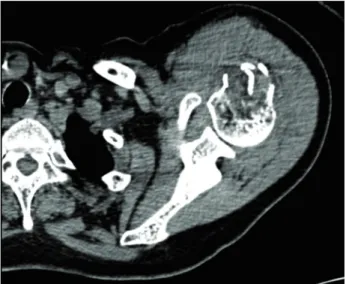
July 2018 (before surgery) showed a proximal humeral fracture by X-ray (Fig. 1) and acute 3-part comminuted fracture of the left proximal humerus by computed tomography scan (Figs. 2 and 3). Following surgery on the 11

th

July 2018, an X-Ray was taken which showed internal fixation for acute 3-part comminuted fracture of the left proximal humerus (Fig. 4).

Patient protection policy on patient information use

In order to protect the patient’s personal information, the medical record was obtained from the Institutional Review Board (No: WKUIOMH-IRB-2018-7).

Fig. 1. Left shoulder X-ray – Preoperation (October 10, 2018).

Fig. 2. Left shoulder computed tomography scan - coronal view (October 10, 2018).

Fig. 3. Left shoulder Computed tomography scan - axial view (October 10, 2018).

Fig. 4. Left shoulder X-ray - Postoperation (October 11, 2018).

(3)

Treatment

Acupuncture treatment

The needles used for acupuncture treatment were 0.3*30 mm standardized stainless-steel needles (Woojeon acupuncture needles, Gun-po, Korea) that were disposable. To avoid infection and thrombosis acupuncture was performed away from surgical sites [8]. Acupuncture was administered at ST36, ST37, GB40, KI3 of the unaffected parts, LI11, LI10, LI4 of the affected parts and Ashi points for posterior neck for 15-minute durations, twice a day.

Herbal medicine

ⓛ Herbal decoction

Gami-Samultang decoction was prescribed 3 times a day. It is composed of Angelicae Gigantis Radix 6 g, Eucommiae Cortex 6 g, Paeoniae Radix 6 g, Rehmanniae Radix preparata 6 g, Achyranthis Radix 6 g, Cnidii Rhizoma 6 g, Zingiberis Rhizoma 4 g, Cinnamomi Ramulus 4 g, Araliae Continentalis Radix 4 g, Chaenomelis Fructus 4 g, Peucedani Radix 4 g, Dendrobii Herba 4 g, Persicae Semen 3 g, Carthami Flos 3 g, Schisandrae Fructus 8 g, Liriopis Tuber 4 g, Astragali Radix 4 g, and Elsholtziae Herba 4 g.

② Tablet

Shinbaro tablet (Green Cross Co.) and Jakyakgamcho-tang extract powder (Kracie Pharma Korea Co.) were prescribed according to the patient’s condition and level of pain.

Cupping therapy

Dry cupping was performed at SI9, SI14, and TE15, and in addition another area of complaint was treated once a day. To prevent side effects and worsening of surgical pain, the treatment time was limited to less than 10 minutes.

Physiotherapy

Ice packs were applied to the surgical area for 20 minutes to treat swelling and pyrexia when it occurred. The patient was allowed to recover 28 days after surgery, to allow reduction of postoperative swelling before physiotherapy could be performed. The sling was then removed from the operated shoulder and when swelling improved, transcutaneous electrical nerve stimulation and the application of hot packs on the operated shoulder was performed for 15 minutes every other day.

Daoyin exercise therapy

After admission, simple exercises such as pendulum exercise, finger pulley exercise, elbow flexion and extension, and shoulder shrugs were performed to prevent joint contraction and deep vein thrombosis. The patient also performed passive flexion of the shoulder until tolerable pain was met. After 21 days of hospitalization, the patient took off the shoulder sling (28 days after surgery), and performed additional exercises such as wall slide, and shoulder pulley exercises. Furthermore, assisted shoulder flexion, abduction and extension was performed with the medical team present once a day. In principle, ROM exercises were conducted within the limits of the patient’s tolerance of pain.

Evaluation Range of motion

The active ROM was measured for the evaluation of the patient’s shoulder joint function. Normal ROM of a shoulder joint is defined as flexion 180°, extension 45°, abduction 180°, adduction 45°, internal rotation 55°, and external rotation 55° [9]. ROM was measured using an angular meter (Baseline 360° clear plastic

goniometer, Fabrication Enterprises, Inc., USA). During the measurement, the patient sat on the side of the bed with her knees bent 90°.

Numeric rating scale

Numerical rating scale (NRS) is a measure to quantify and assess the level of patient subjective pain, and records the most severe pain as 10, and no pain as 0.

Shoulder pain and disability index

The shoulder pain and disability index was developed to measure shoulder pain and disability and is a useful tool for a wide range of patients with shoulder problem including rotator cuff diseases, osteoarthritis, adhesive capsulitis and arthroplasty.

The total score is calculated as 100 points by averaging the pain subscales and disability subscales; a high score indicates greater pain with a more severe disability of the shoulder [10].

Discussion

In this case report, the patient with postoperative pain for traumatic proximal humerus fracture was treated with Korean traditional medicine including acupuncture, cupping therapy and herbal medicine.

Samultang decoction is usually prescribed for the purpose of hematopoietic actions in Korean traditional medicine, in addition, a recent study demonstrated anti-inflammatory action [11]. Gami- samultang decoction was prescribed in order to reduce swelling and inflammation in the surgical area. In addition, other medicine was used to treat the loss of blood stasis and to accelerate fracture recovery.

Acupuncture points were selected to avoid the surgical area to prevent infection. ST, GB and KI meridians were selected as remote acupuncture points, because the patient complained of pain all over her left shoulder and had limited ROM in all directions.

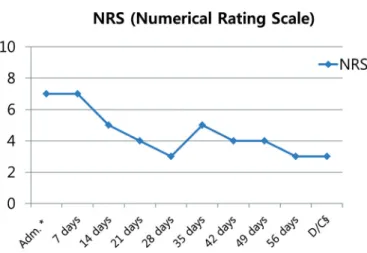
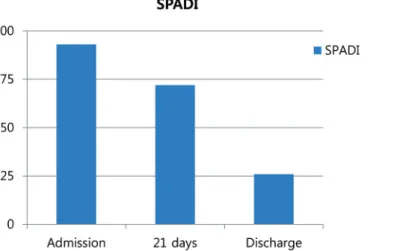
Since the patient complained of severe pain when she abducted her shoulder, ST36 and ST37 were strongly stimulated. KI3 was also stimulated since the patient’s surgical area was at the front of her left shoulder. As a result of treatment, the NRS score decreased from 7 to 3 (Fig. 5), the shoulder pain and disability index score decreased 93 to 25.9 (Fig. 6).

Fig. 5. Changes in the NRS Score for Pain.

Adm, admission date; D/C, discharge date.

(4)

The ROM was measured after the 21st day of hospitalization, on the day the sling was removed. The ROM during the first measurement was flexion 65°, extension 35°, abduction 45°, adduction 25°, internal rotation 55°, and external rotation 20°.

The ROM increased by the discharge date with the degree of flexion at 120°, extension 45°, abduction 105°, adduction 30°, internal rotation 55°, and external rotation 35° (Fig. 7). The ratio of patient’s ROM compared to normal ROM showed an increase by flexion of 30%, extension 22%, abduction 33%, adduction 11%, internal rotation 0%, and external rotation 27%, increasing by 21%

on average (Table 1).

In the Neer classification [12], the fracture type of the patient is a 3-part fracture of the proximal humeral fracture. Orthopedic studies of the 3-part fracture of the proximal humeral fracture, focused only on the outcome of conservative treatment and surgical treatment, so there is difficulty in comparing the general progress after surgery.

According to a rehabilitation program for conservative treatment 1 case recommended the removal of the sling and initiation of passive ROM exercises 3 weeks after the injury, and active ROM exercises to be initiated 6 weeks after the injury [13]. The other case of conservative treatment, recommended initiation of passive ROM exercises immediately after the injury, but removed the sling and initiated active ROM exercises 8 weeks after injury [14].

In the case of surgical treatment of 3 or 4 parts fracture of the proximal humeral fracture, the Hemiarthroplasty group

recommended initiating passive ROM exercise immediately after surgery, but removing the sling and initiating active ROM exercise after 6 weeks and 3 days after surgery. On the other hand, in the Reverse Prosthesis group passive and active ROM exercises were initiated 1 week after surgery. It was not reported when the sling was removed in this case [15].

In this current study, the patient initiated passive ROM exercises immediately after surgery, the sling was removed and active ROM exercises were initiated 4 weeks after surgery. Although it’s difficult to generalize treatment progress, Korean traditional medicine treatment for postoperative proximal humeral fractures showed similar treatment progress compared with conservative or surgical treatment of postoperative proximal humeral fractures.

This study is the first to date where a patient with proximal humeral fracture after surgery was treated with Korean traditional medicine. The patient had a reduced level of surgical pain, improved ROM, and ability to perform daily activities.

This case study is limited by patient numbers. In addition, there are few studies that describe the short-term progress of open reduction and internal fixation in proximal humeral fractures in orthopedics, so it was difficult to compare the effects due to Korean traditional treatment.

Further studies are required to accurately compare the treatment progress after surgery and standardize the postoperative treatment methods in Korean traditional medicine for proximal humeral fractures.

Fig. 6. Changes in the Shoulder pain and Disability index (SPADI). Fig. 7. Changes in range of motion of left shoulder.

Flexion Extension Abduction Adduction Internal Rotation External Rotation

21 days 65º 35º 45º 25º 55º 20º

Discharge 120º 45º 105º 30º 55º 35º

Normal ROM 180º 45º 180º 45º 55º 55º

Improvement rate 30% 22% 33% 11% 0% 27%

ROM, range of motion.

Table 1. Ratio of Patient’s ROM Compared to Normal ROM.

(5)

Conflicts of Interest

The authors have no conflicts of interest to declare.

Acknowledgements

This study was supported by an academic research grant of Wonkwang University in 2018.

References

[1] Schünke M, Schulte E, Schumacher U, Voll M, Wesker K. PROMETHEUS:

Atlas of anatomy general anatomy and musculoskeletal system, 3rd ed.

Seoul (Korea): Seoul Med-Media: 2014. 246 p. [in Korean].

[2] Sarwark JF. Essentials of musculoskeletal care, 4th ed. Seoul (Korea):

Panmun Education: 2013. 38 p. [in Korean].

[3] Howard L, Berdusco R, Momoli F, Pollock J, Liew A, Papp S et al. Open reduction internal fixation vs non-operative management in proximal humerus fractures: a prospective, randomized controlled trial protocol.

BMC Musculoskelet Disord 2018;19:299-308.

[4] Launonen AP, Lepola V, Saranko A, Flinkkilä T, Laitinen M, Mattila VM.

Epidemiology of proximal humerus fractures. Arch Osteoporos 2015;10:2-6.

[5] Hyun HS, Ahn JH, and Shin SJ. Conservative Treatment of Proximal Humeral Fracture. J Korean Fract Soc 2018;31:29-35. [in Korean].

[6] Schumaier A, Grawe B. Proximal humerus fractures: Evaluation and management in the elderly patient. Geriatr Orthop Surg Rehabil 2018;9:1-11.

[7] Lee JE, Lee JM, Oh MS. A case study of radial nerve injury associated with humerus shaft fracture. J Haehwa Med 2014;23:157-166. [in Korean].

[8] Han TR, Bang MS, Chung SG. Rehabilitation Medicine. 5

th

ed. Seoul (Korea):

Koonja Publishing: 2014. p.1201-1203. [in Korean].

[9] The Society of Korean Medicine Rehabilitation. Korea Rehabilitation Medicine. 4

th

ed. Seoul (Korea): Koonja Publishing; 2015. 100 p. [in Korean].

[10] Breckenridge JD, McAuley JH. Shoulder pain and disability index (SPADI).

J Physiother 2011;57:197.

[11] Choi IY, Kim SJ, Kang TH, Lee BH, Lee JH, Lee, JY et al. Anti-inflammatory effect of Samultang in human mast cell line HMC-1. Orient Pharm Exp Med 2006;3:237-244. [in Korean]

[12] Neer CS. Displaced proximal humeral fractures. Orthop Trauma Dir 2007;5:25-29.

[13] Rath E, Alkrinawi N, Levy O, Debbi R, Amar E, Atoun E. Minimally displaced fractures of the greater tuberosity: outcome of non-operative treatment. J Shoulder Elbow Surg 2013;23:e8-e11.

[14] Hodgson S. Proximal humerus fracture rehabilitation. Clin Orthop Relat Res 2006;442:131-138.

[15] Gallinet D, Clappaz P, Garbuio P, Tropet Y, Obert L. Three or four parts

complex proximal humerus fractures: hemiarthroplasty versus reverse

prosthesis: a comparative study of 40 cases. Orthop Traumatol Surg Res

2009;95:48-55.

수치

Fig. 2. Left shoulder computed tomography scan - coronal view (October 10, 2018).
Fig. 5. Changes in the NRS Score for Pain.
Fig. 6. Changes in the Shoulder pain and Disability index (SPADI). Fig. 7. Changes in range of motion of left shoulder.

참조

관련 문서

그러므로 어떤 관심사에 대해 탐구하고 문제를 해결한 경험 중에 서 몰입하거나 집중하여 탐구한 것, 끈질기게 파고들어 탐구한 내용, 친구들과 함께

Department of Internal Medicine, Novosibirsk State University, Russia 1 , Department of Cardiology, Surgut State University, Russia 2 , Department Fundamental

1 John Owen, Justification by Faith Alone, in The Works of John Owen, ed. John Bolt, trans. Scott Clark, "Do This and Live: Christ's Active Obedience as the

Pathology, Internal Medicine, Neuroscience, Psychiatry, Pediatrics, Dermatology, Surgery, Thoracic and Cardiovascular Surgery, Neurosurgery, Orthopedic Surgery,

A Study on the Education Institution of Korean Traditional Music: Centering around

Eighty six point five percent of the subjects felt that the most important factor was visiting a hospital, but combining alternative medicine with hospital

The fast disintegrating tablet (FDT) containing oriental herbal medicine was prepared by using a freeze-drying method.. To improve taste and morphology of

Therefore, students just acquire the ore tical education of Korean traditional music based on text book and so Korean traditional music classes make progress of