특 집
Production of Acetylene Black/silica Composite Particles by Adsorption of Polyethylenimine
Jeongwoo Lee*, Jung Hwan Park**, and Sang Eun Shim†
*Department of Chemical Engineering, Inha University, 253 Yonghyundong, Incheon, 420-751, Republic of Korea
**Department of Environmental and Chemical Technology, Inha Technical College, 253 Yonghyundong, Namgu, Incheon 402-751, Republic of Korea
(Received January 6, 2010, Revised & Accepted January 20, 2010)
Polyethyleneimine 흡착에 의한 아세틸렌 블랙/실리카 복합체 입자 제조
이 정 우*․ 박 정 환**․ 심 상 은†
*인하대학교 화학공학과, **인하공업전문대학 화공환경과 (2010년 1월 6일 접수, 2010년 1월 20일 수정 및 채택)
ABSTRACT:The acetylene black/silica composite particles were prepared by a simple and fast method using poly- ethylenimine (PEI) as a coupling agent. The composite particles were produced via the following two steps; adsorption of PEI on the surface of acetylene black particles and synthesis of silica by sol-gel process. The morphology of the composite particles was a core-shell, and a large number of micropores was created after silica was synthesized on the acetylene black surface.
요 약:본 논문에서는 polyethyleneimine (PEI)를 커플링제로 사용하여 간단한 공정을 통하여 아세틸렌 블랙/실리카 복합체 입자를 제조하였다. 복합체 입자는 PEI를 아세틸렌 블랙 표면에 흡착시키고 졸-겔 합성공정을 통하여 실리카 를 아세틸렌 블랙 위에서 합성하는 두단계 공정을 통하여 제조되었다. 복합체 입자의 모폴로지 분석 결과 실리카가 아세틸렌 블랙위에 존재하는 core-shell 구조를 확인하였으며, 표면에 상당한 미세기공이 존재함을 알 수 있었다.
Keywords:acetylene black; silica; composite particles; polyethyleneimine; sol-gel reaction
†Corresponding Author. E-mail: [email protected]
Ⅰ. Introduction
Carbon black has been widely used as a filler in polymer industry because of its excellent properties such as heat, chem- ical and weathering resistance, lightweightness, electrocon- ductivity, and low thermal expansion.1-3 Specially, electrically conductive composites are prepared through the incorporation of conductive acetylene black (AB). Although AB is essen- tially the same as other carbon blacks, it is considerably differ- ent in that its particles are linked in the form of a chain, and that its graphitization is very advanced. Therefore, it has unique characteristics such as high electrical/thermal con- ductivity and high liquid absorption.1 The dispersibility of car- bon black is important to show such abilities in organic sol-
vents and polymer matrices. In order to improve the dispersion of carbon black in polymer matrices, the grafting of polymers4,5 or short alkyl chains6 onto the surface is one of the most effec- tive procedures. Grafted carbon black is known to disperse easily in organic solvents and polymer matrices.7
Silica offers a unique combination of tear strength, abrasion resistance, and aging resistance compared to carbon black.8 In tire treads, silica yields a lower rolling resistance at equal wear resistance and wet grip than carbon black.9 Therefore, the use of a dual filler system separately composed of carbon black and silica in polymer matrices can give the benefits from each property.10 However, in dual filler systems, carbon black and silica should be independently charged during compound- ing processes.
Herein, we aimed to synthesize the AB/silica composite par- ticles by a sol-gel process to simultaneously use the properties of each material. The sol-gel processing has attracted enormous
research interest during the past several years due to apparent advantages over the conventional processing in a special area of glass formation.11
In a previous study, we had found a simple and fast method to produce the carbon black/silica composite using poly(vinyl pyrrolidone) (PVP) as a coupling agent. This amphiphilic, non- ionic polymer adsorbs onto the surface of various materials such as metals, polystyrene, and graphite. PVP stabilizes col- loidal particles in water and nonaqueous solvents. And it can interact with the hydroxyl-rich silica through the hydrogen bond or by electrical attraction.3 In this present article, we introduced polyethylenimine (PEI) as a coupling agent instead of PVP. PEI is a type of polymer electrolytes with a high density of amines, thus it may be immobilized securely onto the surface of AB through strong electrostatic interactions aris- ing from these amines.
Ⅱ. Experimental
1. Materials
Acetylene black (AB, DENKA Black) was purchased from Denki Kagaku Kogyo Kabushiki Kaisha, Japan. In a primary particle state, its average particle diameter is 36 nm and surface area is 65 m2/g. Tetraethyl orthosilicate (TEOS, Samchun Chemical, Korea) was used for the formation of silica layer.
Polyethyleneimine (30% PEI P-70 solution, Mw: 70,000 g/
mol, Wako Chemical, Japan) was used as a coupling agent.
Highly pure ethanol and ammonia (25-30 wt% NH3 in water) were purchased from Duksan Chemical Co., Korea and used as received.
2. Preparation of AB/Silica Particles
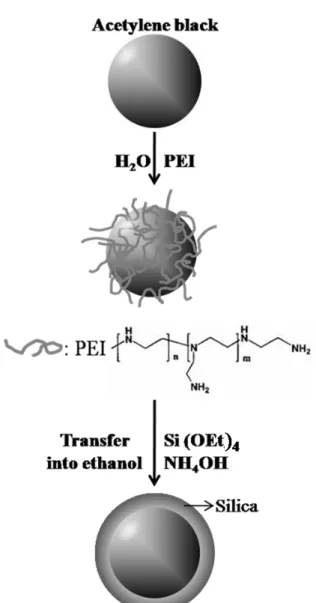
The AB/silica composite particles were produced via the following two steps; the adsorption of PEI onto the surface of AB particles and synthesis of silica via sol-gel reaction.
The procedure is shown in Figure 1.
The adsorption of PEI on AB was carried out in a 500 mL flat bottom flask with magnetic stirring at 500 rpm for 24 hrs at room temperature. 250 mL of distilled water was first poured into the flask and PEI was charged. The amount of PEI solution was 4.5 g to compare with our previous experi- ments using PVP.3 After PEI completely dissolved in water, 1 g AB was charged. To transfer the PEI-adsorbed AB into ethanol after 24 hrs, the solutions were filtered out. The filtered AB was redispersed in a solution of ammonia in ethanol (4.4 vol% ammonia in ethanol) and then 5 g TEOS was charged under stirring at 500 rpm. The reaction was carried out at room temperature for 24 hrs.
Figure 1. Procedure to synthesize acetylene black/silica com- posite particles.
3. Characterization
The morphologies of the AB/silica composite particles were characterized by Transmission Electron Microscope (TEM, CM200, Philips). The elementary analysis of the composite particles was performed using the energy dispersive x-ray spectroscopy (EDAX) equipped in TEM. The silica layer on the AB surface was confirmed by a Fourier transformed infra- red spectroscopy (FT-IR, VERTEX 80v, Bruker), and its quan- tity was measured by a thermogravimetric analysis, TGA Q50 (TA Instrument). The specific surface areas and average pore diameter were determined by N2 adsorption/desorption with the BET method at liquid nitrogen temperature using a Micromeretics ASAP 2000 automatic analyzer. The external surface areas were estimated by the t-plot method.
(a) (b) (c)
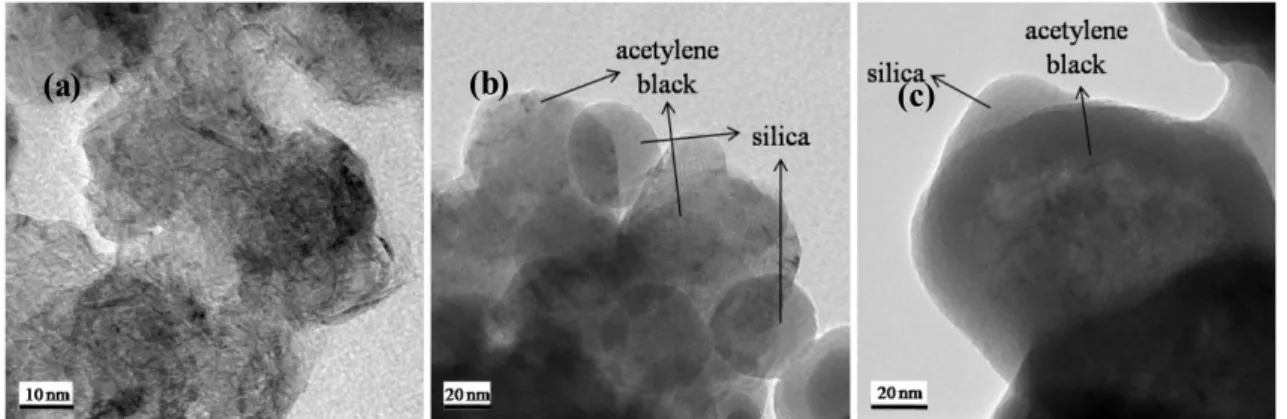
Figure 2. TEM micrographs of (a) pristine acetylene black, acetylene black/silica composites prepared by sol-gel reaction of TEOS with (b) PVP and (c) PEI.
Ⅲ . Results and Discussion
Polyethylenimine (PEI) is a type of polymer electrolytes with a high density of amines, thus it can be immobilized securely onto the surface of various materials such as metals, polystyrene, and graphite due to strong electrostatic inter- actions arising from these amine groups.12 Therefore, in this study, we used PEI as a coupling agent. After completion of the reaction, the solution was washed with ethanol and then centrifuged repeatedly to remove free silica. The resultant was redispersed using an ultrasonicator (200 W, Materials &
Sonics, USA) to check out the binding strength between AB and silica. Although the composite particles were ultra- sonicated for 10 min, their morphology of composite particles did not change. It means that silica was mechanically inter- locked into the pores of AB when the composite particles were synthesized.
Figure 2 represents the TEM images of pristine acetylene black (AB), AB/silica prepared with PVP, and AB/silica par- ticles prepared with PEI. In Figure 2(b), the synthesized silica particles were not attached onto surface of PVP-adsorbed AB.
The amount of PVP adsorbed onto AB was too small, thus the PVP on AB cannot sufficiently interact with the hydrox- yl-rich silica through the hydrogen bond or by electrostatic attraction.13 Therefore, silica particles were not synthesized on surface of AB using PVP. On the contrary, the AB/silica com- posite particles using PEI (Figure 2(c)) show that the AB par- ticles were wrapped by silica layer, not silica particles because of strong electrostatic interactions arising from amine groups in PEI chains. The polycationic amino groups of the PEI are used for the reversible immobilization of silica. The silica is a hydroxyl group-rich material. Therefore, the silica with a negatively charge is immobilized on AB particles coated with an oppositely charged polymer, PEI.
Figure 3 shows FT-IR spectra of pristine AB and AB/silica
composite particles. The peaks at 470 and 810 cm-1 are as- cribed to the Si-O-Si bending vibration, those at 1100 cm-1 to the Si-O stretching vibration, and those at 960 cm-1 to the Si-OH stretching vibration.14 Through this result, one can con- firm that silica is well synthesized from TEOS onto PEI-ad- sorbed AB by the interaction with PEI molecules.
Energy dispersive X-ray (EDAX) was also used to confirm the existence of silica in the composite particles. It is noted that the Cu atom detected in spectra (8.1 keV) was resulted from a TEM grid. Figure 4(b) is the EDAX spectrum of AB/silica composite particles prepared with 0.6 wt% PEI and 5 wt% TEOS. In the spectrum of the composite, the O (25.3 wt%) and Si (54.6 wt%) atoms originated from silica, res- pectively. Through the existence of O and Si, one can again confirm that silica is well synthesized.
Wavenumbers (cm-1)
500 1000 1500 2000 2500 3000 3500 4000
Acetylene black Acetylene black/silica
Figure 3. FT-IR spectra of pristine acetylene black and acety- lene black/silica composite particles.
(b) (a)
Figure 4. The energy dispersive x-ray spectroscopy (EDAX) spectra of (a) pristine acetylene black and (b) acetylene black/
silica composite prepared with PEI.
Temperature (oC)
200 400 600 800 1000
Weight loss (%)
0 20 40 60 80 100
Acetylene black PEI-coated acetylene black Acetylene black/silica composite
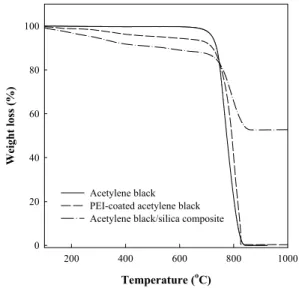
Figure 5. TGA curves of pristine acetylene black, PEI-coated acetylene black, and acetylene black/silica composite particles.
To examine the amount of PEI and silica bonded onto AB, thermogravemetry analysis was performed. The weight loss curves of pristine, PEI-adsorbed, and silica coated AB are pre-
sented in Figure 5. For pristine AB, a constant weight is main- tained up to 700 ℃ under atmospheric condition. In contrast, for PEI-coated AB, about 5.8 % weight loss occurred before 700 ℃ resulting from the thermal decomposition of PEI molecules. For the silica/AB composite, the transition region around 700 ℃ is attributed to the structural degradation of PEI molecules The weight loss of silica/AB composite indicates that the amount of silica bound to AB is about 57.8 wt%.
Surface area and porosity of pristine AB and AB/silica com- posite particles were calculated by nitrogen adsorption and de- sorption at 77.5 K. These isotherms are shown in Figure 6.
The adsorption and desorption isotherms of pristine AB are similar and superimposed and can be classified as a type II isotherm. In contrast, those of AB/silica composite change from type II to type I. This small hysteresis present between the desorption and adsorption isotherms of AB/silica compo- site indicates that a small volume of mesopores exists.15 The specific micropore internal surface (Sinter), external surface (Sexter), and the Brunaer-Emmett-Teller (BET) areas (SBET = Sinter + Sexter) of pristine AB and AB/silica composite particles are summarized in Table 1. It is found that the difference be- tween the BET surface areas of pristine AB and AB/silica
Relative Pressure (P/P0)
0.0 0.2 0.4 0.6 0.8 1.0
Quantity Adsorbed (cm3 /g)
0 50 100 150 200
Acetylene black/Silica Acetylene black
Figure 6. The nitrogen adsorption isotherms at 77.5 K on pris- tine acetylene black and acetylene black/silica composite parti- cles.
Table 1. Surface area and micropore area of pristine AB and AB/silica composite particles
BET surface area (m2/g)
t-plot external surface area
(m2/g)
t-plot micropore area (m2/g)
pristine AB 56.57 35.20 21.37
AB/silica
composite 53.48 12.23 41.25
composite particles is imperceptible, however, the micropore area of AB/silica composite particle increased by 93 %, com- pared to one of pristine AB. It is important to note that more than 70% of the surface area of the composite particle is found to come from the nanosized pores with the specific internal area of 41.25 m2/g, while the external surface area is 12.23 m2/g. This analysis reveals that a large number of micropores was created after silica was synthesized on the AB surface.
Ⅳ . Conclusions
Silica layer was successfully introduced onto the surface of acetylene black (AB) by sol-gel reaction of TEOS. AB was stable in water and ethanol due to the adsorbed polyethyleni- mine (PEI) for the subsequent sol-gel reaction. The PEI-ad- sorbed AB could be directly coated with silica by interaction of PEI with the hydroxyl-rich silica or silica precursor through the hydrogen bond or by electrostatic attraction. It was found that the use of PEI was more effective to prepare silica layer on AB than PVP. The atomic composition of AB/silica par- ticles was 25.3 wt% oxygen and 54.6 wt% silicon. The compo- site particles have highly developed micropores on their sur- face due to the synthesized silica.
Acknowledgement
This paper is published with the support of Inha Technical College Research Grant in 2009.
References
1. J. B. Donnet, R. C. Bansal, and M. J. Wang, Carbon black, Marcel Dekker, USA (1993).
2. N. Tsubokawa, T. Satoh, M. Murota, S. Sato, and H. Shimizu,
“Grafting of hyperbranched poly(amidoamine) onto carbon black surfaces using dendrimer synthesis methodology”, Polym. Adv. Technol., 12, 596 (2001).
3. J. Lee, J. Hong, D. W. Park, and S. E. Shim, “Production of Carbon Black/Silica Composite Particles by Adsorption of Poly(vinyl pyrrolidone)”, Macromol. Res., 17, 718 (2009).
4. R. M. Casado, P. A. Lovell, P. Navabpour, and J. L. Stanford,
“Polymer encapsulation of surfacemodified carbon blacks us- ing surfactant-free emulsion polymerization”, Polymer, 48,
2554 (2007).
5. C. F. Lee, C. Y. Cheng, Y. W. Lee, and Y. C. Wen, “Novel amphiphilic carbon black composite nanoparticles from TEMPO-terminated polymer and TEMPO-terminated block copolymer grafted carbon black”, Polymer, 46, 5514 (2005).
6. E. Papirer, R. Lacroix, and J. B. Donnet, “Chemical mod- ifications and surface properties of carbon blacks”, Carbon, 34, 1521 (1996).
7. Y. Liu, Zhizhongsu, X. Li, W. Guo, Q. Li, and C. Wu, “Effect of Dispersion of Carbon Black on Electrical and Thermal Properties of Poly(Ethylene Terephthalate)/Carbon Black Composites”, J. Macromol. Sci. Part B: Phys., 48, 146 (2009).
8. D. R. Hwang, J. Hong, J. Lee, and S. E. Shim, “In-Situ Synthesis of PS/(-)Silica Composite Particles in Dispersion Polymerization Using An (±) Amphoteric Initiator”, Macromol.
Res., 16, 329 (2008).
9. J. W. Brinke, S. C. Debnath, L. A. E. M. Reuvekamp, and J. W. M. Noordermeer, “Mechanistic aspects of the role of coupling agents in silica-rubber composites”, Compos. Sci.
Technol., 63, 1165 (2003).
10. N. Rattanasom, T. Saowapark, and C. Deeprasertkul, “Rein- forcement of natural rubber with silica/carbon black hybrid filler”, Polym. Test., 26, 369 (2007).
11. A. Venkateswara Rao, P. B. Wagh, D. Haranath, P. P. Risbud, and S. D. Kumbhare, “Influence of temperature on the phys- ical properties of TEOS silica xerogels”, Ceram. Int., 25, 505 (1999).
12. Y. Liu, D. Wu, W. Zhang, X. Jiang, C. He, T. Chung, S.
H. Goh, and K. W. Leong, “Polyethylenimine-Grafted Multi- walled Carbon Nanotubes for Secure Noncovalent Immobili- zation and Efficient Delivery of DNA”, Angew. Chem. Int.
Ed., 44, 4782 (2005).
13. W. Yuan, M. Peng, Q. Yu, B. Tang, and Q. Zheng, “Synthesis and Characterization of Polystyrene/Nanosilica Organic-Inorganic Hybrid”, Chem. Res. Chin. Univ., 22, 797 (2006).
14. U. Vijayalakshmi, A. Balamurugan, and S. Rajeswari, “Syn- thesis and Characterization of Porous Silica Gels for Biomedi- cal Applications”, Trends Biomater. Artif. Organs, 18, 101 (2005).
15. M. Bettoni, P. Candori, F. Marmottini, N. Perenze, C. Rol, G. V. Sebastiani, and F.Vecchiocattivi, “Photocatalytic Activity in CH3CN Related to the Surface Properties of TiO2
Powders Prepared by Sol-Gel Method”, Inter. J. Photoenergy, 2009, Article ID 905987 (2009).