Rubber Material Development and Performance Evaluation of Diaphragm Seal for Steam Generator Nozzle Dam
Chang-Su Woo † , Chi-Sung Song * , Han-Chil Lee ** , and Jin-Wook Kwon ***
Department of Nano Applied Mechanic, Korea Institute of Machinery & Materials 156, Gajeongbuk-ro, Yuseong-gu, Daejeon 34103, Korea
*
Research Planning and Coordination Division, Korea Institute of Machinery & Materials 156, Gajeongbuk-ro, Yuseong-gu, Daejeon 34103, Korea
**
Technical Research Center, MuJinKeeYeon 734-7, Ancheong-dong, Gwangsan-gu, Gwangju 62210, Korea
***
Construction Materials Engineering Center, DRD Holding Co., Ltd. 28, Gongdandong-ro, 55 beon-gil, Geumjeong-gu, Busan 46329, Korea
(Received July 20, 2020, Revised August 19, 2020, Accepted August 24, 2020)
Abstract: Rubber materials, used in nuclear power plants, need high heat-oxidation resistance to curing or cracking under a heat aging environment. This is because they are applied to environments with high temperature, high humidity, and radi- ation exposure. Nuclear radiation causes additional hardening or degradation, therefore, rubber materials need radiation resistance that satisfies the general and any accidental conditions produced in the power plant. Therefore, in this study, we developed a rubber material with excellent heat and radiation resistance for the diaphragm seal of a nuclear steam generator nozzle dam. The rubber material greatly improved the reliability of the steam generator nozzle dam. In addition, 30 inch and 42 inch diaphragm seals were manufactured using the developed rubber material. A nozzle dam was installed in a nuclear power plant and tested under the same conditions as a steam generator to evaluate safety and reliability. In the future, the performance and safety of diaphragm seals developed through field tests of nuclear power plants will be evaluated and applied to currently operating and new nuclear power plants.
Keywords: nuclear power plants, steam generator, nozzle dam, diaphragm seal, rubber material, performance test
Introduction
원자력발전에 사용되는 실링(Sealing), 오링(O-ring), 다이 아프램(Diaphragm) 및 케이블(Cable) 등의 고무제품들은 고 온, 습기 및 방사선 피복 등과 같은 다양한 환경에 놓이게 된 다. 이러한 특수요인에 의하여 고무제품들은 절연체의 탄성 을 잃게 되어 안전성 조건을 만족시키지 못하여 결국에는 예 기치 못한 안전사고가 발생하게 된다.
국내 고무 관련기술 분야는 명확한 이론적 설명과 재현이 매우 난해하여 경험적인 결과를 바탕으로 시행착오법을 시행 하여 발전하여 왔으며 고무소재의 낮은 신뢰성으로 인해 다 른 금속소재의 부품에 비해 비교적 물성치의 편차가 커서 신 뢰성 구축 및 평가가 어려운 분야로 알려져 있다. 또한, 원전 기기에 사용되는 고무제품의 경우에는 아직까지 국산화가 진 행되지 않고 있어 전량 수입에 의존하고 있는 실정이며 내방 사성이 우수한 고무소재에 대한 배합과 제조법에 대한 국내 기술은 매우 취약한 상황이라 할 수 있다. 최근, 원자력 안전
및 신뢰성 확보에 대한 관심이 높아짐에 따라 다양한 사용조 건에서 운용되는 고무부품에 대한 고장 메카니즘 규명과 신 뢰성평가기술 개발이 요구되고 있다.
1,2,3지금까지 외국에서 수행한 연구결과나 프로그램을 고가로 구매하여 고무소재 물 성평가 및 수명예측에 이용되고 있으나, 외국에서 수행한 소 재의 물성과 국내 소재의 구성 성분이 다르기 때문에 국내의 신규제품이나 가동 중 원전기기의 수명예측에 그대로 적용하 기에 무리가 있어 환경조건에 따른 소재 물성평가 및 부품의 신뢰성 평가를 위한 연구개발이 필요하다 하겠다. 또한, 원전 부품은 다른 기계부품에 비해 고무소재개발 및 물성 데이터 부족과 특성 및 수명예측기술 미비, 제조공정과 환경변화에 따른 제품의 불균일화 등으로 체계적인 설계기술과 시험평가 시스템이 구축되지 않아 품질 및 안전성 저하 등의 요인으로 작용하고 있어 부품의 신뢰성 확보를 위한 연구가 절실하다 하겠다.
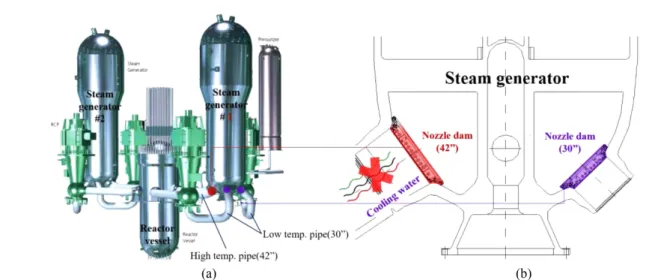
4,5따라서, 본 연구에서는 원자력 증기발생기(Steam generator) 노즐댐(Nozzle dam)의 다이아프램 씰(Diaphragm seal)에 사 용되는 내열성 및 내방사성이 우수한 고무소재를 개발하여 증
†