I. Introduction
Adequate sleep plays a vital role in young children’s physical health and cognitive functioning.
Young children with sufficient sleep show a lower number of medically attended injuries (Koulouglioti et al. 2008), understand others’ emotions better (Berger et al. 2012), and learn more vocabulary
This work was supported by a 2-year Research Grant of Pusan National University Received: 13 July, 2018 Revised: 25 July, 2018 Accepted: 31 July, 2018
†Corresponding Author: Youjeong Park Tel: +82-51-510-2839 E-mail: [email protected]
This is an Open-Access article distributed under the terms of the Creative Commons Attribution Non-Commercial License (http://creativecommons.org/licenses/by-nc/3.0) which permits unrestricted non-commercial use, distribution, and reproduction in any medium, provided the original work is properly cited.
Korean J Community Living Sci 29(3): 379~389, 2018 http://doi.org/10.7856/kjcls.2018.29.3.379
Age- and Sex-Related Differences in Sleep Patterns Among Korean Young Children
Jinwook KimㆍYoujeong Park
1)†Dept. of Child Development and Education, Myongji University, Seoul, Korea Dept. of Child Development and Family Studies, Pusan National University, Busan, Korea
1)한국 유아의 수면양상 발달 및 성차
김 진 욱ㆍ박 유 정
1)†명지대학교 아동학과ㆍ부산대학교 아동가족학과
1)1)
ABSTRACT
The present study examined the age- and sex-related differences in the sleep patterns among Korean children aged between 2 and 5 years (N = 1,413). Data on the children’s bedtime, wake time, nap duration and nighttime sleep duration were drawn from a larger dataset collected by the Korean Institute for Child-Rearing Policy (KICP). The findings indicated that the children’s bedtime and wake time shifted gradually to earlier times with increasing age. Their 24h nap duration and total sleep duration shortened dramatically with age, whereas the nighttime sleep increased then decreased to a modest degree. Although boys showed earlier wake times and shorter nighttime sleep than girls at all ages, boys did not show a shorter total sleep than girls until the age of 4 years, after which the majority of children began the single-phasic sleep/wake pattern. At all ages, a considerable proportion of children exhibited a shorter 24h total sleep duration than the recommended total sleep duration. The results suggest that Korean young children may undergo sleep deficiency and an acute reduction of naps while they move from a bi-phasic to single-phasic sleep/wake pattern.
Key words: age-related changes, preschool children, sex differences, sleep patterns
(Friedrich et al. 2017) than those with insufficient sleep. At the same time, young children experience dramatic changes in sleep/ wake patterns during the early childhood. Namely, children’s poly-phasic sleep/ wake patterns transform into a single-phasic one, as their nocturnal sleep becomes increasingly consolidated and their nap duration decreases (Iglowstein et al. 2003; Acebo et al. 2005; Crabtree & William 2009). Thus, an important developmental task for young children is to undergo the transition of sleep patterns while taking sufficient sleep.
Although a large number of studies have addressed the age-related changes of sleep patterns, few studies have closely examined how young children transit from poly-phasic sleep wake patterns to a single-phasic one during the preschool period. Some studies examined sleep pattern development over broader age ranges (e.g., birth to 16 years; Iglowstein et al. 2003. These studies have highlighted the most dramatic change in sleep patterns occurring in the preschool period (i.e., decrease in nap duration), but not elucidated relatively smaller changes in other sleep variables during the preschool period. For instance, Iglowstein and colleagues (2003) demonstrated that children’s wake time did not change from birth to 16 years.
Other studies examined sleep patterns focusing on the preschool period, but collapsed the age groups (e.g., Jalilolghadr et al. 2012; Mindell et al. 2013), failing to provide developmental data on how children’s sleep variables change while children transit to a single-phasic sleep-wake pattern.
Findings from these studies mainly focused on the relationships among sleep measures and other behavioral measures (Lavigne et al. 1999; Owens et al. 2005; Hysing et al. 2016) or cross-cultural
comparisons of sleep patterns (Mindell et al.
2013). Thus, except for the dramatic change of nap, it remains unclear whether and how various sleep variables (e.g., bedtime, wake time, and nighttime sleep) change during the preschool period.
Child sleep/wake patterns are affected not only by biological maturation but also by cultural and ecological environments. One previous cross-cultural study has shown that children in predominantly- Asian countries overall exhibit later bedtimes and shorter nighttime sleep than those in predominantly- Caucasian countries (Mindell et al. 2013). Moreover, children in predominantly-Asian countries have been shown to keep regular napping until a later age relative to those in predominantly-Caucasian countries. Therefore, it has been argued that the longer nap duration of Asian children compensates for their shorter nighttime sleep, resulting in no difference in 24h total sleep between the two broad cultures (Mindell et al. 2013).
However, it is unclear how well the findings about children in ‘predominantly-Asian countries’
from a broad cross-cultural study apply to Korean
young children. First, the findings in the previous
cross-cultural study were based on the sleep
measures averaged over several Asian countries
(e.g., China, Japan, Korea, Philippines, Singapore,
and Thailand) and averaged over different age
groups of the preschool period. Moreover, research
has shown that Korean infants (Ahn et al. 2016),
primary school children (Seo et al. 2010), and
adolescents (Yang et al. 2006) exhibit shorter 24h
total sleep than their age mates in other countries,
raising the possibility that Korean preschool children
also exhibit shorter 24h total sleep than their peers
in other countries.
Korea has socio-cultural environment that might contribute to characteristics of young children’s sleep patterns that are different from those of children from other countries. First, Korean young children exhibit a high rate of enrollment in childcare institutions. As an example, 92.3% of the children from age 3 to 5 years were enrolled in nursery schools or kindergartens in 2014 (Korean Ministry of Health and Welfare 2014). This high enrollment rate results in young children’s nap duration that largely depends upon the institutions’
nap schedules. Second, Korean parents emphasize early education to an extensive degree, having their young children receive various lessons such as language, mathematics, sports and music (Woo
& Hedges 2015). A considerable proportion of Korean parents (30.4%) exhibit negative attitudes toward mandatory nap time in childcare institutions, and want the institutions to provide educational activities instead of nap time (Kwon 2013). Reflecting the parental needs, some childcare institutions replace the nap time with a time for educational activities. Indeed, a recent report indicated that only 48.5% of Korean kindergarten teachers actually ran regular nap time in their class (Kim et al.
2014). These socio-cultural surroundings may together cause Korean young children to reduce their napping at a fast rate and quit napping at an earlier age in preschool period. If the reduced napping is not compensated, it might cause sleep deficit among Korean young children. To our knowledge, no studies have examined this issue, although a few studies examining Korean children’s time use have provided some information about preschoolers’ total sleep duration (e.g., Chin & Lee 2010).
Lastly, sex differences in preschoolers’ sleep
patterns have received little attention, with inconsistent findings. A number of studies have failed to find sex differences in preschoolers’ bedtime, sleep onset and end times, nap duration, and total 24h sleep duration (Lavigne et al. 1999; Acebo et al.
2005; Goodlin-Jones et al. 2008), suggesting that sex may not impact sleep variables during the preschool years. However, a few studies did find significant sex differences in young children's sleep variables. For instance, in a study examining American children 1 to 5 years, bedtime was earlier in boys relative to girls at 48 months of age (Acebo et al. 2005). Also, girls showed longer nocturnal sleep than boys among Iranian preschoolers (Jalilolghadr et al. 2012). Interestingly, these findings are in line with findings from older subjects. That is, it has been often shown that females take more 24h total sleep than males among primary school children (Gulliford et al.
1990; Sadeh et al. 2000; Liu et al. 2005; Ng et al.
2005; but see Seo et al. 2010; Biggs et al. 2013), adolescents (Fredriksen et al. 2004; but Russo et al. 2007 for weekends only; Olds et al. 2010), and young adults (Lauderdale et al. 2006; Kabrita &
Hajjar-Muҁa 2016). Thus, another possibility is that sex may begin to influence child sleep patterns from the preschool period. Examining sex differences in sleep variables among preschool children may shed light on whether some gender differences in sleep patterns begin to emerge in early childhood.
In sum, the present study aimed to closely
examine the age- and sex-related differences in
sleep patterns of Korean preschool children from
age 2 to 5 years. It also aimed at examining the
prevalence of nap and sleep deficiency among
Korean young children. The results would allow
a close look at the transition process of Korean
young children’s sleep patterns, and shed light on culture-specific characteristics of sleep patterns.
II. Method
1. Data and Sample
The data for this study came from the 2010-2013 Panel Study of Korean Children (PSKC), a nationally representative cohort study of 2,150 Korean children and their families. The PSKC used a stratified multi-stage sampling technique. In the first stage, the nation was stratified per each of its six zones, and sampling was conducted in terms of medical institutes whose annual delivery count was 500 or more. In the second stage, sampling was performed in terms of households with a neonate born from April to July 2008 in the sampled medical institutes. Specifically, PSKC was explained to mothers at individual medical institute, and consent was obtained for participation in the study. The exclusion criteria were as follows: the mother’s inability to communicate in Korean, the mother’s poor postpartum health, serious illness of the infant or the mother, the infant who was put up for adoption, the infant from a multiple pregnancy, and the mother aged 18 years or less. It resulted in a preliminary sample of 2,562 households. In the third stage, 2,150 households that had actually responded to the main study were confirmed as the study sample.
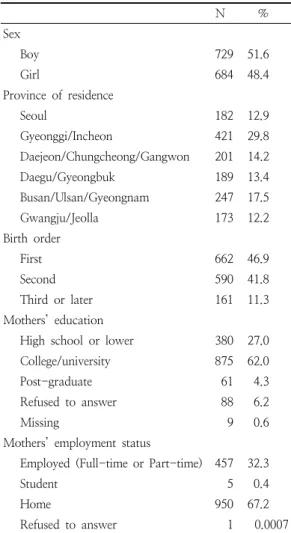
Among these, 1,413 households comprised the sample of the present study, with complete information from the questions regarding child’s sleep/wake patterns from 2010 to 2013. The age range of the present sample at the time of data collection was 24-32 months ( M = 26.26 months, SD = 1.30 months) in 2010, 36-43 months ( M =
38.73 months, SD = 1.40 months) in 2011, 48-54 months ( M = 51.05 months, SD = 1.20 months) in 2012, and 60-66 months ( M = 62.65 months, SD
= 1.30 months) in 2013. Information of other demographic background is shown in Table 1.
N %
Sex
Boy 729 51.6
Girl 684 48.4
Province of residence
Seoul 182 12.9
Gyeonggi/Incheon 421 29.8
Daejeon/Chungcheong/Gangwon 201 14.2
Daegu/Gyeongbuk 189 13.4
Busan/Ulsan/Gyeongnam 247 17.5
Gwangju/Jeolla 173 12.2
Birth order
First 662 46.9
Second 590 41.8
Third or later 161 11.3
Mothers’ education
High school or lower 380 27.0
College/university 875 62.0
Post-graduate 61 4.3
Refused to answer 88 6.2
Missing 9 0.6
Mothers’ employment status
Employed (Full-time or Part-time) 457 32.3
Student 5 0.4
Home 950 67.2
Refused to answer 1 0.0007
Table 1. Demographics of the participants
2. Procedure
Parents annually completed a questionnaire that requested mothers to provide information on their child’s bedtime, wake time, and nap durations at home and childcare institutions if applicable.
Based on the mothers’ responses to these question
items, we calculated the child’s 24h total nap duration (TND), the amount of nighttime sleep (TNS), and 24h total sleep time (TST; sum of TND and TNS). The item regarding whether the child slept well all night or had broken sleep was not consistently included in the questionnaire. Therefore, data from the item were not used in the present study.
3. Data analyses
To examine age- and sex-related differences in each sleep variable, we performed a series of 2 (Sex: Male vs. Female) x 4 (Age: 2 vs. 3 vs. 4 vs.
5 years) mixed-model analyses of variance (ANOVAs) in which age was a within-subject variable and sex
served as a between-subject variable. All significant main effects of age were followed up with pair- wise comparisons using a Bonferroni correction (the overall P = 0.05). Significant age x sex interactions were further examined using independent t tests (two-tailed). Also, Chi-square test was used to compare the prevalence of napping and sleep deficit across age and sex.
III. Results
1. Age and sex differences in bedtime, wake time, TND, TNS, and TST
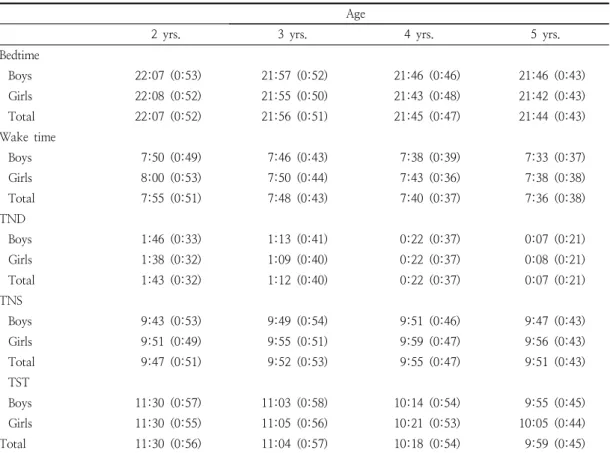
Table 2 presents the means and standard deviations of the sleep variables. First, the mixed-
Age
2 yrs. 3 yrs. 4 yrs. 5 yrs.
Bedtime
Boys 22:07 (0:53) 21:57 (0:52) 21:46 (0:46) 21:46 (0:43)
Girls 22:08 (0:52) 21:55 (0:50) 21:43 (0:48) 21:42 (0:43)
Total 22:07 (0:52) 21:56 (0:51) 21:45 (0:47) 21:44 (0:43)
Wake time
Boys 7:50 (0:49) 7:46 (0:43) 7:38 (0:39) 7:33 (0:37)
Girls 8:00 (0:53) 7:50 (0:44) 7:43 (0:36) 7:38 (0:38)
Total 7:55 (0:51) 7:48 (0:43) 7:40 (0:37) 7:36 (0:38)
TND
Boys 1:46 (0:33) 1:13 (0:41) 0:22 (0:37) 0:07 (0:21)
Girls 1:38 (0:32) 1:09 (0:40) 0:22 (0:37) 0:08 (0:21)
Total 1:43 (0:32) 1:12 (0:40) 0:22 (0:37) 0:07 (0:21)
TNS
Boys 9:43 (0:53) 9:49 (0:54) 9:51 (0:46) 9:47 (0:43)
Girls 9:51 (0:49) 9:55 (0:51) 9:59 (0:47) 9:56 (0:43)
Total 9:47 (0:51) 9:52 (0:53) 9:55 (0:47) 9:51 (0:43)
TST
Boys 11:30 (0:57) 11:03 (0:58) 10:14 (0:54) 9:55 (0:45)
Girls 11:30 (0:55) 11:05 (0:56) 10:21 (0:53) 10:05 (0:44)
Total 11:30 (0:56) 11:04 (0:57) 10:18 (0:54) 9:59 (0:45)
Note. TND = Total nap duration; TNS = Total nighttime sleep; TST = Total sleep time
Table 2. Means and standard deviations of the sleep variables
model ANOVA performed on bedtime yielded a significant main effect of age, F (3, 4233) = 116.43, P < 0.001. Pairwise comparisons using Bonferroni correction revealed significant differences in bedtime between all possible pairs of age ( P s < 0.001) except for between the ages 4 and 5 years ( P = 1.0). Thus, children’s bedtime steadily shifted to earlier times until the age of 4 years (from 22:07 to 21:45; by 22 min), and then remained approximately the same between ages 4 and 5 years. There was no sex difference in bedtime.
Second, the mixed-model ANOVA for wake time yielded a significant main effect of age, F (3, 4233)
= 97.69, P < 0.001. Pairwise comparisons revealed significant differences between all possible pairs of age (all P s < 0.001), demonstrating that children’s wake time gradually moved to earlier times from age 2 to 5 years (from 7:55 to 7:36; by 19 min).
In addition, the analysis yielded a significant main effect of sex, F (1, 1411) = 11.64, P = 0.001, indicating that boys ( M = 7:42, SD = 0:42) woke up earlier than girls ( M = 7:48, SD = 0:43) across ages.
Third, the analysis performed on TND revealed a strongly significant main effect of age, F (3, 4233)
= 2647.75, P < 0.001, and a significant main effect of sex, F (1, 1411) = 7.66, P = 0.006, as well as a significant age x sex interaction, F (3, 4233) = 4.05, P = 0.007. Pairwise comparisons indicated significant differences between all possible pairs of age (all P s < 0.001), indicating that TND significantly declined each year from age 2 to 5 years. At the same time, boys ( M = 1h 46min, SD = 0h 33min) had longer TND than girls ( M = 1h 38min, SD = 0h 32min) at age 2, t (1411) = 4.21, P < 0.001.
There was no sex difference in TND at other ages, t s < 1.77, ns , demonstrating that boys and girls did
not differ in TND after the age of 3 years.
Fourth, the analysis performed on TNS revealed significant main effects of age, F (3, 4233) = 8.70, P < 0.001, and sex, F (1, 1411) = 19.46, P < 0.001.
Pairwise comparisons indicated significant differences in TNS between all pairs of age, except for between 3 and 4 years, and between 3 and 5 years. Thus, TNS increased from age 2 to 3 years (9h 47 min to 9h 52 min; by 5 min), remained approximately the same from age 3 to 4 years, and then declined from age 4 to 5 years (9h 55 min to 9h 51min; by 4 min). Furthermore, boys ( M = 9h 48min, SD = 0h 34min) had shorter TNS than girls ( M = 9h 56min, SD = 0h 32min) regardless of age.
Lastly, the analysis of TST yielded significant main effects of age, F (3, 4233) = 1056.78, P <
0.001, and sex, F (1, 1411) = 7.37, P = 0.007, as well as a significant age x sex interaction, F (3, 4233) = 3.02, P = 0.029. The follow-up analyses revealed that TST significantly decreased each year in both girls and boys, all P s < 0.001. However, the interaction arose because boys and girls did not differ in their TST at ages 2 and 3 years, t s
< 1, but then boys showed significantly shorter TST than girls at ages 4, t (1411) = 2.51, P = 0.012, and 5 years, t (1411) = 4.12, P < 0.001.
2. Prevalence of napping and sleep deficit Next, we examined the prevalence of nap and that of sleep deficit, which was operationalized as TST shorter than the minimum TST recommended by the U.S. National Sleep Foundation (i.e., 11h for 2-year-olds; 10h for 3- to 5-year-olds; Hirshkowitz et al., 2015).
First, 99.6% of the children took naps at 2 years
of age; 84.0% took naps at 3 years; 32.7% of
children at 4 years, and 15.1% at 5 years, a distribution that was significantly different, Χ
2(3, N = 1,413) = 2835.81, P < 0.001. Thus, the percentage of nap-takers continually decreased from age 2 to 5 years, with a particularly sharp decrease between the ages of 3 and 4 years. There was no sex difference in nap prevalence.
Second, sleep deficit was found in 19.8% at 2 years, 7.21% at 3 years, 25.13% at 4 years, and 34.9% at 5 years of age. Thus, approximately one out of four children at 4 years, and one out of three children at 5 years indicated sleep deficit.
3. Additional Analysis: Associations between TND and other sleep variables
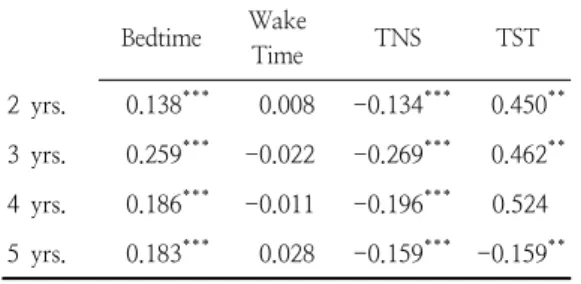
Additionally, we examined whether TND was linked to other sleep variables in a correlation analysis. As shown in Table 3, longer TND was associated with later bedtime and shorter nocturnal sleep at all ages (all P s < 0.001). Furthermore, longer TND was linked to longer TST at ages 2 and 3 years, but with shorter TST at age 5 years.
There was no relationship between TND and TST at age 4 years. TND was not associated with wake time.
Bedtime Wake
Time TNS TST
2 yrs. 0.138
***0.008 -0.134
***0.450
**3 yrs. 0.259
***-0.022 -0.269
***0.462
**4 yrs. 0.186
***-0.011 -0.196
***0.524 5 yrs. 0.183
***0.028 -0.159
***-0.159
****