http://dx.doi.org/10.4078/jrd.2014.21.6.331
331
<Received:January 9, 2014, Revised (1st:March 18, 2014, 2nd:April 9, 2014), Accepted:April 10, 2014>
Corresponding to:Wan-Hee Yoo, Department of Rheumatology, Chonbuk National University Medical School and Research Institute of Clinical Medicine of Chonbuk National University Hospital, San 2-20 Geumam-dong, Deokjin-gu, Jeonju 561-180, Korea.
E-mail:[email protected] pISSN: 2093-940X, eISSN: 2233-4718
Copyright ⓒ 2014 by The Korean College of Rheumatology
This is a Free Access article, which permits unrestricted non-commerical use, distribution, and reproduction in any medium, provided the original work is properly cited.
Coexisting Rheumatoid Arthritis and Takayasu’s Arteritis:
a Case Report and Review of the Literature
Hyun-young Kim, In Suk Min, Ji Eun Yoo, Yeonmi Ju, Pil Hun Song, Jeong San Ku, Won Seok Lee, Wan-Hee Yoo
Department of Rheumatology, Chonbuk National University Medical School and Research Institute of Clinical Medicine of Chonbuk National University Hospital-Chonbuk National University, Jeonju, Korea
The coexistence of rheumatoid arthritis (RA) and Takayasu’s arteritis (TA) is a rare combination and described only in case reports in the literature. Although concurrent pres- ence of RA and TA has been described only in a few liter- atures to date and the number of reports is increasing, the association between RA and TA remains to be clarified.
We present a case of a female patient with both RA and TA, presenting with polyarthritis. We also reviewed the clinical features of the cases with coexistence of RA and TA.
Key Words. Rheumatoid arthritis, Takayasu’s arteritis
Introduction
Takayasu’s arteritis (TA) is a rare, idiopathic, chronic in- flammatory disease characterized by necrotizing and ob- literative segmental panarteritis of unknown aetiology, which attacks the aorta and its major branches (1). Autoimmunity is thought to play an important role, and several cases have been reported an associations between TA and various autoimmune disorders. Rheumatoid arthritis (RA) is a chronic inflamma- tory disease characterized by symmetric, multiple arthritis and extra-articular manifestations (EAM), including the skin, eyes, lungs and blood vessels. Rheumatoid vasculitis is an unusual complication of longstanding, severe RA, which involves the small and medium sized arteries in the body (2). The con- troversy exists about the concurrent presence of both diseases, and it is also unclear whether this disease occurs incidentally or overlaps like other connective tissue diseases. However, the reports of coexistence of RA and TA are increasing in spite of very rare description only in case reports in the literature (4-14). More reports, experience and case control studies will be needed to define the relationship between RA and TA.
We here described a case of a young woman with both RA and TA, and reviewed the clinical features of the reported cas- es with coexistence of RA and TA.
Case Report
A 40-year-old female patient was visited the private clinic with painful swellings on both knees, elbows, and small joints in hands in March 2000. She was diagnosed as having RA.
She had been treated for pulmonary tuberculosis 8 years pre- viously with 4-drug regimen(isoniazid, rifampin, pyrazi- namide, ethambutol) and there was no other medical history.
In July 2007, the patient was referred to our hospital due to poorly controlled symptoms of RA. She was treated with me- thotrexate (10 mg/week), leflunomide (10 mg/day) and pre- dnisolone (5 mg/day), which improved her articular symptoms and laboratory findings.
After 6 months later, she presented with exacerbation of RA as well as cough, sputum and hemoptysis. She was found to have both swelling and tenderness in her peripheral joints of both hands and feet. But she did't experience claudication. On
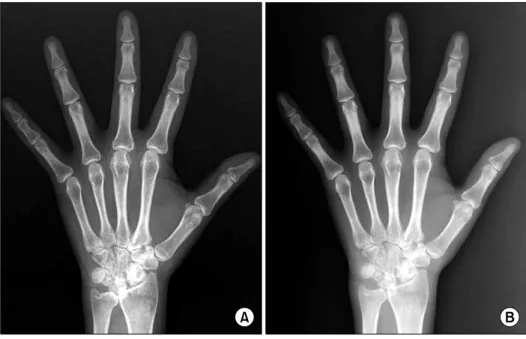
hand in 2007 (A), 2011 (B). Hand X-ray shows narrowing of radio- carpal and carpal bone joint space and irregular bony erosion and sclerosis of carpal bone and distal radius.
Figure 2. (A) Computed tomography (CT) with enhancement of chest shows known tuberculosis-destroyed lung with acute pneumonic consolidation. (B) Takayasu’s arteritis in late stage of disease. Unenhanced CT scan shows extensive calcification composing abdominal aortic lumen. (C) Enhanced CT scan shows stenosis of left common carotid artery.
physical examinations, her lung sounds were decreased with crackles and there wasn't deformity or rheumatoid nodule on her hands. A blood pressure difference between the left and right arm was not noted. But pulsations of both tibial arteries were reduced. She had a reversed arm-leg systolic blood pres- sure discrepancy of 50 mmHg (51/50 mmHg vs 102/100 mmHg, leg vs. arm, respectively). There was bruit over ab- dominal aorta. At admission, laboratory test revealed white blood cell (WBC) of 16.9×10³/mL with neutrophilia and he- moglobin 13.4 g/dL, platelet 299×103/mL, erythrocyte sed- imentation rate (ESR) 82 mm/hr, C-reactive protein (CRP) 293.05 mg/L. Rheumatoid factor (RF) level was 31.5 IU/mL (normal <14 IU/mL), and anti-CCP antibody level was 59.08 IU/mL (normal <5 IU/mL). Her renal function were normal and sputum AFB stains and cultures were negative.
Simple X-ray of right hand showed narrowing of radiocarpal and carpal joint space and irregular bony erosion and sclerosis
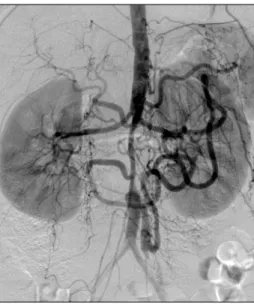
of carpal bone and distal radius (Figure 1). Computed tomog- raphy (CT) with enhancement of chest showed known tuber- culosis-destroyed lung with acute pneumonic consolidation (Figure 2A). And abdominal aorta had incidentally found dif- fuse calcification with complete obstruction of infrarenal aorta (Figure 2B). To further evaluate aortic abnormality on CT, aortic angiography was performed and showed complete ob- struction of infrarenal aorta (Figure 3) with left common car- otid artery stenosis (Figure 2C). Considering the age of the patient, bruit over abdominal aorta and abnormal findings of 3D CT scan of aorta and aortic angiography, TA was diag- nosed by The American College of Rheumatology. Despite of vascular lesion, she had enough peripheral circulation with good patency around the obstructive lesion, percutaneous transluminal angioplasty or stent insertion on obstructive le- sion was not performed. She has been maintained her medi- cation (Figure 4). Under this therapy, she has regular followed
Figure 3. Catheter angiography shows infrarenal abdominal aortic stenosis with extensive collateral vessel formation. Although atherosclerosis commonly affects infrarenal abdominal aorta, atherosclerosis usually produces abrupt caliber changes just beyond stenosis sites; the smooth tapered nature of this stenosis favors TA.
Figure 4. Drug dosage and duration of treatment are shown.
up with no recurrence.
Discussion
Takayasu’s arteritis (TA) is a nonspecific large vasculitis, which induces occlusive or dilative lesions in the aorta, its main vessels, and pulmonary or coronary arteries (1). TA most frequently affects young Asian woman, with an age at onset usually between 10 and 40 years and median age at di- agnosis of 28 years. The pathogenesis remains to be clarified but has been suggested that the vasculitis may deteriorate via autoimmune mechanism with infiltration of cytotoxic T lym- phocyte and release of proinflammatory cytokines (2). This is the reason that TA is a rare pathology associated with other autoimmune disease, such as systemic lupus erythematosus and systemic sclerosis (2). Despite a similar pathogenesis with a prominant role of TNF-, the association between RA and TA is rare (3). The relationship between TA and RA remains unknown.
Despite its predominant articular manifestations, RA is a sys- temic disease often associated with organ-specific EAM (2).
Rheumatoid vasculitis affects from <1% to 5% of RA pa- tients and can occur in any organ, although about 90% of cas- es have cutaneous lesions (2). Commonly inflammation of the small- and medium-sized arteritis in the extremities may be seen, but aortic root changes and aortitis were reported in RA.
RA associated aortitis is almost accompanied by severe ex- tra-articular vasculitic manifestations with positive rheumatoid
factor (RF) and subcutaneous nodules (8). Although aortitis is rarely reported in patients with RA, necropsy data suggested that may be seen in up to 15% of cases (8).
In the previous reports of this disease, age at diagnosis of RA or TA, mucocutaneous, articular manifestations and rheu- matoid factor were described (Table 1). In addition, results of genotype of human lymphocyte antigen (HLA) and type of involvement of large blood vessels in TA were described (4-14). According to the research on TA in 129 Korean pa- tients, the most common clinical symptom of TA were head- ache (60%) and the second most common symptom is exer- tional dyspnea (42%) (15). But in this case, patient present with nonspecific respiratory symptoms and clinical symptoms variety as a cause of late diagnosed Takayasu's arteritis. The concurrent presence of Takayasu arteritis and rheumatoid ar- thritis (RA) is described in only few cases in the literature to date, these were often in female (18 females and 6 males), and the mean age at the time of RA diagnosis was 46.5±14.3 yr (range 16∼74). The mean age at the time of TA diagnosis was 52.1±15.7 yr (range 20∼82), and the age at diagnosis of TA in patients with RA have older than patients with iso- lated TA. Only 3 studies have reported case developed TA before RA (11,13), TA diagnosed after arthritis signs and symptoms in most cases. The average time elapsing between the onset of RA and the development of TA was 5.6 yr. Most of the patients had positive RF and subcutaneous nodules were detected. These studies found that clinical difference regarding arthritis and arthralgias in the course of TA may be attribut- able to a genetic background, as polymorphic HLA genes and their combinations may have had a role in modulating the clinical findings.
Despite the fact that there is still a debate on the exact nature of the coexistence of RA with TA, we suggest that it can be a very rare rheumatic disease entity or that the development
Gravellese et al. (11) Gravellese et al. (11) Gravellese et al. (11) Gravellese et al. (11) Gravellese et al. (11) Gravellese et al. (11) Gravellese et al. (11) Gravellese et al. (11) Towned et al. (12) Nakabayashi et al. (13) Jung et al. (14) Korkmaz et al. (15) Yokoe et al. (16) Verweij et al. (17) Our case
68/M 61/F 52/F 69/M 60/M 46/M 67/M 64/F 44/M 64/F 30/F 36/F 50/F 49/F 45/F
47 58 26 68 48 37 65 61 NR
60 28 34 46 48 31
68 61 52 69 60 46 67 64 44 64 24 36 39 49 39
+ + + + + + + + + + + + + - +
+ + + + + + + + + NR
+ NR NR NR +
NR NR NR NR NR NR NR NR + + + + NR NR +
NR NR NR NR NR NR NR NR NR DR2, 12
NR DR4, 1
NR NR NR
NR NR NR NR NR NR NR NR Aortic root
III NR
I I I III
III I I Aortic root
NR II III III NR NR NR NR NR NR NR RA: rheumatoid arthritis, TA: Takayasu’s arteritis, RF: rheumatoid factor; HLA: human leukocyte antigen, NR: not reported.
of these two diseases in our patient or other previously re- ported cases might be a complication of the chronic auto- immune inflammatory disease and a nonspecific vascular re- sponse to a generalized inflammatory process in association with genetic background predisposing to both RA and TA.
The genetic relationship between RA and TA is not yet clearly established. however, it has been shown that a consid- erable number of reported cases. Thus, physicians should con- sider that RA patients with extra-articular manifestations should be monitored carefully for the development of an oc- clusive arterial involvement such as TA.
Although coexistence of RA and TA were very rarely re- ported, the inter-relationship between these diseases as an EAM has controversies. The clinical characteristics of coexist- ing RA and TA were not well known. We found 23 other cases of RA overlapped with TA or aortitis in the English lit- erature (4-14).
Summary
We report the case of a Asian woman who was diagnosed with TA after being treated for RA for 8 years. As mentioned above, there is still a debate on the coexistence of RA with
TA, it can be a very rare rheumatic disease entity. Physicians should consider that RA patients with extra-articular manifes- tations should be monitored carefully for the development of an occlusive arterial involvement such as TA.
References
1. Nakao K, Ikeda M, Kimata S, Niitani H, Niyahara M.
Takayasu's arteritis. Clinical report of eighty-four cases and immunological studies of seven cases. Circulation 1967;35:1141-55.
2. Turesson C. Extra-articular rheumatoid arthritis. Curr Opin Rheumatol 2013;25:360-6.
3. Matsuno H, Yudoh K, Katayama R, Nakazawa F, Uzuki M, Sawai T, et al. The role of TNF-alpha in the patho- genesis of inflammation and joint destruction in rheuma- toid arthritis (RA): a study using a human RA/SCID mouse chimera. Rheumatology (Oxford) 2002;41:329-37.
4. Sandring H, Welin G. Aortic arch syndrome with special reference to rheumatoid arteritis. Acta Med Scand 1961;170:1-19.
5. Falicov RE, Cooney DF. Takayasu's arteritis and rheu- matoid arthritis; a case report. Arch Intern Med 1964;114:594-600.
6. Sketchler JJ, Waxman J. Takayasu's arteritis diagnosed in a patient with long-standing arthralgias and arthritis.
South Med J 1987;80:516-8.
7. Mimura K, Sueishi K, Tanaka K, Kinjo M. Aneurysm in the sequestrated lung and aortitis associated with the malignant rheumatoid arthritis. Pathol Res Pract 1989;185:381-5.
8. Gravallese EM, Corson JM, Coblyn JS, Pinkus GS, Weinblatt ME. Rheumatoid aortitis: a rarely recognized but clinically significant entity. Medicine (Baltimore) 1989;68:95-106.
9. Townend JN, Emery P, Davies MK, Littler WA. Acute aortitis and aortic incompetence due to systemic rheuma- tological disorders. Int J Cardiol 1991;33:253-8.
10. Nakabayashi K, Nitadori T, Kamiya Y, Nagasawa T.
Atypical Takayasu arteritis: late onset and arthritic mani- festations: report of two cases. Int J Cardiol 1998;66 Suppl 1:S221-7.
11. Jung NY, Jung IH, Sin PJ, Kim JW, Seo JI, Song CH,
et al. Rheumatoid arthritis developed after Takayasu’s arteritis. The Journal of Wonju College of Medicine 1999;12:148-52.
12. Korkmaz C, Zubaroğlu I, Kaya T, Akay OM. Takayasu's arteritis associated with rheumatoid arthritis: a case report and review of the literature. Rheumatology (Oxford) 2001;40:1420-2.
13. Yokoe I, Haraoka H, Harashima H. A patient with Takayasu's arteritis and rheumatoid arthritis who responded to tacrolimus hydrate. Intern Med 2007;46:1873-7.
14. Verweij KE, van Well AM, Vd Sluijs JW, Dees A. Late onset takayasu arteritis and rheumatoid arthritis. Case Rep Med 2012;2012:523218.
15. Park YB, Hong SK, Choi KJ, Sohn DW, Oh BH, Lee MM, et al. Takayasu arteritis in Korea: clinical and an- giographic features. Heart Vessels Suppl 1992;7:55-9.