INTRODUCTION
Cervical cancer is the second most common gynecologic malig
nancy in the world. The major steps required for cervical carci
nogenesis include human papillomavirus (HPV) infection, HPV
persistence, progression to precursor lesions, and invasion [1].
The majority of cervical cancer cases are caused by persistent infection with at least one of the highrisk (HR) carcinogenic HPV types [2]. Consequently, it has been proposed that, like the HPV DNA test, highly sensitive HPV detection methods may be able to strengthen the efficacy of populationbased screening programs, either as a sole screening tool or as an adjunct to current cervical cancer triage. Hybrid Capture 2 (HC2, Qiagen, Gaithersburg, MD, USA), mostly used as an HPV detection me thod, can detect the DNA of the 13 HR and 5 lowrisk HPV types that most commonly affect the cervix. However, HC2 is unable to determine specific HPV types, and HPV 16 and HPV 18 geno
types are responsible for causing the majority of all cervical cancers [3]. Thus, another method is necessary for specific HPV
Comparison of the Seeplex HPV4A ACE and the Cervista HPV assays for the detection of HPV in hybrid capture 2 positive media
Kyung-Jin Min1, Kyeong A So1, Jieun Lee1, Hye-Ri Hong1, Jin-Hwa Hong2, Jae-Kwan Lee1, Ae-Ree Kim3
1Department of Obstetrics and Gynecology, Korea University Guro Hospital, Korea University College of Medicine, Seoul;
2Department of Obstetrics and Gynecology, Kangbuk Samsung Hospital, Seoul; 3Department of Pathology, Korea University Guro Hospital, Korea University College of Medicine, Seoul, Korea
Received Jul 8, 2011, Revised Oct 9, 2011, Accepted Oct 13, 2011
This work was presented at the 26th annual meeting of The Korean Society of Gynecologic Oncology and Colposcopy 2011, Gyeongju, Korea.
Correspondence to Jae-Kwan Lee
Department of Obstetrics and Gynecology, Korea University Guro Hospital, 97 Gurodong-gil, Guro-gu, Seoul 152-703, Korea. Tel: 82-2-2626-3142, Fax:
82-2-838-1560, E-mail: [email protected]
Objective: To validate the efficacy of Seeplex HPV4A ACE for the detection of highrisk (HR) human papillomavirus (HPV) and HPV 16 and/or HPV 18 genotypes as compared to the PCR method and the Cervista HPV assays in cervical swab samples.
Methods: Besides liquidbased cytology, additional 97 cervical swab samples were collected for HPV genotyping by HPV4A ACE, Cervista HPV assays, and PCR method. To check the statistical differences, we also conducted the paired proportion test, Cohen’
s κ statistic, and a receiver operating characteristic curve.
Results: Seeplex HPV4A ACE and the Cervista HPV HR showed substantial agreement with PCR for detection of HR HPVs (88.3%, κ=0.767 and 81.7%, κ=0.636, respectively). Seeplex HPV4A ACE also showed substantial agreement with the Cervista HPV 16/18 test (89.5%, κ=0.628). Additionally, the sensitivity and specificity of Seeplex HPV4A ACE and Cervista HPV HR were 91.4% vs.
84.5% and 73.4%, vs. 72.7%, respectively, when those higher than lowgrade squamous intraepithelial lesions were regarded as abnormalities. HPV genotyping for HPV 16/18 detected cervical intraepithelial neoplasias (CINs) better than HR HPV tests (66.7%
vs. 24.6% by HPV4A ACE, 52.6% vs. 25.9% by Cervista HPV assays in CIN II or more, relatively).
Conclusion: Seeplex HPV4A ACE is an effective method as the PCR and the Cervista HPV assays for the detection of HR HPVs and for genotyping of HPV 16 and 18.
Keywords: Cervista HPV HR, Cervista HPV 16/18, Highrisk HPV, HPV 16, HPV 18, Seeplex HPV4A ACE
genotyping.
Recently, two novel DNA test methods for HPV detection and genotyping have been developed, Seeplex HPV4A ACE (Seegene Inc., Seoul, Korea) and the Cervista HPV assays (Ho
logic Inc., Madison, WI, USA). In contrast to other commercially available HPV genotyping methods, Seeplex HPV4A ACE is DPObased multiplex PCR. HPV 16 and/or 18 genotyping and 16 HPV HR type and HPV low risk HPV 6/11 screening can be done with one PCR test. The Cervista HPV HR and 16/18 tests uses the Invader chemistry (Hologic Inc.), a signal amplifica
tion method for detection of specific nucleic acid sequences.
The Cervista HPV HR is designed for detection of 14 HPV types.
This method uses two types of isothermal reactions, including a primary reaction that occurs on the targeted DNA sequence and a secondary reaction that produces a fluorescent signal.
The Cerivsta HPV assays must be conducted separately, but Seeplex HPV4A ACE is so robust that physicians can obtain HPV results in a single test. The purpose of this study was to validate the sensitivity of Seeplex HPV4A ACE for the detec
tion of HR HPV DNA and HPV 16 and/or HPV 18 genotypes, as compared to the PCR method, the Cervista HPV HR, and Cerv
ista HPV 16/18, in cervical swab samples. Finally, we evaluated the sensitivity and specificity of these HPV DNA tests in corre
lation with cytologic results.
MATERIALS AND METHODS
1. Study population, specimen collection, and histologic examination
Women were enrolled who were referred to the Colposcopy Clinic in Korea University Guro Hospital due to abnormal cyto logy between April and June 2010. A cervical specimen for liquid
based cytology, along with simultaneous HPV DNA detection by the HC2 assay, was collected from each patient. Genomic DNA was extracted from each sample, and the HPV DNA tests were performed by HPV4A ACE, PCR method, Cervista HPV HR assay, and Cervista HPV 16/18 test on the same specimen.
Among them, we used only samples of HPVpositive women by HC2 assay due to the difficulty of HC2negative sample col
lection as limitation of this retrospective study. Colposcopic ex aminations were performed in all women with abnormal cer
vical cytology. Histologic verifications by punch biopsy were performed in women with abnormal colposcopic findings.
2. Liquid-based cytology
A CervexBrush (Rovers Medical Devices, Oss, Netherlands) was used to obtain samples from the uterine cervix. The brush was immediately rinsed in a vial of PreservCyt solution (Hologic
Inc.). The vial was placed in the ThinPrep Processor (Hologic Inc). The ThinPrep slide was then fixed in ethanol and stained with Papanicolaou’s stain. The number of epithelial cells on these slides was estimated from the number of cells contained within computerderived coordinates for 50 random fields located within a 20mm diameter circular area where the cells were deposited. The diagnoses were made using the 2001 Bethesda System for cervical cytology.
3. HC2 assay
HPV DNA testing by the HC2 assay was performed with the HC2 assay system according to the manufacturer’s protocol (Qiagen). The specimens were denatured at 65oC for 45 min
utes and hybridized under highstringency conditions with a mixture of RNA probes that detects 13 different oncogenic HPV types: 16, 18, 31, 33, 35, 39, 45, 51, 52, 56, 58, 59, and 68.
The resultant DNARNA hybrids were captured on the sur
face of the microtiter plate wells coated with an antiDNA
RNA hybrid antibody. The immobilized hybrids were then reacted with an alkaline phosphataseconjugated antihybrid monoclonal antibody. Light intensity was measured with a luminometer. The recommended positivity threshold of 1 pg/
mL was used as a cutoff, and all specimens with a relative light unit/control (RLU/CO) ratio of ≥1.0 were considered positive.
4. PCR method
PCR was conducted in a final reaction volume 20 µL contain
ing 0.1 µg of isolated DNA from a cervical swab, 1 µL of forward (F) and reverse (R) primer (General (F): 5’TTTGTTACTGTG
GTAGATACTAC3’, General (R): 5’GAAAAATAAACTGTAAAT
CATATTC3’, HPV 16 (F): 5’TTTGTTACTGTTGTTGATACTACAC
GC3’, HPV 16 (R): 5’GAAAAATAAACTGTAAATCATATTCCTC3’, HPV 18 (F): 5’TTTGTTACTGTGGTAGATACCAC TCGC3’, HPV 18 (R): 5’GAAAAATAAACTGCAAATCATATTCCTC3’, 10 pmole/
µL) and 10 µL of 2X Master Mix (Lucigen, Middleton, WI, USA).
Here, general primers were common primers to confirm HR HPV. After a preheating step at 94oC for 4 minutes, 40 ampli
fication cycles were carried out in the thermal cycler under the following conditions: denaturation at 94oC for 1 minutes, annealing for 2 minutes and extension at 72oC for 90 seconds.
Amplification was completed with a final extension step at 72oC for 4 minutes. The amplified PCR products were sepa
rated on 4% agarose gel containing ethidium bromide.
5. Seeplex HPV4A ACE screening
Seeplex HPV4A ACE is designed for detection of HPV 16 and/
or HPV 18, screening for 16 HPV HR types (i.e., 26, 31, 33, 35, 39, 45, 51, 52, 53, 56, 58, 59, 66, 68, 73 and 82), and screening for HPV low risk types 6/11. The residual cells in the PreservCyt
solution were centrifuged at 13,000 ×g for 15 minutes, and the cell pellets were resuspended in 100 µL of phosphate
buffered saline. The resuspended cell pellets were added to a Qiamp DNA mini Kit (Cat. No. 51304, Qiagen Inc., Valencia, CA, USA). The extraction of total DNA was performed according to the manufacturer’s instructions. HPV DNA testing by the See
plex HPV4A ACE was performed according to the manufac
turer’s protocol (Seegene, Korea). The kit contains sets of pri
mers that were specifically designed from highly conserved re gions of genetic sequences for HPVs using DPO technology [4]. Optimized multiplex PCR was performed in 20 µL reac
tions containing DNA template, primer mixture, 2X Master Mix (Seegene, Korea) and 8methocypsoralen (MOP), which prevents contaminating DNAs for being amplified. PCR ampli
fication was performed in an Applied Biosystem 9700 thermal cycler (PerkinElmer, Boston, MA, USA) with the following con
ditions: After a preheating step at 94oC for 15 minutes, 40 am
plification cycles were carried out in the thermal cycler under the following conditions: denaturation at 94oC for 30 seconds, annealing at 60oC for 90 seconds, and extension at 72oC for 90 seconds. Amplification was completed with a final extension step at 72oC for 10 minutes. The amplified PCR products were separated on an auto capillary electrophoresis system, the LabChip DX Seeplex Assay system (Caliper, Hopkinton, MA, USA).
The PCR products from each sample (20 µL) were transferred to a 96 well plate and placed in the LabChip DX instrument.
The samples were loaded automatically on the Seeplex Chip and detected sequentially according to the sample order.
Analysis was performed with designated software (Seegene viewer) that presents each of the samples and identifies the fragments that yield a positive readout for the bands of in
terest in the presented results. A tabulated matching matrix provides a simple readout, identifying matching bands to the types of HPV. A text file is automatically generated and saved for each tape.
6. Cervista HPV HR test and Cervista HPV 16/18 test
The Cervista HPV HR is designed for detection of 14 HPV types (i.e., types 16, 18, 31, 33, 35, 39, 45, 51, 52, 56, 58, 59, 66, and 68). The DNA was extracted from residual liquid cytology samples that contained at least 2 mL of sample volume, us
ing the Genfind DNA Extraction Kit (Third Wave Technologies Inc./Hologic Inc., Madison, WI, USA), to perform the HR HPV and 16/18 genotyping tests. DNA was extracted twice, from 2 mL aliquots of the original sample, and placed into 2 separate cryovials labeled B and C. Cryovial B was used for analysis of HR HPV and 16/18 genotyping. Cryovial C was retained for longterm storage except when required as backup material.
The technology for the HR HPV and 16/18 genotyping tests has been previously described [5].
7. Statistical analysis
To compare the clinical accuracy of Seeplex HPV4A ACE and the Cervista HPV HR test to detect lesions higher than lowgrade squamous intraepithelial lesions (LSIL), we also calculated the sensitivity, specificity, positive predictive value (PPV), and negative predictive value (NPV); the sensitivity and specificity of the two tests were compared by the receiver operating characteristic (ROC) curve in dbSTAT for Windows (dBSTAT, Seoul, Korea). Agreement between the HPV assays was assessed by Cohen’s κ statistic, with values of 0.000.20 indicating poor agreement, 0.210.40 fair agreement, 0.41
0.60 moderate agreement, 0.610.80 substantial agreement, and 0.811.00 almost perfect agreement. In addition, we used the dbSTAT for Windows to compare the predictive values between the HR HPVtargeted method and HPV 16 and/or 18–targeted methods. Statistical analyses were performed with SPSS ver. 19.0 (IBM Co., New York, NY, USA) and dBSTAT for Windows ver. 4.5 (dBSTAT). All tests were 2sided, and a P value of less than 0.05 was considered significant.
RESULTS
The cytologic findings, as well as all three HPV DNA test results, were available for 197 patients. The positive rates of each HPV DNA test were 52.3% (103/197) by PCR method, 45.7% (90/197) by Seeplex HPV4A ACE, and 44.2% (87/197) by the Cervista HPV HR test (Table 1). The HR HPVpositive rates by PCR, Seeplex HPV4A ACE, and the Cervista HPV HR test were 11.0%, 4.0%, and 6.0% for the normal cytology group;
89.7%, 84.6%, and 82.1% for atypical squamous cells (ASC);
and 98.2%, 91.4%, and 84.5% for detection of lesions of more than LSIL, respectively.
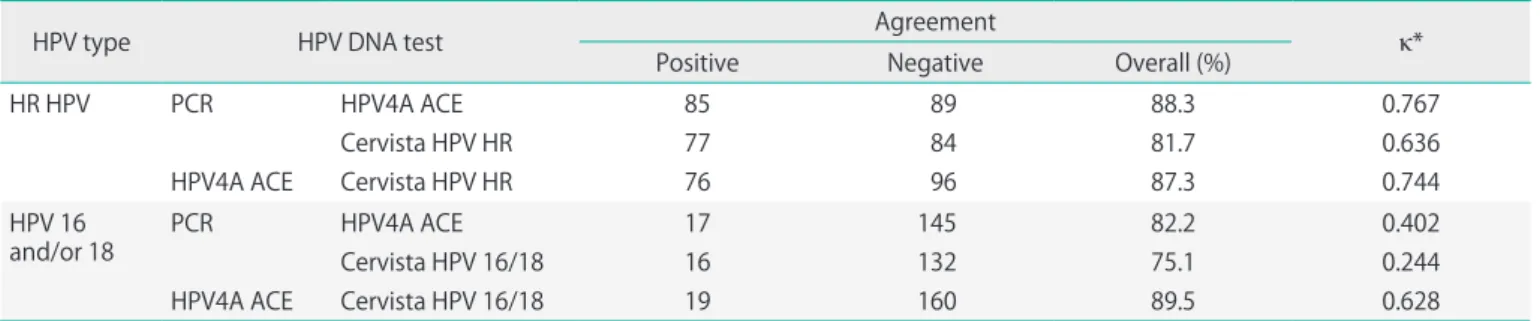
The concordance for HR HPV detection between the Cervista HPV HR test and PCR was 81.7%, showing substantial agree
ment (κ coefficient=0.636) (Table 2). Additionally, the con
cordance between Seeplex HPV4A ACE and the Cervista HPV HR test was 87.3%, showing substantial agreement (κ coef
ficient=0.744). For the detection of HPV 16 and/or 18, Seeplex HPV4A ACE and the Cervista HPV 16/18 test showed substan
tial agreement (89.5%, κ coefficient=0.628).
Table 3 shows the diagnostic accuracy of each HPV DNA test related to cytologic results. The overall HR HPV prevalence was increased in parallel with the increasing severity of the Pap smear result. When an abnormal Pap test was defined as ASCs of undetermined significance (ASCUS) or higher, the sensitiv
ity and specificity of Seeplex HPV4A ACE and Cervista HPV HR both had high test results. However, Seeplex HPV4A ACE defi
nitely showed a higher sensitivity and specificity compared to Cervista HPV HR (88.7% vs. 83.5% and 96% vs. 94%, respective
ly) (Table 3). However, no statistical difference was observed between the two tests. Likewise, when the abnormal Pap test was defined as LSIL or higher, the two HPV DNA tests showed no difference for the detection of cytological results.
We calculated the predictive value for cervical intraepithelial neoplasias (CINs) of each HPV test according to cervical histol
ogy (Fig. 1). In HC2, the predictive value for CINs tended to increase with the level of viral load. However, it was difficult to identify the exact cutoff value to detect CINs. In the other
HPV genotyping tests, Seeplex HPV4A ACE, and Cervista HPV assays, methods to target HPV 16 and/or 18 had a higher pre
dictive value than that of HR HPV (66.7% vs. 24.6% by HPV4A ACE, 52.6% vs. 25.9% by Cervista HPV assays in CIN II or more, relatively, p<0.05).
DISCUSSION
In this study, we found a high efficacy of Seeplex HPV4A ACE in detecting HR HPV, HPV 16, and HPV 18 compared with the PCR method and Cervista HPV HR and HPV 16/18 tests in HC2
positive cervical samples.
Table 1. Results of HPV DNA tests according to cytological diagnosis
Liquid-based cytology No. (%) of positive samples
Results Total PCR HPV4A ACE Cervista HPV HR
Within normal limits 100 11 (11.0) 4 (4.0) 6 (6.0)
Atypical squamous cells 39 35 (89.7) 33 (84.6) 32 (82.1)
Low-grade squamous intraepithelial lesion 44 44 (100.0) 40 (90.9) 36 (81.8)
High-grade squamous intraepithelial lesion 9 8 (88.9) 9 (100.0) 8 (88.9)
Squamous cell carcinoma 5 5 (100.0) 4 (80.0) 5 (100.0)
Total 197 103 (52.3) 90 (45.7) 87 (44.2)
HPV, human papillomavirus; HPV4A ACE, HPV4A auto-capillary electrophoresis; HR, high risk.
Table 2. Concordance among each test for the detection of HR HPV and HPV 16 and/or 18
HPV type HPV DNA test Agreement
κ*
Positive Negative Overall (%)
HR HPV PCR
HPV4A ACE
HPV4A ACE Cervista HPV HR Cervista HPV HR
85 77 76
89 84 96
88.3 81.7 87.3
0.767 0.636 0.744 HPV 16
and/or 18 PCR HPV4A ACE
HPV4A ACE Cervista HPV 16/18 Cervista HPV 16/18
17 16 19
145 132 160
82.2 75.1 89.5
0.402 0.244 0.628 HR HPV, high-risk human papillomavirus; HPV4A ACE, HPV4A auto-capillary electrophoresis.
*p<0.001.
Table 3. Overview of the diagnostic accuracy of each HPV DNA test according to the results of liquid-based cytology
≥ ASC ≥ LSIL
Sensitivity* Specificity* PPV NPV Sensitivity* Specificity* PPV NPV
HPV4A ACE 88.7 96.0 95.6 89.7 91.4 73.4 58.9 95.3
Cervista HPV HR 83.5 94.0 93.1 85.5 84.5 72.7 56.3 91.8
Values are presented as percentage.
HR HPV, high-risk human papillomavirus; ASC, atypical squamous cells including ASCUS and ASC-H; LSIL, low-grade squamous intraepithelial lesions; PPV, positive predictive value; NPV, negative predictive value; HPV4A ACE, HPV4A auto-capillary electrophoresis.
*p<0.001 by ROC curve.
The most obvious cause of cervical precursor lesions or can
cer is persistent infection with one of the carcinogenic HPVs [3]. Among those HPVs, the proportion of HPV types 16 and 18 is the greatest in the development of CIN or cervical cancer [3].
It has been shown that women positive for HPV 16 and HPV 18 have an increased risk of highgrade CIN compared with women positive for other HR HPV types [69]. For this reason, it is important to distinguish HPV 16 and HPV 18 among the carcinogenic HPV types.
The Cervista HPV HR is designed to detect all 14 oncogenic HPVs and to reduce falsepositive results caused by crossreac
tivity with lowrisk HPV genotypes using signal amplification and fluorescence detection. In addition, the Cervista HPV HR contains a unique internal control to validate that sufficient DNA is present for testing. The Cervista HPV 16/18 test, which genotypes for HPV 16/18, is built on same method as Cervista HPV HR. Since then, the results of studies regarding the effi
cacy of Cervista HPV HR and HPV 16/18 have been presented by several researchers [5,1012]. The Seeplex HPV4A ACE test can detect 18 HR HPV genotypes. Among these, the common primers of HR HPV may detect HPV types 39, 52, and 68 by crossreactivity. Seeplex HPV4A ACE demonstrated substantial agreement with PCR (88.3%, κ=0.767). Despite the fact that Seeplex HPV4A ACE has not yet been approved by the FDA, the efficacy of this test is superior over any other products as published previously [13]. This proves the simplicity and reli
ability of HPV4A ACE for HPV genotyping and screening. If two tests have similar abilities to predict abnormal cytology or more than CIN II lesions as in our results, it is more useful to
patients and physicians to use a method that can genotype and screen in one test.
In this study, we consider the HC2 assay as the gold standard for HR HPV detection, and Seeplex HPV4A ACE and the PCR method as a comparative study for HPV 16/18 genotyping.
After the HC2 assay was approved first by the FDA in 2003, it was used as the gold standard in recently published articles regarding HPV DNA tests [1317]. Unfortunately, HC2 can only detect the presence of 13 types of HRHPV. To apply this test in an actual clinical situation, it is considered more useful to compare its results to those of another currently used meth
od. For this reason, we decided to use Seeplex HPV4A ACE and PCR for genotyping as the realtime PCR technique can reinforce the weakness of HC2. Other limitations of this study are that this study did not include a negative result of HC2 and that this study was conducted retrospectively. In a study con
ducted by Digene and the National Cancer Institute, an overall 82.8% agreement (173/209; 95% confidence interval [CI], 77.0 to 87.6) was observed between HC2 and PCR and a positive and negative agreement of 96.7% and 44.6%, respectively (95% CI, 92.5 to 98.9 and 31.3 to 58.5). Due to the possibility of false positive results of HC2, we should include HC2negative samples for an accurate analysis. However, as mentioned in Materials and Methods, HC2negative samples are difficult to collect due to the limitation of this retrospective study. So, we took to experiment with the HC2positive samples, but, because of the high overall and positive agreements, we de
cided to offset the impact that may occur to conduct research on HC2positive samples only.
Seeplex HPV4A ACE has the ability to detect the presence of 18 HR HPV genotypes in high concordance with PCR simulta
neously, and it also can identify HPV 16 and/or 18 genotypes similar to the Cervista HPV HR test. Seeplex HPV4A ACE has not yet received FDAapproval, but it could be said with sufficient means as a HPV DNA test. HPV genotyping tests for HPV 16/18 should be considered to detect CINs more accurately. Seeplex HPV4A ACE is strongly recommended for the detection of HR HPVs and for genotyping of HPV 16 and/or 18. Continuous studies with larger numbers of samples and comparison data with other various HPV DNA genotyping methods are neces
sary to make this novel diagnostic tool more credible and practical at the same time. Research is needed that compare HPV DNA tests by including all of the HC2 results and serial tests on the same target group.
CONFLICT OF INTEREST
No potential conflict of interest relevant to this article was Fig. 1. The predictive value for cervical intraepithelial neoplasias (CINs)
in each human papillomavirus (HPV) DNA test according to final histology.
HR, high-risk HPV; HC2, Hybrid Capture 2; RLU/CO, relative light unit/
control; HPV4A ACE, HPV4A auto-capillary electrophoresis. *p<0.05 by ROC curve.
reported.
ACKNOWLEDGMENTS
This manuscript was supported by Korea University Grant (K1032141).
REFERENCES
1. Schiffman M, Kjaer SK. Chapter 2: Natural history of anoge
nital human papillomavirus infection and neoplasia. J Natl Cancer Inst Monogr 2003;(31):149.
2. Cogliano V, Baan R, Straif K, Grosse Y, Secretan B, El Ghissassi F, et al. Carcinogenicity of human papillo maviruses. Lancet Oncol 2005;6:204.
3. Schiffman M, Castle PE, Jeronimo J, Rodriguez AC, Wacholder S. Human papillomavirus and cervical cancer. Lancet 2007;
370:890907.
4. Chun JY, Kim KJ, Hwang IT, Kim YJ, Lee DH, Lee IK, et al.
Dual priming oligonucleotide system for the multiplex detection of respiratory viruses and SNP genotyping of CYP2C19 gene. Nucleic Acids Res 2007;35:e40.
5. Day SP, Hudson A, Mast A, Sander T, Curtis M, Olson S, et al. Analytical performance of the Investigational Use Only Cervista HPV HR test as determined by a multicenter study. J Clin Virol 2009;45 Suppl 1:S6372.
6. Bosch FX, Burchell AN, Schiffman M, Giuliano AR, de Sanjose S, Bruni L, et al. Epidemiology and natural history of human papillomavirus infections and typespecific implications in cervical neoplasia. Vaccine 2008;26 Suppl 10:K116.
7. Clifford GM, Smith JS, Plummer M, Munoz N, Franceschi S. Human papillomavirus types in invasive cervical cancer worldwide: a metaanalysis. Br J Cancer 2003;88:6373.
8. Herrero R, Hildesheim A, Bratti C, Sherman ME, Hutchinson M, Morales J, et al. Populationbased study of human pa
pil lomavirus infection and cervical neoplasia in rural Costa Rica. J Natl Cancer Inst 2000;92:46474.
9. Khan MJ, Castle PE, Lorincz AT, Wacholder S, Sherman M, Scott DR, et al. The elevated 10year risk of cervical pre
cancer and cancer in women with human papillomavirus
(HPV) type 16 or 18 and the possible utility of typespe ci
fic HPV testing in clinical practice. J Natl Cancer Inst 2005;
97:10729.
10. GalanSanchez F, RodriguezIglesias MA. Use of Cervista HPV HR assay for detection of human papillomavirus in samples with hybrid capture borderline negative results.
APMIS 2010;118:6814.
11. Einstein MH, Martens MG, Garcia FA, Ferris DG, Mitchell AL, Day SP, et al. Clinical validation of the Cervista HPV HR and 16/18 genotyping tests for use in women with ASC
US cytology. Gynecol Oncol 2010;118:11622.
12. Ginocchio CC, Barth D, Zhang F. Comparison of the Third Wave Invader human papillomavirus (HPV) assay and the digene HPV hybrid capture 2 assay for detection of high
risk HPV DNA. J Clin Microbiol 2008;46:16416.
13. Hong JH, Song SH, Kim JK, Han JH, Lee JK. Comparison of the novel human papillomavirus 4 autocapillary elec tro
phoresis test with the hybrid capture 2 assay and with the PCR HPV typing set test in the detection of highrisk HPV including HPV 16 and 18 genotypes in cervical specimens.
J Korean Med Sci 2009;24:57984.
14. Iftner T, Germ L, Swoyer R, Kjaer SK, Breugelmans JG, Munk C, et al. Study comparing human papillomavirus (HPV) realtime multiplex PCR and Hybrid Capture II INNOLiPA v2 HPV genotyping PCR assays. J Clin Microbiol 2009;47:
210613.
15. Mo LZ, MonnierBenoit S, Kantelip B, Petitjean A, Riethmuller D, Pretet JL, et al. Comparison of AMPLICOR and Hybrid Capture II assays for high risk HPV detection in normal and abnormal liquidbased cytology: use of INNOLiPA Genotyping assay to screen the discordant results. J Clin Virol 2008;41:10410.
16. Baleriola C, Millar D, Melki J, Coulston N, Altman P, Rismanto N, et al. Comparison of a novel HPV test with the Hybrid Capture II (hcII) and a reference PCR method shows high specificity and positive predictive value for 13 highrisk human papillomavirus infections. J Clin Virol 2008;42:226.
17. Ratnam S, Coutlee F, Fontaine D, Bentley J, Escott N, Ghatage P, et al. Clinical performance of the PreTect HPVProofer E6/E7 mRNA assay in comparison with that of the Hybrid Capture 2 test for identification of women at risk of cervical cancer. J Clin Microbiol 2010;48:277985.