Environmental Design Factors for Open Space in Healing Facilities
- Focused on Ann & Robert H. Lurie Children's Hospital
and The Nationwide Children’s Hospital -
1
Kim, Sunyoung
1
Prof., Dept. of Environmental Design, Incheon Catholic Univ., Korea
[email protected]
Abstract
The open space of the healing facility should contribute to the psychological and social healing of the users, provide a social environment for rest, and provide a design factor to support the walking path to move to the destination-connected space. In this paper, I examined the relationship between the environmental elements, spatial devices, and the characteristics of the design factors in the open space for healing facilities. As a research method, based on the analysis of previous studies, a healing facility in modern society was defined, and the relationship between the social support and physical environment factors of the healing facility where open space was considered. Through the consideration of cases, the characteristics of the physical space environment, and the design factors of the open space in the healing facility were categorized. As a result of research, open space in the healing facility is a space to promote a social exchange of users, as a physical form for accommodating psychological and social healing functions, it is necessary to construct the connection of the external space with the internal space.
Keywords: Open Space, Design Elements, Healing Environment, Psychological Healing, Social Healing
1. INTRODUCTION
1.1 Research background and purpose
The purpose of this study is to grasp the physical characteristics of open space for social healing and design factors for the environment. Christoph Schirmer emphasized that the open space of the healing environment facility is important for the social service function in which the user's community is formed[1]. The open space of the healing facility is formed of various open spaces and contributes to the function and social healing of the intermediary space for movement and exchange by establishing an amenity environment that considers comfort and functionality. In other words, the open space of the healing facility contributes to the satisfaction and comfort of the user's facilities. I intend to define the healing facilities of modern society and examine the characteristics of the physical environmental elements that make up the open space of the healing environment facilities in terms of social supportability of design.
IJACxx-x-x IJACT 21-3-2
Manuscript received: January 02, 2021 / revised: January 15, 2021 / accepted: February 10, 2021 Corresponding Author: [email protected]
Tel: +82-32-830-7104, Fax: +82-32-830-7072
1.2 Scope of Study
This study considered the characteristics of the physical environment and components constituting the open space of the children’s healing facility, focusing on case studies. As a research method, through the analysis of prior studies, the healing facilities of modern society were defined. Second, the relationship between the social support of the healing facility and the physical space environment was analyzed. Third, the physical environment elements and types of spaces in the open space of the healing environment were identified based on previous studies. Fourth, the cases of open spaces of healing facilities were analyzed by type, and characteristics of environment elements were investigated. The spatial scope of the study was limited to public surroundings open to unspecified people in healing facilities which are a space where the lobby, hall, corridor, core-stairs, elevator, and various facility spaces- are concentrated, and the case studies of open spaces including Children's Memorial Hospital, Ann & Robert H. Lurie Children's Hospital of Chicago, Illinois, and Nationwide Children’s Hospital, Columbus, Ohio, in the USA.
2. THEORETICAL CONSIDERATIONS ON THE HEALING ENVIRONMENT
2.1 Concept of Healing Environment
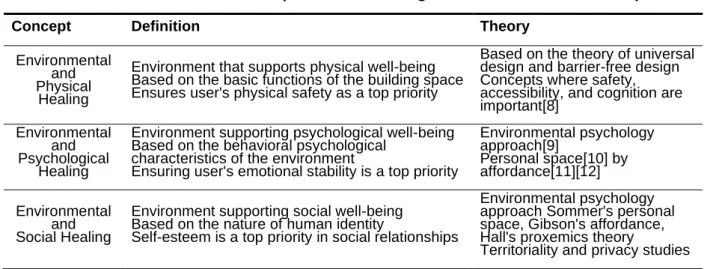
The environment to which the concept of healing is applied contributes to solving social problems and needs through psychological and social healing as well as physical treatment of users. Shin Yun-Jin mentioned that the Greek word ‘Holos’ means healing and it is a source of wholeness, health, and holy and the meaning of healing means that the state of harmony inside and outside is broken, and it returns to a harmonious and complete state[2]. Dr. Leland Kaiser, curing is a patient-focused, spiritual, mental, and empirical method from a high-tech perspective, and healing is a high touch, and it was said that the patient needs experience combining both concepts[3]. Lee Hae-Kyung, Lee Myung-Soo, and Noh Jae-Sung studied to physical healing, psychological healing, and social healing based on Abraham Maslow's human need theory Figure 1.
Figure 1. Maslow's Five-step Theory of Human Needs[6]
The basic direction of the healing environment was that each step interacted with hierarchies in Table 1[4].
Table 1. The Relationship between Healing and Environmental Concept
Lazarus and Folkman addressed the concept of adaptation to the environment as well as the physical adaptation, the psychological response of an individual's acceptance of human's situation, and the importance of social adaptation, which involves social function in a given role and interpersonal relationship in their environment[5]. American psychologist and medical architect Jain Malkin said that psychological healing means a positive attitude toward life such as relieving stress, reducing anxiety, increasing emotional responsiveness, and increasing confidence, and physical healing is healing of disease, wound healing, and sleep. It means a positive recovery of the body, such as improvement and energy recovery. The physical, psychological, and social functions of healing are closely related, and through this interaction, the state of healing is perfected. Therefore, a quality environment satisfies the user's visual function and physiological aspects, and psychologically improves satisfaction by providing visual comfort and aesthetic comfort and this has a positive effect on the healing effect[7].
2.2 The Healing Environmental Factors
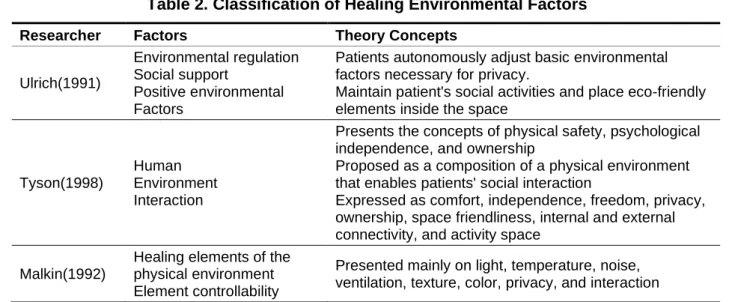
The contents of the healing environment are the patient's autonomous adjustment of the basic environmental factors necessary for the protection of privacy, maintenance of the patient's social activities, and the placement of environmentally friendly elements in the space[8]. Tyson defined the goal of healing as support for lost abilities for a personal existence and gaining pride as a social member[9]. His theory focuses on light, temperature, noise, ventilation, texture, color, privacy, and communication as a study of environmental factors and control for healing in the physical environment. The design factors of the healing environment were divided into individual needs, physical environment elements, and behavioral elements. The environmental elements of the healing facilities can be classified based on the physical spatial environment, user needs, and interactive behavior between the environment and users. This study presented the concept of physical safety, psychological independence, and ownership consciousness in the category of a healing environment and categorized the direction of healing environment design into human, environment, and interaction. The concept of these categories are individual needs, physical factors, and behavioral factors. The individual needs are the elements that protect privacy, increase self-reliance, increase sensory perception, safety, security, and personal approach to the community gardens. The physical factors should provide psychological stability by providing natural elements and viewing environments for stress relief in the physical environment. Since the view of the natural landscape becomes a critical healing factor for patient recovery, it is necessary to provide an efficient arrangement to create a friendly environment that alleviates the patient's anxiety. As a behavioral element for interaction, a space plan can promote the patient's activities with the support of voluntary actions, providing social environment elements. The behavioral factors are the concept of comfort, sense of space, interaction, acceptability, and support through human interaction with space. Prior research of healing environment factors is classified in Table 2.
Concept Definition Theory
Environmental and Physical
Healing
Environment that supports physical well-being Based on the basic functions of the building space Ensures user's physical safety as a top priority
Based on the theory of universal design and barrier-free design Concepts where safety, accessibility, and cognition are important[8]
Environmental and Psychological
Healing
Environment supporting psychological well-being Based on the behavioral psychological
characteristics of the environment
Ensuring user's emotional stability is a top priority
Environmental psychology approach[9] Personal space[10] by affordance[11][12] Environmental and Social Healing
Environment supporting social well-being Based on the nature of human identity
Self-esteem is a top priority in social relationships
Environmental psychology approach Sommer's personal space, Gibson's affordance, Hall's proxemics theory
Table 2. Classification of Healing Environmental Factors
Researcher Factors Theory Concepts
Ulrich(1991)
Environmental regulation Social support
Positive environmental Factors
Patients autonomously adjust basic environmental factors necessary for privacy.
Maintain patient's social activities and place eco-friendly elements inside the space
Tyson(1998)
Human Environment Interaction
Presents the concepts of physical safety, psychological independence, and ownership
Proposed as a composition of a physical environment that enables patients' social interaction
Expressed as comfort, independence, freedom, privacy, ownership, space friendliness, internal and external connectivity, and activity space
Malkin(1992)
Healing elements of the physical environment Element controllability
Presented mainly on light, temperature, noise, ventilation, texture, color, privacy, and interaction
3. DESIGNING SOCIAL SUPPORT IN HEALING FACILITIES
3.1 The Concept of Social Support for Healing
The sociality in the healing environment is related to the patient, the patient's family, and the public, and contributes to the reduction of stress and the healing effect of physical diseases. In the healing environment, the support of interaction using physical environment elements such as the composition of space and the arrangement of furniture can be defined as the social support of design. Marcus emphasized that it is necessary to deal with a social support method design approach for creating a physical environment for social healing [10]. Sadler, DuBose, Malone, and Zimring said the supporting design to create a physical environment for healing ultimately means an increase in healing effects[11]. Ulrich emphasized that the introduction of natural elements and the conversion of the surrounding atmosphere were effective in the healing environment and treated the patient's social support[12]. His research reveals that careful attention to the individual contributes to the patient's stress relief, and important elements of supportive design were explained by stress-reducing environmental control, social support, and positive distraction using a physical environment. Social support of the healing environment supports the physical therapy of the individual by environmental, psychological, social, and cultural support. Social support is essential to the creation of a space environment for healing, and the space of these functions needs to be actively expanded to the public as well as to the private area including families and medical staff. Social support can be expanded by conceptualizing the effect of design elements and it is necessary to provide space for social interaction activities, family visits, and induce information exchange activities.
3.2 Design Factors for Open Space in Healing Facilities
The individual needs, physical environment, and interaction of the healing environment proposed by Tyson, the paradigm of the healing environment is a social service expanding support that gradually forms a relationship with humans. Florence Nightingale noted the importance of individual care in the public sphere of the healing environment, emphasizing individual care and concern. Her example is the provision of an open space through the arrangement of a family space in the hospital room, and the provision of a private space by dividing the space using furniture, such as the placement of a chair, in a 2-3-person[13]. The main function of the open space in the healing facility is to support the behavior of various users and to connect walking to the target facility. The needs for private and public spaces, comfortable physical space environment, eco-friendliness, and open spaces in the healing environment, supporting mutual exchange are
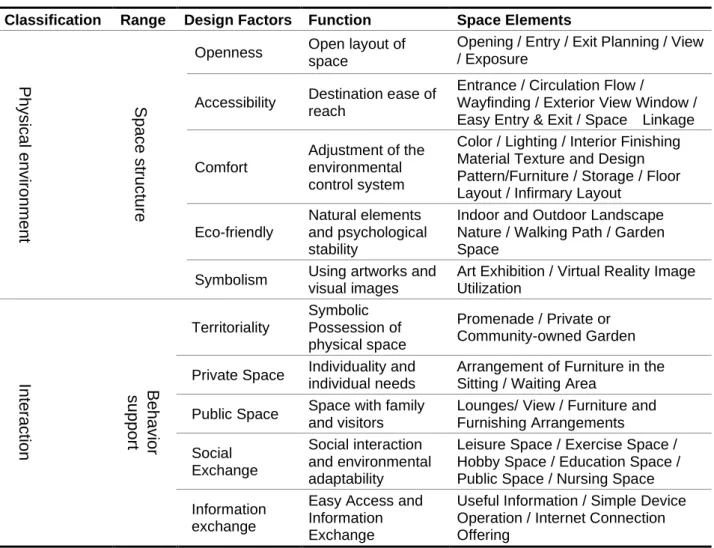
complex designs that organically connect the internal and external environments of the facility using the lower floor of the medical facility. It is necessary to provide an inflow of entry lines to connect the external space and the internal facilities, and a space device for the lobby space and movement of the lower floor. The open space design factors in healing facilities are categorized in Table 3.
Table 3. Open Space Design Factors in Healing Facilities Classification Range Design Factors Function Space Elements
Openness Open layout of space
Opening / Entry / Exit Planning / View / Exposure
Accessibility Destination ease of reach
Entrance / Circulation Flow /
Wayfinding / Exterior View Window / Easy Entry & Exit / Space Linkage
Comfort
Adjustment of the environmental control system
Color / Lighting / Interior Finishing Material Texture and Design Pattern/Furniture / Storage / Floor Layout / Infirmary Layout
Eco-friendly
Natural elements and psychological stability
Indoor and Outdoor Landscape Nature / Walking Path / Garden Space
Symbolism Using artworks and visual images
Art Exhibition / Virtual Reality Image Utilization Territoriality Symbolic Possession of physical space Promenade / Private or Community-owned Garden Private Space Individuality and
individual needs
Arrangement of Furniture in the Sitting / Waiting Area
Public Space Space with family and visitors
Lounges/ View / Furniture and Furnishing Arrangements Social Exchange Social interaction and environmental adaptability
Leisure Space / Exercise Space / Hobby Space / Education Space / Public Space / Nursing Space Information
exchange
Easy Access and Information Exchange
Useful Information / Simple Device Operation / Internet Connection Offering
4. CASE STUDIES OF OPEN SPACE IN HEALING FACILITIES
Hospital Street is a concept of a moving space that minimizes the congestion of entry and exit and the mixing of functions by separating the space of different functions by inducing the user's movement as the main movement axis[15]. The open space linked with Hospital Street is a central space of the healing environment facility, which enriches the patient's spatial experience and enables active acceptance of the natural environment, thereby improving the quality of the healing environment. Also, it functions as a heat-buffered space also has a natural ventilation function using the conversion of airflow. According to a study by Ko Young-Jong and Lee Jong-Man, the public space of the healing environment facility is recognized as an essential concept of hospital construction[14]. Randy Fiser CEO of the American Interior Designers Society(ASID) said that the design of the open space of the healing facility has a very important effect on customer satisfaction. He said that it is necessary to provide furniture with convenient accessibility, organic space allocation, and durability that allows users to use common space in various ways. It is required to provide a private space for users and to secure a personal area through the variability of furniture and furniture arrangements, and an open space for families and visitors to interact with each other. The expansion
P hysi cal en vi ron m en t Inte ractio n S pa ce st ruct ure B eh avi or sup po rt
of healing-related services enhances the space experience and provides convenient access to the necessary facilities and information. Lee So-Young classified the shape of the open space in a healing environment into simple, pneumatic, independent, and vertical types, and the characteristics of the space are shown in Table 4[16].
Table 4. Open Space of Healing Environment Facility
To expand the space experience and provide a comfortable environment, the open space needs to connect the exterior and interior spaces in consideration of openness and grounding. Openness enables the introduction of natural light, the view of the outside, and the sense of external weather conditions, and it is necessary to introduce environmentally friendly elements into the trees, garden views, and connectivity to the garden or the ground by securing grounding properties. According to a research study by Ulrich, providing external views of the natural landscape to inpatients after surgery reduced the number of days of hospitalization, felt less pain, and made a positive diagnosis[17]. Dr. Olds, Anita Rui asked the patients to visually express the healing environment for experimental research on the theme of 'Space can heal', and as a result, 75% of patients drew the external space, 25% of patients have also reported that they have painted an indoor environment that includes elements related to the external space-sky, trees, gardens, windows with yard views, plants, flowers, etc. These findings indicate that images of external spaces including nature in the healing environment have important healing effects[18].
4.1 Flow Connection in Ann & Robert H. Lurie Children’s Hospital
ZGF, Solomon Cordwell Buenz, and Anderson Mikos Architects Ltd. designed the Ann & Robert H. Lurie Children’s Hospital of Chicago, formerly Children's Memorial Hospital, 23 stories, and 1,255,000 sqft2. This project is LEED Gold® and
Lean philosophy encourages efficiencies across the whole medical system[19]. Lean is a set of operating philosophies and methods that help create maximum value for patients by reducing waste and waits and emphasizes the consideration of the customer’s needs, employee involvement, and continuous improvement. This hospital centralized registration using kiosks with the wayfinding, and the innovative benefits included reduced staffing costs for the provider and decreased aggravation for patients who no longer wait in long lines. The new building is connected by bridges and an indoor garden, the Crown Sky Garden is open for patients and families to relax and seek respite and uses light, sound, water, and wood elements to create a calming effect, replicating an outdoor garden and it measures the effectiveness of hospital environments as healing mechanisms. The translucent interactive light wall that weaved throughout the garden at different heights and changes color and brightness as
Type Special Features
Horizontal type Greenhouse type with transparent-material facade
Atrium type Structure with atrium at the stylobate part in lower area and the upper part has a relatively small volume mainly for the infirmary
Individual space type A functionally independent space that appears in low-rise buildings Vertical space type Applied to large-sized buildings with excellency of internal lighting effect
Figure 2. Ann & Robert H. Lurie Children’s Hospital
people approach it. Also, eco-friendly bamboo planters divided the space to allow for active use as well as more quiet respite. The
treehouse hovers above the Crown Sky Garden, allowing families to look over the garden and the canopy of the bamboo trees to see the incredible view of the city. Next to the garden, their aquarium is a relaxing display of beautiful sea creatures that can be seen on both sides of the wall, so children in the Kenneth & Anne Griffin Emergency Care Center also could benefit from its calming effects[20]. Functional components of hospital layouts were carefully planning which are originated from the firm’s practice areas, including corporate workplace designs, academic, and research facilities. The office systems in medical environments made the healthcare is reliable with clean-lined furniture that is wall-mounted or on wheels for the flexibility of the teaming space. Those options allow quick reconfiguration without disrupting underlying architectural finishes like flooring. At the same time, the half-height partitions and soundproofing reduced reliance on architectural walls, and the demountable glass partitions are emblazoned with printed graphics, for vibrant signature branding in full color[21].
4.2 Natural Elements in Nationwide Children’s Hospital
The Nationwide Children’s Hospital, Columbus, Ohio expanded the principles of therapeutic gardens to the entire health care campus and the neighboring community. The design firm MKSK/OLIN team worked with the hospital architects, FKP, integrating holistically the tower with the landscape providing over six acres of green space, healing gardens, and surrounding campus for the hospital. The new landscape space extended historic 9.3 acres of Livingston Park providing a continuous perimeter for the entire hospital campus and an environmentally vibrant setting for the hospital in a park that is in effect a healing garden as well as a community amenity. The design principle is to make the relationships between exterior and interior spaces establish a sense of continuity and a visual connection from the inside to the lush natural materials and plants outdoors.‘A Hospital in A Park, A Park in the Hospital’ is the theme so nature is carried throughout the interior with natural wood textures and imagery of animals that connect people to the outdoors. The interior corridor opened a bright visual connection to the outdoors, constantly linking the user to the exterior garden. The new front lawn added 6 acres of green space to the campus, including a fragrance maze, storyteller’s nook, chalk wall, walking paths, and serene gardens. Design emphasis for the new 6 acres children’s park is placed upon the beneficial aspects of creating
their families, the medical staff, and neighbors. The lawn carried the hospital’s commitment to healthcare outside creating a new destination for patients, families, and neighbors to enjoy.A series of healing gardens provides an amenity that is enjoyed by young patients and the gardens also included a central shady sitting intimate area for storytelling, a moon- light garden that terrace. Upon entering the hospital, visitors walk into a two-story atrium with daylight, views of exterior gardens, and a forest-themed interactive play area. The nature motif was created in partnership with Ralph Appelbaum Associates, has become a visual branding element extended throughout the campus. A brightly colored motif of natural elements integrates the building’s indoor and outdoor spaces and larger-than-life wooden animals represent design theme and can be found throughout all levels of the hospital. At approximately 300 sqft2, the patient rooms of the
facility are providing ample space for family members to stay with patients. Magnetic paint on the walls and a color-changing LED light panel above each patient bed allow patients to customize their room with their favorite color and at night, each of the colors can be seen outside, contributing to the overall architectural
appeal of the building. Figure 3. The Nationwide Children’s
5. DISCUSSION
First, by creating an area for the open form and accommodating various functions, arranging spaces, providing a link that allows entry from outside, and suggesting various uses at the lower floors of facilities. It is required to propose a circulation plan that allows users to easily move from an open space to a target space by arranging open spaces that facilitate access to healing facilities and securing a pedestrian path. Based on the circulation plan that organically connects the interior and exterior spaces of the healing facility, a pedestrian path, waiting space, and convenience facilities for horizontal and vertical movement in the open space must be planned. Second, to secure the right to view the natural landscape and provide landscaping, gardens, and walking trails to enhance the psychological and social treatment effects of patients. The open space using the landscape plan centered on the pedestrian path and visual symbols provides the user with a psychological comfort and a positive image of the healing facility. Providing a walkway with direct access to the balcony, patio structure, and outdoor garden that combines the influx of the hospital room and natural elements will enhance the psychological healing effect for long-term users. Third, to support user interaction, open spaces should be provided with space, furniture, and facilities necessary for social exchange and information exchange by users, such as leisure, sports, walking, and family visits. Flexible furniture forms and arrangements, sculptures, lighting, and visual openness, and various services might provide to positively contribute to user satisfaction and healing effects. Also, to provide private and public spaces, open areas are often derived from variations and extra-flexions along the connective pathways. In order not to obstruct the flow along the paths, open areas must be separated while maintaining visual contact with the space dedicated to the paths.
6. CONCLUSION
As a result of the study, the design elements using open space contributed to the creation of a physical environment for the psychological and social healing of users, to support mutual interaction of users, and further to the formation and social support of healing facilities. This ultimately contributes to the revitalization of medical facilities and the improvement of healing effects through social exchanges through acceptance of the requirements of various user groups visiting and using medical facilities.
REFERENCES
[1] C. Schirmer, Hospital Architecture: Specialist Clinics and Medical Departments, Singapore: Page one, pp.27-50, 2007.
[2] Y.J. Shin, A Study on The Elements of Healing Design of Senior Activity Centers: With a Focus on The Effects of Color And Image of Nature on A Sense of Comfort, Ph.D. Dissertation, Graduate School of Jeonbuk National University Graduate School of, pp.8-10, 2014.
[3] Y.E. Lee, A Study on The Complex Healing Center for The Aged Applied to Immaterial Space in Traditional Architecture, Master's Thesis, Graduate School of Hongik University, pp.11-15, 2010.
[4] H.K. Lee, M.S. Lee, & J.S. Noh, “Schizophrenia and Healing Environment,” Korean Journal of Biological Psychiatry, Vol. 22, No. 3, pp.95-100, 2015.
[5] R. S. Lazarus, and S. Folkman, Stress, Appraisal, and Coping, New York: Springer Publishing Company, pp.226-258, 1984.
[6] Maslow’s Hierarchy of Needs. https://en.wikipedia.org/wiki/Maslow%27s_hierarchy_of_needs
[7] Y.J. Shin, A Study on The Elements of Healing Design of Senior Activity Centers: With a Focus on The Effects of Color And Image of Nature on A Sense of Comfort, Ph.D. Dissertation, Graduate School of Jeonbuk National University Graduate School of, pp.10-13, 2014.
[8] M. M. Tyson, The Healing Landscape: Therapeutic Outdoor Environments, New York: McGraw Hill, pp.20-55, 1998.
[9] J. Malkin, Hospital interior architecture: creating healing environments for special patient populations, New York: Van Nostrand Reinhold, pp.10-41, 1992.
[10] C. C. Marcus, “Healing Gardens in Hospital,” Interdisciplinary Design, and Research e-Journal: Design and Health, 1(1), pp.1-27, 2007.
[11] B. L. Sadler, J. R. E. DuBose, B. Malone & C. M. Zimring, “The Business Case for Building Better Hospitals Through Evidence-Based Design,” Health Environments Research and Design Journal, Vol. 1, No. 3, pp.22-39, 2008.
[12] R. S. Ulrich, “View through a Window Influence Recovery Surgery,” Science New Series, 224(4647), pp.420-421, 1984, “Effects of Interior Design on Wellness: Theory And Recent Scientific Research,” Journal of Health Care Interior Design 3, pp.97-109, 1991, “Effects of Healthcare Environmental Design on Medical Outcomes,” International Academy for Design and Healthcare, pp.49-59, 2000.
[13] F. Nightingale, Notes on nursing: What it is, and what it is not, Lippincott Williams & Wilkins, pp.35-89, 1992.
[14] Y.J. Ko, and J.M. Lee, “Hospital General Hospital Street (Hospital Street) and the horizontal line. A Study on Vertical Linkage,” Journal of the Korean Institute of Architecture, Vol. 22, No. 1, pp.123-126, 2002.
[15] W.C. Lee, A Study on the Planning of Cancer Treatment Centers Focused on Hospital Street, Kyung Hee University Graduate School Dissertation, pp.25-37, 2000.
[16] S.Y Lee, A Study on the Method of Ecological Healthcare Facility for the Healing Environment, Master's thesis, Hanyang University, Graduate School, pp.13-44, 2001.
[17] R. S. Ulrich, “Effects of Interior Design on Wellness: Theory and Recent Scientific Research,” International Academy for Design and Healthcare, pp.97-109, 1991.
[18] A. R. Olds, Child Care Design Guide, New York: McGraw-Hill, pp.83-108, 2000.
[19] Lean management in health care. https://www.ncbi.nlm.nih.gov/pmc/articles/PMC4171573/
[20] Family & Community Destinations.
https://www.luriechildrens.org/en/patients-visitors/explore-the-hospital/family-community-destinations/
![Figure 1. Maslow's Five-step Theory of Human Needs [6]](https://thumb-ap.123doks.com/thumbv2/123dokinfo/4880322.34748/2.892.136.726.673.851/figure-maslow-s-step-theory-human-needs.webp)