Post-Progression Survival in Patients with Non-Small Cell Lung Cancer with Clinically Acquired Resistance to Gefitinib
Most patients with tyrosine kinase inhibitor (TKI)-sensitive non-small cell lung cancer (NSCLC) eventually develop acquired resistance to TKIs. Factors that affect TKI-sensitive patient survival after progression during TKI treatment remain unknown. We attempted to identify factors that affected post-progression survival. We retrospectively reviewed 81 advanced NSCLC patients with disease progression following tumor response and durable ( ≥ 6 months) disease stabilization with first-line or second-line gefitinib. Post-progression survival (PPS) and characteristics were investigated and compared in patients who did (n = 16) and did not (n = 65) resume TKIs. Most patients were female never-smokers with adenocarcinoma. Median overall PPS was 10.3 months (95% confidence interval [CI], 7.458-13.142). Age, gender, smoking history, histology, Eastern Cooperative Oncology Group performance status at gefitinib initiation, initial stage, and platinum-based chemotherapy after gefitinib were not significant predictors of PPS. Pemetrexed use after gefitinib significantly improved PPS (18.5 vs 8.6 months; hazard ratio [HR],
0.45;P = 0.008). Gefitinib reuse tended to lengthen PPS but was insignificant in multivariate analysis (27.4 vs 8.8 months; HR, 0.53; P = 0.095).NSCLC patients assumed to have clinically acquired resistance to TKIs had relatively long PPS. TKIs reuse or pemetrexed use after progression with gefitinib may improve PPS.
Key Words: Carcinoma, Non-Small-Cell Lung; Gefitinib; Survival; Pemetrexed Hyojeong Kim,1 Tak Yun,2
Young Joo Lee,2 Ji-Youn Han,2 Heung Tae Kim,2 and Geon Kook Lee2
1Department of Hemato-oncology, Pusan National University Hospital, Busan; 2Lung Cancer Branch, National Cancer Center, Goyang, Korea Received: 15 March 2013
Accepted: 23 September 2013 Address for Correspondence:
Tak Yun, MD
Lung Cancer Branch, National Cancer Center, 111 Jungbalsan-ro, Ilsandong-gu, Goyang 410-769, Korea Tel: +82.31-920-1621, Fax: +82.31-920-1520 E-mail: [email protected]
http://dx.doi.org/10.3346/jkms.2013.28.11.1595 • J Korean Med Sci 2013; 28: 1595-1602 Oncology & Hematology
INTRODUCTION
Tyrosine kinase inhibitors (TKIs) of epidermal growth factor re- ceptor (EGFR), including gefitinib and erlotinib, have consider- ably improved survival in non-small cell lung cancer (NSCLC) patients (1, 2). The dramatic efficacies of EGFR TKIs have been noted in selected subgroups, including women, never-smokers, those with histological adenocarcinoma,and those of Asian ethnicity (3, 4). Most tumors in these sensitive subgroups were related to EGFR sensitizing mutations (5, 6), and these tumors responded better to EGFR TKIs than to conventional cytotoxic chemotherapies (7, 8).
In several studies, TKIs are associated with a response rate according to Response Evaluation Criteria in Solid Tumors of approximately 70% as well as a progression-free survival (PFS) rate of 8-14 months in lung cancer patients who harbor EGFR activating mutations (8-12). These results were very encourag- ing, and no controversy surrounds the use of TKIs in NSCLC patients with features that suggest a clinical response or EGFR activating mutations.
Even with activating EGFR mutations, however, patients in- evitably develop disease progression during TKI treatment. This secondary or acquired resistance to TKIs has become an issue
from the point of view of subgroup characteristics and underly- ing mechanisms that could lead to overcoming. Some sugges- tions regarding the consensus of clinical criteria for the defini- tion of acquired resistance to EGFR TKI in NSCLC were recently put forth (13, 14). The post-progression survival (PPS) of NSCLC patients with acquired resistance to EGFR TKIs who were treat- ed with supportive care and placebo was reported to be11 months, which was longer than expected in the LUX-lung1 trial (15). Al- though the intrinsic good prognosis of EGFR-mutated NSCLC patients is assumed to result in a relatively long PPS, various at- tempts have been made to overcome acquired resistance to EGFR TKIs and improve PPS in NSCLC patients, including the use of second-generation irreversible TKIs or resuming TKI use. Furthermore, most oncologists still believe that these tu- mors remain “oncogene addicted” to EGFR (16). Yokouchi et al.
(17) reported that some patients who experienced disease pro- gression after gefitinib response were sensitive to gefitinib re- administration following temporary cessation and other treat- ments.
Therefore, we reviewed the patient group deemed likely to develop acquired resistance to gefitinib in order to investigate PPS and the factors that influence PPS, with a focus on resum- ing TKI use.
MATERIALS AND METHODS
The medical records and radiological images of 1,328 stage IIIB or IV NSCLC patients who began gefitinib treatment at the Na- tional Cancer Center Hospital (Goyang, Korea) between June 2001 and October 2008 were retrospectively reviewed. We se- lected patients who were administered gefitinib as first-line or second-line therapy and who had Eastern Cooperative Oncol- ogy Group (ECOG) performance status (PS) of 0-2 at the time of diagnosis,as shown in Fig. 1. To select the group with acquired resistance,we identified 81 patients with PFS > 6 months and confirmed progressive disease (PD) during gefitinib treatment.
PD in the central nervous system alone was an exclusion crite- rion because poor drug penetration could influence the results (13).
Pearson’s chi-square test or Fisher’s exact test was used to compare the baseline characteristics and administered treat- ments between patients who resumed TKI treatment (the TKI- resumed group) and those who did not resume TKI treatment (TKI-not-resumed group). PPS was assessed from the date of first documentation of PD during gefitinib treatment until death or the most recent follow-up. PFS was calculated from the first day of gefitinib treatment to the first documentation of disease
progression or death, and the same method was used for cases in which gefitinib treatment was resumed. The PPS time was estimated according to the Kaplan-Meier method, and survival differences between the groups were assessed using the Cox proportional hazard model. Two-sided P values < 0.05 were considered significant.
Ethics statement
This study was approved by the institutional review board of the National Cancer Center Hospital in Goyang, Korea (IRB num- ber: NCCNCS-11-443). Informed consent was waived by the board.
RESULTS
A total of 81 patients with confirmed PD after responding to ge- fitinib and minimum stable disease duration > 6 months were investigated. The median patient age was 60 yr (range, 36-82 yr), and the proportion of patients > 65 of age was 30.9%. The proportions of patients who were female, never-smokers, had adenocarcinoma, and had initial stage IV disease were 77.8%, 72.8%, 95.1%, and 91.4%, respectively (Table 1). Sixteen patients who resumed TKI treatment included 12 treated with gefitinib and 4 treated with erlotinib. The TKI-resumed and TKI-not-re- sumed groups did not significantly differ with regard to base- line characteristics, including PFS after the first gefitinib expo- sure.
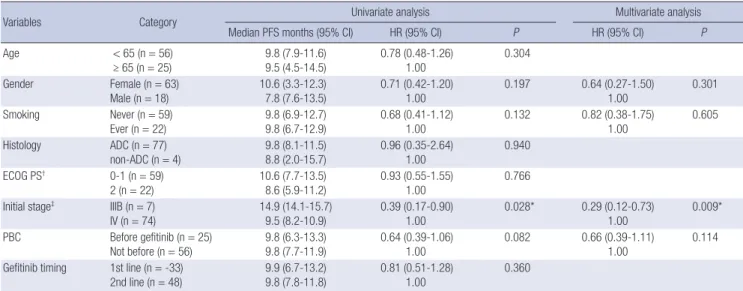
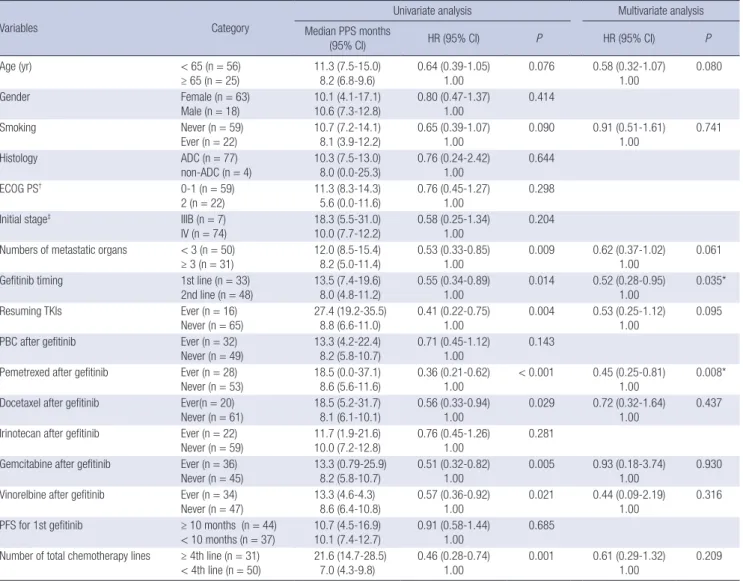
An initial disease stage of IIIB was the only statistically signif- icant factor for longer PFS after initial gefitinib use in both the univariate and multivariate analyses (Table 2). First-line gefi- tinib treatment naturally correlated with a longer PPS than did- second-line treatment (Table 3). Additionally, there was no sig- nificant difference in OS between the first-line and second-line gefitinib treatment groups (24.5 vs 28.5 months; P = 0.855). The number of metastatic organs at the time of PD during gefitinib treatment correlated with PPS in univariate analysis (hazard ra- tio [HR], 0.53 for < 3 metastatic organs; P = 0.009), but not in multivariate analysis (HR, 0.62; P = 0.061). Resuming TKI use also significantly influenced longer PPS in univariate analysis (HR, 0.41; P = 0.004) but not in multivariate analysis (HR 0.53;
P = 0.095).
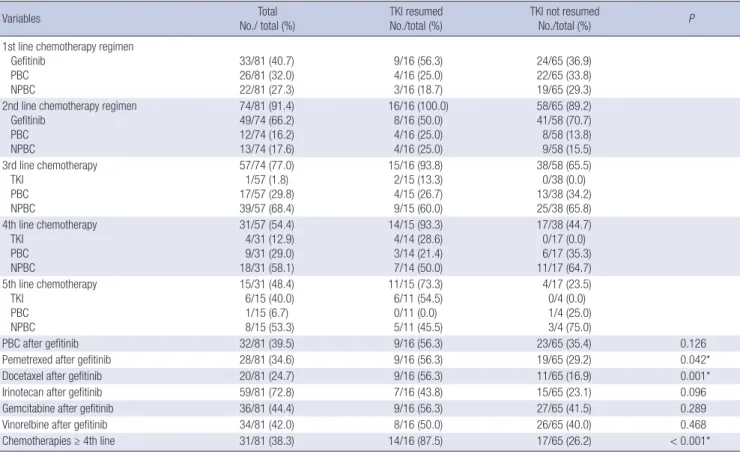
The regimens used after the initial gefitinib exposure were compared between the TKI-resumed and not-resumed groups to rule out confounding effects of chemotherapies besides re- sumed TKI in multivariate analysis. Pemetrexed and docetaxel were used significantly more frequently in the TKI-resumed group than in the not-resumed group. Additionally, the propor- tion of patients who were treated beyond fourth-line chemo- therapy was significantly higher in the TKI-resumed group. The chemotherapies used throughout disease progression are sum- marized in Table 4 up to fifth-line treatments, which mostly Fig. 1. Algorithm for the identification of patients with advanced non-small cell lung
cancer and clinically acquired resistance to gefitinib. NSCLC, non-small cell lung cancer; ECOG PS, ECOG performance status; PFS, progression-free survival; CR, complete response; PR, partial response; SD, stable disease; CNS, central nervous system.
1,328 stage IIIB, IV NSCLC patients who had started gefitinib
between 2001 & 2008
538 patients used 1st or 2nd line gefitinib
458 patients with ECOG PS ≤ 2 at starting 1st line treatment
169 patients with response to gefitinib of CR, PR, or SD (PFS ≥ 6 months)
81 patients with confirmed PD except progression in CNS only
790 patients using ≥ 3rd line gefitinib
80 patients with ECOG PS 3 or 4 at starting 1st line treatment
289 patients with response to gefitinib of PD or SD (PFS < 6 months)
88 patients with progression in CNS only or without PD confirmation
Table 1. Patient characteristics
Characteristics Total
No. (%) TKI resumed
No. (%) TKI not resumed
No. (%) P
Total patients Resumed TKI
81 16 65
Gefitinib 11 (68.7) -
Erlotinib 5 (31.3) -
Age ≥ 65 yr 25 (30.9) 3 (18.8) 22 (33.8) 0.367
Female 63 (77.8) 13 (81.3) 50 (76.9) 1.000
Never smoker 59 (72.8) 13 (81.3) 46 (70.8) 0.537
Adenocarcinoma 77 (95.1) 16 (100.0) 61 (93.8) 0.580
ECOG PS 0-1 at the start of gefitinib 59 (72.8) 14 (87.5) 45 (69.2) 0.212
Initial stage IV* 74 (91.4) 14 (87.5) 60 (92.3) 0.620
Number of metastasis organs ≥ 3 31 (38.3) 7 (43.8) 24 (36.9) 0.615
PFS for the 1st gefitinib ≥ 10 months 43 (53.1) 9 (56.3) 34 (52.3) 0.777
Tested by Fisher’s exact test and chi-square test; *staging according to the revised International System for Staging Lung Cancer. TKI, tyrosine kinase inhibitor (gefitinib and er- lotinib); ECOG, Eastern Cooperative Oncology Group; PS, performance status; PFS, progression-free survival.
Table 2. Progression-free survival analysis
Variables Category Univariate analysis Multivariate analysis
Median PFS months (95% CI) HR (95% CI) P HR (95% CI) P
Age < 65 (n = 56)
≥ 65 (n = 25)
9.8 (7.9-11.6) 9.5 (4.5-14.5)
0.78 (0.48-1.26) 1.00
0.304
Gender Female (n = 63)
Male (n = 18) 10.6 (3.3-12.3)
7.8 (7.6-13.5) 0.71 (0.42-1.20)
1.00 0.197 0.64 (0.27-1.50)
1.00 0.301
Smoking Never (n = 59)
Ever (n = 22) 9.8 (6.9-12.7)
9.8 (6.7-12.9) 0.68 (0.41-1.12)
1.00 0.132 0.82 (0.38-1.75)
1.00 0.605
Histology ADC (n = 77)
non-ADC (n = 4)
9.8 (8.1-11.5) 8.8 (2.0-15.7)
0.96 (0.35-2.64) 1.00
0.940
ECOG PS† 0-1 (n = 59)
2 (n = 22) 10.6 (7.7-13.5)
8.6 (5.9-11.2) 0.93 (0.55-1.55)
1.00 0.766
Initial stage‡ IIIB (n = 7)
IV (n = 74) 14.9 (14.1-15.7)
9.5 (8.2-10.9) 0.39 (0.17-0.90)
1.00 0.028* 0.29 (0.12-0.73)
1.00 0.009*
PBC Before gefitinib (n = 25) Not before (n = 56)
9.8 (6.3-13.3) 9.8 (7.7-11.9)
0.64 (0.39-1.06) 1.00
0.082 0.66 (0.39-1.11) 1.00
0.114 Gefitinib timing 1st line (n = -33)
2nd line (n = 48) 9.9 (6.7-13.2)
9.8 (7.8-11.8) 0.81 (0.51-1.28)
1.00 0.360
Tested by Cox proportional hazards model; *Statistically significant; †ECOG PS at the start of gefitinib; ‡Staging according to the revised International System for Staging Lung Cancer. HR, hazard ratio; CI, confidential interval; ADC, adenocarcinoma; ECOG, Eastern Cooperative Group; PS, performance status; PBC, platinum-based chemotherapy; PFS, progression-free survival.
comprise doublet regimens.
The responses to resumed TKI treatment are shown in Table 5. The median TKI-free interval time in this study was 13 months (range, 0.5-41.1 months) and the median number of interim cytotoxic treatments was 2.
Fig. 2 shows differences in the Kaplan-Meier survival curves according to resumed TKI use and pemetrexed use after gefi- tinib failure. The median PPS was 10.3 months (95% confidence interval [CI], 7.458-13.142). Although pemetrexed use and TKI reuse yielded superior PPS according to the log-rank test, peme- trexed use was the only significant factor that affected PPS in multivariate analysis according to the Cox proportional hazards model (18.5 vs 8.6 months; HR, 0.45; P = 0.008). Finally,the me- dian PFS for patients who resumed gefitinib treatment was 3.7 months (95% CI, 2.843-4.557).
DISCUSSION
Although TKIs have improved NSCLC patient survival, acquir- ed resistance has been an emerging problem even in respon- sive patients. Thus, various efforts have been made to investi- gate the clinical outcomes of this acquired resistance group and overcome resistance. Strategies to overcome acquired resistance to EGFR TKIs include resumed EGFR TKI use, new-generation irreversible EGFR TKI use, MET inhibitor use for MET amplifi- cation, and use of PI3K/AKT/mTOR inhibitor plus MEK inhibi- tor (18-21, 26). The clinical trial results for the new-generation irreversible TKI afatinib were reported. The Lux-Lung1 study included lung adenocarcinoma patients who had received 1 or 2 previous chemotherapy regimens and experienced disease progression after ≥ 12 weeks of erlotinib or gefitinib treatment.
Table 3. Post-progression survival analysis
Variables Category
Univariate analysis Multivariate analysis
Median PPS months
(95% CI) HR (95% CI) P HR (95% CI) P
Age (yr) < 65 (n = 56)
≥ 65 (n = 25) 11.3 (7.5-15.0)
8.2 (6.8-9.6) 0.64 (0.39-1.05)
1.00 0.076 0.58 (0.32-1.07)
1.00 0.080
Gender Female (n = 63)
Male (n = 18)
10.1 (4.1-17.1) 10.6 (7.3-12.8)
0.80 (0.47-1.37) 1.00
0.414
Smoking Never (n = 59)
Ever (n = 22) 10.7 (7.2-14.1)
8.1 (3.9-12.2) 0.65 (0.39-1.07)
1.00 0.090 0.91 (0.51-1.61)
1.00 0.741
Histology ADC (n = 77)
non-ADC (n = 4) 10.3 (7.5-13.0)
8.0 (0.0-25.3) 0.76 (0.24-2.42)
1.00 0.644
ECOG PS† 0-1 (n = 59)
2 (n = 22)
11.3 (8.3-14.3) 5.6 (0.0-11.6)
0.76 (0.45-1.27) 1.00
0.298
Initial stage‡ IIIB (n = 7)
IV (n = 74) 18.3 (5.5-31.0)
10.0 (7.7-12.2) 0.58 (0.25-1.34)
1.00 0.204
Numbers of metastatic organs < 3 (n = 50)
≥ 3 (n = 31) 12.0 (8.5-15.4)
8.2 (5.0-11.4) 0.53 (0.33-0.85)
1.00 0.009 0.62 (0.37-1.02)
1.00 0.061
Gefitinib timing 1st line (n = 33)
2nd line (n = 48)
13.5 (7.4-19.6) 8.0 (4.8-11.2)
0.55 (0.34-0.89) 1.00
0.014 0.52 (0.28-0.95) 1.00
0.035*
Resuming TKIs Ever (n = 16)
Never (n = 65) 27.4 (19.2-35.5)
8.8 (6.6-11.0) 0.41 (0.22-0.75)
1.00 0.004 0.53 (0.25-1.12)
1.00 0.095
PBC after gefitinib Ever (n = 32)
Never (n = 49) 13.3 (4.2-22.4)
8.2 (5.8-10.7) 0.71 (0.45-1.12)
1.00 0.143
Pemetrexed after gefitinib Ever (n = 28) Never (n = 53)
18.5 (0.0-37.1) 8.6 (5.6-11.6)
0.36 (0.21-0.62) 1.00
< 0.001 0.45 (0.25-0.81) 1.00
0.008*
Docetaxel after gefitinib Ever(n = 20)
Never (n = 61) 18.5 (5.2-31.7)
8.1 (6.1-10.1) 0.56 (0.33-0.94)
1.00 0.029 0.72 (0.32-1.64)
1.00 0.437
Irinotecan after gefitinib Ever (n = 22)
Never (n = 59) 11.7 (1.9-21.6)
10.0 (7.2-12.8) 0.76 (0.45-1.26)
1.00 0.281
Gemcitabine after gefitinib Ever (n = 36) Never (n = 45)
13.3 (0.79-25.9) 8.2 (5.8-10.7)
0.51 (0.32-0.82) 1.00
0.005 0.93 (0.18-3.74) 1.00
0.930 Vinorelbine after gefitinib Ever (n = 34)
Never (n = 47) 13.3 (4.6-4.3)
8.6 (6.4-10.8) 0.57 (0.36-0.92)
1.00 0.021 0.44 (0.09-2.19)
1.00 0.316
PFS for 1st gefitinib ≥ 10 months (n = 44)
< 10 months (n = 37)
10.7 (4.5-16.9) 10.1 (7.4-12.7)
0.91 (0.58-1.44) 1.00
0.685 Number of total chemotherapy lines ≥ 4th line (n = 31)
< 4th line (n = 50)
21.6 (14.7-28.5) 7.0 (4.3-9.8)
0.46 (0.28-0.74) 1.00
0.001 0.61 (0.29-1.32) 1.00
0.209
Tested by Cox proportional hazards model; *Statistically significant; †ECOG at the start of gefitinib; ‡Staging according to the revised International System for Staging Lung Can- cer. HR, hazard ratio; CI, confidential interval; ADC, adenocarcinoma; ECOG, Eastern Cooperative Group; PS, performance status; TKI, tyrosine kinase inhibitor (gefitinib and er- lotinib); PBC, platinum-based chemotherapy.
The results showed that afatinib could provide for a PFS benefit (3.3 vs 1.1 months; HR, 0.38; P < 0.001) (15).
Metastatic organ numbers > 3 at the time of progression sug- gest a heavy disease burden and are assumed to result in short- er PPS. Since PPS begins at the time of progression during gefi- tinib treatment, the first-line gefitinib group naturally presents with a longer PPS than the second-line group.
Sun et al. (22) suggested that pemetrexed is a suitable third- line treatment option with good efficacy and a tolerable toxicity profile for NSCLC. This retrospective study of 100 patients, 88 of whom had adenocarcinoma, showed that 70% of the patients received pemetrexed as the third- or further-line treatment.
Wu et al. (23) reported good responses to pemetrexed in lung adenocarcinoma patients with EGFR mutations. In that study, patients with EGFR mutations (n = 93) had a better response rate (P = 0.016) and longer PFS (P = 0.030) than those with wild-
type EGFR (n = 63). In addition, there were no statistical differ- ences in the response rates among patients with classical muta- tions, exon 19 deletion and L858R mutations, and non-classical mutations. Giovannetti et al. (24) suggested that reduced thymi- dylate synthase (TS) gene expression in EGFR-mutated NSCLC could affect pemetrexed efficacy. Pemetrexed appears to be a potential good option for NSCLC cases with acquired resistance to EGFR TKIs.
Pemetrexed was administered to 11 of 33 patients who had received first-line gefitinib, and 1 of those 11 patients received second-line pemetrexed immediately after gefitinib. Among 48 second-line gefitinib users, 17 patients were treated with peme- trexed and 14 of these received pemetrexed immediately after gefitinib. There was no significant difference in PPS between 14 patients who received third-line pemetrexed treatment and 3 who received beyond-fourth-line pemetrexed (median PPS, 8.2
Table 4. Treatment summary
Variables Total
No./ total (%) TKI resumed
No./total (%) TKI not resumed
No./total (%) P
1st line chemotherapy regimen Gefitinib
PBC NPBC
33/81 (40.7) 26/81 (32.0) 22/81 (27.3)
9/16 (56.3) 4/16 (25.0) 3/16 (18.7)
24/65 (36.9) 22/65 (33.8) 19/65 (29.3) 2nd line chemotherapy regimen
Gefitinib PBC NPBC
74/81 (91.4) 49/74 (66.2) 12/74 (16.2) 13/74 (17.6)
16/16 (100.0) 8/16 (50.0) 4/16 (25.0) 4/16 (25.0)
58/65 (89.2) 41/58 (70.7) 8/58 (13.8) 9/58 (15.5) 3rd line chemotherapy
TKI PBC NPBC
57/74 (77.0) 1/57 (1.8) 17/57 (29.8) 39/57 (68.4)
15/16 (93.8) 2/15 (13.3) 4/15 (26.7) 9/15 (60.0)
38/58 (65.5) 0/38 (0.0) 13/38 (34.2) 25/38 (65.8) 4th line chemotherapy
TKI PBC NPBC
31/57 (54.4) 4/31 (12.9) 9/31 (29.0) 18/31 (58.1)
14/15 (93.3) 4/14 (28.6) 3/14 (21.4) 7/14 (50.0)
17/38 (44.7) 0/17 (0.0) 6/17 (35.3) 11/17 (64.7) 5th line chemotherapy
TKI PBC NPBC
15/31 (48.4) 6/15 (40.0) 1/15 (6.7) 8/15 (53.3)
11/15 (73.3) 6/11 (54.5) 0/11 (0.0) 5/11 (45.5)
4/17 (23.5) 0/4 (0.0) 1/4 (25.0) 3/4 (75.0)
PBC after gefitinib 32/81 (39.5) 9/16 (56.3) 23/65 (35.4) 0.126
Pemetrexed after gefitinib 28/81 (34.6) 9/16 (56.3) 19/65 (29.2) 0.042*
Docetaxel after gefitinib 20/81 (24.7) 9/16 (56.3) 11/65 (16.9) 0.001*
Irinotecan after gefitinib 59/81 (72.8) 7/16 (43.8) 15/65 (23.1) 0.096
Gemcitabine after gefitinib 36/81 (44.4) 9/16 (56.3) 27/65 (41.5) 0.289
Vinorelbine after gefitinib 34/81 (42.0) 8/16 (50.0) 26/65 (40.0) 0.468
Chemotherapies ≥ 4th line 31/81 (38.3) 14/16 (87.5) 17/65 (26.2) < 0.001*
*Statistically significant. Tested by Fisher’s exact test and chi-square test; TKI, tyrosine kinase inhibitor; PBC, platinum-based chemotherapy; NPBC, non-platinum based che- motherapy.
Table 5. Response to resumed TKIs
Response Gefitinib resumed (n = 11) Erlotinib resumed (n = 5)
PR 3 1
SD 5 2
PD 3 2
PR, partial response; SD, stable disease; PD, progressive disease.
vs 8.9 months; P = 0.864).
Resumed TKI use in NSCLC after TKI failure might be a treat- ment option. In this study, resumed TKI use did not show sta- tistical significance in multivariate analysis; however, the small number of patients might act as a limitation. Kaira et al. (18) re- ported in a pooled analysis that erlotinib, when used after gefi- tinib failure, could produce clinical benefits in patients with long SD during prior gefitinib treatment, with a PFS range from 1.7 to 5.9 months. In our study, one-third of the TKI-resumed group resumed erlotinib treatment after gefitinib failure. The longer PFS for initial gefitinib treatment and PFS for resumed TKI use was not correlated, and a median PFS of 2.8 months (range, 0.6-3.7 months) for resumed TKI use was determined.
Three of 5 patients (60%) showed a better than SD response, which was comparable to the results of other trials that report- ed disease control rates of up to 63% and a median progression- free survival range of 1.7 to 6.2 months (25).
Tomizawa et al. (26) reported a relatively high response rate of 25% and a disease control rate of 65% for gefitinib reuse ini- tial gefitinib responders. The authors stated that a sufficient EGFR TKI-free interval (median, 217 days) that included some cytotoxic treatments (1-3 regimens) affected the response rate, which was higher than that of other reports regarding erlotinib after resistance to initial gefitinib. The median TKI-free interval time of the current study was 13 months (range, 0.5-41.1 months) and the median number of interim cytotoxic treatments was 2.
The response rate was 27% (3/11), and the disease control rate was 73% (8/11) for those who resumed gefitinib use (Table 5).
The disease control rate of 73% is also comparable with the re- sults of other reported re-administration trials, which ranged from of 44%-89% (25).
Lee et al. (25) suggested tumor heterogeneity as an explana- tion for different responses to the same EGFR-TKI regimen after a drug holiday. The authors proposed that tumor volume is the sum of the EGFR-TKI sensitive clones and resistant clones, re- gardless of molecular mechanisms.
There have been some suggestions to the effect that this ac- quired resistance group possesses a distinct indolent biology.
Oxnard et al. (27) reported that patients with acquired resis- tance to EGFR TKIs had a median PPS of 16 months. In this study, PPS > 10.3 months was assumed to be due to differences
Fig. 2. Kaplan-Meier curves for survival since progression during gefitinib treatment.
(A) Overall, (B) TKI resumed, and (C) pemetrexed administration after gefitinib failure.
Survival differences were tested with the log-rank test. TKI, tyrosine kinase inhibitor;
OS, overall survival; PD, progressive disease
Cumulative survival
Post-progression survival (months)
0 10 20 30 40 50 1.0
0.8
0.6
0.4
0.2
0.0
Median post-PD survival of 10.3 months (95% CI, 7.458-13.142)
A
Cumulative survival
Post-progression survival (months)
0 10 20 30 40 50 1.0
0.8
0.6
0.4
0.2
0.0
C Pemetrexed used (n=28)
Other regimen used (n=53) P < 0.001
Cumulative survival
Post-progression survival (months)
0 10 20 30 40 50 1.0
0.8
0.6
0.4
0.2
0.0
TKI resumed (n=16) TKI not resumed (n=65) P = 0.004
B
in the proportion of TKI use as the first-line therapy (77% vs 40%). Hayashi et al. (28) reported that the average PPS for ad- vanced NSCLC patients after first-line chemotherapy was lon- ger in recent trials than in older trials (6.5 vs 4.4 months; P < 0.001).
In future studies, the possibility of relatively indolent NSCLC bi- ology with acquired resistance to TKIs should be better clarified and considered when investigating this subgroup and interpret- ing the results.
This study has some limitations. First, this retrospective study lacks data for a molecular EGFR mutation study because very few patients had been tested. However, the definition of acquir- ed resistance to TKIs usually includes a clinical definition that covers patients who showed objective clinical benefits from EGFR TKI treatment before progression (13). The clinical defi- nition of acquired resistance to TKIs is reasonable, especially with regard to tumor heterogeneity and the quantities of biop- sied stage IIIB and IV disease. Further, pemetrexed administra- tion after gefitinib failure was administered in all cases beyond
third-line chemotherapy (68% in the third-line and 28% in the beyond-fourth-line groups). We adjusted for the number of to- tal chemotherapies as a potential confounding factor in the mul- tivariate analysis, but statistical significance persisted (P < 0.001;
Table 3).
Agelaki et al. (29) reported that both sequences, either non- platinum-based first-line therapy followed by platinum-based second-line chemotherapy or the reverse, yielded similar effi- cacies in terms of OS, although that was a retrospective study of 390 NSCLC patients. Han et al. (30) conducted a randomized phase 2 study of irinotecan plus cisplatin vs gemcitabine plus vinorelbine as first-line chemotherapy regimens with a second- line crossover phase and showed similar survival rates for both sequences. There is no assumption regarding established evi- dence for the effects of chemotherapy sequence on OS. Addi- tionally, a literature search-based study by Hayashi et al. (28) identified 69 trials that showed a strong association between OS and PPS.
In conclusion, resumed TKI use or pemetrexed use in NSCLC patients with acquired resistance to gefitinib is associated with longer PPS and thus merits further evaluation. These regimens might be good treatment options for patients who develop ac- quired resistance to gefitinib.
DISCLOSURE
The authors have no conflicts of interest to disclose.
REFERENCES
1. Shepherd FA, Rodrigues Pereira J, Ciuleanu T, Tan EH, Hirsh V, Thong- prasert S, Campos D, Maoleekoonpiroj S, Smylie M, Martins R, et al. Er- lotinib in previously treated non-small-cell lung cancer. N Engl J Med 2005; 353: 123-32.
2. Kim ES, Hirsh V, Mok T, Socinski MA, Gervais R, Wu YL, Li LY, Watkins CL, Sellers MV, Lowe ES, et al. Gefitinib versus docetaxel in previously treated non-small-cell lung cancer (INTEREST): a randomised phase III trial. Lancet 2008; 372: 1809-18.
3. Kris MG, Natale RB, Herbst RS, Lynch TJ Jr, Prager D, Belani CP, Schiller JH, Kelly K, Spiridonidis H, Sandler A, et al. Efficacy of gefitinib, an in- hibitor of the epidermal growth factor receptor tyrosine kinase, in symp- tomatic patients with non-small cell lung cancer: a randomized trial.
JAMA 2003; 290: 2149-58.
4. Tsao MS, Sakurada A, Cutz JC, Zhu CQ, Kamel-Reid S, Squire J, Lorimer I, Zhang T, Liu N, Daneshmand M, et al. Erlotinib in lung cancer - mo- lecular and clinical predictors of outcome. N Engl J Med 2005; 353: 133- 44.
5. Paez JG, Jänne PA, Lee JC, Tracy S, Greulich H, Gabriel S, Herman P, Kaye FJ, Lindeman N, Boggon TJ, et al. EGFR mutations in lung cancer:
correlation with clinical response to gefitinib therapy. Science 2004; 304:
1497-500.
6. Jänne PA, Johnson BE. Effect of epidermal growth factor receptor tyro- sine kinase domain mutations on the outcome of patients with non-small cell lung cancer treated with epidermal growth factor receptor tyrosine kinase inhibitors. Clin Cancer Res 2006; 12: 4416s-20s.
7. Mitsudomi T, Morita S, Yatabe Y, Negoro S, Okamoto I, Tsurutani J, Seto T, Satouchi M, Tada H, Hirashima T, et al. Gefitinib versus cisplatin plus docetaxel in patients with non-small-cell lung cancer harbouring muta- tions of the epidermal growth factor receptor (WJTOG3405): an open la- bel, randomised phase 3 trial. Lancet Oncol 2010; 11: 121-8.
8. Mok TS, Wu YL, Thongprasert S, Yang CH, Chu DT, Saijo N, Sunpawer- avong P, Han B, Margono B, Ichinose Y, et al. Gefitinib or carboplatin- paclitaxel in pulmonary adenocarcinoma. N Engl J Med 2009; 361: 947- 57.
9. Jackman DM, Miller VA, Cioffredi LA, Yeap BY, Jänne PA, Riely GJ, Ruiz MG, Giaccone G, Sequist LV, Johnson BE. Impact of epidermal growth factor receptor and KRAS mutations on clinical outcomes in previously untreated non-small cell lung cancer patients: results of an online tumor registry of clinical trials. Clin Cancer Res 2009; 15: 5267-73.
10. Costa DB, Kobayashi S, Tenen DG, Huberman MS. Pooled analysis of the prospective trials of gefitinib monotherapy for EGFR-mutant non- small cell lung cancers. Lung Cancer 2007; 58: 95-103.
11. Maemondo M, Inoue A, Kobayashi K, Sugawara S, Oizumi S, Isobe H, Gemma A, Harada M, Yoshizawa H, Kinoshita I, et al. Gefitinib or che- motherapy for non-small-cell lung cancer with mutated EGFR. N Engl J Med 2010; 362: 2380-8.
12. Rosell R, Moran T, Queralt C, Porta R, Cardenal F, Camps C, Majem M, Lopez-Vivanco G, Isla D, Provencio M, et al. Screening for epidermal growth factor receptor mutations in lung cancer. N Engl J Med 2009; 361:
958-67.
13. Jackman D, Pao W, Riely GJ, Engelman JA, Kris MG, Jänne PA, Lynch T, Johnson BE, Miller VA. Clinical definition of acquired resistance to epi- dermal growth factor receptor tyrosine kinase inhibitors in non-small- cell lung cancer. J Clin Oncol 2010; 28: 357-60.
14. Sequist LV, Besse B, Lynch TJ, Miller VA, Wong KK, Gitlitz B, Eaton K, Zacharchuk C, Freyman A, Powell C, et al. Neratinib, an irreversible pan-ErbB receptor tyrosine kinase inhibitor: results of a phase II trial in patients with advanced non-small-cell lung cancer. J Clin Oncol 2010;
28: 3076-83.
15. Miller VA, Hirsh V, Cadranel J, Chen YM, Park K, Kim SW, Zhou C, Su WC, Wang M, Sun Y, et al. Afatinib versus placebo for patients with ad- vanced, metastatic non-small-cell lung cancer after failure of erlotinib, gefitinib, or both, and one or two lines of chemotherapy (LUX-Lung 1): a phase 2b/3 randomised trial. Lancet Oncol 2012; 13: 528-38.
16. Costa DB. To re-treat or not with gefitinib/erlotinib: This is the question for tyrosine kinase inhibitor-responsive lung cancers that progress. Lung Cancer 2007; 57: 251-2.
17. Yokouchi H, Yamazaki K, Kinoshita I, Konishi J, Asahina H, Sukoh N, Harada M, Akie K, Ogura S, Ishida T, et al. Clinical benefit of readminis- tration of gefitinib for initial gefitinib-responders with non-small cell lung cancer. BMC Cancer 2007; 7: 51.
18. Kaira K, Naito T, Takahashi T, Ayabe E, Shimoyama R, Kaira R, Ono A, Igawa S, Shukuya T, Murakami H, et al. Pooled analysis of the reports of erlotinib after failure of gefitinib for non-small cell lung cancer. Lung Cancer 2010; 68: 99-104.
19. Zhou W, Ercan D, Chen L, Yun CH, Li D, Capelletti M, Cortot AB, Chirie- ac L, Iacob RE, Padera R, et al. Novel mutant-selective EGFR kinase in- hibitors against EGFR T790M. Nature 2009; 462: 1070-4.
20. Papadimitrakopoulou VA, Soria JC, Jappe A, Jehl V, Klimovsky J, John- son BE. Everolimus and erlotinib as second- or third-line therapy in pa- tients with advanced non-small-cell lung cancer. J Thorac Oncol 2012; 7:
1594-601.
21. Sequist LV, von Pawel J, Garmey EG, Akerley WL, Brugger W, Ferrari D, Chen Y, Costa DB, Gerber DE, Orlov S, et al. Randomized phase II study of erlotinib plus tivantinib versus erlotinib plus placebo in previously treated non-small-cell lung cancer. J Clin Oncol 2011; 29: 3307-15.
22. Sun JM, Lee KW, Kim JH, Kim YJ, Yoon HI, Lee JH, Lee CT, Lee JS. Effi- cacy and toxicity of pemetrexed as a third-line treatment for non-small cell lung cancer. Jpn J Clin Oncol 2009; 39: 27-32.
23. Wu SG, Yang CH, Yu CJ, Lee JH, Hsu YC, Chang YL, Shih JY, Yang PC.
Good response to pemetrexed in patients of lung adenocarcinoma with epidermal growth factor receptor (EGFR) mutations. Lung Cancer 2011;
72: 333-9.
24. Giovannetti E, Lemos C, Tekle C, Smid K, Nannizzi S, Rodriguez JA, Ricciardi S, Danesi R, Giaccone G, Peters GJ. Molecular mechanisms underlying the synergistic interaction of erlotinib, an epidermal growth factor receptor tyrosine kinase inhibitor, with the multitargeted antifo-
late pemetrexed in non-small-cell lung cancer cells. Mol Pharmacol 2008;
73: 1290-300.
25. Lee JC, Jang SH, Lee KY, Kim YC. Treatment of non-small cell lung carci- noma after failure of epidermal growth factor receptor tyrosine kinase inhibitor. Cancer Res Treat 2013; 45: 79-85.
26. Tomizawa Y, Fujita Y, Tamura A, Shirai M, Shibata S, Kawabata T, Shiba- yama T, Fukai S, Kawahra M, Saito R. Effect of gefitinib re-challenge to initial gefitinib responder with non-small cell lung cancer followed by chemotherapy. Lung Cancer 2010; 68: 269-72.
27. Oxnard GR, Arcila ME, Sima CS, Riely GJ, Chmielecki J, Kris MG, Pao W, Ladanyi M, Miller VA. Acquired resistance to EGFR tyrosine kinase in- hibitors in EGFR-mutant lung cancer: distinct natural history of patients with tumors harboring the T790M mutation. Clin Cancer Res 2010; 17:
1616-22.
28. Hayashi H, Okamoto I, Morita S, Taguri M, Nakagawa K. Postprogres- sion survival for first-line chemotherapy of patients with advanced non- small-cell lung cancer. Ann Oncol 2012; 23: 1537-41.
29. Agelaki S, Hatzidaki D, Kotsakis A, Papakotoulas P, Polyzos A, Ziras N, Gioulbasanis I, Karampeazis A, Agelidou A, Tsiafaki X, et al. Non-plati- num-based first-line followed by platinum-based second-line chemo- therapy or the reverse sequence in patients with advanced non-small cell lung cancer: a retrospective analysis by the lung cancer group of the Hel- lenic Oncology Research Group. Oncology 2010; 78: 229-36.
30. Han JY, Lee DH, Song JE, Lee SY, Kim HY, Kim HT, Lee JS. Randomized phase 2 study of irinotecan plus cisplatin versus gemcitabine plus vinorel- bine as first-line chemotherapy with second-line crossover in patients with advanced nonsmall cell lung cancer. Cancer 2008; 113: 388-95.