INTRODUCTION
The hand is an essential organ for various activities of daily living. In case of impaired hand functions due to brain lesions, peripheral neuropathies or other causes, it is imperative that hand strength and dexterity be evaluated in order to determine the severity of hand dysfunction and establish an effective reha- bilitation program (1-10). Because the hand function devel- ops as children grow up, the norm of the hand function for each age must be determined (1, 4, 7, 10). With reviewing the literatures, hand dexterity of children has not been wide- ly studied until now (7), whereas there have been several reports on the grip and pinch strength of children (1, 4, 7, 10). And, to the best of our knowledge, there has been no report on the normative data of hand functions for Korean children. So far, the data on hand function from reports of western countries have been used as a reference for the Korean children. How- ever, these data are considered inappropriate for the Korean children because they do not take into account the differences in physical characteristics according to race and region. This is the same logic as using different norms for height, weight, and head circumference according to race and region.
Consequently, the objectives of this study were to provide normative data of hand function, including dexterity for the Korean elementary school children, and identify the charac- teristics of the development of hand functions for the Kore- an elementary school children.
SUBJECTS AND METHODS Subjects
The subjects of this study were the students in an elemen- tary school located in Suwon city, Korea, who did not expe- rience any pain or disability in their upper extremities and, at the same time, who were able to follow the standardized procedure of testing hand function. With these inclusion cri- teria, seven hundred and twelve children between 7 and 12 yrs of age (370 boys, 342 girls) participated in this study.
Evaluation of hand function
The evaluation of hand function was done in each classroom by the first two authors. Before the test, a general orientation to the procedure was given. Children were seated facing the evaluator at their desk with their shoulder adducted and neu- trally rotated, elbow flexed at 90°. The wrist was positioned in between 0°and 30°of dorsiflexion, and between 0°and 15° of ulnar deviation, but not in flexion (1, 11-14). The forearm was positioned in neutral for the evaluation of grip strength and lateral pinch (key) strength, in pronation for tip pinch (two-point) strength and palmar pinch (three-jaw chuck) strength. Grip strength was tested first, followed by tip pinch, palmar pinch, and lateral pinch. Before the evaluation, clin- ical data such as sex, age, height, weight and hand dominance
Shin Young Yim, Ja Ryong Cho, Il Yung Lee
Department of Physical Medicine and Rehabilitation, Ajou University School of Medicine, Suwon, Korea
Address for correspondence Shin Young Yim, M.D.
Department of Physical Medicine and Rehabilitation, Ajou University School of Medicine, San 5, Woncheon-dong, Paldal-gu, Suwon 442-749, Korea Tel : +82.31-219-5284, Fax : 82.31-219-5209 E-mail : [email protected]
552
Normative Data and Developmental Characteristics of Hand Function for Elementary School Children in Suwon Area of Korea: Grip, Pinch and Dexterity Study
This study was designed to establish norms of hand function, and to identify devel- opmental characteristics of hand function among the Korean children. 712 elemen- tary school children participated in measurement of grip strength, three kinds of pinch strength, and dexterity. The hand strength of the Korean children appeared to be weaker than that of western children. The grip strength of boys was significantly stronger than that of girls in all ages for both hands. The order of magnitude of three kinds of pinch strength was, in descending order, lateral pinch, palmar pinch and tip pinch for both boys and girls. There was no significant difference of hand function according to the type of hand dominance in boys. However, girls with left hand domi- nance showed weakness of bilateral grip, right tip pinch, and bilateral lateral pinch strength compared with girls with right hand dominance. In conclusion, this study provided normative data of hand functions including dexterity, and enabled us to identify some developmental characteristics of hand functions for the Korean ele- mentary school children.
Key Words : Hand; Hand Strength; Child; Korea
Received : 14 November 2002 Accepted : 4 April 2003
were collected. Hand dominance was determined by asking for the hand used to hold a pencil and used to throw a ball (1).
Grip strength
Grip strength was evaluated with the JAMAR Hydraulic Hand Dynamometer (Sammons Preston, PO Box 93040 chica- go, IL 60673-3040 U.S.A.) set at the second position for all subjects (15). Two consecutive determinations were performed, while alternating the dominant hand with the non-dominant hand. The mean of the two measurements was used as the outcome of this study.
Pinch strength
The JAMAR Hydraulic Pinch Gauge (Sammons Preston, PO Box 93040 chicago, IL 60673-3040 U.S.A.) was used for the measurement of pinch strength. The pinch meter measures finger prehension force in pounds. Two consecutive determi- nations were performed, while alternating the dominant hand with the non-dominant hand. The mean of the two measure- ments was used as the outcome of this study.
In tip pinch, the pinch meter was grasped with the tips of the thumb and index finger. For palmar prehension, the pinch gauge was grasped between the pads of the thumb, index fin- ger, and long finger. For lateral pinch prehension, the pinch gauge was positioned between the pad of the thumb and the radial side of the middle phalanx of the index finger (1, 7).
Dexterity
Dexterity was measured with the Nine-Hole Peg Board (Sammons Preston, PO Box 93040 chicago, IL 60673-3040 U.S.A.) in terms of the time that it took for a subject to place nine headless pegs in holes on a 5-inch square peg board, and then to remove them. The performance of each subject was recorded in seconds, and the test was performed once with each hand (3). The pegs were placed in a container next to the board on the same side of the hand being tested. The dominant hand
was tested first. The subject was told to pick up one peg at a time, using one hand only, and to put them in the holes until all nine holes were filled. The subject was told that the holes might be filled in any order, and that as soon as he had filled all the holes, he should take the pegs out again from the holes one by one.
Comparison of hand function of the Korean children with that of the western countries
We compared the hand strength of these Korean children with the data of Ager et al. (1). While Ager et al. presented the norms of hand function according to hand dominance, we calculated the mean from the data of both hands of Ager et al., compared Ager’s data with our own data and expressed as follows: the hand strength of the Korean children/ the hand strength of the children of the western countries ×100.
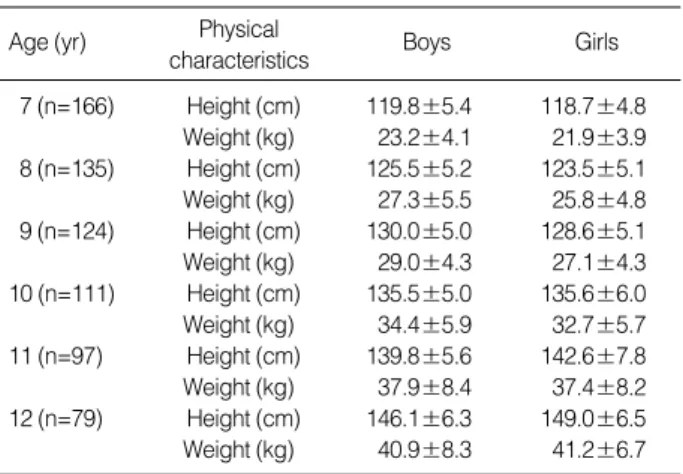
Values are given as mean±standard deviation. There is no significant difference in physical characteristics between boys and girls.
Age (yr) Physical
characteristics Boys Girls
7 (n=166) Height (cm) 119.8±5.4 118.7±4.8 Weight (kg) 23.2±4.1 21.9±3.9 8 (n=135) Height (cm) 125.5±5.2 123.5±5.1 Weight (kg) 27.3±5.5 25.8±4.8 9 (n=124) Height (cm) 130.0±5.0 128.6±5.1 Weight (kg) 29.0±4.3 27.1±4.3 10 (n=111) Height (cm) 135.5±5.0 135.6±6.0 Weight (kg) 34.4±5.9 32.7±5.7 11 (n=97) Height (cm) 139.8±5.6 142.6±7.8 Weight (kg) 37.9±8.4 37.4±8.2 12 (n=79) Height (cm) 146.1±6.3 149.0±6.5 Weight (kg) 40.9±8.3 41.2±6.7 Table 1.Physical characteristics of the elementary school chil- dren
Age (yr) Sex Right/left grip strength*
(Ib)
Right/left tip pinch strength�(Ib)
Right/left palmar pinch strength�(Ib)
Right/left lateral pinch strength�(Ib)
Right/left nine-hole peg test�(sec) 7 (n=166) Boy (n=95) 21.9±3.6/20.8±3.5 2.8±1.1/2.5±1.0 4.0±1.6/3.3±1.5 4.3±1.6/3.9±1.6 26.1±3.2/28.0±3.3
Girl (n=71) 18.9±3.7/17.9±3.6 2.4±0.9/2.2±0.9 2.7±1.5/2.2±1.4 3.3±1.4/2.7±1.3 26.1±3.1/28.4±3.9 8 (n=135) Boy (n=71) 28.3±4.8/26.9±4.7 3.9±2.3/3.7±2.3 4.2±2.8/3.9±2.9 5.4±2.3/5.0±2.5 24.1±4.0/26.6±3.9 Girl (n=64) 24.5±5.0/22.5±4.9 4.8±2.1/4.4±2.3 4.7±2.6/4.3±2.6 5.9±2.0/5.4±2.2 25.1±4.0/28.1±4.2 9 (n=124) Boy (n=57) 33.5±5.7/32.1±5.3 5.2±2.7/4.9±2.8 5.5±2.1/5.1±2.4 6.3±2.7/6.1±2.8 22.1±3.3/23.9±3.0 Girl (n=67) 28.7±4.5/27.1±4.9 4.9±2.6/4.5±2.8 5.1±2.3/4.6±2.5 6.1±2.8/5.7±2.8 21.6±3.1/23.7±2.8 10 (n=111) Boy (n=58) 37.4±5.6/35.4±6.2 5.3±2.3/5.1±2.4 7.1±3.3/6.9±2.8 7.4±2.7/7.0±2.7 20.2±2.7/22.4±3.0 Girl (n=53) 32.3±6.6/29.1±6.2 5.4±1.8/5.1±1.9 6.9±2.5/6.5±2.9 7.2±2.4/6.6±2.4 20.9±2.3/23.1±3.2 11 (n=97) Boy (n=51) 40.8±6.1/37.8±5.8 5.9±2.1/5.5±1.7 11.3±3.1/1.2±2.7 10.9±2.2/10.4±2.0 17.2±1.6/18.9±2.2 Girl (n=46) 35.3±7.6/32.7±7.4 5.6±1.8/5.2±1.4 10.0±2.8/9.7±3.0 10.1±2.0/9.5±2.3 17.1±2.2/19.3±2.8 12 (n=79) Boy (n=38) 46.0±8.5/43.3±9.2 7.1±2.6/5.6±2.1 11.7±2.9/1.9±2.4 12.3±2.5/12.1±2.6 17.1±1.8/18.7±2.6 Girl (n=41) 42.4±7.0/38.5±6.9 6.7±2.2/6.1±1.6 11.4±3.1/10.8±2.5 12.0±2.511.1±2.2 16.2±1.6/17.8±1.8 Values are given as mean±standard deviation. *The grip strength of boys was significantly stronger than that of girls in all age groups for both hands.
�There was no significant difference in three kinds of pinch strength and dexterity between boys and girls.
Table 2.Grip, pinch and dexterity of the elementary school children
Data Analysis
Independent t-test was used for the comparison of the hand function between boys and girls. One-way ANOVA and mul- tiple comparison test using Least Significant Difference me- thod was used for comparison of hand function according to hand dominance.
RESULTS
The hand functions, as well as height and weight for the elementary school children, are presented in Table 1, 2 accord- ing to age and gender. There was a steady increase in height, weight, grip strength, three kinds of pinch strength and dex- terity as the child’s chronological age increased (p<0.05). In regards to the difference by gender, the grip strength of the
Ib
p>0.05
Right grip strength
Right tip pinch strength
Left grip strength
Left tip pinch strength Rt. hand dominance, n=331
Lt. hand dominance, n=22 Both hand user, n=17 50
40 30 20 10
0 7 8 9 10 11 12
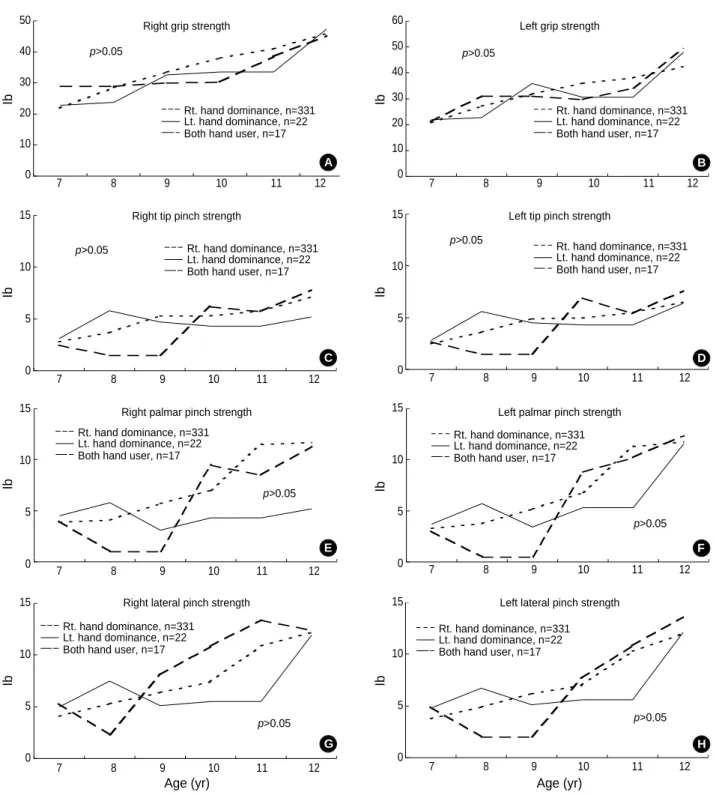
Fig. 1. Hand functions of the boys according to hand dominance. (Fig. 1 continued next)
Ib
p>0.05
Rt. hand dominance, n=331 Lt. hand dominance, n=22 Both hand user, n=17 60
50 40 30 20 10
0 7 8 9 10 11 12
Ib
p>0.05 Rt. hand dominance, n=331
Lt. hand dominance, n=22 Both hand user, n=17 15
10
5
0 7 8 9 10 11 12
Ib
p>0.05
Rt. hand dominance, n=331 Lt. hand dominance, n=22 Both hand user, n=17 15
10
5
0 7 8 9 10 11 12
Right palmar pinch strength Left palmar pinch strength
Ib p>0.05
Rt. hand dominance, n=331 Lt. hand dominance, n=22 Both hand user, n=17 15
10
5
0 7 8 9 10 11 12
Ib
p>0.05 Rt. hand dominance, n=331
Lt. hand dominance, n=22 Both hand user, n=17 15
10
5
0 7 8 9 10 11 12
Right lateral pinch strength Left lateral pinch strength
Ib
Age (yr)
p>0.05 Rt. hand dominance, n=331
Lt. hand dominance, n=22 Both hand user, n=17 15
10
5
0
7 8 9 10 11 12
Ib
Age (yr)
p>0.05 Rt. hand dominance, n=331
Lt. hand dominance, n=22 Both hand user, n=17 15
10
5
0 7 8 9 10 11 12
A B
C D
E F
G H
boys was significantly stronger than that of the girls in all age groups for both hands (Table 2). However, there was no sig- nificant difference in three kinds of pinch strength and dex- terity (Table 2), as well as height and weight between the boys and the girls (Table 1).
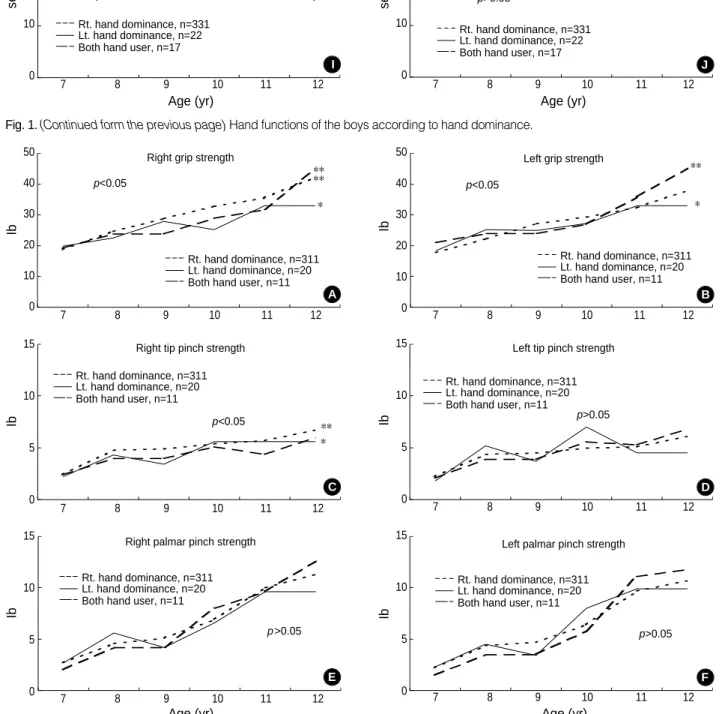
There was no significant difference in hand function accord- ing to the type of hand dominance among the boys (Fig. 1).
However, bilateral grip strength, right tip pinch strength, and bilateral lateral pinch strength were significantly weaker among the girls with left hand dominance, compared to the girls with right hand dominance or both hand users (Fig. 2A-C, G, H).
Fig. 3 shows the comparison of hand strength of these Kore- an children with the data of Ager et al. expressed as follows:
9-hole peg test of right hand 9-hole peg test of left hand
Fig. 1. (Continued form the previous page) Hand functions of the boys according to hand dominance.
sec
Age (yr) p>0.05
Rt. hand dominance, n=331 Lt. hand dominance, n=22 Both hand user, n=17 30
20
10
0 7 8 9 10 11 12
sec
Age (yr) p>0.05
Rt. hand dominance, n=331 Lt. hand dominance, n=22 Both hand user, n=17 30
20
10
0 7 8 9 10 11 12
I J
Fig. 2. Hand functions of the girls according to hand dominance. (Fig. 2 continued next)
Age (yr) Age (yr)
Ib
p<0.05
Right grip strength
Right tip pinch strength
Left grip strength
Left tip pinch strength Rt. hand dominance, n=311
Lt. hand dominance, n=20 Both hand user, n=11 50
40 30 20 10
0 7 8 9 10 11 12
Ib
p<0.05
Rt. hand dominance, n=311 Lt. hand dominance, n=20 Both hand user, n=11 50
40 30 20 10
0 7 8 9 10 11 12
Ib p<0.05
Rt. hand dominance, n=311 Lt. hand dominance, n=20 Both hand user, n=11 15
10
5
0 7 8 9 10 11 12
Ib p>0.05
Rt. hand dominance, n=311 Lt. hand dominance, n=20 Both hand user, n=11 15
10
5
0 7 8 9 10 11 12
Right palmar pinch strength Left palmar pinch strength
Ib
p >0.05 Rt. hand dominance, n=311
Lt. hand dominance, n=20 Both hand user, n=11 15
10
5
0 7 8 9 10 11 12
Ib
p>0.05 Rt. hand dominance, n=311
Lt. hand dominance, n=20 Both hand user, n=11 15
10
5
0 7 8 9 10 11 12
A B
C D
E F
****
*
**
*
**
*
the hand strength of the Korean children/ the hand strength of the children of the western countries ×100 (1). For most of the Korean children tested, the hand strength tended to be weaker than that of Ager et al.’s report. In particular, the pal- mar and lateral pinch strength of the Korean children tended to be weaker than those of Ager et al.’s report in younger ages.
DISCUSSION
To the best of our knowledge, this may be the first report on dexterity of the children using the Nine-Hole Peg test.
Kellor et al. studied the dexterity of subjects aged 18 or more;
the score of the Nine-Hole Peg test for the youngest group was 15.0 sec for males and 16.0 sec for females, while the score for the oldest group was 25.5 sec for males and 23.0 sec for females (3). In comparison, the children in our study ranged from 7 to 12 yrs old and the score of the 7 yr-old children was 26.1 sec for both boys and girls for the right hand on the Nine-Hole Peg test, while the score for the 12 yr-old children was 17.1 sec for boys and 16.2 sec for girls for the right hand. There- fore, the dexterity of the hand is thought to reach the adult level after the age of 12, although the major development of dexterity seems to occur during the elementary school period.
When compared with the adult values from the study of Mathiowetz et al. (6), the grip strength of the children aged 12 in our study was 44.1/46.5% for the boys and 67.5/71.4%
for the girls in each right and left hand, respectively. The tip pinch strength of the children aged 12 yr was 41.8/34.1%
for the boys and 59.3/56.5% for the girls. The palmar pinch
strength of the children aged 12 yr was 50.0/51.7% for the boys and 69.9/68.8% for the girls. The lateral pinch strength of the children aged 12 yr was 50.2/51.3% for the boys and 74.1/72.5% for the girls. Therefore, the developmental rate of hand function in elementary school children seems to be faster in girls than in boys.
Regarding the difference in hand function by gender, in our study, the grip strength of the boys was significantly stronger than that of the girls during the entire period of elementary school. However, there was no significant difference in three kinds of pinch strength and dexterity between the boys and the girls. The previous studies mentioning sexual difference in hand function (1, 7, 16) reported that males tended to be stronger than females in three kinds of pinch strength, as well as grip strength, however, did not statistically analyze the dif- ference of hand function by gender. In this study, the pinch strength test indicated that the order of magnitude, in descend- ing order, was lateral pinch, palmar pinch and tip pinch for both boys and girls, and this finding is consistent with the previous study (16).
As for hand dominance, right hand dominance was found in 89.5% and 90.9%, respectively for the boys and the girls in our study. The report of Ager et al. (1) showed that the right hand dominance was found in 88.5% and 89.1% of the boys and the girls, respectively. In the report of Mathiowetz et al.
(6), right hand dominance was found in 92% of the men and 92.7% of the women. At first, we expected that the children with left hand dominance in our study might be smaller in numbers than those of the western countries, since left hand dominance in our country tended to be forced or changed into
Right lateral pinch strength Left lateral pinch strength
Ib
p<0.05 Rt. hand dominance, n=311
Lt. hand dominance, n=20 Both hand user, n=11 15
10
5
0 7 8 9 10 11 12
Ib
p<0.05 Rt. hand dominance, n=311
Lt. hand dominance, n=20 Both hand user, n=11 15
10
5
0 7 8 9 10 11 12
G H
**
**
**
*
**
**
*
9-hole peg test of right hand 9-hole peg test of left hand
Fig. 2. (Continued form the previous page) Hand functions of the girls according to hand dominance.
sec
Age (yr) p>0.05
Rt. hand dominance, n=311 Lt. hand dominance, n=20 Both hand user, n=11 40
30
20
10
0 7 8 9 10 11 12
sec
Age (yr) p>0.05
Rt. hand dominance, n=311 Lt. hand dominance, n=20 Both hand user, n=11 40
30
20
10
0 7 8 9 10 11 12
I J
right hand dominance by their parents. However, the propor- tion of hand dominance in this study was similar with the two studies from the western countries. This is another interest- ing finding in our study.
With regard to the difference in the strength between dom- inant and non-dominant hands in our study, there was no sig- nificant difference in grip strength according to type of hand
dominance in the boys and the girls, and it was consistent with the previous studies (2, 7). However, bilateral grip strength, right tip pinch strength, and bilateral lateral pinch strength were significantly weaker among the girls with left hand domi- nance, compared to the girls with right hand dominance or both hand users. The former report (7) showed nonsignificant effect of hand dominance in pinch strength in women, as well
(%)*
Right grip strength Left grip strength
Boy Girl 150
100
50
0 7 8 9 10 11 12
Fig. 3. Comparison of hand functions the Korean children and the western children of Ager et al.’s report.1
*: The hand strength of the korean children/ the hand strength of the children of the western countries ×100.
Boy Girl
(%)*
150
100
50
0 7 8 9 10 11 12
A B
(%)*
Right tip pinch strength Left tip pinch strength
Boy Girl 150
100
50
0 7 8 9 10 11 12
Boy Girl
(%)*
150
100
50
0 7 8 9 10 11 12
C D
(%)*
Right palmar pinch strength Left palmar pinch strength
Boy Girl 150
100
50
0 7 8 9 10 11 12
Boy Girl
(%)*
150
100
50
0 7 8 9 10 11 12
E F
(%)*
Age (yr)
Right lateral pinch strength Left lateral pinch strength
Boy Girl 150
100
50
0 7 8 9 10 11 12
Boy Girl
(%)*
Age (yr) 150
100
50
0 7 8 9 10 11 12
G H
as men. Therefore, the reason for this contradictory results should be clarified in future.
We compared our data with the data from the previous stud- ies (1, 4, 7, 10). Among several studies on child’s hand func- tion, the comparison of our data with study of Ager et al.’s (1) was presented in Fig. 3 because this study presented the data of hand functions every one-year age and the operational def- inition used for each pinch type was same with our study. Com- pared with other data including Ager et al.’s data, the hand strength of the Korean children tended to be weaker than that of the children in the western countries. In particular, the pal- mar and lateral pinch strengths of the Korean children tend- ed to be weaker than those of the western children in younger ages. With caution due to the possible methodological differ- ence, there were significant differences in the norms between our data and the data of western countries.
We should mention some methodological limitations of this study. First, the hand strength of our sample group from Suwon may not be the representative of hand strength thro- ughout the entire Korea. Therefore, a study using the same standardized procedures in another area of the country is need- ed. Second, it is known that test-retest reliability is the high- est in all tests of hand strength, when the mean of three trials is used (17). However, due to the limited time, we were only able to use the mean values of two consecutive data.
In conclusion, this study provided normative data of hand functions including dexterity for the elementary school chil- dren in Korea. In addition, we identified the following char- acteristics in the development of hand functions for the Korean elementary school children: 1) There was a steady in- crease in grip strength, three kinds of pinch strength and dex- terity in accordance with increase in child’s age. The order of magnitude of three kinds of pinch strength was lateral pinch, palmar pinch and tip pinch in descending order for both boys and girls. 2) The grip strength of boys was significantly stron- ger than that of girls in all ages for both hands. 3) There was no significant difference of hand function according to type of hand dominance in boys. However, girls with left hand dominance showed significant weakness of bilateral grip st- rength, right tip pinch strength, and bilateral lateral pinch strength compared to girls with right hand dominance. 4) The developmental rate of hand function in elementary school children seemed to be faster in girls than in boys. The dexter- ity of the hand was thought to reach the adult level after the age of 12 yr, although the major development of dexterity seemed to occur during the elementary school period. 5) For most of the children, the hand strength of the Korean children appeared to be weaker than that of the western children. In particular, the palmar and lateral pinch strengths of the Korean children tended to be weaker in the lower grades.
This is thought to be the first report on the hand function
of the Korean children. Therefore, despite some limitations, these norms of hand function will be helpful in understand- ing the characteristics in the development of hand function for children and in evaluating the effectiveness of rehabilita- tion programs.
REFERENCES
1. Ager CL, Olivett BL, Johnson CL. Grasp and pinch strength in chil- dren 5 to 12 years old. Am J Occup Ther 1984; 38: 107-13.
2. Harkonen R, Piirtomaa M, Alaranta H. Grip strength and hand posi- tion of the dynamometer in 204 Finnish adults. J Hand Surg[Br] 1993;
18: 129-32.
3. Kellor M, Frost J, Silberberg N, Iversen I, Cummings R. Hand strength and dexterity. Am J Occup Ther 1971; 25: 77-83.
4. Latcha CM, Freeling MC, Powell NJ. A comparison of the grip stre- ngth of children with myelomeningocele to that of children without disability. Am J Occup Ther 1993; 47: 498-503.
5. Lunde BK, Brewer WD, Garcia PA. Grip strength of college woman.
Arch Phys Med Rehabil 1972; 53: 491-3.
6. Mathiowetz V, Kashman N, Volland G, Weber K, Dowe M, Rogers S. Grip and pinch strength: normative data for adults. Arch Phys Med Rehabil 1985; 66: 69-74.
7. Mathiowetz V, Wiemer DM, Federman SM. Grip and pinch: norms for 6- to 19-yr-olds. Am J Occup Ther 1986; 40: 705-11.
8. Schmidt RT, Toews JV. Grip strength as measured by the Jamar Dy- namometer. Arch Phys Med Rehabil 1970; 51: 321-7.
9. Thorngren KG, Werner CO. Normal grip strength. Acta Orthop Scand 1979; 50: 255-9.
10. Weiss MW, Flatt AE. A pilot study of 198 normal children pinch st- rength and hand size in the growing hand. Am J Occup Ther 1971;
25: 10-2.
11. Boatright JR, Kiebzak GM, O’Neil DM, Peindl RD. Measurement of thumb abduction strength: normative data and a comparison with grip and pinch strength. J Hand Surg[Am] 1997; 22: 843-8.
12. Kraft GH, Detels PE. Position of function of the wrist. Arch Phys Med Rehsbil 1972; 53: 272-5.
13. Pryce JC. The wrist position between neutral and ulnar deviation that facilitates the maximum power grip strength. J Biomechanics 1980;
13: 505-11.
14. Mathiowetz V, Rennells C, Donahoe L. Effect of elbow position on grip and key strength. J Hand Surg[Am] 1985; 10: 694-7.
15. Firrell JC, Crain GM. Which setting of the dynamometer provides maxi- mal grip strength? J Hand Surg[Am] 1996; 21: 397-401.
16. Imrhan SN, Loo CH. Trends in finger pinch strength in children, adults, and the elderly. Hum Factors 1989; 31: 689-701.
17. Mathiowetz V, Weber K, Volland G, Kashman N. Reliability and validity of grip and pinch strength evaluations. J Hand Surg [Am]
1984; 9: 222-6.