식재밀도가 느티나무 조림목의 초기 생육에 미치는 영향
노남진
1
⋅권보람1
⋅양아람2
⋅조민석1
*1
국립산림과학원 산림기술경영연구소,2
국립산림과학원 국제산림연구과Effect of Planting Density on Early Growth Performances of Zelkova serrata Trees
Nam Jin Noh
1
, Boram Kwon1
, A-Ram Yang2
and Min Seok Cho1
*1
Forest Technology and Management Research Center, National Institute of Forest Science, Pocheon 11186, Korea2
Division of Global Forestry, National Institute of Forest Science, Seoul 02455, Korea요 약: 본 연구는 식재밀도가 느티나무 조림목의 초기 생장에 미치는 영향을 구명하고자 수행되었다. 연구지는 경북 경산 과 전북 순창이며, 2015년 3월 말 느티나무 노지묘(1-0)를 4처리 밀도(3천, 5천, 7천, 10천본 ha
-1
)로 식재하였다. 2019년까 지 매년 9월에 조림목의 근원경과 수고를 측정하였고, H/D율과 수간 재적을 계산하였다. 모든 조사지에서 식재밀도가 증 가할수록 근원경 및 수고 생장이 높아지는 경향을 보였으며, 수간 재적은 10천본 ha-1
처리구에서 가장 높게 나타났다. 그 러나 생존율과 H/D율은 식재밀도에 따른 차이가 없었다. 식재후 5년차에, 경산 지역에서의 근원경, 수고, 수간 재적은 순 창 지역에서보다 높게 나타났다. 그러나, 입지 환경이 다른 두 조사지 모두에서 식재밀도 증가에 따라 조림목의 초기 생장이 향상되는 동일한 경향을 확인할 수 있었다. 본 연구는 10천본 ha
-1
의 식재밀도가 느티나무 조림목의 초기 생장을 향상시키기 위한 적정 식재밀도임 확인하였으며, 느티나무의 조림학적 특성으로서 밀식처리에 의해 초기 생장이 향상될 수 있 다는 점을 제안한다.
Abstract: The purpose of this study was to determine the optimal planting density for Zelokva serrata plantations.
The study sites were located in Gyeongsan (GS) and Sunchang (SC), Korea. One-year-old, bare-root seedlings were planted at densities of 3,000; 5,000; 7,000; and 10,000 trees ha
−1
at the end of March 2015. We measured the root collar diameter and height each September from 2015 to 2019, and then calculated the H/D ratio and stem volume.The root collar diameter and height increased with increased planting density, and the stem volume was significantly higher at 10,000 trees ha
−1
than those at the other planting densities. Planting density did not affect the survival rate or H/D ratio. The root collar diameter, height, and stem volume were higher in GS than those in SC five years after planting. This study highlights that early growth performance was improved at increased planting densities at both sites. This study suggests that the initial planting density of 10,000 trees ha−1
is suitable to improve the early growth performance of Z. serrata plantations, and that the improved growth performance at higher planting densities may be a silvicultural characteristic of Z. serrata.Key words: early growth, planting density, planting practice, stem volume, Zelkova serrata
서 론*
현재 우리나라 산림은 임목 수확기가 도래하면서 벌채
* Corresponding author E-mail: [email protected] ORCID
Min Seok Cho https://orcid.org/0000-0003-2847-8412 Nam Jin Noh https://orcid.org/0000-0002-5227-7437
면적의 증가와 함께 조림 면적이 확대되고 있다. 이에 따 라 산림정책에 있어서도 산림생태계의 안정성을 유지하 면서 생산성이 높고 양질의 경제림을 조성하는데 중점을 두고 있고, 지역과 기후를 고려한 경제성 높은 대표 수종 조림을 위해 수종갱신, 목재생산지 등 조림면적을 연 2.5 만 ha 규모로 확대하고자 계획·추진하고 있다(KFS, 2018, 2019). 최근 고품질의 국산 활엽수 용재의 이용 수요가 점차 증가하고 있을뿐만 아니라, 지구 온도 상승에 따라
J OURNAL OF K OREAN S OCIETY OF F OREST S CIENCE ISSN 2586-6613(Print), ISSN 2586-6621(Online) http://e-journal.kfs21.or.kr
281
우리나라 산림생태계에서 침엽수림의 분포가 감소하고 활엽수림의 분포가 증가할 것으로 예측되고 있기 때문에 (Choi et al., 2011; Kim et al, 2017), 주요 활엽수 수종의 조림기술 개발 및 적용에 관한 연구가 절실한 시점이다 (Cho et al., 2020).
2018년 우리나라 전체 조림면적 2.3만 ha 중에서 활엽수 의 조림면적은 37% 이상을 차지하고 있으며, 주요 활엽수 조림수종으로는 참나무류, 자작나무, 백합나무, 벚나무, 물푸레나무, 느티나무 등이 식재되고 있다(KFS, 2019). 이 중 낙엽활엽교목인 느티나무(Zelkova serrata)는 한국, 일본, 중국, 대만 등에 분포하고(Kim and Lee, 2013), 우리나라 에서는 주로 온대 중남부지역에 식재되고 있으며 2010년 이래로 연간 74-398 ha의 면적에 조림되고 있다(KFS, 2019). 느티나무는 목재 산업을 위한 주요 용재수로서의 가치를 인정받고 있어 향후 조림면적은 지속적으로 증가 할 것으로 보인다(Hwang et al., 2015; Oyama et al., 2018).
지금까지 느티나무에 관한 연구는 조경수 개발 중심의 선 발 육종 및 종자 산지 적응성 검토 연구(Park, 1998a; Kim et al., 2010b; Kim and Lee, 2013), 양묘 단계 또는 조림지 에서의 초기 생장 특성 구명 연구(Yang et al., 2014, 2016;
Cho et al., 2017a, 2017b; Yang et al., 2019), 토양 수분 및 광과 관련한 생장특성 연구(Park, 1998b; Yoda et al., 2003), 장령림에서의 탄소저장량 연구(Kim et al., 2010a) 등이 수행되었으나, 식재밀도가 느티나무 조림목의 활착 률 및 초기 생장에 미치는 영향에 관한 식재기술과 관련된 조림학적 관점의 연구는 보고된 바 없다. 현재 우리나라는 경제림 조성을 위해 3,000본 ha
-1
기준으로 조림을 실시하 고 있으나(KFS, 2020), 식재밀도 증가에 대한 필요성이 제 기되고 있다. 국외에서도 용재생산을 위한 활엽수 조림시 에는 5,000본 ha-1
이상 기준이 활용되고 있다(Saha et al., 2012, 2014).조림목의 활착률과 초기 생장을 향상시키기 위해서는 식재밀도에 따른 조림 초기의 생육공간이 매우 중요하다 (Harms et al., 2000; Benomar et al., 2012). 식재밀도에 의 해 결정되는 초기 생육공간은 광, 수분, 양분 등 자원이용 에 있어서 종내 또는 종간경쟁으로 인해(Burkes et al., 2003; Toillon et al., 2013; Saha et al., 2014; Van de Peer et al., 2017), 가지 발달 및 수간 통직성(Alcorn et al., 2007;
Newton et al., 2012), 수관 구조(McCrady and Jokela, 1996; Will et al., 2005; Akers et al., 2013), 양분 및 수분이 용효율(Benomar et al., 2012; Toillon et al., 2013), 생장 특성(Will et al., 2010; Akers et al., 2013; Wang et al., 2018) 등에 영향을 미칠 수 있다. 조림목의 초기 생장에 있어서, 4년생 유칼립투스나무(Eucalyptus spp.)의 조림지 에서 초기 가지 발달을 억제하는 밀식의 효과가 보고된바
있고(Alcorn et al., 2007), 5년생 Fraxinus excelsior을 이용한 연구에서는 식재간격이 밀식(0.8 m, 0.597 m
2
)의 경우에 수고, 직경 및 재적이 증가하는 것으로 나타났다(Kerr, 2003). 일반적으로 밀식에 의한 좁은 생육공간은 측지 발 달을 제한하여 지하고를 높이는 등 향후 용재수로서의 가 치를 향상시킬 가능성이 높지만(Iwasa et al., 1984; Antony et al., 2012; Saha et al., 2014), 적정한 식재밀도는 수종별 로 다를 수 있으며(Otsamo, 2002; Benomar et al., 2012;Van de Peer et al., 2017), 활엽수의 식재밀도 연구는 매우 부족하기 때문에 용재수 생산을 목적으로 하는 느티나무 의 조림에 있어서 적정한 식재밀도 기준을 제시하기 어렵 다(Hwang et al., 2015). 특히 느티나무는 생장 초기에 잎의 면적을 넓혀 초기 생장의 효율성을 높이기 때문에(Park, 1998b), 식재밀도가 생장에 미치는 영향을 식재 초기부터 분석할 필요가 있다. 따라서 본 연구에서는 온대 남부지역 의 느티나무 조림지에서 식재밀도에 따른 조림목의 초기 생육 특성을 연차적으로 분석하여, 느티나무 조림목의 생 존 및 생장 향상을 위한 적정 식재밀도를 구명하고자 한다.
재료 및 방법
1. 연구 대상지 및 조림목 식재
연구 대상지는 경상북도 경산시 용성면 용산리(35°45′
34.47″ N, 128°52′29.43″ E)와 전라북도 순창군 구림면 방 화리(35°27′52.78″ N, 127°03′58.23″ E)에 위치하며, 2개 지역의 조림지 특성은 Table 1과 같다. 순창 지역과 비교 하여 낮은 고도에 위치한 경산 지역은 생장기간(3-10월) 동안의 평균기온이 상대적으로 높았고, 깊은 유효토심과 완만한 경사의 입지 특성을 보였다. 순창 지역은 경산 지 역보다 연평균 강수량이 많았으며, 상대적으로 유효토심 이 얕고 경사도와 석력 함량이 높게 나타났다.
느티나무 1년생 노지묘를 경산지역(3.0 ha)과 순창지역 (3.0 ha)에 4처리의 식재밀도[3,000본 ha
-1
(1.8 m × 1.8 m),Site Gyeongsan Sunchang
Planting area (ha) 3.0 3.0
Elevation (m) 150-170 323-390
Slope (°) 18-20 30
Effective soil depth (cm) > 60 40 Mean air temperature (℃)
a
18.4 16.7 Mean annual precipitation (mm)a
917.6 1184.3a
Mean air temperature during growing season (from Mar. to Oct.) and mean annual precipitation in 2015 to 2018.Table 1. The site characteristics of Zelkova serrata plantation.
Site
Planting density (trees ha
-1
)Planting space (m × m)
Planting area (ha)
Number of planted seedlings
RCD (mm)
Height (cm)
H/D ratio
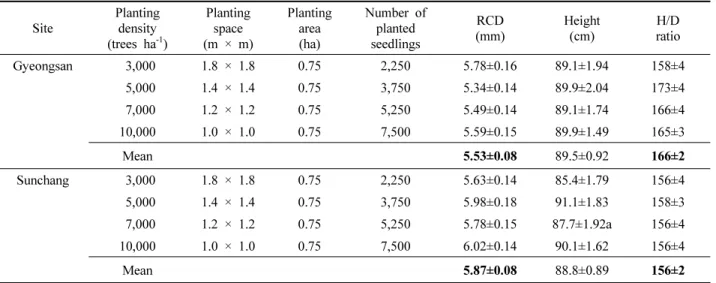
Gyeongsan 3,000 1.8 × 1.8 0.75 2,250 5.78±0.16 89.1±1.94 158±4
5,000 1.4 × 1.4 0.75 3,750 5.34±0.14 89.9±2.04 173±4
7,000 1.2 × 1.2 0.75 5,250 5.49±0.14 89.1±1.74 166±4
10,000 1.0 × 1.0 0.75 7,500 5.59±0.15 89.9±1.49 165±3
Mean 5.53±0.08 89.5±0.92 166±2
Sunchang 3,000 1.8 × 1.8 0.75 2,250 5.63±0.14 85.4±1.79 156±4
5,000 1.4 × 1.4 0.75 3,750 5.98±0.18 91.1±1.83 158±3
7,000 1.2 × 1.2 0.75 5,250 5.78±0.15 87.7±1.92a 156±4
10,000 1.0 × 1.0 0.75 7,500 6.02±0.14 90.1±1.62 156±4
Mean 5.87±0.08 88.8±0.89 156±2
Values indicate mean ± standard error (n=150 per each treatment). There was no significant difference in all variables among pretreatments. Bold letters indicate significant differences in RCD and H/D ratio between two study sites by t-test (P < 0.05).
Table 2. Planting design and initial root collar diameter (RCD, mm), height (cm) and H/D ratio of Zelkova serrata seedlings.
5,000본 ha
-1
(1.4 m × 1.4 m), 7,000본 ha-1
(1.2 m × 1.2 m), 10,000본 ha-1
(1.0 m × 1.0 m)]로 2015년 3월 말에 식재하였다(Table 2). 지역별 조림에 사용된 느티나무 1년 생 공시목의 근원경, 수고, H/D율은 균일하였다(Table 2).2. 토양 특성
식재 당년인 2015년에 지역별 9개 지점에서 토양 시료 채취기(직경 5.5 cm)를 이용하여 토심 20 cm 까지의 시료 를 채취하였다. 채취한 토양 시료는 48시간 이상 충분히 음건하였고, 2 mm체(US standard No. 10)를 이용하여 분 리한 2 mm 이하 토양 시료의 물리화학성을 분석하였다.
토성은 5% sodium hexametaphosphate 용액에 토양을 분 산시킨 후 hydrometer로 측정하였고(Hydrometer법), 토 양 pH는 토양과 증류수를 1:5 비율로 희석하여 교반한 용 액을 pH meter(Orion Star A211, Thermo, USA)로 측정하 였다. 전질소 농도는 Kjeldahl 증류법, 유기물 농도는 Tyurin법, 유효인산 농도는 Lancaster법으로 측정하였다.
또한 치환성 양이온(Ca
2+
, Mg2+
, K+
, Na+
) 농도는 Brown No.1법에 따라 일정량의 토양을 1N 초산암모니움으로 추 출하였고, 추출액을 이온분석기(ICP-OES, Optima 8300, PerkinElmer, Singapore)로 측정하였다(Jones Jr., 1999;RDA, 2000).
3. 생존율 및 생장 조사
식재밀도에 따른 느티나무 조림목의 생존율과 생장 특 성을 조사하기 위하여 각 처리구 마다 50본씩 3반복으로 총 150본의 조림목을 선정하였다. 2015년부터 2019년까지 5년간 매년 9월에 생존율을 조사하고, 전자식 캘리퍼스와
절척을 이용하여 조림목의 근원경(Root collar diameter, RCD, mm)과 수고(Height, H, cm)를 측정하였다. 측정된 값을 이용하여 H/D율[H/D ratio = H / RCD]과 조림목 초 기 품질의 평가 지표인 수간 재적[Stem volume (cm
3
) =∏ × RCD
2
× H / 6]을 계산하였다(Pinto et al., 2011).4. 통계 분석
두 지역 조림지 간의 토양 특성 차이는 t-test를 실시하 여 비교하였다. 또한 식재밀도와 조림 경과연수가 느티 나무 조림목의 생존율, 근원경, 수고, H/D율, 및 수간 재 적에 미치는 영향을 분석하기 위하여 이원분산분석을 실 시하였고, 유의성이 인정된 인자들의 처리에 따른 유의 성 분석을 위해 t-test 또는 Duncan의 다중검정법(P <
0.05)을 이용하였다. 모든 통계 분석에는 SAS(ver. 9.4) 또 는 R 소프트웨어(version 4.0.2) 프로그램을 사용하였다.
결과 및 고찰
1. 조림지 토양 특성
경산 조림지 내 토양은 양토 52.5%, 사토 26.8%, 점토 20.7%로 이루어져 있었으며, 순창은 양토 61.8%, 점토 21.2%, 사토 17.0%로 이루어져 있었다(Table 3). 토양의 입경 분포는 두 지역 사이에 유의한 차이가 나타나지 않 았고(P > 0.05), 모두 양토 함량이 높은 미사질양토의 토 성으로 나타났다. 토양의 화학성은 양이온 칼륨을 제외 하고 모든 항목에서 지역 간에 유의한 차이가 나타났다 (P < 0.05). 순창 지역은 질소 농도와 유기물함량이 경산 지역보다 유의하게 높게 나타났지만, 유효인산은 토양
Site
Texture (%)
pH
Total nitrogen
(%)
Available phosphorus
(mg kg -1 )
Organic matter
(%)
C.E.C.
(cmol c kg -1 )
Exchangeable cations (cmol c kg -1 )
Sand Silt Clay Ca 2+ Mg 2+ K + Na +
Gyeongsan 26.83
±1.49 52.53
±1.38 20.64
±0.78 5.50
±0.13 0.13
±0.01
11.59
±2.02
2.44
±0.20
27.22
±1.19
10.68
±1.40 4.52
±0.19 0.21
±0.01 0.26
±0.02 Sunchang 17.01
±0.82) 61.77
±1.65 21.22
±1.50 4.77
±0.07 0.39
±0.02
6.40
±0.65
8.61
±0.39
31.81
±0.83
1.65
±0.51 0.41
±0.10 0.17
±0.00 0.30
±0.04
P-value 0.3725 0.2631 0.5228 <0.0001 <0.0001 0.0323 <0.0001 <0.0001 <0.0001 <0.0001 <0.0001 0.4401 Values indicate mean ± standard error (n=9).
Table 3. The soil properties of Zelkova serrata plantation sites in 2015.
Site Source D.f. Survival rate RCD Height H/D ratio Stem volume
F-ratio P-value F-ratio P-value F-ratio P-value F-ratio P-value F-ratio P-value Gyeongsan Density (D) 3 2.5 0.0726 41.8 <0.0001 41.3 <0.0001 7.3 <0.0001 34.1 <0.0001 Year (Y) 5 1.0 0.4214 1617.9 <0.0001 1296.1 <0.0001 864.8 <0.0001 533.7 <0.0001 D × Y 15 0.2 0.9995 3.4 <0.0001 3.5 <0.0001 2.2 <0.0001 8.88 <0.0001 Sunchang D 3 1.8 0.1588 49.2 <0.0001 77.4 <0.0001 5.6 <0.0001 46.0 <0.0001 Y 5 2.3 0.0613 1184.3 <0.0001 661.6 <0.0001 563.8 <0.0001 245.9 <0.0001 D × Y 15 0.2 0.9998 5.4 <0.0001 5.7 <0.0001 0.9 0.6093 10.0 <0.0001 Table 4. Results of two-way ANOVA of the planting density, year and their interaction effects on survival rate, root collar diameter (RCD), height, and stem volume for Zelkova serrata trees in Gyeongsan and Sunchang sites.
pH가 더 높은 경산 지역이 순창 지역에서보다 더 높았 다. 그러나 경산과 순창 두 지역의 유효인산 농도는 우리 나라 산림토양 A층의 평균(25.6 mg kg
-1
)과 비교하여 상 대적으로 낮게 나타났다(Jeong et al., 2002). 양이온치환 용량은 순창이 경산보다 높게 나타났지만, 칼슘과 마그 네슘 등 양이온의 농도는 경산 지역이 순창 지역과 비교 하여 현저히 높게 나타났다.2. 생존율
경산, 순창 두 지역 모두에서 식재밀도에 따른 생존율의 유의적인 차이가 나타나지 않았다(Table 4, Figure 1). 경 산 지역에서는 90.7-95.3%, 순창 지역에서는 91.3-96.7%
로 두 지역 모두에서 90% 이상의 생존율을 보였다. 느티 나무 조림목은 식재후 5년간 조림지 환경에 적응했을 뿐 만 아니라 식재 초기에 하층식생과의 경쟁에서 우위를 점하여 현재의 생존율 수준을 유지한 것으로 판단된다 (Otsamo, 2002; Harrington et al., 2003). 본 연구에서는 식재밀도(3,000-10,000본 ha
-1
) 차이가 느티나무 조림목의 초기 생존율에 영향을 미치지 않았기 때문에, 밀식함에 따라 조림목간 경쟁 환경이 조성되고 이에 따른 수고 및 재적 생장의 증가가 유도될 경우(Iwasa et al., 1984), 생 장 특성에 있어서 밀식 조림의 긍정적 효과를 기대할 수 있을 것으로 판단된다.Figure 1. The survival rate of Zelkova serrata trees according to planting density in Gyeongsan and Sunchang sites. The vertical bars represent standard errors of the mean (n=3).
3. 근원경 및 수고생장
경산 지역에 식재된 1년생 조림목의 평균 근원경, 수고, H/D율은 각각 5.53 mm, 89.5 cm, 166이며, 순창 지역에서 는 각각 5.87 mm, 88.8 cm, 156으로 나타났다. 두 지역간에 조림목의 수고는 차이가 없었으나, 근원경과 H/D율은 좁 은 범위내에서 유의적인 차이가 있었다(P < 0.05, Table 2).
식재밀도 처리 이후, 근원경 및 수고 생장은 두 지역 모두 에서 식재밀도가 가장 높은 처리구(10,000 ha
-1
)에서 우수한 경향을 나타났다(Table 5). 강원도 평창지역에서 Kang et al.(2013)에 의해 수행된 음나무(Kalopanax septemlobus) 묘목 의 식재밀도에 따른 생장 특성 연구에서 수고생장에 있 어서 5,000본 ha
-1
과 10,000본 ha-1
의 식재밀도 처리간에 유의적인 차이를 보이지 않았다. 그러나, 본 연구에서는 경산 지역의 느티나무는 식재 당해년도부터 식재밀도에 따라 근원경과 수고 생장에 있어서 유의적인 차이가 나타나기 시작하였으며, 10,000본 ha
-1
식재 처리구에서 매 년 유의적으로 높게 나타났다(P < 0.05, Table 5). 순창 지역에서 근원경은 2016년부터, 수고는 2015년부터 10,000본 ha-1
식재 처리구에서 가장 높았다(P < 0.05, Table 5). 2,500본 ha-1
이하의 식재밀도 범위에서 수행된 선행연구에서, 밀식에 따라 5년생 Betula alnoides조림목 의 수고 생장이 증가하는 효과가 보고된 바 있으나(Wang et al., 2017), 본 연구를 통해서 느티나무 조림목을 대상 으로 10,000본 ha-1
까지의 고밀도 식재 범위에서도 밀식Site Growth Density
(trees ha
-1
) 2015 2016 2017 2018 2019Gyeongsan RCD (mm) 3,000 8.69±0.24 b 14.20±0.38 b 22.88±0.71 b 30.26±0.96 b 44.63±1.43 b 5,000 8.16±0.21 b 14.65±0.38 b 23.53±0.63 b 30.75±0.82 b 45.20±1.13 b 7,000 8.24±0.23 b 14.96±0.43 b 23.79±0.58 b 31.26±0.72 b 42.91±0.95 b 10,000 9.63±0.29 a 19.02±0.60 a 29.57±0.92 a 38.17±1.30 a 50.63±1.58 a
Height (cm) 3,000 103.8±3.2 b 135.5±3.8 c 192.1±4.9 b 228.1±5.3 b 306.1±8.0 b 5,000 106.7±2.4 b 144.5±3.1 bc 192.0±3.7 b 223.5±4.2 b 208.0±6.1 b 7,000 106.1±2.5 b 153.1±3.7 b 197.5±4.2 b 228.1±3.6 b 296.2±5.6 b 10,000 122.0±2.6 a 179.0±4.9 a 219.0±4.5 a 257.2±6.1 a 351.3±11.3 a
H/D ratio 3,000 122.6±4.0 b 97.4±2.8 b 86.3±2.2 a 78.0±2.2 a 70.6±1.7 a 5,000 133.8±2.5 a 101.5±2.0 ab 85.0±2.1 a 75.4±1.7 ab 70.0±1.5 a 7,000 132.0±3.1 a 104.7±2.3 a 85.0±2.2 a 74.6±1.5 ab 70.5±1.6 a 10,000 131.0±3.1 ab 97.0±2.3 b 77.0±1.8 b 70.2±1.6 b 70.2±1.5 a
Sunchang RCD (mm) 3,000 9.65±0.18 a 14.84±0.33 b 19.55±0.54 b 22.62±0.56 b 25.60±0.68 c 5,000 9.50±0.20 a 14.36±0.33 b 20.29±0.35 ab 23.92±0.45 ab 29.34±0.65 b 7,000 9.98±0.23 a 15.37±0.41 ab 20.21±0.49 ab 23.95±0.53 ab 27.89±0.71 b 10,000 9.84±0.19 a 15.97±0.37 a 21.58±0.55 a 24.75±0.61 a 33.01±1.00 a
Height (cm) 3,000 117.2±2.0 ab 148.7±2.6 b 174.8±3.7 b 194.2±4.6 b 192.1±4.8 d 5,000 115.9±2.1 b 150.2±2.6 b 187.2±3.3 ab 208.8±3.6 ab 227.2±4.6 b 7,000 117.8±2.7 ab 150.3±2.9 b 173.6±3.3 b 193.4±3.8 b 211.3±5.2 c 10,000 123.7±2.6 a 163.4±4.1 a 195.1±4.7 a 218.6±5.3 a 256.1±7.0 a
H/D ratio 3,000 123.4±2.2 a 102.6±1.9 ab 92.8±2.2 ab 87.2±1.6 a 76.2±1.4 a 5,000 124.9±2.6 a 107.7±2.4 a 93.7±1.8 a 88.6±1.5 a 78.4±1.2 a 7,000 120.0±2.6 a 100.8±2.4 b 87.6±1.7 b 82.0±1.5 b 76.7±1.4 a 10,000 127.1±2.3 a 104.2±2.2 ab 92.4±1.8 ab 89.9±1.7 a 78.8±1.1 a Values indicate mean ± standard error (n=150). Different letters in a column within the same tree age indicate significant differences among planting density by Duncan’s multiple range test (P < 0.05).
Table 5. The root collar diameter (RCD, mm), height (cm), and H/D ratio of Zelkova serrata trees according to planting density in Gyeongsan and Sunchang sites.
에 따른 근원경 및 수고 생장의 긍정적 효과가 검증되었 다. 한편, 본 연구에서 두 지역 간의 생장 차이는 입지환 경 및 토양 환경의 차이가 복합적으로 영향을 미친 것으 로 보인다(Table 3)(Waring, 2000; Saremi et al., 2014). 본 연구에서 토양의 전질소 농도와 유기물함량은 경산 지역 이 순창 지역보다 유의하게 낮았으나, 상대적으로 높은 평균기온과 유효인산농도와 양이온 함량, 깊은 유효토심, 낮은 석력함량 등의 물리화학적 조건이 초기 생장에 유 리하게 작용한 것으로 판단된다(Baribault et al., 2010).
4. H/D율
H/D율은 조림지 환경에 적응하여 동해, 건조, 바람 등으 로부터 받는 영향에 대한 저항성을 나타내는 지표로서 묘 목의 품질을 나타내는 지표로 활용된다(Burdett, 1990;
Cho et al., 2012; Grossnickle, 2012). 식재밀도에 따른 느 티나무 조림목의 H/D율은 2018년에 경산과 순창지역에 서 각각 10,000본 ha
-1
처리구에서 70.2와 7,000본 ha-1
처 리구에서 82.0으로 유의적으로 낮았으나, 2019년에는 두 지역 모두에서 식재밀도 처리에 따른 유의적인 효과를 보 이지 않았다(Table 5). 경산, 순창 두 지역에 조림된 느티 나무 1-0 노지묘의 평균 H/D율은 각각 161.0, 151.4로 산 림용 묘목규격(220)에 비해 양호한 수준이었으며(Table 2)(KFS, 2015), 식재밀도와 관계없이 시간이 경과함에 따 라 H/D율이 감소하는 일반적인 경향을 보여, 조림목의 안 정적인 활착과 함께 지하부 생장 촉진에 의해 지속적으로 품질이 향상되고 있는 것으로 판단된다. 상대적으로 낮은 식재밀도 범위에서의 선행연구 중 4년생 유칼립투스 (Eucalyptus spp.) 조림지에서는 식재밀도(1,250-1,667본 ha-1
)가 증가함에 따라 가지 크기와 각도가 감소하였고, 낮 은 높이에서의 가지 고사율을 높였으며(Alcorn et al., 2007), 5년생 Betula alnoides조림지에서는 식재밀도(625- 2,500본 ha-1
)의 증가가 살아있는 가지의 양을 감소시켰 다는 연구 결과가 보고된바 있다(Wang et al., 2018). 따라 서, 향후 용재수로서 느티나무의 정확한 목재 품질 평가를 위해서는 H/D율과 함께 가지 각도, 가지 발생수, 굵기 및 지하고 등의 항목을 선정하여 추가적인 분석이 필요할 것 으로 보인다(Salminen and Varmola, 1993; Van de Peer et al., 2017; Cho et al., 2020).5. 수간 재적
식재밀도에 따른 개체목당 수간 재적의 유의적 차이는 두 지역 모두 매년 10,000본 ha
-1
식재 처리구에서 가장 높은 수간 재적을 보였고, 2019년 10,000본 ha-1
식재 처 리구에서의 평균 수간 재적은 경산과 순창 지역에서 각 각 5,469 cm3
본-1
과 1,773 cm3
본-1
으로 3,000본 ha-1
식재처리구에 비해 각각 약 1.50배, 2.36배 크게 나타났다 (Figure 2). 본 연구결과는 Kerr (2003)에 의한 F. excelsior 의 초기 생장 연구에서 0.77-4.86 m의 식재간격 범위에서 밀식할수록 수고 및 줄기직경, 재적이 증가하는 경향과 유사하게 나타났다. 일반적으로 활엽수는 생장기간 동안 침엽수에 비해 토양 내 많은 양분을 필요로 한다(Binkley and Fisher, 2013). 특히 느티나무는 다비성 수종으로 알 려져 있어 초기 생장 시 많은 양분을 필요로 하기 때문에 (Yang and Cho, 2019; Hwang et al., 2015), 조림 후 시간 경과에 따라 토양 내 양분의 부족이 생장 제한 요인으로 작용할 수 있다(Nambiar and Sands, 1993; Mead 2005).
따라서 식재밀도에 따른 토양 및 식물체내 양분 변화의 추가적인 모니터링이 요구되며, 본 연구 결과와 함께 시 비 및 간벌 등의 적정시기가 함께 고려되어야 할 것이다.
그럼에도 불구하고 본 연구는 밀식에 따른 광환경에 있 어서의 경쟁 조건의 조성이 느티나무 개체목들의 초기 생장을 촉진하는 긍정적인 영향을 확인하였으며(Iwasa et al., 1984; Kerr, 2003), 이는 느티나무 초기 재적 생장에 있 어서의 식재밀도와 연계된 조림학적 특성으로 판단된다.
결 론
본 연구는 입지 환경이 다른 두 지역에서 식재밀도에 따른 느티나무 조림목의 초기 생육 특성을 연차적으로 Figure 2. The stem volume of Zelkova serrata trees according to planting density in Gyeongsan and Sunchang sites. The vertical bars represent standard errors of the mean (n=150). Different letters indicate significant differences in stem volume among planting density in 2019 by Duncan’s multiple range test (P
< 0.05).
분석하여 느티나무 조림목의 생존 및 품질 향상을 위한 적정 식재밀도를 구명하고자 수행되었다. 두 지역 모두 에서 조림후 5년간 생존율과 H/D율은 식재밀도에 따른 차이가 없었으나, 식재밀도가 높은 곳(10,000본 ha
-1
)에서 근원경, 수고 및 재적 생장이 모두 높은 것으로 나타나, 밀식조림이 느티나무 조림목의 초기 생장에 미치는 긍정 적 효과를 확인하였다. 향후 느티나무 조림목의 생장 특 성을 지속적으로 모니터링하고, 활엽수 조림목의 초기 생 장에 대한 수종별 이해와 함께 풀베기, 시비처리 등 조림 지 관리 비용 등을 종합적으로 고려하여, 용재수로서 품 질 향상을 위한 적정 식재밀도를 제시할 수 있을 것이다.References
Akers, M.K., Kane, M., Zhao, D., Teskey, R.O. and Daniels, R.F. 2013. Effects of planting density and cultural intensity on stand and crown attributes of mid-rotation loblolly pine plantation. Forest Ecology and Management 310: 468-475.
Alcorn, P.J., Pyttel, P., Bauhus, J., Smith, R.G.B., Thomass, D., James, R. and Nicotra, A. 2007. Effects of initial planting density on branch development in 4-year-old plantation grown Eucalyptus pilularis and Eucalyptus cloeziana trees. Forest Ecology and Management 252(1-3): 41-51.
Antony, F., Schimleck, L.R., Jordan, L., Daniels, R.F. and Clark III, A. 2012. Modeling the effect of initial planting density on within tree variation of stiffness in loblolly pine. Annals of Forest Science 69(5): 641-650.
Baribault, T.W., Kobe, R.K. and Rothstein, D.E. 2010. Soil calcium, nitrogen, and water are correlated with aboveground net primary production in northern hardwood forests. Forest Ecology and Management 260(5): 723-733.
Binkley, D. and Fisher, R.F. 2013. Ecology and management of forest soils. 4th Ed. Willey, USA. pp. 347.
Benomar, L., DesRochers, A. and Larocque, G.R. 2012. The effects of spacing on growth, morphology and biomass production and allocation in two hybrid poplar clones growing in the boreal region of Canada. Trees 26(3):
939-949.
Burdett, A.N. 1990. Physiological processes in plantation establishment and the development of specifications for forest planting stock. Canadian Journal of Forest Research 20(4): 415-427.
Burkes, E.C., Will, R.E., Barron-Gafford, G.A., Teskey, R.O.
and Shiver, B. 2003. Biomass partitioning and growth efficiency of intensively managed Pinus taeda and Pinus elliottii stands of different planting densities. Forest Science
47(2): 224-234.
Cho, M.S., Jeong, J. and Yang, A-R. 2017a. Growing density and cavity volume of container influence major temperate broad-leaved tree species of physiological characteristics in nursery stage. Journal of Korean Forest Society 106(1):40-53 (In Korean with English abstract).
Cho, M.S., Kwon, B., Kim, W. and Jeong, D.H. 2020. Deve- lopment of Silvicultural Techniques for Major Hardwood Species. National Institute of Forest Science. Seoul, Korea.
Research report 20-03. pp. 7-34 (In Korean).
Cho, M.S., Lee, S.W. and Park, B.B. 2012. Effects of fertiliza- tion methods on the growth and physiological character- istics of Larix kaempferi seedlings in the container nursery system. Journal of Bio-Environment Control 21(1): 57-65 (In Korean with English abstract).
Cho, M.S., Meng, L., Song, J.H., Han, S.H., Bae, K. and Park, B.B. 2017b. The effects of biochars on the growth of Zelkova serrata seedlings in a containerized seedling pro- duction system. Forest Science and Technology 13(1):
25-30.
Cho, M.S., Yang, A. and Hwang, J. 2015. Growth performances of container seedlings of deciduous hard wood species grown at three different fertilization treatments. Journal of Korean Forest Society 104(1): 90-97 (In Korean with English abstract).
Choi, S.H., Lee, W.K., Kwak, D.A., Lee, S.C., Son, Y., Lim, J.H. and Saborowski, J. 2011. Predicting forest cover changes in future climate using hydrological and thermal indices in South Korea. Climate Research 49(3): 229-245.
Grossnickle, S.C. 2012. Why seedlings survive: Influence of plant attributes. New Forests 43(5-6): 711-738.
Harms, W.R., Whitesell, C.D. and Debell, D.S. 2000. Growth and development of loblolly pine in a spacing trial planted in Hawaii. Forest Ecology and Management 126(1): 13-24.
Harrington, T.B., Dagley, C.M. and Edwards, M.B. 2003.
Above- and belowground competition from longleaf pine plantations limits performance of reintroduced herbaceous species. Forest Science 49(5): 681-695.
Hwang, J., Cho, M.S. and Yang, A. 2015. Development of Silvicultural Techniques for Species Replacement in Major Plantations. National Institute of Forest Science. Seoul, Korea. Research report 15-10. pp. 120 (In Korean).
Iwasa, Y., Cohen, D. and Leon, J.A. 1984. Tree height and crown shape, as results of competitive games. Journal of Theorogical Biology 112(2): 279-297.
Jeong, J.H., Koo, K.S., Lee, C.H. and Kim, C.S. 2002. Physio- chemical properties of Korean forest soils by regions.
Journal of Korean Forestry Society 91(6): 694-700.
Jones Jr, J.B. 1999. Soil and Plant Analysis Laboratory Registry.
2nd Ed. Soil and Plant Analysis Council. CRC Press LLC.
Florida, USA. pp. 209.
Kang, H.S. 2013. Effects of root pruning, stem cutting and planting density on survival and growth characteristics in Kalopanax septemlobus seedlings. Journal of the Korea Society of Environmental Restoration Technology 16(3):
97-105 (In Korean with English abstract).
Kerr, G. 2003. Effects of spacing on the early growth of planted Fraxinus excelsior L. Canadian Journal of Forest Research 33(7): 1196-1207.
Kim, H.S., Bae, S.W., Lee, S.T. and Hwang, J.H. 2010a.
Analysis of growth characteristics and aboveground carbon storage for Zelkova serrata artificial forests in Gwangneung experimental forest. Journal of Korean Forestry Society 99(1): 144-152 (In Korean with English abstract).
Kim, I.S., Kwon, H.Y., Ryu, K.O. and Choi, H.S. 2010b.
Variation of leaf morphology among 18 populations of Zelkova serrata Mak. Korean Journal of Breeding Science 42(1): 40-49 (In Korean with English abstract).
Kim, I.S. and Lee, J.H. 2013. Geographic variation of seed characteristics and 1-year-old seedling growth of Zelkova serrata. Korean Journal of Agricultural and Forest Meteorology 15(4): 234-244 (In Korean with English abstract).
Kim, M., Yoo, S., Lim, N., Lee, W., Ham, B., Song, C. and Lee, W-K. 2017. Climate Change Impact on Korean Forest and Forest Management Strategies. Korean Journal of Environmental Biology 35(3): 413-425 (In Korean with English abstract).
KFS (Korea Forest Service). 2018. The sixth forest master plan (2018~2037). Korea Forest Service, Korea. pp. 151. (in Korean)
KFS (Korea Forest Service). 2019. Statistical yearbook of forestry. Korea Forest Service, Korea. pp. 444. (in Korean) KFS (Korea Forest Service). 2020. Annual action plan of forest
resources in 2020. pp. 397. (in Korean)
McCrady, R.L. and Jokela, E.J. 1996. Growth phenology and crown structure of selected loblolly pine families planted at two spacings. Forest Science 42(1): 46-57.
Mead, D.J. 2005. Opportunities for improving plantation productivity. How much? How quickly? How realistic?
Biomass and Bioenergy 28(2): 249-266.
Nambiar, E.K.S. and Sands, R. 1993. Competition for water and nutrients in forests. Canadian Journal of Forest Research 23(10): 1955-1968.
Newton, M., Lachenbruch, B., Robbins, J.M. and Cole, E.C.
2012. Branch diameter and longevity linked to plantation spacing and rectangularity in young Douglas-fir. Forest Ecology and Management 266: 75-82.
Otsamo, A. 2002. Early effects of four fast-growing tree species and their planting density on ground vegetation in Imperrata grasslands. New Forests 23(1): 1-17.
Oyama, H., Fuse, O., Tomimatsu, H. and Seiwa, K. 2018.
Variable seed behavior increases recruitment success of a hardwood tree, Zelkova serrata, in spatially heterogeneous forest environments. Forest Ecology and Management 415-416: 1-9.
Park, H.S. 1998. A study on the development of new cultivar showing either yellow or red leaf fall color in Zelkova serrata Makino. (Dissertation). Seoul. Sungkyunkwan University.
Park, Y.M. 1998. Leaf growth characteristics of Betula platyphylla var. japonica and Zelkova serrata. Journal of Industrial Science, Chongju University. 15(3): 213-218.
Pinto, J.R., Marshall, J.D., Dumroese, R.K., Davis, A.S. and Cobos, D.R. 2011. Establishment and growth of container seedlings for reforestation: A function of stocktype and edaphic conditions. Forest Ecology and Management 261(11): 1876-1884.
Rural Development Administration. 2000. Soil and Plant Analysis. National Institute of Agricultural Sciences, Rural Development Administration. pp. 202.
Saha, S., Kuehne, C., Kohnle, U., Brang, P., Ehring, A., Geisel, J., Leder, B., Muth, M., Petersen, R., Peter, J., Ruhm, W.
and Bauhus, J. 2012. Growth and quality of young oaks (Quercus robur and Quercus petraea) grown in cluster plantings in central Europe: A weighted meta-analysis.
Forest Ecology and Management 283: 106-118.
Saha, S., Kuehne, C. and Bauhus, J. 2014. Intra- and inter- specific competition differently influence growth and stem quality of young oaks (Quercus robur L. and Quercus petraea (Mattuschka) Liebl.). Annals of Forest Science 71(3):
381-393.
Salminen, H. and Varmola, M. 1993. Influence of initial spacing and planting design on the development of young Scots pine (Pinus sylvestris L.) stands. Silva Fennia 27(1): 21-28.
Saremi, H., Kumar, L., Turner, R., Stone, C. and Melville, G. 2014. Impact of local slope and aspect assessed from LiDAR records on tree diameter in radiata pine (Pinus radiata D. Don) plantations. Annals of Forest Science 71(7):
771-780.
Toillon, J., Fichot, R., Dallé, E., Berthelot, A. and Brignolas, F. 2013. Planting density affects growth and water-use
efficiency depending on site in Populus deltoides × P. nigra.
Forest Ecology and Management 304: 345-354.
Van de Peer, T., Verheyen, K., Kint, V., Van Cleemput, E.
and Muys, B. 2017. Plasticity of tree architecture through interspecific and intraspecific competition in a young experimental plantation. Forest Ecology and Management 385: 1-9.
Wang, C.S., Tang, C., Hein, S., Guo, J.J. and Zhao, Z.G. 2018.
Branch development of five-year-old Betula alnoides plantations in response to planting density. Forests, 9: 42, http://doi.10.3390/f9010042.
Waring, R.H. 2000. A process model analysis of environmental limitations on the growth of Sitka spruce plantations in Great Britain. Forestry 73(1): 65-79.
Will, R.E., Narahari, N.V., Shiver, B.D. and Teskey, R.O. 2005.
Effects of planting density on canopy dynamics and stem growth for intensively managed loblolly pine stands. Forest Ecology and Management 205(1-3): 29-41.
Will, R., Hennessey, T., Lynch, T., Holeman, R. and Heinemann, R. 2010. Effects of planting density and seed source on loblolly pine stands in southeastern Oklahoma.
Forest Science 56(5): 437-443.
Yang, A-R., Cho, M.S. and Hwang, J. 2014. The effects of seedling types and soil properties in relation to aspects on the early growth of planted Zelkova serrata seedlings.
Journal of Agriculture & Life Science 48(4): 1-12 (In Korean with English abstract).
Yang, A-R., Hwang, J., Cho, M.S. and Son, Y. 2016. The effect of fertilization on early growth of konara oak and Japanese zelkova seedlings planted in a harvested pitch pine plantation. Journal of Forestry Research 27(4):
863-870.
Yang, A-R. and Cho, M.S. 2019. The growth performances and soil properties of planted Zelkova serrata trees according to fertilization in harvested Pinus rigida plantation over 6 years after planting. Journal of Korean Society of Forest Science 108(1): 29-39 (In Korean with English abstract).
Yoda, K., Wagatsuma, H., Suzuki, M. and Suzuki H. 2003.
Stem diameter changes before bud opening in Zelkova serrata saplings. Journal of Plant Research 116(1): 13-18.
Manuscript Received : August 5, 2020
First Revision : August 14, 2020
Accepted : August 26, 2020
Figure S1. (a) The root collar diameter (RCD), (b) height, and (c) H/D ratio of Zelkova serrata trees according to planting density in Gyeongsan and Sunchang plantation sites.
The vertical bars represent standard deviation of the mean (n=150). Asterisks indicate significant differences in the variables among planting densities for each year (P <
0.01). The significant differences in the variables among planting density by Duncan’s multiple range test are shown in Table 5. n.s. not significant.