지역 소재⋅부품⋅장비 국산화 촉진 및 사업화 제도개선 방안에 관한 연구
이승희1*, 장성호2, 정석화3
1금오공과대학교 경영학과 교수, 2금오공과대학교 산업공학부 교수, 3前금오공과대학교 교양교직학부 외래교수
A Study on the Plan for Regional Materials, Parts, Equipment Localization Promotion and Improvement of Commercialization
System
Seung-Hee Lee1*, Sung-Ho Jang2, Seok-Hwa Jeong3
1Professor, Department of Business Administration, Kumoh National Institute of Technology
2Professor, School of Industrial Engineering, Kumoh National Institute of Technology
3Outpatient Professor, Dept. of Liberal Arts & Teacher Training, Kumoh National Institute of Technology
요 약 소재·부품·장비 산업은 제조업의 허리이자 경쟁력의 핵심 요소가 되고 있다. 그러나 우리나라의 경우 핵심 소재·
부품·장비를 해외에 의존하다 보니 산업경쟁력뿐만 아니라 안보적 측면에서도 커다란 위험 상황에 처하게 되었다. 본 연구는 먼저 소재·부품·장비 산업의 개요와 현주소를 살펴보고 그 문제점과 개선점을 파악하고 우리나라 소재·부품·장비 의 국산화를 위한 그동안의 노력과 실적을 살펴보았다. 또한, 정부의 소재·부품·장비 산업에 대한 제도적인 차원이나 생태계적인 차원에서 그 개선방안을 살펴본 후 지역 소재·부품·장비의 국산화의 현황과 실태를 조사해보고 이에 따른 문제점과 개선점을 분석해 보았다. 마지막으로 본 연구는 지역 부품·소재 국산화를 위한 기술개발방안 및 사업화와 관련 한 다양한 제도개선방안을 제시하였다.
주제어 : 소재, 부품, 장비, 국산화 촉진, 제도개선
Abstract The materials, parts, and equipment industries are the backbone of the manufacturing industry and a key element of competitiveness. However, in the case of Korea, as it relies on foreign countries for core materials, parts, and equipment, it is in danger of not only industrial competitiveness, but also security. This study first looked at the outline and current address of the materials, parts, and equipment industries, identified problems and improvements, and examined the efforts and achievements so far for the localization of materials, parts, and equipment in Korea. In addition, after looking at the improvement measures for the government's material, parts, and equipment industry at the institutional level or at the ecological level, the current status and actual condition of localization of local materials, parts and equipment were investigated, and problems and improvements were analyzed. Lastly, this study presented a technology development plan for localization of parts and materials in the region and various institutional improvement plans related to commercialization.
Key Words : Material, Parts, Equipment, Localization Promotion, Improvement of Commercialization System
*This thesis was supported by the National University Development Project in 2019.
*Corresponding Author : Seung-Hee Lee([email protected]) Received December 31, 2020
Accepted February 20, 2021 Revised February 9, 2021
Published February 28, 2021
1. 서론
소재·부품·장비는 국가 주력산업의 근간이자 4차 산업 혁명 시대 경쟁력의 핵심이다. 한국의 소재·부품·장비 산 업은 생산량은 2017년 786조원, 수출은 2018년 2,409 억 달러로 과거에 비해 외형적으로 크게 성장했으나 여 전히 경쟁력의 원천은 중간기술 개발 및 범용 소재·부품·
장비에 집중되어 있다[1].
특히, 우리나라의 경우 주요 핵심 소재·부품·장비를 해 외에 의존하다 보니 산업경쟁력뿐만 아니라 안보적 측면 에서도 커다란 위험 상황에 처하게 되었다. 일본 정부의 한국 수출 품목 규제강화 발표 및 백색국가 제외(‘19.8.2) 조치로 글로벌 산업경쟁력이 약화 됨에 따라 지역 산업 계도 심각한 어려움을 겪고 있다.
한편, 소재·부품·장비 산업은 제조업의 근간으로 기술 경쟁력의 핵심이 되고 있다. 소재·부품·장비의 발전은 관 련 유관 산업으로의 파급 효과 및 신규 제품의 개발을 촉 발하게 하고, 산업 전반에 걸쳐 제조업을 크게 혁신하는 원동력의 기반이 되고 있다[2].
소재·부품ㆍ장비 산업에 관한 그동안의 선행연구들은 주로 국내외 비교분석을 통한 문제점과 개선 방향 제시, 국산화 지원을 위한 정책적 연구가 대부분이었다. 앞으로 는 정부의 소재ㆍ부품ㆍ장비 산업에 대한 제도적인 문제 나 생태계 조성 차원에서의 연구를 통해 근본적인 개선 방안을 마련해야 할 것이다.
소재·부품·장비 산업은 그동안 외형적으로 크게 성장 하였지만, 만성적 해외 의존구조와 낮은 자체 조달률로 위기에 봉착하고 있다. 완제품에 대한 경쟁력을 높이기 위해서는 소재·부품·장비의 국산화가 필요하고, 국산화가 잘 이루어질 경우 대중소기업 간에 양극화 해소에도 크 게 기여하게 된다[3]. 따라서, 국가적으로 산업발전을 위 해 소재·부품·장비 산업에 대한 신중한 검토와 육성이 절 실한 시점이라 할 수 있다.
본 연구는 먼저 소재·부품·장비 산업에 대한 전반적인 개요와 현황을 살펴보고 소부장 산업이 안고 있는 문제 점과 개선점을 파악해 보고 우리나라 소재·부품·장비의 국산화를 위한 그동안의 노력과 실적을 살펴보았다. 또 한, 최근의 정부의 각종 소부장 산업에 대한 지원정책에 대해 살펴본 후 지역 소재·부품·장비의 국산화의 현황과 실태를 조사해보고 그 문제점과 개선점을 분석해 보았다.
마지막으로 본 연구는 지역 소재· 부품 국산화를 위한 기 술개발방안 및 사업화와 관련한 다양한 제도개선방안을 제시해 보았다.
2. 소재⋅부품⋅장비 산업 현황과 정책연구 동향
소재·부품ㆍ장비 산업에 대한 개요와 전반적인 현황과 그동안의 소부장 산업에 대한 정책연구 동향을 먼저 살 펴보기로 한다.
2.1 소재⋅부품⋅장비의 정의와 범위
소재ㆍ부품ㆍ장비 산업 경쟁력 강화를 위한 특별조치 법[법률 제16859호] 제2조(정의)에 의하면 소재ㆍ부품이 란 상품의 제조에 사용되는 원재료 또는 중간생산물을 말하고 장비란 소재ㆍ부품을 생산하거나 소재ㆍ부품을 사용하여 제품을 생산하는 장치 또는 설비를 말한다[4].
한편, 소재ㆍ부품ㆍ장비의 범위는 시행령[대통령령 제 31380호]에 따르면 최종생산물의 고부가가치화에 기여 가 큰 것, 첨단기술 또는 핵심 고도기술을 수반하는 소재 ㆍ부품ㆍ장비로서 기술 파급 효과 또는 부가가치 창출 효 과가 큰 것, 산업의 기반이 되거나 산업 간 연관 효과가 큰 것, 수급이 원활하지 않으면 주력산업 등의 생산에 차 질을 초래하는 것으로 제시하고 있다[5].
2.2 소재⋅부품의 산업분류
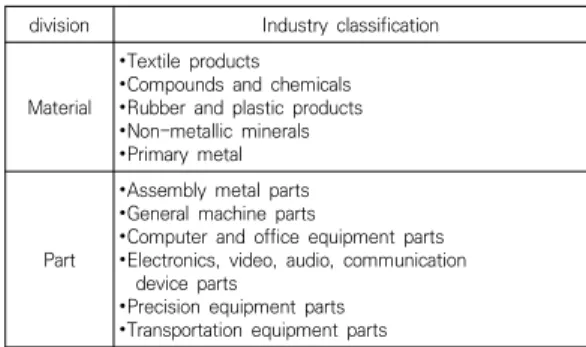
소재산업과 부품산업의 구분이 되는 경계는 금속 산업 을 중심으로 구분할 수 있으며, 1차 금속은 일반적으로 소재산업으로, 조립산업은 부품산업으로 분류하게 되는 데 이 같은 소재와 부품의 세부산업분류는 다음 Table 1과 같다[6].
division Industry classification
Material
∙Textile products
∙Compounds and chemicals
∙Rubber and plastic products
∙Non-metallic minerals
∙Primary metal
Part
∙Assembly metal parts
∙General machine parts
∙Computer and office equipment parts
∙Electronics, video, audio, communication device parts
∙Precision equipment parts
∙Transportation equipment parts
Table 1. Material and part industry classification
2.3 국내 소부장 산업의 현주소
2017년 소재·부품 사업체 수는 제조업에서 37.2%로 2만 5,869개사를 차지하고 있다. 종업원 수는 제조업의
44.5%로 131만 6,000명이고, 생산액은 제조업의 48.9%
로 743조원이며, 부가가치는 제조업의 51.6%로 281조 원를 차지하고 있다[7].
국내 소부장 산업은 2001년 「소재⋅부품 전문기업 등 의 육성에 관한 특별조치법」 제정이후 R&D 분야에 5.4 조원의 예산을 투입하였고 그 결과 소부장 산업의 생산 은 3배로 ’01년 240조원에서 ’17년 786조원이고, 수출 은 5배로 ’01년 646억불에서 ’18년 3,409억불 증가하는 외형적 성장을 가져왔다. 이를 통해 무역수지는 ‘01년 9 억불 적자에서 ’18년 1,375억불로 대규모 흑자로 전환되 는 성과를 가져오게 되었다[8].
(Unit : %) Steel
Car Home appliance Shipbuilding Machine Petrochemical Textile Display Semiconductor
Source: Manufacturing Industry Status(KIET, ’18) Fig. 1. Self-procurement level by industry(KIET, ’18)
즉, 소재‧부품‧장비 자체조달률은 `01년부터 `17년까지 60%대에서 정체를 보이고 있는 실정이다. 특히, 반도체‧
디스플레이 등 정밀산업 자체조달률은 50%이고 자체조 달률(산업연, ‘18)이 낮은 산업 분야의 순서로는 반도체 (27%), 디스플레이(45%), 기계(61%), 자동차(66%) 등으 로 매우 열악한 상황이 아닐 수 없다[9].
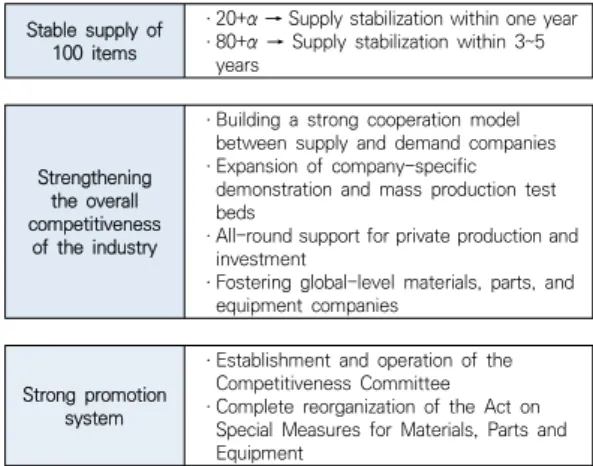
2.4 소재⋅부품⋅장비 경쟁력 강화대책(‘19.8.5) 소부장 강화대책은 특정국의 해외 의존도를 낮추고, 자체기술력 확보를 통한 공급 안정성 및 소부장산업의 경쟁력 강화를 통해 위기를 기회로 전환하여 예산, 금융, 세제, 규제특례 등 국가적 자원과 역량을 총력 투입하는 강화대책이다[4].
또한, 정부는 일본 수출 규제 이후 많은 소재·부품·장 비를 핵심 품목으로 지정하고 국산화에 주력해왔다. 예 산, 컨설팅 등의 각종 연구지원을 통해 정부는 앞으로 ‘소
부장 2.0 전략’이 진행되면, 관련 핵심 품목들이 338개로 3배 이상 확대할 계획이다[10].
Stable supply of 100 items
ㆍ20+α → Supply stabilization within one year ㆍ80+α → Supply stabilization within 3~5
years
Strengthening the overall competitiveness
of the industry
ㆍBuilding a strong cooperation model between supply and demand companies ㆍExpansion of company-specific
demonstration and mass production test ㆍAll-round support for private production and beds
investment
ㆍFostering global-level materials, parts, and equipment companies
Strong promotion system
ㆍEstablishment and operation of the Competitiveness Committee ㆍComplete reorganization of the Act on
Special Measures for Materials, Parts and Equipment
Table 2. Main contents of the countermeasure
2.5 건전한 협력생태계 조성
정부는 수요-공급기업 간 강력한 협력모델을 구축하 여 건전한 협력생태계를 조성하고자 하였다. ‘20년 20개 이상 목표로 협력사업을 적극 발굴하고, R&D‧자금‧입지‧
규제특례 등을 맞춤형 패키지로 지원하는 것으로 4가지 협력사업 유형인 ① 협동 연구개발형, ② 공급망연계형,
③ 공동투자형, ④ 공동 재고확보형을 제시하였다[8].
Vertical cooperation (Between supply and demand
companies)
Horizontal cooperation (Between demand-demand
companies) Type A
(Cooperative R&D type)
Technology roadmap sharing R&D
→ R&D using technology
Type B (Joint investment
type)
Sharing with partners, Joint development and facility investment [Support] Share technology roadmap,
R&D fund, Public procurement Sales channel support, Clarification of transaction standards between affiliates
[Support] Technology
transfer→Partners, Joint R&D activation, Priority occupancy in rental industrial complexes, Corporate tax reduction Type C
(Supply chain connection
type)
Open mass production evaluation test, Building a common
foundation
Type D (Joint inventory
type)
Group buying, Keep
[Support] Facility investment loan, Support for demonstration and mass production, Local tax reduction, Priority allocation of industrial complex quantities
[Support] Overseas purchasing consulting, Overseas logistics storage support, Extension of storage period in bonded areas Source: Joint Ministry. (2019. 8). Measures to Strengthen Competitiveness in Materials, Parts and Equipment.
Table 3. Example of cooperation model between supply and demand companies
2.6 소재⋅부품⋅장비산업 강화를 위한 특별조치법 정부는 ‘21년 일몰예정 특별법을 상시법화하는 전면 적인 개편을 실시하여 그 대상도 소재⋅부품에서 소재⋅
부품⋅장비로 더욱 확장하여 기업단위의 육성법을 산업 중심의 경쟁력 강화로 전환하였다[6].
division Main Content
Legal name
∙Special Measures Act on Fostering Materials and Parts Specialized Companies, etc.
→Special Measures Act to Strengthen Competitiveness in the Materials, Parts and Equipment Industry
Policy target
∙Materials·Parts → Expanded to Materials·Parts·Equipment (The trend of combining and fusion of materials, parts and
equipment is strengthened and mutual influence on the industrial value chain increases)
function
∙Prepare the basis for strengthening full-cycle support such as technology development, test bed, and manpower training
measures
∙Prepare the basis for package support such as finance, location, and special cases in the cooperation model between companies
∙Establishment of special cases for environment, location, preliminary feasibility study, etc.
system
∙Establishment of the Pan-Government Competitiveness Reinforcement Committee (deliberation and adjustment of major matters to strengthen the competitiveness of the materials, parts and equipment industries)
∙Establishment of special accounts for strengthening competitiveness of materials, parts and equipment Source: Ministry of Trade, Industry and Energy. (2019). Passed the Special Act on Small Directors to Strengthen Competitiveness in the Materials, Parts and Equipment Industry.
Table 4. Major amendments to the Special Act on the Director General
3. 지역소재∙부품∙장비 국산화 현황 및 문제점 - K지역을 중심으로 3.1 K지역 소재∙부품∙장비 해외의존현황
소재∙부품∙장비 해외의존률이 높은 K지역을 대상으로 그 현황을 살펴보았다. K지역은 지역 내 제조업 비중이 전국 4.4%로 핵심부품은 수입의존도가 높은 지역이다.
일본 수출규제 품목과 같이 해외의 특정한 공급선에서 독점적으로 공급하는 소재∙부품∙장비를 사용하고 있는 기업이 20.3%(소재 8.1% + 부품 9.5% + 장비 2.7%)이 었으며, 업종별로 금속(12.5%), 전기∙전자(11.5%), 기계 분야(9.4%)는 부품 사용, 화학제품(7.1%), 전기 전자 (11.5%) 분야는 소재사용이 가장 많았다. 특히, 기업부설 연구소(18.0%), 수출 해당기업(17.6%), 수입 해당기업 (22.0%)은 해외부품 사용이 상대적으로 높았다[11].
3.2 해외의존도를 낮추기 위한 필요지원 사항 해외 의존도를 낮추기 위해 가장 필요한 지원에 대한 K지역 조사에서 32.7%의 기업이 국산화를 위한 비용 지 원을 꼽았고 이어서 대체 및 개발품의 판매 마케팅 지원 (20.3%), 대체품 관련 시장 및 기술 동향(19.4%), 관련 제품군에 대한 전문인력양성교육(5.9%), 정확한 정보 전 달(5.2%) 등의 순이었다[12].
(Unit : %) Delivery of accurate information
Market and technology trends related to alternative products R&D expense support for localization Sales and marketing support of alternative and developed products Professional manpower training for related products Etc No response
Fig. 2. The most necessary support to lower the degree of overseas dependence
한편, 업종별로도 조사를 하였는데 K지역의 경우 업 종에 관계없이 국산화를 위한 R&D지원이 필요하다는 기업이 가장 많았다. 매출액에 관계없이 대부분 국산화를 위한 R&D비용 지원을 가장 높게 꼽았으나 50∼100억 미만 기업(28.2%)은 대체품 관련 시장 및 기술 동향을 가장 많이 응답하였다. 기업의 규모가 작을수록 직접적인 국산화를 위한 R&D지원과 대체 및 개발품의 판매 마케 팅 지원을 원했고 기업의 규모가 클수록 대체품 관련 시 장 및 기술 동향을 우선적으로 요구하였다[11].
4. 지역 소재∙부품 기술개발 및 사업화 관련 제도개선 방안
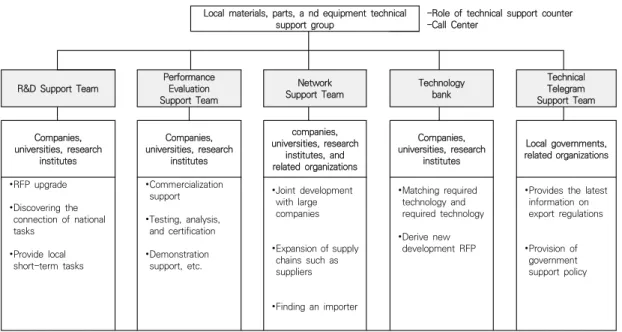
4.1 지역 소재∙부품∙장비 기술자립화 지원단 구성 지자체 및 유관기관을 중심으로 지역 「소재·부품·장비 기술자립화 지원단」(가칭)을 만들어서 전담 관리 할 수 있도록 인력 배치하여 추진하는 방안이다[11].
산학연의 각 기관들이 역할을 분담하여 R&D 지원팀, 성능평가지원팀, 네트워크지원팀, 기술은행, 기술정보지 원팀을 구성해서 다양한 소재∙부품∙장비 지원 활동을 수 행하게 하는 방안이다.
Local materials, parts, a nd equipment technical
support group -Role of technical support counter -Call Center
R&D Support Team Performance Evaluation Support Team
Network
Support Team Technology
bank
Technical Telegram Support Team Companies,
universities, research institutes
Companies, universities, research
institutes
companies, universities, research
institutes, and related organizations
Companies, universities, research
institutes
Local governments, related organizations
∙RFP upgrade
∙Discovering the connection of national tasks
∙Provide local short-term tasks
∙Commercialization support
∙Testing, analysis, and certification
∙Demonstration support, etc.
∙Joint development with large companies
∙Expansion of supply chains such as suppliers
∙Finding an importer
∙Matching required technology and required technology
∙Derive new development RFP
∙Provides the latest information on export regulations
∙Provision of government support policy
Fig. 3. Organization of local materials, parts and equipment technical independence support group
4.2 정부 소재∙부품 국산화 예산 활용
앞으로 정부는 소재∙부품 국산화를 위해 3년간(’20
∼’22) R&D 5조원 이상 투자할 계획이다. 즉, 정부는 반 도체, 디스플레이 등 5대 핵심분야를 중심으로 소재·부 품·장비 R&D에 ’22년까지 앞으로 3년간 5조원이 넘는 예산을 집중 투자할 계획이어서 이를 활용하는 것이다.
division
’18 ’19
’20~’22 (Estimate) Sub Total Original Budget Supplemen
tary Sub Total (A+B)Sum 8,366 8,254 2,232 10,486 KRW 5 Trillion Core
Items(A) 5,262 2,232 7,494
Material
General(B) 2,992 2,992
Table 5. Current status of budget for materials and parts (based on organization)
(Unit: KRW 100 million)
4.3 기타 소재∙부품∙장비 국산화 지원활동 첫째, R&D특구를 통한 지원이다. 현재 강소연구개발 특구 중심으로 기술사업화를 위해 R&BD사업 지원, 펀 드 조성 등을 활용하는 방안이다.
둘째, 현재 전국에 설치 되어있는 지역의 산업융합지 구를 거점으로 소부장 R&D사업을 기획하여 추진하는 방안도 고려해 볼 수 있다.
셋째, 국가혁신클러스터 별로 다양하게 특성화된 자원 과 역량을 활용하여 소부장 R&D 및 사업화를 지원하는 방식이 있을 수 있다.
넷째, 산업계 수요를 적극 반영하여 기초・원천 R&D 를 기획하고, 사업진행 후 가시적 연구성과가 발생하면 기업주도 후속R&D로 연계하는 방안이다.
다섯째, 소재·부품 분야 특별연구단(지역 이공계 대학 이나 과기원 및 연구기관 활용) 운영을 통하여 대학・연구 실 역량 강화를 위해 핵심인력 양성・지원 활용하는 방안 이다.
여섯째, 소재·부품산업 발전을 위해 기업과 공공기관 등이 공동으로 추진하는 “구매조건부 신제품 개발사업”
을 지속적 확대하고 강화할 필요성이 있다.
일곱째, 부품·소재·장비 기업에 대한 대규모 연기금, 모태펀드, 민간 PEF, 개인 등의 투자펀드 조성하여 참여 를 촉진 할 수 있다.
여덟째, 「소재기술백서2019 (2020.6)」에 따르면, 소 재기업의 연구인력은 학사 비중이 가장 높으며, 고급연구 인력인 박사 비중이 가장 낮은 것으로 나타났다. 2011∼
2018년간 소재산업 연구인력의 학력비중은 학사 비중이 48.8∼49.6% 범위로 가장 높았으며, 박사급 연구인력의 경우 8.8∼10.1%로 가장 낮은 비중을 보이고 있다. 따라 서 앞으로 박사급 고급인력양성을 위해 대학의 관련학과 육성과 교육과정 운영, 신규 커리큘럼 신설하는 방안도 고려할 필요가 있다[12,13].
아홉째, 산업단지 내 소부장 관련 시험평가⋅검사, 시 범생산, 품질인증 등의 원스톱 지원이 가능한 ‘소재부품 지원센터’ 구축을 검토할 필요성이 있다[14].
열째, 소재 혁신 플랫폼을 구축하는 것이다. 즉, AI, 빅 데이터를 접목, 신소재 탐색․설계를 신속․효율적으로 지원 하는 데이터 수집․관리․활용 플랫폼을 구축하는 것이다.
또한, 연구・실증 데이터 수집・공유・활용 플랫폼 구축 하고 고난도 측정·분석 기술을 공유한다. 더나아가 新측 정・분석기술을 개발하고 가상공학・테스트베드 등을 활용한 공정조합설계 개발 및 시제품 제작을 지원하는 방안이 있을 수 있다[15].
5. 결론
그동안 주요 소재·부품·장비는 해외 공급처에 의존해 왔으나 앞으로는 국산화를 위한 예산확보, 기술자립화 추 진단 구성, R&D지원, 펀드조성 등의 다양하고 중단기적 지원 활동을 통하여 대외의존도를 낮추어 소재·부품·장 비의 글로벌 경쟁력을 제고해야 해야 할 것이다.
따라서, 향후에는 기초연구 등 지속적인 R&D를 통해 소재‧부품‧장비 분야의 핵심 원천기술 확보를 통한 국산 화 추진 및 글로벌 기술경쟁력 확보와 더불어 가치사슬 의 약한 고리에 위치한 주력 핵심품목에 대한 전략적 투 자가 필요하다.
또한, 핵심품목의 자체 조달률에 대한 진단분석을 통 하여 유형・분야별로 개별 맞춤형 대응전략을 마련하여 핵심품목 중심의 R&D에 집중적으로 투자하고 투자 사 각지대를 해소해야 할 것이다.
특히, 소부장 산업에 대한 제도적 차원이나 생태계 조 성 차원에서 소재·부품·장비 기술의 상용화를 위한 다양 한 금융지원, 수급 기업 간 연계·협업 및 공공기관 구매 촉진 등 다각적인 사업화를 위해 노력해야 할 것이다.
본 연구는 주로 소재·부품·장비 산업의 정부정책과 실 태조사 결과를 바탕으로 문제점과 개선점을 파악하고 방 안을 제시하였으나 향후에는 소재·부품·장비 산업에 대 한 심도 있는 전문가 의견조사와 설문조사가 병행한다면 더욱 의미 있는 대책안들이 만들어질 수 있을 것이다. 또 한, 소부장 정책을 단기적을 시급하게 대처할 수 있는 방 안과 중장기적으로 시간을 두고 근본적으로 추진해야 할 대책으로구분하여 추진함이 바람직할 것이다.
REFERENCES
[1] Y. T. Kim. (2019. 9). Strengthening competitiveness of materials, parts and equipment-Strategies for incorporation of Korean SMEs into the Global Value Chain (GVC), policies and issues.
[2] S. H. Hwang. (2020). Trends and Implications of Industrial Complexes in Strengthening the Competitiveness of the Materials, Parts and Equipment Industry. Industrial Location ISSUE &
TREND, Korea Industrial Complex Corporation Industrial Location Research Institute, No. 4, p. 3.
[3] H. B. Lee. (2019. 8. 23). Effective Strategy for Localization of Materials, Parts and Equipment, Policy Briefing in Korea(www.korea.kr).
[4] Special Measures Act for Strengthening the Competitiveness of the Materials, Parts and Equipment Industry. (2019). [Act No. 16859], [5] Enforcement Decree of the Act on Special Measures
to Strengthen the Competitiveness of the Materials, Parts and Equipment Industry. (2019). [Presidential Decree No. 31380]
[6] Ministry of Knowledge Economy. (2012). Research on Creation of High-quality Jobs by Fostering Materials Industry.
[7] S. I. Feng. (2019. 5). Current status and tasks of the Korean materials and parts industry, policies and issues.
[8] Joint ministries. (2019). Measures to Strengthen Competitiveness of Materials, Parts and Equipment.
[9] Manufacturing Industry Status. (2018). Self- procurement level by industry. KIET.
[10] E. S. Goo. (2020.07.13.). Localization of Materials, Parts and Equipment, Still'Half Success', Korean Economy, p. 55
[11] Gumi City. (2019). Gumi City High-tech Materials, Parts and Equipment Technology Development Research Service Report.
[12] Materials Research Institute. (2020). Material Technology White Paper 2019.
[13] Ministry of Trade, Industry and Energy. (2020). 2020 Budget and Fund Operation Plan Project Explanatory Data (Ⅱ‑1)-Special Account for Strengthening Material, Parts and Equipment Competitiveness.
[14] S. H. Hwang. (2020). Survey results and implications of industrial complex material parts equipment companies, Industrial Location ISSUE & TREND, Korea Industrial Complex Corporation Industrial Location Research Institute, No. 18, p. 13.
[15] Joint ministries. (2020. 10). Materials, parts, equipment R&D advancement plan in preparation for post-corona and GVC reorganization.
이 승 희(Seung-Hee Lee) [정회원]
․ 1993년 8월 : 성균관대학교 대학원 경영학과(경영학 박사)
․ 2004년 2월 ~ 현재 : 국립금오공과대 학교 경영학과 교수,
․ 2009년~현재 : 사)한국디지털정책학 회 수석부회장
․ 2015년 ~ 현재 : 사)대한산업경영학 회 수석부회장
․ 관심분야 : 마케팅, 전자상거래, 유통, 컨설팅, 산업정책
․ E-Mail : [email protected]
장 성 호(Sung-Ho Jang) [정회원]
․ 1981년 2월 : 한양대학교 기계공학(공 학사)
․ 1990년 12월 : Univ. of Michigan 산업공학과(공학박사)
․ 1992년 7월 ~ 현재 : 금오공과대학교 산업공학부 교수
․ 2014년 1월 ~ 현재 : 사)3D프린팅산 업협회 자문위원
․ 관심분야 : 제조공학, 자동화, 시스템공학, 계측공학
․ E-Mail : [email protected]
정 석 화(Seok-hwa Jeong) [정회원]
․ 2017년 2월 : 금오공과대학교 대학원 경영학과(경영학박사)
․ 2019년 9월 : 충남대학교 사범대학 기술교육과 외래교수
․ 전) 금오공과대학교 교양교직과정부 외래교수
․ 전) LG전자(주) 지식재산팀근무
․ 관심분야 : 창업, 발명·특허, 기후변화
․ E-Mail : [email protected]