Screening of Flavonoid Compounds with HMG-CoA Reductase Inhibitory Activities
Kun Ho Son1, Ju Yeon Lee1, Jeong Soon Lee2, Sam Sik Kang3, Ho Yong Sohn1 and Chong Suk Kwon1*
1Department of Food Science and Nutrition, Andong National University, Andong 36729, Korea
2Forest Resources Development Institute of Gyeongsangbuk-do, Andong 36605, Korea
3Natural Products Research Institute, Seoul National University, Seoul 08826, Korea Received November 8, 2017 /Revised January 8, 2018 /Accepted January 16, 2018
3-Hydroxy-3-methylglutaryl-coenzyme A (HMG-CoA) reductase inhibitors (statins) are widely used drugs for lowering blood lipid levels and preventing cardiovascular diseases. HMG-CoA reductase is a key enzyme to control the biosynthesis of cholesterol. We have tested HMG-CoA reductase-inhibitory activity on the flavonoids of 98 species in vitro. The anti-hypercholesterolemic activities of flavonoids were studied using an HMG-CoA reductase assay equipped with a 96-well UV plate. This assay was based on the spectrophotometric measurement of the decrease in absorbance, which represents the ox- idation of NADPH by the catalytic subunit of HMG-CoA reductase in the presence of the substrate HMG-CoA. Among the clinically available statins, pravastatin was used as a positive control. Among the tested compounds, kuraridin, morin and sophoraflavanone G showed strong inhibition activities.
In particular, morin and sophoraflavanone G inhibited HMG-CoA reductase by 45.0% and 54.6% at a concentration of 10 μg/ml, and the IC50 values were calculated to 13.31 μg/ml and 7.26 μg/ml respectively.
Key words : HMG-CoA reductase, kuraridin, morin, sophoraflavanone G
*Corresponding author
*Tel : +82-54-820-5484, Fax : +82-54-820-7804
*E-mail : [email protected]
This is an Open-Access article distributed under the terms of the Creative Commons Attribution Non-Commercial License (http://creativecommons.org/licenses/by-nc/3.0) which permits unrestricted non-commercial use, distribution, and reproduction in any medium, provided the original work is properly cited.
Journal of Life Science 2018 Vol. 28. No. 2. 247~256 DOI : https://doi.org/10.5352/JLS.2018.28.2.247
서 론
심혈관계 질환은 2013년 통계 자료에 따르면 세계적으로 질환별 사망률 순위에 있어서 1위이며 우리나라에서도 사망 률 2위인 질병이다[82]. 심혈관계 질환으로 인한 사망자 수가 2013년에는 전 세계적으로 1,700만 명에 이르며 우리나라에서 도 57,182 명으로 알려져 있다[82]. 여러 역학 조사 결과로부터 심혈관계 질환 발생의 주 위험 요인이 고콜레스테롤혈증, 혈 압, 흡연 그리고 운동 부족으로 알려지면서[2, 25, 26], 식생활 을 비롯한 생활 습관의 변화와 함께 약물 요법을 병행하여 혈청 콜레스테롤 수치를 낮추고자 중재하는 노력들이 시행되 었고, 그 결과 이들 질환의 발병률도 감소하는 것으로 나타났 다[7].
체내에서 사용되는 콜레스테롤의 70% 이상은 체내 콜레스 테롤 신생합성 과정에서 만들어지므로, 콜레스테롤 합성을 저 해하는 것이 혈장 콜레스테롤을 감소시키는 효과적인 방법이 다. 현재 임상적으로 고콜레스테롤혈증 치료에 가장 널리 처
방되고 있는 statin [3, 27]은 콜레스테롤 생합성 과정의 율속효 소인 3-hydroxy-3-methylglutaryl coenzyme A (HMG-CoA) reductase의 경쟁적 저해제이다[21]. Statin에 의해 콜레스테롤 생합성이 저해되면 세포 내 콜레스테롤 농도가 감소하고, 이 에 대해 세포는 sterol regulating binding protein-2 (SREBP-2) 의 활성화와 LDL-receptor 수의 증가를 통해 혈액 콜레스테롤 의 세포 내 유입을 증가시키게 되고 이로 인해 혈중 콜레스테 롤 농도는 낮아지게 된다[109]. 현재 사용되고 있는 statin으로 는atorvastatin, fluvastatin, lovastatin, pitavastatin, pravasta- tin, simvastatin 등이 있다. Statin의 효과적인 혈장 콜레스테 롤 저하 작용으로 인한 심혈관 질환 위험성 감소 효과에도 불구하고 당뇨병 발병 위험성의 증가, 간 손상, 신경계 이상 및 근육통 등의 부작용들이 보고되면서 statin의 안전성이 또 한 중요한 이슈가 되고 있으며, pravastatin은 다른 statin에 비해 당뇨병 발생 위험성과 부작용 발생률이 낮은 것으로 알 려져 있다[73]. 따라서 statin의 단독 사용으로 인한 부작용은 감소시키면서 치료 효과는 상승시킬 수 있는 치료제 또는 치 료보조제의 개발을 위한 연구가 계속되고 있다.
식이 플라보노이드는 phenylchoromane 또는 flavone ring 을 가지고 있는 식물성 색소 그룹이다[86]. 고콜레스테롤혈증 과 심혈관계 질환에 대한 플라보노이드의 효과가 많은 연구에 서 입증되었다. 일본 여성을 대상으로 한 횡단적 연구에서 플 라보노이드 섭취의 증가가 혈장 총 콜레스테롤과 LDL 농도를 감소시킨 것으로 나타났다[4]. 그리고 isoflavone 섭취가 혈장 - Note -
LDL 콜레스테롤 및 중성 지방 농도와 역 상관 관계를 나타낸 다는 메타 분석 결과도 있다[1, 32, 116].
전보에서 저자 등은 천연물로부터 HMG-CoA reductase 저 해제를 탐색하고자 선행 연구에서 분리한 70여종의 phenol성 물질에 대해서 HMG-CoA reductase 저해 활성을 측정하여 1,4-Naphthoquinone 및 plumbagin의 고콜레스테롤혈증 예 방 및 치료제의 가능성을 제시한 바 있다[106]. 따라서 본 연구 에서는 전보에 이은 후속 연구로서 다양한 약용 및 자생식물 로부터 혈장 콜레스테롤 감소 활성을 가지는 물질을 발굴하고 자 식물체로부터 분리한 flavonoid compound 및 관련 화합물 98종에 대해 HMG-CoA reductase 저해 활성을 in vitro에서 탐색하였으며, 그 결과를 보고하는 바이다.
재료 및 방법
실험재료
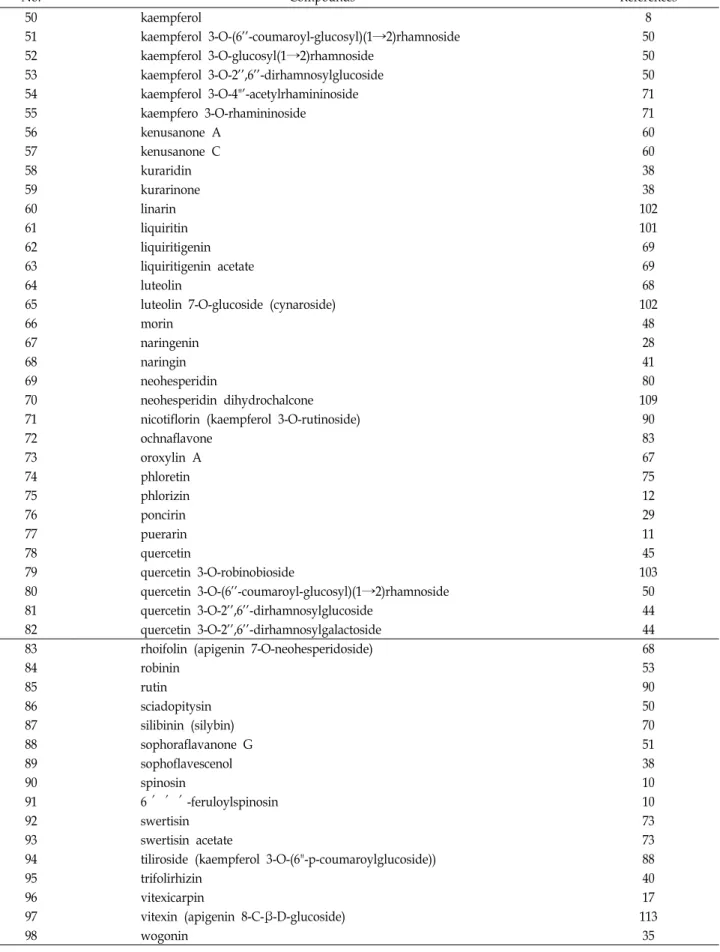
본 실험에서 사용한 98종의 플라보노이드 화합물은 Table 1에 나타내었다. 97종의 화합물은 이전의 선행연구에서 참고 문헌에 제시된 방법으로 천연물로부터 분리 및 구조 동정하였 고, flavonol (3-hydroxyflavone)은 Simga사(St. Louis, MO, USA)에서 구입하여 사용하였다. 시료는 Dimethyl sulfoxide (DMSO)로 1 mg/ml 농도로 희석하여 최종 농도 10 μg/ml에 서 활성을 측정하였다.
HMG-CoA reductase 활성
콜레스테롤 합성 저해 활성은 HMG-CoA reductase assay kit (Sigma, St. Louis, MO, USA)를 사용하여 in vitro에서 측정 하였다. 간략하면, HMG-CoA reductase에 의해 HMG-CoA가 mevalonate로 환원될 때 NADPH가 NADP+ 로 산화되는 정 도를 340 nm에서 15분간 흡광도의 변화로 측정하였다(Molec- ular Devices Co., Sunnyvale, CA, USA). Pravastatin을 pos- itive control로 사용하여 시료의 저해 활성과 비교하였다. HMG- CoA reductase 활성 저해율(%)은 아래의 계산식과 같이blank 의 흡광도 변화(100% 활성)에 대한 시료의 흡광도 변화로 계 산하였다.
활성 저해율(%) = (1 - 시료의 흡광도 변화/Blank의 흡광도 변화) ×100.
이후 HMG-CoA reductase 활성 저해율이 20% 이상인 시료 들에 대해서는 50%의 활성 저해를 나타내는 시료 농도(IC50)를 구하였다.
결과 및 고찰
플라보노이드는 사실상 모든 식이성 식물에 존재하는 저분 자의 폴리페놀 화합물이다[95]. 주로 꽃과 과일에서 노란색, 주황색, 빨간색을 띠며 가을 단풍의 색깔로도 알려져 있다.
식물체에는 구조적으로 독특한 4,000여 가지 이상의 플라보노 이드가 있는 것으로 확인되었다. 이들 화합물은 phenyl ben- zopyrone 골격(C6-C3-C6)의 공통적인 구조를 가지고 있으며, 이중 결합과 중앙에 위치한 고리의 개방 여부에 따라 flavonols, flavanols, flavanonols, flavanones, flavones 및 isoflavones으 로 분류된다[13, 20, 31, 79, 95].
플라보노이드는 래디칼 소거[77], 항산화[6], 항혈전[5, 85, 101], 항허혈증[93, 96, 108], 항부정맥[30], 항고혈압[23, 75], 항염증 활성[94], 산화성 스트레스에 의해 유도된 세포사멸 저 해[87] 등을 통해 심혈관계 질환의 치료에 효과를 나타내는 것으로 알려져 있으며[80, 113], 실제 감귤류와 다양한 약용식 물 유래의 플라보노이드는 전 세계적으로 전통 의학에 널리 사용되고 있다[14, 16, 39, 92, 99].
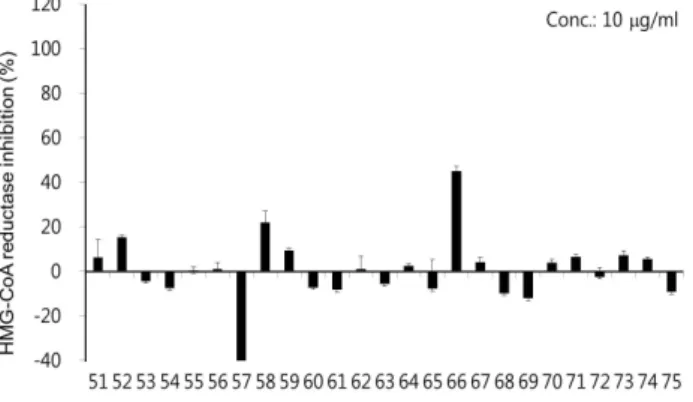
본 연구에서 플라보노이드 및 관련 화합물 98종의 HMG- CoA reductase 저해 활성을 측정한 결과(Fig. 1, Fig. 2, Fig.
3 및 Fig. 4), 시료 농도 10 μg/ml에서 저해율이 가장 높은 화합물은 sophoraflavanone G 로 54.6%의 저해를 보였고, 다 음으로 morin 45.0%, kuraridin 21.9%의 순으로 나타났다. 한 편 시료 농도 50 μg/ml에서 20% 이상의 저해 활성을 나타낸 시료로는, kenusanone A (37.0%), isoquercitrin (26.6%), liq- uiritigenin (25.8%), kurarinone (24.4%), 7,8-dihydroxyflavone (23.6%) 등이 있었다(data not shown). 이상의 시료들 가운데 10 μg/ml에서 저해 활성이 높게 나타난 3종의 플라보노이드 화합물을 대상으로 IC50값을 계산하였다(Table 2). 그 결과, sophoraflavanone G의 IC50는 7.3 μg/ml, morin과 kuraridin 은 각각 13.3 μg/ml과 87.4 μg/ml으로 나타났다. Positive con- trol로 사용한 pravastatin의 저해율은 0.1 μg/ml에서 92.9%였다.
Morin[2-(2,4-dihydroxyphenyl)-3,5,7-trihydroxy-4H-1-ben zopyran-4-one]은 무화과와 같은 뽕나무과 식물에서 주로 분 리되지만 아몬드 껍질과 황목에서도 분리되는 황색 색소인 플라본이다. Morin은 강력한 항산화제[111, 112], xanthine ox- idase 저해제[115], 세포 증식 저해제[64], apoptosis 유도제 [78]로 작용하며 구강암 예방 활성을 나타내는 것으로 알려져 있다[56]. 또한 아라키돈산 대사에서 lipoxygenase와 cyclo- oxygenase 활성 조절제로 작용하여[66] 급성 대장염 쥐에서 장 염증 활성을 저해하며[24, 83], lipopolysaccharide로 유도된 패혈성 쇼크의 발병률을 감소시키는 것으로 알려져 있다[22].
한편 sophoraflavanone G는 Sophora flavescens Aiton (Leguminosae)의 건조 뿌리에서 분리된 주요 lavandulylated flavanones 중 하나로, 항 말라리아, 항균, 항 바이러스 및 항산 화 작용이 있으며, lipopolysaccharide로 처리 한 RAW 세포에 서 nitric oxide와 prostaglandin E2의 생성을 저해하는 것으로 알려져 있다[9, 18, 37, 63, 107]. Sophora flavescens 의 건조뿌리 인 Sophorae radix는 전통적으로는 해열제, 진통제, 구충제 및 건위제로 사용되어 온 약초로서[34, 59, 65], formononetin, kushenol E, kushenol B, sophoraflavanone G, kushenol L,
Table 1. The list of 98 flavonoid compounds
No. Compounds References
1 amentoflavone 50
2 amurenoside B 44
3 anhydroicaritin 3-O-rhamnoside 54
4 apigenin 102
5 artemetin 49
6 astragalin (kaempferol 3-O-β-D-glucoside) 90
7 astrapterocarpan 3-O-glucoside (methylnissolin 3-O-β-glucoside) 69
8 avicularin (quercetin 3-O-α-L-arabinofuranoside) 42
9 baicalin 89
10 baicalein 33
11 bilobetin 50
12 calycosin 69
13 calycosin 7-O-glucoside 69
14 catharticin (alaternin, rhamnocitrin 3-O-rhamininoside) 71
15 (+)-catechin 60
16 chrysin 33
17 daidzein 69
18 7,8-dihydroxyflavone 117
19 diosmetin 7-O-glucoside 104
20 echinoisoflavanone 60
21 echinoisosophoranone 60
22 epicatechin acetate 19
23 epimedin A 43
24 epimedin B 43
25 epimedin C 43
26 epimedoside A 43
27 eupatilin 97
28 evodioside B 113
29 formononetin 69
30 formononetin acetate 69
31 galangin 52
32 galangin 3-O-methyl ether 52
33 genistein 87
34 genistin 57
35 flavonol (3-hydroxyflavone) Sigma
36 hesperidin (hesperetin 7-O-rutinoside) 113
37 hyperin (hyperoside, quercetin 3-O-galactopyranoside) 62
38 icariin 54
39 isoginkgetin 50
40 isoliquiritigenin 101
41 isoliquiritigenin monoacetate 101
42 isomucronulatol 7-O-glucoside 69
43 isoquercitrin (quercetin 3-O-glucopyranoside) 68
44 isorhamnetin 46
45 isorhamnetin 3-O-galactoside (casticin) 55
46 isosophoranone 60
47 isospinosin 72
48 isoxanthohumol 51
49 kaemferide 52
Table 1. Continued
No. Compounds References
50 kaempferol 8
51 kaempferol 3-O-(6''-coumaroyl-glucosyl)(1→2)rhamnoside 50
52 kaempferol 3-O-glucosyl(1→2)rhamnoside 50
53 kaempferol 3-O-2'',6''-dirhamnosylglucoside 50
54 kaempferol 3-O-4"'-acetylrhamininoside 71
55 kaempfero 3-O-rhamininoside 71
56 kenusanone A 60
57 kenusanone C 60
58 kuraridin 38
59 kurarinone 38
60 linarin 102
61 liquiritin 101
62 liquiritigenin 69
63 liquiritigenin acetate 69
64 luteolin 68
65 luteolin 7-O-glucoside (cynaroside) 102
66 morin 48
67 naringenin 28
68 naringin 41
69 neohesperidin 80
70 neohesperidin dihydrochalcone 109
71 nicotiflorin (kaempferol 3-O-rutinoside) 90
72 ochnaflavone 83
73 oroxylin A 67
74 phloretin 75
75 phlorizin 12
76 poncirin 29
77 puerarin 11
78 quercetin 45
79 quercetin 3-O-robinobioside 103
80 quercetin 3-O-(6''-coumaroyl-glucosyl)(1→2)rhamnoside 50
81 quercetin 3-O-2'',6''-dirhamnosylglucoside 44
82 quercetin 3-O-2'',6''-dirhamnosylgalactoside 44
83 rhoifolin (apigenin 7-O-neohesperidoside) 68
84 robinin 53
85 rutin 90
86 sciadopitysin 50
87 silibinin (silybin) 70
88 sophoraflavanone G 51
89 sophoflavescenol 38
90 spinosin 10
91 6′′′-feruloylspinosin 10
92 swertisin 73
93 swertisin acetate 73
94 tiliroside (kaempferol 3-O-(6"-p-coumaroylglucoside)) 88
95 trifolirhizin 40
96 vitexicarpin 17
97 vitexin (apigenin 8-C-β-D-glucoside) 113
98 wogonin 35
Fig. 1. HMG-CoA reductase inhibition (%) of flavonoid com- pounds (From No. 1 to 25). Final concentration of sam- ple is 10 μg/ml. Compounds: 1, amentoflavone; 2, amur- enoside B; 3, anhydroicaritin3-O-rhamnoside; 4, apige- nin; 5, artemetin; 6, astragalin (kaempferol 3-O-β-D-glu- coside); 7, astrapterocarpan 3-O-glucoside (methylnissolin 3-O-β-glucoside); 8, avicularin (quercetin 3-O-α-L-arabi- nofuranoside); 9, baicalin; 10, baicalein; 11, bilobetin; 12, calycosin; 13, calycosin 7-O-glucoside; 14, catharticin (alaternin, rhamnocitrin 3-O-rhamininoside); 15, (+)-cat- echin; 16, chrysin; 17, daidzein; 18, 7,8-dihydroxyflavone;
19, diosmetin 7-O-glucoside; 20, echinoisoflavanone; 21, echinoisosophoranone; 22, epicatechin acetate; 23, epi- medin A; 24, epimedin B; 25, epimedin C.
Fig. 2. HMG-CoA reductase inhibition of flavonoid compounds (From No. 26 to 50). Final concentration of sample is 10 μg/ml. Compounds: 26, epimedoside A; 27, eupatilin; 28, evodioside B; 29, formononetin; 30, formononetin ace- tate; 31, galangin; 32, galangin 3-O-methylether; 33, enis- tein; 34, genistin; 35, flavonol (3-hydroxyflavone); 36, hesperidin (hesperetin 7-O-rutinoside); 37, hyperin (hyperoside,quercetin 3-O-galactopyranoside); 38, icar- iin; 39, isoginkgetin; 40, isoliquiritigenin; 41, isoliquir- itigenin monoacetate; 42, isomucronulatol 7-O-glucoside;
43, isoquercitrin (quercetin 3-O-glucopyranoside); 44, isorhamnetin; 45, casticin (isorhamnetin 3-O-galactoside);
46, isosophoranone; 47, isospinosin; 48, isoxanthohumol;
49, kaemferide; 50, kaempferol.
Fig. 3. HMG-CoA reductase inhibition (%) of flavonoid com- pounds (From No. 51 to 75). Final concentration of sam- ple is 10 μg/ml. Compounds: 51, kaempferol 3-O-(6''- coumaroyl-glucosyl)(1→2)rhamnoside; 52, kaempferol 3-O-glucosyl(1→2)rhamnoside; 53, kaempferol 3-O-2'', 6''-dirhamnosylglucoside; 54, kaempferol 3-O-4"'-ace- tylrhamininoside; 55, kaempferol 3-O-rhamininoside; 56, kenusanone A; 57, kenusanone C; 58, kuraridin; 59, kur- arinone; 60, linarin; 61, liquiritin; 62, liquiritigenin; 63, liquiritigenin acetate; 64, luteolin; 65, luteolin 7-O-gluco- side(cynaroside); 66, morin; 67, naringenin; 68, naringin;
69, neohesperidin; 70, neohesperidin dihydrochalcone;
71, nicotiflorin(kaempferol 3-O-rutinoside); 72, ochna- flavone; 73, oroxylin A; 74, phloretin; 75, phlorizin.
Fig. 4. HMG-CoA reductase inhibition (%) of flavonoid com- pounds (From No. 76 to 98). Final concentration of sam- ple is 10 μg/ml. Compounds: 76, poncirin; 77, puerarin;
78, quercetin; 79, quercetin 3-O-robinobioside; 80, quer- cetin 3-O-(6''-coumaroyl-glucosyl)(1→2)rhamnoside; 81, quercetin 3-O-2'',6''-dirhamnosylglucoside; 82, quercetin 3-O-2'',6''-dirhamnosylgalactoside; 83, rhoifolin (apige- nin 7-O-neohesperidoside); 84, robinin; 85, rutin; 86, scia- dopitysin; 87, silibinin (silybin); 88, sophoraflavanone G;
89, sophoflavescenol; 90, spinosin; 91, 6'''-feruloylspin- osin; 92, swertisin; 93, swertisin acetate; 94, tiliroside (kaempferol 3-O-(6"-p-coumaroylglucoside)); 95, trifolir- hizin; 96, vitexicarpin; 97, vitexin (apigenin 8-C-β-D-glu- coside); 98, wogonin.
Table 2. HMG-CoA reductase inhibition (%) and half maximal inhibitory concentration (IC50) of flavonoid compounds
Compounds Concentration (μg/ml)
0.1 10.0 25.0 50.0 100.0 IC50
pravastatin 92.9
kuraridin morin
sophoraflavanone G
21.9 45.0 54.6
ND 62.3 77.5
43.2 73.3 117.6
85.5 ND*
ND
87.4 13.3 7.3
*ND : Not determined.
A B
C
Fig. 5. Structure of finally selected flavonoidic compounds. A:
kuraridin, B: morin, C: sophoraflavanone G.
kushenol M, kuraridin, kurarinone, kushenol N, 및 kushenol F와 같은 다양한 플라보노이드가 함유되어 있는 것으로 보고 되어 있다[15, 36, 97, 100].
상기와 같이, 98종의 플라보노이드 화합물을 대상으로 HMG- CoA reductase 저해 활성을 탐색한 결과, sophoraflavanone G 와 morin의 저해 활성이 가장 강력한 것으로 확인되었으며, 이들을 이용한 고콜레스테롤혈증 개선 효과를 가지는 건강기 능성 식품 또는 약품의 개발을 위한 추후 연구가 필요한 것으 로 사료된다.
감사의 글
이 논문은 2015학년도 안동대학교 연구비에 의하여 연구되 었음.
References
1. Anderson, J. W., Johnstone, B. M. and Cook-Newell, M. E.
1995. Meta-analysis of the effects of soy protein intake on serum lipids. N. Engl. J. Med. 333, 276-282.
2. Anderson, K. M., Wilson, P. W., Garrison, R. J. and Castelli, W. P. 1987. Longitudinal and secular trends in lipoprotein cholesterol measurements in a general population sample.
The Framingham offspring study. Atherosclerosis 68, 59-66.
3. Ansell, B. J., Watson, K. E. and Fogelman, A. M. 1999. An evidence-based assessment of the NCEP adult treatment panel II guidelines. JAMA. 282, 2051-2057.
4. Arai, Y., Watanabe, S., Kimira, M., Shimoi, K., Mochizuki, R. and Kinae, N. 2000. Dietary intakes of flavonols, flavones and isoflavones by Japanese women and the inverse correla- tion between quercetin intake and plasma LDL cholesterol concentration. J. Nutr. 130, 2243-2250.
5. Bagchi, D., Sen, C. K., Ray, S. D., Das, D. K., Bagchi, M., Preuss, H. G. and Vinson, J. A. 2003. Molecular mechanisms of cardioprotection by a novel grape seed proanthocyanidin extract. Mutat. Res. 523-524, 87-97.
6. Belinky, P. A., Aviram, M., Mahmood, S. and Vaya, J. 1998.
Structural aspects of the inhibitory effect of glabridin on LDL oxidation. Free Radic. Biol. Med. 24, 1419-1429.
7. Blankenhorn, D. H., Johnson, R. L., Nessim, S. A., Azen, S. P., Sanmarco, M. E. and Selzer, R. H. 1987. The cholesterol lowering atherosclerosis study (CLAS): design, methods and baseline results. Control Clin. Trials. 8, 356-387.
8. Chae, S. W., Lee, S. Y., Kim, J. S., Bae, K. H., Kim, S. K.
and Kang, S. S. 2006. Constituents from Hypericum ascyron.
Kor. J. Pharmacogn. 37, 162-168.
9. Chen, L., Cheng, X., Shi, W., Lu, Q., Go, V. L., Heber, D.
and Ma, L. 2000. Inhibition of growth of Streptococcus mu- tans, methicillin-resistant Staphylococcus aureus, and vanco- mycin resistant enterococci by kurarinone, a bioactive fla- vonoid isolated from Sophora flavescens. J. Clin. Microbiol. 43, 3574-3575.
10. Cheng, G., Bai, Y., Zhao, Y., Tao, J., Liu, Y., Tu, G., Ma, L., Liao, N. and Xu, X. 2000. Flavonoids from Ziziphus jujuba Mill var. spinosa. Tetrahedron 56, 8915-8920.
11. Cherdshewasart, W., Subtang, S. and Dahlan, W. 2007.
Major isoflavonoid contents of the phytoestrogen rich-herb Pueraria mirifica in comparison with Pueraria lobata. J. Pharm.
Biomed. Anal. 43, 428-434.
12. Cho, J. Y., Lee, K. D., Park, S. Y., Jeong, W. C., Moon, J.
H. and Ham, K. S. 2013. Isolation and identification of α- glucosidase inhibitors from the stem bark of the Nutgall tree (Rhus javanica linné). J. Kor. Soc. Applie. Biol. Chem. 56, 547- 552.
13. Cook, N. C. and Samman, S. 1996. Flavonoids- Chemistry, metabolism, cardioprotective effects, and dietary sources. J.
Nutr. Biochem. 7, 66-76.
14. Craig, W. J. 1999. Health-promoting properties of common herbs. Am. J. Clin. Nutr. 70, 491S-499S.
15. De Naeyer, A., Vander Berghe, W., Pocock, V., Milligan, S., Haegeman, G. and De Keukeleire, D. 2004. Estrogenic and anticarcinogenic properties of kurarinone, a lavandulyl fla- vanone from the roots of Sophora flavescens. J. Nat. Prod. 67, 1829-1832.
16. Di Carlo, G., Mascolo, N., Izzo, A. A. and Capasso, F. 1999.
Flavonoids: old and new aspects of a class of natural ther- apeutic drugs. Life Sci. 65, 337-353.
17. Diaz, F., Chavez, D., Lee, D. H., Mi, Q., Chai, H. B., Tan, G. T., Kardono, L. B. S., Riswan, S., Fairchild, C. R., Wild, R., Farnsworth, N. R., Cordell, G. A., Pezzuto, J. M. and Kinghorn, A. D. 2003. Cytotoxic flavone analogues of vitex- icarpin, a constituent of the leaves of Vitex negundo. J. Nat.
Prod. 66, 865-867.
18. Ding, P. L., Liao, Z. X., Huang, H., Zhou, P. and Chen, D.
F. 2006. (+)-12alpha-Hydroxysophocarpine, a new quinolizi- dine alkaloid and related anti-HBV alkaloids from Sophora flavescens. Bioorg. Med. Chem. Lett. 16, 1231-1235.
19. Do, J. C., Son, K. H. and Kang, S. S. 1988. Studies on the constituents of the roots of Rubus parvifolius (I) -isolation of (-)-epicatechin-. Kor. J. Pharmacogn. 19, 170-173.
20. Ebadi, M. 2002. Flavonoids. In: Pharmacodynamic basis of herbal medicine. CRC Press, 393-403.
21. Endo, A. 1992. The discovery and development of HMG-Co A reductase inhibitors. J. Lipid Res. 33, 1569-1582.
22. Fang, S. H., Hou, Y. C., Chang, W. C., Hsiu, S. L., Chao, P. D. and Chiang, B. L. 2003. Morin sulfates/glucuronides exert anti-inflammatory activity on activated macrophages and decreased the incidence of septic shock. Life Sci. 74, 743- 756.
23. Galisteo, M., Garcia-Saura, M. F., Jimenez, R., Villar, I. C., Zarzuelo, A., Vargas, F. and Duarte, J. 2004. Effects of chron- ic quercetin treatment on antioxidant defense system and oxidative status of deoxycorticosterone acetate-salt- hyper- tensive rats. Mol. Cell Biochem. 259, 91-99.
24. Galvez, J., Coelho, G., Crespo, M. E., Cruz, T., Rodriguez- Cabezas, M. E., Concha, A., Gonzalez, M. and Zarzuelo, A.
2001. Intestinal anti-inflammatory activity of morin on chronic experimental colitis in the rat. Aliment. Pharmacol.
Ther. 15, 2027-2039.
25. Gordon, T. and Kannel, W. B. 1972. Predisposition to athero- sclerosis in the head, heart, and legs. The Framingham study. JAMA. 221, 661-666.
26. Grundy, S. M. 1977. Treatment of hypercholesterolemia. Am.
J. Clin. Nutr. 30, 985-992.
27. Grundy, S. M. 1998. Statin trials and goals of cholesterol- lowering therapy. Circulation 97, 1436-1439.
28. Gujer, R., Magnolato, D. and Self, R. 1986. Glucosylated fla- vonoids and other phenolic compounds from Sorghum.
Phytochem. 25, 1431-1436.
29. Han, A. R., Kim, J. B., Lee, J., Nam, J. W., Lee, I. S., Shim, C. K., Lee, K. T. and Seo, E. K. 2007. A new flavanone glyco- side from the dried immature fruits of Poncirus trifoliata.
Chem. Pharm. Bull. 55, 1270-1273.
30. Haramaki, N., Aggarwal, S., Kawabata, T., Droy-Lefaix, M.
T. and Packer, L. 1994. Effects of natural antioxidant Ginkgo
biloba extract (EGb 761) on myocardial ischemia-reperfusion injury. Free Radic. Biol. Med. 16, 789-794.
31. Harborne, J. B. and Williams, G. A. 2000. Advances in fla- vonoid research since 1992. Phytochemistry 55, 481-504.
32. Hertog, M. G., Kromhout, D., Aravanis, C., Blackburn, H., Buzina, R. and Fidanza, F. 1995. Flavonoid intake and long-term risk of coronary heart disease and cancer in the seven countries study. Arch. Intern. Med. 155, 381-386.
33. Horvatha, C. R., Martosb, P. A. and Saxena, P. K. 2005.
Identification and quantification of eight flavones in root and shoot tissues of the medicinal plant Huang-qin (Scutellaria baicalensis Georgi) using high-performance liquid chromatography with diode array and mass spectrometric detection. J. Chromatogr. A. 1062, 199-207.
34. Hsiang, C. Y., Hsieh, C. L., Wu, S. L., Lai, I. L. and Ho, T. Y. 2001. Inhibitory effect of anti-pyretic and anti-inflam- matory herbs on herpes simplex virus replication. Am. J.
Chin. Med. 29, 459-467.
35. Huang, W. H., Chien, P. Y., Yang, C. H. and Lee, A. R.
2003. Novel synthesis of flavonoids of Scutellaria baicalensis Gerogi. Chem. Pharm. Bull. 51, 339-340.
36. Jin, J. H., Kim, J. S., Kang, S. S., Son, K. H., Chang, H. W.
and Kim, H. P. 2010. Anti-inflammatory and antiarthritic activity of total flavonoids of the roots of Sophora flavescens.
J. Ethnopharmacol. 127, 589-595.
37. Jung, H. J., Kang, S. S., Woo, J. J. and Choi, J. S. 2005. A new lavandulylated flavonoid with free radical and ONOO- scavenging activities from Sophora flavescens. Arch. Pharm.
Res. 28, 1333-1336.
38. Jung, M. J., Kang, S. S., Jung, H. A., Kim, G. J. and Choi, J. S. 2004. Isolation of flavonoids and a cerebroside from the stem bark of Albizzia julibrissin. Arch. Pharm. Res. 27, 593-599.
39. Kadarian, C., Broussalis, A. M., Mino, J., Lopez, P., Gorzalc- zany, S., Ferraro, G. and Acevedo, C. 2002. Hepatoprotective activity of Achyrocline satureioides (Lam.) DC., Pharmacol. Res.
45, 57-61.
40. Kang, M. H., Lee, J. H., Lee, J. H., Cho, S. Y., Choi, J. S., Kim, Y. S., Kang, S. S. and Jung, C. S. 2006. Antigastritic and anti helicobacter pylori of trifolirhizin from Sophora radix. Kor. J. Pharmacogn. 37, 266-271.
41. Kang, M. S. 2009. Isolation of an antibacterial substance against tetracycline resistant gene, tetB, from Poncirus trifo- liata. M. A. Thesis, Pukyong National University, Busan, Korea.
42. Kang, S. S. 1981. Flavonoids from the leaves of Polygonum sachalinense fr. schm.(I). Kor. J. Pharmacogn. 12, 208-210.
43. Kang, S. S. 1991. Flavonoids from Epimedium koreanum. J.
Nat. Prod. 54, 542-546.
44. Kang, S. S., Chang, Y. S. and Kim, J. S. 2000. Two new acy- lated flavonol glycosides from Vicia amurensis. Chem. Pharm.
Bull. 48, 1242-1245.
45. Kang, S. S., Choi, J. S., Lee, M. W., Lee, T. S. and Kim, J.
S. 1998. Antioxidant components from Aralia continentalis.
Kor. J. Pharmacogn. 29, 13-17.
46. Kang, S. S., Choi, J. S., Woo, W. S. and Chi, H. J. 1983.
Isorhamnetin glycosides from the leaves of Typha latifolia.
Kor. J. Pharmacogn. 14, 137-139.
47. Kang, S. S., Kang, Y. J. and Lee, M. W. 1991. Flavonoids from Epimedium koreanum. J. Nat. Prod. 54, 542-546.
48. Kang, S. S., Kim, J. G., Lee, T. H. and Oh, K. B. 2006.
Flavonols inhibit sortases and sortase-mediated Staphylococ- cus aureus clumping to fibrinogen. Biol. Pharm. Bull. 29, 1751- 1755.
49. Kang, S. S., Kim, J. S., Kim, H. J., Jung, Y. R. and Shin, S. W. 1994. Phytochemical analysis of Viticis fructus. Kor.
J. Pharmacogn. 25, 214-220.
50. Kang, S. S., Kim, J. S., Kwak, W. J. and Kim, K. H. 1990.
Flavonoids from the leaves of Ginkgo biloba. Kor. J. Pharma- cogn. 21, 111-120.
51. Kang, S. S., Kim, J. S., Son, K. H., Chang, H. W. and Kim, H. P. 2000. A new prenylated flavanone from the roots of Sophora flavescens. Fitoterapia 71, 511-515.
52. Kang, S. S., Kim, J. S., Son, K. H., Kim, H. P. and Chang, H. W. 2000. Isolation of cox-2 Inhibitors from Alpinia officinarum. Kor. J. Pharmacogn. 31, 57-62.
53. Kang, S. S., Lee, Y. S. and Lee, E. B. 1988. Saponins and flavonoid glycosides from Yellow sweetclover. Arch. Pharm.
Res. 11, 197-202.
54. Kang, S. S., Shin, K. H., Chung, S. G. and Cho, E. H. 1988.
Flavonoids from Epimedium koreanum. Kor. J. Pharmacogn. 19, 93-96.
55. Kang, S. S., Um, B. H., Kim, J. S. and Ahn, B. T. 1997.
Isolation of flavonoids from Evodiae fructus. Kor. J. Pharma- cogn. 28, 9-14.
56. Kawabata, K., Tanaka, T., Honjo, S., Kakumoto, M., Hara, A., Makita, H., Tatematsu, N., Ushida, J., Tsuda, H. and Mori, H. 1999. Chemopreventive effect of dietary flavonoid morin on chemically induced rat tongue carcinogenesis. Int.
J. Cancer 83, 381-386.
57. Kazakov, A. L., Kechatov, E. A. and Chemerko, V. M. 1975.
Isoflavones of the oilcake of the seeds of Glycyne hispida.
Chem. Nat. Compd. 11, 264-265.
58. Kim, D. W., Chi, Y. S., Son, K. H., Chang, H. W., Kim, J.
S., Kang, S. S. and Kim, H. P. 2002. Effects of sophora- flavanone G, a prenylated flavonoid from Sophora flavescens, on cyclooxygenase-2 and in vivo inflammatory response.
Arch. Pharm. Res. 25, 329-335.
59. Kim, Y. C., Kim, H. S., Wataya, Y., Sohn, D. H., Kang, T.
H., Kim, M. S., Kim, Y. M., Lee, G. M., Chang, J. D. and Park, H. 2004. Antimalarial activity of lavandulyl flavanones isolated from the roots of Sophora flavescens. Biol. Pharm. Bull.
27, 748-750.
60. Kim, J. S., Byun, J. H., Kang, S. S., Son, K. H., Kim, H. P.
and Chang, H. W. 2002. Isolation of flavonoids and a sap- onin from Echinosophora koreensis. Kor. J. Pharmacogn. 33, 110- 115.
61. Kim, J. S., Kim, Y. J., Lee, J. Y. and Kang, S. S. 2008. Phyto- chemical studies on Paeoniae radix (2); phenolic and related compounds. Kor. J. Pharmacogn. 39, 28-36.
62. Kim, J. S., Shim, S. H., Xu, Y. N., Kang, S. S., Son, K. H., Chang, H. W., Kim, H. P. and Bae, K. 2004. Phenolic Glyco-
sides from Pyrola japonica. Chem. Pharm. Bull. 52, 714-717.
63. Kim, Y. C., Kim, H. S., Wataya, Y., Sohn, D. H., Kang, T.
H., Kim, M. S., Kim, Y. M., Lee, G. M., Chang, J. D. and Park, H. 2004. Antimalarial activity of lavandulyl flavanones isolated from the roots of Sophora flavescens. Biol. Pharm. Bull.
27, 748-750.
64. Kuo, H. M., Chang, L. S., Lin, Y. L., Lu, H. F., Yang, J. S., Lee, J. H. and Chung, J. G. 2007. Morin inhibits the growth of human leukemia HL-60 cells via cell cycle arrest and in- duction of apoptosis through mitochondria dependent path- way. Anticancer Res. 27, 395-405.
65. Kuroyanagi, M., Arakawa, T., Hirayama, Y. and Hayashi, T. 1999. Antibacterial and antiandrogen flavonoids from Sophora flavescens. J. Nat. Prod. 62, 1595-1599.
66. Laughton, M. J., Evans, P. J., Moroney, M. A., Hoult, J. R.
and Halliwell, B. 1999. Inhibition of mammalian 5-lip- oxygenase and cyclooxygenase by flavonoids and phenolic dietary additives. Relationship to antioxidant activity and to iron ion-reducing ability. Biochem. Pharmacol. 42, 1673- 1681.
67. Lee, D. H. 2007. Studies on the flavonoid constituents iso- lated from the root of Scutellaria baicalensis Georgi. M. A.
Thesis, Andong National University, Andong, Korea.
68. Lee, E. J., Kim, J. S., Kim, H. P., Lee, J. H. and Kang, S.
S. 2010. Phenolic constituents from the flower buds of Lonicera japonica and their 5-lipoxygenase inhibitory activ- ities. Food Chem. 120, 134-139.
69. Lee, E. J., Yean, M. H., Jung, H. S., Kim, J. S. and Kang, S. S. 2008. Phytochemical studies on Astragalus Root (2) - flavonoids and a lignan. Nat. Prod. Sci. 14, 131-137.
70. Lee, J. I., Hsu, B. H., Wu, D. and Barrett, J. S. 2006.
Separation and characterization of silybin, isosilybin, sily- dianin and silychristin in milk thistle extract by liquid chro- matography–electrospray tandem mass spectrometry. J.
Chromatogr. A. 1116, 57-68.
71. Lee, J. Y. 2013. Glycosides from the aerial parts of Patriia villosa. Ph. D. Thesis, Seoul National University, Seoul, Korea.
72. Lee, S. Y., Lee, J. Y., Kim, J. S., Lee, J. H. and Kang, S. S.
2012. Flavonoids from the seeds of Zizyphus jujuba var.
spinosa. Kor. J. Pharmacogn. 43, 127-136.
73. Lennernäs, H. and Fager, G. 1997. Pharmacodynamics and pharmacokinetics of the HMG-CoA reductase inhibitors.
Similarities and differences. Clin. Pharmacokinet. 32, 403-425.
74. Li, W., Sun, Y. N., Yan, X. T., Yang, S. Y., Choi, C. W. and Kim, Y. H. 2013. Phenolic compounds from Desmodium caudatum. Nat. Prod. Sci. 19, 215-220.
75. Liu, X., Wei, J., Tan, F., Zhou, S., Wurthwein, G. and Rohdewald, P. 2004. Pycnogenol, French maritime pine bark extract, improves endothelial function of hypertensive patients. Life Sci. 74, 855-862.
76. Liu, Q., Zeng, H., Jiang, S., Zhang, L., Yang, F., Chen, X.
and Yang, H. 2015. Separation of polyphenols from leaves of Malus hupehensis (Pamp.) Rehder by off-line two-dimen- sional high speed counter-current chromatography com- bined with recycling elution mode. Food Chem. 186, 139-145.
77. Lopez-Lopez, G., Moreno, L., Cogolludo, A., Galisteo, M., Ibarra, M., Duarte, J., Lodi, F., Tamargo, J. and Perez- Vizcaino, F. 2004. Nitric oxide (NO) scavenging and NO protecting effects of quercetin and their biological sig- nificance in vascular smooth muscle. Mol. Pharmacol. 65, 851-859.
78. Manna, S. K., Aggarwal, R. S., Sethi, G., Aggarwal, B. B. and Ramesh, G. T. 2007. Morin (3,5,7,2',4'-Pentahydroxyflavone) abolishes nuclear factor-kB activation induced by various carcinogens and inflammatory stimuli, leading to suppre- ssion of nuclear factor- kB-regulated gene expression and up-regulation of apoptosis. Clin. Cancer Res. 13, 2290-2297.
79. Harboume, J. B. 1993. The impact of plant flavonoids on mammalian biology: implications for immunity, inflamma- tion and cancer. In: The flavonoids advances in research since 1986. 619-652.
80. Mojzisova, G. and Kuchta, M. 2001. Dietary flavonoids and risk of coronary heart disease. Physiol. Res. 50, 529-535.
81. Nogata, Y., Sakamoto, K., Shiratsuchi, H., Ishii, T., Yano, M. and Ohta, H. 2006. Flavonoid composition of fruit tissues of Citrus species. Biosci. Biotechnol. Biochem. 70, 178-192.
82. O’Rourke, Y., VanderZanden, A., Shepard, D. and Leach- Kemon, K. 2015. Cardiovascular disease worldwide, 1990- 2013. JAMA. 314, 1905.
83. Ocete, M. A., Galvez, J., Crespo, M. E., Cruz, T., Gonzalez, M., Torres, M. I. and Zarzuelo, A. 1998. Effects of morin on an experimental model of acute colitis in rats. Pharmacol- ogy 57, 261-270.
84. Okigawa, M., Kawano, N., Aqil, M. and Rahman, W. 1973.
The structure of ochnaflavone, a new type of biflavone and the synthesis of its pentamethyl ether. Tetrahedron Lett. 14, 2003-2006.
85. Osman, H. E., Maalej, N., Shanmuganayagam, D. and Folts, J. D. 1998. Grape juice but not orange or grapefruit juice inhibits platelet activity in dogs and monkeys. J. Nutr. 128, 2307-2312.
86. Paladini, A. C., Marder, M., Viola, H., Wolfman, C., Wasow- ski, C. and Medina, J. H. 1999. Flavonoids and the central nervous system: from forgotten factors to potent anxiolytic compounds. J. Pharm. Pharmacol. 51, 519-526.
87. Park, C., So, H. S., Shin, C. H., Baek, S. H., Moon, B. S., Shin, S. H., Lee, H. S., Lee, D. W. and Park, R. 2003.
Quercetin protects the hydrogen peroxide- induced apopto- sis via inhibition of mitochondrial dysfunction in H9c2 car- diomyoblast cells. Biochem. Pharmacol. 66, 1287-1295.
88. Park, J. G., Cheon, H. J., Kim, Y. S., Kang, S. S., Choi, J.
S. and Lee, S. M. 2007. Hepatoprotective activities of daid- zin, daidzein, genistein and puerarin in primary cultured rat hepatocytes. Yakhak Hoeji. 51, 115-125.
89. Park, S. H. 2014. Antioxidant compounds from the ethyl ace- tate fraction of Daphne genkwa S. et Z. Ph. D. Thesis, Woosuk University, Wanju, Korea.
90. Park, S. W., Lee, C. H., Kim, Y. S., Kang, S. S., Jeon, S. J.
Son, K. H. and Lee, S. M. 2008. Protective effect of baicalin against carbon tetrachloride–induced acute hepatic injury in mice. J. Pharmacol. Sci. 106, 136-143.
91. Park, S. Y., Kim, J. S., Lee, S. Y. Bae, K. H. and Kang, S.
S. 2008. Chemical constituents of Lathyrus davidii. Nat. Prod.
Sci. 14, 281-288.
92. Pascual, M. E., Slowing, K., Carretero, E., Sanchez Mata, D. and Villar, A. 2001. Lippia: traditional uses, chemistry and pharmacology: a review. J. Ethnopharmacol. 76, 201-214.
93. Pietri, S., Maurelli, E., Drieu, K. and Culcasi, M. 1997.
Cardioprotective and anti-oxidant effects of the terpenoid constituents of Ginkgo biloba extract (EGb 761). J. Mol. Cell.
Cardiol. 29, 733-742.
94. Read, M. A. 1995. Flavonoids: naturally occurring anti-in- flammatory agents. Am. J. Pathol. 147, 235-237.
95. Ren, W., Qiao, Z., Wang, H., Zhu, L. and Zhang, L. 2003.
Flavonoids: promising anticancer agents. Med. Res. Rev. 23, 519-534.
96. Rump, A. F., Schussler, M., Acar, D., Cordes, A., Ratke, R., Theisohn, M., Rosen, R., Klaus, W. and Fricke, U. 1995.
Effects of different inotropes with antioxidant properties on acute regional myocardial ischemia in isolated rabbit hearts. Gen. Pharmacol. 26, 603-611.
97. Ryu, S. Y., Kim, S. K., No, Z. and Ahn, J. W. 1960. A novel flavonoid from Sophora flavescens. Planta. Medica. 62, 361- 363.
98. Ryu, S. N., Han, S. S., Yang, J. J., Jeong, H. G. and Kang, S. S. 2005. Variation of eupatilin and jaceosidin content of Mugwort. Kor. J. Crop Sci. 50, 204-207.
99. Samuelsen, A. B. 2000. The traditional uses, chemical con- stituents and biological activities of Planta go major L. A.
Review. J. Ethnopharmacol. 71, 1-21.
100. Shen, C. C., Lin, T. W., Huang, Y. L., Wan, S. T., Shien, B. J. and Chen, C. C. 2006. Phenolic constituents of the roots of Sophora flavenscens. J. Nat. Prod. 69, 1237-1240.
101. Shen, J. G. and Zhou, D. Y. 1995. Efficient of Ginkgo biloba extract (EGb 761) in antioxidant protection against my- ocardial ischemia and reperfusion injury. Biochem. Mol.
Biol. Int. 35, 125-134.
102. Shim, S. H., Lee, S. Y., Kim, J. S., Son, K. H. and Kang, S. S. 2005. Norditerpenoid alkaloids and other components from the processed tubers of Aconitum carmichaeli. Arch.
Pharm. Res. 28, 1239-1243.
103. Shin, H. J., Lee, S. Y., Kim, J. S., Lee, S. H., Choi, R. J., Chung, H. S., Kim, Y. S. and Kang, S. S. 2012. Sesquiter- penes and other constituents from Dendranthema zawadskii var. latilobum. Chem. Pharm. Bull. 60, 306-314.
104. Slimestada, R., Torskangerpoll, K., Nateland, H. S., Johan- nessen, T. and Giske, N. H. 2005. Flavonoids from Black chokeberries, Aronia melanocarpa. J. Food Compos. Anal. 18, 61-68.
105. Son, K. H., Kim, J. S., Kang, S. S., Kim, H. P. and Chang, H. W. 1994. Isolation of flavonoids from Lonicera japonica.
Kor. J. Pharmacogn. 25, 24-27.
106. Son, K. H., Lee, J. H., Lee, J. S., Kang, S. S., Sohn, H. Y.
and Kwon, C. S. 2017. Screening of phenolic compounds with inhibitory activities against HMG-CoA reductase. J.
Life Sci. 27, 325-333.
107. Tashiro, M., Suzuki, F., Shirataki, Y., Yokote, Y., Akahane,
초록:플라보노이드 화합물로부터 HMG-CoA reductase 저해 활성 물질 탐색
손건호1․이주연1․이정순2․강삼식3․손호용1․권정숙1*
(1안동대학교 생활과학대학 식품영양학과, 2경상북도산림자원개발원, 3서울대학교 천연물과학연구소)
심혈관계 질환은 질환별 사망률 순위에 있어서 세계에서는 1위이며, 우리나라에서는 2위인 질병이다. 심혈관계 질환 발생의 주 위험 요인인 콜레스테롤은 HMG-CoA reductase에 의해 간에서 신생합성이 조절된다. 현재 고콜 레스테롤혈증 치료에 statin이 널리 사용되고 있지만 광범위한 부작용이 보고되고 있어서 이를 대체하거나 보조할 수 있는 천연물 유래의 기능성 물질 개발이 필요한 실정이다. 따라서 본 연구에서는 혈장 콜레스테롤 감소 활성을 가지는 물질을 발굴하고자 98종의 플라보노이드 및 그와 관련된 화합물들을 대상으로 10 μg/ml 농도에서 HMG-CoA reductase 저해 활성을 탐색하였다. 그 결과, sophoraflavanone G, morin, 및 kuraridin이 각각 54.6%, 45.04% 및 21.9%의 저해활성을 타내었으며, IC50값을 계산한 결과, sophoraflavanone G가 7.3 μg/ml로 가장 낮았 으며 morin과 kuraridin은 각각 13.3 μg/ml과 87.4 μg/ml으로 확인되어, 향후 고콜레스테롤혈증 예방 및 치료제 의 가능성을 제시하였다.
K., Motohashi, N., Ishihara, M., Jiang, Y. and Sakagami, H. 2002. Effects of prenylflavanones from Sophora species on growth and activation of mouse macrophage-like cell line. Anticancer Res. 22, 53-58.
108. Varga, E. 2002 The protective effect of EGb 761 in isolated ischemic/reperfused rat hearts. Acta. Pharm. Hung. 72, 265- 271.
109. Wierzbicki, A. S. 2003. New lipid-lowering agents. Expert Opin. Emerg. Drugs. 8, 365-376.
110. Wong, R. and Horowitz, R. M. 1986. The x-ray crystal and molecular structure of neohesperidin dihydrochalcone sweetener. J. Chem. Soc. Perkin Trans. 1. 5, 843-848.
111. Wu, T. W., Zeng, L. H., Wu, J. and Fung, K. P. 1993. Morin hydrate is a plant-derived and antioxidant-based hep- atoprotector. Life Sci. 53, 213-218.
112. Wu, T. W., Zeng, L. H., Wu, J. and Fung, K. P. 1994. Morin:
a wood pigment that protects three types of human cells in the cardiovascular system against oxyradical damage.
Biochem. Pharmacol. 47, 1099-1103.
113. Yamashiro, S., Noguchi, K., Matsuzaki, T., Miyagi, K., Nakasone, J., Sakanashi, M., Sakanashi, M., Kukita, I., Aniya, Y. and Sakanashi, M. 2003. Cardioprotective effects of extracts from Psidium guajava L. and Limonium wrightiiy
Okinawan medicinal plants, against ischemia-reperfusion injury in perfused rat hearts. Pharmacology 67, 128-135.
114. Yoo, S. W., Kim, J. S., Kang, S. S., Son, K. H., Chang, H.
W., Kim, H. P., Bae, K. H. and Lee, C. O. 2002. Constituents of the fruits and leaves of Euodia daniellii. Arch. Pharm. Res.
25, 824-830.
115. Yu, Z., Fong, W. P. and Cheng, C. H. 2006. The dual actions of morin (3,5,7,2',4'-pentahydroxyflavone) as a hypour- icemic agent: uricosuric effect and xanthine oxidase in- hibitory activity. J. Pharmacol. Exp. Ther. 316, 169-175.
116. Zhan, S. and Ho, S. C. 2005. Meta-analysis of the effects of soy protein containing isoflavones on the lipid profile.
Am. J. Clin. Nutr. 81, 397-408.
117. Zhang, Y., Zhu, H., Ye, G., Huang, C., Yang, Y., Chen, R., Yu, Y. and Cui, X. 2006. Antiviral effects of sophoridine against coxsackievirus B3 and its pharmacokinetics in rats.
Life Sci. 78, 1998-2005.
118. Zhang, R., Kang, K. A., Piao, M. J., Ko, D. O., Wang, Z.
H., Chang, W. Y., You, H. J., Lee, I. K., Kim, B. J., Kang, S. S. and Hyun, J. W. 2009. Preventive effect of 7,8-dihy- droxyflavone against oxidative stress induced genotoxicity.
Biol. Pharm. Bull. 32, 166-171.