Antioxidant Activities of Various Extracts of Hovenia dulcis Thunb Fruits
Weicheng Hu
1,2, Kabyeon Lee
3 and Myeong-Hyeon Wang
1*
1
College of Biomedical Science, Kangwon National University, Chuncheon 200-701, Korea
2
College of Biosciences and Biotechnology, Yangzhou University, Yangzhou 225009, China
3
Korea Forest Research Institute, 44-3 Omokchon-dong, Kwonsun-ku, Suwon, 441-847, Korea
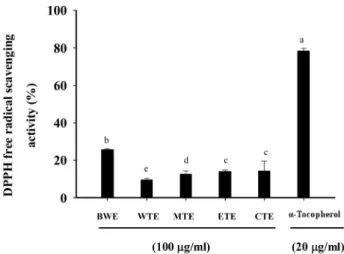
Abstract - Hovenia dulcis Thunb fruits were successively extracted with hot water, water, methanol, ethyl acetate, and
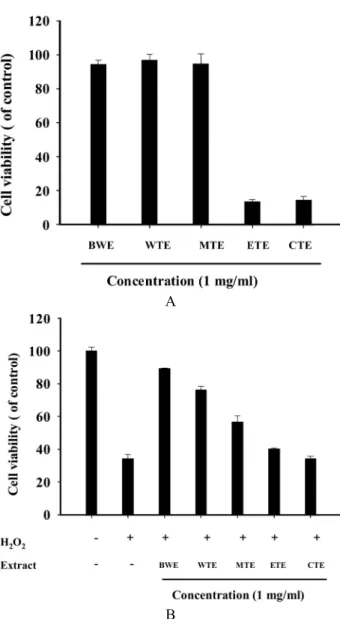
chloroform. The crude extracts were investigated for potential antioxidant by measuring scavenging against DPPH free radicals, reducing power, superoxide radicals, and protection of protein damage and cultured cells from a lethal dose of hydrogen peroxide (H
2O
2). In all chemical assays used, the hot water extract of H. dulcis fruits, which contained 61.14 ± 2.57 (Tannic acid mg/g extract, n=3) of total phenolic compounds contents exhibited highest activity in in vitro models of DPPH free radical scavenging activity, reducing power assay, superoxide radical scavenging activity and protection of protein damage. In addition, the hot water extract protected cultured RAW 264.7 macrophages from a lethal dose of H
2O
2
and reduced reactive oxygen species level in RAW 264.7 cells.
Key words - Hovenia dulcis fruit, Antioxidant, Reactive oxygen species, Protein damage
Introduction
Reactive oxygen species (ROS) and reactive nitrogen species (RNS) including free radicals such as superoxide ra- dical anion (•O2
-), hydroxyl radicals (•OH), singlet oxygen (
1O
2), hydrogen peroxide (H
2O
2) and nitric oxide (NO) are constantly produced continuously in the cells of the human body (Fang et al., 2002). Oxidation is essential in living orga- nisms to obtain the energy needed for biological processes.
However, excessively high levels of free radicals or ROS create oxidative stress, which leads to produce some detri- mental effects, including lipid peroxidation of cellular memb- ranes, alteration of lipid–protein interaction, enzyme inacti- vation and DNA breakage, and in the end, to cause cell injury, necrosis or apoptosis (Lefebvre et al., 2002; Agarwal et al., 2003). Although human body has multiple antioxidant sys- tems to protect the cellular molecules against the oxygen radi- cals induced damage. These defense mechanisms include antioxidative enzymes, such as superoxide dismutase, cata- lase and glutathione peroxidase. The innate defense is not enough for severe oxidative stress, and therefore overpro-
duction of oxidative radicals may cause tissue damages (Blok- hina et al., 2003; Lassen et al., 2008). Consequently, certain amounts of exogenous antioxidants are constantly required to retain an adequate level of antioxidants in order to balance the ROS in human body (Reiter et al., 1997). Therefore, much attention has been focused on natural antioxidants. Plants contain a variety of free radical scavenging molecules such as phenolic compounds, nitrogen compounds, vitamins, terpe- noids, and other endogenous metabolites that are rich in anti- oxidant activity (Su et al., 2009; Huang et al., 2010).
Hovenia dulcis Thunb, belongs to Rhamnaceae family, is
wildly distributed in East Asia. It has been used in traditional
folk remedies for the treatment of liver diseases and detoxi-
fication of alcoholic poisoning. H. dulcis can remarkably re-
duce alcohol concentration in blood; thereby alleviate alco-
holic liver tissue (Hase et al., 1997; Kim, 2001). Some per-
vious literatures showed that H. dulcis possessed antioxi-
dative, antimicrobial, anti-diabetic, and anticancer activities
(Wang et al., 1994; Lee et al., 1999; Cho et al., 2000; Ji et al.,
2002). The fruit of H. dulcis is edible raw or cooked. Some
researchers reported that the fruits of H. dulcis own hepatop-
rotective activity (Ko et al., 2006). Nevertheless, research on
the directly free radical scavenging activity the fruit of H.