• 검색 결과가 없습니다.

Latitudinal Differences in the Distribution of Mesozooplankton in the Northeastern Equatorial Pacific

N/A
N/A
Protected

Academic year: 2021

Share "Latitudinal Differences in the Distribution of Mesozooplankton in the Northeastern Equatorial Pacific"

Copied!
10
0
0

로드 중.... (전체 텍스트 보기)

전체 글

(1)

Article

Latitudinal Differences in the Distribution of Mesozooplankton in the Northeastern Equatorial Pacific

Jung-Hoon Kang * , Woong-Seo Kim, and Seung-Kyu Son

Marine Geoenvironment and Resources Research Division, KORDI Ansan P.O. Box 29, Seoul 425-600, Korea

Abstract : To investigate latitudinal variations in the zooplankton community along the meridian line (5

o

N- 12

o

N, 131.5

o

W), we measured temperature, salinity, nitrate, chlorophyll-a and zooplankton at depths above 200 m from July 10

th

to 25

th

, 2003. For comparative analysis, data of the physico-chemical properties and chl-a were matched to the two sampling depths (surface mixed layer and thermocline depth-200 m) of zooplankton. Latitudinal differences in the mesozooplankton distribution were mainly influenced by diver- gence formed at a boundary line formed by currents of opposing directions, consisting of North Equatorial Current (NEC) and North Equatorial Counter Current (NECC). High concentrations of chl-a south of 9

o

N, caused by equatorial upwelling related nutrients, is thought to be affected by the role of this divergence bar- rier, supported by relatively low concentrations in waters north of 9

o

N. The latitudinal differences of the chl-a were significantly associated with the major groups of zooplankton, namely calanoid and cyclopoid copepods, appendicularians, ostracods, chaetognaths, invertebrate larvae, and others. And temperature sig- nificantly affected the latitudinal variation of radiolarians, siphonophores, salps and immature copepods.

The latitudinal differences in the two factors, temperature and chl-a, which explained 71.0% of the total zooplankton variation, were characterized by the equatorial upwelling as well as the divergence at 9

o

N. The physical characteristics also affected the community structure and abundance of zooplankton as well as average ratios of cyclopoid versus calanoid copepods. The abundance of dominant copepods, which were consistent with chl-a, were often associated with the carnivorous zooplankton chaetognaths, implying the relative importance of bottom-up regulation from physical properties to predatory zooplankton during the study period. These results suggested that latitudinal distribution of zooplankton is primarily controlled by current-related divergences, while biological processes are of secondary importance in the northeastern Equatorial Pacific during the study period in question.

Key words : Calanoid and cyclopoid copepods, divergence, bottom-up regulation

1. Introduction

The present study stems from the survey associated with deep-sea mining in the KODOS (Korea Deep Ocean Study) area present at the Clarion-Clipperton Fracture Zone located in the southeastern part of the North Pacific Ocean. The study area, which is located in the southeastern part of the North Pacific gyre, is characterized by oligotrophic waters with low nutrients and chl-a concentrations below 1 µg/l (MOMAF 1996) and high species diversity of the copepod community (McGowan and Walker 1979).

The equatorial Pacific divergence is the world’s largest and most seasonally consistent source of upwelled waters affecting the ocean surface. The upwelled waters may support a significant amount of new production per year (Chavez and Barber 1987) and influence the latitudinal gradients of plankton dynamics. Primary production and chlorophyll are usually high near the equator and decrease north and south of the equator (Blackburn et al. 1970; Vinogradov 1981; Barber et al. 1996), while mesozooplankton (>200 µm) often exhibit peaks in abundance farther to the north and south than phytoplankton (Vinogradov 1981; White et al. 1995; Le Borgne et al. 2003) due to slower growth rates as compared to phytoplankton. The “downstream”

*Corresponding author. / E-mail : [email protected]

(2)

352 Kang, J.-H. et al.

succession of phytoplankton, herbivorous, carnivorous zooplankton and fish, which contribute to the spatial patterns of mesozooplankton, is a result of temporal evolution of plankton communities in response to upwelling and sub- sequent northward meridional transport of upwelled materials (Roman et al. 2002).

At latitudes further north, divergences occurring between the westward North Equatorial Current (NEC) and the eastward North Equatorial Counter Current (NECC), which characterized the physico-chemical environments of the northeastern Equatorial Pacific, draw up the bottom waters resulting in the enhancement of phytoplankton production (Betzer et al. 1984; Chavez and barber 1987; Son et al.

2001). Even though the dominant phytoplankton consisting of pico- and nanoplankton is typically too small for direct consumption of mesozooplankton, they may contribute to the steady state, by regulating stocks of micrograzers or large algae (Le Borgne et al. 2003). Accordingly, biomass of mesozooplankton can vary with respect to the biomass of lower trophic levels due to the divergences (Vinogradov 1981; White et al. 1995) or to variations of hydrography and circulation.

Most studies about the latitudinal distribution of the mesozooplankton community have been conducted as part of the JGOFS study (1992-1994) (Roman et al. 1995;

White et al. 1995; Zhang et al. 1995; Welling et al. 1996;

Roman et al. 2002), EBENE cruise (1996)(Le Borgne et al.

2003; Gaudy et al. 2003) and the 1997-1999 coastal survey (Peterson et al. 2002; Peterson and Keister 2002) when the El Niño-La Niña events prevailed in the northeastern Equatorial Pacific. On the contrary, studies conducted during normal conditions were rare in relation to the latitudinal distribution of mesozooplankton in the northeastern Pacific Ocean. The present study period was thought to have proceeded under normal conditions on the basis of the upwelling-related variation of seawater temperatures at 10.5

o

N of 131.5

o

W (MOMAF 2003).

The equatorial Pacific region is characterized by significant intra- and interannual variability in the intensity of upwelling (White et al. 1995). Intra-annual variability of plankton biomass is caused by seasonal changes with variations in the thermocline depth of the eastern tropical Pacific (Owen and Zeitzschel 1970; Blackburn et al. 1970; Dessier and Donguy 1985). Interannual variability of plankton dynamics is dependent on variations in the vertical water structure in association with the coupled ocean-atmosphere system of the equatorial North Pacific (Bidigare and Ondrusek 1996; Chavez et al. 1996; Welling et al. 1996; Whitney et al. 1998).

Therefore, the present study will provide an opportunity for understanding the inter-annual variability in latitudinal distribution of mesozooplankton by comparing previous data obtained during the years of El Niño and La Niña in the same study area. In this context, in assessing the latitudinal variation of mesozooplankton distribution, we measured the physical properties (temperature and salinity), nitrate, chlorophyll-a and zooplankton along the meridian line from 5

o

N to 12

o

N of 131.5

o

W in the northeastern Equatorial Pacific in July 2003.

2. Materials and methods

Sampling and analysis

Physical properties, nitrate and chl-a concentration Samplings were conducted along the meridian line from 5

o

N to 12

o

N of 131.5

o

W in the northeastern Pacific during the cruise of RV “ONNURI” from July 10

th

to 25

th

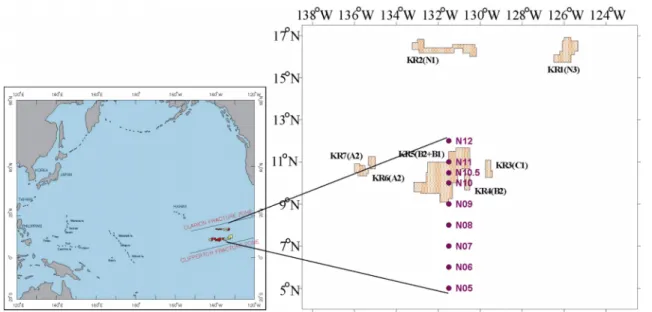
, 2003 (Fig. 1). Observations of vertical temperature and salinity were made using a SBE 911 plus CTD (conductivity- temperature-depth) from surface to a depth of 200 m and binned in to a depth of 1 m. Discrete water samples were collected from 9 depths (0 m, 10 m, 30 m, 50 m, 75 m, 100 m, 120 m, 150 m, and 200 m) using 10-L PVC Niskin bottles mounted on an instrumented rosette sampler with the CTD.

Water samples for nutrient (nitrate) analysis were frozen in 20 ml polycarbonate scintillation vials until they could be analyzed using an autoanalyzer (Alliance) according to the procedures recommended by Parsons et al. (1984).

Water samples (2-L) for chlorophyll-a (chl-a) were pre- filtered through a 300 µ m mesh and then filtered through 25-mm Whatman GF/F filter paper under low vacuum pressure of less than 125 mmHg. The filter papers, which were kept frozen in liquid nitrogen, were extracted in 90%

acetone overnight at a temperature of 4

o

C. Chl-a con- centrations were determined using a Turner Design 10- AU that was calibrated with commercial chl-a (Sigma) standards according to Parsons et al. (1984).

Zooplankton

Zooplankton were collected from two different depths (0-70 m and 70-200 m) based on the thermocline depth.

The samplings were carried out by vertical towing using

an opening-closing net (100 cm diameter and 300 µ m

mesh size) at every one degree between 5

o

and 12

o

N at

131.5

o

W. The net was lowered to the depth of interest

from a stationary research vessel and towed upward at a

speed of 30~50 m·min

−1

. Considering the characteristic of

(3)

diurnal vertical migration of zooplankton, all samplings were done during the nighttime from 10:00 P.M. to 02:00 A.M. during the survey period. Zooplankton samples in the cod-end bucket were transferred to 1-L sampling bottles and immediately fixed into the final concentration of 5% with neutralized formalin.

Zooplankton were identified into taxonomic groups and enumerated under a stereomicroscope (Stemi-2000C).

Copepods were identified according to genus level. The volume filtered by the net was calculated from the readings of flowmeter (Hydro-Bios Model 438-115) fixed at the mouth of the net frame. Zooplankton abundances at all stations were expressed as the individuals·100 m

−3

.

Data analysis

Cluster analysis was carried out to group stations on the basis of dissimilarity calculated by a Bray-Curtis similarity matrix. As a result of cluster analysis, representative species, accounting for the observed assemblage difference, are identified for different groups through the SIMPER program.

The effects of physical properties and lower level of plankton on the spatial heterogeneity of zooplankton were analyzed by principal component analysis (PCA) based on correlation coefficients among parameters obtained from the sampling data. These parameters consisted of temperature, salinity, total chl-a, and sigma-t. Multivariate statistical analyses were conducted using SPSS 10.0 and SIMPER (PRIMER 5.2.8) statistical software packages.

3. Results

Latitudinal differences along the meridian line 131.5

o

W Physico-chemical properties

Latitudinal and vertical distributions of physico-chemical conditions in the epipelagic waters (200 m) varied depending on the upwelling of thermocline depth, which stemmed from the opposing course of currents along the meridian line 131.5

o

W in 2003 (Fig. 2).

The divergence occurred around 9

o

N, where NECC Fig. 1. Map showing the location of surveyed stations along the meridian line 131.5

o

W in the northeastern equatorial

Pacific in July 2003.

Fig. 2. East and westward geostrophic currents calculated

from CTD (conductivity-temperature-depth) data

based on the depth of 1000 m from 5

o

N to 12

o

N

along the meridian 131.5

o

W in the northeastern

Equatorial Pacific in 2003. (+: westwards, −: east-

wards).

(4)

354 Kang, J.-H. et al.

flowed eastward between 5

o

N and 9

o

N, and NEC westward between 9

o

N and 12

o

N (Fig. 2). The thermocline shoaled to the surface at 9

o

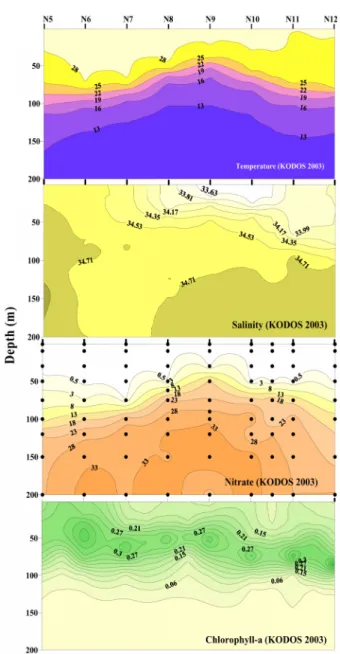
N, from which the depth dramatically decreased to the south, in contrast with slow decrease to the north. The surface mixed layer south of 10.5

o

N was characterized by the thick water mass of high temperature (>28.0

o

C), while it was 1

o

C lower than the southern part at 10.5

o

N (Fig. 3). Water mass less than 34 psu was distributed extensively in surface waters from 8

o

N to 12

o

N and water mass less than 33.5 psu was observed between 8.5

o

N and 9.5

o

N corresponding to the area of NECC, and even lower

salinity of 33.2 psu was found at 8.5

o

N. Furthermore, saline water (>34.7 psu) was found at depths greater than 100 m between 7.5

o

N and 12

o

N. High nitrate concentrations were recorded from 8

o

N to 10

o

N, whereas oligotrophic waters (<0.01 µ M) characterized other stations in the surface mixed layer (Fig. 3).

Chlorophyll-a

The surface chl-a concentration between 5

o

N and 8

o

N, corresponding to the NECC, was higher compared to the northern stations. At 9

o

N, Subsurface Chlorophyll Maximum (SCM) and thermocline depths shoaled to the surface waters, and then chl-a gradually decreased as SCM depth deepened to the north (Fig. 3). The upwelled waters at 9

o

N affected the depths of thermocline and nitracline, resulting in variation of chl-a and nitrate concentrations at the surface and lower layers (Fig. 3).

Zooplankton community

Species composition and abundance

Copepods are the most dominant group accounting for 55.5%-82% (surface mixed layer) and 57.8%-84.9%

(thermocline-200 m) of the total zooplankton community analyzed during the study period (Fig. 4). The percentage of copepods increased at depths around 9

o

N, and from which it decreased to the south and north. The next groups are followed by ostracods and chaetognaths. Ostracods showed commonly higher relative abundance at lower latitudes (5

o

N-7

o

N), whereas low percentages of less than 3% at higher latitudes (8

o

N-12

o

N) were recorded at both depths. Gelatinous herbivores (i.e. appendicularians, salps) as well as carnivorous taxa (i.e. siphonophores), though less abundant than crustaceans, showed important contribu- tions to the entire distribution of zooplankton. Especially, radiolarians associated with other groups peaked at higher latitudes of 11

o

N and 12

o

N (Fig. 4).

In the surface mixed layer, abundances of calanoid and cyclopoid copepods were coincident with the variation in total zooplankton. Abundance of all groups was higher at lower latitudes from 5

o

N to 7

o

N (Fig. 5). Ostracods were particularly characterized by a remarkable peak in abundance.

In the bottom layer (thermocline-200 m), abundances of calanoid and cyclopoid copepods also corresponded to variations in the abundance of total zooplankton (Fig. 5).

Abundance of ostracods was also higher at lower latitudes, whereas salps were higher at higher latitudes (10.5

o

N- 12

o

N) (Fig. 5).

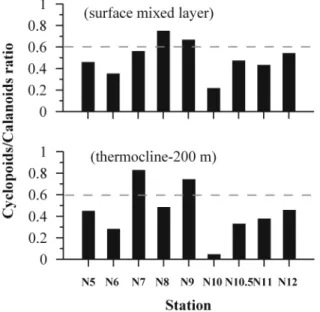
Average ratios of cyclopoid versus calanoid copepods were 0.49 (surface mixed layer) and 0.44 (bottom layer).

Fig. 3. Vertical profiles of temperature, salinity, nitrate

and chlorophyll-a concentrations along the merid-

ian line stretching from 5

o

N to 12

o

N of 131.5

o

W

in the northeastern Equatorial Pacific in 2003.

(5)

Fig. 4. Latitudinal differences in total abundance and taxonomic percentage of zooplankton along the meridian line 131.5

o

W observed during the study period.

Fig. 5. Latitudinal differences in distribution of major taxonomic groups of zooplankton in surface and bottom layers

occurring during the study period.

(6)

356 Kang, J.-H. et al.

The ratios increased around 9°N, where divergence between NECC and NEC occurred and thermocline depth shoaled (Fig. 6).

Cluster analyses, composition, and abundance

A Bray-Curtis similarity index of 75% produced three clusters of stations in the surface mixed layer and the index of 65% produced two clusters in the bottom layer (thermocline-200 m) (Fig. 7). In the surface mixed layer, the zooplankton community was grouped consecutively in latitudinal order in relation to the divergence at 9

o

N. The consecutively grouped stations are Groups A, B and C, which stands for the south of divergence, north of divergence and northernmost stations, respectively. Zooplankton among clusters was mostly characterized by varying degrees of abundance and species composition (Fig. 7). The representa- tive species, which discriminate between clustered groups, could be listed as ostracods, Clausocalanus sp., radiolarians, Oncaea sp., copepodite of Euchaeta sp., and siphonophores (Table 1).

In the bottom layer, the zooplankton community was classified into two clusters, which showed a different pattern from the surface mixed water (Fig. 7). The grouped pattern might not be related to the divergence unlike the case with the surface mixed layer. The representative species, which discriminate between clustered groups, could be listed as Oncaea sp. and Paracalanus sp. (Table 1).

Relationship between zooplankton groups and envi- ronmental factors

Factor analysis was conducted with the pooled data of zooplankton collected above 200 m in the study period.

The first principal component (Z

1

), which explained 71.0% of the total zooplankton variation, indicated high positive factor loading for chl-a (0.92), temperature (0.91) and all zooplankton groups with eigenvalues exceeding 0.61, otherwise negative factors for nitrate, sigma-t and salinity.

In contrast, the second principal component (Z

2

), which explained 14.5% of the total information, showed that the highest positive factor loading for salinity (0.84), followed by sigma-t (0.39), nitrate (0.28) and chl-a (0.19), as well as a negative loading factor for temperatures.

From a scattered diagram based on Z

1

and Z

2

factor loading distributions, all zooplankton groups were grouped with chl-a and temperature, whereas salinity, sigma-t and nitrate was kept at a distance from the groups (Fig. 8).

Appendicularians, ostracods, calanoid and cyclopoid copepods, chaetognaths, invertebrate larvae and others were Fig. 6. Average ratios of cyclopoid versus calanoid

copepods at both depths (surface mixed layer, thermocline-200 m) along the meridian line 131.5°W in the northeastern equatorial Pacific during the study period.

Fig. 7. Dendrogram showing clustered groups by the

Bray-Curtis index based on zooplankton abun-

dance collected from two depths, including sur-

face and lower layers along the meridian line

131.5°W in the northeastern Equatorial Pacific

during the study period.

(7)

associated with chl-a. On the other hand, siphonophores, radiolarians, salps and immature copepods were all classified according to temperature (Fig. 8).

4. Discussion

The patterns of mesozooplankton latitudinal distributions varied with those of physico-chemical properties and the related chl-a concentrations obtained during the study period. The noticeable contrasting feature appeared in the pattern of physico-chemical and biological distribution to the south and north of 9

o

N along the transect 131.5

o

W.

In the central equatorial Pacific, the upwelling divergence draws up the lower water linking to an increase of macronutrients in the surface water and affects the northward evolution of nutrients via phytoplankton to planktonic fish (Vinogradov 1981). Thus, variation in directions as well as the speed of currents causes divergence reflecting the fact that the upwelling-related input of micronutrients could affect the latitudinal distribution of mesozooplankton through the northward evolution through the “bottom up limitation” factor in the equatorial ecosystem (White et al.

1995).

North of the equator, the currents of opposing directions, Table 1. Species list in decreasing order of importance in discriminating among clustered groups on the basis of

similarity percentage at surface and lower layers.

Total (surface) A B C

Rank Species Abund. (%) Species Abund. (%) Species Abund. (%)

1 Ostracods 9,209(16.3) Clausocalanus sp. 5,017(20.6) Radiolarians 1,443(16.5) 2 Oncaea sp. 5,198(10.1) Copepodite (Euchaeta) 2,457(11.0) Siphonophores 1,057(11.7) 3 Paracalanus sp. 4,052(9.1) Oithona sp. 2,485(6.9) Oncaea sp. 1,061(11.4) 4 Oithona sp. 3,248(8.5) Copepodite 1,946(6.9) Paracalanus sp. 1,217(9.3) 5 Acrocalanus sp. 6,096(6.9) Chaetognaths 1,316(6.4) Clausocalanus sp. 957(7.2) 6 Chaetognaths 2,366(5.6) Paracalanus sp. 1,280(6.3) Euchaeta sp. 732(6.2)

7 Copepodite 2,013(4.0) Euchaeta sp. 1,475(5.5) Copepodite 686(5.2)

8 Appendicularians 1,653(3.9) Oncaea sp. 2,429(5.3) Corycaeus sp. 329(4.1) 9 Clausocalanus sp. 2,274(3.8) Radiolarians 1,091(4.9) Copepodite (Euchaeta) 1,226(4.1)

10 Radiolarians 1,322(3.5) Siphonophores 809(4.6) Chaetognaths 488(4.1)

Total (lower) A B

Rank Species Abund. (%) Species Abund. (%)

1 Oncaea sp. 484(14.6) Paracalanus sp. 370(13.7)

2 Paracalanus sp. 329(9.5) Ostracods 612(12.2)

3 Copepodite 296(8.7) Clausocalanus sp. 149(11.4)

4 Clausocalanus sp. 292(8.2) Copepodite 261(10.1)

5 Copepodite (Euchaeta) 241(6.9) Acrocalanus sp. 223(8.1)

6 Chaetognaths 183(5.9) Oncaea sp. 386(7.8)

7 Euchaeta sp. 153(5.2) Chaetognaths 211(7.4)

8 Siphonophores 177(4.9) Scolecithricella sp. 110(4.8)

9 Oithona sp. 192(4.6) Siphonophores 162(3.3)

10 Eucalanus sp. 113(3.9) Euchaeta sp. 115(3.3)

Fig. 8. Factor loading results for the first and second

principal components above the depth of 200 m

in the northeastern Equatorial Pacific during the

study period.

(8)

358 Kang, J.-H. et al.

namely South Equatorial Current (SEC), North Equatorial Counter Current (NECC) and North Equatorial Current (NEC) are located in the present study area (5

o

N-12

o

N, 131.5

o

W) during the study period. Those currents, which are affected by the Coriolis forces, led to the occurrence of divergences and convergences at the boundary between currents of opposing directions (Pickard and Emery 1982).

The divergences result in upwelling of water, which is often richer in nutrients than the displaced surface water and so biological production is promoted. At convergences, concentrations of upper layer plankton may occur because they are brought together horizontally by the flow, but resist the downward motion of the water (Pickard and Emery 1982). The position and magnitude of the currents varied seasonally as well as inter-annually in association with the equatorial upwelling (Blackburn et al. 1970;

Dessier and Donguy 1985, Bidigare and Ondrusek 1996;

Whitney et al. 1998) and could influence the formation, magnitude and position of divergence and convergence.

The geostrophic currents above 200 m showed current composition in the study area during the study period (Fig. 2). The divergence occurred at 9

o

N corresponding to the boundary between eastward NECC and westward NEC.

The trajectories of buoys from NOAA also supported the dominant directions of currents during the study period (http://www.aoml.noaa.gov/phod). A weak eastward flow was observed south of 10

o

N. However, the westward current was dominant north of 10

o

N.

The physical features were coincident with differences of the latitudinal distribution of chl-a concentration at the study area in the northeastern Equatorial Pacific (MOMAF 1998, 1999, 2003). The equatorial upwelling of the strong westward currents were responsible for the high concen- tration of chl-a in the equatorial zone in 1998 and 2003, when nutrients generally upwelled from lower water to surface water (Mann and Lazier 1991). Phytoplankton consecutively responded to the nutrients, resulting in an increase in the abundance of herbivorous as well as carnivorous zooplankton (Vinogradov 1981; White et al.

1995; Roman et al. 2002). However, higher concentration of chl-a occurred at northern stations (around 10

o

N) rather than at southern ones in 1999 when a strong eastward flowing current dominated the equatorial zone (MOMAF 1998, 1999, 2003). Moreover, the differences in chl-a concentration in the equatorial zone between 1998 and 2003 might be related to differences of northward movement associated with the speed of westward currents.

Generally, numerical responses of zooplankton to the latitudinal gradients in phytoplankton biomass are greatly

influenced by the upwelled nutrients from lower waters in the equatorial upwelling zone (White et al. 1995; Roman et al. 2002). The chlorophyll content reached its seasonal maximum in August when upwelling intensity was the strongest in the equatorial area between 4

o

S and 4

o

N (Dessier and Donguy 1985). This was consistent with present result that chl-a in July was also highest around 5

o

N in the near equator and gradually decreased in the north in 1998 and 2003, but not in 1999. Phytoplankton develops rapidly in newly upwelled water and the “downstream” succession from phytoplankton via zooplankton to fish larvae has been observed by the temporal evolution according to meridional transport in an upwelling area (Blackburn et al. 1970; White et al. 1995; Roman et al. 2002).

In the present study, the latitudinal distributions of mesozooplankton showed variable patterns with respect to nitrate and the related chlorophyll concentrations. The high abundance of total mesozooplankton within the study period was closely associated with the physical barrier role of divergence in preventing the northward chl-a extension.

In 1998, the convergence zone, caused by SEC and NECC at 7

o

N, played a role in distinguishing the abundance and composition of mesozooplankton between 5

o

N and 7

o

N from those found between 8

o

N and 12

o

N (MOMAF 1998). Besides, the convergence acted as a means of distinguishing the peak of zooplankton abundance at 7

o

N in 1998 from the peaks it reached at 5

o

N at various longitudes of 140

o

W and 180

o

W (Roman et al. 2002; Le Borgne et al. 2003).

Conversely, the divergence zone, formed by NECC and NEC at 9

o

N, segregated the area south of 9

o

N from that north of 9

o

N in the latitudinal distribution of chl-a in 2003. The chl-a distribution in 1999 was characterized by higher concentrations around 10

o

N, without the northward extension being related to the equatorial upwelling. Those distinctive differences characterized the latitudinal distribution and inter-annual variation of mesozooplankton during the 3 year study period (MOMAF 1998, 1999, 2003).

Calanoid and cyclopoid copepods, counting for most of

the total zooplankton community, represented the latitudinal

distribution in coincident with that of chl-a in 2003. The

abundance of small calanoid copepods also increased in

association with the upwelling, but the cyclopoid copepods

may prefer to increase not only large-scale upwelling but

also small-scale divergence according to the higher ratio

of cyclopoid versus calanoid copepods (Fig. 6). Cyclopoid

copepods have been documented as dominating the increase

of zooplankton in upwelling areas (Smith et al. 1981),

enclosed water columns following nutrient enrichment

(9)

(Harris et al. 1982), warm core rings enriched with nutrients (Roman et al. 1985). Thus, this trend reflected the latitudinal gradients in the ratio of cyclopoids to calanoids in response to the divergence in 2003.

On the other hand, Roman et al. (1995) reported that cyclopoids were more abundant during the El Niño conditions in 1992, with average sea surface temperatures (28.7

o

C) and thermocline depressed to 20-40 m at the Equator at 140

o

W. This could be explained by their inclination to remain relatively motionless and ambush their prey, an advantage of reduced swimming activity and respiratory demand. However, this conservation of energy is mainly supported by lower respiration measurements on the cyclopoid copepod Oithona (Lampitt and Gamble 1982), which is not consistent with the present study dominated by Oncaea sp.

In summary, the latitudinal characteristics of zooplankton in July 2003 are distinguished from previous studies conducted in the northeastern Equatorial Pacific. The northward movement of nutrients and the related chl-a was limited to the south around 9

o

N, where divergence occurred by NECC and NEC and acted as a physical barrier against the transport. The divergence influenced latitudinal differences in abundance of zooplankton and grouped patterns of stations. And abundance of dominant copepods was signif- icantly associated with those of carnivorous zooplankton.

This means that the bottom-up limitation by the newly input macronutrients controlled the distribution of planktonic components in the study area during the study period.

Acknowledgements

Many thanks to the captain and crew of R/V ONNURI for facilitating the sea-going work, and to colleagues in the KODOS program for sharing data and discussion.

Special thanks to two reviewers, Drs. H.K. Kang and S.M.

Choi for critically reading the manuscript. This work was supported by ‘The development of deep seabed mineral resources (PM19700)’.

References

Barber, R.T., M.P. Sanderson, S.T. Lindley, F. Chai, J.

Newton, C.C. Trees, D.G. Foley, and F.P. Chavez. 1996.

Primary production and its regulation in the equatorial Pacific during and following the 1991-92 El Niño. Deep- Sea Res. II, 43, 970-993.

Betzer, P.R., W.J. Showers, E.A. Laws, C.D. Winn, G.R.

DiTullio, and P.M. Kroopnick. 1984. Primary productivity

and particle fluxes on a transect of the equator at 153

o

W in the Pacific Ocean. Deep-Sea Res., 31, 1-11.

Bidigare, R.R. and M.E. Ondrusek. 1996. Spatial and temporal variability of phytoplankton pigment distributions in the central equatorial Pacific Ocean. Deep-Sea Res. II., 43, 809-833.

Blackburn, M., R.M. Laurs, R.W. Owen, and B. Zeitzschel.

1970. Seasonal and areal changes in standing stocks of phytoplankton, zooplankton and micronekton in the eastern tropical Pacific. Mar. Biol., 7, 14-31.

Chavez, F.P. and R.T. Barber. 1987. An estimate of new production in the equatorial Pacific. Deep-Sea Res., 34, 1229-1243.

Chavez, F.P., K.R. Buck, S.K. Service, J. Newton, and R.T.

Barber. 1996. Phytoplankton variability in the central and eastern tropical Pacific. Deep-Sea Res. II, 43, 835-870.

Dessier, A. and J.R. Donguy. 1985. Planktonic copepods and environmental properties of the eastern equatorial Pacific:

seasonal and spatial variations. Deep-Sea Res., 32, 1117- 1133.

Gaudy, R., G. Champalbert, and R. Le Borgne. 2003. Feeding and metabolism of mesozooplankton in the equatorial Pacific high-nutrient, low-chlorophyll zone along 180

o

. J.

Geophys. Res., 108(C12), 8144.

Harris, R.P., M.R. Reeve, G.D. Grice, G.T. Evans, V.R.

Gibson, J.R. Beers, and B.K. Sullivan. 1982. Trophic interactions and production process in natural zooplank- ton communities in enclosed water columns. p. 353-387.

In: Marine Mesocosms. ed. by G.D. Grice and M.R.

Reeve. Springer-Verlag, New York.

Lampitt, R.S. and J.C. Gamble. 1982. Diet and respiration of the small planktonic marine copepod, Oithonanana. Mar.

Biol., 66, 185-190.

Le Borgne, R., G. Champalbert, and R. Gaudy. 2003. Meso- zooplankton biomass and composition in the equatorial Pacific along 180

o

. J. Geophys. Res., 108(C12), 8143.

Mann, K.H. and J.R.N. Lazier. 1991. Dynamics of marine ecosystems: Biological-physical interactions in the oceans.

Blackwell Scientific Publications, Cambridge. 466 p.

McGowan, J.A. and P.W. Walker. 1979. Structure in the copepod community of the North Pacific Central Gyre.

Ecol. Monogr., 49, 195-226.

MOMAF. 1996. A report on '96 Deep Sea Bed Mineral Resources Exploration. MOMAF, Seoul.

MOMAF. 1998. A report on '98 Deep Sea Bed Mineral Resources Exploration. MOMAF, Seoul.

MOMAF. 1999. A report on '99 Deep Sea Bed Mineral Resources Exploration. MOMAF, Seoul.

MOMAF. 2003. A report on 2003 Deep Sea Bed Mineral Resources Exploration. MOMAF, Seoul.

Owen, R.W. and B. Zeitzschel. 1970. Phytoplankton produc- tion: seasonal change in the oceanic eastern tropical Pacific. Mar. Biol., 7(1), 32-36.

Parsons, T.R., Y. Maita, and C.M. Lalli. 1984. A manual of chemical and biological methods for seawater analysis.

Pergamon Press, New York. 173 p.

(10)

360 Kang, J.-H. et al.

Peterson, W.T. and J.E. Keister. 2002. The effect of a large cape on distribution patterns of coastal and oceanic copepods off Oregon and northern California during the 1998-1999 El Niño-La Niña. Prog. Oceanogr., 53, 389- 411.

Peterson, W.T., J.E. Keister, and L.R. Feinberg. 2002. The effects of the 1997-99 El Niño/La Niña events on hydrography and zooplankton off the central Oregon coast. Prog. Oceanogr., 54, 381-398.

Pickard, G.L. and W.J. Emery. 1982. Descriptive physical oceanography, 4

th

ed. Pergamon Press. 249 p.

Roman, M.R., H.G. Dam, A.L. Gauzens, J. Urban-Rich, D.G. Foley, and T.D. Dickey. 1995. Zooplankton vari- ability on the equator at 140

o

W during the JGOFS EqPac study. Deep-Sea Res. II, 42, 673-693.

Roman, M.R., A.L. Gauzens, and T.J. Cowles. 1985. Tem- poral and spatial changes in epipelagic microzooplankton and mesozooplankton biomass in warm-core Gulf Stream ring 82-B. Deep-Sea Res., 32, 1007-1022.

Roman, M.R., H.G. Dam, R. Le Borgne, and X. Zhang.

2002. Latitudinal comparisons of equatorial Pacific zoop- lankton. Deep-Sea Res. II, 49, 2695-2711.

Smith, S.L., C.M. Boyd, and P.V.Z. Lane. 1980. Short-term variations in the vertical distribution of small copepods off the coast of northern Peru. p. 417-426. In: Coastal upwelling. ed. by F.A. Richards. American Geophysical Union.

Son, S.K., J.H. Hyun, C.K. Park, S.B. Ghi, and K.H. Kim.

2001. Characteristics of chemical environment by chang- ing temperature at the surface layer in the northeast Equatorial Pacific. J. Kor. Soc. Mar. Environ. Eng., 4, 24-37.

Vinogradov, M.E. 1981. Ecosystems of equatorial upwellings.

p. 69-90. In: Analysis of Marine Ecosystems. ed. by A.R.

Longhurst. Academic Press, New York.

Welling, L.A., N.G. Pisias, E.S. Johnson, and J.R. White.

1996. Distribution of polycystine radiolarian and their relation to the physical environment during the 1992 El Niño and following cold event. Deep-Sea Res. II, 43, 1413-1434.

White, J.R., X. Zhang, L.A. Welling, M.R. Roman, and H.G. Dam. 1995. Latitudinal gradients in zooplankton biomass in the tropical Pacific at 140

o

W during the JGOFS EqPac study: Effects of El Niño. Deep-Sea Res.

II, 42, 715-733.

Whitney, F.A., C.S. Wong, and P.W. Boyd. 1998. Interannual variability in nitrate supply to surface waters of the Northeast Pacific Ocean. Mar. Ecol. Prog. Ser., 170, 15- 23.

Zhang, X., H.G. Dam, J.R. White, and M.R. Roman. 1995.

Latitudinal variations in mesozooplankton grazing and metabolism in the central tropical Pacific during the U.S.

JGOFS EqPac study. Deep-Sea Res. II, 42, 695-714.

Received Apr. 16, 2004

Accepted Jun. 14, 2004

수치

Fig. 2. East and westward geostrophic currents calculated from CTD (conductivity-temperature-depth) data based on the depth of 1000 m from 5 o N to 12 o N along the meridian 131.5 o W in the northeastern Equatorial Pacific in 2003
Fig. 3. Vertical profiles of temperature, salinity, nitrate and chlorophyll-a concentrations along the  merid-ian line stretching from 5 o N to 12 o N of 131.5 o W in the northeastern Equatorial Pacific in 2003.
Fig. 4. Latitudinal differences in total abundance and taxonomic percentage of zooplankton along the meridian line 131.5 o W observed during the study period.
Fig. 7. Dendrogram showing clustered groups by the Bray-Curtis index based on zooplankton  abun-dance collected from two depths, including  sur-face and lower layers along the meridian line 131.5°W in the northeastern Equatorial Pacific during the study pe
+2

참조

관련 문서

작곡가의 원곡이 지휘자와 연주가에 의해 새롭게 태어나듯이, 우리가 배우고 체득한 모든 이론들과 지식, 테크닉들은 우리 자신에게서 새롭게

2재화 2요소 헥셔-올린 모형에서는 어느 한 경제에서 어느 한 요소의 양이 증가하면, 그 요소를 집약적으로 사용하는 산업의 생산량은 증가하고 다른

Ross: As my lawfully wedded wife, in sickness and in health, until

glen plaids 글렌 플레이드와 캐시미어 카디건, 캐리지 코트, 그리고 케이프 -&gt; 격자무늬의 캐시미어로 된 승마용 바지, 마부용 코트, 말 그림이 수

다양한 번역 작품과 번역에 관한 책을 읽는 것은 단순히 다른 시대와 언어, 문화의 교류를 넘어 지구촌이 서로 이해하고 하나가

The index is calculated with the latest 5-year auction data of 400 selected Classic, Modern, and Contemporary Chinese painting artists from major auction houses..

1 John Owen, Justification by Faith Alone, in The Works of John Owen, ed. John Bolt, trans. Scott Clark, &#34;Do This and Live: Christ's Active Obedience as the

Second, the analysis of the differences in sports participation time showed statistically significant differences in the operation of the competition and