• 검색 결과가 없습니다.

Second Complete Remission of Relapsed Stage IV Non-Small Cell Lung Cancer Following Retreatment

N/A
N/A
Protected

Academic year: 2021

Share "Second Complete Remission of Relapsed Stage IV Non-Small Cell Lung Cancer Following Retreatment"

Copied!
5
0
0

로드 중.... (전체 텍스트 보기)

전체 글

(1)

Tuberc Respir Dis 2012;72:381-385

CopyrightⒸ2012. The Korean Academy of Tuberculosis and Respiratory Diseases. All rights reserved.

Second Complete Remission of Relapsed Stage IV Non-Small Cell Lung Cancer Following Retreatment

Su Jin Yoo, M.D., Jeong Eun Lee, M.D., Sun Young Jung, M.D., Dong Il Park, M.D., Myoung Rin Park, M.D., Hee Sun Park, M.D., Sung Soo Jung, M.D., Ju Ock Kim, M.D., Sun Young Kim, M.D., Ph.D.

Department of Internal Medicine, Chungnam National University Hospital & Cancer Research Institute, Chungnam National University School of Medicine, Daejeon, Korea

Non-small cell lung cancer (NSCLC) is the leading cause of cancer related deaths. Most patients were presented with advanced disease at the time of diagnosis. In advanced NSCLC, it is almost impossible to anticipate complete remission by using only cytotoxic chemotherapy or molecularly targeted agents. In our case, two patients were diagnosed as advanced NSCLC and received chemotherapy. They achieved complete response (CR). After finishing treatment, disease recurred. They were retreated with the same regimens and achieved second CR. Until now, they have received each regimen, continuously, and the CR state has been maintained.

Key Words: Carcinoma, Non-Small-Cell Lung; Remission Induction; Retreatment; Maintenance Chemotherapy

Address for correspondence: Sun Young Kim, M.D., Ph.D.

Department of Internal Medicine, Chungnam National University Hospital & Cancer Research Institute, Chungnam National University School of Medicine, 640, Daesa-dong, Jung-gu, Daejeon 301-721, Korea

Phone: 82-42-220-7154, Fax: 82-42-257-5753 E-mail: [email protected]

Received: Sep. 2, 2011 Revised: Sep. 16, 2011 Accepted: Sep. 27, 2011

Introduction

Non-small cell lung cancer (NSCLC) is the leading cause of cancer related death worldwide. Most patients present with advanced disease at diagnosis, and approx- imately 75% of patients require chemotherapy after di- agnosis or for disease recurrence

1

. The modest improve- ment in quality of life and overall survival with tradi- tional chemotherapy has reached a plateau, and there- fore more effective agents are needed. Newly devel- oped molecularly targeted agents have improved overall survival or have demonstrated superior efficacy with re- duced therapeutic toxicities in advanced NSCLC

2

. However, in advanced NSCLC, it is almost impossible to anticipate complete remission by using only cytotoxic chemotherapy or molecularly targeted agents.

We report two cases of advanced stage NSCLC with complete response (CR) after chemotherapy, followed by disease recurrence, and then finally with CR after retreatment.

Case Report 1. Case 1

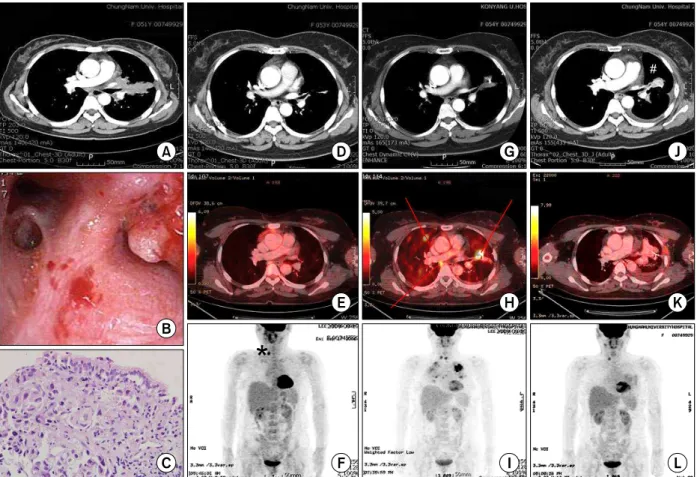
In October 2006, a 51-year-old female without re- markable medical, social, or family history was admitted for cough. On the chest posteroanterior (PA) radio- graph, a 7.2 cm sized mass was identified in the left upper lobe (LUL). It was diagnosed as an adeno- carcinoma by bronchoscopic biopsy (positive immuno- histochemical staining for cytokeratin [CK]-20 and neg- ative for CK-7 and p63). The disease stage was IV (T4N3M1) (Figure 1A∼C).

Six cycles of docetaxel (75 mg/m

2

) and cisplatin (75 mg/m

2

) combination therapy was administered as a first-line chemotherapy. Erlotinib, an epidermal growth factor receptor-tyrosine kinase inhibitor (EGFR-TKI) was administered for 2 months as second-line therapy.

Because of disease progression, subsequent treatment

with pemetrexed (500 mg/m

2

) was initiated as third-line

(2)

Figure 1. Summary from the initial diagnostic investigation to last follow-up. (A∼C) Initial diagnostic investigation. (A) Chest computed tomography (CT). (B) Bronchoscopy. (C) Bronchoscopic biopsy (H&E stain, ×400). (D∼F) Response evaluation after third-line pemetrexed treatment. *Indicates hyroiditis confirmed by fine needle aspiration. (G∼I) Response evaluation at 9 months after discontinuation of pemetrexed treatment. (J∼L) Second complete response state after four cycles of pemetrexed retreatment.

#

Indicates fibrotic scar after CyberKnife treatment. (D, G, J) Chest CT. (E, F, H, I, K, L) Positron emission tomography-CT.

therapy from September 2007 at 3-week intervals.

Positron emission tomography (PET)-computed tomog- raphy (CT) performed after nine cycles did not detect any metabolic evidence of cancer, and this was consid- ered to indicate CR. Sixteen cycles of pemetrexed were administered as maintenance therapy. Chest CT and PET-CT, performed in September 2008, revealed a CR state (T0N0M0) (Figure 1D, F). Although increased glu- cose metabolism was not detected, abnormal findings were observed in the brain area. Brain magnetic reso- nance imaging (MRI) indicated a Schwanoma, which was removed using a gamma knife. After the operation, the patient complained of generalized weakness and stopped chemotherapy. Follow-up was performed

regularly.

A recurred lung mass at the primary mass site was confirmed on a chest CT performed in June 2009, which was 15 months after CR and 9 months after therapy ter- mination (Figure 1G). New lung and bone metastases appeared on PET-CT in September 2009 (Figure 1H, I).

In October 2009, pemetrexed at the same dose was ad-

ministered every 3-weeks. After four cycles in January

2010, no fluoro-2-deoxy-d-glucose uptake on PET-CT

was observed (Figure 1J∼L). This was deemed the sec-

ond remission, and pemetrexed treatment has been sub-

sequently maintained. The CR state was maintained on

chest CT in July 2011.

(3)

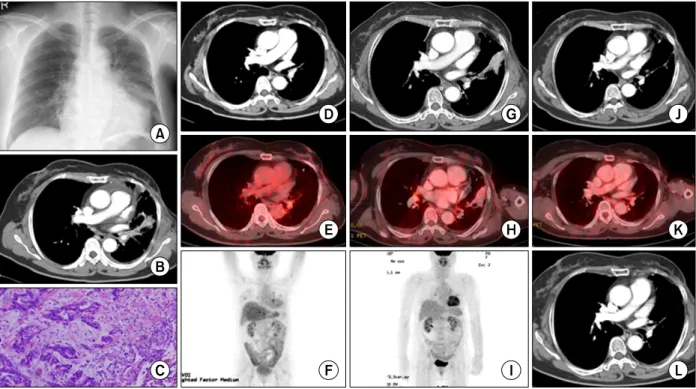
Figure 2. Summary from the initial diagnostic investigation to last follow-up. (A∼C) Initial diagnostic investigation. (A) Chest X-ray. (B) Chest computed tomography (CT). (C) Lung biopsy (H&E stain, ×200). (D) Response evaluation after 5 months treatment. (E, F) Response evaluation after 13 months treatment. (G∼I) Response evaluation at 5 months after discontinuation of erlotinib treatment. (J, K) Second complete response state after 2 months of erlotinib retreatment.

(D, G, J) Chest CT. (E, F, H, I, K) Positron emission tomography-CT. (L) Chest CT (July 2011).

2. Case 2

In September 2005, a 58-year-old female with a tuber- culosis history, and without a history of drinking, smok- ing, or special findings in the family history, was admit- ted for cough. A mass in the LUL was detected on a chest PA radiograph (Figure 2A). The mass was diag- nosed as an adenocarcinoma by wedge lung resection (positive immunohistochemical staining for thyroid tran- scription factor-1 (TTF-1) and CK-7 and negative for CK-20, CK-5/6, and calretinin (Figure 2C). The disease stage was IIIB (T4N2M0) (Figure 2B). No brain or bone metastases were detected on brain MRI or a whole body bone scan. Gemcitabine (1,000 mg/m

2

) and cisplatin (75 mg/m

2

) combination therapy was administered at 3-week intervals as first-line chemotherapy. However, progression was detected on a chest CT performed after three cycles. Subsequently, treatment with daily 150 mg erlotinib as second-line therapy was initiated in Decem-

ber 2005. A partial response (PR) continued on every follow-up chest CT scan. The lesions had almost dis- appeared on a chest CT performed after 5 months (Figure 2D). A PET-CT performed after 13 months did not detect any metabolic evidence of cancer and this was considered to indicate CR (Figure 2E, F). Erlotinib was administered for 38 months as maintenance therapy. The patient complained of severe anorexia and nausea, and she wanted to stop the erlotinib treatment.

Follow-up was performed regularly.

A chest CT and PET-CT were performed in July 2009,

and a recurred lung mass at the primary mass site was

confirmed (Figure 2G∼I), which was 38 months after

CR and 5 months after therapy termination. The mass

was diagnosed as an adenocarcinoma by percutaneous

needle lung biopsy (positive immunohistochemical

staining for TTF-1 and CK-7 and negative for CK-20,

CK-5/6, and calretinin). After confirming disease pro-

gression in August 2009, erlotinib was administered at

(4)

the initial dose. The lesions had almost disappeared on the chest CT and the PET-CT after 2 months (Figure 2J, K). This was deemed the second remission, and erloti- nib treatment has been subsequently maintained. A chest CT in July 2011 indicated that the CR state was maintained (Figure 2L).

Discussion

In our cases, the two patients were diagnosed with advanced NSCLC and received chemotherapy with pe- metrexed as the third-line and erlotinib as the sec- ond-line therapy, respectively, and they achieved CR.

However, they unfortunately stopped treatment, result- ing in disease recurrence. After recurrence, they were retreated with the same regimens (pemetrexed and erlo- tinib, respectively) and achieved a second CR. Until now, they have received these regimens continuously and have maintained a CR state.

The efficacy of chemotherapy is modest or dis- appointing in patients with advanced NSCLC. These cas- es are worthy of noting due to the dramatic response and CR achieved by the same drug. In these cases, we must consider characteristics of relapsed cancer cells and the importance and duration of maintenance therapy.

Relapsed cancer cells are probably homogenous with specific characteristics that meet the targets of each drug. Predictable markers for specific drugs should be identified at the initial work-up. Recently, EGFR-TKI was approved as first-line treatment in an EGFR muta- tion positive group. Searching for specific targets in pa- tients will allow for prolonged survival and a good qual- ity of life.

Another issue concerning NSCLC treatment is main- tenance therapy, in which the duration of chemotherapy is prolonged by administering additional drugs in pa- tients who have not progressed or who have achieved a response. According to the National Comprehensive Cancer Network guideline 2011 v3, maintenance treat- ment is divided into continuation maintenance and switch maintenance. Continuation maintenance refers to

the use of at least one of the agents given first-line, be- yond 4∼6 cycles, in the absence of disease progre- ssion. Bevacizumab (category 1), cetuximab (category 1), and pemetrexed (category 2B) can be used for con- tinuation maintenance. Switch maintenance refers to the initiation of a different agent, not included as part of the first-line regimen, in the absence of disease pro- gression after 4∼6 cycles of initial therapy. Pemetrex- ed, erlotinib (category 2B), and docetaxel (category 3) can be used. We expect prolonged progression free sur- vival (PFS) through the use of maintenance therapy and a decreased dropout rate after first-line treatment based on previous data. In the phase III, placebo-controlled Sequential Tarceva in Unresectable NSCLC (SATURN) study, PFS was significantly prolonged by erlotinib vs.

a placebo in the overall population, irrespective of gen- der, ethnic origin, smoking status, or EGFR status (median PFS, 12.3 weeks vs. 11.1 weeks; hazard ratio [HR], 0.71; 95% confidence interval [CI], 0.62∼0.82; p

< 0.0001) and in patients who are EGFR immunohis- tochemistry positive (median PFS, 12.3 weeks vs. 11.1 weeks; HR, 0.69; 95% CI, 0.58∼0.82; p<0.0001)

3

. Yokouchi et al.

4

retrospectively evaluated the clinical courses of 27 patients with NSCLC who received gefiti- nib and achieved either a CR or PR. Some of the pa- tients who experienced disease progression after re- sponding to gefitinib were again sensitive to readminis- tration of gefitinib following temporary cessation of gefi- tinib and other treatments

4

. There is great potential to produce a dramatic response after maintenance therapy in homogenous tumors such as these cases. However, they were likely to acquire a good response by retreat- ment for the progression after the general treatment schedule. Intermittent treatment is an option in this group.

However, acquired resistance to chemotherapeutic agents easily appears and we can not predict acquired resistance. But, it is certain that someone had homoge- nous characteristics regardless of advanced stage and less acquired resistance.

Retreatment of patients with small cell lung cancer

(SCLC) with the original regimen was used in a sensitive

(5)

relapse group that maintained a response over 6 months after the original regimen

5

. This rule cannot be applied in patients with NSCLC. If valid markers for sensitive relapse are discovered, these controversies will be solved.

We must also consider the toxicity of retreatment or maintenance treatment. Cara and Tannock

6

reviewed 18 articles regarding retreatment toxicity for relapsed can- cer with the same therapy, including four studies about SCLC. Toxicity associated with retreatment was similar or greater than that experienced during initial treat- ment

6

.

No guidelines exist to determine how long main- tenance therapy is needed for patients who reach CR.

Furthermore, there are no guidelines of how to treat re- lapsed cancer after CR. We need guidelines for retreat- ment using the same therapy and maintenance therapy considering toxicity and more predictable biomarkers for sensitive relapse, tumor heterogeneity, and acquired resistance. We also require additional clinical trials about duration or schedule of treatment in cases that have reached CR, particularly those with a homogenous tumor character.

References

1. DeVita VT, Hellman S, Rosenberg SA. Cancer: princi- ples and practice of oncology. 7th ed. Philadelphia:

Lippincott Williams & Wilkins; 2005.

2. Lee SY, Park JY. Personalized therapy in lung cancer:

focused on molecular targeted therapy. J Lung Cancer 2011;10:1-12.

3. Cappuzzo F, Ciuleanu T, Stelmakh L, Cicenas S, Szczésna A, Juhász E, et al. Erlotinib as maintenance treatment in advanced non-small-cell lung cancer: a multicentre, randomised, placebo-controlled phase 3 study. Lancet Oncol 2010;11:521-9.

4. Yokouchi H, Yamazaki K, Kinoshita I, Konishi J, Asahina H, Sukoh N, et al. Clinical benefit of read- ministration of gefitinib for initial gefitinib-responders with non-small cell lung cancer. BMC Cancer 2007;7:

51.

5. National Comprehensive Cancer Network. NCCN clin- ical practice guidelines in oncology: small cell lung cancer, v.3. Fort Washington, PA: National Compre- hensive Cancer Network; 2011.

6. Cara S, Tannock IF. Retreatment of patients with the

same chemotherapy: implications for clinical mecha-

nisms of drug resistance. Ann Oncol 2001;12:23-7.

수치

Figure  1.  Summary  from  the  initial  diagnostic  investigation  to  last  follow-up
Figure  2.  Summary  from  the  initial  diagnostic  investigation  to  last  follow-up

참조

관련 문서

Purpose: Our institution has implemented two different adjuvant protocols in treating patients with non-small cell lung cancer (NSCLC): chemotherapy followed

During follow-up, three patients (one patient with pathologic stage IIB NSCLC and two patients with pathologic stage IIIA NSCLC) experienced recurrence and died as a result of

Surgical resection is the most effective treatment for early-stage non-small cell lung cancer (NSCLC), and lobectomy is the standard surgical technique for

Background: The purposes of this study were to evaluate the appropriateness of the stage migration of stage IIA non-small cell lung cancer (NSCLC) in the

Forest plot showing a comparison of recurrence-free survival between segmentectomy and lobectomy in (A) stage I and (B) stage IA non-small cell lung cancer. All of them used

Objective: We aimed to compare the prognoses of patients with pathologically true negative (P-TN) N2 and PET/CT false negative (FN) results in stage T1 non- small cell lung

Randomized phase III trial of pemetrexed versus docetaxel in patients with non-small cell lung cancer previously treated with chemotherapy.. Shepherd FA,

The results of this study showed that FXIII activity was higher in patients with NSCLC than in the healthy group. Patients with squamous cell carcinoma and stage III and IV