Effect of Long Term Fertilization on Microbial Biomass, Enzyme Activities, and Community Structure in Rice Paddy Soil
Chang Hoon Lee*, Seong Soo Kang, Ki Youl Jung1, Pil Joo Kim2,3 Division of Soil and Fertilizer, NAAS, RDA, Suwon, 441-707, South Korea
1FunctionalCereal Crop Research Division, NCSI, RDA, Miryang, 1085, South Korea
2Division of Applied Life Science (BK 21 Program), Gyeongsang National University, Jinju, 660-701, South Korea
3Institute of Agriculture and Life Science, Gyeongsang National University, Jinju, 660-701, South Korea
(Received: October 31 2013, Accepted: November 18 2013)
The effects of long-term fertilization on soil biological properties and microbial community structure in the plough layer in a rice paddy soil in southern Korea were investigated in relation to the continuous application of chemical fertilizers (NPK), straw based compost (Compost), combination these two (NPK + Compost) for last 40 years. No fertilization plot (Control) was installed for comparison. Though fertilization significantly improved rice productivity over control, the long-term fertilization of NPK and compost combination was more effective on increasing rice productivity and soil nutrient status than single application of compost or chemical fertilizer. All fertilization treatments had shown significant improvement in soil microbial properties, however, continuous compost fertilization markedly increased soil enzyme and microbial activities as compared to sole chemical fertilization. Results of microbial community structure, evaluated by EL-FAME (ester-linked fatty acid methyl esters) method, revealed big difference among Control, NPK, and Compost. However, both Compost and Compost+NPK treatments belonged to the same cluster after statistical analysis. The combined application of chemical fertilizer and organic amendments could be more rational strategy to improve soil nutrient status and promote soil microbial communities than the single chemical fertilizer or compost application.
Key words: Long-term fertilization, Paddy soil, Microbial community structure, FAMES
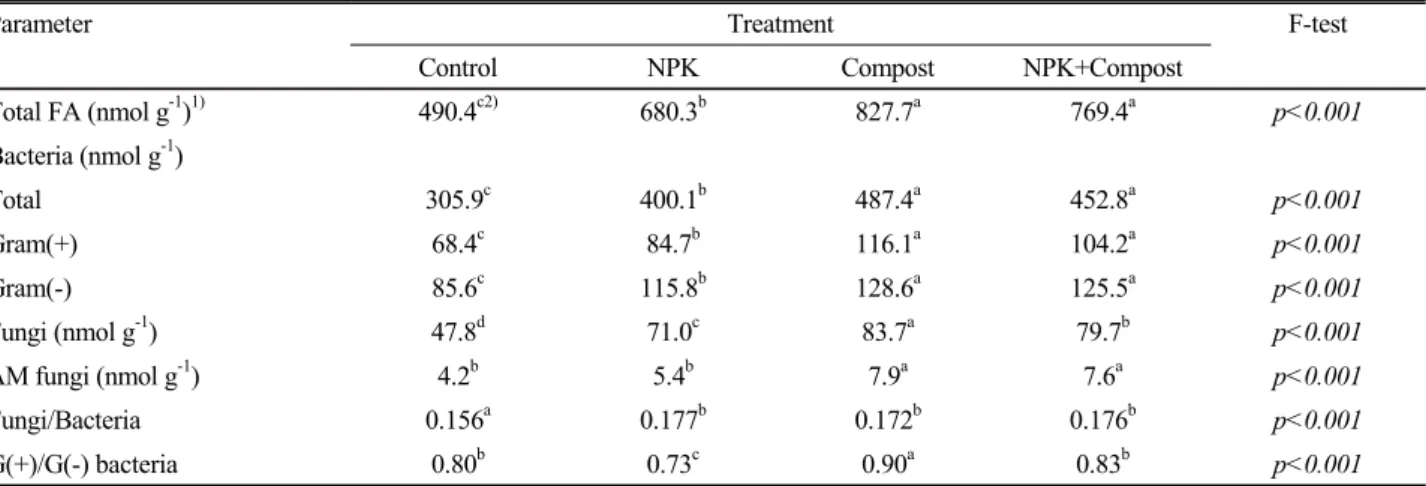
Changes of biomarker distribution determined by EL-FAME profiles in the long- term fertilized paddy soil at harvesting stage in the 40th year after the onset
Parameter Treatment F-test
Control NPK Compost NPK+Compost
Total FA (nmol g-1)1) 490.4c2) 680.3b 827.7a 769.4a p<0.001
Bacteria (nmol g-1)
Total 305.9c 400.1b 487.4a 452.8a p<0.001
Gram (+) 68.4c 84.7b 116.1a 104.2a p<0.001
Gram (-) 85.6c 115.8b 128.6a 125.5a p<0.001
Fungi (nmol g-1) 47.8d 71.0c 83.7a 79.7b p<0.001
AM fungi (nmol g-1) 4.2b 5.4b 7.9a 7.6a p<0.001
Fungi/Bacteria 0.156a 0.177b 0.172b 0.176b p<0.001
G (+)/G (-) bacteria 0.80b 0.73c 0.90a 0.83b p<0.001
Notes) 1)Total FA means sum of fatty acid methyl esters and 52 of FAMEs were detected. We assigned the following biomarkers to specific microbial groups: bacteria (sum of were i15:0, a15:0, 15:0, i16:0, 16:1w7c, i17:0, a17:0, 17:0, cyl7:0, 18:1w7, and cyl9:0), fungi (sum of 18:2w6c and 18:1w6c), and arbuscular mycorrhizal fungi (AMF) (16:1w5c). 2)Different letters in the same column indicate significant differences at P < 0.05 (Tukey’s test).
1)
*Corresponding author : Phone: +82312900335, Fax: +82312900208, Email: [email protected]
§Acknowledgement: We deeply extend our appreciation to the staff of the National Institute of Crop Science, NICS, RDA for providing assistance on the conduct of this study, and for properly maintaining the long-term fertilized paddy soil making it a valuable resource for the past, present and future several generations of researchers. This study was supported by 2013 Postdoctoral Fellowship of National Academy Agricultural Science (PJ:008598032013), Rural Development Administration, Republic of Korea.
Introduction
Rice paddy soil is an anthropogenic soil, evolvement and formation of which are greatly affected by fertilization, irrigation, and tillage. In general, due to long-term submerging and fertilizations, paddy soils generally experience soil quality degradation, such as breakdown of stable aggregation and deterioration of soil organic matter, which adversely affect agricultural sustainable development. In case of long- term fertilization in paddy soil, soil organic carbon concentration was continuously decreased due to application of single chemical fertilizers and this in turn resulted deterioration in soil physical properties (Lee et al., 2009). Continuous loss of soil organic matter deteriorates soil physical properties which again lead to the suppression of microbial and enzymatic activities in soil (Haynes and Tregurtha, 1999). In addition, injudicious application of agrochemicals proportionately increases the phytotoxicity in soils. However, only few studies, related to the effect of long-term fertilization on soil health in rice paddy, have been reported so far.
Soil quality is the term currently being used to describe the health of arable soils (Doran et al., 1994; Gregorich et al., 1994). As a complex functional state, soil quality cannot be measured simply and directly, but it may be inferred from management-induced changes in soil properties. Historically, due to the availability of simple analysis methods soil quality research focused primarily on chemical and physical properties (Larson and Pierce, 1991). More recently, it has been suggested that soil biological properties can serve as sensitive indicators of agro-ecosystems in response to soil management practices (Islam and Weil, 2000; Kennedy and Papendick, 1995). The subsequent method to assess the status of soil health might be to culture the microbes, but this technique does not give a very clear picture, because cultivation based methods are very selective and only a small proportion of soil microorganisms can be cultured (Torsvik et al., 1990).
Analysis of microbial phospholipid fatty acid (PLFA) profiles was proved extremelyuseful for the characterizationof microbial communities from arable soils (Bossioet al., 1998;
Ibekwe and Kennedy, 1998; Reichardt et al., 1997; Wander et al., 1995; Zelles etal., 1992). During this study, microbial cells in soil are saponifiedby heat and the addition of a strong base.
Once fatty acidsare cleaved from lipids, they are methylated to form fatty acid methyl esters (FAMEs).The FAMEs are extracted in an organic solvent and analyzed by gas chromatography (Sasser, 1990). While the simplicity of the method is advantageous, it is uncertain whether or not fatty acids extracted by the MIDI method originate only from living microorganisms.Because of this concern, the ester- linked(EL) procedure was developed and this method uses a mild alkaline reagent to lyse cells and releasefatty acids from lipids once the ester bonds are broken. Recently, the EL
method successfully characterizedmicrobial communities of several grass seed field soils andplaced communities into groupings similar to those generatedby a DNA-based method (Ritchie et al., 2000).
Since fertilization among agricultural practices could be a strongest challenge to change soil quality and health condition, we evaluated the effect of long-term fertilization on the microbial community structure in rice paddy soil by EL-FAME method. The objective of this study was to evaluate soil microbial community structure for maintaining better soil health through integrated nutrient management strategy.
Materials and Methods
Fertilization background and soil sampling To inves- tigate the fertilization effects on rice yields and soil properties, the long-term experiment was established in 1967 at Department of Functional Cereal Crop Research Farm, Milyang (36°36´N;
128°45´E; 12 m elev.) in the southeast part of Korea. The soil belonged to the Pyeongtaeg series (somewhat poorly drained fine silty mixed mesic, Typic Haplaquepts). Four fertility treatments were arranged within a randomized complete block with three replications. Individual plot size was 10 m wide and 10 m long. Fertility treatments included the following: the Control (no fertilization), NPK, Compost, and NPK+Compost.
In NPK and NPK+Compost, inorganic fertilizers were applied with the rates of N-P2O5-K2O at 120-80-80 kg ha-1 during 1967-1972 and 150-100-100 kg ha-1 by using urea, super phosphate and potassium chloride since 1977. Straw compost mixed with cattle manure and composted for more than six months in the outdoor was applied annually at the rate of 10 Mg ha-1 in Compost and NPK+Compost treatments. The straw compost used in 2005 had mean values of 429, 19.6, 5.2 and 29.5 g kg-1 of total-C, N, P and K, respectively. Inorganic fertilizer and manure were broadcast by hand on to the surface of each plot prior to tillage before rice transplanting.
The sieved soils (< 2 mm) were analyzed for chemical properties as follows: pH (1:5 with H2O), organic matter content (Walkley and Black method; Allison 1965). The total N and available P contents were determined using the Kjeldahl digestion and Lancaster method (NAAS, 2010), resepctively.
Exchangeable Ca2+, Mg2+, and K+ were extracted with 1 M NH4OAc (pH 7.0) at a soil: solution ratio of 1:5 for 1 h.
Cation exchange capacity (CEC) of soil was measured using 0.1 M NaCl following the ion retention method of Schofield (1949).
Microbial biomass and enzyme activity The soil samples were collected from 0-15 cm depth in each long-term fertilization plot at the harvesting stage in the 40th year after the installation (2005). A field-moist subsample was sieved (< 2 mm) and stored at 4°C for microbial biomass C, N, and P
concentration. Part of this sample was subsequently oven- dried for analyzing soil enzyme activity.
Soil microbial biomass C and N (MBC and MBN, respectively) were determined by the chloroform-fumigation extraction (FE) method (Vance et al., 1987). The TOC analyzer was used to determine the organic C (Corg) and total N in 0.5 M K2SO4 extracts of soils non-fumigated and fumigated with ethanol-free chloroform for 24 h. The MBC was calculated as MBC = (Corg in fumigated soil - Corg in non-fumigated soil)/kc. Where, kc = 0.33, the factor used here to convert the extracted organic C to MBC (Sparling and West, 1988). The MBN was calculated using the equation as MBN = (total N in fumigated soil - total N in non-fumigated soil)/kn. Where, kn is 0.45, the factor used to convert the extracted organic N to MBN (Jenkinson, 1988). The amount of microbial biomass P (MBP) was determined by the FE method (Brookes et al., 1982). The amount of MBP was calculated based on the amount of NaHCO3-extractable inorganic P in fumigated soil minus the amount of that extracted from non-fumigated soil then divided by a kp value of 0.40.
Dehydrogenase activity was determined from the conversion of 2,3,5 -triphenyltetrazolium chloride (TTC) to triphenyl formazan (TPF) over a 24 h period (Tabatabai, 1994). β -glucosidase activity were determined using 0.05 M p- nitrophenyl-β-d-glucopyranoside dissolved in modified universal buffer (MUB-HCl buffer pH 6) (Eivazi and Tabatabai, 1988) as substrates. Urease activity was determined using 0.1 M phosphate buffer (pH 7) as reported by Nannipieri et al.
(1974). Acid phosphomonoesterase activity (PMEase) was assayed by the method of Tabatabai (1982), based on the use of disodium p-nitrophenyl phosphate (pNPP) as an analogue substrate for PMEase. Similarly, the phosphodiesterase activity (PDEase) was investigated using the diester substrate of bis-p-nitrophenoly phsophate (bis-pNPP) (Tabatabai, 1982).
Microbial community structure To characterize microbial community structure, the FAME analysis was performed using published procedure (Schutter and Dick, 2000) with a slight modification. Before analysis, fresh soil sampled from the surface layer (0-15cm) in the 40th year after the onset and lyophilized. Three gram of lyophilized soil sample was treated with 10 mL of 0.2 MKOH in methanol and incubated at 37℃ for 1 hr. After incubation, the pH was adjusted to 7.0 with 1.0 M acetic acid, then 10 mL hexane and vortexed.
After centrifugation (1600 rpm, 20 min), 5 mL of hexane layer was evaporated N2 gas. The residue was dissolved in 170 μL of 1:1 = hexane: methyl t-buthyl ether with 30 μL of 0.01 M methylnona -decanoate (C 19:0) as internal standard and analyzed with a Hewlett-Packard5890 Series II (Palo Alto, CA) equipped with an HP Ultra 2 capillarycolumn (5%
diphenyl-95% dimethylpolysiloxane, 25 m by 0.2) and a
flame ionization detector. The temperature program ramped from 170 to 270°C at 5°C per min, with 2 min at 270°C between samples to clean the column. Identification and quantification of FAMEs were conducted according to the MIDI software using MIDI microbial calibration standards (Microbial ID, Inc, Newark, DE, USA). The FAMEs i15:0, a15:0, 15:0, i16:0, 16:1ω9, i17:0, a17:0, cy17:0, 18:1ω7 and cy19:0 were chosen to represent bacterial FAMEs (Frostegard and Baath, 1996; Zells, 1999). Fatty acids with iso or anteiso branching were used as markers for Gram-positive and cy17:0 for Gram-negative bacteria (Frostegard et al., 1993).
The 16:lω5 was used as a marker for arbuscular mycorrhiza (AMF) (Olsson et al. 1995), and 18:2 ω 6,9 and 18:3ω6 were served as a fungal biomarker (Frostegard and Baath, 1996;
Schutter and Dick, 2000).
Statistics analysis Soil and FAMEs data, microbial biomass and enzyme activities data were analyzed with a General Linear Model, with Block and Treatment as model components.
When significant treatment effects were found, Tukey’s test was used to compare treatment means. Means were considered significantly different at p-levels < 0.05. A principal component analysis (PCA) was performed on relative concentrations of individual fatty acids (mol %). The concentration of each fatty acid in a sample was divided by the total FAMEs concentration of that sample to account for differences in abundance. Treatment effects on FAME community com- position and substrate-utilization profiles were assessed by ANOVA on the scores for principal component (PC) 1, 2, and 3. LSD was used for multiple comparisons (p < 0.05). All statistical analyses were performed using SAS 9.1.
Results and Discussion
Soil chemical properties Most of the soil properties except soil pH were significantly (P < 0.05) improved by continuous fertilization (Table 1). Soil organic carbon (SOC) content and related properties like cation exchange capacity, total nitrogen and exchangeable cation concentrations were significantly (P
< 0.05) higher in the organic amendment (compost and compost+NPK) treated plots and chemical fertilizer application recorded comparatively higher available P and exchangeable K content than other treatments.
In this experiment, effect of long-term fertilization on soil chemical properties on soil health of paddy field was studied.
Several long-term fertilizer field trials in multiple rice cropping systems, mainly double- and triple-crop rice monoculture and rice-wheat systems, had shown declining rice and wheat yields (Duxbury et al., 2000; Nambiar, 1994;Yadav et al., 1998, 2000). As reported in previous article (Lee et al., 2009), Dawe et al. (2000) and Yadav et al. (2000) found increased rice yield after long-term fertilization. Improved soil chemical
Table 1. Chemical properties of soil in the long-term fertilized paddy at harvesting stage in the 40th year after the onset.
Parameter Treatments F-test
Control NPK Compost NPK+Compost
pH (1:5) 5.47a1) 5.19b 5.36a 5.46a p<0.01
Total C (g kg-1) 22.3c 23.6c 27.4b 30.0a p<0.001
Total N (g kg-1) 3.31b 3.12b 3.83a 3.94a p<0.001
Available P(mg kg-1) 18.6d 79.1b 38.1c 101.8a p<0.001
Exchangeable cation (cmol+ kg-1)
K 0.08c 0.16b 0.31a 0.33a p<0.001
Ca 3.72c 3.98bc 4.50b 5.26a p<0.01
Mg 0.78b 0.93b 0.90b 1.19a p<0.01
Cation exchange capacity (cmol+ kg-1) 9.32b 9.63b 12.51a 12.27a p<0.001 Notes) 1)Different letters in the same column indicate significant differences at P < 0.05 (Tukey’s test).
Table 2. Microbial biomass and enzyme activities in the long- term fertilized paddy soil at harvesting stage in the 40th year after the onset.
Parameter Treatments F-test
Control NPK Compost NPK+Compost
Microbial biomass (mg kg-1)
C 216.7c1) 292.6b 337.7a 344.6a P<0.001
N 28.7c 43.3b 49.4a 52.0a P<0.01
P 10.2c 16.3b 21.4a 21.1a P<0.001
Enzyme activity
Dehydrogenase (mg kg-1 day-1) 58.8c 88.4b 128.3a 118.9a P<0.01
b-glucosidase (mg kg-1 hr-1) 21.6 c 44.2b 60.9a 57.9a P<0.01
Urease (mg kg-1 hr-1) 85.7c 218.0b 224.7a 251.7a P<0.01
Acid phosphatase (mg kg-1 hr-1) 115.7c 291.0b 325.7a 327.7a P<0.01
Phosphodiesterase (mgkg-1 hr-1) 56.3c 119.3b 135.0a 137.0a P<0.01
Notes) 1)Different letters in the same column indicate significant differences at P < 0.05 (Tukey’s test).
properties also supported the statement that increment in rice yield may be achieved through proper nutrient management in long-term basis. The combination of compost and NPK fertilizers was especially effective in this aspect.
Microbial biomass and enzyme activities Application of compost returns organic matter to soil which in turn stimulates soil biological properties. This readily available carbon acts as a energy source for microbial proliferation and leads to the increased microbial biomass in compost treated plots. This dual effect of organic amendments has also been reported by other authors in several conditions (Masciandaro et al., 1997; Schjonning et al., 2002). Continuous long-term fertilization significantly (P < 0.01) increased microbial biomass carbon (MBC), nitrogen (MBN) and phosphorus (MBP) content of paddy field soil (Table 2). Analysis indicated higher microbial biomass in compost amended soils (compost and compost+NPK) than in control and NPK treated plots
(Table 2). Though MBC/ MBN ratio was slightly decreased by fertilization, it was not statistically different from that of other treatments. Long-term fertilization also decreased MBC/ MBP ratio and this ratio of organic amendment treated plots was significantly (P < 0.01) lower than that of NPK treated plots. Like soil microbial biomass, enzyme activities of paddy soil were influenced by the long-term fertilization. In this experiment, changes in activities of several enzymes (β -glucosidase, urease and acid phosphatase)as affected by long-term fertilization in paddy soil was studied and data were presented in Table 2. Data indicated that activities of all these enzymes were significantly (P < 0.01) increased due to fertilization and compost and compost+NPK treatments recorded significantly (P < 0.01) higher soil enzyme activities as compared to sole NPK treatment.
Most bacteria are known to have comparatively higher MBN and MBP than fungi (Sarathchandra et al., 1988). The higher MBC/MBN and MBC/ MBP ratios in compost treated plots indicated that organic amendment modified the microbial
Table 3. Changes of biomarker distribution determined by EL-FAME profiles in the long- term fertilized paddy soil at harvesting stage in the 40th year after the onset.
Parameter Treatment F-test
Control NPK Compost NPK+Compost
Total FA (nmol g-1)1) 490.4c2) 680.3b 827.7a 769.4a p<0.001
Bacteria (nmol g-1)
Total 305.9c 400.1b 487.4a 452.8a p<0.001
Gram(+) 68.4c 84.7b 116.1a 104.2a p<0.001
Gram(-) 85.6c 115.8b 128.6a 125.5a p<0.001
Fungi (nmol g-1) 47.8d 71.0c 83.7a 79.7b p<0.001
AM fungi (nmol g-1) 4.2b 5.4b 7.9a 7.6a p<0.001
Fungi/Bacteria 0.156a 0.177b 0.172b 0.176b p<0.001
G(+)/G(-) bacteria 0.80b 0.73c 0.90a 0.83b p<0.001
Notes) 1)Total FA means sum of fatty acid methyl esters and 52 of FAMEs were detected. We assigned the following biomarkers to specific microbial groups: bacteria (sum of were i15:0, a15:0, 15:0, i16:0, 16:1w7c, i17:0, a17:0, 17:0, cyl7:0, 18:1w7, and cyl9:0), fungi (sum of 18:2w6c and 18:1w6c), and arbuscular mycorrhizal fungi (AMF) (16:1w5c). 2)Different letters in the same column indicate significant differences at P < 0.05 (Tukey’s test).
Fig. 1. Microbial community structure in the long-term fertilized paddy soil at harvesting stage in the 40th year after the onset.
Means of six replicates and standard deviations (S.D.).
distribution in soil and it encouraged the proliferation of bacterial community in this paddy soil. It is a well-known fact that organic amendments stimulate microorganisms to produce enzymes related with the nitrogen and phosphorus cycles (Dinesh et al., 2004; Madejón et al., 2001; Marschner et al., 2003). We also found that TOC and nutrient contents had a significantly positive correlation (p < 0.01) with microbial biomass C, N and P, and extracellular enzymatic activities (β -glucosidase, urease, acid phosphomonoesterase). As a result, the higher correlation between either TOC or nutrient contents or biochemical properties indicates the importance of organic matter addition (Masciandaro et al., 1997) and soil organic carbon accumulation on boost soil microorganisms and enzyme activities.
Microbial community and structure Continuous fertili- zation of paddy soil with chemical fertilizer and compost for 40 years leads to the variations not only in the soil chemical and biochemical properties (Table 1 and 2), but also caused great diversity in the soil microbial community (Table 3). In the control treatment, the total amount of FAMEs extracted was 490.7 nmol g−1 soil (Table 3). It was significantly increased by fertilization, and rest of the treatments followed the order: NPK+Compost ≈ Compost > NPK. Results revealed that concentration of marker fatty acids were more effectively increased by organic amendment application (Compost, and NPK+Compost) than that by single chemical fertilizer (NPK) treatment. Signature fatty acids for gram (-) bacteria (16:1 ω7c, 18:1 ω7c, cy17:0, cy19:0), and gram (+) bacteria (15:0, i15:0, a15:0 and i16:0, 17:0, i17:0, a17:0) were significantly increased in all treated soils. The amounts of these PLFAs were also higher in compost treatments than chemical fertilization only, but there was no significant
difference in concentrations of these PLFAs of Compost and NPK+Compost treatments.
Principle component analysis was performed with all detected FAMEs for identifying microbial community structure among treatments (Fig. 1). The variability explained by the first and two principle components was 45.6 %, and in this, the first principle component (PC1) accounted for 25.0 % of the total variance and the second function 20.6%. Statistical analysis of PC values showed that community structure in chemical and compost treatment significantly differed from control for PC 1 (p < 0.001), but there was significant difference between these treatments for PC 2 (p < 0.001).
The FAMEs responsible for this separation were i15:0, a15:0, i17:0, a17:0, and cy17:0 (correlated with PC1) and 16:0 10 Me, 18:0 Me, and cy 19:0 (responsible for PC 2 separation).
This result indicates that the Gram (+) and (-) bacteria were mostly influenced by long-term integrated nutrient management which in turn was responsible for creating variation in microbial community in different treatments in paddy soil.
Compost and NPK+Compost treatments are equally beneficial in improving soil microbial diversity and soil biochemical properties. But when soil physico-chemical properties were considered, it suggested that NPK+compost treatment was significantly most effective maintaining soil nutrient status.
Therefore, it could be concluded that combined application of compost and chemical fertilizers are the best option for maintaining soil health in long-term rice cultivation.
Conclusion
The results of this study confirmed that long-term cropping systems and fertility practices significantly alter rice productivity and soil biological properties. The combined application of chemical fertilizer and compost was the most effective for increasing rice productivity and soil nutrient balance than sole chemical fertilizer or compost amendment. Fertilization had a significantly beneficial impact on soil microbial properties. Long-term compost application significantly improved soil microbial properties as compared with chemical fertilization, but microbial community structure showed very close similarity between sole compost plot and the combination treatment of compost and chemical fertilizer. Based on data, it could be concluded that the combined application of chemical fertilizers and organic amendment could be a rational strategy to sustain soil productivity as well as improving soil health statues than the sole chemical fertilizer or compost application.
References
Allison, L.E. 1965. Organic carbon. In Methods of soil analysis, ed. C. A. Black, Madison, Wisc., ASA, pp. 1367-1376.
Bossio, D.A., K.M. Scow, N. Gunapala, and K.J. Graham. 1998.
Determinants of soil microbial communities: effects of agricultural management, season and soil type on phospholipid fatty acid profiles. Microbial Ecol. 36:1-12.
Brookes, P.C., D.S. Powlson, and D.S. Jenkinson.1982. Measurement of microbial biomass phosphorus in soil. Soil Biol. Biochem.
14:319-329.
Dawe, D., A. Dobermann, P. Moya, S. Abdulrachman, B. Singh, P. Lal, S.Y. Li, B. Lin, G. Panaullah, O. Sariam, Y. Singh, A.
Swarup, P.S. Tan, and Q. X. Zhen. 2000. How widespread are yield declines in long-term rice experiments in Asia? Field Crops Res. 66:175-193.
Dinesh, R., M.A. Suryanarayana, S. Ghosha, and T.E. Sheeja.
2004. Long-term influence of leguminous cover crops on the biochemical properties of a sandy clay loam Fluventic Sulfaquent in a humid tropical region of India. Soil Tillage Res.
77:69-77.
Doran, J.W., and T.B. Parkin.1994. Defining and assessing soil quality. In Defining Soil Quality for a Sustainable Environment Doran, J.W., Coleman, D.C., Bezdicek, D.F., Stewart, B.A.
(Eds.), Soil Science Society of America: Madison, Wisconsin, pp. 3-21.
Duxbury, J.M., I.P. Abrol, R.K. Gupta, and K. Bronson. 2000.
Analysis of long-term soil fertility experiment with rice-wheat rotation South Asia. In: Abrol, I.P., Bronson, K., Duxbury, J.M., Gupta, R.K. (Eds.), Long-term Soil Fertility Experiments in Rice-Wheat Cropping Systems. Rice Wheat Consortium Research Series 6. Rice-Wheat Consortium for the Indo- Gangetic Plains, New Delhi, India, pp. 7-12.
Eivazi, E., and M.A. Tabatabai.1988. Glucosidases and galacto- sidases in soils. Soil Biol. Biochem. 20:601-606.
Frostegard, A., and E. Baath. 1996. The use of phospholipid fatty acid analysis to estimate bacterial and fungal biomass in soil.
Biol. Fertil. Soils. 22:59-65.
Frostegard, A., E. Baath, and A. Tunlid.1993. Shifts in the structure of soil microbial communities in limed forests as revealed by phospholipid fatty acid analysis. Soil Biol.
Biochem. 25:723-730.
Haynes, R.J., R. Tregurtha. 1999. Effects of increasing periods under intensive arable vegetable production on biological, chemical and physical indices of soil quality. Biol. Fertil. Soils.
28:259-266.
Gregorich, E.G., M.R. Carter, D.A. Angers, C.M. Monreal, and B.H. Ellert. 1994. Towards a minimum data set to assess soil organic matter quality in agricultural soils. Can. J. Soil Sci.
74:367-385.
Ibekwe, A.M., and A.C. Kennedy. 1998. Fatty acid methyl ester (FAME) profiles as a tool to investigate community structure of two agricultural soils. Plant and Soil. 206:151-161.
Islam, K.R., and P.R. Weil. 2000. Soil quality indictor properties in Mid-Atlantic Soils as influenced by conservation management.
J. Soil Water Conserv. 55:69-78.
Jenkinson, D.S. 1988. The determination of microbial biomass carbon and nitrogen in soil. In: Wilson, J.R. (Ed.), Advances in nitrogen cycling in agricultural ecosystems, C.A.B. International, Wallingford, U.K., pp. 368-386.
Kennedy, A.C., and R.I. Papendick. 1995. Microbial characteristics of soil quality. J. Soil Water Conserv. 50: 243-248.
Larson, W.F., and F.J. Pierce. 1991. Conservation and enhancement of soil quality. In Evaluation for Sustainable Land Management in the Developing World; Proceedings of the 12 International Board for Soil Resource and Management: Bangkok, Thailand;
Vol. 2.
Lee, S.B., C.H. Lee, K.Y. Jung, K.D. Park, D.K. Lee, and P.J.
Kim. 2009. Changes of soil organic carbon and its fractions in relation to soil physical properties in a long-term fertilized paddy. Soil Tillage Res. 104:227-232.
Madejón, E., P. Burgos, R. López, and F. Cabrera. 2001. Soil
enzymatic response to addition of heavy metals with organic residues, Biol. Fertil. Soils. 34:144-150.
Marschner, P., E. Kandeler, and B. Marschner. 2003. Structure and function of the soil microbial community in a long-term fertilizer experiment. Soil Biol. Biochem. 35:453-461.
Masciandaro, G., B. Ceccanti, and C. Garcia. 1997. Change in soil biochemical and cracking properties induced by “living mulch systems”. Can. J. Soil Sci. 77:579-587.
Nannipieri, P., B. Ceccanti, S. Cervelli, and P. Sequi. 1974. Use of pyrophosphate to extract urease from a podzol. Soil Biol.
Biochem. 6:359-362.
Nambiar, K.K.M. 1994. Soil fertility and Crop Productivity under Long-term Fertilizer use in India. Indian Council for agricultural research, New Delhi, India, pp. 27-28.
Olsson, P.A., E. Baath, I. Jakobsen, and B. Soderstrom. 1995.
The use of phospholipid and neutral lipid fatty acids to estimate biomass of arbuscular mycorrhizal fungi in soil. Mycol. Res.
99:623-629.
NAAS. 2010. Fertilizer application recommendations for crop plants, National Academy of Agricultural Science, RDA, Suwon, Korea.
Reichardt, W., G. Mascarina, B. Padre, and J. Doll. 1997.
Microbial communities of continuously cropped, irrigated rice fields. Appl. Environ. Microbiol. 63:233-238.
Ritchie, N.J., M.E. Schutter, R.P. Dick, and D.D. Myrold. 2000.
Use of length heterogeneity-PCR and FAME to characterize microbial communities in soil. Appl. Environ. Microbiol.
66:1668-1675.
Sasser, M. 1990. Identification of bacteria through fatty acid analysis. In: Klement, S., Rudolf, K., Sands, D., (Eds.), Methods in phytobacteriology. Akademiai Kiado, Budapest, pp. 199-204.
Sarathchandra, S.U., K.W. Perrott, M.R. Boase, and J.E. Waller.
1988. Seasonal changes and the effects of fertiliser on some chemical, biochemical and microbiological characteristics of high-producing pastoral soil. Biol. Fertil. Soils. 6:328-335.
Schjonning, P., S. Elmholt, L.J. Munkholm, K. Debosz. 2002.
Soil quality aspects of humid sandy loams as influenced by organic and conventional long-term management. Agric.
Ecosyst. Environ. 88:195-214.
Schofield, R.K. 1949. Effect of pH on electric charges wried by clay particles. J. Soil Sci. 1:l-8.
Schutter, M.E., and P.D. Richard. 2000. Comparison of fatty acid methyl ester (FAME) methods for characterizing microbial communities. Soil Sci. Soc. Am. J. 64:1659-1668.
Tabatabai, M.A. 1994. Soil enzymes. In: Weaver, R.W., Angel, J.S., Bottomley, P.S. (Eds.), Madison, Methods of soil analysis, part 2, Wisc., SSSA, pp. 775-833.
Tabatabai, M.A. 1982. Assay of enzymes in soil. In: Page, A.L.
(Ed.), Methods of Soil Analysis, Volume 2, American Society of Agronomy and Soil Science of America, Madison, WI, pp.
922-947.
Torsvik, V., and D.F.L. Goksøyr. 1990. High diversity in DNA of soil bacteria. Appl. Environ. Microbiol. 56:782-787.
Wander, M.M., D.S. Hedrick, D. Kaufman, S.J. Traina, B.R.
Stinner, S.R. Kehrmeyer, and D.C. White. 1995. The functional significance of the microbial biomass in organic and conventionally managed soils. Plant and Soil. 170:87-97.
Yadav, R.L., D.S. Yadav, R.M. Singh, and A. Kumar. 1998.
Longterm effects of inorganic fertilizer inputs on crop productivity in a rice-wheat cropping system. Nutr. Cycl.
Agroecosys. 51:193-200.
Yadav, R.L., B.S. Dwivedi, K. Prasad, O.K. Tomar, N.J. Shurpali, and P.S. Pandey. 2000. Yield trends, and changes in soil organic-C and available NPK in a long-term rice–wheat system under integrated use of manures and fertilizers. Field Crops Res. 68:219-246.
Zelles, L., Q.Y. Bai, T. Beck, and F. Beese. 1992. Signature fatty acids in phospholipids and lipopolysacharides as indicators of microbial biomass and community structure in agricultural soils. Soil Biol. Biochem. 24:317-323.
Zelles, L. 1999. Fatty acid patterns of phospholipids and lipopolysaccharides in the characterization of microbial communities in soil: a review. Biol. Fertil. Soils. 29:111-129.