Effect of Long Term Fertilization on Soil Carbon and Nitrogen Pools in Paddy Soil
Chang Hoon Lee*, Ki Youl Jung1, Seong Soo Kang, Myung Sook Kim, Yoo Hak Kim, and Pil Joo Kim2 Soil and Fertilizer Management Division, NAAS, RDA, Suwon, 441-707, South Korea.
1Functional Cereal Crop Research Division, NCSI, RDA, Miryang, 1085, South Korea.
2Division of Applied Life Science (BK 21 Program), Gyeongsang National University, Jinju, 660-701, South Korea
(Received: May 31 2013, Accepted: June 15 2013)
Fertilizer management has the potential to promote the storage of carbon and nitrogen in agricultural soils and thus may contribute to crop sustainability and mitigation of global warming. In this study, the effects of fertilizer practices [no fertilizer (Control), chemical fertilizer (NPK), Compost, and chemical fertilizer plus compost] on soil total carbon (TC) and total nitrogen (TN) contents in inner soil profiles of paddy soil at 0-60 cm depth were examined by using long-term field experimental site at 42nd years after installation. TC and TN concentrations of the treatments which included N input (NPK, Compost, NPK+Compost) in plow layer (0-15 cm) ranged from 19.0 to 26.4 g kg-1 and 2.15 to 2.53 g kg-1, respectively. Compared with control treatment, SOC (soil organic C) and TN concentrations were increased by 24.1 and 31.0%, 57.6 and 49.7%, and 72.2 and 54.5% for NPK, Compost, and NPK+Compost, respectively. However, long term fertilization significantly influenced TC concentration and pools to 30 cm depth. TC and TN pools for NPK, Compost, NPK+Compost in 0-30 cm depth ranged from 44.8 to 56.8 Mg ha-1 and 5.78 to 6.49 Mg ha-1, respectively. TC and TN pools were greater by 10.5 and 21.4%, 30.3 and 29.6%, and 39.9 and 36.3% in N input treatments (NPK, Compost, NPK+Compost) than in control treatment. These resulted from the formation and stability of aggregate in paddy soil with continuous mono rice cultivation. Therefore, fertilization practice could contribute to the storage of C and N in paddy soil, especially, organic amendments with chemical fertilizers may be alternative practices to sequester carbon and nitrogen in agricultural soil.
Key words: Long-term fertilization, Carbon pool, Nitrogen pool, Rice, Paddy soil
Soil C and N pools in inner profiles affected by long-term fertilization for 42 years.
Treatments Carbon (Mg ha-1) Nitrogen (Mg ha-1)
0-15 15-30 30-45 45-60 0-60 0-15 15-30 30-45 45-60 0-60
--- cm --- --- cm ---
Control 27.4c 13.1b 6.0a 2.9a 49.5c 2.94b 1.82c 1.23b 0.75bc 6.74c
NPK 31.4b 13.4b 6.6a 3.5a 55.0b 3.60a 2.18b 1.48a 0.97a 8.23ab
Compost 35.5a 17.3a 6.5a 3.5a 62.9a 3.73a 2.44a 1.05b 0.70c 7.92b
NPK+Compost 38.5a 18.3a 6.6a 3.3a 66.7a 3.91a 2.58a 1.16c 0.93ab 8.58a Note) Means with the same letter in column are not significantly different at p<0.05 level by Duncan’s test.
1)
*Corresponding author : Phone: +82312900335, Fax: +85312900208, Email: [email protected]
§Acknowledgement: We deeply extend our appreciation to the staff of the National Institute of Crop Science, NICS, RDA for providing assistance on the conduct of this study, and for properly maintaining the long-term fertilized paddy soil making it a valuable resource for the past, present and future several generations of researchers. This study was supported by 2013 Postdoctoral Fellowship of National Academy Agricultural Science (PJ:008598032013), Rural Development Administration, Republic of Korea.
Introduction
Dynamics of C and N in soils have received increasing attention, since soil organic C (SOC) is related to the water-holding capacity and nutrient availability in the soil, and in particular, has a hidden value to help mitigate the erosion and greenhouse effect on the environment (Lal et al., 1998). Soil N storage can also reduce the rate of N fertilization, N leaching, and greenhouse gas emission.
Therefore, it becomes important to study the storage of soil C and N in helping to decrease erosion and greenhouse gas emissions from soils.
In agricultural soils, human activities such as fertilizer practices and cropping systems play a key role in the regulation of C and N contents (Halvorson et al., 1999; Sainju et al., 2002; Karlsson et al., 2003; Gal et al., 2007;
Jagadamma et al., 2007). In particular, fertilizer application has the most powerful tool to increase C and N storage and sequestration in agricultural soils (Schumann et al., 2002).
More specifically, organic matter (OM) application with or without chemical fertilizers in the paddy field has played a very significant role in enhancing soil organic C and N quantity and quality (Huang et al., 2009). However, much of the published information on the impact of fertilization practices on crop productivities and nutrient balances have been based on short time changes, and minimal information is available regarding the long-term changes in SOC and nutrients and their vertical distribution, particularly, in mono-rice paddy soil ecosystem.
Long-term field experiments provide direct observations of changes in SOC storage and N balance over the decades and are critical for predictions of future soil productivity and soil-environment interactions (Richter et al., 2007). The SOC and TN contents in agro-ecosystems can be increased by suitable fertilization (Cai and Qin, 2006), particularly by organic manure plus chemical fertilizer (Zhang et al., 2006;
Ding et al., 2012). For example, long-term application of fertilizers and manures are most efficient soil management practice for preserving organic C in soils cropped with maize-wheat-cowpea in the semiarid subtropical areas of India (Rudrappa et al., 2006). Undoubtedly, rice cropping, as an important land use, has significant effects on C and N cycling around the globe. However, there is little information to the long-term fertilization effect on C and N storage in intensively-fertilized rice cultivation systems in temperate zones. Korea is well-known for its intensive farming structure and 60% of its arable land (ca. 1.8 million ha in 2008) is being utilized for rice production, however to date, there had been no studies done to investigate the effects of fertilization on C and N storage in mono-rice paddy soils after long-term cultivation.
In this study, we examined the effects of long-term
fertilization on soil C and N pools in the inner soil profile after 42 years. Secondly, a reasonable fertilizer management was suggested to improve soil fertility, which can be associated with increased rice productivity.
Materials and Methods
Experimental site and Fertilization Long-term field experiment was installed in a typical paddy soil (Pyeongtaeg series, somewhat poorly drained fine silty mixed mesic, Typic Endoaquepts) at the National Institute of Crop Science, Milyang (36º36' N and 128º45' E, elevation 12m) in the southeastern part of Korea at 1967. The plots (10 mÎ10 m) were randomly arranged in the experimental field and each treatment was carried out in triplicate. In NPK and NPK + Compost, chemical fertilizers were applied with the rates of N-P2O5-K2O=120-80-80 kg ha-1 in 1967-1976 and 150-100-100 kg ha-1 since 1977 by using urea, fused phosphate and potassium chloride, respectively. Rice straw compost was applied at a rate of 10 Mg ha-1 in Compost, and NPK + Compost treatments. The straw compost used in 2008 had mean values of 442, 18.9, 5.1 and 26.5 g kg-1 of total C, N, P and K, respectively. Inorganic fertilizer and compost were broadcast by hand on to the surface of each plot prior to tillage before rice transplanting. Six rice cultivars were cultivated as follows: ‘Palkyeng’ in 1967-1971, ‘Milyang’ in 1972-1975, ‘Nagdongbyeo’ in 1972-1986, ‘Palgongbyeo’ in 1987-1993, ‘Hwanambyeo’ in 1994-1996, and ‘Hwasambyeo’
since 1997.
Soil physical and chemical properties Rice was harvested in the 42nd year after installation, and yield components such as grain and straw yields were recorded. Soil samples of Ap horizon collected after rice harvesting were analyzed for physical and chemical properties. The moist soil sample was dried at 105 °C for 24 h to measure soil bulk density (BD) (Blake and Hartge, 1986). Soil porosity was calculated using BD and particle density (PD, 2.65 Mg m-3) according to the equation: porosity (%) = (1 - BD/PD) × 100. The water holding capacity was calculated with the help of Keen's box (steel box of 5.0 cm I.D. and 4 cm height with perforated bottom and a filter paper disc fixed with a steel ring at the bottom end) for the soil samples. Water-stable aggregate distribution was determined by placing soil samples on top of a nest of sieves (17.5 cm diameter with openings of 1.0 and 0.25 mm), immersing directly in water, and oscillating for 5 min (20 mm stroke length, 31 cycles min-1). After removing the two sieves and placing them in an oven to dry, water containing soil passing the 0.25 mm screen was poured over a 0.053 mm screen, the soil was washed with a gentle stream of water, and the soil retained transferred into a drying bottle with a small stream of water. The <0.053 mm fraction was
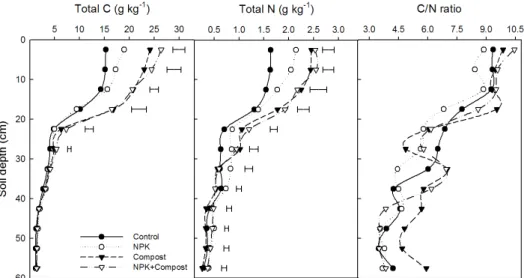
Fig. 1. Distributions of total C, total N, and C/N ratios in inner soil profile of a long-term fertilized paddy in the 42nd year after installation. Bars mean least significant difference (p<0.05).
calculated as the difference between initial soil weight and summation of the other fractions. All fractions were oven dried at 55°C for ≥24 h following visual dryness.
Mean-weight diameter was calculated by summing the products of aggregate fraction weight and mean diameter of aggregate classes (Kemper and Rosenau, 1986).
Soil pH was measured with distilled water (1:5 with H2O).
Organic carbon and TN contents were determined by Walkley Black methods (Allison, 1965) and Kjeldahl digestion, respectively. The available phosphate content was determined using the Lancaster method (NAAS, 2000). Exchangeable cation was estimated by using Inductively Coupled Plasma Spectroscopy (OPTIMA 4300DV, Perkin Elmer, USA) after extracts of 1Nammoniumacetate solution (pH 7.0) (NASS, 2000). The cation exchange capacity (CEC) was determined by 1M ammonium acetate exchange followed by Kjeldahl’s distillation of ammonium (NAAS, 2000).
Soil organic carbon and total nitrogen pools After rice harvest in 2008 (the 42nd year after the onset), soil samples were collected in the soil profile (0-60 cm) by a soil probe (internal diameter of 11.0 cm) for quantification of TC and TN storage. Soil bulk density was determined by collecting undisturbed soil samples with cut every 5 cm interval. These soil samples were oven dried at 105℃ for 48 hr to take the dried weight of soil samples. The dried samples for bulk density were grinded to determine the total C and N concentration in each soil samples by using a CHNS Elemental Analyzer (CHNS-932, Leco, USA). Soil total carbon and nitrogen pools were calculated as per the following equation:
Total C and N pool (Mg ha-1) = Total C and N concentration (g kg-1)
× Soil depth (m) × Bulk density (Mg m-3)
× 10000 m-2 ha-1 × 10⁻⁴
Statistical analysis One-way analysis of variance (ANOVA) procedures, with Duncan’s test and least significant difference (LSD), were used for significant differences in variables among treatments at p<0.05. Statistical analysis was performed using the SAS package, version 9.1.
Results and discussion
Soil total C and N concentration The TC and TN concentrations was significantly influenced by forty-two years of N input with chemical fertilizer, compost, and chemical fertilizer plus compost inner soil profiles in paddy soil (Fig. 1). The TC concentration in 0-30 cm depth increased significantly with continuous compost application.
However, the TC concentration in compost and NPK+Compost treatment was not difference. The lowest TC was in Control treatment and was similar in NPK treatment. The TC concentration below 30 cm depth was statistically similar among fertilizer practices. Total N concentration followed a pattern similar to that of SOC (Fig. 1) and the relationships between TC and TN concentrations in 0-60 cm depth was a positive correlation. TN concentration was the highest in 0-15 cm depth of all treatment, and was shown a statistical difference from 0 to 60 cm under profiles. As shown the Fig. 1, total N concentration was influenced to the soil C:N ratio with increasing TN concentration in NPK and NPK+Compost treatments under profiles, whereas the difference of soil C:N ratio was not observed among the treatments.
Inputs of N to fertilizer practices can affect carbon concentration by the decomposition of soil organic carbon with lower soil C:N ratio (Jandl et al., 2007; Coulter et al.,
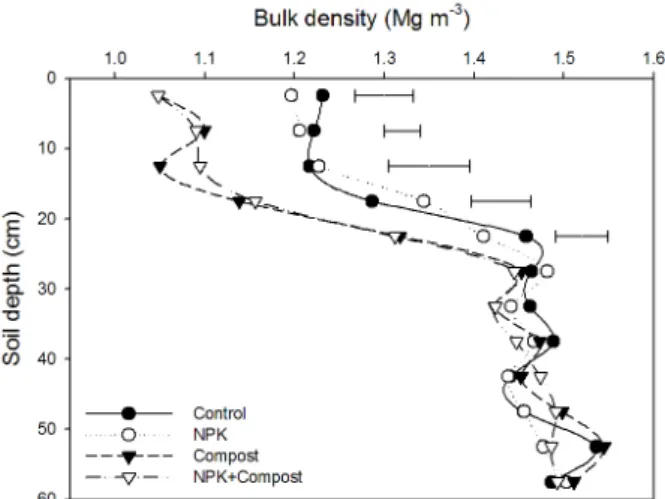
Fig. 2. Distribution patterns of bulk density in inner soil profile of a long-term fertilized paddy in the 42nd year after installation. Bars mean least significant difference (p<0.05).
2009). In this study, N supply was 150 kg ha-1 yr-1 since 1977 with chemical fertilizer and ca. 99 kg ha-1 yr-1 with compost.
The total N concentration at 0-30 cm of depth was lower in NPK than in the compost treatment (Compost, and NPK+Compost). Low soil C:N ratio might result in a priming effect of SOC concentration, which can generally accelerate the mineralization rates of C and N in soils. In contrast, the highest N input with chemical fertilizer plus compost might slow the mineralization rate of C by addition of external carbon as compost and root biomass. This suggests that increasing management intensity in agriculture, especially with larger N inputs from fertilizer or manure application, could lead to a faster increase in soil N than C, resulting in lower soil C:N ratio. However, the decline in soil C:N ratio may not indicate increased plant N availability because TN is associated with the total silty+clay fraction(Brar et al., 2013).
Soils with lower C:N ratios are prone to greater N losses through leaching (Ju et al., 2006; Yu et al., 2007; Shi et al., 2009; Zhou et al., 2010). N input with chemical fertilizer increased in inner profiles, especially, and decreased soil C:N ratio in NPK.
Soil C and total N pools The bulk density of soil was changed with different long-term fertilization. The bulk density exhibited an increasing trend with increasing in soil depth (0-60 cm) in respective treatments and was no statistical differences between the treatments under 25 cm depth in inner profiles (Fig. 2). The bulk density in 0-25 cm depth decreased in the compost treatments (Compost and NPK + Compost), and was not different in the NPK compared to the Control. Organic input could reduce the bulk density in soil by addition of root and crop residues due to cementing action of organic acid and polysaccharides formed during the decomposition of organic residues by higher microbial activities (Brar et al., 2013, Hati et al., 2008). Also, there was
documented well the effects of long-term fertilization on soil bulk density by some researchers (Bhattacharyya et al., 2004;
Agbede et al., 2008; Rasool et al., 2008).
Similar to TC and TN concentrations, there was also a significant increase in the C and N pools in treatments applied compost with/without chemical fertilizer (Table 1). The TC stock of 0-60 cm depth was ca. 48.2 Mg ha-1 in Control at the 42nd year after the installation. The TC stock increased to 7.3% (51.7 Mg ha-1) by NPK application, but more effectively to 24-26% (59.7-60.5Mg ha-1 in Compost, NPK+Compost).
Total N stock in Control was ca. 6.7 Mg ha-1 at 0-60 cm of profiles. Total N stock was highest in NPK+Compost with ca.
8.6 Mg ha-1 (ca. 27.2% increase), followed by NPK (ca.
22.1% increase), and Compost (ca. 17.5% increase). The changes of TN content in the surface layer, which was significantly higher in compost-applied (Compost, and NPK + Compost) plots than by chemically-alone fertilized (NPK) treatment (Date was not shown). The TN accumulation at the inner 0-60cm soil depth was slightly lower in Compost than in NPK treatment due to a higher BD in NPK than in Compost. However, N concentration is expected to decrease in NPK but should increase in Compost treatment in the future, since TN concentration in soil surface layer was observed to continually and significantly decrease alone by chemical fertilization (NPK), not in the compost-applied plots (Compost, NPK+Compost), with the lapse of years. Conse- quently, continuous compost addition plays an important role to increase soil N storage in paddy soil.
Yields and soil properties Grain yield was 3380 kg ha-1 in Control in the 42nd year, which was comparable with 5968 (ca. 77% increase compared with the Control), 5175 (ca. 53%
increase), and 6958 kg ha-1 (ca. 106% increase) in NPK, Compost, and NPK+Compost, respectively (Table 2). Straw yield was similarly increased with grain by fertilizations. As reported in our previous paper (Lee et al., 2009), the grain yield continuously and slightly increased with the rate of 4.57 kg ha-1 yr-1 from ca. 3.3 Mg ha-1 in Control, mainly due to improved rice cultivars. In comparison, grain yield increased significantly with time in other fertilized plots, but yield increase was more effective in continuous compost application treatments (Compost, and NPK + Compost). For example, grain yield increased with the rate of 30.4 kg ha-1 yr-1 from ca. 5.3 Mg ha-1 in NPK, 63.9 kg ha-1 yr-1 from 3.5 Mg ha-1 in Compost and 51.4kg ha-1 yr-1 from 5.5Mg ha-1 in NPK + Compost. The higher yield increase in the continuously compost-applied plots (Compost, and NPK+Compost) might have been affected by the improved soil biological, chemical and physical properties.
In cultivated soils, chemical and physical processes are of major importance to decide soil fertility. A decline in soil organic matter invariably leads to an increase in BD and a
Table 1. Storage of total C and N in inner profiles affected by long-term fertilization for 42 years.
Treatments Carbon (Mg ha-1) Nitrogen (Mg ha-1)
0-15 15-30 30-45 45-60 0-60 0-15 15-30 30-45 45-60 0-60
--- cm --- --- cm ---
Control 27.4c 13.1b 6.0a 2.9a 49.5c 2.94b 1.82c 1.23b 0.75bc 6.74c
NPK 31.4b 13.4b 6.6a 3.5a 55.0b 3.60a 2.18b 1.48a 0.97a 8.23ab
Compost 35.5a 17.3a 6.5a 3.5a 62.9a 3.73a 2.44a 1.05b 0.70c 7.92b
NPK+Compost 38.5a 18.3a 6.6a 3.3a 66.7a 3.91a 2.58a 1.16c 0.93ab 8.58a
Note) Means with the same letter in column are not significantly different at p<0.05 level by Duncan’s test.
Table 2. Rice biomass yield, soil physical and chemical properties of long-term fertilized paddy in the 42nd year after installation.
Parameters Treatments
Control NPK Compost NPK+Compost
Rice biomass yield (kg ha-1)
Grain 3380 ± 291d 5968 ± 34b 5175 ± 133c 6958 ± 197a
Straw 3557 ± 241c 5835 ± 126b 5675 ± 286c 7420 ± 96a
Total 6937 ± 527d 11802 ± 124b 10850 ± 259c 14378 ± 118a
Soil physical properties
Bulk density (g cm-3) 1.27 ± 0.04a 1.24 ± 0.02a 1.11 ± 0.03b 1.11 ± 0.04b
Porosity (%) 42.9 ± 1.69b 46.1 ± 1.82b 50.9 ± 0.80a 52.0 ± 1.47a
Water stable aggregate (%) 7.90 ± 0.52c 10.77 ± 0.71b 13.20 ± 0.70a 13.54 ± 0.58a Mean weight diameter (mm) 0.345 ± 0.02a 0.356 ± 0.02a 0.436 ± 0.01b 0.426 ± 0.01b Water holding capacity (%) 16.3 ± 0.17c 16.9 ± 0.13ab 16.7 ± 0.35bc 17.4 ± 0.21a Soil chemical properties
pH (1:5 with H2O) 5.16 ± 0.09c 5.40 ± 0.06ab 5.26 ± 0.06bc 5.46 ± 0.06a
Total C (g kg-1) 14.6 ± 0.58c 17.9 ± 1.15b 23.5 ± 1.02a 25.3 ± 0.74a
Total N (g kg-1) 1.55 ± 0.04c 1.92 ± 0.12bc 2.45 ± 0.32ab 2.56 ± 0.21a
Available P (mg kg-1) 20.7 ± 2.18d 83.3 ± 2.96b 43.6 ± 2.14c 134.9 ± 2.99a
Exchangeable cations (cmol+kg-1)
K 0.11 ± 0.01d 0.14 ± 0.01b 0.64 ± 0.02c 0.59 ± 0.01a
Ca 3.8 ± 0.17c 4.2 ± 0.08c 4.9 ± 0.05b 6.0 ± 0.33a
Mg 0.82 ± 0.05c 1.11 ± 0.04b 1.06 ± 0.05b 1.44 ± 0.08a
Cation exchange capacity (cmol+kg-1) 9.8 ± 0.25b 10.7 ± 0.29b 13.1 ± 0.59a 13.4 ± 0.62a Note) Means with the same letter in column are not significantly different at p<0.05 level by Duncan’s test.
decrease in soil porosity (Tisdall and Oades, 1982). In our long-term fertilized paddy, the improved chemical and physical properties of soils were observed with compost application (Compost, and NPK+Compost) (Table 2). For example, TC concentration and C related parameters (i.e., CEC, TN, and exchangeable cations) were significantly improved in compost-applied plots than in non-compost applied treatments. Bulk density was much lower in Compost, and NPK + Compost, and not in NPK and Control treatments.
In the chemical and no fertilization plots, the increase in BD resulted to a decrease in porosity, in contrast with the compost amended soils which had low BD and increased porosity.
Significant improvement of other physical properties such as
water stable aggregate, mean weight diameters, and water holding capacity was also observed in treatments (Compost, NPK+Compost) continuously added with compost. It is well-known that soil C compounds provide some of the major soil constituents involved in binding soil into aggregates, and stability of soil aggregates increases with increased levels of soil C (Tisdall and Oades, 1982). Thus, continuous compost application is vital for creating and retaining a stable soil structure. Organic matter increases the soil specific surface area, resulting in an increase in water retention and consequently an increase in the water content responsible for the plasticity limit (Smith et al., 1985).
Conclusion
Total C pool in the inner soil profile was increased by fertilization, but was higher in Compost and NPK+Compost than the NPK treatment. Total N pool was also significantly increased by fertilization, but this increase was highest in NPK+Compost, followed by NPK, and Compost treatment.
Long term fertilization significantly influenced total C concentration and pools to 30 cm depth. The C and N pools were greater 10.5 and 21.4 %, 30.3 and 29.6 %, and 39.9 and 36.3 % in N input treatment (NPK, Compost, NPK+Compost) than in the Control treatment. Significantly improved soil chemical and physical properties were observed in compost- applied plots implying that long time application of compost is very effective to increase C and N storage in paddy soil, and in the long run can ensure more high and sustainable soil and crop productivity.
Reference
Agbede, T.M., S.O. Ojeniyi., and A.J. Adeyemo. 2008. Effect of poultry manure on soil physical and chemical properties, growth and grain yield of sorghum in southwest, Nigeria.
Eurasian J. Sustain. Agri. 2: 72-77.
Allison, L.E. 1965. Organic carbon. In: Black, C.A., Evans, D.D., White, J.L., Ensminger, L.E., Clark, F.E. (Eds.), Methods of Soil Analysis, Part 2, pp. 1367-1376. American Soc. of Agron., Madison, WI, USA.
Bhattacharyya, R., V. Prakash., S. Kundu., A.K. Srivastva., and H.S. Gupta. 2004. Effect of long-term manuring on soil organic carbon, bulk density and water retention characteristics under soybean-wheat cropping sequence in N-W Himalayas.
J. Indian Soc. Soil Sci. 52: 238-242.
Brar, B.S., K. Singh., G.S. Dheri., and B. Kumar. 2013. Carbon sequestration and soil carbon pools in a rice-wheat cropping system: Effect of long-term use of inorganic fertilizers and organic manure. Soil Tillage Res. 128: 30-36
Blake, G.R., and G.E., Hartge. 1986. Bulk density. In: Methods of Soil Analysis. Part 1. Physical and Mineralogical Methods, pp. 363-375. Agronomy Monograph No. 9. 2nd ed. American Society of Agronomy (ed. A. Klute), Madison, WI, USA.
Cai, Z.C. and S.W. Qin. 2006. Dynamics of crop yields and soil organic carbon in a long-term fertilization experiment in the Huang-Huai-Hai Plain of China. Geoderma. 136. 708-715.
Coulter, J.A., E.D. Nafziger., and M.M. Wander. 2009. Soil organic matter response to cropping system and nitrogen fertilization. Agron. J. 101(3): 592-599.
Ding, X., X. Han., Y. Liang., Y. Qiao., L. Li., and N. Li. 2012.
Changes in soil organic carbon pools after 10 years of continuous manuring combined with chemical fertilizer in a Mollisol in China. Soil Tillage Res. 122: 36-41.
Gal, A., J.V. Tony., M. Erika., J.K. Eileen., and W.M. William.
2007. Soil carbon and nitrogen accumulation with long-term no-till versus moldboard plowing overestimated with till-zone sampling depth. Soil Tillage Res. 96: 42-51.
Halvorson, A.D., C.A. Reule., and R.F. Follett. 1999. Nitrogen fertilization effects on soil carbon and nitrogen in a dryland cropping system. Soil Sci. Soc. Am. J. 63: 912-917.
Hati, K.M., A. Swarup., B. Mishra., M.C. Manna., R.H.
Wanjari., K.G. Mandal., and A.K. Misra. 2008. Impact of long-term application of fertilizer, manure and lime under intensive cropping on physical properties and organic carbon content of an Alfisol. Geoderma. 148: 173-179.
Huang, Q.R., F. Hu., S. Huang., H.X. Li., Y.H. Yuan., G.X.
Pan., and W.J. Zhang. 2009. Effect of Long-Term Fertilization on Organic Carbon and Nitrogen in a Subtropical Paddy Soil. Pedosphere. 19(6): 727-734.
Jagadamma,S., R. Lal. R.G. Hoeft, E.D. Nafziger., and E.A.
Adee. 2007. Nitrogen fertilization and cropping systems effects on soil organic carbon and total nitrogen pools under chisel-plow tillage in Illinois. Soil Tillage Res. 95: 348-356.
Jandl, R., M. Lindner., B. Vesterdal., B. Bauwens., R. Baritz., F. Hagedorn., D.W. Johnson., K. Minkkinen., and A.B.
Kenneth. 2007. How strongly can forest management influence soil carbon sequestration. Geoderma. 137: 253-268.
Ju, X., C. Kou., F. Zhang., and P. Christie. 2006. Nitrogen balance and groundwater nitrate contamination: comparison among three intensive cropping systems on the North China Plain. Environ. Pollut. 143: 117-125.
Karlsson, L.O.T., O. Andren., T. Katterer., and L. Mattsson.
2003. Management effects on topsoil carbon and nitrogen in Swedish long-term field experiments—budget calculations with and without humus pool dynamics. Eur. J. Agron. 30:
137-147.
Kemper, W.D., and R.C. Rosenau. 1986. Aggregate stability and size distribution. In: Methods of Soil Analysis. Part f.
Physical and Mineralogical Methods, . pp. 435-442.
Agronomy Monograph No. 9. 2nd ed. American Society of Agronomy (ed. A. Klute), Madison, WI, USA.
Lal, R., J.M. Kimble., R.F. Follett., and C.V. Cole. 1998. The Potential of U.S. Cropland to Sequester Carbon and Mitigate the Greenhouse Effect. pp. 128. Ann Arbor Press, Chelsea, MI, USA.
Lee, S. B., C.H. Lee., K. Y. Jung., K. D. Park., D. K. Lee., and P. J. Kim. 2009. Changes of soil organic carbon and its fractions in relation to soil physical properties in a long-term fertilized paddy. Soil Tillage Res. 104: 227-232.
NAAS. 2010. Fertilizer application recommendations for crop plants, National Academy of Agricultural Science, RDA, Suwon, Korea.
Rasool, R., S.S. Kukal., and G.S. Hira. 2008. Soil organic carbon and physical properties as affected by long-term application of FYM and inorganic fertilizers in maize-wheat system. Soil Tillage Res. 101: 31-36.
Richter, D., M. Hofmockel., M. Callaham., D. Powlso., and P.
Smith. 2007. Long-Term Soil Experiments: Keys to Managing Earth’s Rapidly Changing Ecosystems. Soil Sci.
Soc. Am. J. 71: 266-27.
Rudrappa, L., T.J. Purakayastha., D. Singh., and S. Bhadraray.
2006. Long-term manuring and fertilization effects on soil organic carbon pools in typic haplustept of semi-arid sub-tropical India. Soil Tillage Res. 88: 180-192.
Sainju, U.M., B.P. Singh., and W.F. Whitehead. 2002.
Long-term effects of tillage, cover crops, and nitrogen fertilization on organic carbon and nitrogen contents in sandy loam soils in Georgia. USA. Soil Tillage Res. 63:
167-179.
Schumann, G.E., H.H. Janzen., and J.E. Herrick. 2002. Soil carbon dynamics and potential carbon sequestration by rangelands. Environ. Pollut. 116: 391-396.
Shi, W.M, J. Yao., and F. Yan. 2009. Vegetable cultivation under greenhouse conditions leads to rapid accumulation of nutrients, acidification and salinity of soils and groundwater contamination in South-Eastern China. Nutr. Cycl. Agroecosys.
83: 73-84.
Smith, C.W., A. Hadas., J. Dan., and H. Koyumdjisky. 1985.
Shrinkage and atterberg limits in relation to other properties of principal soil types in Israel. Geoderma. 35: 47-65.
Tisdall, J.M., and J.M. Oades. 1982. Organic matter and water stable aggregates in soils. J. Soil Sci. 33: 141-163.
Yu, H., Z. Li., and Y. Gong. 2007. Comparison of nitrogen loss and use efficiency of vegetable in vegetable field under traditional and improved water and N-fertilizer manage- ment. Transac. Chinese Soc. Agri. Eng. 23: 54-59.
Zhang, X., L. Chen., B. Fu., Q. Li., X. Qi., and Y. Ma. 2006.
Soil organic carbon changes as influenced by agricultural land use and management: a case study in Yanhuai Basin, Beijing, China. Acta. Ecologica. Sinica. 26(10): 3198-3203.
Zhou, J., Z. Chen., Z. Liu., B. Zhai., and D.S. Powlson. 2010.
Nitrate accumulation in soil profiles under seasonally open
‘sunlight greenhouses’ in north west China and potential for leaching loss during summer fallow. Soil Use Manage. 26:
332-339.