Introduction
Soil is an important natural resource that needs to be preserved and, if possible, its quality and productive capacity improved. Amendments can change amount and quality of dissolved organic matter present in soil solution. Dissolved organic matter is an easily available substrate for soil microorganisms and its importance for microbial activity has been shown by studies, in which soil respiration increased with amendment rate and was closely related to a decline in soluble organic carbon (Marschner and Noble, 2000). Amendments usually increase the amount of soil organic C and the concentration of other nutrients such as nitrogen (Madejon et al., 2001; Crecchio et al., 2001).
Different types of amendments may differ in organic
matter composition, and this in turn, affects the decomposition rate and can change the microbial community structure. For example, both copiotrophs (organisms tend to be found in environments are rich in nutrients) and oligotrophs (organisms that can live in an environment that offers very low levels of nutrients) were significantly stimulated by newly added C in the form of cover crop debris, but copiotrophs rapidly peaked at the very early stage of cover crop decomposition while peak populations of oligotrophs occurred at a later stage when available C decreased (Hu et al., 1999).
Land-uses that deplete organic C stocks in soils may cause declines in the catabolic diversity of soil microbial communities. Although the implications of this for microbial processes are unknown, maintenance of soil organic C may be important for preservation of microbial diversity (Degens et al., 2000). In addition, it had been addressed that applications of dairy manure over a 5-year period resulted in significant increases in C, N, and soil
Received : June 5. 2009 Accepted : August 3. 2009*Corresponding author: Phone : +82312900549, E-mail : [email protected]
Impact of Amendments on Microbial Biomass, Enzyme Activity and Bacterial Diversity of Soils in Long-term Rice Field Experiment
Suh, J.S.
1,
*H.J. Noh
2, and J.S. Kwon
11
National Academy of Agricultural Science, R.D.A., 249 Seodun-dong, Suwon, Korea
2
National Institute of Horticultural and Herbal Science, R.D.A., 475 Imok-Dong, Suwon, Korea
The long-term effects of soil management history on microbial communities are still poorly understood.
Our objectives were to determine the impact of long-term application of soil amendments on microbial communities in rice paddy fields. The treatments selected were control where crops were grown without any nutrient application (CON); nitrogen-phosphorus-potassium (NPK); NPK plus compost (CNPK);
NPK plus lime (LNPK); and NPK plus silicate (WNPK). The long-term addition of organic and inorganic amendments significantly changed soil chemical properties. The amount of organic carbon increased in the treatments with fertilizer and amendments over that in the soil without inputs. However, we could not observe the differences of bacterial population among the treatments, but the number of aerobic bacteria increased by the addition of amendments. Isolates from the rice paddy soils before irrigation were Dactylosporangium, Ewingella, Geobacillus, Kocuria, Kurthia, Kytococcus, Lechevalieria, Micrococcus, Micromonospora, Paenibacillus, Pedobacter, Pseudomonas, Pseudoxanthomonas, Rhodococcus, Rothia, Sphingopyxis, Stenotrophomonas, and Variovorax. Dominant genera were Arthrobacter, Kocuria, Kurthia, and Bacillus in the long-term field. Microbial biomass was the highest in the compost treatment (CNPK), and was the lowest in the CON. Dehydrogenase activity in soils treated with rice compost straw was the highest and the activity showed an increasing trend according to treatment as follows: CON < WNPK <
NPK = LNPK < CNPK. These results demonstrate that soil management practice, such as optimal application of fertilizer and amendment, that result in accumulations of organic carbon may increase microbial biomass and dehydrogenase activity in long-term rice paddy soils.
Key words: Microbial biomass, Diversity, Rice field, Long-term
microbial biomass, as well as changes in microbial community structure (Peacock et al., 2001). Pascual et al.
(2000) also reported that when a degraded soil was amended with municipal solid waste, microbial biomass and respiration rates significantly increased but only at the higher rate of amendment.
Organic fertilizers usually increase soil microbial biomass (Masto et al., 2006; Peacock et al., 2001), and enzyme activities (Crecchio et al., 2001; Kandeler et al., 1999; Madejon et al., 2001). Inorganic fertilizers had relatively less effect on soil microbial biomass and activities than organic fertilizers (Parham et al., 2003;
Plaza et al., 2004).
An increase in enzyme activity was also observed after addition of either nitrogen, phosphorus, and potassium (NPK) fertilizer or farmyard manure in a long-term study.
And the activities of enzymes involved in C, N, P and S cycling were studied in a field experiment with low rates of organic and inorganic amendments over 40 years, some of which have been previously shown to respond to organic amendments (Kandeler et al., 1999).
For this study, the more than 50-year old static fertilization experimental site in Korea was chosen. The main objectives were (1) to evaluate the effects of amendments in long-term paddy field on microbial diversity, microbial biomass, and enzymatic activities; (2) to test whether a correlation exists among microbial biomass size and enzyme activity and (3) to compare bacterial diversity by the bacterial species.
Materials and Methods
Soil sampling and processing The soil was collected from a rice paddy field managed for 54 years located in Suwon, Korea (37
˚16'28"N/126
˚59'31"E). The soil was a moderately well-drained and rapid permeability (coarse-loamy, mixed, nonacid, mesic family of Fluvaquentic Eutrudepts). The experiment plots were designed as a completely randomized. Each plot was approximately 6.3m by 8.3m, and 36 plots established for long-term rice cropping experiment.
The treatments selected were control where crops were raised without any nutrient application(CON); nitrogen, phosphorus and potassium (NPK); NPK plus compost (CNPK); NPK plus lime (LNPK); and NPK plus silicate (WNPK).
Application rates of N, P and K were 75-75-75 (1954- 1970), 100-75-75 (1971-1978), 150-86-86 (1979-1985),
and 110-70-80 kg ha
-1(1986-2008), respectively. Silicate was applied with 400 kg ha
-1and lime was applied to neutralize soil pH until 6.5. Rice straw compost was applied with 7,500 kg ha
-1for the long-term experimental field (Yeon et al., 2007).
The samples were collected from the three points of 0- 20 cm depth layers of plots before water irrigation for planting in April 2007. Soil samples were passed through a 2 mm sieve, and mixed thoroughly. Soil chemicals were analysed by the method recommended by National Institute of Agricultural Science and Technology (NIAST, 2000). Briefly, Soil pH(1:5) was determined by pH meter. Amount of cations were determined by inductively coupled plasma spectrophotometer (ICP, GBC Integra XMP). Available phosphorus determined by Lancaster method. And other selected chemical soil properties were determined using methods proposed by NIAST.
Biological analysis The modified Bligh & dyer
extraction method was used for lipid extraction for
phospholipid fatty acid (PLFA) analysis (Manirakiza et
al., 2001; Peacock et al., 2001). Lyophilized soil was
extracted with the single-phase chloroform-methanol-
buffer system. To 5 g soil samples, 5 ml of chloroform,
10 ml of methanol, and 4ml of phosphate buffer (50 mM,
pH = 7.4) were added, mixed, and allowed to equilibrate
for 3 h in glass centrifuges tubes. The single phase
extractant was separated from the solid material by
centrifugation at 2000 rpm for 20 min and decanting into
another test tube. Five ml of chloroform was used to
wash the pelletized solids, which were then re-
centrifuged, and the chloroform added to the extract. An
additional 5 ml of water was added to the extract to force
the separation of the aqueous phase from the organic
phases. After separation for approximately 12 h, the
organic phase was pipetted into a new test tube and the
solvent removed with a stream of dry nitrogen at 37
℃.
The total lipid extract was fractionated into neutral lipids,
glycolipids, and polar lipids by silicic acid column
chromatography. Pasteur pipettes (1 cm diameter)
partially blocked with a plug of glass wool were prepared
and 0.5 g silicic acid added as a slurry in chloroform. The
columns were pre-eluted with 2 ml of chloroform, and
samples were transferred to the columns. Neutral lipids
were eluted with 5 ml chloroform, glycolipids with 5 ml
acetone, and polar lipids with 5 ml of methanol. The
solvent was removed from the polar lipids under a stream
of dry nitrogen at 37
℃. The polar lipids were identified by analysis of their fatty acid methyl-ester profiles by the Microbial Identification System (MIS) of MIDI (Newark, DE, USA). The imported data sets were created using the area under each peak area.
The fatty acids 14:0 ISO, 15:1 ISO G, 15:0 ISO, 15:0 ANTEISO, 16:0 ISO, 17:0 ISO and 17:0 ANTEISO were chosen to represent gram positive bacterial PLFAs with 15:00, 16:1 ω 9c and 17:00 for bacteria, 16:1 ω 5c for AM fungi, 16:0 10 methyl and 17:0 10 methyl for actinomycetes, 17:0 CYCLO, 18:1 ω 7c and 19:0 CYCLO ω8c for Gram negative bacteria, 20:4 ω6,9,12,15c for protozoa (Fierer et al., 2003; Kourtev et al., 2003).
Soil bacteria were isolated by the dilution method using tryptic soybean agar (TSA) medium, and identified using MIS of MIDI. Microbial biomass C was estimated by fumigation-extraction. Microbial biomass C was calculated as follows: microbial biomass C = E
C/ k
EC, where E
C= (organic C extracted from fumigated soils) - (organic C extracted from non-fumigated soils) and k
EC=0.38 (Brookes et al., 1985; Vance et al., 1987).
Dehydrogenase activity was estimated using 2, 3, 5,- triphenyltetrazolium chloride (TTC) as a substrate (Sukul, 2006; Suh et al., 2007).
Statistical analysis ANOVA (one- and two-way with replicates) was used to determine significant differences among parameters. the effects of amendments and culture were evaluated by multiple comparisons among class means, based on values of a least significance (LSD) test and on Duncan's multiple range test (P<0.05). The relationship among each parameter was determined by regression and multiple linear correlation coefficients (R).
Results and Discussion
Chemical and Biological properties The long-term addition of organic and inorganic amendments caused changes in soil chemical properties. Organic carbon
concentrations varied from 0.96 to 1.55 %, and showed an increasing trend according to treatment as follows:
CON < NPK < WNPK < LNPK < CNPK. The contents was higher in soils with amendment than synthetic fertilizer only. The contents of nitrogen and available phosphorus were the highest in the compost plot but the lowest in the CON (Table 1).
This result have coincide in Hati et al. (2008) who reported that soil organic carbon content up to 30 cm depth was significantly influenced by the applications of NPK fertilizer, lime, and organic manure after 29 years of intensive cropping under a soybean-wheat crop rotation.
Copiotrophs and oligotrophs were significantly stimulated by newly added C in the form of cover crop debris, but copiotrophs rapidly peaked at the very early stage of cover crop decomposition while peak populations of oligotrophs occurred at a later stage when available C decreased (Hu et al. 1999). Therefore it can be expected that chemical changes may affect microbial properties in rice paddy soils treated with amendments.
However, we could not read the differences of bacterial population among the treatments in this study (Table 2), but the number of aerobic bacteria was increased by the addition of amendments with the report of Liu et al.
(2007). Also Suh et al.(2007) reported that dehydrogenase-producing bacteria was high in soil treated with organic matter.
However we show only aerobic bacteria, Bacillus and gram negative bacteria, it is necessary to analyse functional microorganisms that represents metabolic process such as decomposition of organic materials, or individual species of microbes using identification system as report of Liu et al., (2007). They found that the abundance of total culturable bacteria, enteric bacteria and fluorescent Pseudomonas spp. were not affected by soil amendment such as tillage or mulch in any year, but thermophilic organisms were affected by soil amendment in both years and were significantly higher in soils
Chemicals
CON, without fertilizer; NPK, inorganic fertilizer; C, rice straw compost; L, lime; W, silicate.
pH (1:5) C (%) N (%) P2O5(mg kg-1) K (cmol+kg-1) C/N
6.07 0.96 0.19 38 0.10 5.05
5.68 1.09 0.20 129 0.12 5.45
5.41 1.55 0.31 205 0.11 5.00
6.08 1.20 0.24 153 0.12 5.00
6.49 1.18 0.24 143 0.10 4.92 WNPK LNPK
CNPK NPK
CON
Table 1. Chemical characteristics of the rice paddy soils used in long-term fertilization experiment.
amended with cotton gin trash than the other soil amendments such as synthetic fertilizer, poultry manure and green manure. It implies that functional biomarker is necessary for biological evaluation method of soils.
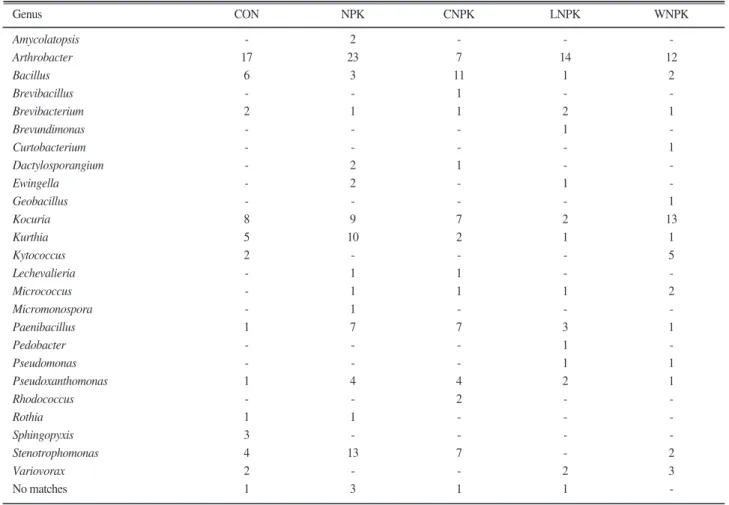
Bacterial diversity Phospholipid fatty acids are successfully quantitated with only very minor modifications to the fatty acid-naming table, and the single colonies of bacteria were correctly identified (Buyer, 2002). Bacteria strains isolated from the long-term experimental site were identified by MIS as shown in
Table 3. Genera of Dactylosporangium, Ewingella, Geobacillus, Kocuria, Kurthia, Kytococcus, Lechevalieria, Micrococcus, Micromonospora, Paenibacillus, Pedobacter, Pseudomonas, Pseudoxanthomonas, Rhodococcus, Rothia, Sphingopyxis, Stenotrophomonas, and Variovorax were isolated from the paddy soils sampled before irrigation.
Legard et al. (1994) identified bacteria using MIS and they reported that of the 15 bacteria most frequently recovered and identified, Curtobacterium flaccumfaciens, Microbacterium lacticum, Pantoea agglomerans,
Treatment
CON, without fertilizer; NPK, inorganic fertilizer; C, rice straw compost; L, lime; W, silicate. Means are indicated ± standard deviation.
CON NPK CNPK LNPK WNPK
44.7±0.6 46.4±3.4 55.5±0.6 53.6±0.6 76.1±3.5
17.9±1.2 23.7±0.0 22.8±0.6 18.3±0.6 25.8±1.2
39.3±1.2 38.4±2.3 28.0±1.2 29.5±1.2 41.0±1.2 Gram negative bacteria
(×104) Bacillus
(×104) Aerobic bacteria
(×105)
Microbial population (cfu g-1) Table 2. Microbial numbers of rice paddy soils on the treatments.
Genus
CON, without fertilizer; NPK, inorganic fertilizer; C, rice straw compost; L, lime; W, silicate.
Amycolatopsis Arthrobacter Bacillus Brevibacillus Brevibacterium Brevundimonas Curtobacterium Dactylosporangium Ewingella Geobacillus Kocuria Kurthia Kytococcus Lechevalieria Micrococcus Micromonospora Paenibacillus Pedobacter Pseudomonas Pseudoxanthomonas Rhodococcus Rothia Sphingopyxis Stenotrophomonas Variovorax No matches
- 17
6 - 2 - - - - - 8 5 2 - - - 1 - - 1 - 1 3 4 2 1
2 23
3 - 1 - - 2 2 - 9 10
- 1 1 1 7 - - 4 - 1 - 13
- 3
- 7 11
1 1 - - 1 - - 7 2 - 1 1 - 7 - - 4 2 - - 7 - 1
- 14
1 - 2 1 - - 1 - 2 1 - - 1 - 3 1 1 2 - - - - 2 1
- 12
2 - 1 - 1 - - 1 13
1 5 - 2 - 1 - 1 1 - - - 2 3 - WNPK LNPK
CNPK NPK
CON
Table 3. Bacterial genus isolated from long-term rice paddy field.
Pseudomonas aureofaciens, P. fluorescens, P. putida, and Serratia plymuthica occurred in both the glasshouse and field grown spring wheat. However dominant bacterial genera isolated from rice paddy soils in this study were Arthrobacter, Kocuria, Kurthia, and Bacillus, the major genera inhabited in whole treatments were Arthrobacter, Bacillus, Brevibacterium, Kocuria, Kurthia, Paenibacillus, and Pseudoxanthomonas at 10
5dilution of soil suspension.
The procedure of identification is limited by the need to culture the bacteria under a standard set of conditions. In other words, these conditions are only selective for culturable microbial populations, so it should enable microbial communities to be studied without the need to culture microbes.
Phospholipid fatty acids in soils Plot of LNPK was followed the CNPK treatment in the microbial biomass C content in this study. This pattern confirms that liming improve and sustain favorable conditions for microbial growth and activity like as application of rice straw compost. This liming effect can be confirmed with the report of Fuentes et al. (2006) who said that microbial biomass also increased with liming rate, but slowly decreased with time.
Soil microbial biomass C would only show trends in the long term and may only be as sensitive, as an indicator of environmental change, as other soil chemical properties in a semi-natural or natural ecosystem in the short term. However, as it changes faster than, for example, soil organic C, it would show the direction of such change more quickly (Hargreaves et al., 2003).
Content of PLFAs was analysed as of complementary measures of microbial populations or biomass (Fig. 1),
because of the limitation of microbial calculation using artificial cultivation method. The fatty acid 18:2ω6 is used as an indicator of fungal biomass, but the acid was not detected in the rice paddy soils. The reason of this may come from the waterlogging condition of experiment, however, more detail research about this phenomenon is needed to be performed.
The application of amendment reflected different profiles in bacterial, AM fungi, and actinomycetal PLFAs in this study. The concentration of total bacterial PLFAs was the highest after organic matter amendment and low in mineral treatments, therefore these results indicated that the long-term fertilization treatments changed the microbial community structure in the soil with following report of Marschner et al.(2003).
Böhme et al. (2005) considered that fertilization in general and its forms affect important functional and structural soil microbial properties on three different fertilizer treatments such as inorganic, farmyard manure, without any application. Also they mentioned that phospholipid fatty acid (PLFA) analysis proved to be a more sensitive indicator than functional parameters such as protease, phosphatase and glucosidase activities.
The difference of PLFA value was comparatively distinct to the microbial populations among the treatments in this study. Therefore, we could suggest that the PLFA concentration may be better indicator than bacterial population in the long-term rice paddy soils.
Soil microbial biomass The microbial biomass in soil is not only the catalyst of all microbial transformations in soil, but also constitutes a pool of nutrients that has a rapid turnover compared with soil organic matter.
Fig. 1. Phospholipid fatty acid (PLFA) distribution of rice paddy soils treated with amendments. CON, without fertilizer;
NPK, inorganic fertilizer; C, rice straw compost; L, lime; W, silicate.
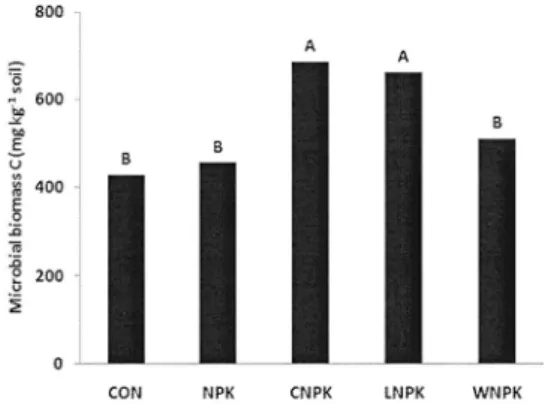
Fig. 2. Microbial biomass C in long-term rice paddy soils (ANOVA, SAS). Letters indicate significant difference between treatments at p<0.05 (n=2). CON, without fertilizer;
NPK, inorganic fertilizer; C, rice straw compost; L, lime; W, silicate.
Bacteria and fungi are the main constituents of soil microbial biomass.
The soil texture of experimental site was coarse loamy having property of moderately well-drained and rapid permeability. So the soil texture may contain high microbial biomass, because mineralization decreases with increasing clay content indicating that the soil microbial biomass is more active, in general, in sandy soils than in fine-textures soils (Franzluebbers et al., 1996).
The microbial biomass content ranged from 428 to 686 mg kg
-1(Fig. 2). Microbial biomass was the highest in the compost treatment (CNPK), and was the lowest in the CON. Relation with this result, we can consider that an increased microbial biomass content after farmyard manure application was also reported by Böhme et al (2005).
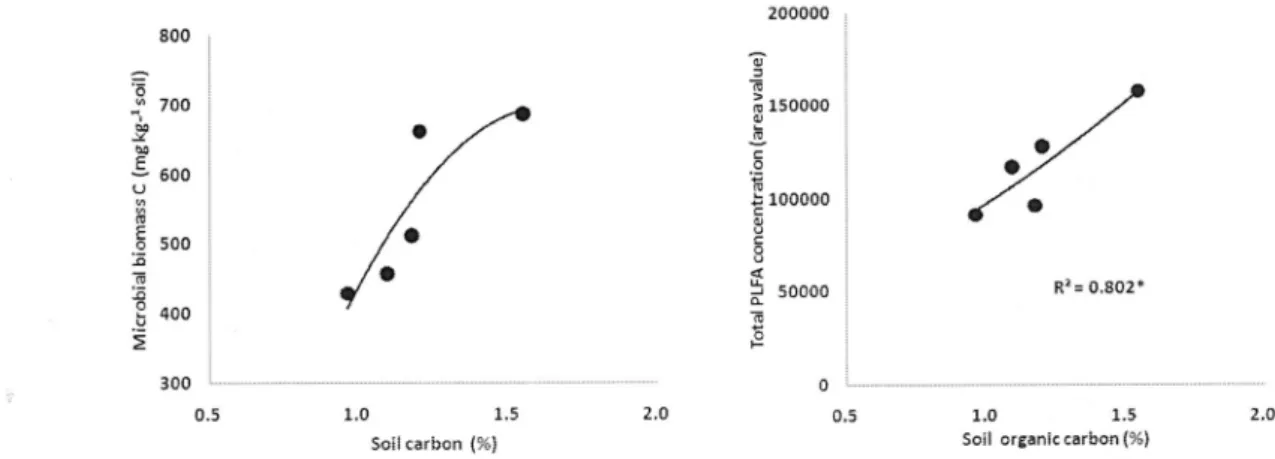
Microbial biomass C was increased with soil carbon content as Fig 3. It reflects that the increase of soil organic carbon may lead to increase microbial biomass, but in this study we could not have significant correlation between them with the findings of Böhme et al (2005) in showing that soil microbial biomass reflected a contrary trend and was therefore not significantly correlated with organic carbon. However, the PLFA value was significantly correlated to soil carbon content at P<0.05, so PLFA value may be better parameter for microbial community in this long-term experimental site.
Dehydrogenase activity Despite changes in microbial community structure, enzyme activities of alkaline phosphatase, arylsulfatase, xylanase, invertase, protease, and urease may generally not affected by the treatments of mineral or organic matter on the report of Marschner et
al. (2003). It is due to the functional redundancy of soil microorganisms, that is, one function can be carried out by a range of different microorganisms.
However, dehydrogenase activity is thought to reflect the total range of oxidative activity of soil microflora (Masto et al. 2006), therefore the activity of which depends on the metabolic state of the soil biota. Also this enzyme has been considered a sensitive indicator of soil quality and it has been proposed as a valid biomarker to indicate changes in total microbial activity due to changes in soil managements, under different agronomic practices and climates (Kandeler et al., 1999).
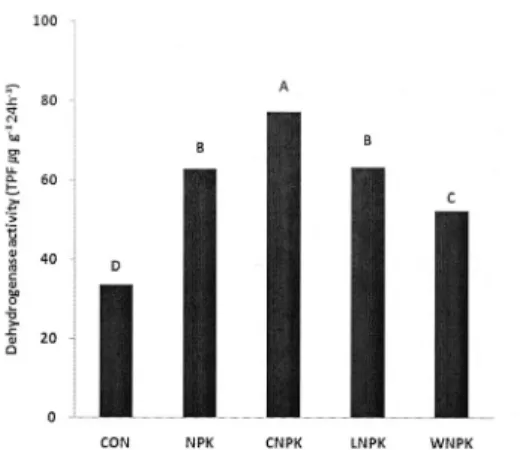
Optimum and balanced application of nutrients lead to significant increase in dehydrogenase activity (Masto et al. 2006). However, in compost treatment, an increase in dehydrogenase activity was observed (Fig. 4). This may suggests that the application of a balanced amount of fertilizer nutrients and compost improved the organic matter status of soil, which in turn enhanced the enzyme activity.
Values of dehydrogenase in soils treated with rice compost straw was the highest in this long-term experiment in this study. The activity showed an increasing trend according to treatment as follows: CON
< WNPK < NPK = LNPK < CNPK. The differences in dehydrogenase activity between soils depend on microbial activity because dehydrogenase are intracellular enzymes. So it can be explained that the difference in enzyme activity among treatments in this study is due to differences in the composition of microbiota with the report (Madejon et al. 2001).
Dehydrogenase activity reflects the total oxidative activity of the microbial biomass and being involved in central aspect of metabolism (Tripathi et al., 2007). And
Fig. 3. Regression between soil carbon and microbial biomass in soils of long-term rice paddy field.
* Indicates significant correlation at P<0.05 level.
there is a linear correlation between biomass C estimated with the SIR technique and to total amount of PLFA (Bååth and Anderson, 2003). We had similar result as of them as shown in Fig 3 and 4, so it is possible that the content of PLFA could be use as an indicator for soil microbial biomass C, and enzyme activity such as dehydrogenase having function of organic matter composition. We found that the CON soil, which showed low values for microbial biomass carbon content, also display the lowest dehydrogenase activity. The decrease in activity may be due to the low levels of organic matter (Pascual, 2000). Because the biomass C and dehydrogenase activity are significantly correlated to soil organic C and total N (Chu et al., 2007).
Since the microbial community plays a critical role in regulating processes such as decomposition of organic matter and nutrient cycling in the soil at the ecosystem level, it is necessary to have interests in understanding the factors that regulate its size, activity, and structure.
Summary
Continuous application of fertilizer and compost has a significant effect on soil biological indicators with different magnitudes on microbial biomass, PLFAs and dehydrogenase activity. Bacterial population in soil was comparatively higher in compost, lime, and silicate than in control and or fertilizer amendment. Genera of Dactylosporangium, Ewingella, Geobacillus, Kocuria, Kurthia, Kytococcus, Lechevalieria, Micrococcus, Micromonospora, Paenibacillus, Pedobacter, Pseudomonas, Pseudoxanthomonas, Rhodococcus, Rothia, Sphingopyxis, Stenotrophomonas, and
Variovorax were isolated from the paddy soils sampled before irrigation. The dominant genera were Arthrobacter, Kocuria, Kurthia, and Bacillus in the long- term field.
The value of total peak areas of the microbial PLFA was highest in the plot treated with rice straw compost, and the microbial biomass and dehydrogenase activity were related to soil carbon. The set of methods, especially PLFA, microbial biomass, and dehydrogenase, applied in this study were contributed to a better understanding of long-term fertilization in soils.
References
Bååth, E., and T.H. Anderson. 2003. Comparison of soil fungal/bacterial ratios in a pH gradient using physiological and PLFA-based techniques. Soil Biol. Biochem. 35:955-963.
Böhme, L., U. Langer, and F. Böhme. 2005. Microbial biomass, enzyme activities and microbial community structure in two European long-term field experiments. Agric. Ecosyst. Environ.
109:141-152.
Brookes P.C., A. Landman, G. Pruden, and D.S. Jenkinson. 1985.
Chloroform fumigation and the release of soil nitrogen: a rapid direct extraction method to measure microbial biomass nitrogen in soil. Soil Biol. Biochem. 17:837-842.
Buyer, J.S. 2002. Identification of bacteria from single colonies by fatty acid analysis. J. Microbiol. Methods. 48:259-265.
Chu, H., X. Lin, T. Fujii, S. Morimoto, K. Yagi, J. Hu, and J. Zhang.
2007. Soil microbial biomass, dehydrogenase activity, bacterial community structure in response to long-term fertilizer management. Soil Bio. Biochem. 39:2971-2976.
Crecchio, C., M. Curci, R. Mininni, P. Ricciuti, and P. Ruggiero.
2001. Short term effects of municipal solid waste compost amendments on soil carbon and nitrogen content, some enzyme activities and genetic diversity. Biol. Fertil. Soils. 34:311-318.
Degens, B.P., L.A. Schipper,, G.P. Sparling, and M. Vojvodic- Vukovic. 2000. Decreases in organic C reserves in soils can reduce the catabolic diversity of soil microbial communities. Soil Biol.
Biochem. 32:189-196.
Fierer N., J.P. Schimel, and P.A. Holden. 2003. Variations in microbial community composition through two soil depth profiles.
Soil Biol. Biochem. 35:167-176.
Franzluebbers, A.J., R.L. Haney, F.M. Hons, D.A. Zuberer. 1996.
Active fractions of organic matter in soils with different texture.
Soil Biol. Biochem. 28:1367-1372.
Fuentes, J.P., D.F. Bezdicek, M. Flury, S. Albrecht, and J.L. Smith.
2006. Microbial activity affected by lime in a long-term no-till soil.
Soil Till. Res. 88:123-131.
Hargreaves, P.R., P.C. Brookes, G.J.S. Ross, and P.R. Poulton.
2003. Evaluating soil microbial biomass carbon as an indicator of long-term environmental change. Soil Biol. Biochem. 35:401-407.
Hati, K.M., A. Swarup, B. Mishra, M.C. Manna, R.H. Wanjari, K.G.
Fig. 4. Dehydrogenase activity in long-term rice paddy soils (ANOVA, SAS). Letters indicate significant difference between treatments at p<0.05 (n=3). CON, without fertilizer;
NPK, inorganic fertilizer; C, rice straw compost; L, lime; W, silicate.
Mandal, and A.K. Misra. 2008. Impact of long-term application of fertilizer, manure and lime under intensive cropping on physical properties and organic carbon content of an Alfisol. Geoderma.
148:173-179.
Hu, S.J., A.H.C. Van Bruggen, and N.J. Grünwald,, 1999.
Dynamics of bacterial populations in relation to carbon availability in a residue-amended soil. Appl. Soil Ecol. 13:21-30.
Kandeler, E., M. Stemmer, and E.M., Klimanek. 1999. Response of soil microbial biomass, urease and xylanase within particle size fractions to long-term soil management. Soil Biol. Biochem.
31:261-273.
Kourtev P.S., J.G. Ehrenfeld, and M. Häggblom. 2003.
Experimental analysis of the effect of exotic and native plant species on the structure and function of soil microbial communities. Soil Biol. Biochem. 35:895-905.
Legard, D.E., M.P. Mcquilken, J.M. Whipps, J.S. Fenlon, T.R.
Fermor, I.P. Thompson, M.J. Bailey, and J.M. Lynch. 1994.
Studies of seasonal changes in the microbial populations on the phyllosphere of spring wheat as a prelude to the release of a genetically modified microorganism. Agric. Ecosyst. Environ.
50:87-101.
Liu, B, M.L. Gumpertz, S. Hu, and J.B. Ristaino. 2007. Long-term effects of organic and synthetic soil fertility amendments on soil microbial communities and the development of southern blight.
Soil Biol. Biochem. 39:2302-2316.
Madejón, E., P. Burgos, R. López, and F. Cabrera. 2001. Soil enzymatic response to addition of heavy metals with organic residues. Biol. Fertil. Soils. 34:144-150.
Manirakiza, P., A. Covaci, and P. Schepens. 2001. Comparative study on total lipid determination using Soxhlet, Roese-Gottlieb, Bligh & Dyer, and Modified Bligh & Dyer extraction methods.
Journal of Food Composition and Analysis. 14:93-100.
Marschner, B., and A.D. Noble. 2000. Chemical and biological processes leading to the neutralisation of acidity in soil incubated with litter materials. Soil Biol. Biochem. 32:805-813.
Masto, R.E., P.K. Chhonkar, D. Singh, and A.K. Patra. 2006.
Changes in soil biological and biochemical characteristics in a
long-term field trial on a sub-tropical inceptisol. Soil Biol.
Biochem. 38:1577-1582.
National Institute of Agricultural Science and Technology (NIAST).
2000. Methods of soil and plant analysis, NIAST. Rural Development Administration, Suwon, Korea.
Parham, J.A., S.P. Deng, H.N. Da, H.Y. Sun, and W.R. Raun. 2003.
Long-term cattle manure application in soil. II. Effect on soil microbial populations and community structure. Biol. Fertil. Soils.
38:209-215.
Pascual, J.A., C. Garcia, T. Hernandez, J.L. Moreno, and M. Ros.
2000. Soil microbial activity as a biomarker of degradation and remediation processes. Soil Biol. Biochem. 32: 1877-1877.
Peacock, A.D., M.D. Mullen, D.B. Ringelberg, D.D. Tyler, D.B.
Hedrick, P.M. Gale, and D.C. White. 2001. Soil microbial community responses to dairy manure or ammonium nitrate applications. Soil Biol. Biochem. 33:1011-1019.
Plaza, C., D. Hernández, J.C. García-Gil, and A. Polo. 2004.
Microbial activity in pig slurry-amended soils under semiarid conditions. Soil Biol. Biochem. 36:1577-1585.
Suh, J.S, S.J. Kim, H.J. Noh, J.S. Kwon, and W.K. Jung. 2007.
Long-term composting and fertilization impact on dehydrogenase- producing bacteria and dehydrogenase activity in rice paddy soil.
Korean J. Soil Sci. Fert. 40: 229-233.
Sukul, P. 2006. Enzymatic activities and microbial biomass in soil as influenced by metalaxyl residues. Soil Biol. Biochem. 38:320- 326.
Tripathi, S., A. Chakraborty, K. Chakrabarti, B.K. Bandyopadhyay.
2007. Enzyme activities and microbial biomass in coastal soils of India. Soil Biol. Biochem. 39:2840-2848.
Vance, E.D., P.C. Brookes, and D.S. Jenkinson. 1987. An extraction method for measuring soil microbial C. Soil Biol. Biochem.
19:703-707.
Yeon, B.Y. H.K. Kwak, Y.S. Song, H.J. Jun, H.J. Cho, and C.H.
Kim. 2007. Changes in rice yield and soil organic matter content under continued application of rice straw compost for 50 years in paddy soil. Korean J. Soil Sci. Fert. 40:454-459.
토양미생물 군락에 대한 유기물 및 비료의 장기 연용 효과를 평가하고자 동일비료연용 논토양을 대상으로 미 생물상, 미생물체량 및 세균 군락의 상호관계에 대해 조사하였다. 유기태 탄소함량은 비료를 연용한 곳 보다 볏 짚 퇴비를 시용한 처리구에서 높았다. 토양 세균수는 무비구와 화학비료 시용구에 비해 퇴비, 석회, 규산을 병 용한 처리구에서 비교적 높았다. 영년동일 논토양에서 Dactylosporangium, Ewingella, Geobacillus, Kocuria, Kurthia, Kytococcus, Lechevalieria, Micrococcus, Micromonospora, Paenibacillus, Pedobacter, Pseudomonas, Pseudoxanthomonas, Rhodococcus, Rothia, Sphingopyxis, Stenotrophomonas, Variovorax 등의 세균이 분리되었으 며, Arthrobacter, Kocuria, Kurhtia 및 Bacillus 등의 세균이 우점하였다. 미생물체량 및 탈수소효소 활성은 볏짚 퇴비 시용구에서 가장 높았다.
개량제 장기 연용이 논토양의 미생물체량, 효소활성 및 세균 다양성에 미치는 영향
서장선1*·노형준2·권장식1
1국립농업과학원, 2국립원예특작과학원