녹비 시용이 초기 논 토양 미생물군집에 미치는 영향
김은석·이영한*
경상남도농업기술원
Response of Soil Microbial Communities to Applications of Green Manures in Paddy at an Early Rice-Growing Stage
Eun-Seok Kim and Young-Han Lee*
Gyeongsangnamdo Agricultural Research and Extension Services, Jinju 660-370, Korea
Applications of green manures generally improve the soil quality in rice paddy in part through restructuring of soil microbial communities. To determine how different green manures affect soil microbial communities during the early stages of rice growth, fatty acid methyl ester (FAME) profiles were used to the effects of different management practices: 1) conventional farming (CF), 2) no-treatment (NT), 3) Chinese milk vetch (CMV), 4) green barley (GB), and 5) triticale in paddy field. With applications of green manures, soil organic matter was significantly higher than CF, while soil Na concentration was significantly lower compared with CF (p<0.05). Total soil microbial biomass of CMV was higher (p<0.05) than NF by approximately 31%. The highest ratio of monounsaturated fatty acid to saturated fatty acid was found in the GB plot, followed by CMV and triticale compared with CF (p<0.05), possibly indicating that microbial stress was less in GB and CMV plots. Populations of Gram-negative bacteria and arbuscular mycorrhizal fungi also were significantly higher green manures than CF (p<0.05). Our findings suggest that GB should be considered as optimum green manure for enhancing soil microbial community at an early growing stage in paddy field.
Key words: FAME, Microbial community, Paddy, Green manure, Green barley
접수 : 2011. 3. 14 수리 : 2011. 3. 30
*연락저자 : Phone: +82557716413 E-mail: [email protected]
서 언
녹비작물은 토양에 유기물과 양분을 공급할 뿐만 아니 라 토양의 입단을 촉진하고 토양 미생물의 활동을 증대시 키는 효과가 있다 (Lee et al., 2010; Mac Rae and Mehuys, 1985). 우리나라에서도 친환경농업의 실천을 위해 농가현 장에 적용할 수 있는 화학비료 대체기술로서 자운영, 청보 리, 트리티케일 등의 녹비작물이 다양하게 연구되고 있다 (Lee et al., 2009; Park et al., 2009). 그러나 논 토양에 투입된 녹비는 혐기적인 조건에서 미생물에 의해 초기에 다 량으로 분해되므로 녹비의 C/N율과 산소부족으로 인한 토 양 생태계의 심각한 변동을 가져올 수 있다 (Burgos and Talbert, 1996; Teasdale and Daughtry, 1993). 그러나 이 러한 문제점에도 불구하고 투입된 녹비가 벼 생육초기에 토 양 미생물의 다양성에 미치는 영향을 검토한 연구는 거의 없다.
최근에 토양 미생물의 군집을 분석하기 위해서 주로 MIDI 기술이 많이 이용되고 있다 (Buyer and Drinkwater, 1997;
Cavigellie al., 1995; Fries et al., 1997; Ibekwe and Kennedy, 1998; Macalady et al., 1998). 특히 다량의 토 양 시료를 비교적 간단하고 빠르게 분석할 수 있는 Fatty acid methyl ester (FAME) 방법을 사용하여 토양의 미생 물 생체량 뿐만 아니라 미생물 군집을 쉽게 분석할 수 있다 (Frostegård and Bååth, 1996; Macalady et al., 1998; Pennanen, 2001; Rajendran et al., 1994; Schutter and Dick, 2000).
따라서 본 연구는 논 토양에 자운영, 청보리, 트리티 케 일을 시용하고 벼 생육초기에 토양 미생물 생태계의 변화에 미치는 영향을 검토하여 벼 재배를 위한 최적의 녹비작물 을 선발코자 수행하였다.
재료 및 방법
시험포장 및 재배환경 벼 생육초기 토양 미생물의 다양성에 미치는 녹비작물의 시용효과를 검토하기 위해 경
Table 1. The chemical properties of soil before addition of fertilizers to field.
pH OM Avail. P2O5 Exch. Cation Fe Mn Zn NH4-N
K Ca Mg Na
(1:5) g kg-1 mg kg-1 --- cmolc kg-1 --- --- mg kg-1 ---
6.4 26 194 0.41 6.3 1.8 0.24 221 44 1.2 26.9
Table 2. The concentrations of selected green manures applied in the paddy experimental fields.
Cover crop Dry weight T-N P2O5 K2O T-C C/N
g m-2 --- % ---
Chinese milk vetch 931 2.84 0.16 2.92 42.86 15.3
Green barley 1,300 0.85 0.08 1.91 42.47 50.4
Triticale 280 3.10 0.36 4.78 39.79 12.9
남농업기술원 시험포장 (35°12′26″N, 128°07′06″E) 이현 미 사질양토 (모래 9.1, 미사 73.0, 점토 17.9%)에서 동진1호를 시험품종으로 선정하여 2010년에 수행하였다. 시험기간인 6월에서 7월 5일까지 평균 기온은 22.3℃, 강우량은 62 mm 였다. 토양 양분관리를 위해 관행 처리구 (N-P2O5-K2O = 90-45-57 kg ha-1)와 무처리구, 녹비 시용으로 자운영, 청 보리, 트리티케일 처리구로 나누어 완전임의배치법 3반복으 로 시험하였다. 녹비작물은 시험 전년도인 2009년에 ha당 자운영은 9월 20일에 30 kg, 청보리와 트리티케일은 10월 18일에 각각 220 kg을 파종하였다. 수확된 자운영과 청보 리는 전량으로 토양에 투입하였고 트리티케일은 4월 15일 예취한 후 재생된 것을 5월 30일에 경운 하여 10 cm 깊이 로 담수한 후 6월 10일에 기계이앙 하였으며 잡초제어를 위해 제초제를 6월 21일에 시용 하였다.
토양 및 식물체 분석 토양 화학성 분석을 위해 7월 5일 채취한 토양은 실험실에서 7일간 풍건하여 2 mm 체 를 통과된 것을 화학성분 분석에 사용하였다. 화학성분 분 석은 농촌진흥청 농업과학기술원 토양 및 식물체 분석법 (NIAST, 2000)을 적용하여 pH는 토양과 증류수의 비율을 1:5로 추출하여 초자전극법 (Orion 520A pH meter, Orion Research Inc., Boston, USA)으로 측정하였고, 유기물은 Tyurin법으로 적정하였으며, 유효인산은 Lancaster법과 유 효규산은 1M NaOAc (pH 4.0)의 가용규산으로 비색계 (UV- 1650PC, Shimadzu Co., Kyoto, Japan)를 사용하였다. 치 환성 칼륨, 칼슘, 마그네슘 등의 양이온은 1M NH4OAc로 추출하여 ICP (AAnalyst 300, Perkin-Elmer, Norwalk, USA) 로 분석하였다. 시험전 토양 화학성분은 Table 1과 같이 pH는 6.4의 약산성을 나타내었고 유기물 함량은 26 g kg-1 였으며 유효인산 함량은 적정수준 보다 높은 194 mg kg-1으 로 전형적인 논 토양의 특성을 나타냈다 (Lee et al., 2010).
수확된 녹비작물은 채취 후 70℃에서 24시간 건조시키 고 분쇄기 (RM100 Mortar Grinder, Retsch, Germany)를 사 용하여 270 mesh로 조제한 후 건물 0.5 g을 습식 분해하
여 농촌진흥청 토양 및 식물체 분석법 (NIAST, 2000)으로 분석하였으며 투입된 녹비의 생산량과 양분가치는 Table 2 와 같다. 자운영과 청보리의 건조량은 각각 931 g m-2와 1,300 g m-2이었으나 트리티케일은 4월 15일 예취 후 재생 된 것을 사용하여 280 g m-2수준이었다. 또한 자운영과 트 리티케일은 탄질율이 각각 15.3과 12.9로서 낮은 수준이었 으나 청보리는 50.4로 높은 비율을 보였다.
토양 미생물 군집 분석 벼 생육초기 녹비작물이 미 생물 군집에 미치는 영향을 검토하기 위해 7월 5일에 토양 을 채취하였다. 채취한 토양은 -80℃에 2일간 보관하여 동 결건조 한 후 미생물 군집 분석에 사용하였다. 미생물 군집 은 개별적으로 미생물이 가지고 있는 고유 세포벽 지방산을 분석하는 FAME 방법을 이용하였다 (Schutter and Dick, 2000). 또한 미생물의 정량은 internal standard 19:0을 이 용하여 분석하였다. 미생물 군집 분석은 GC Agilent 6890N (Agilent Technologies, USA)과 HP-ULTRA 2 capillary column (25 m × 0.2 mm × 0.33 µm film thickness, Agilent Technologies, USA)을 이용하였다. 칼럼 온도는 170℃에서 270℃가 될 때 까지 분당 5℃씩 가온하였고 마지막 270℃
에서 2분간 유지하였다. 분석된 미생물 세포벽 지방산은 MIDI software program package (MIDI, Inc., Newark, DE)을 이용하여 각각의 지방산에 대한 미생물 군집을 분석하였다 (Hamel et al., 2006; Pankhurst et al, 2002). 총 세균은 i15:0, a15:0, 15:0, i16:0, 16:1ω9, 16:1ω7, i17:0, a17:0, 17:0, cy17:0, 18:1ω7c 및 cy19:0 함량을 합산하여 분석하였다 (Macalady et al., 1998; Schutter and Dick, 2000). 그람 음 성 세균은 지방산 16:1ω7c, 18:1ω7c, cy17:0 및 cy19:0을 합 산하였고 (Zelles, 1997) 그람 양성 세균은 지방산 i15:0, a15:0, i16:0, i17:0 및 a17:0을 합산하여 구하였다 (Zelles, 1997). 방선균은 지방산 10Me18:0을 사용하였고 (Schutter and Dick, 2000) 곰팡이는 지방산 18:1ω9c와 18:2ω6c를 사 용하였다 (Bradleya et al., 2006). 또한 지방산 16:1ω5c는 arbuscular mycorrhizal fungi의 biomarker로 이용하였다
Table 3. The chemical properties of soil at an early rice growing stage.
Treatment pH OM Avail. P2O5 Exch. Cation Fe Mn Zn NH4-N
K Ca Mg Na
(1:5) g kg-1 mg kg-1 --- cmolc kg-1 --- --- mg kg-1 ---
Conventional farming 6.7 26 174 0.36 6.9 2.0 0.60 198 35 1.6 25.2
No-treatment 6.8 29 143 0.35 6.4 2.0 0.60 184 41 1.0 22.5
Chinese milk vetch 6.5 28 166 0.38 5.7 1.7 0.47 269 26 1.3 29.8
Green barley 6.6 32 170 0.32 5.9 1.9 0.42 201 29 0.8 25.8
Triticale 6.7 32 145 0.42 6.5 1.9 0.48 217 36 1.1 30.9
LSD (p<0.05) 0.20 0.8 10.4 0.088 0.63 0.17 0.072 43.4 6.7 NS† 7.10
†NS, not significant.
Table 4. Soil microbial biomass of soil expressed as nmol (nmol g-1) at an early rice growing stage.
Biomass Conventional
farming No-treatment Chinese milk
vetch Green barley Triticale LSD (p<0.05)
Total FAMEs 287 244 320 299 291 57.1
Bacteria 86 77 104 99 89 20.0
Gram-negative bacteria 39 37 48 50 41 9.4
Gram-positive bacteria 38 33 44 39 39 9.5
Actinomycetes 4.1 3.3 4.2 4.3 3.6 NS‡
Fungi 36 31 39 37 38 NS
Arbuscular mycorrhizal fungi 3.4 2.9 5.0 5.1 4.7 1.01
Gm(-) to Gm(+) bacteria 1.0 1.1 1.1 1.3 1.1 0.19
Fungi to Bacteria 0.42 0.40 0.38 0.38 0.42 NS
cy17:0 to 16:1w7c 0.28 0.34 0.30 0.22 0.34 NS
cy19:0 to 18:1w7c 0.71 0.62 0.55 0.55 0.54 NS
MUFA to SFA† 0.71 0.71 0.74 0.83 0.73 0.093
†MUFA, monounsaturated fatty acids; SFA, saturated fatty acids. ‡NS, not significant.
(Balser et al., 2005; Frostegård et al., 1993; Olsson et al., 1998). 그리고 그람 음성 세균과 그람 양성 세균의 비율, cy17:0와 16:1ω7c 비율, cy19:0와 18:1ω7c 비율 및 불포화 지방산 (MUFA)과 포화 지방산 (SFA) 비율은 토양에서 미생 물 스트레스 지표로 사용하였다 (Bossio and Scow, 1998;
Grogan and Cronan, 1997; Guckert et al., 1986; Kieft et al., 1997).
다변량 주성분 분석 및 통계분석 분석된 토양 화 학성은 SAS 프로그램 9.1.3 버젼 (2006)을 사용하였다. 토 양 및 미생물 총량은 5% 수준에서 LSD 검정을 하였고 각 각의 미생물 군집은 총 지방산 함량에 대한 %로 변경하여 주성분 분석에 사용하였다.
결과 및 고찰
초기 논 토양 화학성분 담수 이후 초기 논 토양의 화학성 변화는 Table 3과 같다. 토양의 pH는 자운영 처리 구에서 6.5으로 무처리구 6.8에 비해 유의적인 감소를 나타 내어 토양의 Fe 함량은 유의적인 증가를 보였다 (p<0.05).
이러한 경향은 Lee et al. (2009)이 보고한 바와 같이 탄 질율이 낮고 분해되기 쉬운 녹비작물을 다량 시용할 경우 토양의 pH가 낮아진다는 결과와 일치하였다. 토양 유기물 함량은 청보리, 트리티케일, 자운영 등의 녹비를 시용함으 로 관행에 비해 유의적인 증가를 나타냈다 (Reganold et al., 1987). 자운영 처리구는 청보리와 트리티케일 처리구에 비 해 토양 유기물 함량이 낮은 수준을 보였는데 이러한 경 향은 탄질율이 상대적으로 낮고 분해가 쉽게 일어난 것으 로 판단되었다 (Khalil et al., 2005; Trinsoutrot et al., 2003). 반면 트리티케일은 재생된 어린 녹비를 사용하여 상 대적으로 탄질율이 낮은 수준이었으나 밀과 호밀을 교잡한 맥류로서 분해가 느리게 되는 특성을 보였다 (Miedaner et al., 2001). 녹비를 시용함으로써 토양의 나트륨 함량은 유의 적인 감소를 나타냈다 (p<0.05). 이러한 경향은 유기물을 시 용함으로 양이온인 나트륨과 흡착함으로 토양의 염류농도를 감소시킨다는 Zhong et al. (2010)의 결과와 일치하였다.
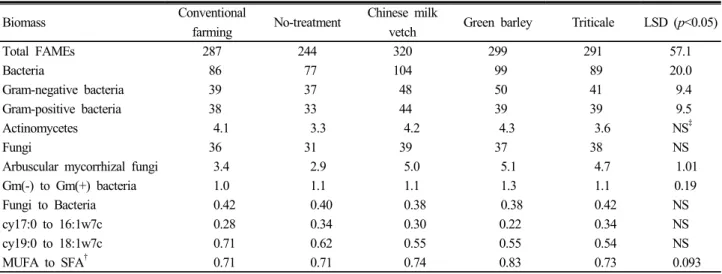
토양 미생물 함량 녹비 시용에 따른 초기 논 토양의 미생물체 함량과 지방산 함량의 비율은 Table 4와 같다. 총 FAME 함량은 자운영 처리구가 320 nmol g-1으로 무처리
Table 5. Soil microbial community of soil expressed as % total FAME at an early rice growing stage.
Biomarker Conventional
farming No-treatment Chinese milk vetch
Green
barley Triticale LSD
(p<0.05)
Bacteria 29.76 31.64 32.33 33.01 30.56 2.058
Gram-negative bacteria 13.64 14.97 15.20 16.61 14.16 1.692
Gram-positive bacteria 13.21 13.46 13.80 13.08 13.32 NS‡
Actinomycetes 1.42 1.36 1.30 1.44 1.23 NS
Fungi 12.58 12.62 12.23 12.42 12.96 NS
Arbuscular mycorrhizal fungi 1.16 1.18 1.57 1.69 1.62 0.277
PC1† -1.02 -0.31 0.29 1.42 -0.37 1.135
PC2 0.42 -0.22 -0.46 0.16 0.10 NS
†PC, principal component. ‡NS, not significant.
Fig. 1. Principal component analysis. A: soil microbial communities amended with different cover crops. Bars represent one standard deviation of the mean. B: Principal component analysis showing loading values of individual microbial biomarker given in A.
244 nmol g-1에 비해 유의적으로 높았으나 (p<0.05) 관행 과 다른 녹비 시용구와는 차이가 없었다. 그리고 총 세균 함 량, 그람음성 세균 함량, 그람 양성 세균 함량도 총 FAME 함량과 유사한 결과를 나타냈다. 이러한 결과는 토양 유기 물의 공급에도 불구하고 Zhang et al. (2010)이 보고한 바 와 같이 6월 21일에 시용한 제초제의 영향으로 판단되었다.
토양의 방선균 함량과 곰팡이 함량은 녹비 시용구가 관행 과 무처리구에 비해 많은 경향이었으나 유의적인 차이가 없 었다. 그러나 내생균근균의 함량은 청보리 5.1 nmol g-1, 자운영 5.0 nmol g-1, 트리티케일 4.7 nmol g-1으로 관행 3.4 nmol g-1과 무처리 nmol g-1에 비해 유의적인 증가를 나 타냈다 (p<0.05). 이러한 경향은 유기물 시용으로 토양의 내생균근균 함량이 크게 증가한다고 보고한 Wright and Upadhyaya (1998)의 결과와 일치하였다. 특히 내생균근균 은 토양 침식을 방지하거나 토양 탄소를 저장하는 미생물 로서 농업환경에 매우 중요한 역할을 하는 것으로 알려져 있어 청보리, 자운영, 트리티케일 등의 녹비작물 시용이 중 요한 것으로 판단되었다 (Rillig et al., 2001).
토양의 그람음성 세균과 그람양성 세균의 비율은 청보리 처리구가 다른 처리구에 비해 유의적으로 높았다 (p<0.05).
그람음성 세균은 토양의 영양분이 부족할 경우 매우 민감하 게 반응하여 개체수가 감소한다 (Guckert et al., 1986; Kieft et al., 1997). 따라서 이러한 결과는 Table 2와 같이 청보리 의 시용량이 다른 처리구에 비해 미생물의 먹이인 탄소가 풍 부하여 그람음성 세균 함량이 많아진 것으로 판단되었다.
토양 환경과 영양적인 스트레스 지표로 사용되는 cy17:0과 16:1ω7c 비율 그리고 cy19:0과 18:1ω7c 비율은 상대적으로 미생물 영양원이 풍부한 청보리 처리구에서 낮은 경향을 보였으나 다른 처리구와 유의적인 차이는 없었다 (Bossio and Scow, 1998; Kieft et al., 1997). 반면에 영양적인 스트레 스 지표로 사용되는 불포화지방산과 포화지방산 함량의 비율은 청보리 처리구가 다른 처리구에 비해 유의적인 증가 를 보였다 (Bossio and Scow, 1998; Grogan and Cronan, 1997; Guckert et al., 1986; Kieft et al., 1997). 이러한 경 향은 Bossio et al. (1998)이 유기물을 시용함으로 토양의 불 포화지방산 함량이 증가한다고 보고한 결과와 일치하였다.
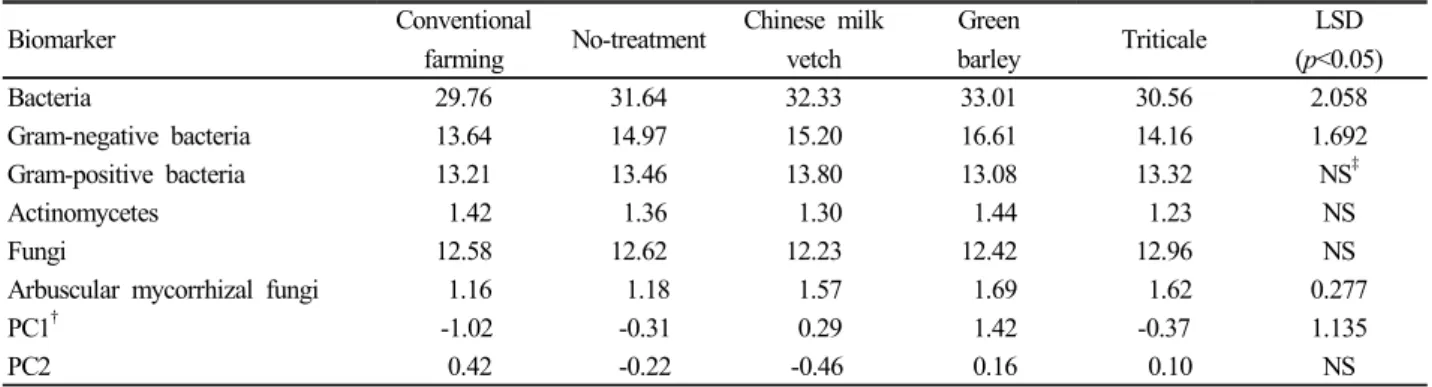
토양 미생물 군집 주성분 분석 녹비 시용에 따른 초기 논 토양의 미생물 구성비율은 Table 5와 같다. 총 세 균 군집은 청보리와 자운영 처리구가 관행에 비해 유의적인
증가를 나타냈다 (p<0.05). 이러한 경향은 유기물의 공급으 로 그람양성 세균 보다 그람음성 세균의 증가에 기인된 것 으로 나타났다. 방선균과 곰팡이의 군집은 모든 처리구에서 구성비율이 비슷하였다. 그러나 내생균근균의 구성비율은 청보리, 트리티케일, 자운영 처리구가 관행과 무처리구에 비해 유의적으로 높게 나타났다 (p<0.05).
녹비 시용에 따른 토양 미생물 군집의 차이를 비교하기 위 하여 개별적인 미생물 분포비율을 주성분 분석에 사용하 였다 (Drenovsky et al., 2004; Steenworth et al., 2003).
주성분 PC 1은 미생물 군집의 38.3%를 설명할 수 있었고 주 성분 PC 2는 미생물 군집의 21.3%를 설명하여 전체 59.6%
를 설명할 수 있었다 (Fig. 1A and 1B). PC 1에서 청보리와 자운영 처리구는 양의 값을 보인 반면 관행과 트리티케일 및 무처리구는 음의 값을 나타냈다 (Fig. 1A). 특히 청보 리 처리구는 Table 5에 나타낸 바와 같이 PC 1에서 관행, 무처리구 및 트리티케일 처리구와 유의적인 차이를 보였 다 (p<0.05). 반면에 PC 2는 모든 처리구에서 유의적인 차 이가 없었다. 주성분 분석에서 PC 1에 가장 큰 영향을 미친 미생물은 그람음성 세균인 것으로 나타났다 (p<0.05). 그리 고 그람음성 세균과 그람양성 세균의 구성비율, 불포화지 방산과 포화지방산의 구성비율도 PC 1에 양의 값으로 영 향을 미친 반면, cy17:0과 16:1ω7c 비율, 곰팡이와 총세균 의 비율 그리고 cy19:0과 18:1ω7c 비율은 음의 값으로 영 향을 미친 것으로 나타났다 (Fig. 1B).
이상의 결과 청보리, 자운영 그리고 트리티케일과 같은 녹비를 시용한 논 토양에서 초기 미생물의 함량과 다양성 을 증진시킬 수 있는 최적의 녹비는 청보리인 것으로 나 타났다. 그러나 투입한 청보리의 건물량이 다른 녹비에 비 해 많아서 비롯된 결과인지 추후 동일량을 시용하여 초기 미생물상을 검토할 필요가 있을 것으로 판단된다.
요 약
논 토양에서 청보리, 자운영과 트리티케일을 시용하고 벼 생육초기에 토양 미생물 생태계의 변화에 미치는 영향을 검토하였다. 녹비를 시용한 처리구는 관행에 비해 토양 유 기물 함량은 유의적으로 증가하였으나 토양의 나트륨 함 량은 유의적인 감소를 나타냈다. 내생균근균의 함량과 구 성비율은 녹비 시용으로 관행 보다 유의적으로 높아졌으 며 특히 청보리 처리구가 가장 높았다. 또한 토양의 그람 음성 세균과 그람양성 세균의 비율과 불포화지방산과 포화 지방산 함량의 비율은 청보리 처리구가 다른 처리구에 비 해 유의적인 증가를 보였다. 그리고 주성분 분석에서 PC 1 에 가장 큰 영향을 미친 미생물 군집은 그람음성 세균인 것으로 나타났으며 청보리 처리구는 관행과 가장 큰 차이를
나타냈다. 이러한 결과를 종합한 결과 청보리는 논 토양의 초기 미생물 다양성을 증대시킬 수 있는 최적의 녹비작물 로 판단된다.
사 사
본 연구는 농촌진흥청 공동연구사업 (과제번호: PJ0069 06202011)의 지원에 의해 이루어진 것임을 밝힙니다.
인 용 문 헌
Balser, T., K.K. Treseder, and M. Ekenler. 2005. Using lipid analysis and hyphal length to quantify AM and saprotrophic fungal abundance along a soil chronosequence. Soil Biol.
Biochem. 37:601-604.
Bossio, D.A. and K.M. Scow. 1998. Impacts of carbon and flooding on soil microbial communities: phospholipid fatty acid profiles and substrate utilization patterns. Microb. Ecol.
35:265-278.
Bossio, D.A., K.M. Scow, N. Gunapala, and K.J. Graham.
1998. Determinants of soil microbial communities: effects of management, season and soil type on phospholipid fatty acid profiles. Microb. Ecol. 36:1-12.
Bradleya, K., A. Rhae, R.A. Drijberb, and J. Knopsc. 2006.
Increased N availability in grassland soils modifies their microbial communities and decreases the abundance of arbuscular mycorrhizal fungi. Soil Biol. Biochem. 38:1583- 1595.
Burgos, N.R. and R.E. Talbert. 1996. Weed control by spring cover crops and imazethapyr in no-till southern pea (Vigna unguiculata). Weed Technol. 10:893-899.
Buyer, J.S. and L.E. Drinkwater. 1997. Comparison of substrate utilization assay and fatty acid analysis of soil microbial communities. J. Microbiol. Meth. 30:3-11.
Cavigelli, M.A., G.P. Robertson, and M.J. Klug. 1995. Fatty acid methyl ester (FAME) profiles as measures of soil microbial community structure. Plant Soil 170:99-113.
Cobb, D., R. Feber, A. Hopkins, L. Stockdale, T. O’Riordan, B. Clements, L. Firbank, K. Goulding, S. Jarvis, and D.
Macdonald. 1999. Intergrating the environmental and economic consequences of converting to organic agriculture: evidence from a case study. Land Use Policy 16:207-221.
Drenovsky, R.E., D. Vo, K.J. Graham, and K.M. Scow. 2004.
Soil water content and organic carbon availability are major determinants of soil microbial community composition.
Microb. Ecol. 48:424-430.
Fries, M.R., G.D. Hopkins, P.L. McCarty, L.J. Forney, and J.M. Tiedje. 1997. Microbial succession during a field evaluation of phenol and toluene as the primary substrates for trichloroethene cometabolism. Appl. Environ. Microbiol.
63:1515-1522.
Frostegård, Å., A. Tunlid, and E. Bååth. 1993. Phospholipid fatty acid composition, biomass and activity of microbial communities from two soil types experimentally exposed to different heavy metals. Appl. Environ. Microbiol. 59:3605- 3617.
Frostegård, Å. and E. Bååth. 1996. The use of phospholipid fatty acid analysis to estimate bacterial and fungal biomass in soil. Biol. Fertil. Soils 22:59-65.
Grogan, D.W. and J.E. Cronan. 1997. Cyclopropane ring formation in membrane lipids of bacteria. Microbiol. Mol.
Biol. Rev. 61:429-441.
Guckert, J.B., M.A. Hood, and D.C. White. 1986. Phospholipid ester-linked fatty acid profile changes during nutrient deprivation of Vibrio cholerae: increases in cis/trans ratio and proportions of cyclopropyl fatty acid. Appl. Environ.
Microbial. 52:794-801.
Hamel, C., K. Hanson, F. Selles, A.F. Cruz, R. Lemke, B.
McConkey, and R. Zentner. 2006. Seasonal and long-term resource-related variations in soil microbial communities in wheat-based rotations of the Canadian prairie. Soil Biol.
Biochem. 38:2104-2116.
Ibekwe, A.M. and A.C. Kennedy. 1998. Fatty acid methyl ester (FAME) profiles as a tool to investigate community structure of two agricultural soils. Plant Soil 206:151-161.
Khalil, M.I., M.B. Hossain, and U. Schmidhalter. 2005.
Carbon and nitrogen mineralization in different upland soils of the subtropics treated with organic materials. Soil Biol.
Biochem. 37:1507-1518.
Kieft, T.L., E. Wilch, K. O’connor, D.B. Ringelberg, and D.C. White. 1997. Survival and phospholipid fatty acid profiles of surface and subsurface bacteria in natural sediment microcosms. Appl. Environ. Microbiol. 63:1531-1542.
Lee, Y.H., B.K. Ahn, and J.H. Lee. 2010. Effects of rice straw application and green manuring on selected soil physical properties and microbial biomass carbon in no-till paddy field. Korean J. Soil Sci. Fert. 43:105-112.
Lee, Y.H., D. Son, and Z.R. Choe. 2009. Effects of rice- winter cover crops cropping systems on the rice yield and quality in no-tillage paddy field. Korean J. Environ. Agri.
28:53-58.
Lee, Y.H., S.T. Lee, J.Y. Heo, M.G. Kim, K.P. Hong, W.D.
Song, C.W. Rho, J.H. Lee, W.T. Jeon, B.G. Ko, K.A. Roh, and S.K. Ha. 2010. Monitoring of chemical properties from paddy soil in Gyeongnam Province. Korean J. Soil Sci.
Fert. 43:140-146.
Macalady, J.L., M.E. Fuller, and K.M. Scow. 1998. Effects of metam sodium fumigation on soil microbial activity and community structure. J. Environ. Qual. 27:54-63.
Mac Rae, R.Y. and G.R. Mehuys. 1985. The effect of green manuring on the physical properties of temperate area soils.
Adv. Soil Sci., Vol. 3. Springer-Verlag, Inc., NY, pp71-94.
Miedaner, T., C. Reinbrecht, U. Lauber, M. Schollenberger, and H.H. Geiger. 2001. Effects of genotype and genotype- environment interaction on deoxynivalenol accumulation and resistance to Fusarium head blight in rye, triticale, and wheat. Plant Breeding 120:97-105.
NIAST. 2000. Methods of analysis of soil and plant. National Institute of Agricultural Science and Technology, Suwon, Korea (In Korean).
Olsson, P.A., R. Francis, D.J. Read, and B. Söderström. 1998.
Growth of arbuscular mycorrhizal mycelium in calcareous dune sand and its interaction with other soil micro-organisms as estimated by measurement of specific fatty acids. Plant Soil 201:9-16.
Park, T.I., J.H. Seo, O.K. Han, K.H. Park, J.S. Choi, J.G.
Kim, J.C. Park, H.S. Kim, H.Y. Heo, S.B. Baek, Y.U.
Kwon, H.H. Park, M.S. Kang, K.G. Park, and S.J. Suh.
2009. A new auricleless barley cultivar “Dami” for whole crop forage. Korean J. Breed. Sci. 41:349-353.
Pankhurst, C.E., A. Pierret, B.G. Hawke, and J.M. Kirby.
2002. Microbiological and chemical properties of soil associated with macropores at different depths in a red- duplex soil in NSW Australia. Plant soil 238:11-20.
Pennanen, T. 2001. Microbial communities in boreal coniferous forest humus exposed to heavy metals and changes in soil pH-a summary of the use of phospholipids fatty acids, Biolog® and 3H-Thymidine incorporation methods in field studies. Geoderma 100:91-126.
Rajendran, N., O. Matsuda, Y. Urushigawa, and U. Simidu.
1994. Characterization of microbial community structure in the surface sediment of Osaka Bay, Japan, by phospholipid fatty acid analysis. Appl. Environ. Microbiol. 60:248-257.
Reganold, J.P., L.F. Elliott, and Y.L. Unger. 1987. Long-term effects of organic and conventional farming on soil erosion.
Nature 330:370-372.
Rillig, M.C., S.F. Wright, K.A. Nichols, W.F. Schmidt, and M.S. Torn. 2001. Large contribution of arbuscular mycorrhizal fungi to soil carbon pools in tropical forest soils. Plant Soil 233:167-177.
SAS. 2006. SAS enterprise guide Version 4.1. SAS Inst., Cary, NC.
Schutter, M.E. and R.P. Dick. 2000. Comparison of fatty acid methyl ester (FAME) methods for characterizing microbial communities. Soil Sci. Soc. Am. J. 64:1659-1668.
Sttenworth, K.L., L.E. Jackson, F.J. Calderon, M.R. Stromberg, and K.M. Scow. 2003. Soil microbial community composition and land use history in cultivated and grassland ecosystems of coastal California. Soil. Biol. Biochem. 35:489-500.
Teasdale, J.R. and C.S.T. Daughtry. 1993. Weed suppression by live and desiccated hairy vetch (Vicia villosa). Weed Sci. 41:207-212
Trinsoutrot, I., S. Recous, B. Bentz, M. Lineres, D. Cheneby, and B. Nicolardot. 2000. Biochemical quality of crop residues
and carbon and nitrogen mineralization kinetics under nonlimiting nitrogen conditions. Soil Sci. Soc. Am. J. 64:
918-926.
Wright, S.F. and A. Upadhyaya. 1998. A survey of soils for aggregate stability and glomalin, a glycoprotein produced by hyphae of arbuscular mycorrhizal fungi. Plant Soil 198:97-107.
Zelles, L. 1997. Phospholipid fatty acid profiles in selected members of soil microbial communities. Chemosphere 35:
275-294.
Zhang, C., X. Liu, F. Dong, J. Xu, Y. Zheng, and J. Li. 2010.
Soil microbial communities response to herbicide 2,4- dichlorophenoxyacetic acid butyl ester. Eur. J. Soil Biol.
46:175-180.
Zhong, W., T. Gu, W. Wang, B. Zhang, X. Lin, Q. Huang, and W. Shen. 2010. The effects of mineral fertilizer and organic manure on soil microbial community and diversity.
Plant Soil 326:511-522.