REVIEW ARTICLE
Korean J Biol Psychiatry 2013;20:66-73
ISSN 1225-8709 / eISSN 2005-7571
서
론
성(sex, sexuality)은 인류의 역사 속에 항상 공존하였다.
그러나 20세기 초에 이르러서야 비로소 성에 대해 체계적이 고 과학적인 논의가 이루어지기 시작했다. Freud는 발기부전 (erectile dysfunction)이나 조루(premature ejaculation) 등의 성기능 장애 발생에서 불안(anxiety)이라는 심리적인 작용이 중요하다고 언급함으로써, 불안의 역할을 성 의학(sexual med- icine) 영역에 처음으로 도입하였다.1) Freud2)는 1905년에 ‘Three Essays on the Theory of Sexuality’라는 책을 발표하여 유아 기 성욕(infantile sexuality)을 처음 주장하였다. Freud는 여성 의 오르가슴(orgasm)을 음핵(clitoris)을 통한 오르가슴과 질
(vagina)을 통한 오르가슴으로 구분하고, 질을 통한 오르가 슴이 음핵을 통한 오르가슴보다 더욱 성숙하다고 이야기하 였고, 이는 오랫동안 정설로 인식되었다. Reich3)는 Freud의 수제자로 1942년에 ‘The Function of the Orgasm’이라는 책 을 써서 오르가슴을 느끼지 못하기 때문에 노이로제를 포함한 모든 질환과 경제적 착취, 범죄와 같은 온갖 사회적 갈등을 야 기시킨다고 설명하였다.
1948년 Kinsey 등은 미국 남성 5300명과 일대일 면접을 하여 ‘Sexual Behavior in the Human Male’, 1953년에 여성 5940명을 대상으로 직접 면접하여 ‘Sexual Behavior in the Human Female’이라는 보고서를 발표하였다.4)5) 이 두 개의 보 고서를 통칭하여 ‘Kinsey Reports’라고 한다. 과거 성적인 영역
인간의성 반응에 대한모델
인천산재병원 정신건강의학과
최 인 광
Models of Sexual Response in Humans
In Kwang Choi, MD
Department of Psychiatry, Incheon Workers’ Compensation Hospital, Incheon, Korea
Sexual behavior is crucial in life, yet comparatively little is known about the mechanisms in the sexual response in humans. A lot of theories and models have been developed to explain about the process of the sexual response in humans. The first model of sexual function was described by Masters and Johnson, defined the four-phase model (phases of excitation, plateau, orgasm and resolution).
Helen Kaplan proposed a slightly different model of human sexual response by adding the conception of the desire phase. Some years later, a new model of circular sexual response pattern was described by Whipple and Brash-McGreer, who acknowledged the cyclic nature of women’s sexual response. Basson presented an alternative model of women’s normative sexual function, which featured a re- sponsive form of desire in women’s sexual response. Bancroft developed a new theoretical model, the Dual Control Model, which pos- tulates sexual response and arousal is ultimately determined by the balance between the sexual activation or excitation system and the sexual inhibition system. The Sexual Tipping Point is a model created by Perelman, suggesting that a sexual response is determined by a balance between excitatory or inhibitory factors that may be psychological, organic, psychosocial, or cultural. A comprehensive un- derstanding of sexual response and function is of paramount importance for the psychiatrist to study sex, offer counseling to the patient on sex, and practice sex therapy. In this literature, models of sexual response would be reviewed to understand the knowledge of the sexual functioning in humans.
Key WordsZZSex ㆍSexuality ㆍSexual response ㆍSexual function ㆍModel of sexual response.
Received: June 5, 2013 / Revised: July 10, 2013 / Accepted: July 11, 2013 Address for correspondence: In Kwang Choi, MD
Department of Psychiatry, Incheon Workers’ Compensation Hospital, 446 Munemi-ro, Bupyeong-gu, Incheon 403-712, Korea Tel: +82-32-5000-156, Fax: +82-32-512-9932, E-mail: [email protected]
은 숨기고 감추어야 하는 것으로 간주되었으나, Kinsey Reports 의 등장은 사람들이 성에 대해 생각하고 이야기하는 방법을 변 화시켰다. 그 당시 동성애를 한 차례 이상 경험한 남성이 37%
에 해당되고, 기혼 남성의 절반, 기혼 여성의 25%가 혼외정사 를 갖고, 여성의 절반은 혼전에 성관계를 갖는다는 등의 놀라 운 연구 결과는 여러 매스컴의 집중조명을 받았으며, Kinsey Reports는 곧바로 베스트셀러가 되었다.
1966년 산부인과 의사인 Wiliam Masters와 임상 심리학자 인 Virginia Johnson은 694명의 남녀를 대상으로 1만 번 이상 의 성행위를 직접 관찰 후, ‘Human Sexual Response’ 책을 출 판하였다. 이 책에서 Masters와 Johnson6)은 일부 여성이 성행 위시에 다중 오르가슴(multiple orgasm)이 가능하고, 질을 통 한 오르가슴이나 음핵을 통한 오르가슴이나 별다른 차이가 없다고 하여 Freud와 상반된 의견을 제시하였다. 1970년에
‘Human Sexual Inadequacy’ 책을 발간하여 여성불감증(fe- male frigidity), 발기부전, 조루, 지루(delayed ejaculation) 등 의 성기능 장애의 치료율이 거의 80% 이상이라는 보고를 하여, 행동치료 기법을 이용한 성 치료(sex therapy)의 기틀을 마련 하였다.7) Kaplan8)은 1974년에 ‘New Sex Therapy’ 책을 출판 하여 성적 욕구의 개념을 강조하였고, 행동치료 위주였던 Mas- ters와 Johnson의 성 치료에 정신분석적 치료 방법을 병합하 여 성 치료의 기법을 확대시켰다. 오늘날까지 성과 성 치료에 대한 연구 과정에서 인간의 성 반응을 설명하는 다양한 모델 들이 만들어졌다. 인간의 성 반응 모델들을 살펴보는 것은 성 을 이해하고, 임상에서 성에 관한 면담을 하거나 성 치료를 하는 데에 기초가 된다.
본
론
선형적 모델(Linear models)
Masters and Johnson : the four-phase model
1966년에 Masters와 Johnson6)에 의해서 성기능에 관하여
‘EPOR 모델’이라고 하는 모델이 제시되었다. Masters와 John-
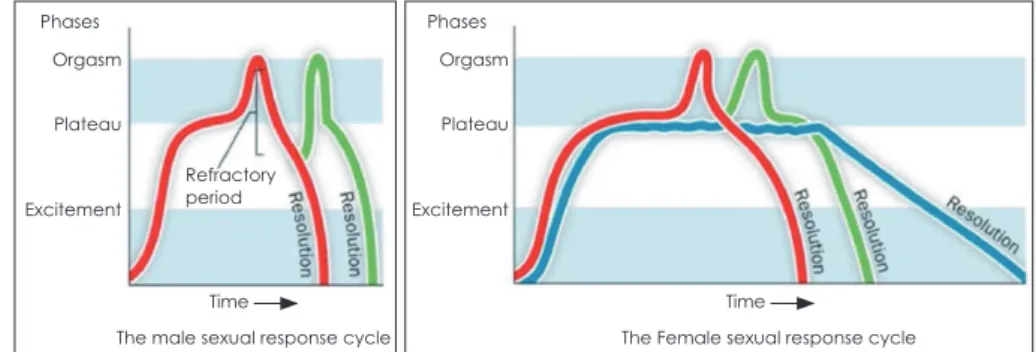
son은 남성과 여성의 성 반응의 생리학적 기전을 체계적으로 연구하여 흥분기(excitation phase, E), 고원기(plateau phase, P), 절정기(orgasm phase, O), 해소기(resolution phase, R)의 4단계로 특징지어진 선형 모델을 발표하였다(Fig. 1, Table 1).
이 모델에 따르면, 남성, 여성 모두 성적 긴장이 점진적으로 증 가하였다가 오르가슴을 통해 해소된다고 한다. 또한 약 15~
20%의 여성은 해소기에 도달하기 전에 다중 오르가슴을 경험 할 수 있다. Masters와 Johnson의 모델은 현재까지 널리 수용 되었고, 양성에서 성 반응을 개념화하는 데에 기초가 되었다. 이 모델은 또한 남성과 여성의 성기능 장애와 관련 문제를 이해하 기 위한 초석이 되었다.7)
Masters와 Johnson의 모델의 상당한 영향에도 불구하고, 특히 여성의 성 반응과 관련해서 한계와 비판이 제시되었다.9) 첫째로, 이 모델은 성적 자극의 시작부터 오르가슴과 해소에 이르기까지 성적 흥분이 증가하는 과정을 선형적으로 가정하 고 있다. 이러한 관점에서, 이 모델은 여성마다 서로 다르게 나 타날 수 있는 성 반응과 같은 여성에서도 성행위시마다 다양 하게 반응할 수 있는 성 반응에 대해 충분히 설명하고 있지 못 하다. 둘째로, Masters와 Johnson의 모델은 성 반응의 생리학 적 측면에 주로 초점을 맞추기 때문에, 성 반응의 주관적, 심 리학적, 대인관계적 측면의 중요성을 반영하고 있지 못하다. 셋 째로, 이 모델은 성적으로 활동적인 여성이 항상 성적 개시나 자극에 반응한다고 가정하고 있고, 성적 욕구나 리비도(libido) 의 영향에 대해서는 아무런 설명이 없다.
Helen Kaplan : the DEOR model
1974년 Kaplan8)은 인간의 성 반응에 대해 다소 다른 모델 을 제안하였다. Kaplan의 모델은 Masters와 Johnson의 모델 과 마찬가지로 실험실의 생리학적인 연구에서 얻어진 것이 아 니라, 성 치료사로서 임상적 경험에 의해 만들어졌다. Kaplan은 성 반응이 욕구기(desire phase, D), 흥분기(excitation phase, E), 절정기(orgasm phase, O)의 3요소로 이해될 수 있다고 주장하 였다(Fig. 2).
분명히 Kaplan의 모델이 Masters와 Johnson의 모델과 가
Fig. 1. Masters and Johnson’s four- phase model : sexual response cy- cle.6)
Phases
Time Refractory period
The male sexual response cycle Orgasm
Plateau
Excitement
Phases
Time
The Female sexual response cycle Orgasm
Plateau
Excitement
장 다른 차이점은 성 반응의 개념에 욕구기를 추가했다는 것 이다. 이로 인해 Kaplan의 모델은 ‘DEOR 모델’이라고도 불린 다. 과거에 고려 대상이 아니었던 성교를 하고 싶거나 성적이고 자 하는 욕구가 전제되어야 성적인 흥분이 발생한다고 하였 다. Kaplan은 욕구에 초점을 맞춤으로써, 성교하고자 하는
욕구와 성적으로 흥분된 느낌의 차이에 대한 토론의 장을 마 련하였다. 그로 인해, 성적 욕구에 대해서는 오늘날까지 많은 논쟁이 있다.9)10)
좀 더 구체적으로, Kaplan model의 첫번째 단계인 욕구기 는 성적 욕구 또는 욕망의 생리학적, 심리적 부문의 2가지로 구 Table 1. Masters and Johnson’s four-phase model : the EPOR model6)
Male Female
Excitement •0 In response to sexual stimuli the process of vasocongestion occurs, where more blood flows into the penis than is flowing out, resulting in an erection. How long this takes, and what the erection feels like will differ from man to man, and for the same man over time.
Physical changes may include the following :
•0 Changes in the scrotum and testes, with the testes increas- ing in size and the scrotum elevating, coming closer to the body.
•0 The skin may become flushed, men may experience heightened sensitivity in parts of their body, like the nip- ples.
•0 Some increase in heart rate, blood pressure, and muscle tension.
•0 In response to sexual stimuli, vaginal lubrication will usu- ally begin. There are many reasons why women may have less (or no) vaginal lubrication, even when there is excitement and arousal.
Other physical changes may include the following :
•0 Vasocongestion resulting in the clitoris becoming en- gorged.
•0 The size and shape of the labia may change.
•0 The inner two thirds of the vagina may expand.
•0 There may be enlargement of the breasts.
•0 The skin may become flushed, women may experience heightened sensitivity in parts of their body, like the nip- ples.
•0 An increase in heart rate, blood pressure, and muscle tension.
Plateau Physical changes during this phase may include :
•0 An increase in the size of the head of the penis, and the head may also change color, becoming purplish.
•0 The Cowper’s gland secretes fluid, often referred to as pre- cum, which comes out of the tip of the penis.
•0 The testes move further in towards the body, and increase in size.
•0 There may be a sex flush, muscle tension, increase in heart rate and rising blood pressure.
Physical changes during this phase may include :
•0 A continued swelling of the tissues in the vagina, which may be accompanied by contractions of the vaginal opening.
•0 The clitoris can withdraw into the clitoral hood and the external clitoris can shorten in size.
•0 The labia minora increase in size and turn a reddish- purple.
•0 There may be a sex flush, muscle tension, increase in heart rate and rising blood pressure.
Orgasm During the first stage :
•0 Contractions in the vas deferens, seminal vesicles, and the prostate cause seminal fluid to collect in a pool at the base of the penis, in the urethra (‘come’ or ejaculate).
•0 This collection is usually felt as a ‘tickling’ type sensation.
In the second stage of the orgasmic phase :
•0 Contractions of muscles occur in a ‘throbbing’ manner around the urethra, and propel ejaculate through the urethra and out of the body.
•0 These contractions (which occur at different speeds, and in different quantities) are usually experienced as highly pleasurable feelings of release.
Physical changes involved in female orgasm may include :
•0 Contractions of the pelvic muscles around the vagina.
•0 The uterus and anal sphincter also contract in a throb- bing or rhythmic way.
•0 Muscles may spasm, blood pressure and heart rate reach a peak.
•0 The contractions (which occur at different speeds, and in different numbers) are usually experienced as highly pleasurable feelings of release.
•0 No distinction is made between vaginal and clitoral or- gasms in women or orgasm induced through any other form of stimulation. Following one or more orgasm, a gradual return to the pre-stimulated state (resolution) occurs.
Resolution This phase includes :
•0 The loss of the erection as the blood flows out of the pe- nis, which occurs in two stages over the period of a few minutes.
•0 The scrotum and testes return to normal size.
•0 A general feeling of relaxation.
•0 There is also a refractory period following ejaculation when a man is physically incapable of obtaining an- other erection. This period may last from a few minutes to much longer. It seems to be longer in older men, al- though there are many possible individual differences.
This phase includes :
•0 Blood that had engorged areas of the body now flows out, swelling decreases and eventually muscle tension and skin flush go away.
•0 A general feeling of relaxation
EPOR : excitement, plateau, orgasm, resolution
성된다. 성적 욕구 또는 욕망은 두뇌의 변연계(limbic system) 에 의해 주로 조절되며, 호르몬과 심리적인 부문에 의해 부분 적으로 영향을 받는다. 욕구기는 남성과 여성에서 적절한 성적 흥분과 이어지는 오르가슴으로 진행하기 위해 반드시 필요한 전 단계로 여겨진다. Kaplan model에서는 비록 성적 욕구는 두뇌와 같이 중심에서 매개되지만, 흥분과 오르가슴은 척수 내의 center가 관여되는 말초적인 과정으로 생각된다. Kaplan model은 정신질환 진단 및 통계 편람(Diagnostic and Statis- tical Manual of Mental Disorders)의 3번째와 4번째판에서 남성 및 여성 성기능 장애의 진단분류 체계의 기초로 사용되 었다.11)12)
이 모델에서, 성적 반응은 자발적인 성적 욕구로 시작되며, 성적 흥분으로 이어져 결국 오르가슴 및 해소에 이르게 된다.
이 모델은 정상 상황에서 여성의 성 반응 단계는 한 단계가 다 른 단계에 선행하는 선형 방식으로 진행되며, 남성의 성 반응과 유사하다고 제시한다.
일부 학자들은 앞서 2개의 ‘선형적 모델(EPOR, DEOR 모 델)’이 일부 한계를 가지고 있다고 말한다.13-17) 특히, 이 2가지 모델은 남성과 여성에서 평행하게 진행되는 성 반응 과정이 선 형적이고 대체로 변하지 않는다고 가정한다. 더욱이, 선형 모델 은 여성보다는 남성에 좀 더 부합한 것처럼 보인다. 마지막으 로, 성 반응의 각 단계는 서로 명확하게 구분되어 있지 않고, 부분적으로 겹쳐질 수 있으며 항상 일렬로 진행되는 것은 아 니다. 새로운 모델들은 개인이나 상황에 따른 성 반응의 다양 성을 강조하고, 무엇보다도 여성의 정상 성 반응을 설명하기 위 해 비선형적(non-linear) 모델을 제시한다.
순환적 모델(Circular models)
Whipple and Brash-McGreer’s model
수년 후, 일부 학자들은 Masters와 Johnson, Kaplan의 과
거 이론들과는 완전히 다른 새로운 성 반응 모델을 제시하였 다. 원형적 혹은 순환적(circular)인 성 반응 패턴을 중심으로 하는 새로운 모델을 기술한 학자는 Whipple과 Brash-Mc- Greer18)이다.
Whipple과 Brash-McGreer는 성 반응 단계를 첫 번째 단 계인 유혹(seduction), 두 번째 단계인 감각(sensations), 세 번 째 단계인 골몰 및 절정(surrender and orgasm), 네 번째 단계 인 반영(reflection)의 4단계로 나누었다. Whipple과 Brash- McGreer은 만족스러운 성적 경험이 여성으로 하여금 성교를 하고자 하는 욕구를 더 가지게 강화시키고, 반대로 성적 경험 이 불쾌하거나 부정적일 경우 여성은 성적 활동을 위한 욕구 를 상실한다고 설명하였다. 즉, 성적인 경험이 즐거운 것으로 여겨지는 반영(reflection)이 다음의 성적 만남에서 유혹 단계 로 이어지는 것이다. 비록 Whipple과 Brash-McGreer의 모델 이 성 반응이 각 단계를 거친다고 말하는 점에서 기존의 선형 모델과 크게 다르지는 않으나, 이 모델에서는 여성 성 반응이 순환적 특징을 가진다는 점을 인정하고 있다. 더욱이, 여성 성 반응에서 유혹, 감각, 골몰과 절정의 각 단계가 서로 독립적이 거나 분리되어 있다고 보지 않는다.16)
실제로 일부 여성은 성적 욕구가 없어도 흥분하고 오르가슴 과 만족감을 느낄 수 있거나 오르가슴에 도달하지 않더라도 성적 욕구와 흥분, 만족감을 경험할 수 있기 때문에, Masters 와 Johnson, Kaplan에 의해 제안된 선형 모델이 모든 여성에 게 부합되는 것은 아니라고 인식되고 있다.
Basson’s model
시간 순으로 발생하고 서로 중첩되는 각각의 성 반응 단계 를 포괄하는 정상적인 여성의 성기능에 관한 과거의 설명에 대 해 Basson13)은 새로운 대안적 모델을 제시하였다. ‘자발적 (spontaneous)’인 성적 욕구에 초점을 두는 다른 모델과 다 르게, Basson의 여성 성 반응에 관한 순환적 모델은 일단 성 적 흥분이 경험되어야 욕구가 ‘반응적(responsive)’으로 발생 한다고 설명한다.14) 정신적, 신체적 부문에서 서로 중첩되고 순 차적이지 않은(non-sequential) 방식으로 여성들이 성 반응 단 계를 경험하는 것을 관찰한 후 Basson은 이 모델을 제시하였
다.19)20) 이러한 관점에서 보면, 욕구는 성적 행동에 참여하는
동안 초기 성적 흥분에 부가적으로 유발되는 것이다. 여성들이 감정적 접근과 친밀함의 증가, 사랑의 표현, 육체적 쾌락의 수 용 및 공유, 파트너를 향한 개방성, 적절한 상황에서 성적 자극 을 수용하고자 하는 의지 등과 같은 다양한 이유와 동기를 가 지고 성적 행동에 참여하는 것이 연구를 통해 확인되었다.19)21) Basson의 model에 따르면, 여성들은 욕구가 중립적(neutral) 인 상태에서 성적 행동을 시작한다. 만일 여성이 파트너로부터 Fig. 2. Kaplan’s triphasic model.8)
Time Resolution Orgasm
Arousal
Desire
Sexual excitement/tension
적절한 감정적 친밀함을 경험하면, 여성은 성적 자극을 추구하 고 수용할 수 있다.13) 성적 자극을 수용하면 여성은 성적으로 중립적인 상태에서 흥분된 상태로 변하게 된다. 흥분을 크게 하기 위한 자극을 계속 원할수록, 성적 욕구는 여성이 성적 만 족과 오르가슴으로 치닫도록 촉진한다. 그러므로, 성적 욕구 는 자발적으로 일어나기보다는 반응적(responsive)이라고 할 수 있다. 여성들은 가끔 성적 사고, 성적인 꿈, 성적 판타지의 형태로 자발적인 성적 욕구를 경험할 수도 있으나, 파트너가 관여된 성적 경험과 관련해서 여성의 성적 욕구는 기저에 머 물러 있다. 이것은 성적으로 활동하고 만족하는 많은 여성들 은 성적 욕구가 자발적이라는 전통적 관념과 불일치되는 결 과를 보여주는 것이다. 즉, 이러한 여성들이 단순히 육체적인 성적 흥분이나 표출이 목적이 아닌 스스로의 필요에 의한 성 적 자극이 일정 수준까지 도달하는 경험을 하게 되면, 비로소 성적 흥분과 반응적 형태의 성적 욕구가 동시에 발생하는 것 처럼 보인다. 흥분이 더욱 커질수록, 오르가슴에 도달하는 가 능성이 점점 높아지게 된다. 오르가슴의 방출이 없어도 육체적 인 행복이 생길 수도 있다. 헌신과 유대감의 증가, 관계의 불 완전성에 대한 관용의 증가와 같은 감정적 친밀뿐만 아니라, 파트너의 행복을 성적 행동의 참여에 대한 보상으로 얻게 되 고, 나아가 이것들이 다음 성적 행동의 순환을 활성화시키는 동기적 요소로 작용한다(Fig. 3).
Basson의 모델에서는 성적 흥분은 생물학적, 심리적 요인에 의해 영향을 받는 과정으로 개념화된다. 이 모델은 여성이 성
적 활동과 자극에 관여하는 것이 반드시 성적으로 흥분한 것 을 의미하는 것은 아니라고 가정한다. 흥분하는 여성의 능력, 즉 arousability는 성 매개성 감염(sexually transmitted infection, STI)에 감염되는 것에 대한 두려움, 과거의 부정적 성적 경험, 성적 폭행, 부적절한 산아 제한, 낮은 자아상과 같은 요인들 의 영향을 받을 수 있다.22)23) 여성이 원하는 만큼 자극이 충분 한 시간 동안 주어지고, 자극에 집중할 수 있게 되면, 성적 흥분 과 쾌락이 강화된다. 분명하게, 성적으로 흥분하기 위한 자극 의 유형, 소요되는 시간, 상황은 개인에 따라 매우 다르다. 감정 적, 신체적으로 긍정적인 결과는 다음의 성적 동기를 증가시키 는 데에 기여한다.19)
전통적 모델과 비교하여, 여성의 성 반응 주기에 대한 이러 한 순환적 모델은 오르가슴과 해소를 필수적인 것이 아니라 고 간주한다. 자극이 충분히 지속되고, 여성이 집중할 수 있고, 성적으로 흥분된 감각을 즐기게 되며, 고통과 같은 부정적 결 과를 경험하지 않게 된다면, 오르가슴의 경험 유무와 관계없 이 성적 만족이 발생할 수 있다.19) 오르가슴과 객관적 종료 시 점에 반(反)하는 성적 만족의 주관적 특성에 대한 이러한 강 조는 여성의 성적 경험이 다양하다는 의견과 일치된다. 주관 적인 흥분 또는 성적 행동에 대한 감정적 관여에 대한 감정이 생식기 울혈(genital congestion)과 같은 생리적 반응과 항상 일치되는 것은 아니다. 실제로, 감정과 사고는 생식기 혈관울 혈(genital vasocongestion)에서 오는 되먹임(feedback) 작용 보다 성적 흥분의 주관적 경험에 더욱 강력한 영향을 미친다.
Sexual stimuli with appropriate
context
Spontaneous
“innate” desire
Subjective arousal Willingness to
become receptive
Motivation
Psychological and biological processing
Arousal and receptive sexual
desire Sexual
satisfaction with or without orgasm(s) Multiple reasons
and incentives for instigating or agreeing to sex
Nonsexual rewards : emotional intimacy, well-being, lack
of negative effects from sexual
avoidance Fig. 3. Basson’s circular model of sexual re-
sponse.19)
이 모델은 보다 포괄적인 틀 안에서 생물학적, 심리적, 상황적 요인을 통합하고 있다. 마지막으로, 이 모델은 여성에서 흥분 과 욕구 간의 상호 관계를 인정하고 있으며, 과거에 받아들여 졌던 자발적 성적 욕구의 우월성과 성적 행동의 종료 시점으로 서의 오르가슴의 필요성에 대해서는 무시하고 있다. 그럼에도 불구하고, 주관적 및 상호 간의 요인으로 초점을 옮기고, 여성 의 성적 경험의 비선형적 특징을 인정함으로써, Basson의 모델 은 여성의 건강한 성적 반응을 이해하는 데에 상당한 공헌을 하였다.16)
Basson의 모델은 많은 한계점을 가지고 있다. Masters와 Johnson 모델, Kaplan 모델에서처럼 이 순환적 모델은 자원자 를 대상으로 한 임상적 관찰을 기초로 하고 있다.24) 또한, 여 성의 성적 욕구가 대개 수용적이고 반응적인 특성을 가지고 있 다고 인식함으로써, 성적으로 수동적이거나 조심스러운 여성 에 대한 부정적인 고정관념을 강화시켰다. 더욱이, 이 모델은 상당히 친밀함을 기초로 하기 때문에, 성적 욕구와 흥분이 친 밀함과 관련이 없는 여성들을 이론에서 배제시키고 있다.
다요인적 모델(Multifactor models)
선형적 또는 순환적 부문에 부합하지 않는 다양한 범주의 성적 반응 모델이 제시되었다. 이러한 관점에서 일부 연구들은 성적 동기를 유발하는 신경학적, 생화학적 요인을 규명하는 것을 목적으로 한다. 전반적으로, 이러한 모델들은 성적 반응 을 유발하고 성기능 장애를 발전시키는 데에 기여하는 여러 요 인들을 통합하는 데에 중점을 두는 반면, 성 반응의 각 단계 를 설명하는 데에는 초점을 덜 두고 있다. 지난 20년 동안 연구 에서 Levine25)은 성적 욕구가 생물학적(욕망), 심리학적(동기), 문화적(가치관)의 의미가 있다는 개념을 발전시켰다.
1998년에 Fisher26)는 기본 감정이 신경의 개별적인 회로나 체계를 통해 활성화됨으로써 발생한다고 하는 ‘감정/동기 체 계(emotion/motivation system)’에 대해 설명하였다. Fisher 는 인간이 행동으로 이끄는 세 개의 주요 동기 회로 또는 두뇌 체계를 가지고 있다고 하였다. 첫 번째는 estrogen과 andro- gen이 관여하는 욕망(lust, libido)이고, 두 번째는 dopamine, norepinephrine, serotonin의 수준에 영향을 받는 로맨틱한 애 정(romantic attraction), 세 번째는 oxytocin과 vasopressin 이 관계하는 애착(attachment)이다. 이 세 개의 감정/동기 체계 (emotion/motivation system)가 진화하여 결혼, 간통, 이혼, 재혼, 스토킹, 지나친 감정으로 인한 살인과 기타 범죄, 낭만적 인 사랑의 거절로 인한 우울증 등의 발생에 기여한다.27)
Toates28)는 성적 동기, 흥분, 행동을 이해하기 위해 자극적 인 동기 이론의 원칙과 행동의 위계적 통제 이론을 통합하여, 성적 자극과 동기의 인지적 표상에 대한 근원으로서 외적인
부문의 중요성을 강조하였다. Toates는 성적 동기가 환경으로 부터 보상이 있을 것이라는 유인에 의해 발생하며, 성적 자극 이 자극을 지향한 동기의 수준을 증가시킨다고 주장하였다.
뿐만 아니라, 자극에 주의를 집중하는 것이 생리적, 주관적 성적 흥분에 중요한 역할을 한다는 증거를 보여주었다.29) 인지 적으로 주의를 분산하거나 성적 기능에 대한 걱정과 같은 심 리적 요인들이 성적 반응을 억제시킬 수도 있다.30) 정보 처리과 정이 어떻게 성적 흥분에 영향을 미칠 수 있는지를 설명하는 모델들도 개발되었다.31)
The dual control model
과거 10년 동안 킨제이 연구소(Kinsey Institute)의 많은 연 구들은 ‘Dual Control 모델’이라는 새로운 이론적 모델을 기 초로 진행되었다.32) 이 모델은 특정 상황에서 개인에게 발생하 는 성적 반응과 연관된 흥분이 성적 흥분체계(sexual activation or excitation system)와 성적 억제체계(sexual inhibition sys- tem)라는 두뇌의 두 개의 체계 간의 균형에 의해 최종적으로 결정되고, 각각의 체계는 신경생리학적 기질을 가지고 있다고 가정한다.33) 이 모델은 다음의 3가지 기본 가설을 만들었다.34)
• 비록 성적 흥분은 전형적으로 둘 이상의 상호작용에서 발생하고, 자극이 흥분성 또는 억제성인가에 대해서 상호작 용과 관련된 상황과 문화적 배경이 중요한 역할을 하지만, 자극의 효과는 개인의 신경생물학적 특징에 의해 최종적으 로 결정된다.
• 성적 반응의 신경생물학적 억제는 종(species) 간의 적절 한 적응적 패턴이다. 즉, 성적 활동으로 인해 개인이 불리하거 나 위험한 경우에 처하거나 상황의 요구에 적절히 대응하는 것 이 방해될 경우에는 성적 반응의 가능성 및 성적 흥분과 욕구 의 영향이 감소된다.
• 개인은 성적 흥분 및 억제에 대해 다양한 성향을 가진다.
비록 대다수의 사람들은 적응적이거나 문제를 일으키지 않 는 성향을 가지나, 비정상적으로 높은 흥분 성향과 낮은 억제 성향을 가진 사람들은 매우 위험하거나 문제를 일으키는 성 적 행동을 할 가능성이 높다. 그리고 비정상적으로 낮은 흥분 성향과 높은 억제 성향을 가진 사람들은 성기능 장애와 같이 성적 반응과 관련된 문제를 경험할 가능성이 높다.
이 모델을 사용한 초기 연구는 남성에 초점을 맞추었다.
Dual control 모델의 두 개의 구성 요소를 측정하기 위해 개인 을 대상으로 설문하여 사용하는 Sexual Inhibition Scales/
Sexual Excitation Scales(이하 SIS/SES) 척도를 개발하였 다.35) 비록 성적 흥분과 억제의 개념이 여성의 성적 반응에도 해당되고 SIS/SES 설문지가 여성을 대상으로 한 연구에서 의 의를 보여주었으나,36) dual control 모델을 바탕으로 하는 유
용한 연구들이 대부분 남성의 성적 반응의 신경생리학적, 정 신생리학 부문에 한정되므로, 이 척도는 원래 남성에게 사용 하기 위해 개발된 것이다. SIS/SES 설문지가 성적 반응성에 특이적인 성향을 주로 측정한다는 것이 연구들에 의해 지지 되었다.37) 그러나 학자들은 반대의 성에서 사용 가능하도록 용 어를 바꾸어 SIS/SES 설문지를 개작해 사용하여 남학생과 여학생을 대상으로 비교한 결과, 사회적 통념과 유사하게 남 성에서 흥분 성향이 높고 여성에서 흥분 성향이 유의하게 낮 은 것으로 나타났다.38) 여성을 대상으로 개발된 척도인 Sexual Excitation Scales II for Women(SESII-W)을 사용한 비슷한 비교연구에서도 모든 부문에서 성별에 따른 차이가 발견되 었다.39) 여성들은 성적 흥분이 긍정적인 파트너의 특징과 호 르몬 변화에 의해 유의하게 강화되는 것으로 보고되고 있다.
반면, 남성은 다양한 성적 자극과 부정적인 감정 상태에 의 해 성적 흥분이 증가되는 것으로 나타났다. 억제 요인과 관련 하여, 신뢰와 친밀함과 같은 관계의 중요 요인을 바탕으로 하 지 않은 상황에서 여성은 남성에 비해 성적 흥분의 감소를 더 많이 보고하였다. 여성은 또한 ‘성기능에 대한 염려’와 ‘환 경’과 같은 억제 요인에서 높은 점수를 보였고, 이러한 부문 에서의 높은 점수는 성기능이나 성행위 수행, 자신이 어떻게 보여지고 인식되는지에 대한 우려를 반영한다. 이러한 우려 는 여성으로 하여금 성교 동안 성적 흥분을 저해한다.34)
이러한 연구 결과에 근거하여 초반에 학자들은 번식 결과 를 촉진하도록 디자인된 남성과 여성의 기본적 패턴(basic pattern)을 각각 제시하였다.40) 즉, 남성은 성적 쾌락 추구에 지배된 성적 경험을 하고, 여성은 감정적 친밀함과 남성의 보 호 안에 있다는 느낌을 얻기 위해 성적 경험을 한다는 것이 다. 그러나 이후에 번식에 반드시 필요하지 않으나 보상의 성격 을 가지고 있는 ‘초(超)-부가 구성요소(super-added compo- nents)’라고 하는 경험적 측면이 남성과 여성 모두의 성적 행 동에 관여하는 것이 밝혀졌다. 남성은 감정적 친밀, 여자가 자 신을 원한다는 느낌, 지속적 관계를 위한 형식을 즐길 수 있 고, 이것은 여성의 ‘기본적 패턴’의 구성요소와 유사하다. 여성 은 성적 접촉이나 질의 전벽(anterior vaginal wall)이나 음핵 (clitoris)의 애무를 통해 성적 쾌락을 느끼고, 오르가슴을 경 험할 수 있는데, 이것은 남성의 기본적 패턴의 근본적 구성요 소와 유사하다. 기본적 구성요소와 초-부가적 구성요소를 구 분하는 설명이 현재에 이르러야 비로소 주목받는 이유는 여성 의 초-부가 구성요소는 여성의 성적 쾌락을 언급하여 과거의 통념과 상반되고, 남성의 초-부가 구성요소는 겉으로 보기에 덜 성적이기 때문에 학자들로부터 이제까지 잘 인정되지 않 았기 때문이다. 그러나 남성의 성적 다양성보다 큰 여성의 성 적 다양성을 이해하기 위해 학자들이 노력하면서, 이러한 모든
것은 더욱 적절한 것으로 받아들여진다.40)
The sexual tipping point model
Sexual tipping point 모델은 Perelman41)에 의해 만들어진 모델로, 성적 반응이 심리적, 기질적, 정신사회적, 문화적인 부 문으로 구성된 흥분 혹은 억제 요인의 균형에 의해 결정된다 고 설명한다. 이러한 요인들이 합쳐진 효과가 어떤 식으로 성적 반응이 표현될지를 결정하는 고유한 역치, 즉 sexual tipping point를 결정한다. 이 모델에 따르면, sexual tipping point는 개인마다 다르며, 동일인이라도 처한 상황이나 각 성적 경험마 다 다를 수 있다.17) 주어진 상황 속의 성적 반응의 고유한 역치 를 결정하는 데에 있어서 다양한 요인들이 작용하는데, 이 때 더 영향을 미치는 우세한 요인과 덜 중요한 요인이 있게 된다.
Perelman42)은 이 모델이 남성과 여성 모두에서 정상 성적 반 응과 성적 반응 장애에 영향을 미치는 다양한 요인을 설명하 는 유용한 도구라고 주장한다.
Sexual tipping point는 정상분포곡선을 보인다. 이 모델은 인간의 다른 특질들처럼 정상분포곡선을 보이는 성적 태도, 성적 반응, 성적 행동 등의 작은 독립적인 수많은 변인들이 sexual tipping point가 정상분포 양상을 보이는 데에 관여 한다고 설명한다. Perelman은 성적 흥분이 키나 몸무게처럼 정 상분포 양상을 보이는 반면, 오르가슴 잠복기(orgasmic la- tency)는 머리카락이나 눈 색깔처럼 비대칭 분포를 보인다고 하였다. 상황적, 정신사회적 요소가 상보적으로 영향을 미치며, 이러한 영향은 복잡하다. 성적 반응은 정상분포를 보이지만, 정신적, 육체적 요인의 영향도 받는다. 대부분의 장애가 전형 적으로 심리적 요인과 기질적 요인의 결합으로 발생하지만, 정신사회적 원인과 기질적 원인이 최종 성적 반응이 흥분인지 억제인지 결정한다. 긍정적인 정신 및 신체 요인은 성적 반응의 가능성을 증가시키는 반면, 부정적인 정신 및 신체 요인은 성 적 반응을 억제한다. 이러한 모든 요소들이 결합하여 고유한 역치인 sexual tipping point를 결정짓는다.41) 휴식 동안에 성 적 반응은 억제 요인과 흥분 요인의 상반된 작용의 힘이 균형 을 이루어 성적 반응 상태는 중립적(neutral)인 범주에 속하게 된다.
결
론
인간의 성 반응 모델은 초기의 선형적 모델에서부터 비선 형적 모델, 다요인적 모델에 이르기까지 다양한 모델이 있다.
성에 관한 연구가 진행되고, 성 반응에 대한 다양한 이론이 제 시되면서 남성과 여성의 차이뿐만 아니라, 개인 간 차이, 상황 간 차이와 같은 인간의 성 반응의 다양성을 인정하고 있다. 나
아가, 생물학적, 심리적, 문화적, 사회적 요인이 성 반응에 미치 는 영향을 인식하고, 이에 대한 연구도 폭넓게 진행되고 있다.
인간의 성 반응에 대한 올바른 이해는 성에 대한 잘못된 인식 을 바로잡고, 성에 관한 연구를 비롯하여, 임상 현장에서 성에 대한 면담과 성 치료를 하는 데에 많은 도움이 될 것이다.
중심 단어:성・섹슈얼리티・성 반응・성기능・성 반응 모델.
Conflicts of interest
The author has no financial conflicts of interest.
REFERENCES
1) Wiederman M. The state of theory in sex therapy. J Sex Res 1998;
35:88-99.
2) Freud S. Three Essays on the Theory of Sexuality. Standard Edition, 7. London: Hogarth Press;1905.
3) Reich W. The Function of the Orgasm. New York: Orgone Institute Press, Inc;1942.
4) Kinsey AC, Pomeroy WB, Martin CE. Sexual behavior in the human male. Bloomington: Indiana University Press;1948.
5) Kinsey AC, Pomeroy WB, Martin CE, Gebhard PH. Sexual behavior in the human female. Bloomington: Indiana University Press;1953.
6) Masters WH, Johnson VE. Human Sexual Response. Boston: Little Brown;1966.
7) Masters WH, Johnson VE. Human Sexual Inadequacy. Boston: Lit- tle Brown;1970.
8) Kaplan HS. The New Sex Therapy. New York: Bruner Mazel;1974.
9) DeRogatis LR, Clayton AH, Rosen RC, Sand M, Pyke RE. Should sexual desire and arousal disorders in women be merged? Arch Sex Behav 2011;40:217-219; author reply 221-225.
10) Brotto LA, Graham CA, Binik YM, Segraves TR, Zucker KJ. Should Sexual Desire and Arousal Disorders in Women Be Merged? A Re- sponse to DeRogatis, Clayton, Rosen, Sand, and Pyke (2010). Arch Sex Behav 2010;40:217-219.
11) American Psychiatric Association. Diagnostic and Statistical Man- ual of Mental Disorders. 3rd ed, Text Revision. Washington DC:
American Psychiatric Association;1980.
12) American Psychiatric Association. Diagnostic and Statistical Man- ual of Mental Disorders. 4th ed, Text Revision. Washington DC: Amer- ican Psychiatric Association;2000.
13) Basson R. The female sexual response: a different model. J Sex Mar- ital Ther 2000;26:51-65.
14) Giles KR, McCabe MP. Conceptualizing women’s sexual function:
linear vs. circular models of sexual response. J Sex Med 2009;6:2761- 2771.
15) Bean JL. Expressions of female sexuality. J Sex Marital Ther 2002;
28 Suppl 1:29-38.
16) Rosen RC, Barsky JL. Normal sexual response in women. Obstet Gynecol Clin North Am 2006;33:515-526.
17) Hayes RD. Circular and linear modeling of female sexual desire and arousal. J Sex Res 2011;48:130-141.
18) Whipple B, Brash-McGreer KB. Management of female sexual dys- function. In: Sipski ML, Alexander CJ, editors. Sexual function in people with disability and chronic illness. A health professional’s guide. Gaithersburg: Aspen Publishers;1997. p.509-534.
19) Basson R. Women’s sexual dysfunction: revised and expanded defi- nitions. CMAJ 2005;172:1327-1333.
20) Dennerstein L, Lehert P. Modeling mid-aged women’s sexual func-
tioning: a prospective, population-based study. J Sex Marital Ther 2004;30:173-183.
21) Basson R, Wierman ME, van Lankveld J, Brotto L. Summary of the recommendations on sexual dysfunctions in women. J Sex Med 2010;
7(1 Pt 2):314-326.
22) Bancroft J. Sexual desire and the brain. J Sex Marital Ther 1989;3:
11-27.
23) Andersen BL, Cyranowski JM. Women’s sexuality: behaviors, re- sponses, and individual differences. J Consult Clin Psychol 1995;
63:891-906.
24) Wylie K, Mimoun S. Sexual response models in women. Maturitas 2009;63:112-115.
25) Levine S. Demystifying love. New York: Routledge;2008.
26) Fisher HE. Lust, attraction, and attachment in mammalian repro- duction. Hum Nat 1998;9:23-52.
27) Fisher HE, Aron A, Mashek D, Li H, Brown LL. Defining the brain systems of lust, romantic attraction, and attachment. Arch Sex Behav 2002;31:413-419.
28) Toates F. An integrative theoretical framework for understanding sexual motivation, arousal, and behavior. J Sex Res 2009;46:168-193.
29) de Jong DC. The role of attention in sexual arousal: implications for treatment of sexual dysfunction. J Sex Res 2009;46:237-248.
30) Sanders SA, Graham CA, Milhausen RR. Predicting sexual problems in women: the relevance of sexual excitation and sexual inhibition.
Arch Sex Behav 2008;37:241-251.
31) Janssen E, Everaerd W, Spiering M, Janssen J. Automatic process and the appraisal of sexual stimuli: toward an information process- ing model of sexual arousal. J Sex Res 2000;37:8-23.
32) Bancroft J, Janssen E. The dual control model of male sexual re- sponse: a theoretical approach to centrally mediated erectile dysfunc- tion. Neurosci Biobehav Rev 2000;24:571-579.
33) Bancroft J. Central inhibition of sexual response in the male: a theo- retical perspective. Neurosci Biobehav Rev 1999;23:763-784.
34) Bancroft J. Human Sexuality and its Problems, 3rd ed. Edinburgh:
Churchill Livingstone Elsevier;2009.
35) Janssen E, Vorst H, Finn P, Bancroft J. The Sexual Inhibition (SIS) and Sexual Excitation (SES) Scales: II. Predicting psychophysio- logical response pattens. J Sex Res 2002;39:127-132.
36) Carpenter D, Janssen E, Graham C, Vorst H, Wicherts J. Gender sim- ilarities in Dual Control Model processes: A short version of the Sex- ual Inhibition and Excitation Scales (SIS/SES-Short Form). Poster presented at the 32nd annual meeting of the International Academy of Sex Research (IASR); Amsterdam, The Netherlands;2006.
37) Janssen E, Bancroft J. The dual-control model: the role of sexual in- hibition and excitation in sexual arousal and behavior. In: Janssen E, editor. The psychophysiology of sex. Bloomington: Indiana Uni- versity Press;2007. p.197-222.
38) Carpenter D, Janssen E, Graham C, Vorst H, Wicherts J. Women’s scores on the sexual inhibition/sexual excitation scales (SIS/SES):
gender similarities and differences. J Sex Res 2008;45:36-48.
39) Graham CA, Sanders SA, Milhausen RR. The sexual excitation/sex- ual inhibition inventory for women: psychometric properties. Arch Sex Behav 2006;35:397-409.
40) Bancroft J, Graham CA. The varied nature of women’s sexuality:
unresolved issues and a theoretical approach. Horm Behav 2011;59:
717-729.
41) Perelman MA. The sexual tipping point: a mind/body model for sex- ual medicine. J Sex Med 2009;6:629-632.
42) Perelman M. The Sexual Tipping Point: a model to conceptualize etiology, diagnosis and combination treatment of female and male sexual dysfunction. J Sex Med 2006;3(Suppl.1):52.