• 검색 결과가 없습니다.

Innovation and Productivity: A Case of Australian Business

N/A
N/A
Protected

Academic year: 2021

Share "Innovation and Productivity: A Case of Australian Business"

Copied!
5
0
0

로드 중.... (전체 텍스트 보기)

전체 글

(1)

www.earticle.net

Innovation and Productivity: A Case of Australian Business

Young-Kon Yoon

*

, Kyung-Joo Yoon

**

Institute for International Commerce Research

*

, Global Cyber University

**

Abstract This paper investigates two important relationships relating to firm behaviour and performance using econometric methods. First, the relationship between product market competition and innovation is examined, and then the association between innovation and productivity is separately investigated. Data from the Australian Bureau of Statistics’ Business Longitudinal Database are used in the analysis. For every measure of competition considered except one, the results of the modelling are consistent with an anti-Schumpeterian relationship between competition and innovation – that is, firms appear more likely to innovate if they face stronger competition. The results examining the relationship between innovation and productivity, although weaker than those between competition and innovation, suggest that innovation is associated with better productivity outcomes.

Key Words : competition, innovation, productivity, Australian businesses

* Senior Researcher, Institute for International Commerce Research

** Professor, Global Cyber University(Corresponding Author)

논문 접수 2015년 1월 10일, 1차 수정을 거처 심사완료 2015년 2월 25일

1. Introduction

This paper investigates two important relationships between firm behaviour and performance using econometric methods.

First, the relationship between product market competition and innovation is examined, and then the association between innovation and productivity is separately investigated[12].

The relationship between competition and innovation is a complex one. Competition evolves over time as firms enter and leave the market, as new products and processes are introduced, and as firms employ different strategies with regard to their competitors.

In an effort to better capture the complexity

of product market competition and the variety of business responses to changes in such competition, a number of different competition indicators can be used in this analysis: market share, number of competitors, price-cost margin, export status, and whether or not a business reports downward pressure on its profit margins in order to remain competitive[3].

Innovation and the evolution of productivity

are also complex processes. At any point in

time, firms evaluate their competitive position

and make strategic decisions about whether

and how to engage in innovation. Decisions

to invest in innovation activity will in general

meet with varying degrees of success and

(2)

www.earticle.net

have different implications for the evolution of productivity.

To now there has been relatively little analytical scrutiny of the relationships between competition, innovation and productivity at the firm level in Australia, largely due to a lack of suitable data.

However, the recently developed Australian Bureau of Statistics’ (ABS) Business Longitudinal Database (BLD)[4] – a dataset of firm characteristics, tax and trade information – provides new opportunities for firm-level analysis in Australia, and is the data source employed for analysis in this paper.

2. COMPETITION AND INNOVATION

This paper has generally found the competition-related variables to have an important statistical association with innovation activity at the firm level.

There are two different approaches. Higher levels of market share are associated with a greater propensity to innovate – a Schumpeterian-type result, and one that is consistent with some previous Australian empirical work. All the other competition-related variables included in the modelling indicate an anti-Schumpeterian relationship – that increasing competition is associated with a higher likelihood of innovation by the firm[12].

The inclusion of multiple competition variables in the analysis has enabled a more

‘complete’ multi-dimensional look at the relationship between competition indicators and firm-level innovation activity. Overall,

the weight of evidence supports an anti-Schumpeterian[17] relationship, but not exclusively so.

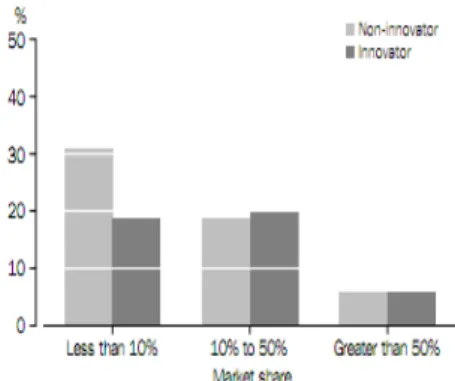
The market share information is drawn directly from the BCS question of how much market share a firm perceives itself to hold, with response categories of ‘less than ten percent’, ‘ten to fifty percent’ or ‘greater than fifty percent’. Inspection of this data reveals that a greater proportion of firms reporting the higher market-share responses are innovators relative to those firms reporting lower market share responses[4].

Figure 1. Distribution of market share

Whether or not a firm exports, and the

share of its export sales in total sales are

also variables of interest. Also, the export

exposure of a firm is another type of product

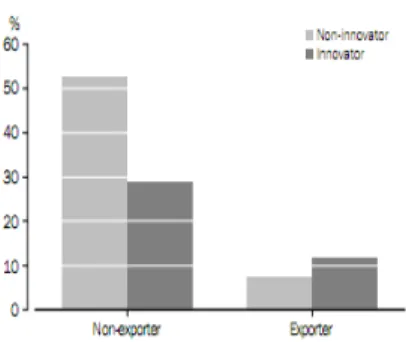
market competition indicator. Figure 2 has

shown export status to be significantly

associated with innovation status, providing a

prima facie reason for including such a

variable.

(3)

www.earticle.net

Figure 2. Exporting firms and export intensity

Estimation of the models shows that all but one (export intensity) of the competition variables described above have a statistically significant association with the likelihood of a firm being an innovator[12].

That is, the level of product market competition that a firm faces appears to be strongly associated with the likelihood of innovation activity – but the nature of the results is mixed, suggesting both Schumpeterian and anti-Schumpeterian aspects depending on the measure of competition.

3. INNOVATION AND RODUCTIVITY

Two measures of productivity are investigated for the analysis in this paper.

The first is a subjective measure of productivity derived from responses to the BCS – surveyed firms are asked how their productivity changed relative to the previous year with the options of choosing ‘improved’,

‘declined’ or ‘stayed the same’.

Figure 3. Firm responses to how productivity changed compared to the previous year

The alternative measure of productivity employed in the analysis is a more ‘objective’

proxy measure of multifactor productivity derived from tax information. This measure is created by dividing value added by the sum of primary factor input costs[9].

Each of the innovation types is statistically significantly associated with the higher outcomes of the reported productivity variable.

That is, for each type of innovation, a firm is less likely to report a decline, and more likely to report an increase in productivity if it also innovated in the previous year, compared to a firm that did not innovate[14]. The corresponding marginal effects on the predicted probabilities of reporting a decline in productivity and of reporting an increase in productivity, in the following year, are presented in Table 1.

<Table 1> Expanded marginal effects from

the ordered probit model

(4)

www.earticle.net

4. CONCLUSION

This paper uses the ABS Business Longitudinal Database to examine the relationship between competition, innovation and productivity in the context of the established theoretical literature.

Two main theories of how competition and innovation interact: Schumpeterian and

‘anti-Schumpeterian’ are examined in the Australian case, with the evidence pointing strongly, but not entirely unambiguously, to an anti-Schumpeterian relationship. That is, the analysis finds that most of the competition-related indicators used here are strongly and positively associated with an increase in the propensity to innovate – the only exception being that of the market share indicator, which is a result found in other studies too.

Amongst the population of innovators, a larger market share and the propensity to export are identified as factors associated with a higher degree of novelty of

innovation being completed, while a lower profit margin and a declaration to be

‘hampered by competition’ are both found to be associated with firms completing a greater number of different types of innovation.

Some(but not all) intellectual property protection methods are found to be associated with firms achieving a higher degree of novelty of innovations and completing a greater number of innovations.

In terms of innovation and productivity at the firm level, a positive and statistically significant association is found between

completing an innovation in any one of the four types of innovation, and reporting a productivity improvement in the following year. The association between ‘goods and services’ and ‘operational process’ type innovations and improved productivity is particularly strong.

REFERENCES

[1] Aghion, P. and Schankerman, M. (2004)

“On the Welfare Effects and Political Economy of Competition-Enhancing Policies”, Economic Journal, 114(498), pp.

800–824.

[2] Aghion. P.; Bloom, N.; Blundell, R.;

Griffith, R. and Howitt, P. (2005)

“Competition and Innovation: An Inverted-U Relationship”, Quarterly Journal of Economics, 120(2), pp. 701–

728.

[3] Ahn, S. (2002) Competition, Innovation and Productivity Growth: A Review of Theory and Evidence, OECD Economics Department Working Papers, no. 317, OECD Publishing.

[4] Australian Bureau of Statistics (ABS) (2009) Technical Manual: Business Longitudinal Database, Expanded CURF, Australia, 2004–05, 2005–06 and 2006–

07, cat. no. 8168.0.55.002, ABS, Canberra.

[5] Capellari, L. and Jenkins, S. (2003)

“Multivariate Probit Regression Using Simulated Maximum Likelihood”, The Stata Journal, 3(3), pp. 278–294.

[6] Capellari, L. and Jenkins, S. (2006)

Calculation of Multivariate Normal

Probabilities by Simulation, with

(5)

www.earticle.net

Applications to Maximum Simulated Likelihood Estimation, Institute for the Study of Labor, Discussion Paper 2112.

[7] Department of Industry, Tourism and Resources (DITR) (2006) Collaboration and Other Factors Influencing Innovation Novelty in Australian Businesses: An Econometric Analysis, Industry Policy Division, Canberra.

[8] Dolman, B. (2007) The Distribution of Recent Economic Gains: Some Early Observations, The 3rd Productivity Perspectives Conference, December, 2007, Canberra.

[9] Greene, W.H. (2008) Econometric Analysis, (Sixth edition), Pearson Prentice Hall.

[10] Griffith, R.; Harrison, R. and Simpson, H. (2006) Product Market Reform and Innovation in the EU, Working Paper 06/17, Institute for Fiscal Studies.

[11] Griffiths W. and Webster, E. (2009) What Governs Firm-Level R&D:

Internal or External Factors?, Melbourne Institute Working Paper Series #13/09, University of Melbourne.

[12] Leo Soames and Donald Brunke, Competition, Innovation and Productivity in Australian Businesses,

AUSTRALIAN BUREAU OF

STATISTICS 2011.

[13] Long, J. and Freese, J. (2006) Regression Models for Categorical Dependent Variables using Stata, (Second edition), Stata Press Publication, College Station, Texas.

[14] Rogers, M. (2004) “Networks, Firm Size and Innovation”, Small Business Economics, 22(2), pp. 141–153.

[15] Salop, S. (1977) “The Noisy Monopolist:

Imperfect Information, Price Dispersion and Price Discrimination”, Review of Economic Studies, 44(3), pp. 393–406.

[16] Scherer, F.M. (1965) “Corporate Incentive Output, Profits and Growth”, Journal of Political Economy, 73(3), pp.

290–297.

[17] Schumpeter, J. (1942) Capitalism, Socialism and Democracy, Allen and Unwin, London.

[18] Wong, M.; Page, D.; Abello, R. and Pang, K. (2007) “Explorations of Innovation and Business Performance Using Linked Firm-Level Data”, Methodology Research Papers, cat. no.

1351.0.55.020, Australian Bureau of Statistics, Canberra.

[19] Wooldridge, J. (2002) Econometric Analysis of Cross Section and Panel Data, (First edition), The MIT Press:

Cambridge, Massachusetts.

수치

Figure 1. Distribution of market share
Figure 3. Firm responses to how productivity changed compared to the previous year

참조

관련 문서

The proposal of the cell theory as the birth of contemporary cell biology Microscopic studies of plant tissues by Schleiden and of animal tissues by Microscopic studies of

In this section, we would like to understand if the objectives pursued by the Notice, namely to provide correct, comprehensive and clear guidance on market definition in

Economy, finance, tax and competition, Science and technology Digital Assembly 2016: Putting the Digital Single Market at the heart of Europe. Slovak National

 1994~1997기간 마킬라도루(Maquiladora) 지역과 이외 지역에서 모두 실질 임금이 20%이 하락(생산성 향상에도 불구하고).  왜

The index is calculated with the latest 5-year auction data of 400 selected Classic, Modern, and Contemporary Chinese painting artists from major auction houses..

It considers the energy use of the different components that are involved in the distribution and viewing of video content: data centres and content delivery networks

After first field tests, we expect electric passenger drones or eVTOL aircraft (short for electric vertical take-off and landing) to start providing commercial mobility

1 John Owen, Justification by Faith Alone, in The Works of John Owen, ed. John Bolt, trans. Scott Clark, &#34;Do This and Live: Christ's Active Obedience as the