• 검색 결과가 없습니다.

The effect of brand equity of CVS PB Products on Repurchase Intention

N/A
N/A
Protected

Academic year: 2021

Share "The effect of brand equity of CVS PB Products on Repurchase Intention"

Copied!
9
0
0

로드 중.... (전체 텍스트 보기)

전체 글

(1)

Print ISSN: 1738-3110 / Online ISSN 2093-7717 http://dx.doi.org/10.15722/jds.16.12.201812.23

The effect of brand equity of CVS PB Products on Repurchase Intention * **

Soon-Hong Kim *** , Byong-Kook Yoo ****

Received: November 15, 2018. Revised: November 29, 2018. Accepted: December 05, 2018.

Abstract

Purpose - The purpose of this study was to set brand awareness and brand image as independent variables from Keller’s (1993) definition of brand equity and to analyze whether those variables have an influence on customer satisfaction and customer loyalty with perceived quality and value as mediator variables.

Research design, data, and methodology - Data is collected through questionnaires from 200 of responders. Survey respondents were young people who use convenience stores. Questionnaires were tested in October 2017. SPSS and AMOS were used for structural equation as an analysis method.

Results - The analysis results specified above can be summarized as follows: 1) Brand awareness had statistically significant influence on perceived quality and perceived value; 2) Brand image had a positive (+) influence on perceived quality and had no significant influence on perceived value; 3) Perceived quality and perceived value had a significant influence on customer satisfaction, and customer satisfaction had a statistically significant influence on customers’

repurchase intention.

Conclusions - Brand awareness and brand image had an influence on young consumers’ decision-making process for purchasing PB food products. Convenience stores have to focus on developing food products with brand awareness and brand image more suitable for satisfying consumer preferences.

Keywords: Private Brand, Brand Equity, Brand Awareness, Brand Image, Perceived Quality, Perceived Economic Value.

JEL Classifications: L10, L81, M10, M30, M31.

1. Introduction

With the intensifying competition in the distribution industry, retailers are pursuing a new marketing strategy that minimizes the distribution stages in consideration of the consumer behavior and provides satisfactory products at low prices. The most representative one is the private brand (hereinafter PB). Since 2010, large distributors around the world have been focusing on developing PB products. In the early days, PB products began to be developed at discount stores, selling cheaper products by reducing intermediate distribution stages. As PB products have begun to be developed at convenience stores (hereinafter CVS) in recent years, however, PB products

* This study was supported by the research grant of Incheon National University in 2015.

** This study was revised and supplemented paper published at winter conference of ICBE 2017.

*** First Author, Incheon National University, School of International Trade, Korea, Tel: +82-32-835-8523, E-mail: [email protected]

**** Corresponding Author, Incheon National University, School of International Trade, Korea, Tel: +82-32-835-8529,

E-mail: [email protected]

are gaining popularity mainly in the younger generation.

The reason why they prefer CVS PB products is because lunch box foods that can be easily eaten at any time at relatively low prices for 24 hours have been developed.

Not just an image of a simply low-cost product, PB products have now become one of the preferred brands centered on food and beverage products such as lunch boxes, popcorn, and cup-ramen. It is necessary to understand the consumers’ purchase preference factors for CVS food PB products which have boomed in recent years.

In the past, the brand image of PB products was not as good as those of NB products. Nowadays, the brand awareness and brand image of PB products sold in CVS are as good as those of NB products among consumers. The number of PB products being purchased by consumers has been making steady progress without any help of special advertisements made through the mass media. When PB products initially appeared as a brand self-developed by retail companies, they were simply recognized as cheap products, and their product quality was recognized to be relatively low compared to that of NB products.

However, the brand awareness of PB products recently

has been making progress through the word-of-mouth

effect as more and more purchase review comments have

(2)

been spread on blogs and social networking services used by young consumers. In addition, the friendly image of PB products has been inducing consumers to leave favorable comments about the brand quality of PB products as well.

‘YOURS’, a PB brand launched by GS25 in 2017, and

‘HEYROO’, a PB brand launched by CU, were developed as premium brands differentiated from pre-existing PB brands, and the economic and quality values of these brands have been receiving favorable comments from consumers. The sales ratio of PB products sold in convenience stores is focuses mainly on food products.

The brand awareness and brand image of PB food products perceived among consumers are becoming more and more favorable.

Brand awareness and brand image are known as the components of brand equity. Brand equity is a term initially used by Aaker(1991), and the components of brand equity were specified further by Keller(1993) as brand awareness and brand image. As far as convenience stores are concerned the positive effects of the brand awareness and brand image of PB food products are determined to have an important influence on the economic value and quality value perceived by consumers(Shin et al., 2016).

Perceived quality value and perceived value are not the objective, but the subjective values of a product evaluated by consumers after purchase(Zeithaml, 1988). The positive brand awareness and brand image of a particular product have an important influence on the quality value and economic value subjectively perceived by consumers. On the other hand, a number of studies on PB products suggested that perceived quality and perceived value had a positive influence on customer satisfaction and customers’

repurchase intention.

However, although there were a number of studies on PB products that used brand image as the independent variable of customer value and of customers’ repurchase intention, not that many of these studies also used brand awareness as the independent variable of customer value and of customers’ repurchase intention. Accordingly, the purpose of this study was to set brand awareness and brand image as the independent variables of customer value and of customers’ repurchase intention, and, thereby, analyze whether or not the set independent variables have an influence on customer satisfaction and customers’

repurchase intention.

2. Literature Review

2.1. Changes in the consumption status and patterns of PB products

PB products in Korea began to attract attention when low-priced items called price destruction were sold at

discount stores during the depression of the financial crisis in the late 1990s. As distributors’ own brands, PB products began to attract consumers’ attention while the mid-margin drastically declined and the price of the product became cheaper. The domestic PB market has been growing sharply over the past decade. The consuming pattern of consumers, which is looking for cheaper products due to the economic downturn immediately after the global financial crisis, has played the role of locomotive in the sales of PB products. And the base of PB products originating from discount stores was led by convenience stores due to the diversification of PB products and diversification of consumers' preferences.

PB is the relative concept to the manufacturer brand NB (National Brand), and refers to the brand that the retailer independently launches by planning, development, production or consignment production along with marketing and sales (Kim & Kim, 2008). Schutte(1996) defined it as making own brand of discount store for the product produced through the subcontracting with the manufacturer.

2.2. Brand Equity

Brand equity is a commercial value where consumers’

favor to the brand enhances product value. Aaker(1991) identified 5 brand equity components: brand loyalty, brand awareness, perceived quality, brand associations, and other proprietary assets(patents, registered trademarks, distribution relations, etc.). Namely, consumers tend to perceive the value of the product higher than what they actually have paid with greater brand equity. On the other hand, depending on how brand equity is measured, it can be defined from 2 perspectives: the financial perspective of companies, and the perspective of consumers.

Keller(1993) defined brand equity from the perspective of consumers and stated that brand equity is the additional value that a consumer attaches with the brand that is unique from all the other brands available, which eventually brings benefits to company performance. He proposed brand awareness and brand image as the components of brand equity. The definition of brand equity proposed by Keller(1993) can be seen as more of an advanced version of the components of brand equity proposed by Aaker (1991), because Keller (1993) introduced a sequential concept between the components of brand equity, and simplified the definition of them. As described, a number of studies were conducted on brand equity, and the components of brand equity were diversely defined.

However, the definitions of brand equity still remain to be unified. In addition, it was proposed in many of these studies that the components of brand equity selected as the independent variables had an influence on perceived value and customers’ purchase intention.

Although perceived quality is one of the components of

brand equity proposed by Aaker(1991), brand image and

(3)

perceived quality as a component of brand equity are often studied as causality. There are a number of studies on PB products conducted to analyze whether or not brand image has an influence on perceived quality. In case of PB products, CVS have launched premium private brands focusing on food products and there are many cases where consumers purchase, or repurchase the product with positive perception from brand associations and brand image built from the experiences like review comments on the internet.

In a study by Keller(1993), brand awareness was defined as an important component of brand equity. However, although there were a number of studies on PB products that used brand image as the independent variable of customer value and of customers’ repurchase intention, few of these studies used brand awareness as the independent variable of customer satisfaction and customers’ repurchase intention. Accordingly, this study is differentiated from previous studies by using brand awareness and brand image as the components of brand equity, and this study will analyze whether brand equity has an influence on perceived quality and perceived value as well as analyze whether brand equity has an influence on customer satisfaction and customer loyalty, using perceived value and perceived quality as its mediator variable.

2.2.1. Brand Awareness

According to Aaker(1991), brand awareness referred to the ability which customers can recall or recognize a brand included in a particular product category. According to Aaker(1991)’s theory, brand awareness not only leads to the positive brand image in the minds of the potential consumers, but also creates favorable consumer responses to a product or service and enhances purchase intention.

Keller(1993) also stated that brand awareness is the ability of a consumer to recall in mind a particular brand in a product. Brand recognition is also known as aided awareness which refers to the ability of a consumer to recognize the brand of a particular product that one has seen or heard. Brand recall is also known as non-aided awareness which refers to the ability of a consumer to recall a particular brand in one’s mind in the process of selecting a certain product. Brand awareness is an important component is brand equity, and the reasons that support such statement are as follows. Initially, a brand product with high brand awareness is included in the consideration set that consumers can recall, and serves as a preferable product to be purchased. In addition, a brand product with high brand awareness induces consumers to build brand familiarity and confidence, which lead to customers’ intention to pay premium for that brand product. Keller(1993) also stated that when it comes to a low–involvement product brand, higher brand awareness is more likely to enhance consumers’ purchase intention.

When consumers are aware of the brand of the product

that they wish to purchase their information search cost for that product can be reduced and their decision-making process for product selection can be more promptly processed, meaning that brand awareness will have a positive influence on their perceived quality. In particular, the brand awareness of PB products sold in CVS has been recently making considerable progress. Unlike NB products advertised through the mass media, the brand awareness of PB food products sold in CVS has been making progress through the word-of-mouth effect as more and more purchase review comments have been spread on social networking services used by young consumers. Since such brand awareness induces consumers to recall or recognize a certain brand in the process of purchasing a product, it serves as an important factor in their purchase decision- making process.

2.2.2. Brand Image

When consumers select a particular product, they evaluate the values of that particular product based on the brand image that they have in mind. Aaker(1991) stated that brand image is the overall impression of a brand that consumers have in mind, and that brand image is created through the process of combining various factors associated with that brand. Keller(1993), having approached brand image from the perspective of consumers, stated that brand image is the thought or feeling itself that consumers have in mind when they recall a certain brand. He stated that brand image includes certain types: product, price, property, benefit, attitude.

Kotler(1997) defined brand image as a subjective mental picture of a brand that consumers have in their mind.

2.3. Perceived Quality and Perceived Value

According to Mitra and Golder(2006), quality is generally divided into objective quality and perceived quality. Perceived quality is the quality of a brand evaluated by consumers, and is a concept different from the actual quality of the product. Zeithaml(1998) defined perceived quality as the overall perception about the superiority of a product that consumers have in mind.

Garvin(1987) stated that perceived quality is the quality of a product subjectively perceived by consumers through their indirect evaluations made with brands, product images and advertisements. Aaker(1991) also stated that perceived quality is the overall quality of a product or service perceived by consumers. Richardson et al.(1994) stated that it is important to monitor both the intrinsic and extrinsic factors in evaluating quality. He proposed product function, convenience and design as the intrinsic factors, and proposed price, brand image and store image as the extrinsic factors.

The components of perceived quality include product

function, design and characteristics. For food products,

taste serves as an important component of perceived

(4)

quality. Putting previous studies together, perceived quality can be defined as the evaluation about the overall product quality after the purchase, affected by brand image, brand awareness and product image(Kim et al., 2011). In this study, considering precedent studies on PB products, the intrinsic factors included as the components of perceived quality were product taste, ease of use, and menu diversity recognized after purchasing PB food products.

Perceived value refers to not only the physical characteristics or objective values of a product perceived by consumers as they purchase the product, but also the benefit values of the product properties perceived by consumers(Woodruff, 1997). That is to say, a product is highly valued when consumers determine after the product usage that the quality of the product is higher than expected in comparison to the price paid. Sheth et al.(1991) said ‘Economic value is a perception of good quality for price or lower price compared to alternatives’.

Zeithaml(1988) proposed the perceived value as the concept that mediate the influence of price and price information on the purchasing behavioral intention.

As components of values perceived by consumers, Zeithaml(1988) viewed the cheapness of price, the demand for the product or service, quality compared to the cost paid, something obtained for payment as components.

Regarding it as a relative benefit related to the price of the product rather than meaning the price as an absolute concept of value perception. In this study, among the various concepts of perceived value, the analysis was focused on the economic value proposed by Zeithaml(1988), considering the importance of functional value for PB products.

2.4. Customer Satisfaction and Repurchase Intention Customer satisfaction has been frequently studied as a very important mediator variable that has an influence on customers’ repurchase intention or customer loyalty. It was reported in diverse studies that consumers who felt positive about the perceived quality or perceived value of a product were usually satisfied with the product or service, and were likely to repurchase the same product or service. As a result of analysis about related theses on customer satisfaction and customer loyalty by La et al.(2015) it was found that

‘perceived quality’ was used as an independent variable of customer satisfaction in 32% of all the analyzed studies, that

‘perceived value’ was used as an independent variable of customer satisfaction in 25% of the studies, and that

‘repurchase(reuse) intention’ was used as an outcome variable in 37% of the studies.

Customer satisfaction was mostly based on Oliver(1980)’s expectancy and dis confirmation theory. Oliver(1980) stated that customer satisfaction is the summary of cognitive evaluations on the difference between actual quality or performance and expected level made by customers. Mano

and Oliver(1993) included consumers’ satisfaction with their purchase decisions and wether it was wise choices or not in the overall satisfaction level(La et al., 2015). Homburg et al.(2005) defined customer satisfaction as the extent to which consumers evaluate their post-consumption perceived quality based on their pre-consumption expected quality(Choi et al., 2015). In a number of studies on PB products, customer satisfaction was studied as an important mediator variable of customers’ repurchase intention. In a number of studies on PB products, the overall satisfaction associated with perceived quality and perceived value served as important variables that resulted in customers’ repurchase intention.

Repurchase intention refers to consumers’ intention to repurchase, or consumers’ purchase behavior to continuously purchase, the same product or service after they got satisfied with the perceived quality or perceived value of the product or service. Blackwell and Eagle(2001) stated that if consumers’ trust and attitude had an influence on their purchase intention, it is likely to result in consumers’

purchase behavior. Richardson et al.(1994) stated that consumers’ intention to purchase PB products sold by retailers refers to the extent to which consumers are willing to purchase such PB products. Accordingly, purchase intention is known be to be most suitable variable for predicting consumers’ actual purchase behavior. Because purchase intention is a variable that can be comparatively easily measured, it is widely used in related studies.

2.5. Previous research studies on How the Brand Equity of PB Products Affects Customer

Satisfaction and Customers’ Repurchase Intention Previous studies on how the brand equity of PB products affects customers' repurchase intentions in Korea are as follows. Kim et al. (2014), in a study on PB rice products, suggested the brand image of the PB product has a significant influence on the purchase intention by using the credibility as its mediator variable. Kim et al.(2011) analyzed the effect of PB brand on consumer attitude (brand attitude, product attitude, purchase intention). Yoo et al.(2018) showed brand trust of the CVS PB products had a statistically significant relationship the brand images and quality levels, but the perceived value was not affected statistically. In a study conducted by Choi and Lee(2013), the display and presentation of VMDs of SPA brands had a positive influence on brand awareness and brand image, which in turn had a positive influence on purchase intention.

In this study, the SPA brand had three VMD factors of space, display and presentation, and both brand awareness and brand image had influence upon purchase intention. The study of Lee and Choi(2015) revealed that value equity and brand equity have a positive influence on relationship equity.

And relationship equity has a positive influence on purchase

(5)

intention through brand attitude. However, value equity and brand equity do not influence on brand attitude. However, this study did not devide brand equity from brand awareness and brand image. Kim(2015) found that commercial brand images had positive effects on the reliability and loyalty of customers.

Most of previous research above set brand image as independent variable. But few research set brand awareness as independent variable. Aaker(1991) presented brand awareness, brand image, perceived quality, and other proprietary brands as brand equity. but it does not describe the causal relationship between components. Keller(1993) defined brand equity more clearly by setting brand awareness and brand image. In a study by Agarwal et al.

(2000), it was confirmed that products with more favorable brand awareness had a more positive influence on consumers’ perceived quality. It is also meaningful to look for factors influencing customers' intention to repurchase by using purely brand awareness and brand image as a exogenous variables as a brand equity component.

Accordingly, this study set brand awareness and brand image as independent variables from Keller(1993)’s definition of brand equity, and analyzed whether those variables have an influence on customer satisfaction and customer loyalty with perceived value and perceived quality as mediator variables.

3. Research Design, Data and Methodology 3.1. Research Design and Hypothesis

3.1.1. How Brand Equity Relates to Perceived Quality and Perceived Value

In this research, using brand awareness and brand image as components of brand equity set by Keller(1993), we will analyze how brand equity not only affects the perceived quality value and perceived economic value of PB products, but also uses these two as its mediator variable to affect customer satisfaction and customers’ repurchase intention.

Dodds and Grewall(1991) conducted a study and proposed that brand image had an influence on perceived quality(Shin and kong, 2004). Richardson et al.(1994) stated that perceived quality was more influenced by images, advertisements and brands than it was influenced by actual quality. In a study by Agarwal et al. (2000), it was found that products with more favorable brand recognition had a more positive influence on perceived quality and perceived value. Accordingly, in this study, it was assumed that the brand awareness and brand image of PB products sold in convenience stores would have a positive(+) influence on perceived quality value and perceived value.

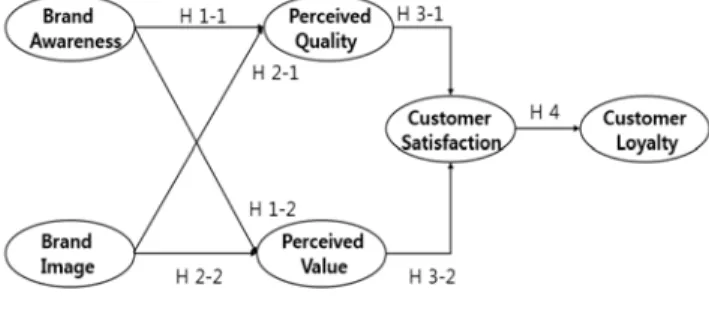
H1 : Brand awareness would have a positive(+) influence on perceived quality value and perceived value.

H1-1 : Brand awareness would have a positive(+) influence on perceived quality value.

H1 -2 : Brand awareness would have a positive(+) influence on perceived value.

H2 : Brand image would have a positive(+) influence on perceived quality value and perceived value.

H2-1 : Brand image would have a positive(+) influence on perceived quality value.

H2-2 : Brand image would have a positive(+) influence on perceived value.

3.1.2. How Perceived Quality and Perceived Value Relate to Customer Satisfaction and Customers’ Repurchase Intention

Oliver(1981) stated that perceived quality enhances customer satisfaction, and thereby, has an influence on customers’ use intention. Formell(1992) stated that customer satisfaction is the overall post-purchase evaluation made based on all the product/service purchase and consumption experiences acquired over time.

Accordingly, in this study, based on the precedent studies described above, the following hypotheses were set regarding the relation among perceived quality, perceived value, customer satisfaction and customers’ purchase intention about PB food products sold in CVS.

H3 : Perceived quality and perceived value would have a positive(+) influence on customer satisfaction.

H3-1 : Perceived quality value would have a positive(+) influence on customer satisfaction.

H3-2 : Perceived value would have a positive(+) influence on customer satisfaction.

H4 : Customer satisfaction would have a positive(+) influence on customers’ repurchase intention. The model of this study is shown in <Figure 1>

Figure 1: Model of Research

(6)

3.2. Operational Definition

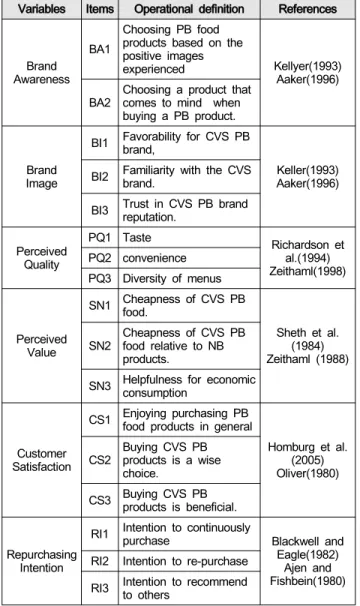
3.2.1. The Operational Definition of Brand Awareness In this study, as far as the operational definition of brand awareness is concerned, the definitions of brand awareness set by Keller(1993) and by Aaker(1996) were used as a reference to set brand recognition and brand recall as the constructs for selecting two questions. The selected questions were as follows: ‘I choose the PB food products in CVS based on the positive images experienced’

and ‘When I purchase PB products in CVS, I purchase the ones I recall’.

3.2.2. Operational definition of brand image

With reference to the definitions of Keller(1993), Aaker (1996), the operational definition of brand image consisted of three items such as the favorability for the CVS PB brand, familiarity with the CVS PB brand and trust in the CVS PB brand reputation.

3.2.3. The Operational Definition of Perceived Quality In this study, as far as the operational definition of perceived quality is concerned, a study by Richardson et al.(1994) and Zeithaml(1998) were used as a reference to select three questions for determining the subjective quality of food and beverage brands experienced by consumers. The selected questions were as follows: 1) ‘It tastes good’, 2) ‘It is convenient’, and 3) ‘There are diverse menus’.

3.2.4. Operational definition of perceived economic values With reference to the definitions of Sheth et al.(1984) and Zeithaml(1988), Kim et al.(2014), perceived economic values consisted of three items: cheapness of the CVS PB food, CVS PB food price’s relatively cheapness for the NB products and the CVS PB food price’s help for consumer life.

3.2.5. The Operational Definition of Customer Satisfaction In this study, the operational definition of customer satisfaction being concerned, the definition of customer satisfaction set by Homburg, et al.(2005), and the definition set by Oliver(1980) were used to select three questions for determining customer satisfaction. The selected questions were as follows: 1) ‘It is a wise choice to purchase PB food products’, 2) ‘I enjoy purchasing PB food products in general’ and 3) ‘I believe that it is profitable to purchase PB food products’.

3.2.6. Operational definition of repurchasing intention With reference to the definitions of Blackwell and Eagle

(2001), Ajen and Fishbein(1980), the operational definition of the repurchasing intention consisted of three items:

Intention to continuously purchase CVS PB food, Intention to re-purchase, and intention to recommend to others.

<Table 1> shows the operational definitions of the variables applied to this study.

Table 1: Operational Definitions of Variables and References Variables Items Operational definition References

Brand Awareness

BA1

Choosing PB food products based on the positive images

experienced Kellyer(1993)

Aaker(1996) BA2 Choosing a product that

comes to mind when buying a PB product.

Brand Image

BI1 Favorability for CVS PB brand,

Keller(1993) Aaker(1996) BI2 Familiarity with the CVS brand.

BI3 Trust in CVS PB brand reputation.

Perceived Quality

PQ1 Taste Richardson et

al.(1994) Zeithaml(1998) PQ2 convenience

PQ3 Diversity of menus

Perceived Value

SN1 Cheapness of CVS PB food.

Sheth et al.

(1984) Zeithaml (1988) SN2 Cheapness of CVS PB

food relative to NB products.

SN3 Helpfulness for economic consumption

Customer Satisfaction

CS1 Enjoying purchasing PB food products in general

Homburg et al.

(2005) Oliver(1980) CS2 Buying CVS PB

products is a wise choice.

CS3 Buying CVS PB products is beneficial.

RI1 Intention to continuously purchase Blackwell and Eagle(1982)

Ajen and Fishbein(1980) Repurchasing

Intention RI2 Intention to re-purchase RI3 Intention to recommend to others

3.3. Sample Design and Data Collection

Data is collected through questionnaires from 200 of responders. Survey respondents were young people in their 20s and 30s who using convenience stores in Incheon.

Questionnaires was tested in October 2017. In this study,

SPSS and AMOS were used for statistical analysis, and

structural equation was used as an analysis method.

(7)

4. The Results of Analysis 4.1. Characteristics of Samples

<Table 2> shows the demographic results of the analysis.

Respondents consisted of .55.3% male and 44.7% female.

The age group consists of 81.2% in their 25s or less, 18.8

% in their 30s or less. The number of times a consumer visits a CVS was 34.5% once a day 22.3% once every 2 days, 14.2% once every 3 days, 11.7% twice a day. The most frequently purchased products at convenience stores were 39.6% of food items, 31.5% of beverages, and 23.4%

of cookies.

Table 2: Demographic Characteristics

Variables Items Frequency Percentage

Sex Man

Woman 109

88 55.3

44.7 Number of times

consumers visit CVS

Twice a day Once a day Once every 2 days Once every 3 days

23 68 44 28

11.7 34.5 22.3 14.2

NB/PB’s preference

NB PB That’s all right

14 31 151

15.7 7.1 76.6 Frequently

purchased products

Food items Beverages Cookies.

78 62 46

39.6 31.5 23.4

4.2. Confirmatory Factor Analysis

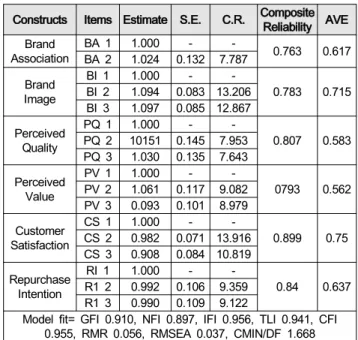
In <Table 3>, a confirmatory factor analysis (CFA)analysis was performed to test the model fit. If values such as Goodness-of-Fit Index (GFI), Adjusted Goodness-of-Fit Index (AGFI), NFI, IFI, TLI, and CFC are 0.9 or more and RMR and RMSEA are 0.05 or less, CMIN / DF are 3 or less, there is a fit of the model. As a result of the CFA analysis on the total variables, In <Table 3>, the GFI, IFI, TLI, and CFI indices were found to be 0.9 highe. And the standardized Regression Weights index values are 0.5 or less. Accordingly, the fitness of the research model is satisfactory as a whole.

4.3. Reliability and Validity Analysis

Validity analysis was used to measure the accuracy of the variable concept. The validity test requires the higher the convergent validity value, the more satisfactory, and the lower the discriminant validity value, the more satisfactory.

Average variance extracted (AVE) values are used to measure the degree of convergence and the value should be at least 0.5. Composite reliability Index should be at least 0.7, indicating that it is internally consistent. The reliability and convergent validity of these items can be

considered to be satisfactory. Therefore, the test of reliability and convergent validity of the items meet the reliability and convergent validity. As a result of discriminant validity test, if the AVE value from each factor is larger than the square of the correlation coefficient of each factor, the discriminant validity is satisfied among the factors.

In <Table 4>, the values (*) of the correlation coefficients of each factor show the AVE index. The AVE obtained among the factors is larger than the square of the correlation coefficient of each factor and the coefficient of determination, so it can be considered that the discriminant validity is meet between the factors.

Table 3: Results of Confirmatory Factor Analysis

Constructs Items Estimate S.E. C.R. Composite Reliability AVE Brand

Association BA 1 BA 2 1.000 1.024 0.132 7.787 - - 0.763 0.617 Brand

Image

BI 1 1.000 - -

0.783 0.715 BI 2 1.094 0.083 13.206

BI 3 1.097 0.085 12.867 Perceived

Quality

PQ 1 1.000 - -

0.807 0.583 PQ 2 10151 0.145 7.953

PQ 3 1.030 0.135 7.643 Perceived

Value

PV 1 1.000 - -

0793 0.562 PV 2 1.061 0.117 9.082

PV 3 0.093 0.101 8.979 Customer

Satisfaction

CS 1 1.000 - -

0.899 0.75 CS 2 0.982 0.071 13.916

CS 3 0.908 0.084 10.819 Repurchase

Intention

RI 1 1.000 - -

0.84 0.637 R1 2 0.992 0.106 9.359

R1 3 0.990 0.109 9.122

Model fit= GFI 0.910, NFI 0.897, IFI 0.956, TLI 0.941, CFI 0.955, RMR 0.056, RMSEA 0.037, CMIN/DF 1.668 Table 4: Correlation coefficient and Results of Discriminant validity Analysis

* (AVE coefficient) Factors Association Brand Brand

Image Perceived Quality Perceived

Value

Customer Satisfactio

n

Repurchae Intention Brand

Association 0.617*

Brand

Image 0.26 0.715

* Perceived

Quality 0.39 0.40 0.583*

Perceived

Value 0.07 0.01 0.08 0.562*

Customer

Satisfaction 0.21 0.10 0.19 0.20 0.75*

Repurchase

Intention 0.33 0.267 0.41 0.13 0.17 0.637*

(8)

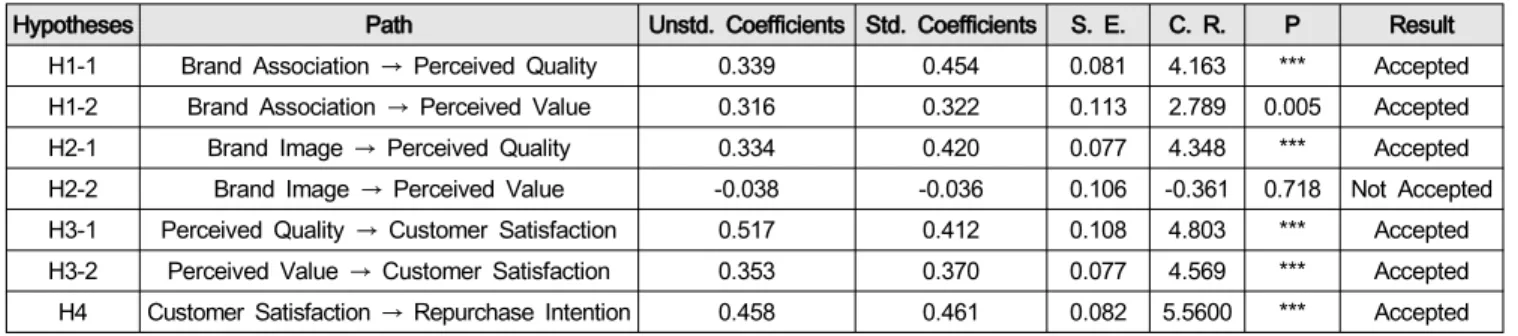
Table 5: Hypotheses testing results

Hypotheses Path Unstd. Coefficients Std. Coefficients S. E. C. R. P Result

H1-1 Brand Association → Perceived Quality 0.339 0.454 0.081 4.163 *** Accepted

H1-2 Brand Association → Perceived Value 0.316 0.322 0.113 2.789 0.005 Accepted

H2-1 Brand Image → Perceived Quality 0.334 0.420 0.077 4.348 *** Accepted

H2-2 Brand Image → Perceived Value -0.038 -0.036 0.106 -0.361 0.718 Not Accepted

H3-1 Perceived Quality → Customer Satisfaction 0.517 0.412 0.108 4.803 *** Accepted

H3-2 Perceived Value → Customer Satisfaction 0.353 0.370 0.077 4.569 *** Accepted

H4 Customer Satisfaction → Repurchase Intention 0.458 0.461 0.082 5.5600 *** Accepted P***<0.001

4.4. Results of the Path Analysis of the Research Model

The final model analysis showed GFI 0.883, IFI 0.918, TLI 0.898, CFI 0.917, RMR 0.082, RMSEA 0.077 and CMIN/DF 2.159. In some indices, a value of 0.9 or less was found, but the IFI and CFI, value were 0.9 or more, and RMR and RMSEA are 0.1 or less, CMIN / DF are 3 or less, Accordingly, the results of fitness of this study model can be accepted as a satisfactory overall value.

The analysis results specified above can be summarized as follows. It was found that brand awareness had statistically significant influence on perceived quality (H1-1) (C.R.=4.163) and perceived value (H1-2) (C.R.=2.789). It was found that brand image had a positive(+) influence on perceived quality (H2-1) (C.R.=4.348), but had no significant influence on perceived value (H2-2) (C.R.= -0.361). Brand image had no significant influence on perceived value. The reasons for rejection can inferred that the brand image of familiarity and favorability of CVS PB no longer affects the economic value of being ‘cheap’. Also, It was found that perceived quality and perceived value had a significant influence on customer satisfaction, and that customer satisfaction had a statistically significant influence on customers’ repurchase intention.

5. Conclusion

This present study differentiates itself from others of its kind since it was to analyze the impact of brand equity on customer satisfaction and customer repurchase intention using perceived quality and perceived value as mediator variables. The analysis results specified above can be summarized as follows. It was found that brand awareness had statistically significant influence on perceived quality and perceived value. It was found that brand image had a positive(+) influence on perceived quality and had no significant influence on perceived value. It was found that perceived quality and perceived value had a significant influence on customer satisfaction, and that customer

satisfaction had a statistically significant influence on customers’ repurchase intention. Brand image had no significant influence on perceived value. This implies that the brand image of PB food products sold in CVS has no significant influence on the perceived value of PB food.

On the other hand, it was confirmed through research that brand awareness consisting of brand recall and of experience-based brand recognition had an influence on perceived value and perceived quality value. It was confirmed that brand awareness consisting of brand recognition and of brand recall had a greater influence than brand favorability and brand reputation on perceived value and perceived quality.

The results from this study also confirmed that brand awareness and brand image had an influence on young consumers’ decision-making process for purchasing PB food products. In other words, consumers tend to prefer and repurchase PB products of which brands are liked, enjoyed and remembered more. Since PB food products already left such a strong impression on consumers, it is expected that they will be continuously welcomed by consumers in the future. It is suggested that convenience store companies focus on developing considerable food products with brand awareness and brand image more suitable for not only satisfying consumer preferences, but also leaving a strong impression on consumers.

However, as the distribution of PB products gets

expanded and the portion of sales is becomes growing

larger, the profit structure of NB makers is on gradual

decrease. Especially, the profits of small and medium-sized

enterprises is becoming more serious. The supply of

high-quality PB products suitable for consumers' preferences

is also good, but the management crisis of small and

medium-sized manufacturers should be solved through

win-win efforts. Manufacturers and retailers should jointly

participate in the development of the PB products and

brands, and the retailers should reduce costs through joint

logistics and collaborative structures such as SCM strategy

to perform inventory management and sales management

together rather than price competitiveness due to

manufacturer's sacrifice and should be socially trusted by

consumers and the public. In addition, related departments

(9)

such as the Small and Medium Business Administration should establish a support system in which retailers and manufacturers can co-exist.

This study has a limitation that the subjects are mainly  younger students and the research samples are not plentiful.

The variables used in the study should be more diverse including variables such as service quality but the fitness level was lowered in the analysis process, so excluded. In future studies, we are to perform related studies using more diverse samples and variables.

References

Aaker, D. A. (1991). Managing brand equity: Capitalizing on the value of a brand name. New York: The Free Press.

Agarwal, S., & R. Kenneth T. (2000). The Effects of Extrinsic Product Cues on Consumers' Perceptions of Quality, Sacrifice, and Value. Journal of the Academy of Marketing Science, 28(2), 280-292.

Ajzen, I., & Fishbein, M. (1980). Understanding attitude and prediction social behavior. Englewood Cliffs. NJ:

Prentice Hall.

Bentler, P. M., & Chou, C. (1987). Practical Issues in Structural Modeling. Sociological Methods and Rearch, 16(August), 78-117.

Blackwell, R. D., Miniard, P. W., & Engel, J. F. (2001).

Consumer behavior (9th ed), Ft. Worth, Tex. ; London : Harcourt College Publishers.

Choi, I. S., Lee, S. Y. (2013). A Study on VMD of SPA Brands and Purchasing Intention: Focus on Seoul and Gyeonggi-Do. Journal of Distribution Science, 11(9), 51-57.

Ding, L. Velicer, W. F., & Harlow, L. L. (1995). Effect of Estimation Methods, Number of Indicators per Factor and Improper Solutions on Structural Equation Modeling Fit Indicies. Structural Equation Modeling, 2. 19-43.

Dodds, W. B., Monroe, K. B., & Grewal, D. (1991) Effects of Price, Brand, and Store Information on Buyers’ Product Evaluations. Journal of Marketing Research, 38, 307-326.

Formell, C. (1992). National customer satisfaction barometer: The Swedish experience. Journal of Marketing, 56(January), 6-21.

Garvin, D. A. (1987). Competing on the Eight Dimensions of Quality. Harvard Business Review, 65(6), 101-109.

Homburg, C., Koschate, N., & Hoyer, W. D. (2005). Do Satisfied Customers Really Pay More? A Study of the Relationship Between Customer Satisfaction and Willingness to Pay. Journal of Marketing, 69(2), 84-96.

Keller, K. L. (1993). Conceptualizing measuring and managing customer-based brand equity. Journal of

Marketing, 57(1), 1-22.

Kim, Deok-Hyeon, Ha, Ji-Young, Lee, Seoung-Hyun, &

An, Wook-Hyun. (2014). Mediation of Production Trust on Brand Image Influence on Repurchase Intention for PB Rice. Journal of Distribution Science, 12(8), 83-90.

Kim, Moon-Jung, Oh, Young-Ye, & Kim, Ki-Soo (2011).

An Influence of Distributor's Corporate Image on Consumer Behavior Towards PB Products. Journal of Distribution Science, 9(4), 83-91.

Kim, Young-Hwan, & Kim, Pan-Jin (2008). An study on purchasing activity of Private Brand clothing in large discount store, Journal of Distribution Science, 6(1), 117-128.

Kim, Yu-Kyung (2015). Relationships between the Effect Factors of Private Brand Images and Customer Trust and Loyalty. Journal of Distribution Science, 13(7) (2015) 73-83.

Kotler, P. (1997). Marketing Management: Analysis, Planning, Implementation, and Control (9th Edition).

Upper Saddle River: Prentice Hall.

Lee, D., & Choi, Y. (2015). Brand Equity and Purchase Intention: The Fashion Market in China. Journal of Distribution Science, 13(7), 85-90.

Mano, H., & Oliver, R. L. (1993). Assessing the Dimensionality and Structure of The Consumption Experience: Evaluation, Feeling, and Satisfaction.

Journal of Consumer Research, 20(3), 451-466.

Oliver, R. L. (1980). A Cognitive Model of the Antecedents and Consequences of Satisfaction Decisions. Journal of Marketing Research. 17(Nov.

1980), 460-469.

Oliver, R. L. (1981). Measurement and Evaluation of Satisfaction Process in Retail Settings. Journal of Retailing, 57, 25-48.

Richardson, P. l S., Jain, A. K. & Alan, D. (1994).

Extrinsic and intrinsic cue effects on perceptions of store brand quality. Journal of Marketing, 58, 28-36.

Schutte, T. F. (1996). The Semantics of Branding. Journal of Marketing, 33(4), 5-11.

Sheth, J. N., Newman, B. I., & Gross, B. L. (1991). Why We Buy, What We Buy: A theory of Consumption Values. Journal of Business Research, 22(2), 159-170.

Woodruff. R. B. (1997). Customer Value: The Next Source for Competitive Edge. Journal of the Academy of Marketing Science, 25(2), 139-153.

Yoo, C. K., Kim, G. P., & Kwon, C. M. (2018). A Study on Brand Trust and Product Attribute of the Convenience Store. International Journal of Industrial Distribution & Business, 9(3), 81-87.

Zeithaml, V. A. (1998). Consumer Perceptions of Price,

Quality and Value. Journal of Marketing, 52(2), 2-22.

수치

Figure  1:  Model  of  Research
Table  1:  Operational  Definitions  of  Variables  and  References Variables Items Operational  definition References
Table  2:  Demographic  Characteristics
Table  5:  Hypotheses  testing  results

참조

관련 문서

The purpose of this study was to investigate the effects of a disability awareness program on improving the attitudes of regular elementary school

The purpose of this study was to examine the effect of shadowing using English movies on listening and speaking skills, learning interest, and attitudes

It is necessary to reconsider the Chinese brand image in the current market environment of the world where the influence of China is increasing. Therefore, in this

model development and empirical testing. Brand authenticity: Towards a deeper understanding of its conceptualization and measurement.. Brand authenticity: Testing

As for the relationship of obesity level to clothing shopping orientation, the underweight boys made up the largest brand-oriented group, and the

Along with the results of the analysis of visual design elements of outdoor signboards and consumer surveys conducted to enhance the brand image of

The purpose of this study was to investigate the effects of sound-finding strategies based on phonological awareness on word recognition, oral reading

After that, we look forward to the results and expect that it will be used as a tool to determine the direction of brand development and renewal by