1890
A
recent randomized trial showed that periprocedural com- plications occurred at similar rates in carotid endarterec- tomy (CEA) and carotid artery stenting (CAS). However, the incidence of periprocedural complications other than myocar- dial infarction was higher in CAS than in CEA.1Statins are used widely given their pleiotropic and cho- lesterol-lowering effect; these drugs reduce the incidence of stroke and of myocardial infarction in stroke patients.2,3 Statin pretreatment reduced the incidence of myocardial infarction after percutaneous coronary interventions4,5 and the risk of perioperative stroke and mortality after CEA.6,7 However, few studies have reported on whether statin use before CAS reduced periprocedural complications.8–11 In
addition, no specific statin dose has been recommended in carotid interventions, unlike for acute coronary inter- ventions; for patients undergoing percutaneous coronary interventions, high-dose statin before percutaneous coro- nary interventions is recommended for reducing the risk of periprocedural complications.12 It is also unknown whether statin pretreatment has dose-dependent effects on peripro- cedural complication risk in patients with CAS. Here, we investigated whether statin pretreatment is associated with a reduction of periprocedural complications and whether statin has dose-dependent effects on periprocedural compli- cation risks in patients undergoing CAS for symptomatic carotid stenosis.
Background and Purpose—We investigated whether statin pretreatment can dose dependently reduce periprocedural complications in patients undergoing carotid artery stenting because of symptomatic carotid artery stenosis.
Methods—We enrolled a consecutive series of 397 symptomatic carotid artery stenosis (≥50% stenosis on conventional angiography) treated with carotid artery stenting at 2 tertiary university hospitals over a decade. Definition of periprocedural complications included any stroke, myocardial infarction, and death within 1 month after or during the procedure. Statin pretreatment was divided into 3 categories according to the atorvastatin equivalent dose: none (n=158; 39.8%), standard dose (<40 mg of atorvastatin, n=155; 39.0%), and high dose (≥40 mg; n=84; 21.2%). A multivariable logistic regression analysis with the generalized estimating equation method was used to investigate independent factors in periprocedural complications.
Results—The patients’ mean age was 68.7 years (81.6% men). The periprocedural complication rates across the 3 categories of statin use were 12.0%, 4.5%, and 1.2%. After adjustment, a change in the atorvastatin dose category was associated with reduction in the odds of periprocedural complications for each change in dose category (standard-dose statin: odds ratio, 0.24; 95% confidence interval, 0.07−0.81; high-dose statin: odds ratio, 0.11; 95% confidence interval, 0.01−0.96;
P for trend=0.01). Administration of antiplatelet drugs was also an independent factor in periprocedural complications (OR, 0.18; 95% CI, 0.05−0.69).
Conclusions—This study shows that statin pretreatment may reduce the incidence of periprocedural complications dose dependently in patients with symptomatic carotid artery stenting. (Stroke. 2017;48:1890-1894. DOI: 10.1161/
STROKEAHA.117.016680.)
Key Words: cerebral infarction ◼ carotid stenosis ◼ cerebrovascular disorders ◼ hydroxymethylglutaryl-CoA reductase inhibitors ◼ stroke
on Preventing the Periprocedural Complications of Carotid Artery Stenting
Jeong-Ho Hong, MD; Sung-Il Sohn, MD; Jaehyuk Kwak, MD; Joonsang Yoo, MD;
Hyuk Won Chang, MD; O-Ki Kwon, MD; Cheolkyu Jung, MD; Inyoung Chung, MD;
Hee-Joon Bae, MD; Ji Sung Lee, PhD; Moon-Ku Han, MD
Received January 23, 2017; final revision received April 15, 2017; accepted May 11, 2017.
From the Department of Neurology (J.-H.H., S.-I.S., J.K., J.Y.); Department of Radiology (H.W.C.), Keimyung University School of Medicine, Dongsan Medical Center, Daegu, Korea; Department of Neurology (I.C., H.-J.B., M.-K.H.), Department of Neurosurgery (O.-K.K.), and Department of Radiology (C.J.), Seoul National University Bundang Hospital, Seongnam, Korea; and Clinical Trial Center, University of Ulsan College of Medicine and Asan Medical Center, Seoul, Korea (J.S.L.).
Guest Editor for this article was Seemant Chaturvedi, MD.
The online-only Data Supplement is available with this article at http://stroke.ahajournals.org/lookup/suppl/doi:10.1161/STROKEAHA.
117.016680/-/DC1.
Correspondence to Moon-Ku Han, MD, PhD, Department of Neurology, Stroke Center, Seoul National University Bundang Hospital, Seoul National University College of Medicine 300 Gumi-dong, Bundang-gu, Seongnam-si, Gyeonggi-do, 463–707, Korea. E-mail [email protected]
© 2017 American Heart Association, Inc.
Stroke is available at http://stroke.ahajournals.org DOI: 10.1161/STROKEAHA.117.016680
10153,10178
Downloaded from http://ahajournals.org by on January 13, 2019
Subjects and Methods
Selection of Study Patients and Data Collection
Our study population was collected retrospectively from a pro- spective CAS registry of 2 tertiary university hospitals, between July 2003 and June 2013. Eligibility criteria for the current investi- gation were the following. (1) Patients treated with CAS for symp- tomatic carotid stenosis, defined as a transient ischemic attack, transient monocular visual loss, or any ischemic stroke affected by a relevant carotid artery within 180 days before procedure. (2) Patients with carotid artery stenosis of >50%, as measured by the North American Symptomatic Carotid Endarterectomy Trial13 cri- teria on conventional catheter angiography. Patients with inacces- sible vessels for revascularization or who had recently (<7 days) stroke of a size sufficiently large to predict hemorrhagic conver- sion during the procedure were excluded. Life expectancy of <1 year or any acute, serious medical problem was also criteria for exclusion.
We obtained demographics, vascular risk factors, current medica- tion regimes, and procedural characteristics from the CAS registry database. Neurological examination was performed by independent neurologists or neurosurgeons immediately and again 24 hours after the stenting procedure, and daily thereafter, until discharge from the hospital. After discharge, a 30-day clinical event history was obtained
by neurologists or neurosurgeons during outpatient clinic visits or by trained nurses by telephonic interviews.
The statin name and dose were ascertained by self-reporting or hospital record review. Patients were accordingly categorized into no-statin, standard-dose (≤40 mg), and high-dose statin groups (> 40 mg) according to the atorvastatin-equivalent dose, based on the lipid reduction fraction at the time of CAS, independently of the duration of therapy.14,15 Data from subjects with complete lipid profiles were used for comparison of patients in the 3 groups. The data were col- lected prospectively to monitor the quality of stroke care. The study was approved by the local institutional review boards of each center.
Periprocedural complications were defined as the composite out- come of any stroke, myocardial infarction, or death because of any cause during or within 1 day after the CAS procedure (immediate procedural events) and 1 to 30 days after the procedure (30-day clini- cal events). Stroke was defined as an acute neurological deficit with focal signs and symptoms on neurological examination, regardless of symptom duration, and classified as ischemic or hemorrhagic, based on computed tomography or magnetic resonance imaging.
Myocardial infarction was defined by the third universal definition.16 Ischemic heart disease was defined as a composite variable of myo- cardial infarction, unstable angina, percutaneous coronary interven- tions, coronary artery bypass graft, or percutaneous transluminal coronary angioplasty.
Table 1. Baseline Characteristics of Patients Undergoing Stenting for Symptomatic Carotid Artery Stenosis Total
(n=397)
No Statin (n=158)
Standard-Dose Statin (n=155)
High-Dose Statin
(n=84) P Value
Age, y 68.7±9.9 68.5±9.4 69.1±10.7 68.3±9.4 0.79
Sex (men), n (%) 324 (81.6%) 135 (85.4%) 119 (76.8%) 70 (83.3%) 0.13
Vascular risk factors
Hypertension 275 (69.3%) 98 (62.0%) 109 (70.3%) 68 (81.0%) 0.009
Diabetes mellitus 169 (42.6%) 67 (42.4%) 64 (41.3%) 38 (45.2%) 0.84
Dyslipidemia 99 (24.9%) 11 (7.0%) 59 (38.1%) 29 (34.5%) <0.0001
Smoking 182 (45.8%) 74 (46.8%) 71 (45.8%) 37 (44.0%) 0.92
Atrial fibrillation 30 (7.6%) 8 (5.1%) 16 (10.3%) 6 (7.1%) 0.21
Ischemic heart disease 80 (20.2%) 37 (23.4%) 21 (13.5%) 22 (26.2%) 0.03
Myocardial infarction 30 (7.6%) 13 (8.2%) 9 (5.8%) 8 (9.5%) 0.54
Unstable angina 53 (13.4%) 24 (15.2%) 14 (9.0%) 15 (17.9%) 0.11
PCI 26 (6.5%) 13 (8.2%) 8 (5.2%) 5 (6.0%) 0.53
CABG 14 (3.5%) 9 (5.7%) 3 (1.9%) 2 (2.4%) 0.16
PTCA 5 (1.3%) 2 (1.3%) 2 (1.3%) 1 (1.2%) —
Acute carotid stenting 43 (10.8%) 20 (12.7%) 15 (9.7%) 8 (9.5%) 0.64
Procedure within 2 wk of onset 241 (60.7%) 96 (60.8%) 88 (56.8%) 57 (67.9%) 0.25 Pre-stenting medication
Antiplatelet therapy 383 (96.5%) 147 (93.0%) 152 (98.1%) 84 (100%) 0.008
Severity of lesional stenosis 80.9±11.9 81.1±12.5 80.5±12.2 81.1±10.6 0.90
50−69% 44 (11.1%) 20 (12.7%) 19 (12.3%) 5 (6.0%)
70−89% 221 (55.7%) 81 (51.3%) 87 (56.1%) 53 (63.1%) 0.34
≥90% 132 (33.2%) 57 (36.1%) 49 (31.6%) 26 (31.0%)
Contralateral stenosis > 50% 96 (24.2%) 37 (23.4%) 42 (27.1%) 17 (20.2%) 0.48
Post-stenting dilatation 135 (34.0%) 49 (31.0%) 56 (36.1%) 30 (35.7%) 0.59
Embolic protection device 355 (89.4%) 137 (86.7%) 143 (92.3%) 75 (89.3%) 0.28 CABG indicates coronary artery bypass graft; PCI, percutaneous coronary intervention; and PTCA, percutaneous transluminal coronary angioplasty.
Downloaded from http://ahajournals.org by on January 13, 2019
Procedure Protocol
All patients requiring CAS who were admitted to 2 different hospitals were treated following the same guidelines.17 Dual antiplatelet therapy with aspirin plus clopidogrel was administered routinely for at least 7 days before the procedure. For urgent CAS, aspirin and a loading dose of clopidogrel (300 mg) were administered. An intravenous bolus injec- tion of 3000 U heparin was given after femoral artery puncture. Cerebral embolic protection devices were used in most of the procedures. Post- stenting balloon dilatation was used at the discretion of the operators.
Afterward, at least 1 antiplatelet drug was administered for ≥1 year.
Statistical Analysis
Variables were presented as means±SDs, medians (interquartile range), or frequencies (percentages) as appropriate. P<0.05 was con- sidered to indicate significance. Statistical analyses were performed using SAS Statistical software, version 9.2 for Windows (SAS, Cary, NC). To compare baseline characteristics and periprocedural com- plications among the 3 groups according to the pre-treatment statin dose, Pearson χ2 test was used for categorical variables, ANOVA for parametric variables, and the Kruskal–Wallis test for nonpara- metric variables because the periprocedural period was relatively short. Multivariable logistic regression analysis using the general- ized estimating equation method, with predefined variables (quartile of recruitment) and the potential confounders that were significantly associated with periprocedural complication in a bivariate analysis (P<0.2), was performed to predict the occurrence of periprocedural complications and to consider the center effect.
Results
Finally, 397 CAS cases were enrolled; the mean age was 68.7±9.9 years and 324 cases (81.6%) included men. In total, 239 cases (60.2%) received statins; atorvastatin was the most commonly used statin (n=191; 80.0%). Statin drugs and doses used before CAS are summarized in Table I in the online-only Data Supplement.
There were 39.8% cases in the no-statin, 39.0% in the stan- dard-dose, and 21.1% in the high-dose groups. At baseline, there were significant differences in the proportion of hyper- tension, dyslipidemia, and ischemic heart disease and pre- treatment with antiplatelet drugs among the groups (P<0.05).
Although 2 centers used a CAS protocol following the same guidelines, antiplatelet drugs were not administered before CAS in 3.5% of cases (n=14): these cases were enrolled in the
early phase of the 10-year CAS registry, and most involved urgent procedures. Urgent carotid stenting was performed in 43 cases (10.8%), and the proportion of acute carotid stenting did not differ among the 3 groups (Table 1).
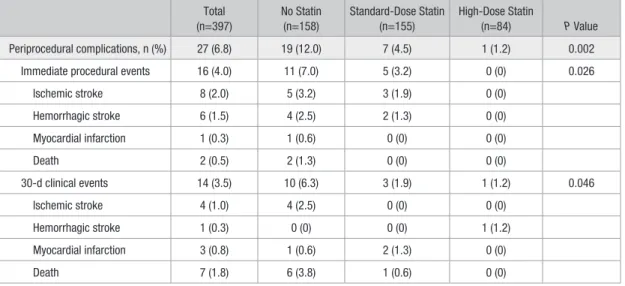
High- and standard-dose statin use was associated with periprocedural complication reduction within 30 days, as compared with the no-statin group (12.0% versus 4.5% ver- sus 1.2%; P=0.002). When we divided the data into imme- diate procedural events and 30-day clinical events, these trends remained unchanged (Table 2). After adjusting for Table 2. Periprocedural Complications Within 30 Days After Stenting for Symptomatic Carotid Artery Stenosis
Total (n=397)
No Statin (n=158)
Standard-Dose Statin (n=155)
High-Dose Statin
(n=84) P Value
Periprocedural complications, n (%) 27 (6.8) 19 (12.0) 7 (4.5) 1 (1.2) 0.002
Immediate procedural events 16 (4.0) 11 (7.0) 5 (3.2) 0 (0) 0.026
Ischemic stroke 8 (2.0) 5 (3.2) 3 (1.9) 0 (0)
Hemorrhagic stroke 6 (1.5) 4 (2.5) 2 (1.3) 0 (0)
Myocardial infarction 1 (0.3) 1 (0.6) 0 (0) 0 (0)
Death 2 (0.5) 2 (1.3) 0 (0) 0 (0)
30-d clinical events 14 (3.5) 10 (6.3) 3 (1.9) 1 (1.2) 0.046
Ischemic stroke 4 (1.0) 4 (2.5) 0 (0) 0 (0)
Hemorrhagic stroke 1 (0.3) 0 (0) 0 (0) 1 (1.2)
Myocardial infarction 3 (0.8) 1 (0.6) 2 (1.3) 0 (0)
Death 7 (1.8) 6 (3.8) 1 (0.6) 0 (0)
Table 3. Multivariable Logistic Regression Analysis With Generalized Estimating Equation Method of Prediction for Periprocedural Complications Within 30 Days After Stenting for Symptomatic Carotid Artery Stenosis
OR 95% CI P Value
Male 0.57 0.21–1.54 0.27
Hypertension 1.85 0.74–4.62 0.19
Ischemic heart disease 0.70 0.24–2.05 0.52
Dyslipidemia 1.34 0.37–4.94 0.66
Antiplatelet 0.18 0.05–0.69 0.01
Quartile of recruitment
1−100 Reference
101−199 0.75 0.29–1.98 0.56
200−298 0.49 0.14–1.68 0.26
299−397 0.35 0.09–1.37 0.13
Statin
No-statin use Reference Standard-dose statin
(atorvastatin <40 mg)*
0.24 0.07–0.81 0.02
High-dose statin
(atorvastatin ≥40 mg)* 0.11 0.01–0.96) 0.046 Based on lipid reduction fraction, statin drug and dose were substituted by atorvastatin equivalent dose. CI indicates confidence interval; and OR, odds ratio.
*P=0.01 for linear trend effect of statin dose
Downloaded from http://ahajournals.org by on January 13, 2019
confounders, including sex, hypertension, ischemic heart dis- ease, hyperlipidemia, and antiplatelet pretreatment, as well as the quartile of recruitment (as a learning curve effect; ie, time dependent) and a center effect, statin pre-treatment remained an independent predictor of periprocedural complications after CAS. There was a linear trend effect of the statin dose (standard-dose statin: odds ratio, 0.24; 95% CI, 0.07−0.81;
high-dose statin: odds ratio, 0.11, 95% CI, 0.01−0.96; P for trend=0.01), but no significant difference in the lipid profiles among the 3 groups (Tables 3 and 4).
Discussion
Our study indicated a dose-dependent effect of statins on risk reduction for periprocedural complications after CAS, independent of baseline lipid profiles. Considering that arte- rial stenting may induce platelet activation, thrombosis, and inflammation within the vessel wall,18,19 embolic events are more important periprocedural complications during CAS than during CEA.20,21 Recently, evidence has increasingly indicated that premorbid statin use can significantly decrease the rate of cardiovascular and cerebrovascular events after vascular procedures and CEA, as well as secondary stroke events.4–7,22–25 However, current guidelines for the manage- ment of patients with carotid artery disease also do not rec- ommend statin use, or a specific dose before CAS for carotid artery stenosis, because of a lack of evidence.17
In our study, 6.8% of cases had experienced periprocedural complications within 1 month of the procedure; this rate is similar to that reported in previous clinical trials that enrolled patients with symptomatic CAS.20,26 However, the incidence rate was only 3.3% (8/239) in the high- and standard-dose groups. Our novel findings of the dose-dependent effect of statins on the risk of periprocedural complications in symptom- atic patients undergoing CAS may involve various mechanisms.
Symptomatic carotid arteries have unstable or vulnerable plaques that can cause thrombotic and embolic complications during CAS. Statin pre-treatment improves atheroma stabil- ity27,28 and can reduce the embolic debris during CAS.29
Several studies have shown congruent findings on the rela- tionship between the reduction of the risk of periprocedural complications in CAS and statin pretreatment.8,9,11 Patti et al10 conducted randomized controlled studies evaluating the clopidogrel load and high-dose statin reload in statin-treated patients undergoing CAS: this strategy reduced 50% of the ischemic event risk. However, these results cannot be general- ized to only symptomatic patients because of the heterogene- ity and relatively small number of subjects and do not clarify the appropriate statin dose.
In our study, cholesterol levels were not different in patients with and without periprocedural complications, in agreement with a previous study.11 Ibrahimi et al32 assessed the correla- tion between plaque stability by meta-analysis, based on echo- genicity during ultrasound imaging and lipid profile changes, but found no such relationship. Our results suggest pleiotropic effects of antithrombotic and profibrinolytic pathways, medi- ated by statins, which are dose dependent, similar to the cho- lesterol-lowering properties of statins.33,34
This study has several limitations. Given its nonrandom- ized retrospective design, our findings should be interpreted cautiously. The patient selection leans toward less challenging patients and could thus misrepresent the risks in the excluded patients. Moreover, our patients were limited to only symp- tomatic CAS patients. Patients with clinically asymptomatic carotid stenosis may also have unstable plaque; thus, our find- ings should be validated in asymptomatic cohorts. We could not evaluate asymptomatic embolic infarction by diffusion- weighted images of the brain after the procedure in our ret- rospective study. Our subjects were collected at 2 different centers over a period of ≈10 years, which may have influenced our findings.35 We therefore adjusted for the center and learn- ing curve effects as confounders during multivariable logistic regression analysis, using the generalized estimating equation method. Finally, this study was not powered to address differ- ent statin regimens.
Although we cannot suggest the pre-CAS statin treatment duration for patients with symptomatic carotid stenosis, we demonstrated that statin pretreatment before CAS for symp- tomatic carotid stenosis can reduce periprocedural complica- tions dose dependently. We recommend the use of a high-dose statin before CAS in patients with symptomatic carotid stenosis.
Sources of Funding
This work was supported by the National Research Foundation of Korea grant funded by the Korea Government (MSIP; No.
2014R1A5A2010008), and by the research promoting grant from the Keimyung University Dongsan Medical Center in 2014.
Disclosures
None.
References
1. Bonati LH, Lyrer P, Ederle J, Featherstone R, Brown MM. Percutaneous transluminal balloon angioplasty and stenting for carotid artery stenosis.
Cochrane Database Syst Rev. 2012:CD000515
2. Amarenco P, Bogousslavsky J, Callahan A 3rd, Goldstein LB, Hennerici M, Rudolph AE, et al; Stroke Prevention by Aggressive Reduction in Cholesterol Levels (SPARCL) Investigators. High-dose atorvastatin after Table 4. Lipid Profiles Stratified According to Statin Dose
Total (92.5%;
347/375)
No Statin (89.5%;
136/152)
Standard-Dose Statin (92.5%; 135/146)
High-Dose Statin
(98.7%; 76/77) P Value
Total cholesterol 174.0±43.7 171.9±37.9 179.5±50.6 167.9±39.5 0.14
Triglyceride 132.9±76.1 133.5±76.9 138.6±84.4 121.7±56.6 0.3
HDL 42.1±10.6 42.5±11.3 42.2±9.7 41.5±11.0 0.8
LDL 103.1±35.6 100.4±29.2 108.5±42.0 98.4±32.8 0.07
Data are shown for subjects with a complete lipid profile. HDL indicates high-density lipoprotein; and LDL, low-density lipoprotein.
Downloaded from http://ahajournals.org by on January 13, 2019
stroke or transient ischemic attack. N Engl J Med. 2006;355:549–559.
doi: 10.1056/NEJMoa061894.
3. Hong KS, Lee JS. Statins in acute ischemic stroke: a systematic review.
J Stroke. 2015;17:282–301. doi: 10.5853/jos.2015.17.3.282.
4. Chan AW, Bhatt DL, Chew DP, Quinn MJ, Moliterno DJ, Topol EJ, et al. Early and sustained survival benefit associated with statin ther- apy at the time of percutaneous coronary intervention. Circulation.
2002;105:691–696.
5. Pasceri V, Patti G, Nusca A, Pristipino C, Richichi G, Di Sciascio G;
ARMYDA Investigators. Randomized trial of atorvastatin for reduction of myocardial damage during coronary intervention: results from the ARMYDA (Atorvastatin for Reduction of MYocardial Damage during Angioplasty) study. Circulation. 2004;110:674–678. doi: 10.1161/01.
CIR.0000137828.06205.87.
6. Kennedy J, Quan H, Buchan AM, Ghali WA, Feasby TE. Statins are associated with better outcomes after carotid endarterectomy in symptomatic patients. Stroke. 2005;36:2072–2076. doi: 10.1161/01.
STR.0000183623.28144.32.
7. McGirt MJ, Perler BA, Brooke BS, Woodworth GF, Coon A, Jain S, et al.
3-hydroxy-3-methylglutaryl coenzyme a reductase inhibitors reduce the risk of perioperative stroke and mortality after carotid endarterectomy.
J Vasc Surg. 2005;42:829–836; discussion 836–827.
8. Takayama K, Taki W, Toma N, Nakahara I, Maeda M, Tanemura H, et al. Effect of pitavastatin on preventing ischemic complications with carotid artery stenting: a multicenter prospective study–epoch-cas study.
Cardiovasc Intervent Radiol. 2014;37:1436–1443
9. Reiff T, Amiri H, Rohde S, Hacke W, Ringleb PA. Statins reduce peri- procedural complications in carotid stenting. Eur J Vasc Endovasc Surg.
2014;48:626–632.
10. Patti G, Tomai F, Melfi R, Ricottini E, Macri M, Sedati P, et al. Strategies of clopidogrel load and atorvastatin reload to prevent ischemic cerebral events in patients undergoing protected carotid stenting. Results of the randomized armyda-9 carotid (clopidogrel and atorvastatin treatment dur- ing carotid artery stenting) study. J Am Coll Cardiol. 2013;61:1379–1387.
11. Groschel K, Ernemann U, Schulz JB, Nagele T, Terborg C, Kastrup A. Statin therapy at carotid angioplasty and stent placement: effect on procedure-related stroke, myocardial infarction, and death. Radiology.
2006;240:145–151.
12. Levine GN, Bates ER, Blankenship JC, Bailey SR, Bittl JA, Cercek B, et al. 2011 accf/aha/scai guideline for percutaneous coronary interven- tion: executive summary: a report of the american college of cardiology foundation/american heart association task force on practice guide- lines and the society for cardiovascular angiography and interventions.
Circulation. 2011;124:2574–2609.
13. NASCET Steering Committee. North American Symptomatic Carotid Endarterectomy Trial. Methods, patient characteristics, and progress.
Stroke. 1991;22:711–720.
14. Law MR, Wald NJ, Rudnicka AR. Quantifying effect of statins on low density lipoprotein cholesterol, ischaemic heart disease, and stroke: sys- tematic review and meta-analysis. BMJ. 2003;326:1423.
15. Jones P, Kafonek S, Laurora I, Hunninghake D. Comparative dose effi- cacy study of atorvastatin versus simvastatin, pravastatin, lovastatin, and fluvastatin in patients with hypercholesterolemia (the CURVES study).
Am J Cardiol. 1998;81:582–587.
16. Thygesen K, Alpert JS, Jaffe AS, Simoons ML, Chaitman BR, White HD, et al; Joint ESC/ACCF/AHA/WHF Task Force for the Universal Definition of Myocardial Infarction. Third universal definition of myo- cardial infarction. Circulation. 2012;126:2020–2035. doi: 10.1161/
CIR.0b013e31826e1058.
17. Brott TG, Halperin JL, Abbara S, Bacharach JM, Barr JD, Bush RL, et al;
American College of Cardiology Foundation/American Heart Association Task Force on Practice Guidelines; American Stroke Assocation;
American Association of Neuroscience Nurses; American Association of Neurological Surgeons; American College of Radiology; American Society of Neuroradiology; Congress of Neurolgocial Surgeons; Society of Atherosclerosis Imaging and Prevention; Society for Cardiovascular Angiography and Interventions; Society of Interventional Radiology;
Society of NeuroInterventional Surgery; Society for Vascular Medicine;
Society for Vascular Surgery; American Academy of Neurology and Society of Cardiovascular Computed Tomography. 2011 ASA/ACCF/AHA/AANN/
AANS/ACR/ASNR/CNS/SAIP/SCAI/SIR/SNIS/SVM/SVS guideline on the management of patients with extracranial carotid and vertebral artery disease. Stroke. 2011;42:e464–e540. doi: 10.1161/STR.0b013e3182112cc2.
18. Badimon JJ, Ortiz AF, Meyer B, Mailhac A, Fallon JT, Falk E, et al.
Different response to balloon angioplasty of carotid and coronary arteries: effects on acute platelet deposition and intimal thickening.
Atherosclerosis. 1998;140:307–314.
19. Chaabane C, Otsuka F, Virmani R, Bochaton-Piallat ML. Biological responses in stented arteries. Cardiovasc Res. 2013;99:353–363. doi:
10.1093/cvr/cvt115.
20. Brott TG, Hobson RW 2nd, Howard G, Roubin GS, Clark WM, Brooks W, et al; CREST Investigators. Stenting versus endarterectomy for treat- ment of carotid-artery stenosis. N Engl J Med. 2010;363:11–23. doi:
10.1056/NEJMoa0912321.
21. Bonati LH, Jongen LM, Haller S, Flach HZ, Dobson J, Nederkoorn PJ, et al; ICSS-MRI Study Group. New ischaemic brain lesions on MRI after stenting or endarterectomy for symptomatic carotid stenosis: a sub- study of the International Carotid Stenting Study (ICSS). Lancet Neurol.
2010;9:353–362. doi: 10.1016/S1474-4422(10)70057-0.
22. Sillesen H, Amarenco P, Hennerici MG, Callahan A, Goldstein LB, Zivin J, et al; Stroke Prevention by Aggressive Reduction in Cholesterol Levels Investigators. Atorvastatin reduces the risk of cardiovascular events in patients with carotid atherosclerosis: a secondary analy- sis of the Stroke Prevention by Aggressive Reduction in Cholesterol Levels (SPARCL) trial. Stroke. 2008;39:3297–3302. doi: 10.1161/
STROKEAHA.108.516450.
23. Amarenco P, Labreuche J. Lipid management in the prevention of stroke:
review and updated meta-analysis of statins for stroke prevention. Lancet Neurol. 2009;8:453–463. doi: 10.1016/S1474-4422(09)70058-4.
24. Antoniou GA, Hajibandeh S, Hajibandeh S, Vallabhaneni SR, Brennan JA, Torella F. Meta-analysis of the effects of statins on perioperative out- comes in vascular and endovascular surgery. J Vasc Surg. 2015;61:519–
532.e1. doi: 10.1016/j.jvs.2014.10.021.
25. Schouten O, Boersma E, Hoeks SE, Benner R, van Urk H, van Sambeek MR, et al; Dutch Echocardiographic Cardiac Risk Evaluation Applying Stress Echocardiography Study Group. Fluvastatin and periop- erative events in patients undergoing vascular surgery. N Engl J Med.
2009;361:980–989. doi: 10.1056/NEJMoa0808207.
26. Ederle J, Dobson J, Featherstone RL, Bonati LH, van der Worp HB, de Borst GJ, et al. Carotid artery stenting compared with endarterectomy in patients with symptomatic carotid stenosis (international carotid stent- ing study): an interim analysis of a randomised controlled trial. Lancet.
2010;375:985–997.
27. Abela GS, Vedre A, Janoudi A, Huang R, Durga S, Tamhane U. Effect of statins on cholesterol crystallization and atherosclerotic plaque stabilization. Am J Cardiol. 2011;107:1710–1717. doi: 10.1016/j.
amjcard.2011.02.336.
28. de Lorenzo F, Feher M, Martin J, Collot-Teixeira S, Dotsenko O, McGregor JL. Statin therapy-evidence beyond lipid lowering contribut- ing to plaque stability. Curr Med Chem. 2006;13:3385–3393.
29. Tadros RO, Vouyouka AG, Chung C, Malik RK, Krishnan P, Ellozy SH, et al. The effect of statin use on embolic potential during carotid angio- plasty and stenting. Ann Vasc Surg. 2013;27:96–103. doi: 10.1016/j.
avsg.2012.06.007.
30. Goldstein LB, Amarenco P, Szarek M, Callahan A 3rd, Hennerici M, Sillesen H, et al; SPARCL Investigators. Hemorrhagic stroke in the Stroke Prevention by Aggressive Reduction in Cholesterol Levels study. Neurology. 2008;70(24 pt 2):2364–2370. doi: 10.1212/01.
wnl.0000296277.63350.77.
31. Scheitz JF, Seiffge DJ, Tütüncü S, Gensicke H, Audebert HJ, Bonati LH, et al. Dose-related effects of statins on symptomatic intracerebral hemorrhage and outcome after thrombolysis for ischemic stroke. Stroke.
2014;45:509–514. doi: 10.1161/STROKEAHA.113.002751.
32. Ibrahimi P, Jashari F, Bajraktari G, Wester P, Henein MY. Ultrasound assessment of carotid plaque echogenicity response to statin therapy:
a systematic review and meta-analysis. Int J Mol Sci. 2015;16:10734–
10747. doi: 10.3390/ijms160510734.
33. Endres M. Statins and stroke. J Cereb Blood Flow Metab. 2005;25:1093–
1110. doi: 10.1038/sj.jcbfm.9600116.
34. Violi F, Calvieri C, Ferro D, Pignatelli P. Statins as antithrom- botic drugs. Circulation. 2013;127:251–257. doi: 10.1161/
CIRCULATIONAHA.112.145334.
35. Hong JH, Kang J, Yeo MJ, Kim BJ, Jang MU, Bae HJ, et al. The 10-year trend of periprocedural complication following carotid artery stenting;
single center experience. Cardiovasc Intervent Radiol. 2015;38:280–
287. doi: 10.1007/s00270-014-0917-y.
Downloaded from http://ahajournals.org by on January 13, 2019