DOI: https://doi.org/10.14579/MEMBRANE_JOURNAL.2021.31.4.253
1)
†
Corresponding author(e-mail: [email protected], http://orcid.org/0000-0002-5858-1747)
압력지연삼투를 위한 최근 분리막 기술에 관한 총설
전 성 수
*
⋅라즈쿠마 파텔**
⋅김 종 학***
,†*
연세대학교 언더우드학부 융합과학공학부,**
연세대학교 언더우드학부 융합과학공학부 에너지환경융합전공***
연세대학교 화공생명공학과(2021년 8월 19일 접수, 2021년 8월 27일 수정, 2021년 8월 27일 채택)
Review on the Recent Membrane Technologies for Pressure Retarded Osmosis
Sungsu Jeon * , Rajkumar Patel ** , and Jong Hak Kim ***
,†* Integrated Science and Engineering Division (ISED), Underwood International College, Yonsei University, 85 Songdogwahak-ro, Yeonsu-gu, Incheon 21983, South Korea
** Energy and Environmental Science and Engineering (EESE), Integrated Science and Engineering Division (ISED), Underwood International College, Yonsei University, 85 Songdogwahak-ro, Yeonsu-gu, Incheon 21983, South Korea
*** Department of Chemical and Biomolecular Engineering, Yonsei University, 50 Yonsei-ro, Seodaemun-gu, Seoul 03722, South Korea
(Received August 19, 2021, Revised August 27, 2021, Accepted August 27, 2021)
요 약: 물 오염, 지구 온난화, 기후 변화를 해결하기 위한 해결책이 시급한 상황에서, 담수의 수요를 충당하고 친환경 에 너지를 생산하기 위한 방법으로 염도차를 이용한 압력지연삼투공정이 제시되고 있다. 압력지연삼투공정에 대한 꾸준한 연구 에도 불구하고 최근 기술의 부족과 비싼 멤브레인의 가격 등의 한계로 인해 상용화가 되지 않고 있다. 한편 멤브레인은 압력 지연삼투공정과 염도차 발전 기술에 가장 중요한 구성품이다. 염도차 발전 기술에 사용되는 산화그래핀 멤브레인과 나노복합 체 멤브레인의 기술 발전 연구가 지속되고 있다. 특히 낮은 온도의 폐기물 온도에서도 높은 에너지 효율 발전이 가능하도록 효율이 높은 멤브레인과 용매 및 용질에 대한 연구가 활발하다. 높은 투과도와 분리도를 가진 멤브레인, 특히 산화그래핀 멤 브레인을 사용함으로써 농도 분극을 줄이고 전력 밀도를 높이는 연구들도 진행 중이다. 본 총설에서는 압력지연삼투 멤브레 인과 이를 통한 이론적 모델링, 그 외 기술을 통해 공정의 효율을 발전시키는 방법에 대해 논의한다.
Abstract: Solutions to water pollution, global warming, and climate change have been currently discussed. Pressure re- tarded osmosis (PRO) using a difference in salt concentration between two fluids is proposed to meet the demand for clean water and produce eco-friendly energy. Although PRO has been researched continuously, it has not been commercialized yet due to limitations such as lack of technology and the high price of membranes. Meanwhile, the membrane is one of the most significant parts of the PRO engine and salinity gradient power (SGP) technology. Research continues to technologi- cally develop graphene oxide membranes and nanocomposite membranes used in salinity gradient power generation. Studies on efficient membranes, solvents, and solutes are active to enable high energy efficiency of the osmotic heat engine even at low temperatures of waste. Studies have been conducted on reducing internal concentration polarization and increasing pow- er density by using membranes with balanced permeability and selectivity. In this review, dealing with these studies, we dis- cuss the types of PRO membranes, theoretical modeling of technologies through efficient membranes, and other technologies to develop the process efficiency.
Keywords:
pressure retarded osmosis; salinity gradient power; graphene oxide; nanocomposite membranes
dustrialization, and economic growth have made it nec- essary to use a lot of fossil fuels, and fossil fuels have emitted greenhouse gases, polluting the environment [2-3]. Industrialization also caused water pollution and increased the need for clean water [4]. At this time when eco-friendly energy technologies and clean water production are needed to prevent climate change and replace fossil fuels, a desalination is one of the prom- ising technologies [5].
Recently, a technology producing electricity from the osmotic pressure is emerging, which is called pressure retarded osmosis (PRO) [6]. Energy is released from the mixing of two aqueous solutions with different sal- inities and transported to hydraulic pressure in PRO [7]. Unlike fossil fuels, it is less damaging to the envi- ronment because it would not generate dangerous pol- lutions to the surroundings [8]. Also, it has such a large range to use that various source of water could be utilized [9].
In 1954, it was first described to generate electricity from the osmotic pressure conceptually and the study has been conducted since then [10]. However, generat- ing electricity from low-grade heat energy has some difficulties because of current technology limitations and the high cost of membranes. Also, harnessing en- ergy from sources with variable and low temperature is theoretically difficult regarding the second law of ther-
modynamics [11]. Membrane, a critical component of PRO, has been used for water desalination and reverse osmosis [12-14].
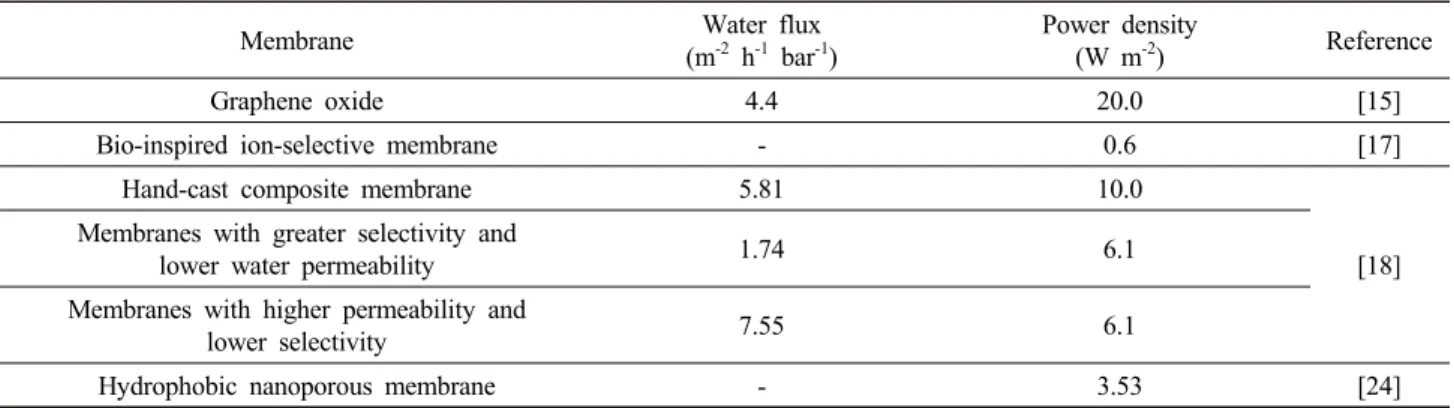
In this review, we discuss several technologies to in- crease the energy efficiency of osmotic heat engine to harvest salinity gradient power, especially about de- salination membranes and their modeling. Fig. 1 shows the schematic diagram of desalination membrane proc- ess using thermal energy. Table 1 represents the sum- mary of desalination membrane used for power generation.
2. Desalination membranes for power generation
To address the problem of the lack of a sufficient semipermeable membrane, Tong et al. synthesized a free-standing membrane consisting of graphene oxide (GO) to generate electricity in an osmotic heat engine [15]. GO dispersions were synthesized through a modi-
Membrane Water flux
(m-2 h-1 bar-1)
Power density
(W m-2) Reference
Graphene oxide 4.4 20.0 [15]
Bio-inspired ion-selective membrane - 0.6 [17]
Hand-cast composite membrane 5.81 10.0
[18]
Membranes with greater selectivity and
lower water permeability 1.74 6.1
Membranes with higher permeability and
lower selectivity 7.55 6.1
Hydrophobic nanoporous membrane - 3.53 [24]
Table 1. Summary of membrane used for power generation in the literature
Fig. 1. Schematic diagram of membrane process for power
generation using thermal energy.
fied Hummer’s method, while a vacuum filtration proc- ess is used to synthesize the free-standing graphene ox- ide membrane (GOMs). They tried to synthesize thin- nest GOM to generate a high water permeability while thickest GOM as to make a sufficient mechanical strength. They determined the membrane thickness us- ing cross-sectional SEM images and analyzed GO chemistry using a K-Alpha X-ray photoelectron spec- trometer system. Fig. 2 shows the XPS and SEM im- ages of GO and free-standing GOM.
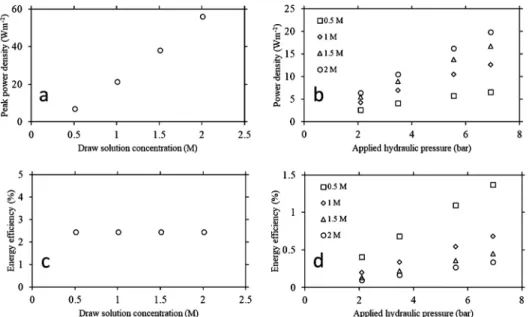
A modified RO test cell was applied to measure the membrane water and salt permeability, using DI water and salt solutions, respectively. In Tong’s study, to de- termine suitable coefficients for PRO, the porous frit was substituted by a porous mesh-type SEPA CF spacer in the RO testing cell. Especially, the salt per- meability coefficient was computed by B=, by measur- ing R (the membrane salt rejection). Fig. 3 shows power density and energy efficiency values of GOM.
The synthesized GOM with 4.4 L/m2 h bar of water permeability coefficient showed high power density (20.0 W/m2) under hydraulic pressure of 6.90 bar and
with 2 M draw solution of ammonium bicarbonate solution. Tong et al. concluded that the free-standing GOM is well qualified to be applied in the osmotic heat engine, but they mentioned that further research on stable GOM with higher burst pressure is needed.
The way to increase energy efficiency is by eliminat- ing the membrane support layer while the internal con- centration polarization is minimized. Ammonium bicar- bonate solution used as the working fluid is an effi- cient way to achieve high power density and the sys- tem energy efficiency increases if the applied hydraulic pressure increases.
Using GOMs in PRO can provide a new way to de- velop salinity gradient power (SGP) technology [16].
Tong et al. synthesized GO sheets and the free-standing GOMs using the same methods mentioned earlier. The free-standing GOMs had a smooth surface, as con- firmed from the SEM images and showed outstanding mechanical strength and average water permeability coefficient. The thinnest free-standing GOM has good stretch resistance and rigidity and stretch resistance (GOM-1 tensile strength 174.5MPa). In general, the
Fig. 2. Characterization of GO and free-standing GOM. (a) Fitting results of C 1s X-ray photoelectron spectroscopy (XPS)
spectra of the GO material, (b) SEM image of GO sheets dispersed on a silicon wafer, (c) surface SEM image of the
free-standing GOM, and (d) cross-sectional SEM image of the free-standing GOM. (Reproduced with permission from Tong
et al., 15, Copyright 2018, American Chemical Society).
water permeability coefficient decreases significantly if the GOM thickness increases. The highest water per- meability coefficient of GOM-1 was calculated by ap- plying RO setup with modified cross flow, 4.27 L/m2 h bar because of the smallest thickness (1.73 mm). To characterize the free-standing GOM, water and salt flux of the GOM-1 was quantified in the FO system.
The higher draw solution concentration, the higher wa- ter permeability coefficient and the higher reverse salt flux were measured. At the same time, lower mem- brane structure parameter was measured, which can re- duce ICP, a main factor cutting down the membrane performance in PRO.
Also, the free-standing GOMs can minimize ICP and increase water flux with high draw solution concentration.
Tong et al. obtained a power density of 24.62 W/m2 at a hydraulic pressure of 6.90 bar using 3 M and 0.017 M of NaCl as a draw and a feed solution, respectively.
This indicates that applying GOMs with higher water flux, superior mechanical strength, and high draw sol- ution concentration can create higher power density, which will serve as the foundation of the PRO for sus-
tainable development.
For development of osmotic electricity, membranes must have features including high ionic flux and highly efficient ion rectification with long-term stability in seawater [17]. Chen et al. showed that bio-inspired ion-selective membranes can be employed for osmotic energy. They fabricated high strength aramid nano- fibers in the presence of boron nitride (BN) nanosheets. BN nanosheets were hydroxylated to have better interaction with Aramid fibers. Different compo- sition of aramid/boron nitride (ABN) nanocomposite membrane are fabricated to check the effect of filler.
Assembled ABN30 membranes show a uniform ar- rangement of BN nanosheets. The presence of hy- droxylated group enhances the hydrophilicity of the composite membrane without affecting the flexibility.
Hydrophilicity of the membrane was checked by con- tact angle measurement. X-ray diffraction (XRD) is used to analyze the structures of the ABN membranes.
It showed self-assembly pattern of BN nanosheets. The intensity and position of diffraction peak of 2D boron nitride nanosheets in ABS are intact.
Fig. 3. Power generation of the GOM. (a) peak power density values of the GOM with different draw solution concen-
trations, (b) power density values of the GOM under different applied hydraulic pressures, (c) energy efficiency values with
different draw solution concentrations when the peak power density is achieved, and (d) energy efficiency values of the
GOM under different applied hydraulic pressures. (Reproduced with permission from Tong et al., 15, Copyright 2018,
American Chemical Society).
The tensile strength of the ABN membrane reached higher, due to the strong interfacial interaction through hydrogen bonds between aramid nanofibers and hy- droxylated surface of BN nanosheets. Additionally, thermal stability of ABN is higher than neat aramid membranes, with a higher decomposition temperature.
The power density of 0.6 W/m2 is obtained from the membranes with wide-ranging temperature (0.0~95°C) and pH (2.8~10.8), which is important for the econom- ic feasibility of osmotic engine.
N. Y. Yip et al. propose the fabrication of thin-film composite membranes to obtain an efficient membrane for PRO [18]. Nonsolvent-induced phase separation of polysulfone (PSf) on poly(ethylene terephthalate) (PET) was utilized to fabricate the thin, porous support layer, and the polyamide active layer was created on top of
the PSf support layers through interfacial polymerization.
The morphology of the membranes is shown in Fig. 4.
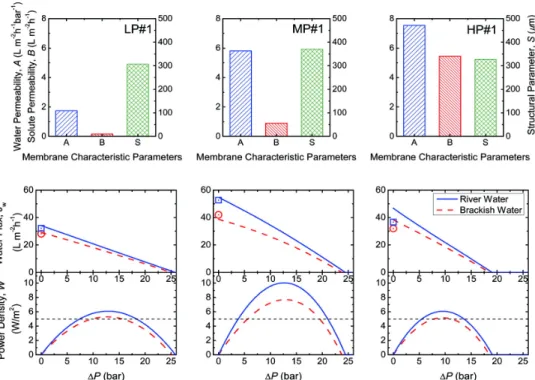
The TFC-PRO membranes performance is related to the interplay between the support layer and the active layer with minimized ICP, low salt permeability and high water permeability. Fig. 5 shows experimentally measured water fluxes for the fabricated membranes, LP#1, MP#1, and HP#1. Yip et al. also suggested the new model to predict the power density by calculating the water flux in PRO, which incorporates external concentration polarization (ECP). They showed that a hand-cast membrane with balanced permeability and selectivity (A = 5.81 L/m2 h bar, B = 0.88 L/m2 h) achieved the highest potential peak power density (10.0 W/m2) from a river water feed solution and seawater draw solution. It is because of the ability of the sup- port layer to prevent the accumulation of leaked salt, an average salt permeability, and the high water per- meability of the active layer. On the other hand, mem- branes with greater selectivity and lower water perme- ability (A= 1.74 L/m2 h bar B=0.16 L/m2 h) showed a lower peak power density (6.1 W/m2), while mem- branes with a higher permeability and lower selectivity (A= 7.55 L/m2 h bar B=5.45 L/m2 h) performed poorly (6.1 W/m2), because of severe reverse salt permeation.
3. Novel salt-form PRO systems
The research to be carried out to obtain osmotic heat engine running is about the appropriate application cir- cumstances, system performance and thermodynamic efficiencies [19]. Therefore, Tong et al. conducted a research on the efficiency of osmotic heat engine sys- tem (with NH4HCO3 solution as the working fluid) and the feasibility to generate electricity from diverse heat sources. It was reported that high energy efficiency (hth) and exergy efficiency (hx) were reached 4.61%
and 17.90% respectively, at lower operating temper- ature (323K) and with high draw solution concentration (2 M) and low feed solution concentration (0.1 M).
Also, an even greater energy return was calculated
Fig. 4. SEM micrographs of thin-film PRO membrane on
PET fabric layer: (A) cross section with a fingerlike mac-
rovoid structure extending across the entire PSf support
layer, (B) magnified view of the polyamide active layer
surface, and (C) magnified view of the skin layer at the
top of the PSf porous support with dense, sponge-like
morphology. The magnified views are representative im-
ages and do not correspond to the actual locations on the
center micrograph. (Reproduced with permission from Yip
et al., 18, Copyright 2011, American Chemical Society).
from the low-grade industrial waste heat (54.7) than a solar thermal energy (1.3-2.2). Low energy return from the solar thermal energy was obtained because the large area of the flat-plate solar collector is needed. It is appropriate to harvest energy from industrial waste, at lower operating temperature and with high draw sol- ution concentration and low feed solution concentration.
The power density and concentration of the draw solution (DS) are important factors to choose an ad- equate draw solute [20]. Gong et al. found the data set that evaluated three inorganic draw solutes, 13 W/m2 for MgCl2, 14 W/m2 for NaCl, and lower power den- sities for MgSO4. It indicates that draw solutes with more diffusive salts achieve higher water flux and in- duce ICP. However, the outstanding draw solute for osmotic engines is depended not just on the solution properties, but on the complex interaction between the
membrane properties and solution properties, which means both the selectivity and diffusivity of the mem- brane affect transport. In conclusion, various membrane is needed to evaluate which draw solute is best sat- isfied for osmotic engine and storage application.
McGinnis et al. investigated using concentrated am- monia-carbon dioxide draw solution in PRO process, an osmotic heat engine, to produce high osmotic pres- sure and make efficient water flux [21]. The internal concentration polarization would be removed, and high membrane water flux and effective mass transport would be obtained by using deionized water working fluid at low temperature, which can let membrane power density be greater than 200 W/m2 and maximum thermal efficiency be 16% of Carnot efficiency.
Furthermore, more effective power generation is possi- ble with the mixture of a highly concentrated NH3/CO2
Fig. 5. Plots of modeled water flux ( J
w), and power density ( W) , (bottom) as a function of applied hydraulic pressure, Δ P , for TFC-PRO LP#1 (left), MP#1 (center), and HP#1 (right) membranes and their respective characteristic parameters (top):
intrinsic water permeability, A ; solute permeability coefficient, B ; and support layer structural parameter, S . Osmotic pressure of synthetic seawater is 26.14 bar, as determined by OLI Stream Analyzer software, and osmotic pressures of synthetic river water and 1,000 ppm TDS brackish water are 0.045 and 0.789 bar, respectively, as calculated using the van’t Hoff equation.
Symbols (open squares and circles) represent measured experimental water fluxes of the membrane with synthetic river water
and brackish water as feed solutions, respectively. All experiments and calculations are done for draw and feed solutions at
25°C. (Reproduced with permission from Yip et al., 18, Copyright 2011, American Chemical Society).
draw solution and a deionized working fluid. In addi- tion, the employment of an ammonia-carbon dioxide osmotic heat engine might be an economically com- petitive because the power production is possible from various energy sources, even from the low temperature heat sources which cannot be used by other heat engines.
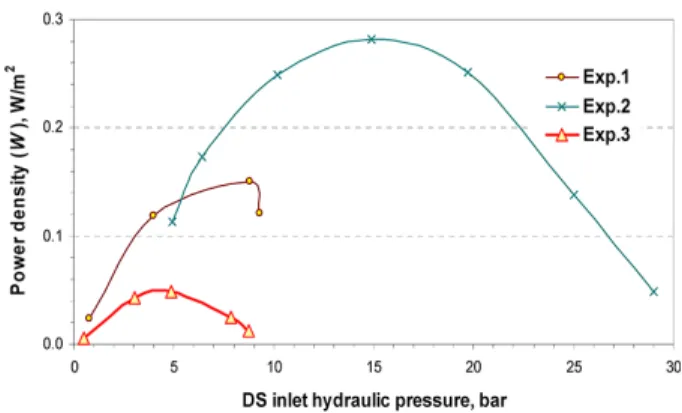
Hydro-osmotic power (HOP) has a high potential of osmotic energy to generate electricity [22]. Fig 6 shows a change in power density as a function of DS inlet hydraulic pressure. By using an appropriate mem- brane and setting more than 25 bar of the osmotic po- tential difference, a cost of £30 M/MWh of clean elec- tricity could be gained, which means that the system permeability and osmotic pressure difference have a critical impact on the productivity of HOP plant.
Furthermore, Sharif et al. investigated different opera- tional conditions for pilot plant. They showed that the membrane system constitutes 50~80% of the HOP plant cost and that research on suitable membranes is needed to increase the feasibility of the process. The higher membrane permeability, the lower the capital cost and the higher the power productivity. In addition, the water permeability is a critical factor to evaluate the HOP process feasibility. The interaction between the properties of the fluid and the membrane properties will have a greatest impact on developing HOP plant technology.
4. Energy production from heat source
The heat-based SGP such as thermal-driven electro- chemical generator (TDEG) have recently received more attention than conventional PRO but the former system is based on the electrochemical reaction. In re- cent study by Luo et al., the concept of a novel sys- tem of waste heat conversion using TDEG is proposed to utilize waste heat, which consists a reverse electro- dialysis (RED) stack and a distillation column [23].
Luo et al. obtained a maximum power density (0.33 W/m2, ionic flux efficiency (88%), and energy effi- ciency (31%) at the optimal condition of LC concen- tration (0.02 M) and flow rate (800 mL/min), by using NH4HCO3 solutions as working fluids. The feasibility of NH4HCO3 made it validated to generate electricity for TDEG, a promising way to produce energy from waste heat.
The existing technologies are not suitable for energy production from heat source of lower grade with dif- ferent heat output and with a small difference of tem- perature between the source and the environment [24].
Straub et al. suggested using thermo-osmotic vapor transport through hydrophobic, nanoporous membranes to create energy from low-grade heat sources. Power densities of 3.53 0.29 W/m2 are obtained in the proc- ess pushing the vapour flux to a hot reservoir (60°C) to a pressurized cold reservoir (13 bar, 20°C) through the membrane. The efficiency of a continuous closed- loop system would be bigger than 50% of the Carnot efficiency. This process has a great merit over other systems because it is possible to generate energy from low and changing source temperatures and low temper- ature differences (less than 40°C). There is a specific limit for working fluid, so water can be used to make it environment friendly. It would be achievable that a lot of energy can be producible from low-grade heat sources by further technical developments (improved pressure resistance of small pore size vapor-gap mem- branes, better heating configurations, new type of working fluids and batch operations, etc.).
Fig. 6. Power density (W) as a function of the DS inlet
hydraulic pressure for different osmotic systems. (Reproduced
with permission from Sharif et al., 22, Copyright 2014,
MDPI).
and membranes has been conducted. In this review, studies on seawater desalination membranes and theo- retical modeling of desalination technologies through efficient membranes were discussed. Membranes in PRO are the crucial parts that determine the energy ef- ficiency of PRO engines. A free-standing GOMs can be applied in PRO process, in that they can minimize ICP and achieve high water flux. Further research on stable GO membranes with higher burst pressure is re- quired to increase power density. Bio-inspired nano- composite membranes and thin-film composite mem- branes are also applied. A hand-cast membrane with balanced permeability and selectivity showed the high- est potential power density when the experiment is conducted with thin-film composite membranes.
Modeling of the process of recovery of waste heat from salinity gradient was discussed with PRO heat engine. It is well-qualified to generate energy from in- dustrial waste at lower operating temperatures and high concentration differences. Draw solute and water per- meability are also the main factors to affect the power density of osmotic heat engines. Draw solutes with more diffusive salts showed to achieve higher water flux and induce ICP. Above all things, the complicated interplay between the membrane properties and sol- ution properties should be significantly considered to select the finest draw solute for osmotic engines. Clean water and energy can be produced from low-grade heat sources by further technical developments of PRO.
Increasing water permeation and reducing reverse salt flux by developing better membranes and draw solutes are required to enhance the PRO performance.
Accordingly, further studies focused on developing new membranes should be continued.
Shon, “Salinity gradient energy generation by pres- sure retarded osmosis: A review”, Desalination, 500, 114841 (2021).
2. B. Anand, R. Shankar, S. Murugavelh, W. Rivera, K. Midhun Prasad, R. Nagarajan, “A review on solar photovoltaic thermal integrated desalination technologies”, Renew. Sustain. Energy Rev., 141, 110787 (2021).
3. M. Qasim, N. A. Darwish, S. Sarp, N. Hilal,
“Water desalination by forward (direct) osmosis phenomenon: A comprehensive review”, Desalination, 374, 47 (2015).
4. A. Yadav, P. K. Labhasetwar, V. K. Shahi,
“Membrane distillation using low-grade energy for desalination: A review”, J. Environ. Chem. Eng., 9, 105818 (2021).
5. A. Ali, R. A. Tufa, F. Macedonio, E. Curcio, E.
Drioli, “Membrane technology in renewable-energy- driven desalination”, Renew. Sustain. Energy Rev., 81, 1 (2018).
6. J. Kim, K. H Lee, J. L. Lim, “Comprehensive Analysis of Major Factors Associated with the Performance of Reverse Osmosis Desalination Plant for Energy-saving”, J. Membr. Sci., 29, 314 (2019).
7. J. Kim, H. J. Park, K. H. Lee, B. Kwon, S. Kwon, J. L. Lim, “Impact Analysis of Water Blending to Reverse Osmosis Desalination Process”, J. Membr.
Sci., 30, 190 (2020).
8. J. Y. Lee, J. W. Rhim, “Identification of Fouling Phenomena and Establishment for Optimized Removal Process of Alginic Acid Sodium Salt Through Capacitive Deionization”, J. Membr. Sci., 30, 342 (2020).
9. N. AlZainati, H. Saleem, A. Altaee, S. J. Zaidi, M.
Mohsen, A. Hawari, G.J. Millar, “Pressure retarded osmosis: Advancement, challenges and potential”,
J. Water Process Eng., 40, 101950 (2021).
10. M. Tawalbeh, A. Al-Othman, N. Abdelwahab, A.
H. Alami, A. G. Olabi, “Recent developments in pressure retarded osmosis for desalination and power generation”, Renew. Sustain. Energy Rev., 138, 110492 (2021).
11. N. Bajraktari, C. Hélix-Nielsen, H. T. Madsen,
“Pressure retarded osmosis from hypersaline sour- ces—A review”, Desalination, 413, 65 (2017).
12. S. Adham, A. Hussain, J. Minier-Matar, A. Janson, R. Sharma, “Membrane applications and oppor- tunities for water management in the oil & gas in- dustry”, Desalination, 440, 2 (2018).
13. N. Ghaffour, S. Soukane, J. G. Lee, Y. Kim, A.
Alpatova, “Membrane distillation hybrids for water production and energy efficiency enhancement: A critical review”, Appl. Energy, 254, 113698 (2019).
14. H. K. Lee, H. T. T. Dao, W. Kang, Y. N. Kwon,
“Review on Changes in Surface Properties and Performance of Polyamide Membranes when Exposed to Acidic Solutions”, J. Membr. Sci., 30, 283 (2020).
15. X. Tong, X. Wang, S. Liu, H. Gao, R. Hao, Y.
Chen, “Low-Grade Waste Heat Recovery via an Osmotic Heat Engine by Using a Freestanding Graphene Oxide Membrane”, ACS Omega, 3, 15501 (2018).
16. X. Tong, X. Wang, S. Liu, H. Gao, C. Xu, J.
Crittenden, Y. Chen, “A freestanding graphene ox- ide membrane for efficiently harvesting salinity gradient power”, Carbon, 138, 410 (2018).
17. C. Chen, D. Liu, L. He, S. Qin, J. Wang, J. M.
Razal, N. A. Kotov, W. Lei, “Bio-inspired Nano- composite Membranes for Osmotic Energy Harvesting”,
Joule, 4, 247 (2020).
18. N. Y. Yip, A. Tiraferri, W. A. Phillip, J. D.
Schiffman, L. A. Hoover, Y. C. Kim, M. Elimelech,
“Thin-film composite pressure retarded osmosis membranes for sustainable power generation from salinity gradients”, Environ. Sci. Technol., 45, 4360 (2011).
19. X. Tong, S. Liu, J. Yan, O. A. Broesicke, Y. Chen, J. Crittenden, “Thermolytic osmotic heat engine for low-grade heat harvesting: Thermodynamic inves- tigation and potential application exploration”, Appl.
Energy, 259, 114192 (2020).
20. H. Gong, D. D. Anastasio, K. Wang, J. R.
McCutcheon, “Finding better draw solutes for os- motic heat engines: Understanding transport of ions during pressure retarded osmosis”, Desalination, 421, 32 (2017).
21. R. L. McGinnis, J. R. McCutcheon, M. Elimelech,
“A novel ammonia-carbon dioxide osmotic heat engine for power generation”, J. Membr. Sci., 305, 13 (2007).
22. A. O. Sharif, A. A. Merdaw, M. Aryafar, P.
Nicoll, “Theoretical and experimental investigations of the potential of osmotic energy for power pro- duction”, Membranes, 4, 447 (2014).
23. X. Luo, X. Cao, Y. Mo, K. Xiao, X. Zhang, P.
Liang, X. Huang, “Power generation by coupling reverse electrodialysis and ammonium bicarbonate:
Implication for recovery of waste heat”, Electrochem.
Commun., 19, 25 (2012).
24. A. P. Straub, N. Y. Yip, S. Lin, J. Lee, M.
Elimelech, “Harvesting low-grade heat energy us- ing thermo-osmotic vapour transport through nano- porous membranes”, Nat. Energy, 1, 16090 (2016).