토양으로부터 새로이 분리된 단백질 분해효소 생산 미생물 Bacillus subtilis FBL-1의 동정
김민아, 시진범, 위영중*
영남대학교식품공학과
Received: November 30, 2015 / Revised: February 15, 2016 / Accepted: March 2, 2016
서 론
단백질분해효소(protease, EC 3.4.21-24)는펩타이드결합 으로이루어진단백질을가수분해하는효소로잘알려져있으 며, 1984년 Masaaki 등에의하여단백질분해효소의활성과 기능에따라 serine protease, thiol protease, metalloprotease 등으로분류되었다[11]. 또한 Kageyama [9]와 Nunokawa 등[12]은 단백질분해효소의 작용 pH 영향에 따라 acid protease, neutral protease, alkaline protease로 분류하였 다. 최근에는단백질분해효소의활성부위에존재하는아미 노산의작용기작에따라 serine protease, metalloprotease, aspartic protease, cysteine protease 등으로구분되고있다 [16].
단백질분해효소는산업화를위하여꾸준히연구되어온
효소중하나이며, 전체효소시장의약 60% 이상을차지하
고있는중요한효소이다. 효소시장에서단백질분해효소는 동물, 식물, 미생물로부터생산이가능하며, 이중에서미생 물유래단백질분해효소의경우단백질분해효소시장의약 40% 이상을점유하고있다. 미생물로부터생산된단백질분 해효소는생화학적인다양성을가지고있을뿐만아니라유 전자조작이간편하며, 생명공학적인활용가능성등다양한 장점을지니고있다[4]. 또한, 효소분리정제후의가공측면 에서도동물유래나식물유래단백질분해효소에비하여미 생물유래단백질분해효소가훨씬용이하기때문에훌륭한 단백질분해효소의공급원으로각광받고있다[6].
단백질분해효소는세제산업, 제약산업, 피혁산업, 식품산 업, 환경, 토양활성개량, 화장품산업, 사료산업, X-ray 필 름제조등매우다양한산업에서응용되고있다[2, 8, 13, 18].
현대산업이발달함에따라환경오염은항상사회적인문제 로대두되어왔으며, 그중생활하수의비율이날로증가하 고있어세제에의한환경오염이심각한문제로대두되고있 Identification of a Newly Isolated Protease-producing Bacterium, Bacillus subtilis FBL-1, from Soil
Mina Kim, Jin-Beom Si, and Young-Jung Wee*
Department of Food Science and Technology, Yeungnam University, Gyeongsan 38541, Republic of Korea
A novel proteolytic bacterium was isolated from soil at Yeungnam University, South Korea. The strain, named FBL-1, was rod-shaped with a smooth surface. Biolog and API 50CHB test results revealed that strain FBL-1 was a Bacillus species. Based on 16S rDNA sequencing and chemotaxonomic characterization, the strain was identified as Bacillus subtilis because it had the highest homology with Bacillus subtilis subsp. subtilis NCIB 3610(99.5%). In liquid culture at 37°C with shaking at 200 rpm, fructose and yeast extract were found to be the best carbon and nitrogen sources, respectively, for cell growth and protease production. The highest protease activity (451.640 U/ml) was obtained when the strain was cultured in medium containing 20 g/l of fructose and 5 g/l of yeast extract. Although further studies are needed to char- acterize the protease and enhance its activity, the newly isolated protein-degrading B. subtilis FBL-1 can be applicable for the production of peptides and for the degradation of proteins in various industries.
Keywords: Bacillus subtilis, identification, isolation, protease, soil bacterium
*Corresponding author
Tel: +82-53-810-2951, Fax: +82-53-810-4662 E-mail: [email protected]
© 2016, The Korean Society for Microbiology and Biotechnology
으므로단백질분해효소를함유한생분해성세제에대한연 구가꾸준히이뤄지고있다[15]. Alkaline protease는높은 pH 조건의세제내에서도그활성을나타내므로세제의첨 가제로매우용이하게사용된다. 미생물유래단백질분해효 소는산성이나중성조건에서비교적높은활성을나타내는 경우가많으나넓은 pH 영역에서활성을유지할수있는단 백질분해효소가효소의활용성측면에서더유리할것이다 [1, 7, 15].
본연구에서는토양으로부터단백질분해효소를생산하는 미생물을새로이분리하여동정함으로써, 새로운단백질분 해효소공급원을확보하고자하였다. 그결과, 단백질을효
과적으로분해할수있는활성을가진균주 FBL-1을토양으
로부터분리하였으며, 본논문에서는 FBL-1 균주의동정및 특성에대하여서술하였다.
재료 및 방법
Protease 생산 미생물의 분리
토양에서식하는 protease 생산미생물을분리하기위하
여경상북도경산시소재영남대학교내의토양을채취하여 멸균식염수(0.85% NaCl) 9 ml에현탁한후, 10-5−10-7으로 희석하여 분리용 평판고체배지(TSB 3.0 g/l, skim milk 2.0 g/l, agar 2.0 g/l)에도말하였다. 도말한평판고체배지는
37°C에서 24시간동안배양한후미생물집락의크기가크
면서 skim milk를 분해하여 집락 주변으로 투명환(clear zone)을강하게형성한 colony를선별하였다. 선별한 colony 는다시분리용평판고체배지에옮겨배양한후, 본연구에
서 사용한 미생물 증식용 전배양 배지인 TSB (BactoTM
Tryptic Soy Broth Soybean-Casein Digest Medium) 배지 에접종하여 37°C에서 200 rpm으로 24시간동안진탕배양 하였다. 배양액을원심분리하여얻은상층액으로부터 protease 활성을측정하고활성이가장우수한균주를최종분리하였다. 형태학적 및 배양학적 특성
분리균주의형태학적특성은전계방사형주사전자현미경 (SEM, Scanning Electron Microscope, S-4100, Hitachi Co., Japan)으로관찰하였다. 액체배지에배양한균체현탁 액을원심분리하여균을침전시켜충분한양이될때까지모 은후, 2.5% glutaraldehyde와 1% osmium tetroxide로고 정하여 ethanol로탈수시키고임계점건조기(Critical Point Dryer, HCP-2, Hitachi Co., Japan)로건조한후, 정밀에칭 코팅기(Precision Etching Coating System, Gatan 682, USA)로코팅한후관찰하였다.
분리 균주의 배양학적 특성을 조사하기 위하여 TSB와 skim milk를포함한평판고체배지에서생육한 colony의색
깔, 크기, 모양등의특성을조사하였다. 생리학적 특성
탄소원이용성및발효특성등분리균주의생리학적특 성은 Biolog test와 API 50CHB kit (Biomerieux, France) 를통하여제조사의지침에따라수행하였으며, API 50CHB kit test 결과는 API 50CHB database V4.0을이용하여동 정하였다.
16S rDNA 염기서열 및 계통 분석
분리 미생물을 TSB 배지에 24시간 동안 진탕배양 후
15,000 rpm에서 10분간원심분리하여균체를회수하였다. 회수된 균체의 genomic DNA를 Wizard genomic DNA purification kit (Promega Co., WI, USA)를사용하여추출
및 분리하여 PCR 주형으로 사용하였다. 16S rDNA는
universal primer인 27F (5'-AGA GTT TGA TCC TGG CTC AG-3') 및 1492R (5'-GGC TAC CTT GTT ACG ACT T-3')을 사용하여 증폭하였다. 증폭된 16S rDNA 단편은 Wizard SV Gel 및 PCR clean-up system (Promega Co.)을이 용하여정제한후, ABI PRISM 377 DNA analyzer (Applied Biosystems, CA, USA)를이용하여분석하였다. 16S rDNA 염기서열분석은오차의가능성을배제하기위하여 3회반 복실시하였다. 분석된 16S rDNA 염기서열은 NCBI (National Center for Biotechnology Information)의 BlastN program의 GeneBank database의정보로부터균주염기서열의상동성 을 확인하였다. 또한 EzTaxon database (http://www.
ezbiocloud.net/)로부터표준균주의 16S rDNA 염기서열들을 조사하여계통발생적연관성을분석하였다[10]. 수집된염기 서열들 간의 Multiple alignment는 Clustal X (2.0) software를사용하였고 BioEdit software (7.0)를사용하여 편집하였다. Mega (5.03) software를 이용하여 neighbor- joining method, maximum likelihood method, maximum
parsimony method에 의해 염기서열간의 유전적 거리와
phylogenetic tree를 얻었다. 신뢰도(bootstrap value)는 1,000회의재구성된자료로부터새로운 tree를작성하여계 산하였다.
Protease 생산을 위한 배양방법
전배양배지로서 TSB를이용하여 37°C, 200 rpm에서 15시간배양한후본배양의접종균으로이용하였다. 균주보 관은전배양배지에서 37°C, 200 rpm으로 15시간배양한후 2 ml micro-cap tube에 glycerol 0.7 ml와배양액 0.7 ml를 혼합하여 -20°C에서보관하였다.
분리미생물의 protease 생산에탄소원이미치는영향을
알아보기위하여탄소원 20 g/l, 질소원 5 g/l로배지를조성
하여배양하였다. 탄소원은 glucose, maltose, xylose, starch, fructose, glycerol, galactose, sucrose, lactose 총 9가지 종 류를 각각 이용하였고 질소원은 beef extract로 고정하고 250 ml 삼각플라스크에서 100 ml 조업부피로 37°C, 200 rpm, 24시간동안진탕배양하였다.
분리미생물의 protease 생산에질소원이미치는영향을
알아보기위하여탄소원 20 g/l, 질소원 5 g/l로배지를조성 하여배양하였다. 탄소원은 fructose로고정하고질소원은 beef extract, yeast extract, malt extract, tryptone, peptone, urea, ammonium sulfate, ammonium chloride, corn steep liquor 총 9가지종류를각각이용하여 250 ml 삼각플라스 크에서 100 ml 조업부피로 37°C, 200 rpm, 24시간동안진 탕배양하였다.
미생물 성장 분석
배양액의광학밀도가 0.7 이하로되도록희석하여분광광 도계(UV-1201, Shimadzu Co., Japan)를사용하여 660 nm 에서광학밀도(optical density)를측정한후, 표준곡선에의 한광학밀도와건조균체량(g/l)의관계식으로부터건조균체 량(g/l)을산출하였다. 광학밀도와건조균체량(g/l)의관계
식을얻기위하여전배양 배지에분리된 균주를 37°C에서
24시간배양한후, 그배양액과증류수의비율을 0.0에서 1.0 까지의 용액으로 제조하여 각각 광학밀도를 측정하였다. Bench-top centrifuge (VS-15000N, Vision Scientific Co., Korea)를사용하여 13,000 × g에서 10분동안원심분리한후
상층액을버리고가라앉은균체를항량이될때까지 80°C
에서 24시간 동안 건조기(VS-1202D3, Vision Scientific Co., Korea)에서건조하고그무게를측정하였다.
Protease 활성 분석
50 mM glycine-NaOH buffer (pH 9.0)에 casein (Sigma
Aldrich Co., USA)을녹인 1% (w/v) casein 용액 500 µl에 배양액을 13,000 × g에서 10분원심분리하여얻은조효소액 20 µl를첨가하여 40°C에서 10분간반응시킨후, 반응정지 를위해 10% trichloroacetic acid를 500µl 첨가하였다. 분
해되지않은단백질을제거하기위하여 12,000 rpm에서
10분간원심분리하여얻은상층액을다시동일조건에서원 심분리하였으며, 이후얻은상층액을반응물로사용하였다. 반응물은 Folin & Ciocalteu 방법을이용하여 protease 활 성을분석하였다. 반응물 500 µl를 500 mM Na2CO3 25 ml 와충분히혼합한후, Folin & Ciocalteu's Phenol Reagent (Sigma Aldrich Co.)를 20%로희석한 용액 500 µl를넣고 40°C에서 10분간반응시켜 660 nm에서측정한흡광도를 U/
ml로산출하였다[3, 5]. Protease 활성 1 unit은반응시간 1분동안 1 µg의 tyrosine을생성하는효소의양으로정의 하였다[13, 17].
통계 처리
모든실험은 3회반복으로수행하여평균값과표준편자로 나타내었고, 유의성은 SPSS 23.0 software (SPSS Inc., IL, USA)를이용하여유의수준 p < 0.05에서분산분석을통하여 검증하였으며, Duncan’s multiple range test를통하여차이 를확인하였다.
결과 및 고찰
형태학적, 배양학적 및 생리학적 특성
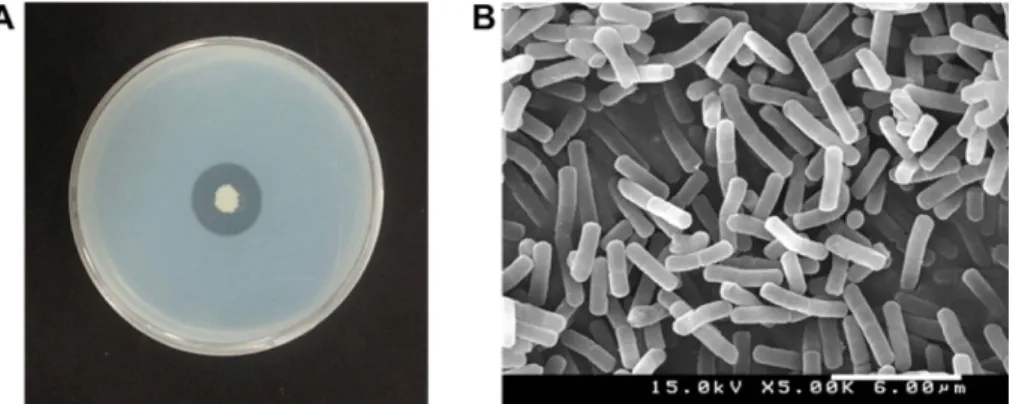
경상북도경산시에위치한영남대학교내토양에서식하 는 protease 생산미생물한종을선발하여 FBL-1으로명명 하여실험을진행하였다. 균주 FBL-1은 skim milk를포함
한 TSB 고체배지에서하얀색을띄며약간울퉁불퉁한표면
을갖는 colony를형성하였고(Fig. 1A), 평판고체배지상에
Fig. 1. Isolation of proteolytic bacterial strain FBL-1. (A) Proteolytic activity of the strain on agar plate. The strain was cultured on TSB agar plate containing skim milk at 37°C for 24 h. (B) Scanning electron microscopy (SEM) analysis. Cells were fixed with 2.5% glu- taraldehyde and 1% osmium tetroxide, dehydrated with a series of ethanol concentrations in distilled water (50−100%), dried with crit- ical point dryer, and coated with gold.
Table 1. Biolog test results of strain FBL-1. ---+-+---+-- Waterα- Cyclodextrinβ- CyclodextrinDextrinGlycogenInulinMannanTween 40Tween 80N-Acetyl-D- glucosamineN-Acetyl-β-D- mannosamineAmygdalin ----+-----+- L- ArabinoseD- ArabitolArbutinD- CellobioseD- FructoseL- FucoseD- GalactoseD-galac- turonic acidGentiobioseD- gluconic acidα-D- Glucosem-Inositol ---+-+---- α-D- LactoseLactuloseMaltoseMaltotrioseD- MannitolD- MannoseD- MelezitoseD- Melibioseα-Methyl-D- galactosideβ-Methyl-D- galactoside3-Methyl glucoseα-Methyl- D-glucoside +-++--+----+ β-Methyl-D- glucosideα-Methyl-D- mannosidePalatinoseD- PsicoseD- RaffinoseL- RhamnoseD- RiboseSalicinSedoheptu- losanD- SorbitolStachyoseSucrose -+--- D- TagatoseD- TrehaloseTuranoseXylitolD- XyloseAcetic acidα-Hydroxy- butyric acidβ-Hydroxy- butyric acidγ-Hydroxy- butyric acidp-Hydroxy- phenyl acetic acid
α-Keto glutaric acidα-Keto valeric acid ----+---+--- LactamideD-lactic acid methyl esterL- Lactic acidD- Malic acidL- Malic acidPyruvic acid methyl esterSuccinic acid mono- methyl Ester
Propionic acidPyruvic acidSuccinamic acidSuccinic acidN-Acetyl-L- glutamic acid ---+-+-+---- L- AlaninamideD- AlanineL- AlanineL-Alanyl- glycineL- AsparagineL- Glutamic acidGlycyl-L- glutamic acidL- Pyroglutamic acid
L-SerinePutrescine2,3- ButanediolGlycerol --+++-+--- Adenosine2'-Deoxy ade- nosineInosineThymidineUridineAdenosine-5'- mono phosphate
Thymidine-5'- mono phosphate Uridine-5'- mono phosphate D-Fructose-6- phosphateα-D-Glucose- 1-phosphateD-Glucose- 6- phosphateD-L-α- Glycerol phosphate
서투명환을크게생성하여강한단백질분해활성을나타냈 다. 주사전자현미경(SEM)으로관찰한결과, FBL-1 균주는 긴막대모양의단일세포이며약 3 μm 길이의간균형태를 나타냈다(Fig. 1B).
균주 FBL-1의표현형질에 대한 1차적인 동정을위하여
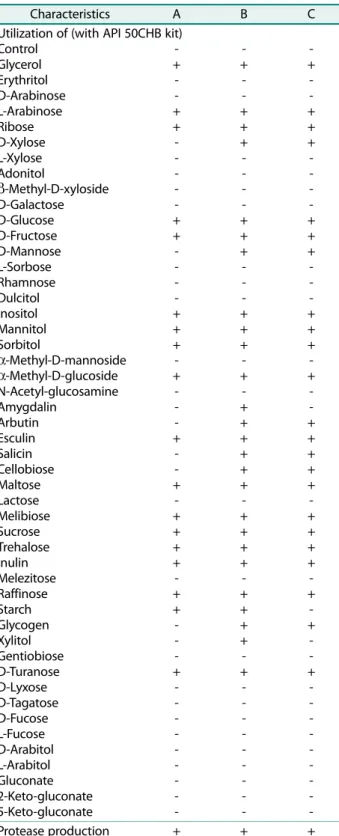
Biolog test와 API 50CHB test를수행하였으며그결과를 각각 Table 1과 Table 2에나타냈다. Biolog test를사용한 생리학적 특성 분석 결과, dextrin, inulin, N-acetyl-D- glucosamine, D-fructose, α-D-glucose, maltotriose, D- mannose, β-methyl-D-glucoside, palatinose, D-psicose, D-ribose, sucrose, D-trehalose, L-malic acid, pyruvic acid, L-alanyl-glycine, L-glutamic acid, L-pyroglutamic acid, inosine, thymidine, uridine, thymidine-5'-mono phosphate에대한 assimilation 반응에서양성으로관찰되 었다. API 50CHB kit를사용한생리학적특성 분석결과, Table 2에서 보는 바와 같이 FBL-1 균주는 glycerol, L- arabinose, ribose, galactose, glucose, fructose, inositol, mannitol, sorbitol, α-methyl-D-glucoside, N-acetyl-glucosamine, maltose, melibiose, sucrose, trehalose, inulin, raffinose, starch, D-turanose에대한 assimilation 반응에서양성으로 관찰되었으며, esculin hydrolysis (β-glucosidase) 효소반응 에서양성을보였다. 비교균주인 B. subtilis subsp. subtilis NCIB 3610의 경우 glycerol, L-arabinose, ribose, D- xylose, glucose, fructose, mannose, inositol, mannitol, sorbitol, α-methyl-D-glucoside, amygdalin, arbutin, esculin, salicin, cellobiose, maltose, melibiose, sucrose, trehalose, inulin, raffinose, starch, glycogen, xylitol, D-turanose에 대하여양성으로반응하였으며, B. subtilis DSM 347의경 우 glycerol, L-arabinose, ribose, D-xylose, glucose, fructose, mannose, inositol, mannitol, sorbitol, α-methyl-D-glucoside, arbutin, esculin, salicin, cellobiose, maltose, melibiose, sucrose, trehalose, inulin, raffinose, glycogen, xylitol, D- turanose에대하여양성반응을나타냈다[14]. Table 2에서 보는 바와 같이 protease 생산에 대해서는 FBL-1, B.
subtilis subsp. subtilis NCIB 3610, B. subtilis DSM 347 모두양성임을알수있었다. Biolog test 결과와 API 50CHB test 결과를바탕으로 API 50CHB database V4.0을이용하 여동정한결과, 균주 FBL-1은 Bacillus megaterium과 73%, B. subtilis와 22.9% 특성이유사한것으로판정되었으나보
다더정확한동정을위해서는 16S rDNA 염기서열분석을
통한비교가필요할것으로판단되었다. 계통발생학적 특성
균주 FBL-1의 16S rDNA 염기서열을분석하여 NCBI의
BlastN program으로다른미생물들과의상동성을조사한
Table 2. Phenotypic diversity of strain FBL-1 and related strains of Bacillus subtilisa.
Characteristics A B C
Utilization of (with API 50CHB kit)
Control - - -
Glycerol + + +
Erythritol - - -
D-Arabinose - - -
L-Arabinose + + +
Ribose + + +
D-Xylose - + +
L-Xylose - - -
Adonitol - - -
β-Methyl-D-xyloside - - -
D-Galactose - - -
D-Glucose + + +
D-Fructose + + +
D-Mannose - + +
L-Sorbose - - -
Rhamnose - - -
Dulcitol - - -
Inositol + + +
Mannitol + + +
Sorbitol + + +
α-Methyl-D-mannoside - - -
α-Methyl-D-glucoside + + +
N-Acetyl-glucosamine - - -
Amygdalin - + -
Arbutin - + +
Esculin + + +
Salicin - + +
Cellobiose - + +
Maltose + + +
Lactose - - -
Melibiose + + +
Sucrose + + +
Trehalose + + +
Inulin + + +
Melezitose - - -
Raffinose + + +
Starch + + -
Glycogen - + +
Xylitol - + -
Gentiobiose - - -
D-Turanose + + +
D-Lyxose - - -
D-Tagatose - - -
D-Fucose - - -
L-Fucose - - -
D-Arabitol - - -
L-Arabitol - - -
Gluconate - - -
2-Keto-gluconate - - -
5-Keto-gluconate - - -
Protease production + + +
aStrains: A, strain FBL-1; B, B. subtilis subsp. subtilis NCIB 3610; C, B. susbtilis DSM 347. Data were obtained from Oguntoyinbo et al. [14].
+, Positive; -, negative.
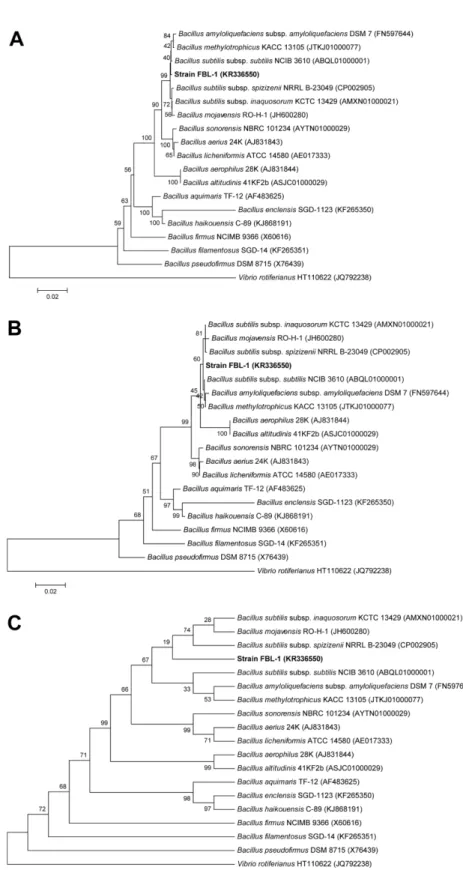
Fig. 2. Phylogenetic tree based on 16S rDNA sequences showing the evolutionary relationship between strain FBL-1 and other related taxa. Trees were constructed by the (A) neighbor-joining method, (B) maximum likelihood method, and (C) maximum parsi- mony method, respectively. Vibrio rotiferianus (JQ792238) was used as an outgroup in the trees. Numbers at nodes are bootstrap values expressed as percentages of 1,000 replications. GeneBank accession numbers of the sequences are indicated in parentheses. Bar indi- cates 2 substitutions per 100 nucleotides.
결과, Bacillus 속미생물들과높은상동성을보였다. Table 3에서보는바와같이 FBL-1 균주의 16S rDNA 염기서열은 B. subtilis subsp. subtilis NCIB 3610 (99.5%), B.
subtilis subsp. inaquosorum KCTC 13429 (99.4%), B.
subtilis subsp. spizizenii NRRL B-23049 (99.3%), B.
methylotrophicus KACC 13105 (99.3%) 등 Bacillus 속균 주들과 높은 상동성을 나타냈다. 이 결과를 바탕으로 Neighbor-Joining 법, Maximum likelihood 법, Maximum parsimony 법으로각각계통도를작성하여그결과를 Fig.
2에나타냈다. 계통발생학적관계를바탕으로균주 FBL-1을 B. subtilis FBL-1으로최종명명하였고, 그 16S rDNA 염기 서열은 GeneBank에 KR336550으로등록하였다.
탄소원 종류에 따른 균체 성장 및 protease 활성 비교 B. subtilis FBL-1의발효가진행되는동안 protease의생 산에가장큰영향을미치고, 보다높은수준의 protease를 생산할수있는탄소원을알아보기위하여총 9가지의탄소 원종류에따른 protease 활성과건조균체량을비교하였다.
Fig. 3에서보는바와같이건조균체량은탄소원을첨가하지
않은경우를제외하고모두높은결과를보였으나, protease
활성은특정탄소원에서만높게나타났다. Fructose를탄소 원으로첨가한경우의 protease 활성이 201.436 U/ml로가 장우수한결과를보였으며, 그다음으로 maltose 117.681
U/ml, sucrose 90.116 U/ml, glucose 36.046 U/ml 등의 protease 활성을나타내었다. 균체성장의경우 glucose를탄 소원으로사용한경우건조균체량이 2.065 g/l로가장높게 나타났으나 protease 활성은 36.046 U/ml로서상대적으로 낮은결과가관찰되었다. 반면, fructose를탄소원으로사용 한경우건조균체량은 1.580 g/l로실험에사용한탄소원들 중중간정도의균체성장을보였으나 protease 활성은가장 높은값을나타냈다. 탄소원을첨가하지않은경우에도건조 균체량은 0.689 g/l까지증가하였는데, 이는 복합질소원인
beef extract에 포함된 영양원에 의한 것으로 생각되나
protease 활성은전혀검출되지않았다. 이실험의결과로부 터 B. subtilis FBL-1을 이용한 protease 생산에 있어서 fructose가가장우수한탄소원임을알수있었다. 탄소원을 포함하지않고 beef extract 5 g/l 만을포함한배지의경우 protease 활성을전혀보이지않았으나, 탄소원을포함한모 든배지에서효소활성이 나타나는것으로 보아탄소원이
protease 생산에중요한영향을미친다는사실을알수있
었다.
질소원 종류에 따른 균체 성장 및 protease 활성 비교 B. subtilis FBL-1의 protease 생산과균체성장에적합한
질소원을알아보기위하여질소원종류에따른 protease 활
성과건조균체량을비교하였다. Fig. 4에서보는바와같이 Table 3. Similarity index of strain FBL-1 compared with related taxa.
Strain Accession number Similarity (%) Nucleotide
differences /compared
Bacillus subtilis subsp. subtilis NCIB 3610T ABQL01000001 99.5 8/1477
Bacillus subtilis subsp. inaquosorum KCTC 13429T AMXN01000021 99.4 9/1477
Bacillus subtilis subsp. spizizenii NRRL B-23049T CP002905 99.3 11/1477
Bacillus methylotrophicus KACC 13105T JTKJ01000077 99.3 11/1477
Bacillus mojavensis RO-H-1T JH600280 99.1 14/1477
Bacillus amyloliquefaciens subsp. amyloliquefaciens DSM 7T FN597644 98.9 16/1477
Bacillus licheniformis ATCC 14580T AE017333 98.0 30/1476
Bacillus aerius 24KT AJ831843 97.8 32/1465
Bacillus sonorensis NBRC 101234T AYTN01000016 97.8 33/1476
Bacillus altitudinis 41KF2bT ASJC01000029 96.9 46/1476
Bacillus aerophilus 28KT AJ831844 96.8 47/1475
Bacillus aquimaris TF-12T AF483625 95.9 60/1456
Bacillus haikouensis C-89T KJ868191 95.6 64/1456
Bacillus firmus NCIMB 9366T X60616 94.9 73/1419
Bacillus pseudofirmus DSM 8715T X76439 94.0 87/1456
Bacillus filamentosus SGD-14T KF265351 93.6 90/1399
Bacillus enclensis SGD-1123T KF265350 91.1 122/1375
T, type strain
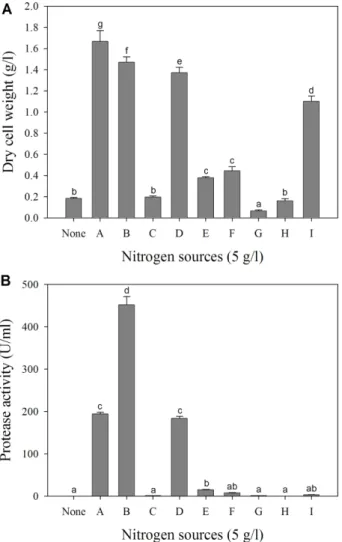
질소원이포함되지않은배지에서는전혀 protease 활성을
나타내지않았기때문에질소원또한탄소원과함께 protease
생산에중요한인자임을알수있다. Protease 생산에가장 우수한영향을미치는질소원으로는 yeast extract (451.640 U/ml)로확인되었으며, 그다음으로는 beef extract (194.014 U/ml)와 tryptone (183.414 U/ml)을사용한경우에서비교 적높은활성을보였다. 대부분의유기질소원의경우에는 protease 활성이높게나타났으나, malt extract 및 peptone 의 경우는 다른 유기 질소원에 비하여 상대적으로 낮은 protease 활성과 균체 성장을 보였다. 또한, ammonium
sulfate, ammonium chloride, urea와같은 무기 질소원을 사용한경우 protease 활성이매우낮게나타났다. 균체성 장의경우 beef extract를질소원으로사용한경우건조균체 량이 1.668 g/l로 가장 높게 나타났으나 protease 활성은 194.014 U/ml로서상대적으로낮은결과가관찰되었다. 반 면, yeast extract를질소원으로사용한경우건조균체량은 1.471 g/l로 beef extract를사용한경우보다는다소낮은값 을보였으나 protease 활성은 yeast extract를사용한경우 에비하여 2배이상높은결과를보였다. 따라서 B. subtilis Fig. 3. Effect of carbon sources on (A) cell growth and (B) pro-
tease production in liquid culture. B. subtilis FBL-1 was cultured in the medium containing 20 g/l of each carbon source and 5 g/
l of beef extract with shaking at 37°C for 24 h. Means with differ- ent letters (a-g) are significantly different (p < 0.05) according to Duncan’s multiple range test, and the bars indicate the standard deviation of three replicates experimented. A, glucose; B, malt- ose; C, xylose; D, starch; E, fructose; F, glycerol; G, galactose; H, sucrose; I, lactose.
Fig. 4. Effect of nitrogen sources on (A) cell growth and (B) protease production in liquid culture. B. subtilis FBL-1 was cul- tured in the medium containing 20 g/l of fructose and 5 g/l of each nitrogen source with shaking at 37°C for 24 h. Means with different letters (a-g) are significantly different (p < 0.05) accord- ing to Duncan’s multiple range test, and the bars indicate the standard deviation of three replicates experimented. A, beef extract; B, yeast extract; C, malt extract; D, tryptone; E, peptone;
F, urea; G, ammonium sulfate; H, ammonium chloride; I, corn steep liquor.