† 책임저자: 정회원, 버밍엄대학교 E-mail : [email protected]
TEL : (021)472-3193 FAX : (021)414-4160
* 비회원, 버밍엄대학교, 토목공학과 교수
철도차량의 개발 및 운용을 위한 RAMS 관리 시스템 개발
Development of a framework for engineering RAMS into rolling stock
through life cycle in the operator perspective
박문규† 안민*
Mun-Gyu Park Min-An
ABSTRACT
RAMS is becoming increasingly important in the decision making process for the rolling stock projects in order to improve competitiveness by reducing system life cycle cost while improving reliability, availability, maintainability and safety. In order to apply and manage RAMS of rolling stock systems effectively in the operator perspective, it is essential to integrate and control RAMS systematically from the early stage of rolling stock projects. RAMS management is to implement a RAMS system into rolling stock projects in terms of a rolling stock operator, which presents the strategic directions of RAMS policy, objectives, requirements, control, analysis, measurement and improvement throughout life cycle of rolling stock projects.
This article presents a new framework of RAMS management that provides an effective and efficient way for managing RAMS in rolling stock systems in the railway industry.
Keyword: RAMS (reliability, availability, maintainability and safety), rolling stock, RAMS management, life cycle cost, rolling stock projector and operator.
1. Introduction
Today, the main concerns of operators in the development of a rolling stock focus on the increase of speed, reliability (RAMS), and capability of rolling stock. RAMS is becoming a key decision factor in rolling stock projects because it affects the product process and life cycle cost, (BS EN 60300-1, 2003). Particularly, maintenance and its related cost may be from 60% to 75 % of the total life cycle cost of that system and it can be reduced by the application of system RAMS from the concept of the project of system, (Blanchard, et.al, 1994). To reduce these range, rolling stock RAMS has been required increasingly by the operators in the recent projects of rolling stock, but they have undergone much trial and errors. The operators have not laid out the actual RAMS requirements appropriate to the system to be developed, and they have passively performed the demonstration of their RAMS requirements, (Cha, et.al, 2008).
To apply and manage RAMS into rolling stock effectively in the operator perspective during the system life cycle, it is essential to direct and control RAMS activities systematically from the initial stage of the project to system disposal. However, the application of RAMS to rolling stock has usually been a responsibility of the rolling stock supplier because of the complexity of the system and RAMS techniques. Without the strong leading role of the operator, it may be excessive to expect an optimal RAMS achievement in the rolling stock project. At the very least, it should be a collaborated challenge of both the operator and the supplier of
the rolling stock. In that respect, rolling stock operators should need a strategic approach to managing all RAMS activities, (BS ISO 9000, 2005; BS EN 60300-1, 2003).
For this, the rolling stock operator should build an inclusive framework which can manage all RAMS activities during the life cycle of the system: the strategic direction of RAMS policy and its objectives; the development of the RAMS requirements/targets; the control of the RAMS requirements; the implementation of verification and validation; and their continual improvement. This also indicates a clear focus on RAMS management to be performed during the life cycle, (BS EN 60300-2, 2004).
This article discusses a fundamental methodology to systematically define rolling stock RAMS in the perspective of the rolling stock operator, and specifies a framework model for RAMS management of rolling stock. With this view, this article specifies essential concepts for the definition of rolling stock RAMS where a rolling stock operator organization needs to direct and control RAMS systematically, and provides a framework model and process which considers both the effectiveness and efficiency of the RAMS activities.
For the purposes of this article, the following definitions apply: (1) system defines as a set of interrelated or interacting assembly (subsystems and components) which performs specified functionality: (2) product describes as the results of a process, meaning that a system transforms inputs into outputs: (3) item is the generic term for any part, device, subsystem, functional unit, equipment or system that is individually regarded, (BS 13306, 2001, BS EN 50126-1, 1999; BS ISO 9000, 2005).
2. Rolling stock RAMS
2.1 Definition of System RAMS
Technique of Reliability, availability, maintainability and safety (RAMS) was established in 1980s, but it originated from reliability engineering in the industrial age. Reliability engineering as an international standard has been used since 1970s. After that, the increasing concern about maintainability was integrated with reliability as another engineering. Finally, reliability and maintainability engineering were integrated by the concept of dependability in the early 1980s. RAMS, as a combined engineering of dependability and safety, has mainly been adopted by the safety and mission critical industries, (e.g. aerospace, defense, transportation, etc), and in the railway industries it has been applied from the European Union since 1999 and was adopted as an international standard in 2002, (Villemeur, 1992; BS EN 50126-1, 1999, IEC 62278, 2002).
System RAMS is defined as the ability that a system can perform for its intended objectives when needed, availably and safely. A system generally has a set of system properties, including RAMS property, as shown at Figure 3.1, which are intentionally assigned, selected or designed into the system to achieve the planned objectives of the system. These properties are important factors in designing the functions needed to perform the specific tasks of the system. A system property has a set of the particular features or characteristics inherent in the system. RAMS property can generally have the four characteristics depending on the system objectives: reliability, availability, maintainability and safety as in Figure 3.1, (BS EN 62347, 2007; BS EN 60300-1, 2003).
2.1.1 Principle for rolling stock RAMS
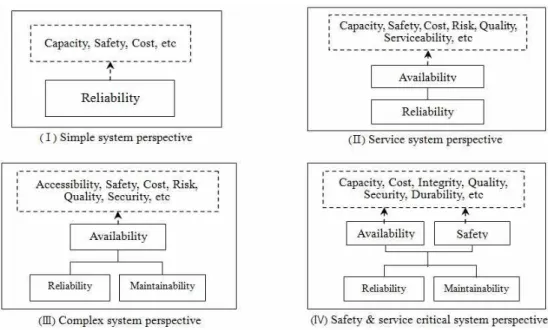
System RAMS can be defined by the four performance characteristics (i.e. reliability, availability, maintainability and safety) and the contributory performance characteristics (e.g. integrity, security, cost, etc) that define the success of the system as depicted at Figure 2.1. It is, in a way, a unique engineering concept in which many contributors can address the business objectives and its independent performance characteristic in that it has the core performance characteristics of the technical discipline. The system RAMS and contributory performance characteristics can be selected variously by the system operator depending on the risk
of the system, the intended system objectives and one or more major contributors in the business perspective as illustrated at Figure 2.2. The aim of the railway RAMS standard (EN 50126-1, 1999) is the quality of service that is a major contributor of railway RAMS. Rolling stock also takes a role as part of railway, (IEC TC56 WG3, 2009).
Figure 2.1 Example of RAMS characteristics and contributories
Figure 2.2 Example of the application of RAMS and contributory performance characteristics
2.1.2 Railway and Rolling Stock RAMS
Railway RAMS (BS EN 50126-1, 1999) was developed for a common understanding and a consistent approach for railway RAMS of all concerned when RAMS is applied to a railway system. It is comprised of four core performance characteristics and three contributory performance characteristics such as quality, performance and safety in the system level. Railway RAMS assumes the business perspective and the particular life cycle cost of railway systems. So it is a main aim to achieve an optimal combination of RAMS characteristics and cost in the RAMS strategy. Railway RAMS, as its title, is to develop and specify the appropriate railway RAMS requirements, and effectively demonstrate the railway RAMS requirements, but it needs expanded RAMS notion for the vertical separation of operation and maintenance.
Railway systems (e.g. track, signaling and rolling stock) may define a variety of RAMS framework under the designed objectives and characteristics of the systems and the given environments. There are many types
of rolling stocks depending on their business objectives and operational conditions, and a rolling stock has many kinds of systems, subsystems and components by means of the designed individual functional tasks.
They can each apply different RAMS frameworks as in Figure 2.2 in the above mentioned perspective. Thus, rolling stock RAMS should be considered in the aspect of a bridge role between system functional performance and the business perspective, and also take an umbrella role which prevents the problems which rolling stock systems can have during the system life cycle, (BS 50126-1, 1999; IEC TC56 WG3, 2009).
Once more, RAMS for Rolling stock should consider the dynamic characteristic arisen from the guided constant movement of the wheel through a metal to metal contact on the rail track. This dynamic characteristic may have a great influence on the system functions. The fluctuation in load and speed resulted from the change of the operating conditions and geographical environments requires higher reliability performance. The long distance driving, including interoperability and failures occurring on the move also needs the specific maintainability. In particular, rolling stock is at the centre of most of railway accidents. It always requires a focus on the safety in the technical aspect, (Profillidis, 2006).
These specific characteristics of rolling stock mentioned until now requires various RAMS engineering techniques which can predict and measure it in advance. Accordingly, RAMS for rolling stock requires the development of the specific RAMS measures to quantify most RAMS requirements and the effective RAMS management system to undertake powerful and thorough RAMS activities. It needs to consider the separation of rolling stock RAM and rolling stock safety to prepare every railway accident related to rolling stock safety.
3. Rolling stock RAMS Management 3.1 Concepts for RAMS management
3.1.1 System Concept
System RAMS starts from defining the functions of the system to apply RAMS. The functions are a basis of system RAMS. Therefore, defining the concept of the system is for identifying key functions needed in the tasks of the system. A system consists of many system elements such as hardware, software, human, or their combination, which interrelate to or are interacting with its application environments. Prior to defining the system concept, it is necessary to distinguish or separate the systems’ boundary from the other systems. The system concept is to define the following four details: (1) the purpose and its defined objectives; (2) the selected properties and their characteristics; and (3) conditions and factors influencing system functions and their relationship, (BS EN 62347, 2007).
Figure 3.1 Examples of system properties and related characteristics
The purpose and objectives of the system give a focus that can define the system concept. The purpose
presents a framework to conduct its objectives, and the objectives provide the strategic directions which can determine the system’s quality, effectiveness, performance, and the other related systems because they are a basis of determining the systems’ properties and assist in selecting its inherent features or characteristics for each system property. A system has a set of system properties, as described as Section 2.1 and shown at Figure 2.2, which can be assigned, selected, or designed depending on the system objectives a system property has several system features or characteristics which determine the elements of which is comprised in the system, (BS EN ISO 9000, 2005; BS EN ISO 9001, 2008; BS EN 62347, 2007).
3.1.2 Conditions and factors influencing System concept
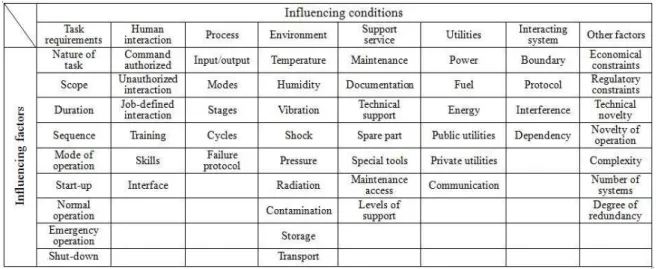
The influential conditions consider especially when determining the properties of a system. As mentioned above, a system property affects the design of the system elements. Therefore, it is necessary to define the influential conditions when the system concept is defined. The following conditions are generally considered for the system as presented in Table 3.1: task requirements; human interface; operational process; environment exposed; support services available; utilities for the system operation; externally interacting systems; and constraints and regulations.
Each of these influential conditions can be affected by various factors influence the status of its condition as mentioned above. The extent which their factors affect the functions of the system depends on the nature and the duration of the tasks. Example of the relationship between the influencing conditions and their factors is given in Table 3.1 in detail. The influencing conditions and their factors are used when evaluating the functions of a system. These factors also become the factors that affect system RAMS, (BS EN 62347, 2007).
Table 3.1 Examples of relationship of influencing factors and influencing conditions
3.1.3 System Operation and Operating Profile Concept
System functions are designed to achieve the intended performance within a generic operating pattern all the time, but it has to consider the degradation of system performance over predetermined tolerable limit as called a separate operation stage, which should consider emergency situations and responses. Degradation has an effect on the quality of service provided by the system. Therefore, the system should have diverse system operating profiles depending on the system operation situations.
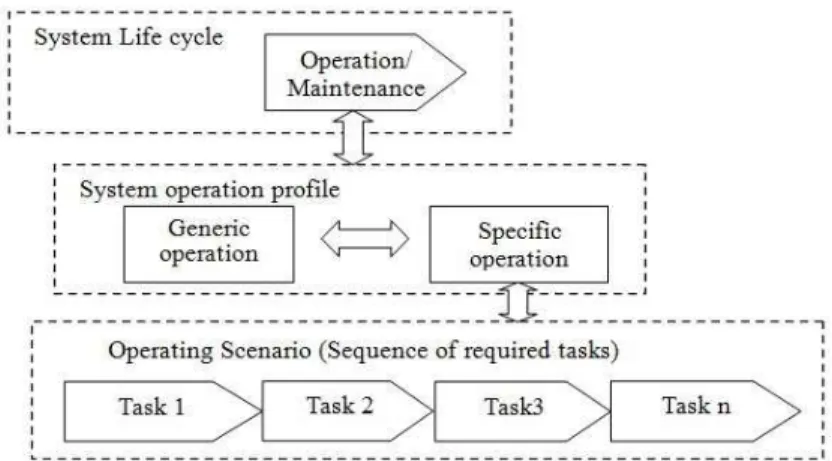
A system operating profile, or a specific operating scenario, treats the sequence of the tasks of the system and it is divided by generic operation and specific operation. It includes specific tasks, activities and conditions. The tasks in an operating profile can be achieved throughout the various functions designed into the system. The functions which are included in the specific operating profile should effectively consider in
the system operator's perspective, (BS EN 62347, 2007).
Rolling stock have several characteristics: single track operation without passing towards the same direction;
the simultaneous service of many types of rolling stocks on a same track; the operation in the varied geographic and climate environments; and the operation in terms of interaction with many external systems.
These characteristics require various specific operating scenario depending on possible situation, in order to prepare for the degradation of rolling stock. Figure 3.2 presents a framework to build the specific operating scenarios in the specific operation condition, (BS EN 62347, 2007).
Figure 3.2 Operating profile and operating scenario in system operation
3.1.4 Process Approach and System Life Cycle Concept
The approach as a means of process concept of the system RAMS can be a leading principle to operate RAMS management systematically because numerous RAMS activities, repeating and linking each other can be determined and managed by diverse processes during the system life cycle. It can also link between an individual process and the combined and interacted processes within the system conveniently by means of activities using resources that transform inputs into outputs as depicted at Figure 3.3. Process approach gives many advantages for RAMS management: (1) the systematical definition for the essential activities; (2) the clear establishment of responsibility and accountability for; (3) the identification of the interface of RAMS activities; (4) the focus on key RAMS activities; and (5) the evaluation of risks, (BS EN 60300-3-15, 2007).
Figure 3.3 Concept of process for managing RAMS
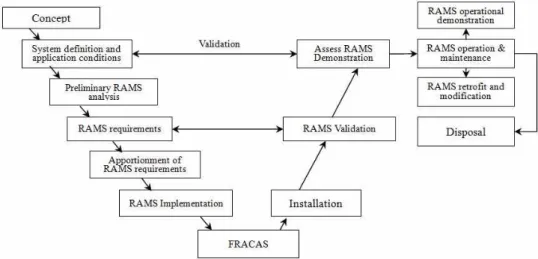
A system has a life cycle stage, regardless of the size and complexity of the system. A life cycle is consisted of the sequence of the discrete stages as at Figure 3.4, and each of stages is the result of one or more process and it has its specific objectives. In Figure 3.4, the left stages from concept to RAMS
implementation can affect subsequence stages in RAMS operation and maintenance phase and the decision made for the system architecture and technology through RAMS requirements can affect production, system integration and life cycle enhancement, etc. Like this, the establishment of life cycle concept is essentially required to conduct RAMS tasks and coordinates RAMS activities effectively. The time duration of a system RAMS is affected by various factors: RAMS characteristics selected type, technology used; the support provision, (BS EN 62347, 2007; 60300-3-15, 2007).
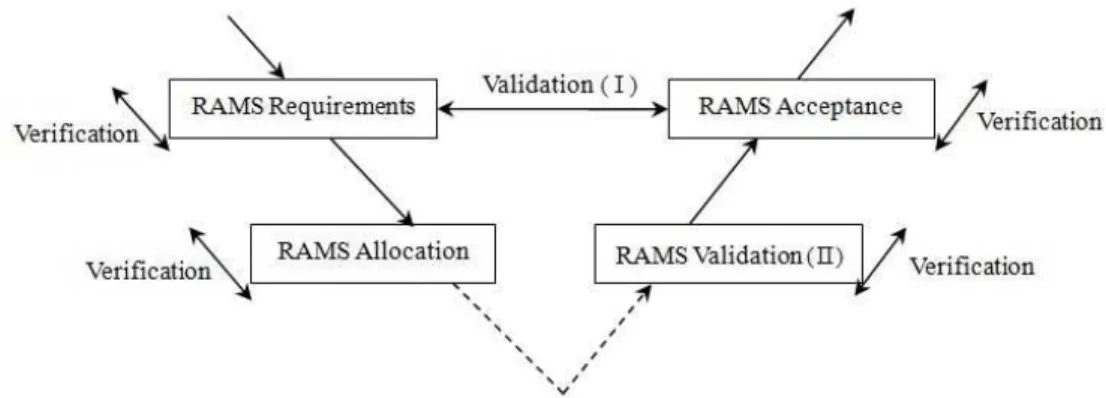
EN 50126-1 (1999) presented V model as railway life cycle as Figure 3.4. The top down branch (left side) is a refining process and the bottom up branch (right side) is a demonstration and an operational process. V model is very useful for the understanding of RAMS management during the system life cycle and very effective to apply RAMS activities during life cycle: RAMS definition, RAMS verification and validation and RAMS improvement, etc.
Figure 3.4 V-shaped model applied RAMS
3.1.5 Maintenance Concept
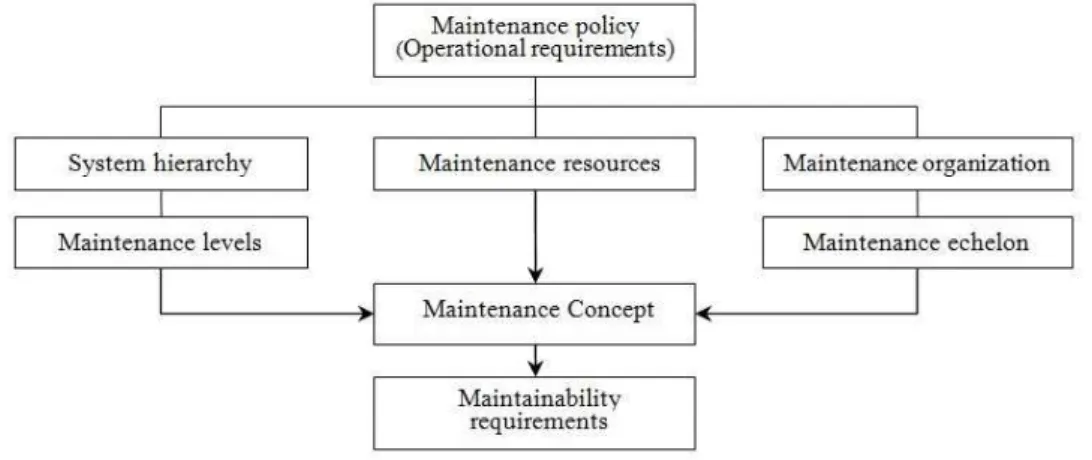
Maintenance concept is an essential factor of system RAMS. It becomes the basis for specific maintenance activities of a system to be developed and it becomes a set of maintainability design practices and goals; it defines the basic approach for the maintenance activities (e.g. the types, personnel, and location for maintenance); and it becomes the base of the maintenance support policies and requirements. These factors require a systematical approach for the improvement of the RAMS characteristics. As depicted in Figure 3.5, The maintenance concept is design by maintenance policy as a framework and it includes the interrelationship between levels of maintenance, lines of maintenance and locations of maintenance, (BS EN 60300-3-10, 2001).
The level of maintenance is determined by the set of maintenance tasks, which are a formed group from a hierarchy (break down structure). It is broken down into units of maintenance work or elementary maintenance activates, but the sequence of elementary maintenance activities become an actual factor when determining the level of maintenance. The following is a general example of the level of maintenance of a system, (BS EN 60300-3-14, 2004; EN 13306, 2008):
-
Level1: simple actions.-
Level2: basic actions by qualified personnel using detailed procedures.-
Level3: complex actions by qualified personnel using detailed procedures.-
Level4: actions implied the know-how of a technique or a technology by specialized technical personnel.-
Level5: actions implied a knowledge held by the manufacturer or a specialized company with industrial logistic support equipment.Maintenance echelon, or line of maintenance, means an organizational unite where conducts maintenance. It includes field mechanics and groups of people needed for repair or overhaul. The line of maintenance is generally distinguished as a field (first line of maintenance), a workshop (second line of maintenance), and a manufacturer (third line of maintenance). The skill of the personnel, the facilities available, the location, etc is the standard of categorizing the line of maintenance. The level of repair analysis (LORA) helps optimize the maintenance echelon. The objective of maintenance echelon is to reduce the cost and subject to availability constraints, (BS 6548-4, 1993; BS EN 60300-3-14, 2004; Kowalski, 1995).
Figure 3.5 A process for developing Maintenance concept
When determining maintenance concept, the following information is needed: (1) a definition of the various levels of maintenance; (2) the depths of corrective maintenance; (3) the environmental conditions; (4) the available maintenance resources; (5) limitation of preventive maintenance; (6) maximum turnaround times; (7) qualification of maintenance persons and operators; and the related legal or statutory requirements. The maintenance concept should be revised according to design method to achieve the optimal cost in effective maintenance, (BS IEC 60300-3-10, 2001).
3.1.6 Failure Concept
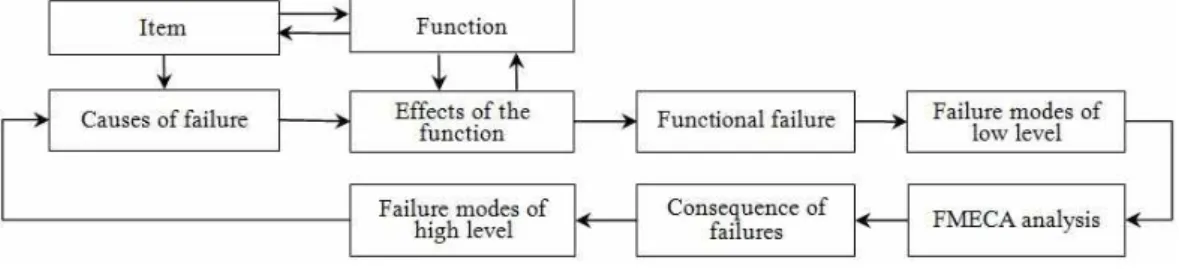
The failures which occur in system adversely affect RAMS performance characteristics as at Figure 3.6, but they are the important focus of RAMS activities. Villemeur (1992) as referred to RAMS is, in its broad meaning, the science of failure of an item. This failure is an important consideration when determining RAMS performance characteristics and their level, and they are major subjects which perform RAMS activities, because the failures are closely related to the system functions, (Moubray, 1997; BS EN 60300-3-11, 2009).
Figure 3.6 Failures affecting RAMS
Failure in system RAMS means failure in terms of function defined in Section 3.1.1. In European Standard (EN 60050 (191), 1990) defines failure as a system lose the intended function. Moubray (1997) also referred to RAMS related failures as a functional failure. Functional failures can classified in terms of the following situations: (1) complete loss of functions; (2) insufficient functions compared to the required performance; (3) intermittent functions; and (4) untimely functions. The partial and total loss of functions should approach separately, because they have the different effects respectively. The functional failures are defined by failure mode concept as in Figure 2.5, (Villemeur, 1992).
The failure modes draw a line depending on the consequences of failure. Success of a system is swayed by the performance of critical system elements. Therefore, the failure modes of the critical system elements are important for system RAMS. Failure mode includes a description of the item and failure mechanism, and it depends on the level of the item and its failure criteria. The procedure of defining failure modes is shown in Figure 3.7. Failure consequences at a lower level become failure modes at a higher level, and the failure modes at the lower level become the failure causes at a higher level. This procedure is repeated until the highest level. By these findings, failure modes is categorized by the consequence: (1) hidden or evident; and (2) safety/environmental, economical/operational consequences, (Villemeur, 1992; BS EN 60300-3-11, 2009;
Moubray, 1997; BS EN 60812, 2006).
Figure 3.7 Procedure of determining failure modes
3.1.7 Mathematical concept
Mathematical concepts are used to quantify RAMS characteristics, which are expressed by the probability and statistics, and it becomes key decisions factor when develops and specifies RAMS requirements. The simplest model for reliability is a random variable (time to failure, T). Failure rate, λ(t), which are derived from the failure distribution function, F(t) is used widely together with the failure density function, f(t). This section treats the functions about reliability and maintainability. Each of these functions can be used to calculate RAMS performance characteristics and develop the diverse RAMS parameters, (BS EN 61703, 2002;
Ebeling, 1997; MIL-HDBK-338B, 1998).
Pr (3.1)
(3.2)
(3.3) 3.1.7.1 Reliability parameters.(1) Reliability, R(t), is the probability of lasting until a given time, t.
Pr≥ (3.4) The relation of R(t) and F(t) is the following:
(3.5)
(3.6)
∞ (3.7)
∞ (3.8) (2) Failure rate,λ(t), is the ratio of the probability that a failure instantly falls within the instant time or the given time interval, [t, t +△t].Pr ≤≤ ∆ ∆ (3.9)
∆
∆
(3.10) lim
∆→∆
∆
(3.11)
·
(3.12)
(3.13)
ln ln (3.14) Where, R(0) = 1 and ln R(0) = 0 exp
(3.15) (3) Mean Time To Failure, MTTF or E(T), is only the mean or expected value, of probably distribution defined by f(t).
∞
∞
∞ (3.16) 3.1.7.2 Maintainability parametersReliability focuses on the system lasting during the possible long period, but maintainability pinpoints the repair within the given time. Maintainability is a measure of the ease and rapid maintenance from a failure status and is, like reliability, also expressed by probabilistic parameters. Therefore, maintainability parameters are expressed to compare with the reliability functions. Like table 3.2, it is possible to substitute maintainability parameters for reliability parameters as following: (1) time to restore for the time to failure;
(2) repair rate for failure rate; and (3) maintainability for reliability, (MIL-HDBK-338B, 1998; BS EN 61703, 2002).
3.1.8 Verification and validation Concept
Validation and verification (V&V) means all activities of demonstrating RAMS requirements during the life cycle. European standards (EN 60300 and EN 5012X series) emphasize the V&V concept as an integrated activity to analyze, evaluate and assess all RAMS activities during the life cycle, but it is not easy to define clearly the distinction between them although the instance for the V&V is given at Figure 3.8. The definition of the V&V may take a great impact on the RAMS assurance process and it is defined by the system operator within RAMS requirements, (BS EN 60300-4, 2007; BS EN 50126-1, 1999; Nordland, 2002).
EN 50126-1 (1999) defines that verification is a process that confirms whether the specific RAMS requirements is truly and accurately carried out at the defined life cycle throughout examination and objective evidence. This concept defines the following four perspectives: (1) what – the specific RAMS requirements;
(2) when - at any life cycle; (3) how – by the examination and evidence; and, (4) why – for the
confirmation of the true and accurate demonstration.
Table 3.2 Comparison of basic reliability and maintainability parameters
On the other hand, validation means “legally or officially acceptable based on what is logical or true” That is, validation is the demonstration activities to accept the results of the particular RAMS requirements undertaken under the operating conditions. It implies the acceptance test under the operating conditions but validation and verification get confused depending on the RAMS requirements. these they only offers the basic direction, but it shows that they can change depending on the RAMS requirements, (BS EN 50126-1, 1999; Nordland, 2002).
Figure 3.8 Verification & validation Concept
3.2 Framework for RAMS management
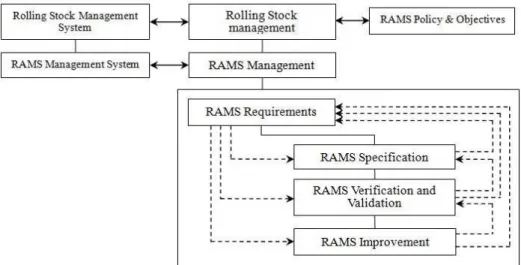
RAMS management is to direct and control all RAMS activities systematically. Ultimately, it is a process that makes the series of decisions for the achievement of what to want and need through the RAMS organization during the system life cycle. These activities should consider various changes such as changing pattern of a system, technical advances, social pressure, and competition. the management framework model for rolling stock RAMS proposed at Figure 3.9 is comprised of four set activities under RAMS management system, (BS 6079, 2010; BS EN 60300-1, 2003).
3.2.1 RAMS Policy and Objectives
RAMS policy and objectives help establish a focus to direct RAMS management and they show a strategic direction in the rolling operator perspective. It reflects the purpose of RAMS management including a mission, a vision and value, and provides the a framework for setting RAMS objectives, which are specified
for relevant functions and levels for RAMS activities and it measures to facilitate an effective and efficient review, (BS EN ISO 9000, 2005).
3.2.2 RAMS management system
RAMS management system is a system which manages a RAMS organization systematically and transparently under RAMS policy and its objectives. It is therefore an essential system for the organization which addresses RAMS management. The fundamental and generic principles that can apply RAMS to the intending system should be reflected into the management system. This system can effectively assist establishing the RAMS management activities in Figure 3.9. Figure 3.10 is a proposed process model for RAMS management in the operator perspective, (BS ISO 9000, 2005; BS EN 60300-1, 2003).
Figure 3.9 Framework Model for RAMS management
RAMS management system should present a framework for the strategic direction of RAMS policy and objective to control RAMS requirements and activities, and to coordinate all RAMS activities as part of the overall management system as at Figure 3.9 and 3.10. It should use a system life cycle framework as mentioned earlier for implementing RAMS activities. RAMS policy and objective is stated for the responsibility and accountability of all RAMS activities. The planning considers the outlines of the sequence of RAMS activities through the life cycle framework process, and links RAMS to system quality and value through measures, analysis and improvement, (BS EN 60300-1, 2003; BS EN 60300-2, 2004).
Figure 3.10 Process model of RAMS management system
3.2.3 RAMS Requirements
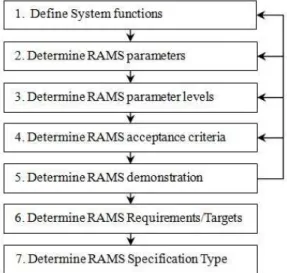
RAMS requirement is stated by the system operator on what is necessarily performed through RAMS activities. It includes the needs and expectations of the system operator such as the degree of RAMS performance characteristics, and the ways and criteria of verification and validation. The following factors such as the needs, the requirements and targets, the system concept and its application environments, RAMS demonstration, and specification (contracting) are considered when the RAMS performance characteristic is determined. The level of verification and validation depends on the business objectives and risk. Figure 3.11 shows a straightforward procedure for the determination of RAMS requirements/targets, (BS EN 60300-3-4, 2008; BS ISO 9000, 2005).
The concepts used during this procedure are discussed above, but in addition, RAMS targets and life cycle costs is discussed. The life cycle cost is a factor that the system operators are most interested in, but it is not a decisive factor. The continuous changes of the railway environment towards the flexible management will make the higher position of the cost in the total weight. The system operator should consider the RAMS targets, which are reachable through RAMS management and independent of RAMS requirements. They are not necessary goals to be reached, but the system operator makes a ceaseless effort to achieve the RAMS targets with the system suppliers, (BS EN 60300-3-4, 2008).
Rolling stock is a type of customer-made system. So it requires new RAMS activities: new RAMS parameters and their levels, and the new type and degree of validation and verification. Many rolling stock systems are also a combination of both customer-made and commercial off the shelf (COTS). These factors demand the utmost care when determining the RAMS activities. If the system operator requires the change of the COTS, it means no longer COTS, (BS EN 60300-3-4, 2008).
Figure 3.11 Procedure of RAMS requirement determination
3.2.4 RAMS Specification
A system RAMS specification is to allocate RAMS requirements for each related function of the system from a RAMS perspective. the specification provides a set of main RAMS requirements of the related functions and relevant characteristics. RAMS requirements are a necessary requisite for seeking fulfillment in a contract agreement and a RAMS specification is a precise statement of the requirements. The RAMS specification is a basis for establishing clear understanding of the requirements. It becomes a basis for RAMS management and it usually forms a part of a contract between the supplier and the operator. RAMS specification is written in various ways as below, but it is desired that the specification is written by the
system operator and supplier under mutual agreement:
․
specification written by the system supplier;․
specification written by the system operator; and․
specification written by the system operator and supplier3.3 RAMS Verification and Validation
As mentioned earlier in Section 3.7.1, V&V is activities that demonstrates the achievement of specific RAMS requirement during the system life cycle. They are performed by the methods of analysis, tests, examination and/or evidence, and their level depends on the levels of RAMS characteristics. If the system operator accepts maintenance activity, it can be controlled by the lower levels. RMS case for reliability, maintainability and safety can be used as an evidence of V&V implementation. V&V are carried out by various techniques, but the choice of which is at the volition of the system supplier. Nevertheless, the system operator necessary identify the purposes and the main characteristics of the selected techniques, (BS EN 60300-3-4, 2007; Norland, 2002).
V&V are carried out by various techniques. The choice of the techniques is at the volition of the system supplier, but the system operator should identify the purposes and the provision of the techniques. The V&V contain the following activities below, (BS EN 60300-3-4, 2007):
1) analysis
· Compliance with standard, regulations and guidelines · Export review/ best practices/ certification
· Calculations used for other design purpose · Proposed analysis
2) Testing and Demonstration
· Review performance for identical or similar system in their applications · Proposed RAMS testing
3.4 RAMS Improvement
RAMS continually improves to increase the effectiveness of the system through the RAMS policy and strategic plans, use of suitable assessment or survey methods and the analysis for timely preventive and corrective action during the life cycle. Records related maintain to be establish trends. the system operator establish and maintain procedures for a systematic improvement. the following RAMS improvement considers:
related methods and tools for verification and validation; root cause analysis for the solution of potential critical problems; risk assessment information; appropriate data control for the accuracy and integrity of information; and technical for life cycle enhancement, (BS EN 60300-2, 2004).
4. Conclusion
This article discussed the various ways of controlling and managing RAMS activities into rolling stock systems: the principles that define rolling stock RAMS and its contributory performance and how to apply its attributes into rolling stock system; the necessary concepts for rolling stock RAMS management; and a framework model for rolling stock RAMS management in order to encourage innovation and flexibility of RAMS management, and design for optimizing rolling stock systems within known constraints and technical limitation.
System RAMS is a matchless engineering technique useful in most industries, particularly safety and mission critical industries like rolling stock. However, railway system fields, including rolling stock, have still been lukewarm in applying system RAMS throughout the whole life cycle because of the complexity of its
techniques. However, railway transportation is changing towards horizontal integration, i. e. interoperability of railway networks; vertical separation, e. g. between management of infrastructure and rolling stock operation and outsourcing of maintenance and support functions; and a due and transparent certification process to improve safety approval and equipment acceptance. RAMS technique will be required increasingly in the development, its operation and maintenance stage of the rolling stock.
Reference
1. Benjamin S. Blanchard, Dinesh Verma and Elmer L. Peterson, “Maintainability - A key to effective serviceability and maintenance management", John Wily & Sons INC, pp vii, 1994.
2. BS 6548-4, “Maintainability of equipment – Part 4: Guide to the planning of maintenance and maintenance support”, BRITISH STANDARD, 1993.
3. BS EN 60300-1, “Dependability management – Part 1: Dependability management systems”, BRITISH STANDARD, 2003.
4. BS EN 60300-2, “Dependability management – Part 1: Guidelines for dependability management”, BRITISH STANDARD, 2004.
5. BS EN 60300-3-1, “Dependability management – Part 3-1: Application guide – Analysis techniques for dependability - guide on methodology”, BRITISH STANDARD, 2004.
6. BS EN 60300-3-4, “Dependability management – Part 3-4: Application guide – Guide to the specification of dependability requirements”, BRITISH STANDARD, 2008.
7. BS EN 60300-3-10, “Dependability management – Part 3-10: Application guide – Maintainability”, BRITISH STANDARD, 2001.
8. BS EN 60300-3-11, “Dependability management – Part 3-11: Application guide – Reliability centered maintenance”, BRITISH STANDARD, 2009.
9. BS EN 60300-3-14, “Dependability management – Part 3-14: Application guide – Maintenance and maintenance support”, BRITISH STANDARD, 2004.
10. BS Draft EN 60300-3-15, “Dependability management – Part 3-15: Application guide – Guidance to engineering of system dependability”, BRITISH STANDARD, 2007.
11. BS EN 62347, “Guidance on system dependability specifications”, BRITISH STANDARD, 2007.
12. BS EN 60812, “Analysis techniques for system reliability – Procedure for failure mode and effects analysis (FMEA)”, BRITISH STANDARD, 2006.
13. BS EN 13306, “Maintenance terminology”, BRITISH STANDARD, 2008.
14. BS EN 61703, “Mathematical expressions for reliability, availability, maintainability and maintenance support terms”, BRITISH STANDARD, 2002.
15. BS EN ISO 9000, “Quality management system – Fundamental and vocabulary”, BRITISH STANDARD, 2005.
16. BS EN ISO 9001, “Quality management systems – Requirements”, BRITISH STANDARD, 2008.
17. BS EN 50126-1, “Railway applications – The specification and demonstration of Reliability, Availability, Maintainability and Safety (RAMS) – Part 1: Basic requirements and generic process”, BRITISH STANDARD, 1999.
18. Cha Jea-Hwan, Chung In-Soo, Jo Kwang-Woo, “KTX-Ⅱ RAMS Application Standard for Safety of Passenger Transportation” Korean society for railway conference 2008, pp, 1525-1538, 2008.
19. Charles E. Ebeling, “Reliability and maintainability Engineering”, McGRAW-HILL, pp 23-30, 1997.
20. IEC TC 56 WG, “CONCEPT OF DEPENDABILITY”, WWW.sars.org.uk, 2009.
21. IEC 62278, “Railway applications – The specification and demonstration of Reliability, Availability,
Maintainability and Safety (RAMS)", IEC INTERNATIONAL STANDARD, 2002.
22. R. Kowalski, "Maintainability and reliability", In: Handbook of Reliability Engineering and Management, W. Coombs, CF. moss, RY (eds), McGRAW-HILL, Chapter 15, 1995.
23. ML-HDBK-338B, “Electronic Reliability design Hand Book”, USA MILITARY STANDARD, 1988.
24. Odd Nordland, “V&V – Verification or validation?”, The 6th World Multi-conference on systems, cybernetics and informatics; proceedings volumeⅦ, 2002.
25. V.A. Profillidis, “Railway management and engineering”, Tj Internationals Ltd, pp1-23, 2006.
26. Alain Villemeur, “Reliability, Availability, Maintainability and Safety Assessment – Volume 1: Methods and Techniques”, JOHN WILLEY & SONS, pp3-13, 31, 1992.
27. John Moubray, “Reliability centered maintenance – second edition”, Industrial Press Inc. pp21-128, 1997.