• 검색 결과가 없습니다.

Evaluation of ${\alpha}$-glucosidase Inhibitory Activity of Jeju Seaweeds Using High Throughput Screening (HTS) Technique

N/A
N/A
Protected

Academic year: 2021

Share "Evaluation of ${\alpha}$-glucosidase Inhibitory Activity of Jeju Seaweeds Using High Throughput Screening (HTS) Technique"

Copied!
7
0
0

로드 중.... (전체 텍스트 보기)

전체 글

(1)

* Corresponding author

Phone: +82-64-754-3475, Fax: +82-64-756-3493 E-mail: [email protected]

Evaluation of α-glucosidase Inhibitory Activity of Jeju Seaweeds Using High Throughput Screening (HTS)

Technique

Seok-Chun Ko

1

, Seung-Hong Lee

1

, Sung-Myung Kang

1

, Ginnae Ahn

1

, Seon-Heui Cha

2

and You-Jin Jeon

1*

1

Department of Marine Life Science, Jeju National University, Jeju 690-756, Republic of Korea

2
Marine Bio Research Team, Korea Basic Science Institute (KBSI), Jeju 690-140, Republic of Korea.

Abstract As a rapid and quick bioactive compound evaluation technique, we utilized an auto- matic system of high throughput screening (HTS) to investigate α-glucosidase inhibitory efficacy of seaweeds, collected from Jeju Island in Korea. In this study, different extracts with methanol at 20 ℃ and 70℃ from 23 species of brown seaweeds and 22 species of red seaweeds and 9 species of green seaweeds were subjected to HTS. Of the brown seaweeds tested, Myelophycus simplex (20B3), Ishige sinicola (20B5, 70B5), Colpomenia sinuosa, (20B14, 70B14), Hizikia fusi- forme (20B21), Ishige okamurai (70B22) and Ecklonia cava (70B23) showed significantly high α-glucosidase inhibitory activity with 96.52%, 98.34%, 98.37%, 80.49%, 96.16%, 76.32%, 98.32%

and 98.12%. Schizymenia dubyi (20R15), Gelidium amansii (20R16) and Polysiphonia japonica (70R22) amomng the red seaweeds showed remarkable α-glucosidase inhibitory activity more than 95%. On the other hand, the green seaweeds showed poor α-glucosidase inhibitory activities (less the10%) at 1 mg/ml.

Key words : High Throughput Screening (HTS), α-Glucosidase, Seaweeds, Inhibitory activity

Introduction

Diabetes mellitus is one of the most serious and chronic disease that is developing increasingly with the increasing obesity and ageing in the general population [1]. Persistent hyperglycemia in diabetic patients de- spite appropriate therapeutic measures leads to several complications, such as retinopathy, neuropathy, and car- diovascular diseases [2,3]. Diabetes mellitus is primar- ily classified into insulin-dependent (type I diabetes) and non-insulin-dependent (type II diabetes) [4]. The prevalence of type II diabetes is increasing globally [5].

Postprandial hyperglycemia plays an important role in the development of type II diabetes and complications associated with the disease, including macro-vascular and micro-vascular diseases [6].

One of the therapeutic approaches for decreasing postprandial hyperglycemia is to retard absorption of

glucose by the inhibition of carbohydrate-hydrolyzing enzymes including α-glucosidase and α-amylase, in the digestive organs [7,8]. The synthetic α -glucosidase inhibitor, such as miglitol, acarbose and voglibose are known to reduce postprandial hyper- glycemia primarily by delaying glucose absorption and interfering with the carbohydrate-digesting en- zymes [9,10]. However, the continuous use of those synthetic agents should be limited because those agents may induce side effects such as diarrhea, vomiting, abdominal cramp and flatulence [11].

Therefore, a number of studies have been conducted in the search for natural α-glucosidase inhibitors that induce no deleterious side effects [12,13].

Marine bioresources are known to be attractive as

they sometimes yield new compounds showing several

kinds of different bioactivities which are not possible

in land plants. In particular, seaweeds are known to pro-

(2)

vide an abundance of bioactive materials with valuable pharmaceutical and biomedical potential. According to the results of the previous studies, some bioactive sub- stances are contained in seaweeds, and various con- stituents have been demonstrated to possess antioxidant, anticoagulant, antibacterial and anticancer effects [14-17].

High throughput screening (HTS) is an instrument for quick screening and a large number of materials are automatically tested, for activity as activators and inhibitors of a particular biological target [18]. Assay systems and robotics that were capable of screening thousands of materials per day in the latter half of the 1990s had to evolve into ultraHTS (uHTS) methods ca- pable of 100,000 assays per day or more [19]. Today, most pharmaceutical companies use HTS to find lead compounds from millions of materials or compounds on the primary screening.

This study has adopted HTS technique to investigate the α-glucosidase inhibitory activity of the methanolic extract from 54 seaweed species.

Materials and Methods Regents

α-glucosidase and p-Nitrophenyl- α-D-glucopyrano- side were all purchased from Sigma (St. Louis, MO, USA). All other chemicals and reagents were of ana- lytical grade.

Preparation of seaweed extracts

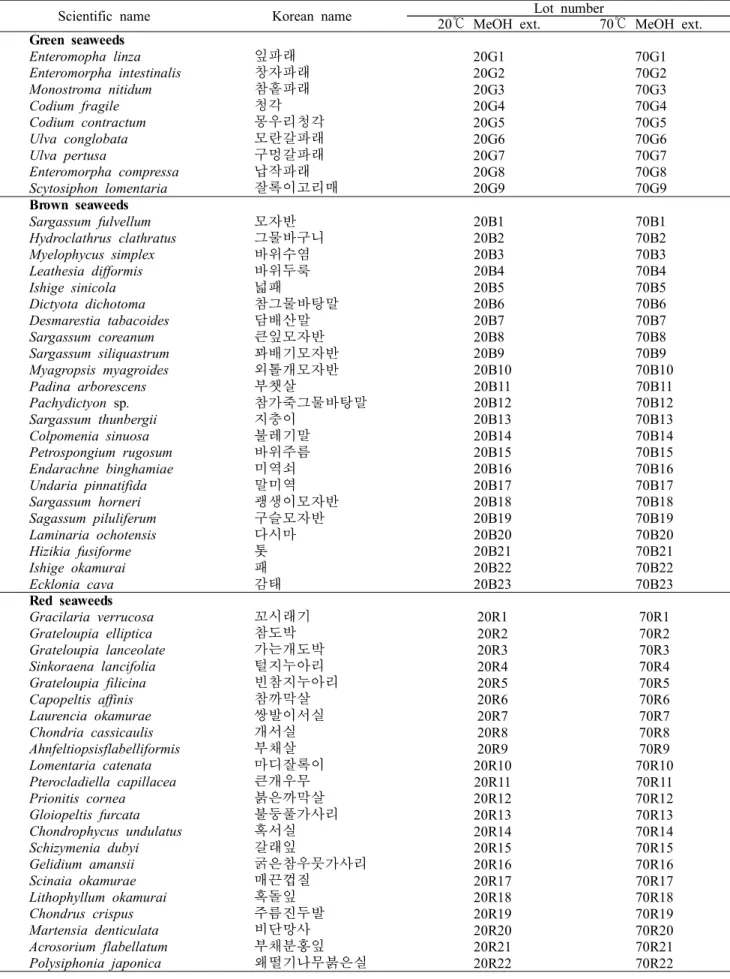
The 54 seaweed species were collected along the coast of Jeju Island in South Korea (Table 1). The sam- ple was washed 3 times with tap water in order to re- move salt, epiphytes, and sand attached to the surface of the samples. Finally, the sample was carefully rinsed using fresh water, and stored at −20°C. The frozen samples were then lyophilized and homogenized with a grinder prior to the extraction. For preparation of the extracts from dried seaweeds, one gram of the seaweed powders were mixed with 100 ml of 95% methanol and placed in shaking incubator for 24 h at 20°C and 70°C.

The mixtures were centrifuged at 3,500 rpm for 20 min at 4°C and filtered with Whatman filter paper to remove the residue, there after evaporated under vaccum at 40°C to remove all methanol and then dissolved in DMSO and used for the experiments.

α -glucosidase inhibitory activity by HTS system

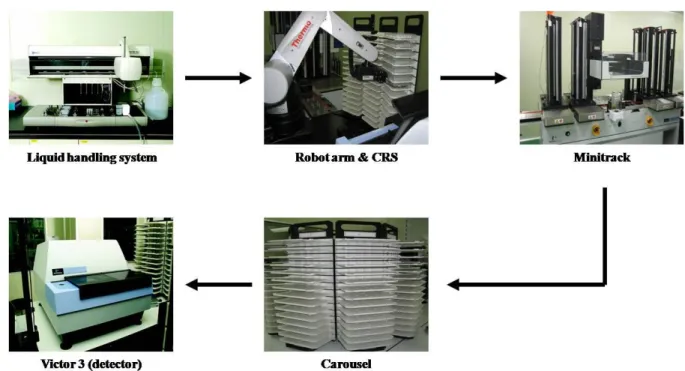
The α-glucosidase inhibitory activity assay was done by the chromogenic method described by Watanabe et al. [20] and using a polara 2.0 program in HTS system, which is fully controlled system (Fig. 1). Briefly, yeat α-glucosidase (0.7 mU/ml) was dissolved in 0.1 M phosphate buffer (pH 7.0) containing 2 g/L bovine se- rum albumin and 0.2 g/L NaN

3

and used as an enzyme solution. A 5 mM ρ-nitrophenyl-α-D-glucopyranoside in the same buffer (pH 7.0) was used as a substrate solution. The 50 μl of enzyme solution and 50 μl of sample dissolved in DMSO at the 4 mg/ml concen- tration were added to each well of 96-well plate using liquid handling system. Then, the plate was transferred to the minitrack using Robotic arm. Next, 100 μl of substrate solution was added to each well. Next, the 96-well plate was transferred to the Carousel using Robotic arm and incubated for 10 min at room temperature. Finally, reacted with Victor 3 (detector) and measured absorbance at 405 nm.

Results and Discussion

Although many α-glucosidase inhibitors have been developed and used, their side effects to

α-glucosidase inhibitors are serious problems to be overcome in the treatment of diabetes mellitus. There is a need, therefore, to develop safer and better ther- apeutic agents from natural bioresources. Recently, there has been increasing interest in the α-glucosidase inhibitory therapeutic potential of natural resources, suggested that many plants have α-glucosidase in- hibitory activities. Thus, several natural resources have been investigated with respect to suppression of glucose production from carbohydrates in the gut or glucose ab- sorption from the intestine [13]. α-glucosidase is one of the glucosidases located in the brush-border surface membrane of intestinal cells, and is a key enzyme of carbohydrate digestion [21]. The inhibition of α -glucosidase, in the human digestive tract, is considered to be effective to control diabete mellitus by diminish- ing the absorption of glucose decomposed from starch by this enzyme [22].

The purpose of the present study was to investigate

the α-glucosidase inhibition effects of the methanolic

extract of 54 seaweed species. α-glucosidase inhibitory

effects of green seaweed extracts are shown in Fig. 2.

(3)

Table 1. Jeju seaweeds used in this study

Scientific name Korean name Lot number

20℃ MeOH ext. 70℃ MeOH ext.

Green seaweeds

Enteromopha linza 잎파래 20G1 70G1

Enteromorpha intestinalis 창자파래 20G2 70G2

Monostroma nitidum 참홑파래 20G3 70G3

Codium fragile 청각 20G4 70G4

Codium contractum 몽우리청각 20G5 70G5

Ulva conglobata 모란갈파래 20G6 70G6

Ulva pertusa 구멍갈파래 20G7 70G7

Enteromorpha compressa 납작파래 20G8 70G8

Scytosiphon lomentaria 잘록이고리매 20G9 70G9

Brown seaweeds

Sargassum fulvellum 모자반 20B1 70B1

Hydroclathrus clathratus 그물바구니 20B2 70B2

Myelophycus simplex 바위수염 20B3 70B3

Leathesia difformis 바위두룩 20B4 70B4

Ishige sinicola 넓패 20B5 70B5

Dictyota dichotoma 참그물바탕말 20B6 70B6

Desmarestia tabacoides 담배산말 20B7 70B7

Sargassum coreanum 큰잎모자반 20B8 70B8

Sargassum siliquastrum 꽈배기모자반 20B9 70B9

Myagropsis myagroides 외톨개모자반 20B10 70B10

Padina arborescens 부챗살 20B11 70B11

Pachydictyon sp. 참가죽그물바탕말 20B12 70B12

Sargassum thunbergii 지충이 20B13 70B13

Colpomenia sinuosa 불레기말 20B14 70B14

Petrospongium rugosum 바위주름 20B15 70B15

Endarachne binghamiae 미역쇠 20B16 70B16

Undaria pinnatifida 말미역 20B17 70B17

Sargassum horneri 괭생이모자반 20B18 70B18

Sagassum piluliferum 구슬모자반 20B19 70B19

Laminaria ochotensis 다시마 20B20 70B20

Hizikia fusiforme 톳 20B21 70B21

Ishige okamurai 패 20B22 70B22

Ecklonia cava 감태 20B23 70B23

Red seaweeds

Gracilaria verrucosa 꼬시래기 20R1 70R1

Grateloupia elliptica 참도박 20R2 70R2

Grateloupia lanceolate 가는개도박 20R3 70R3

Sinkoraena lancifolia 털지누아리 20R4 70R4

Grateloupia filicina 빈참지누아리 20R5 70R5

Capopeltis affinis 참까막살 20R6 70R6

Laurencia okamurae 쌍발이서실 20R7 70R7

Chondria cassicaulis 개서실 20R8 70R8

Ahnfeltiopsisflabelliformis 부채살 20R9 70R9

Lomentaria catenata 마디잘록이 20R10 70R10

Pterocladiella capillacea 큰개우무 20R11 70R11

Prionitis cornea 붉은까막살 20R12 70R12

Gloiopeltis furcata 불둥풀가사리 20R13 70R13

Chondrophycus undulatus 혹서실 20R14 70R14

Schizymenia dubyi 갈래잎 20R15 70R15

Gelidium amansii 굵은참우뭇가사리 20R16 70R16

Scinaia okamurae 매끈껍질 20R17 70R17

Lithophyllum okamurai 혹돌잎 20R18 70R18

Chondrus crispus 주름진두발 20R19 70R19

Martensia denticulata 비단망사 20R20 70R20

Acrosorium flabellatum 부채분홍잎 20R21 70R21

Polysiphonia japonica 왜떨기나무붉은실 20R22 70R22

(4)

Fig. 1. High throughput screening system for assessing α-glucosidase inhibitory activity.

Fig. 2. α-glucosidase inhibitory activity of methanolic extract (1 mg/ml) from Jeju green seaweeds. (A) 20°C, (B) 70°C.

All the green seaweed extracts showed poor α -glucosidase inhibitory activities (less 15%).

α-glucosidase inhibitory effects of brown seaweed extracts are shown in Fig. 3. Among the tested brown seaweed extracts at 20°C, Ishige sinicola (20B5),

Fig. 3. α-glucosidase inhibitory activity of methanolic extract (1 mg/ml) from Jeju brown seaweeds. (A) 20°C, (B) 70°C.

Myelophycus simplex (20B3), Colpomenia sinuosa

(20B14) and Hizikia fusiforme (20B21) showed high-

ly potent α-glucosidase inhibitory effects with

98.34%, 96.82%, 80.49% and 75.32%, respectively

(Fig. 3(A)). As shown in Fig. 3(B), Ishige sinicola

(5)

(70B5), Colpomenia sinuosa (70B14), Ishige okamur- ai (70B22) and Ecklonia cava (70B23) inhibited the α-glucosidase inhibition effects by more than 95%.

Of those extracts, Ishige sinicola (70B5), Ishige oka- murai (70B22), Ecklonia cava (70B23) and Colpomenia sinuosa (70B14) exhibited α-glucosidase inhibitions of 98.37%, 98.32%, 98.12% and 96.16%, respectively.

α-glucosidase inhibitory effects of red seaweed ex- tracts are shown in Fig. 4. Among the tested red seaweed extracts at 20°C, Schizymenia dubyi (20R15) and Gelidium amansii (20R16) showed highly potent α-glucosidase inhibitory effects with 97.39% and 96.47%, respectively (Fig. 4(A)). As shown in Fig. 4(B), Polysiphonia japonica (70R22) inhibited the α-glucosidase inhibition effects by more than 95%. However, other red seaweed ex- tracts showed poor α-glucosidase inhibitory activities (less 10%).

Oxidative stress induced by increase of hyper- glycemia cause diabetes-associated pathological dam- age [23,24]. Thus, to reduce the risk of dia- betes-associated pathological damage including dia- betes, attenuation of oxidative stress mediated by hy- perglycemia is important. Reactive oxygen species

Fig. 4. α-glucosidase inhibitory activity of methanolic extract (1 mg/ml) from Jeju red seaweeds. (A) 20°C, (B) 70°C.

(ROS) are considered to be important mediators of several biologic responses such as cell proliferation, and extracellular matrix deposition. Recent ob- servations indicate that hyperglycemia triggers the generation ROS, and oxidative stress [25]. In addition, ROS-induced highly reactive oxidative damage was associated with diabetes [26,27].

Seaweeds have been well-known as an important source to produce natural bioactive secondary metabo- lites including polyphenolic compounds with unique linkage [28]. The polyphenolic compounds of the sea- weeds are referred to as phlorotannins and those are readily soluble in polar solvents like methanol [29]. The previous reports on seaweeds have revealed that it con- tains a variety of phlorotannin derivates which are com- monly known to have strong antioxidant effect [30-32].

Also, phlorotannins inhibits the α-glucosidase and pro- tective effect against high glucose-induced oxidative stress in human umbilical vein endothelial cells [1,4].

This suggests that the α-glucosidase inhibitory activities of the methanol extracts of seaweeds can be attributed to the phlorotannins.

In conclusion, methanolic extracts from 54 seaweed species collected from Jeju Island were evaluated for their α-glucosidase inhibitory activities by HTS technique. Most seaweed species tested in this study showed potential α-glucosidase inhibitory activities. Of the seaweed species Ishige sinicola (20B5 and 70B5), Myelophycus simplex (20B3), Colpomenia sinuosa (70B14), Ishige okamurai (70B22), Ecklonia cava (70B23), Schizymenia dubyi (20R15), Gelidium amansii (20R16) and Polysiphonia japonica (70R22) showed excellent α-glucosidase inhibition effects by more than 95%. However, further studies are essential to purify α-glucosidase inhibition compounds to elucidate rela- tionships between structure and activity which might help with future drug design. Therefore, seaweeds pres- ent in Jeju Island are possible candidates for future α- glucosidase inhibition drug discovery.

Acknowledgements

This research was supported by a grant from Marine

Bioprocess Research Center of the Marine Bio21

Project funded by the Ministry of Land, Transport and

Maritime Affairs, Republic of Korea.

(6)

References

1. Heo, S. J., Hwang, J.Y., Choi, J.I., Han, J. S., Kim, H.

J. and Jeon, Y. J. 2009. Diphlorethohydroxycarmalol iso- lated from Ishige okamurae, a brown algae, a potent α -glucosidase inhibitor, alleviates postprandial hyper- glycemia in diabetic mice. Eur J Pharmacol 615, 252-256.

2. He, Z. H. and King, G. L. 2004. Microvascular complica- tions of diabetes. Endocrin. Metab. Clin. 33, 215-238.

3. Krentz, A. J., Clough, G. and Byren, C, D. 2007.

Interaction between microvascular and macrovascular disease in diabetes: pathophysiology and therapeutic implications. Diabetes Obes. Metab. 9, 781-791.

4. Lee, S. H., Park, M. H., Heo, S. J., Kang, S. M., Ko, S. C., Han, J. S. and Jeon, Y. J. 2010. Dieckol isolated from Ecklonia cava inhibits α-amylase in vitro and alle- viates postprandial hyperglycemia in streptozotocin-in- duced diabetic mice. Food Chem. Toxicol. In Press.

5. Zimmet, P., Alberti, K. and Shaw, J. 2001. Global and societal implications of the diabetes epidemic. Nature 414, 782-787.

6. Baron, A. D. 1998. Postprandial hyperglycemia and α -glucosidase inhibitors. Diabetes Res. Clin. Pract. 40, S51-S52.

7. Clissold, S. P. and Edward, C. 1990. A preliminary re- view of its pharmacodynamic and pharmacokinetics prop- erties, and therapeutic potential. Drugs 35, 214-243.

8. Bhandari, M. R., Jong-Anurakkun, N., Hong, G. and Kawabata, J. 2008. α-glucosidase and α-amylase in- hibitory activities on Nepalese medicinal herb Pakhanbhed (Bergenia ciliate, Haw.). Food Chem. 106, 247-252.

9. Lee, H. S. and Kim, M. K. 2001. Rat intestinal α -glucosidase and lens aldose reductase inhibitory activ- ities of grain extracts. Food Sci. Biotechnol. 10, 172-177.

10. Mooradian, A. D. and Thurman, J. E. 1999. Drug therapy of postprandial hyperglycemia. Drugs 57, 19-29.

11. Hanefeld, M. 1998. The role of acarbose in the treatment of non-insulin-dependent diabetes mellitus. J. Diabetes Complicat. 12, 228-237.

12. Kim, K. Y., Nam, K. A., Kurihara, H. and Kim, S. M.

2008. Potent α-glucosidase inhibitors purified from the red alga Grateloupia elliptica. Phytochemistry 69, 2820-2825.

13. Matsui, T., Tanaka, T., Tamura, S., Toshima, A., Miyata, Y., Tanaka, K. and Matsumoto, K. 2007. Alpha-glucosi- dase inhibitory profile of catechins and theaflavins. J.

Agric. Food Chem. 55, 99-105.

14. Heo, S. J., Park, E. J., Lee, K. W. and Jeon, Y. J. 2005.

Antioxidant activities of enzymatic extracts from brown seaweeds. Bioresour. Technol. 96, 1613-1623.

15. Kashiwagi, M., Mynderse, J. S., Moore, R. E. and Norton, T. R. 1980. Antineoplastic evaluation of pacific basin ma- rine algae. J. Pharm. Sci. 69, 735-738.

16. Gonzalez, A. G., Darias, V. and Estevez, E. 1982.

Chemo-therapeutic activity of polyhalogenated terpenes

from Spanish algae. Planta Med. 44, 44-46.

17. Kosovel, V., Avanzini, A., Scarcia, V. and Furlani, A.

1988. Algae as possible sources of antitumoral agents.

Preliminary evaluation of the in vitro cytostatic activity of crude extracts. Pharmacol. Res. Commun. 20, 27-31.

18. Silverman, L., Campbell, R. and Broach, J. R. 1998. New assay technologies for high-throughput screening. Curr . Opin. Chem. Biol. 2, 397-403.

19. Hertzberg, R. P. and Pope, A. J. 2000. High-throughput screening: new technology for the 21st century. Curr . Opin. Chem. Biol. 4, 445-451.

20. Watanabe, J., Kawabata, J., Kurihara H. and Niki, R.

1997. Isolation and identification of alpha-glucosidase in- hibitors from Tochucha (Eucommia ulmoides). Biosci.

Biotechnol. Biochem. 61, 177-178.

21. Lebovitz, H. E. 1997. Alpha-glucosidase inhibitors.

Endocrinol. Metab. Clin. 26, 539-551.

22. Hara, Y. and Honda, M. 1990. The inhibition of α -amylase by tea polyphenols. Agric. Biol. Chem. 54, 1939-1945.

23. Uemura, S. Matsushita, H., Li, W., Glassford, A. J., Asagami, T., Lee, K. H., Harrison, D. G. and Tsao, P.

S. 2001. Diabetes mellitus enhances vascular matrix met- alloproteinase activity: role of oxidative stress. Circ. Res.

88, 1291-1298.

24. Fraga, C. G., Leibovita, R. M. and Roeder, R. G. 1998.

Lipid peroxidation measured as thiobarbituric-reactive substances in tissue slices: Characterization and compar- ison with homogenates and microsomes. Free radic. Biol.

Med. 4, 155-161.

25. Lee, Y. J., Kang, D. G., Kim, J. S. and Lee, H. S. 2008.

Lycopus lucidus inhibits high glucose-induced vascular inflammation in human umbilical vein endothelial cells.

Vasc. Pharmacol. 48, 38-46.

26. Beckman, J. S., Beckman, T. W., Chen, J., Marshall, P.

A. and Freeman, B. A. 1990. Apparent hydroxyl radical production by peroxynitrite: implications for endothelial injury from nitric oxide and superoxide. Proc. Natl. Acad.

Sci. USA 87, 1620-1624.

27. Mandrup-Poulsen, T., Helqvist, S. Wogensen, L. D., Molvig, J., Pociot, F., Johannesen, J. and Nerup, J. 1990.

Cytokine and free radicals as effector molecules in the destruction of pancreatic β cells. Curr. Top. Microbiol.

Immunol. 164, 169-193.

28. Torres, M. A., Barros, M. P., Campos, S. C., Pinto, E., Rajamani, S., Sayre, R. T. and Colepicolo, P. 2008.

Biochemical biomarkers in algae and marine pollution:

a review. Ecotox. Environ. Safe 71, 1-15.

29. Van Alstyne, K. L., Whitman, S. L. and Ehlig, J. M.

2001. Differences in herbivore preferences, phlorotannin production, and nutritional quality between juvenile and adult tissues from marine brown algae. Mar. Biol. 139, 201-210.

30. Ahn, G. N., Kim, K. N., Cha, S. H., Song, C. B., Lee,

J. H., Heo, M. S., Yeo, I. K., Lee, N. H., Jee, Y. H.,

Kim, J. S., Heu, M. S. and Jeon, Y. J. 2007. Antioxidant

activities of phlorotannins purified from Ecklonia cava

on free radical scavenging using ESR and H

2

O

2

-mediated

(7)

DNA damage. Eur. Food Res. Technol. 226, 71-79.

31. Kim, J. A., Lee, J. M., Shin, D. B. and Lee, N. H. 2004.

The antioxidant activity and tyrosinase inhibitory activity of phlorotannins in Ecklonia cava. Food Sci. Biotechnol.

13, 476-480.

32. Shibata, T., Ishimaru, K., Kawaguchi, S., Yoshikawa, H.

and Hama, Y. 2008. Antioxidant activities of phlor- otannins isolated from Japanese Laminariaceae. J. Appl.

Phycol. 20, 705-711.

수치

Table  1.  Jeju  seaweeds  used  in  this  study
Fig.  1.  High  throughput  screening  system  for  assessing  α-glucosidase  inhibitory  activity.
Fig.  4.  α-glucosidase  inhibitory  activity  of  methanolic  extract  (1  mg/ml)  from  Jeju  red  seaweeds

참조

관련 문서

Inhibitory Effect of Aqueous Extracts from the Fruit Body of Lentinus edodes on Rat Intestinal Mucosa α-glucosidase Activity.. and Reducing the Increase of Blood Glucose

We studied antioxidant activity and inhibitory effect of α-glucosidase from aqueous, ethanolic and methanolic fractions of Galla rhois. In FRAP and ORAC assay for

α-Glucosidase inhibitory activity of Neolentinus lepideus fruiting body showed the highest at 86.3% in the 95% ethanol extracts and water extract from Pleurotus cornucopiae was

Abstract − We examined ethanol extracts prepared from the Korean marine algae belonging to the Sargassaceae family for their inhibitory effects on α -glucosidase activity

Abstract Culture broth of Bacillus subtilis Y3-7 in tryptic soy broth (TSB) isolated from Korean traditional fermented food was evaluated for the inhibition of α

Therefore, in this study, α-amylase, α-glucosidase, pancreatic lipase inhibitory activities were screened in vitro, and cytotoxicity was evaluated against human cancer