ISSN 2288-0356(Online) http://dx.doi.org/10.14518/crals.2013.31.4.010 Original Article
Comparison of Antioxidant Activity and α-Glucosidase Inhibiting Activity by Extracts of Galla rhois
Seung-Hyun Lee
1, Sang-Han Lee
1,2*1
Department of Food Science & Biotechnology, Graduate school, Kyungpook National University, Daegu 702-701, Korea
2
Food & Bio-Industry Research Institute, Daegu 702-701, Korea
Abstract
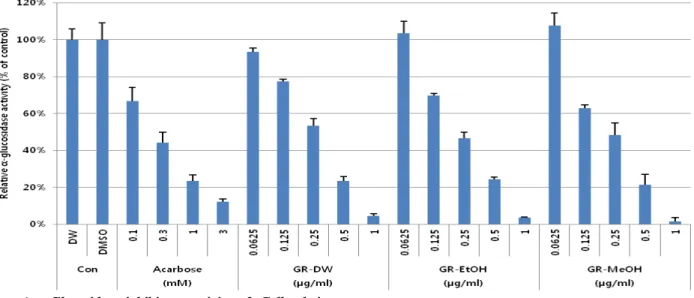
We studied antioxidant activity and inhibitory effect of α-glucosidase from aqueous, ethanolic and methanolic fractions of Galla rhois . In FRAP and ORAC assay for measuring antioxidant activity, we confirmed that Galla rhois extracts had strong antioxidant activity and ethanolic and methanolic extracts were relatively stronger than aqueous extract. We used trolox as a positive control. In order to measure the inhibitory effect of α-glucosidase, we compared acarbose and Galla rhois extracts. As a result of α-glucosidase inhibitory assay, aqueous, ethanolic and methanolic extracts of Galla rhois showed high inhibitory activitity and ethanolic and methanolic extracts were relatively stronger than aqueous extract. The 50% inhibitory concentrations (IC50s) of acarbose, aqueous, ethanolic and methanolic fractions were 0.45 mM, 0.53 μg/mL, 0.415 μg/mL and 0.37 μg/mL, respectively. These results suggest that Galla rhois extracts can be a clinically useful anti-diabetic ingredient, indicating that it needs to be fractionated and isolated and should be further investigated.
Keywords:acarbose, α-glucosidase, enzyme kinetics, FRAP assay, Galla rhois , ORAC assay, trolox,
Introduction 1)
In recent decades, the prevalence of adult diseases is being increased due to modern people's lifetime increase, westernized eating habits, stress and irregular life, etc. Adult diseases include cerebrovascular disease, heart disease and diabetes.
The onset of such adult diseases is mainly caused by oxidative stress. Oxidative stress means unbalance of reactive oxygen species' generation and antioxidant system. Reactive oxygen species (ROS) are chemically reactive molecules containing oxygen and are called harmful oxygen. They can react with other organic matter in cells. ROS in adequate amounts make physiological function such as cell signaling, muscle extension, etc. Inhibition of making ROS or removal of ROS through reaction with already occurred ROS is called antioxidant activity.
People have antioxidant system to maintain adequate amounts of ROS in the body. Excess onset of ROS makes oxidative stress in the body and consequently causes heart disease, cancer and diabetes (Finkel and Holbrook 2000; Heitzer et al. 2001;
Valko et al. 2006). Now butylated hydroxy anisol (BHA) and butylated hydroxy toluene (BHT) are widely used synthetic antioxidants. These are restricted to use because these 50 mg/kg/day or higher dose in the long-term can induce lipid metabolism's imbalances and cancer. We need alternative
functional material for synthetic antioxidant. Not only already proven materials in fork remedies and oriental medicines but also natural substances which being possible to eat and having fewer side-effect are studied actively (Bae et al. 2012).
Diabetes is occurred when glucose homeostasis is broken by insulin metabolism problem. There are two main types of diabetes depending on insulin action. Type 1 diabetes results from the body's failure to produce insulin and Type 2 diabetes results from insulin resistance, a condition in which cells fail to use insulin properly, sometimes combined with an absolute insulin deficiency, reduced insulin receptors. Insulin resistance means that the body normally produces insulin but the cells in the body become resistant to insulin (through changes in their surface receptors) and unable to use it as effectively. It is caused by genetic factors and environmental factors such as aging, obesity, lack of exercise, dose of immunosuppressive drug, stress. Most of the diabetes are type 2 diabetes because most onsets are caused by environmental factors (Lee et al.
2012a, b).
α -Glucosidase inhibitors interrupt carbohydrate digestion such as starch, sugar and they are orally administered anti-diabetic drugs used to treat type 2 diabetes. In digestion steps, carbohydrate is decomposed into monosaccharide, and then Received: December 12, 2013 / Revised: December 20, 2013 / Accepted: December 31, 2013
*