Evaluation of Cytotoxicity, Carbohydrate, and Lipid Inhibitory Activity of Codonopsis lanceolata using Different Solvent Fractions
Hee-Ock Boo*, Jeong-Hun Park*, Seung-Mi Kim*, Sun-Hee Woo**, and Hyeon-Yong Park*†
*Department of Biology, College of Natural Science, Chosun University, Gwangju 61452, Korea
**Department of Crop Science, Chungbuk National University, Cheongju 28644, Korea
†Corresponding author: (Phone) +82-62-230-6652 (E-mail) [email protected]
<Received December 7, 2015; Accepted December 10, 2015>
ⓒ 본 학회지의 저작권은 한국작물학회지에 있으며, 이의 무단전재나 복제를 금합니다.
This is an Open-Access article distributed under the terms of the Creative Commons Attribution Non-Commercial License (http://creativecommons.org/licenses/by-nc/3.0) which permits unrestricted non-commercial use, distribution, and reproduction in any medium, provided the original work is properly cited.
DOI : http://dx.doi.org/10.7740/kjcs.2015.60.4.498
Original Research Article
ABSTRACT This study was conducted to evaluate the cyto- toxicity and α-amylase, α-glucosidase, pancreatic lipase inhibition in vitro by different solvent fractions from the roots of Codonopsis lanceolata. The values of IC50 against Calu-6 cell showed a high effect in n-hexane fraction (10.13 µg/mL) whereas DW fraction exhibited the weakest inhibition on cell viability, having an IC50 value of over 1,000 µg/mL.
The values of IC50 against HCT-116 cell showed the highest activity in n-BuOH fraction (102.01 µg/mL), followed by n-hexane fraction (145.85 µg/mL), methylene chloride fraction (332.02 µg/mL), ethyl acetate fraction (462.93 µg/mL) and DW fracion (>1,000 µg/mL). α-Amylase inhibitory activity in methylene chloride fraction and ethyl acetate fraction was found to have a higher inhibitory effect with 24.5% and 25.6%
than the other fractions. The highest α-glucosidase inhibitory activity was observed from the ethyl acetate fraction extract, while the extract of DW fraction showed the lowest level of inhibitory activity at given experiment concentration.
The pancreatic lipase inhibitory activity of C. lanceolata was found to have a higher the effect in ethyl acetate fraction.
Inhibition of lipase activity of the ethyl acetate fraction and n-hexane fraction showed a relatively high, while the extract of DW fraction showed the lowest level at given experiment concentration. These results suggested that the roots of C.
lanceolata may assist in the potential biological activity on carbohydrate, lipid Inhibitory activity and anticancer activity.
Keywords : Cytotoxicity, α-Amylase, α-Glucosidase, Pancreatic lipase, Codonopsis lanceolata
Codonopsis lanceolata is a perennial flowering plant belonging to the family Campanulaceae and is grown com- mercially in East Asia. The roots of C. lanceolata have been used as a tonic crude drug and an edible plant in Korea, and mainly contain triterpenoid saponins including codonolaside,
codonolaside I-V, lancemaside A-G. Their saponins have shown anti-inflammatory effects such as bronchitis and cough, insomnia, and hypomnesia. Lancemaside A, which is a main constituent of C. lanceolata was reported to potently inhibit LPS-stimulated, TLR-4-linked NF-jB activation of 293-hTLR4- hemagglutinin (HA) cells (Joh et al., 2010). C. lanceolata is well known to affect various pharmacological effects for human health and its consumption is increasing. Recently, plant and plant-derived products are treated a part of the healthcare system by applying the bioactive phytochemicals. Various chemical agents with strong apoptosis-inducing activity, but minimal toxicity have potential as anticancer drugs. As an herb, C.
lanceolata is widely used in food preparation, but its medicinal application has not been explored yet in South Korea (Wang et al., 2011). Screening of α-amylase and α-glucosidase inhibitors from medicinal plants has received much attention throughout the world. This study was designed to investigate the in vitro anti-cancer activity of different solvent fractions of C. lanceolata and to understand how the fractions act against α-amylase, α -glucosidase and lipase activity. α-Amylase inhibitors are also known as starch blockers because they contain substances that prevent dietary starches from being absorbed by the body.
They exert their blood glucose lowering effect through the inhibition of an enzyme such as salivary and pancreatic amylase (Frantz et al., 2005). Starches are complex carbohydrates that cannot be absorbed unless they are first broken down by the digestive enzyme amylase and other secondary enzymes (Marshall et al., 1975). In other words, α-amylase and α-glucosidase are enzymes involved in starch breakdown and intestinal absorption, respectively, that is, α-amylase is involved in the digestion of carbohydrates to produce simpler saccharides, whereas the α- glucosidase is involved in their absorption. Inhibition of these
two enzymes would result in a lower blood glucose levels after a rich carbohydrate diet. Acting as a key enzyme for carbohydrate digestion is intestinal α-glucosidase, a glucosidase secreted in the epithelium of the small intestine. α-Glucosidase has been recognized as a therapeutic target for the modulation of postprandial hyperglycemia, which is the earliest metabolic abnormality that occurs in NIDDM (Non-insulin dependent diabetes mellitus) (Kim et al., 2005). α-Glucosidase inhibitors such as acarbose, miglitol, and voglibose are known to reduce postprandial hyperglycemia primarily by interfering with the activity of carbohydrate-digesting enzymes and delaying glucose absorption. Weight loss and weight maintenance are the important goals of obesity treatment which can be done by several ways including the use of lipase inhibitors. Recently, lipase inhibitors from plants such as saponins, polyphenolic compounds and terpenes have garnered increasing attention since they showed sufficient activity (Rahul and Kamlesh, 2007). In order to search for the new sources of lipase inhibitors, the present study investigated the lipase inhibitory activity of C. lanceolata.
This study was also designed to determine the effect of cytotoxicity in the different solvent fractions of C. lanceolata extract. Recent interests in the study of functional plants have focused on their potential benefits to human health. The functional plants have been used as traditional medicine, but scientific evaluation is still lacking in this regard. Therefore, in this study, α-amylase, α-glucosidase, pancreatic lipase inhibitory activities were screened in vitro, and cytotoxicity was evaluated against human cancer cell lines (Calu-6 and HCT-116) from solvent fractions of C. lanceolata.
MATERIALS AND METHODS Samples preparation
Roots of C. lanceolata plant were freeze dried and then ground into a fine powder. Each plant powder was stored at -20°C for further experiments. The freeze dried powder was immersed in 70% methanol and the filtrate was collected for three times with constant stirring of the mixture at every 24 hrs interval of a 72 hrs total collection period. The extract was then concentrated under reduced pressure at 45°C using a vacuum rotary evaporator. The concentrated extract was partitioned between hexane and water. The aqueous layer further fractionated with methyl chloride, ethyl acetate and butyl alcohol. Four
solvent fractions (hexane, methyl chloride, ethyl acetate and butyl alcohol) were collected and concentrated using vacuum rotary evaporator.
Cytotoxicity measurement using the MTT assay The cytotoxicity of C. lanceolata sample was assayed using human cancer cell lines, Calu-6 for human pulmonary carcinoma and HCT-116 for human colorectal carcinoma. The cell lines were purchased from Korea Cell Line Bank (KCLB) for MTT (3-(4,5-dimethylthiazol-2-yl)-2,5-diphenyltetrazolium bromide) assay. The cells plated on 96 well plates at a con- centration of 3 x 10⁴ cells/mL. The cells were incubated for 24 hrs in RPMI-1640 medium at 37°C under 5% CO2 in a humidified incubator, and treated with 2 µL of various concentrations (50, 100, 200, 400, 800 and 1000µg mL-1) of extracts. After the incubation for 48 hr, the cells were washed twice with phosphate buffer solution (PBS). MTT solution at 5mg/mL was dissolved in 1mL of PBS, and 10µL of it was added to each of the 96 wells. After the reaction for 4 hr, the solution in each well containing media, unbound MTT and dead cells were removed by suction and 100 µL of DMSO was added to each well. The plates were shaken for 15 minutes using plate shaker, and the absorbance was recorded using an ELISA reader (Bio-Rad model 550, USA) at a wavelength 540 nm.
The viability of the treatment was determined as percentage of viability compared to untreated cell, and the values were then used to iteratively calculate the concentration of plant extracts required to cause a 50% reduction (IC50) in growth for each cell lines.
Measurement of α-amylase inhibitory activity in vitro The α-amylase inhibitory assay was adapted and modified from Satoyama et al. (1998) and Oh et al. (2010). An identical volume of 2% starch solution (0.1 M citric acid; pH 6.0) and 3.2% agar solution (0.1 M citric acid; pH 6.0) was mixed at 60°C water bath, and then substrate plate was made by the addition, and cooling of 100 μL in each well of microplate.
After incubation at 37°C for 10 min, 25 μL of α-amylase (10 unit /mL) and 25 μL of each plant extract were added in each well and followed by a 120 min reaction at 37°C. The α- amylase activity was determined by measuring the absorbance of the mixture at 655 nm, using a spectrophotometer (Biochrom Co., England). The α-amylase activity (inhibition rate percent) was calculated using the following equation:
α-amylase inhibitory activity (%)
= [1-(Ai–Af)/(Bi–Bf)] ×100
Ai–Af : the absorbance of reaction solution before and after reaction
Bi–Bf : the absorbance of the blank test before and after reaction
Measurement of α-glucosidase inhibitory activity in vitro
The α-glucosidase inhibitory assay of the extracts was adapted as described by Kim et al. (2011) and Wang et al. (2006) with slight modification. The sample extract of 20 mg/mL concentration and 720 μL of 0.2 M potassium phosphate buffer (pH 6.8) containing 100 μL of α-glucosidase solution (0.15 U/mL) were mixed. After measuring the absorbance of the mixture at 405 nm and keeping at room temperature for 5 min, 100 μL of 5 mM 4-nitrophenyl-α-D-glucopyranoside solution was added, more reacted at room temperature for 10 min, and then the absorbance reading of the reaction mixtures was recorded at 405 nm. The α-glucosidase inhibitory activity was calculated from the change in absorbance and was expressed as inhibition %.
α- glucosidase inhibitory activity (%)
= [(Control 405– Extract 405)] / Control 405 ×100
Measurement of pancreatic lipase inhibitory activity in vitro
The inhibitory activity against pancreatic lipase was measured using p-nitrophenyl butyrate (p-NPB) as a substrate with a modified method from Zhang et al. (2008). The pancreatic lipase stock solution was prepared to a concentration of 1 mg/mL in 0.1 mM potassium phosphate (pH 6.0), and then was stored at -20°C. The assay mixture contained 25 μL of the extracts and 25 μL of the pancreatic lipase solution was added in 950 μL of 0.1 mM potassium phosphate (pH 7.2, 0.1%
Tween 80), after incubation at 30˚C for 1 hour, and then was reacted at 37°C for 5 min with 1 μL of p-NPB. The lipase inhibitory activity was determined by measuring the absorbance at 405 nm, and was calculated using the following equation:
Lipase inhibitory activity (%) = [1-(B-C) / A] ×100)
A : Absorbance of reaction solution without the sample extract
B : Absorbance of reaction solution with the sample extract C : Absorbance of reaction solution without the enzyme
Data analysis
The statistical analysis was performed using the procedures of the Statistical Analysis System (SAS version 9.1). The ANOVA procedure followed by Duncan test was used to determine the significant difference (p < 0.05) between treatment means.
RESULTS AND DISCUSSION
Cytotoxicity
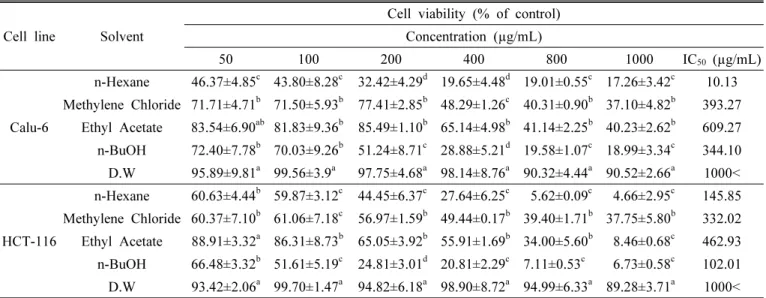
The cytotoxicity of C. lanceolata on two human cancer cell lines were evaluated using the MTT assay. When cells were treated for 48 hrs with various concentrations (50, 100, 200, 400, 800 and 1000 µg/mL) of different solvent fractions, the rate of cell survival progressively decreased in a dose-dependent manner. The cytotoxicity evaluation against human cancer cell lines of different solvent fractions from roots of C. lanceolata are shown in Table 1. Hexane fraction at 50 μg/mL exhibited a pronounced cytotoxic effect (46.37%) on Calu-6 cell com- parable to that of the ethyl acetate fraction (83.54%) and DW fraction (95.89%) at the same concentration. The cytotoxicity on HCT-116 cell at 50 μg/mL showed a high effect in n-hexane fraction (60.63%) and methylene chloride fraction (60.37%). The values of IC50 (concentration causing 50% cell death) against Calu-6 cell showed a high effect in n-hexane fraction (10.13 µg/mL) whereas DW fraction exhibited the weakest inhibition on cell viability, having an IC50 value of over 1,000 µg/mL. The values of IC50 against HCT-116 cell showed the highest activity in n-BuOH fraction (102.01 µg/mL), followed by n-hexane fraction (145.85 µg/mL), methylene chloride fraction (332.02 µg/mL), ethyl acetate fraction (462.93 µg/mL) and DW fracion (>1,000 µg/mL). Numerous compounds found in plants with anticancer properties are such as alkaloids, phenyl- propanoids, and terpenoids (Kintzios, 2006; Park et al., 2008;
Yan-Wei et al., 2009; Vijayarathna and Sasidharan, 2012).
Wang et al. (2011) investigated the effects of C. lanceolata extract on cancer cells and the molecular mechanism by which it induces apoptosis in human HT-29 colon cancer cells. It is well known that chemicals and medicinal plant medicines may
Table 1. Cytotoxicity of different solvent fractions of Codonopsis lanceolata on two human cancer cell lines.
Cell line Solvent
Cell viability (% of control) Concentration (µg/mL)
50 100 200 400 800 1000 IC50 (µg/mL)
Calu-6
n-Hexane 46.37±4.85c 43.80±8.28c 32.42±4.29d 19.65±4.48d 19.01±0.55c 17.26±3.42c 10.13 Methylene Chloride 71.71±4.71b 71.50±5.93b 77.41±2.85b 48.29±1.26c 40.31±0.90b 37.10±4.82b 393.27
Ethyl Acetate 83.54±6.90ab 81.83±9.36b 85.49±1.10b 65.14±4.98b 41.14±2.25b 40.23±2.62b 609.27 n-BuOH 72.40±7.78b 70.03±9.26b 51.24±8.71c 28.88±5.21d 19.58±1.07c 18.99±3.34c 344.10 D.W 95.89±9.81a 99.56±3.9a 97.75±4.68a 98.14±8.76a 90.32±4.44a 90.52±2.66a 1000<
HCT-116
n-Hexane 60.63±4.44b 59.87±3.12c 44.45±6.37c 27.64±6.25c 5.62±0.09c 4.66±2.95c 145.85 Methylene Chloride 60.37±7.10b 61.06±7.18c 56.97±1.59b 49.44±0.17b 39.40±1.71b 37.75±5.80b 332.02 Ethyl Acetate 88.91±3.32a 86.31±8.73b 65.05±3.92b 55.91±1.69b 34.00±5.60b 8.46±0.68c 462.93 n-BuOH 66.48±3.32b 51.61±5.19c 24.81±3.01d 20.81±2.29c 7.11±0.53c 6.73±0.58c 102.01 D.W 93.42±2.06a 99.70±1.47a 94.82±6.18a 98.90±8.72a 94.99±6.33a 89.28±3.71a 1000<
zData represent the mean values±SE of three independent experiments. Means with the same letter in column are not significantly different at p<0.05 level by Duncan’s multiple range test.
Calu-6: human pulmonary carcinoma cell, HCT-116: human colorectal carcinoma cell.
Fig. 1. Inhibition of α-amylase activity using different solvent fractions of Codonopsis lanceolata. Means with the same letter in column are not significantly different at p<0.05 level by Duncan’s multiple range test. The bars represent the standard error. M.C: methylene chloride. E.A: ethyl acetate, n-BuOH: n-butyl alcohol, D.W: distilled water.
produce toxic effects. These results suggest that different solvent fractions from C. lanceolata can be used as a source of cytotoxic agent.
α-Amylase inhibition
Inhibition of α-amylase by different solvent fractions from C. lanceolata are shown in Fig. 1. α-Amylase inhibitory activity in methylene chloride and ethyl acetate fractions was found to have a higher inhibitory effect with 24.5% and 25.6%
than the other fractions. α-Amylase inhibitory activity in n-hexane fraction, n-BuOH fraction and DW fraction showed to appear significantly lower. α-Amylase and α-glucosidase inhibitors have been useful as oral hypoglycemic drugs for the control of hyperglycemia especially in patients with type 2 diabetes mellitus.
Inhibition of these enzymes delays carbohydrate digestion and prolong the overall carbohydrates digestion time causing a reduction in the rate of glucose absorption and consequently reducing postprandial plasma glucose rise (Kimura et al., 2006). The α-amylase inhibitory effects of C. lanceolata may be attributed to the presence of phytochemicals. This also explains the reason behind the effective inhibitory activity displayed by the water extract towards the enzyme when compared to that exhibited by methanol extract. α-Amylase is an enzyme found in the salivary, intestinal mucosal and pancreatic secretions, functioning in the breakdown of the α-1-4-glycosidic bonds in
starch. Thus, this enzyme increases the bioavailability of glucose in the blood. Our study demonstrates an appreciable α-amylase inhibitory activity according to different solvent fractions. In particular, results suggests that the methylene chloride and ethyl acetate fractions act effectively as α-amylase inhibitors leading to a reduction in starch hydrolysis and hence eventually to lowered glucose levels.
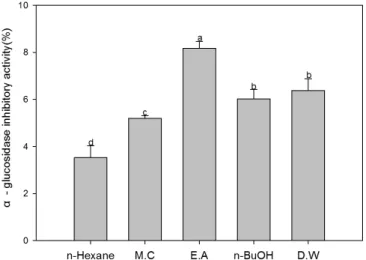
Fig. 2. Inhibition of α-glucosidase activity using different solvent fractions of Codonopsis lanceolata. Means with the same letter in column are not significantly different at p<0.05 level by Duncan’s multiple range test. The bars represent the standard error. M.C: methylene chloride. E.A: ethyl acetate, n-BuOH: n-butyl alcohol, D.W: distilled water.
Fig. 3. Inhibition of lipase activity using different solvent fractions of Codonopsis lanceolata. Means with the same letter in column are not significantly different at p<0.05 level by Duncan’s multiple range test. The bars represent the standard error. M.C: methylene chloride. E.A: ethyl acetate, n-BuOH: n-butyl alcohol, D.W: distilled water.
α-Glucosidase inhibition
The measurement results of α-glucosidase inhibitory activity by different solvent fractions from C. lanceolata are shown in Fig. 2. The ethyl acetate fraction extract had the highest α- glucosidase inhibitory activity, while the extract of DW fraction showed the lowest level of α-glucosidase inhibitory activity at a given experiment concentration. Depending on the extraction solvent fraction, it was observed that there was a significant difference in α-glucosidase inhibitory activity. α-Glucosidase, a key enzyme for carbohydrate digestion, has been recognized as a therapeutic target for modulation of postprandial hyperg- lycemia, which is the earliest metabolic abnormality to occur in type 2 diabetes mellitus (Vadivelan et al., 2012). Many natural resources have been investigated with respect to suppression of glucose production from carbohydrates in the gut or glucose absorption from the intestine (Hara and Honda, 1990). α- Amylase catalyses the hydrolysis of a-1, 4-glucosidic linkages of starch, glycogen and various oligosaccharides and α-glucosidase further breaks down the disaccharides into simpler sugars, readily available for the intestinal absorption. The inhibition of their activity, in the digestive tract of humans, is considered to be effective to control diabetes by diminishing the absorption of glucose decomposed from starch by these enzymes (He et al., 2006). Jung et al. (2006) reported the α-glucosidase inhibitory activity of tangshenoside I and adenosine isolated from the
roots of C. lanceolata. Our present research suggest that the presence of potential functional compounds of C. lanceolata may have a potentially important role in managing carbohydrate digesting enzymes via the inhibition of α-glucosidase enzyme activity.
Pancreatic lipase inhibition
The inhibitory effect of different solvent fractions from C.
lanceolata against pancreatic lipase was investigated that are shown in Fig. 3. The pancreatic lipase inhibitory activity of C.
lanceolata was found to become a higher effect in ethyl acetate fraction. Inhibition of lipase activity of the ethyl acetate fraction and n-hexane fraction showed a relatively high, while the extract of DW fraction showed the lowest level at given experiment concentration. Obesity is an increasingly serious global problem, not only for the harm it causes in its own right, but also due to the associated health threats, especially type 2 diabetes, systemic hypertension, cardiovascular disease, certain cancers, asthma, and sleep apnea (Kopelman, 2000; Finer, 2006). Many edible plants present an exciting opportunity for the development of newer therapeutics for biologically active antihyperlipidaemic agents from natural resources, especially the reduction of fat digestion and absorption (Kurihara et al., 2006; Zhang et al., 2008; Moller et al., 2009). Pancreatic lipase inhibitors which help to limit intestinal fat absorption at the initial stage, have
been proved as useful medications for the treatment of hyperli- pidaemia and a great promise as anti-obesity agents (Sharma et al., 2005). The mechanism of lipase inhibitors is to block the absorption of fat by inhibiting lipase in the gastrointestinal tract (Davidson, et al., 1999). Consequently, the root of C.
lanceolata in this study may have great potential as dietary supplements or nutraceutical foods for lipase inhibitory effect with antihyperlipidaemic properties.
ACKNOWLEDGEMENT
This study was supported by research fund from chosun university, 2015.
REFERENCES
Davidson, M. H., J. Hauptman, M. DiGirolamo, J. P. Foreyt, C. H.
Halsted, and D. Heber. 1999. Weight control and risk factor reduction in obese subjects treated for 2 years with orlistat: A Randomized Controlled Trial. JAMA. 281 : 235-242.
Frantz, S., L. Calvillo, J. Tillmanns, I. Elbing, C. Dienesch, H.
Bischoff, G. Ertl, and J. Bauersachs. 2005. Repetitive postprandial hyperglycemia increases cardiac ischemia/reperfusion injury:
prevention by the alpha-glucosidase inhibitor acarbose. FASEB J. 19 : 591-593.
Hara, Y. and M. Honda. 1990. The inhibition of a-amylase by tea polypphenols. Agri. Biol. Chem. 54(8) : 1939-1945.
He, Q., Y. Lv, and K. Yao. 2006. Effects of tea polyphenols on the activities of α-amylase, pepsin, trypsin and lipase. Food Chem.
101 : 1178-1182.
Joh, E. H., I. A. Lee, S. J. Han, S. J. Chae, and D. H. Kim. 2010.
Lancemaside A ameliorates colitis by inhibiting NF-jB activation in TNBS-induced colitis mice. Int. J. Colorectal Dis. 25 : 545-551.
Jung, S. W., A. J. Han, H. J. Hong, M. G. Choung, K. S. Kim, and S. H. Park. 2006. α-Glucosidase inhibitors from the roots of Codonopsis lanceolata Trautv. Agric. Chem. Biotechnol. 49(4) : 162-164.
Kim, H. Y., S. H. Lim, Y. H. Park, H. J. Ham, K. J. Lee, D. S. Park, K. H. Kim, and S. M. Kim. 2011. Screening of α-amylase, α-glucosidase and lipase inhibitory activity with Gangwon-do wild plants extracts. J. Korean Soc. Food Sci. Nutr. 40(2) : 308-315.
Kim, Y. M., Y. K. Jeong, M. H. Wang, W. Y. Lee, and H. I. Rhee.
2005. Inhibitory effect of pine extract on α-glucosidase activity and postprandial hyperglycemia. Nutrition. 21 : 756-761.
Kimura, Y., Y. Araki, A. Takenaka, and K. Igarashi. 2006. Protective effect of dietary nasunin and parapect induced oxidative stress in rat. Biosci. Biotechnol. Biochem. 63 : 799-804.
Kintzios, E. 2006. Terrestrial plant-derived anticancer agents and plant species used in anticancer research. Crit. Rev. Plant Sci.
25 : 79-113.
Kurihara, H., H. Shibata, Y. Fukui, Y. Kiso, J. K. Xu, X. S. Yao, and H. Fukami. 2006. Evaluation of the hypolipemic property of Camellia sinensis var. ptilophylla on postprandial hyper- triglyceridemia. J. Agric. Food Chem. 54 : 4977-4981.
Marshall, J. J. and C. M. Lauda. 1975. Purification and properties of phaseolamin, an inhibitor of alpha-amylase, from the kidney bean, Phaseolus vulgaris. J Biol Chem. 250 : 8030-8037.
Moller, N. P., N. Roos, and J. Schrezenmeir. 2009. Lipase inhibitory activity in alcohol extracts of worldwide occurring plants and propolis. Phytother. Res. 23 : 585-586.
Oh, S. J., J. H. Lee, K. S. Ko, D. B. Shin, and S. C. Koh. 2010.
Antioxidative activity, including inhibitory activities of ACE, APN and α-amylase, in Theaceae plants native to Jeju Island.
Korean J. Plant Res. 23(5) : 406-414.
Park, H. J., M. J. Kim, E. Ha, and J.H. Chung. 2008. Apoptotic effect of hesperidin through caspase 3 activation in human colon cancer cells, SNU-C4. Phytomedicine. 15 : 147-151.
Rahul, B. B. and K. B. Kamlesh. 2007. Pancreatic lipase inhibitors from natural sources: unexplored potential. Drug Discov.
Today. 12 : 879-889.
Satoyama, T., T. Hara, M. Murata, and Y. Fujio. 1998. A simple assay method for α-amylase using microplates. Nippon Nogei- kagaku Kaishi. 72 : 933-936.
Sharma, N., V. K. Sharma, and S. Y. Seo. 2005. Screening of some medicinal plants for anti-lipase activity. J. Ethnopharmacol.
97 : 453-456.
Vadivelan, R., S. P. Dhanabal, A. Wadhawani, and K. Elango. 2012.
α-Glucosidase and α-amylase inhibitory activities of Raphanus sativus Linn. IJPSR. 3(9) : 3186-3188.
Vijayarathna, S. and S. Sasidharan. 2012. Cytotoxicity of methanol extracts of Elaeis guineensis on MCF-7 and Vero cell lines.
Asian Pac. J. Trop Biomed. 2(10) : 826-829.
Wang, H. Z., C. H. Chang, C. P. Lin, and M. C. Tsai. 2006. Using MTT viability assay to test the cytotoxicity of antibiotics and steroid to cultured porcine corneal endothelial cells. J. Ocular Pharm Therapeutics 12 : 35-43.
Wang, L., M. L. Xu, J. H. u, S. K. Rasmussen, and M. H. Wang.
2011. Codonopsis lanceolata extract induces G0/G1 arrest and apoptosis in human colon tumor HT-29 cells – Involvement of ROS generation and polyamine depletion. Food Chem. toxicol.
49 : 149-154.
Yan-Wei, H., L. Chun-Yu, D. Chong-Min, W. Wen-Qian, and G.
Zhen-Lun. 2009. Induction of apoptosis in human hepatocarcinoma SMMC-7721 cells in vitro by flavonoids from Astragalus complanatus. J. Ethnopharmacol. 123 : 293-301.
Zhang, J., M. J. Kang, M. J. Kim, M. E. Kim, J. H. Song, Y. M.
Lee, and J. I. Kim. 2008. Pancreatic lipase inhibitory activity of taraxacum officinale in vitro and in vivo. Nutr. Res. Pract.
2(4) : 200-203.