• 검색 결과가 없습니다.

Alpha-Glucosidase Inhibitory Activity in Different Pepper Cultivars (Capsicum annuum L.)

N/A
N/A
Protected

Academic year: 2021

Share "Alpha-Glucosidase Inhibitory Activity in Different Pepper Cultivars (Capsicum annuum L.)"

Copied!
7
0
0

로드 중.... (전체 텍스트 보기)

전체 글

(1)

Received: March 13, 2017 Revised: January 22, 2018 Accepted: January 26, 2018

OPEN ACCESS

HORTICULTURAL SCIENCE and TECHNOLOGY 36(3):444-450, 2018

URL: http://www.kjhst.org pISSN : 1226-8763 eISSN : 2465-8588

This is an Open Access article distributed under the terms of the Creative Commons Attribution Non-Commercial License which permits unrestricted non-commercial use, distribution, and reproduction in any medium, provided the original work is properly cited.

Copyrightⓒ2018 Korean Society for Horticultural Science.

We thank Asia Seed Corporation (Seoul, Korea) for providing the pepper fruits. This work was supported under the Basic Science Research Program (NRF-2017R1D1A1A02018460) funded by the National Research Foundation of Korea, Bio-industry Technology Development Program 117043-3 of iPET (Korea Institute of Planning and Evaluation for Technology in Food Agri- culture and Forestry) and Next-Generation BioGreen 21 Program (Plant Molecular Breeding Center No. PJ01329601) of Rural Development Administration of Korea.

Alpha-Glucosidase Inhibitory Activity in Different Pepper Cultivars (Capsicum annuum L.)

Young-Cheon Kim 1† , Daeun Choi 1† , Jeong Hwan Lee 2 , and Sanghyeob Lee 1*

1

Department of Bioindustry and Bioresource Engineering, Plant Engineering Research Institute, Sejong University, 98 Gunja-dong, Gwangjin-gu, Seoul 05006, Korea

2

Department of Life Sciences, Chonbuk National University, 567 Baekje-daero, Deokjin-gu, Jeonju, Jeollabuk-do 54896, Korea

*Corresponding author: [email protected]

These authors contributed equally to this work.

Abstract

The number of cases of type II diabetes has increased dramatically worldwide. Plant-based foods offer some options for treating this disease. Effective diabetes prevention is achieved by controlling postprandial hyperglycemia by α-glucosidase inhibition. This study investigated the α-glucosidase inhibitory activity of extracts of 14 cultivars of pepper fruits ( Capsicum annuum L.), which are widely consumed in Korea. Pepper fruit extracts were prepared with 70% ethanol and water, and diluted to 50% and 25% strengths before performing an α-glucosidase inhibition assay. No significant differences in α-glucosidase inhibitory activity were found between the two different aqueous extracts. Mee-In and Dda-Go-Ddo-Dda-Go cultivars had the highest and most sustained inhibitory activity (almost 100%) against α-glucosidase. In contrast, while extracts from Soon- Han-Gil-Sang, Gil-Sang, Sweety, Hyul-Jo K, Shin-Hong, and Ai-Mat inhibited α-glucosidase activity, the level of inhibition sharply decreased with decreasing extract concentrations between 100% and 50%. The results of this study suggest the possible existence of unknown inhibitors that are present at different concentrations in different pepper cultivars. Further studies are required to identify the unknown enzymes that are key to α-glucosidase inhibition in pepper fruits.

Additional key words: acarbose, compound, diabetes, solanaceae, vegetable

Introduction

Diabetes mellitus is a chronic metabolic disorder caused by an absolute or relative lack of insulin. It is

characterized by hyperglycemia and disruptions in carbohydrate, protein, and fat metabolism. It is also

associated with several complications, such as retinopathy, neuropathy, and peripheral vascular

insufficiency (Chehade and Mooradian, 2000), and represents a global health problem (Pandey et al.,

2011). There has been a sharp increase in the number of diabetic patients worldwide, including Korea,

because of changes in lifestyle and diet. High carbohydrate diets elevate postprandial hyperglycemia,

which can progress to type II diabetes (Gerrits and Tsalikian, 1993). Inhibitors of α -glucosidase and α

-amylase have been suggested as an effective means of lowering postprandial hyperglycemia, which is

(2)

known to be the earliest defect occurring in type II diabetes (Matsui et al., 2006).

Pepper (Capsicum annuum L.), belonging to the Solanaceae plant family, is the most highly consumed season-free crop in the world (Wahyuni et al., 2013). The pepper fruit, widely used in dried or fresh forms, is one of most important ingredients in traditional Korean fermented foods, including various kinds of kimchi (Ku and Kang, 2010). The red pepper fruit contains a range of essential nutrients and bioactive compounds, including provitamin A and flavonoids that are known to have antioxidant, antimicrobial, antiviral, anti-inflammatory, and anticancer effects (Minguez-Mosquera and Hornero-Mendez, 1993; Lee et al., 1995; Ku et al., 2009; Luo et al., 2011). Capsaicin, known to confer a spicy taste, is a main constituent of the pepper fruit, and has been extensively studied for its pharmacological relevance (Luo et al., 2011).

A previous study found that phenolic compounds from pepper leaves, including polyamine phenolic conjugates, chlorogenic acid derivatives, anthocyanin, and flavone glycosides, have antioxidant activities (Kim et al., 2014). Recently, Park et al. (2016) reported that pepper (C. annuum L. cv. Dangjo) leaf extract inhibited the activities of α -glucosidase and α -amylase-possibly caused by the presence of luteolin 7-O-glucoside (L7G), a flavonoid glucoside. To date, few studies have analyzed α -glucosidase inhibitory (AGI) activity using pepper fruits. This study, therefore, set out to investigate the AGI effects of pepper fruits.

Materials and Methods Reagents

Alpha-Glucosidase from Saccharomyces cerevisiae, p-nitrophenyl glucopyranoside (pNPG), acarbose, and L7G were purchased from Sigma-Aldrich (MO, USA). All other unnoted chemicals were purchased from Sigma-Aldrich.

Plant Material

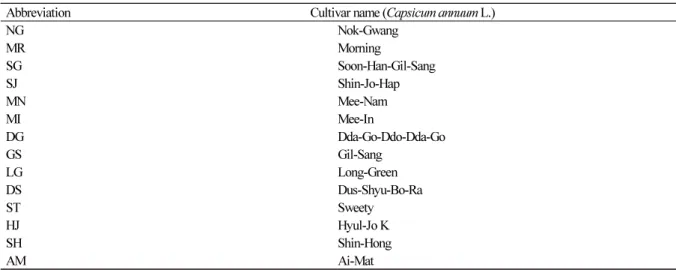
Fruits of 14 pepper cultivars (C. annuum) were obtained from Asia Seed Corporation, Seoul, Korea (Table 1). Three fresh fruits per cultivar were wiped with a paper towel to remove contaminants, and were cut into pieces before being placed in liquid nitrogen. Fruits were dried at 55°C for 2 d, and ground to a fine powder using a mortar and pestle. The powdered samples were stored at 4°C until use.

Table 1. List of cultivars and abbreviations used in this study

Abbreviation Cultivar name ( Capsicum annuum L.)

NG Nok-Gwang

MR Morning

SG Soon-Han-Gil-Sang

SJ Shin-Jo-Hap

MN Mee-Nam

MI Mee-In

DG Dda-Go-Ddo-Dda-Go

GS Gil-Sang

LG Long-Green

DS Dus-Shyu-Bo-Ra

ST Sweety

HJ Hyul-Jo K

SH Shin-Hong

(3)

Preparation of Plant Extracts

Two hundred and fifty milligrams of powdered sample was divided into two portions for extraction with 2 mL of 70%

ethanol (EtOH) and water (H

2

O), and incubated at 55°C for 16 h. Extracts were filtered through the Empty PD-10 column (GE Healthcare, PA, USA), and concentrated in a speed vacuum centrifuge (CVE-2200, Eyela, Japan). Samples were extracted in triplicate, and the dried extracts were stored at 4°C until use.

Alpha-Glucosidase Inhibition Assay

The effect of pepper fruits on α -glucosidase activity was determined using the procedure described by Kim et al. (2005), with some modifications. The pNPG substrate solution was prepared in 20 mM phosphate buffer (pH 6.9). One hundred microliters of α -glucosidase (1.0 U·mL

-1

) was preincubated with 50 µL of 100%, 50%, and 25% extracts (70% EtOH and H

2

O) for 10 min. Then, 50 µL of substrate (3.0 mM pNPG dissolved in 20 mM phosphate buffer at pH 6.9) was added to start the reaction. The reaction mixture was incubated at 37°C for 20 min, and stopped by adding 2 mL of 0.1 M Na

2

CO

3

. Alpha-glucosidase activity was determined by measuring the yellow-colored paranitrophenol released from pNPG at 405 nm.

The blank control was prepared using the same procedure, except that α -glucosidase was replaced with 20 mM phosphate buffer (pH 6.9).

Percentage inhibition was calculated as follows:

% Inhibition = 

 

 

    

  × 

Conditions for High Performance Liquid Chromatography (HPLC)

Extracts from the cultivars Mee-In (MI) and Soon-Han-Gil-Sang (SG) were prepared using the same procedure as described above for the AGI assay. Dried extracts were reconstituted in 150 µL methanol (MeOH) before being injected into the HPLC system. The HPLC system comprised an LC-20AD pump, SPD-20A ultraviolet/visible light detector, CBM-20A communications bus module, and an SIL-20AC autosampler (Shimadzu, Kyoto, Japan), which was used in combination with a 4.6 × 250 mm Syncronis C

18

column (Thermo Scientific, MA, USA). The mobile phases contained two solvents: (A) 0.1%

formic acid in H

2

O, and (B) 0.1% formic acid in acetonitrile. Samples were injected in a total volume of 20 µL, and the flow rate of the solvent was maintained at 1 mL/min. Separation of the sample extracts was carried out using the following gradient elution profile: 5% B for 10 min, which was increased to and maintained at 70% and 100% B for 35-40 min and 45-50 min, respectively, and then restored to and maintained at 5% B for 55-60 min. UV signals were monitored at 350, 300, and 210 nm.

All reagents used were of analytical grade.

Statistical Analysis

Version 3.4.3 of the R program was used to perform analysis of variance (ANOVA) and t-tests. The latter was used to

compare between the means of data obtained from different concentrations of SG and MI fruit extracts. Tukey’s ANOVA test

was used to assess differences between the means of data obtained from extracts of different varieties of pepper fruit.

(4)

Results and Discussion

The purpose of this study was to investigate the AGI effects of 14 pepper cultivars commonly consumed in Korea. The α -glucosidase activity assay was conducted using different concentrations of extracts obtained from different solvents (70%

EtOH and H

2

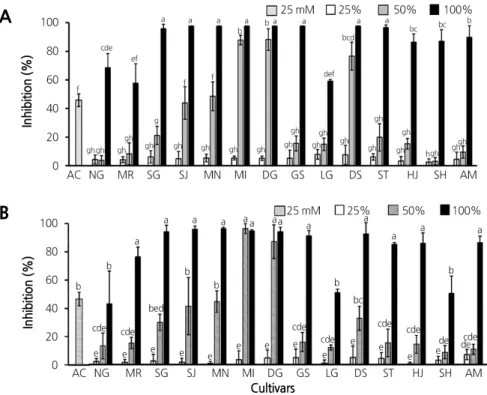
O). A list of pepper cultivars used in this study is given in Table 1, and their appearances are presented in Fig. 1. Results of the AGI assays conducted with two different solvents are shown in Fig. 2. Acarbose diluted to 25 mM was used as positive control. Undiluted extracts using 70% EtOH had almost 100% AGI activity, except for extracts of Nok-Gwang (NG), Morning (MR), and Long-Green (LG) cultivars. However, AGI activity decreased sharply when extracts from NG, MR, SG, Gil-Sang (GS), LG, Sweety (ST), Hyul-Jo K (HJ), Shin-Hong (SH), and Ai-Mat (AM) were diluted to 50%. Interestingly, there was almost no change in AGI activity between undiluted and diluted extracts (50%) of MI and Dda-Go-Ddo-Dda-Go (DG); the degree of change was lower for extracts from Shin-Jo-Hap (SJ), Mee-Nam (MN), and Dus-Shyu-Bo-Ra (DS) extracts. All of the extracts diluted to 25% showed inhibition rates of than 10% (Fig. 2A).

Fig. 1. Pepper fruits used in this study. NG, Nok-Gwang; MR, Morning; SG, Soon-Han-Gil-Sang; SJ, Shin-Jo-Hap; MN,

Mee-Nam; MI, Mee-In; DG, Dda-Go-Ddo-Dda-Go; GS, Gil-Sang; LG, Long-Green; DS, Dus-Shyu-Bo-Ra; ST, Sweety; HJ,

Hyul-Jo K; SH, Shin-Hong; AM, Ai-Mat. Scale bars = 20 mm.

(5)

A

B

Fig. 2. Inhibitory effects of pepper fruit extracts on α-glucosidase activity. Seventy percent ethanol (A) and H

2

O (B) were used for extraction. Twenty-five millimoles of acarbose (AC) served as the positive control. NG, Nok-Gwang; MR, Morning; SG, Soon-Han-Gil-Sang; SJ, Shin-Jo-Hap; MN, Mee-Nam; MI, Mee-In; DG, Dda-Go-Ddo-Dda-Go; GS, Gil-Sang;

LG, Long-Green; DS, Dus-Shyu-Bo-Ra; ST, Sweety; HJ, Hyul-Jo K; SH, Shin-Hong; AM, Ai-Mat. Vertical bars represent the mean ± SD value (n = 3). Different lower case letters indicate significant difference (p < 0.05) according to Tukey’s test.

The AGI activities of samples extracted with H

2

O were also determined to compare the extraction efficiencies of 70%

EtOH to H

2

O. There was no significant difference between 70% EtOH and H

2

O extraction solvents; the cultivar-dependent AGI activity associated with undiluted and 50% diluted H

2

O extracts followed the same trends as the corresponding samples extracted with 70% EtOH (Fig. 2B).

Interestingly, different patterns of decreasing AGI activity were detected between the two sample groups. The first group, comprising MI, DG, and DS extracts, showed almost no change upon dilution; the second group, comprising SG, SJ, MN, GS, ST, HJ, SH, and AM extracts, showed sharply decreasing AGI activity after dilution to 50%. These results suggest the presence of an unknown compound or compounds in pepper cultivars that inhibit α -glucosidase in a concentration- dependent manner. To elucidate this possibility, AGI assays of SG and MI sample extracts (which, having different decreasing AGI activity patterns were selected to represent the two groups) were compared. As shown in Fig. 3, the MI extract maintained almost 100% AGI activity up to 40% extract concentration. However, the AGI activity of SG extract began to decrease at 80% extract concentration, and continued to decrease to around 30% of AGI activity at 50% extract concentration.

These patterns reflect the results in Fig. 2A. Taken together, these results suggest that the MI extract contains a higher

concentration of an unknown AGI compound.

(6)

Fig. 3. Alpha-glucosidase inhibition assay of Mee-In (MI) and Soon-Han-Gil-Sang (SG) pepper fruit extracts diluted from 100% to 80%, 60%, 40%, 30%, 25%, 10%, and 5%. Ethanol (70%) was used for extraction. Vertical bars represent the mean ± SD (n = 3). Asterisks (*) indicate significant difference between MI and SG (two-sided t-test, p < 0.05).

A

B

C

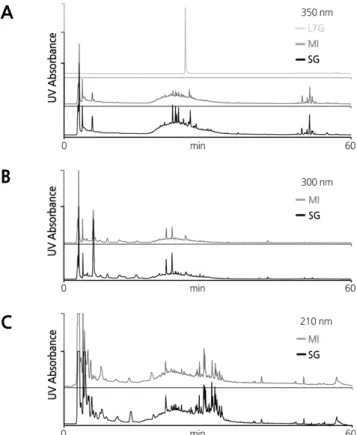
Fig. 4. Determination of alpha-glucosidase inhibitory compounds by comparing high performance liquid chromatography (HPLC) chromatograms. (A) HPLC chromatograms of L7G standard, Mee-In (MI) extract, and Soon-Han-Gil-Sang (SG) extract; UV signals monitored at 350 nm. (B) Chromatogram comparison of MI and SG extracts; UV signals monitored at 300 nm and (C) 210 nm.

Park et al. (2016) reported that LG7, a compound in the extract of pepper leaves, inhibits α -glucosidase and α -amylase

activity, and reduces blood glucose levels in diabetic mice. Extracts of MI and SG were analyzed using an HPLC system to

determine LG7 levels, but no significant difference in LG7 concentrations were found between the two samples (Fig. 4A). A

previous study identified active antioxidants in pepper leaves, namely, a phenolic compound, a polyamine phenolic

(7)

Telagari and Hullatti (2015) reported that Adiantum caudatum L. and Celosia argentea L. extracts rich in triterpenoids, phenolics, and flavonoids were effective α -glucosidase and α -amylase inhibitors. One or more of these phenolic or flavonoid compounds might be a key effector of AGI in pepper fruit extracts. In this study, extracts of MI and DG had the highest AGI effect of all the pepper extracts studied. NG, MR and LG showed relatively lower AGI activity, even at 100%

extract concentration. After separating the components of MI and SG using HPLC, their chromatograms yielded no evidence of any major AGI compounds (Fig. 4A, B, and C). To identify AGI effectors in pepper fruits, further research is required using precise analytical methods and instruments such as HPLC, gas chromatography, and liquid chromatography-tandem mass spectrometry. This study provides an exciting opportunity to advance our knowledge of the usefulness of pepper fruits as a nutraceutical to control diabetes.

Literature Cited

Bhandari SR, Bashyal U, Lee YS (2016) Variations in proximate nutrients, phytochemicals, and antioxidant activity of field-cultivated red pepper fruits at different harvest times. Hortic Environ Biotechnol 57:493-503. doi:10.1007/s13580-016-1008-6

Chehade JM, Mooradian AD (2000) A rational approach to drug therapy of type 2 diabetes mellitus. Drugs 60:95-113. doi:10.2165/

00003495-200060010-00006

Gerrits PM, Tsalikian E (1993) Diabetes and fructose metabolism. Am J Clin Nutr 58:796S-799S. doi:10.1093/ajcn/58.5.796S Kim WR, Kim EO, Kang K, Oidovsambuu S, Jung SH, Kim BS, Nho CW, Um BH (2014) Antioxidant activity of phenolics in leaves of three

red pepper (Capsicum annuum) cultivars. J Agric Food Chem 62:850-859. doi:10.1021/jf403006c

Kim YM, Jeong YK, Wang MH, Lee WY, Rhee HI (2005) Inhibitory effect of pine extract on alpha-glucosidase activity and postprandial hyperglycemia. Nutrition 21:756-761. doi:10.1016/j.nut.2004.10.014

Ku KM, Kang YH (2010) Quinone reductase inductive activity of capsicum annuum leaves and isolation of the active compounds. J Korean Soc Appl Biol Chem 53:709-715. doi:10.3839/jksabc.2010.107

Ku KM, Kim HS, Kim BS (2009) Antioxidant activities and antioxidant constitutents of pepper leaves from various cultivars and correlation between antioxidant activities and antioxidant constituents. J Appl Biol Chem 52:70-76. doi:10.3839/jabc.2009.013

Lee Y, Howard LR, Villalon B (1995) Flavonoids and antioxidant activity of fresh pepper (Capsicum annuum) cultivars. J Food Sci 60:473-476. doi:10.1111/j.1365-2621.1995.tb09806.x

Luo XJ, Peng J, Li YJ (2011) Recent advances in the study on capsaicinoids and capsinoids. Eur J Pharmacol 650:1-7. doi:10.1016/

j.ejphar.2010.09.074

Matsui T, Ogunwande IA, Abesundara KJ, Matsumoto K (2006) Anti-hyperglycemic potential of natural products. Mini Rev Med Chem 6:349-356. doi:10.2174/138955706776073484

Minguez-Mosquera MI, Hornero-Mendez D (1993) Separation and quantification of the carotenoid pigments in red peppers (Capsicum annuum L.), paprika, and oleoresin by reversede-phase HPLC. J Agric Food Chem 41:1616-1620. doi:10.1021/jf00034a018 Pandey A, Tripathi P, Pandey R, Srivatava R, Goswami S (2011) Alternative therapies useful in the management of diabetes: A systematic

review. J Pharm Bioallied Sci 3:504-512. doi:10.4103/0975-7406.90103. doi:10.4103/0975-7406.90103

Park MS, Zhu YX, Pae HO, Park SH (2016) In vitro and in vivo alpha-glucosidase and alpha-amylase inhibitory effects of the water extract of leaves of pepper (capcicum annuum L. cultivar Dangjo) and the active constituent luteolin 7-o-glucoside. J Food Biochem 40:696- 703. doi:10.1111/jfbc.12252

Telagari M, Hullatti K (2015) In-vitro alpha-amylase and alpha-glucosidase inhibitory activity of Adiantum caudatum Linn. and Celosia argentea Linn. extracts and fractions. Indian J Pharmacol 47:425-429. doi:10.4103/0253-7613.161270

Wahyuni Y, Ballester AR, Sudarmonowati E, Bino RJ, Bovy AG (2013) Secondary metabolites of capsicum species and their importance

in the human diet. J Nat Prod 76:783-793. doi:10.1021/np300898z

수치

Table 1. List of cultivars and abbreviations used in this study
Fig. 1. Pepper fruits used in this study. NG, Nok-Gwang; MR, Morning; SG, Soon-Han-Gil-Sang; SJ, Shin-Jo-Hap; MN,  Mee-Nam; MI, Mee-In; DG, Dda-Go-Ddo-Dda-Go; GS, Gil-Sang; LG, Long-Green; DS, Dus-Shyu-Bo-Ra; ST, Sweety; HJ,  Hyul-Jo K; SH, Shin-Hong; AM,
Fig. 2. Inhibitory effects of pepper fruit extracts on α-glucosidase activity. Seventy percent ethanol (A) and H 2 O (B) were  used  for  extraction
Fig. 4. Determination of alpha-glucosidase inhibitory compounds by comparing high performance liquid chromatography  (HPLC) chromatograms

참조

관련 문서

ABSTRACT : In order to find out anticancer activity of Korean pepper (Capsicum annuum L.), the cytotoxicity against 8 cell lines including 293 (normal kidney cells) and

This study was carried out to investigate the effects of rain-shelter types on growth, and fruit quality of red pepper ( Capsicum annuum , ‘Kemmaru’) cultured in paddy..

The present study evaluated the effect of chitosan on the changes of soil chemical properties, soil microbial population, and yield of red pepper (Capsicum annuum L.)

ABSTRACT : In order to find out anticancer activity of Korean pepper (Capsicum annuum L.), the cytotoxicity against 8 cell lines including 293 (normal kidney cells)

This study was conducted to determine the impact of temperature elevated based on climate change scenario on growth and fruit quality of red pepper ( Capsicum annuum L.)

Changes of carbohydrates in pepper (Capsicum annuum L.) flowers in relation to their abscission under different shading regimes.. Flower and fruit abortion in

α-glucosidase inhibitory activity assay of stings of Gleditsia sinensis extracts.. AC, acarbose (1 mg/ml) pos- itive control; GSM, stings of Gleditsia sinensis methanol extracts;

In conclusion, methanolic extracts from 54 seaweed species collected from Jeju Island were evaluated for their α-glucosidase inhibitory activities by HTS