Case Report
A Case of Decreased Visual Field after Uneventful Cataract Surgery: Nonarteritic Anterior Ischemic Optic Neuropathy
Hun Lee
1, Chan Yun Kim
1, Gong Je Seong
1, Kyoung Tak Ma
2
1
Department of Ophthalmology, Institute of Vision Research, Yonsei University College of Medicine, Seoul, Korea
2
Siloam Eye Hospital, Seoul, Korea
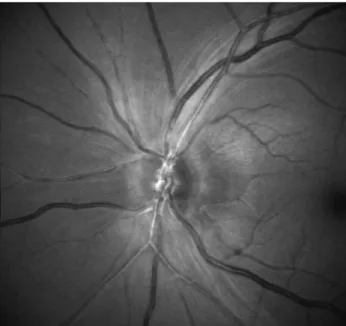
The purpose of this article is to report a case of nonarteritic anterior ischemic optic neuropathy (NAION) after un- eventful cataract surgery. A 53–year-old Filipina underwent cataract surgery. She had a small optic disc with cup-to-disc ratio of 0.2 in the left eye and 0.3 in the right eye. On the first postoperative day, the uncorrected visual acuity (UCVA) was 20/20, with an intraocular pressure (IOP) of 20 mmHg in the left eye. At one week after oper- ation, the UCVA was 20/20 and the IOP was 15 mmHg. Three weeks later, she underwent cataract surgery in the right eye. On the first postoperative day, her UCVA was 20/20 in both eyes, but she complained of a visual field de- crease in the left eye. A relative afferent pupillary defect (RAPD) was noted and the optic disc was pallid and swollen diffusely. A red-free photo showed defect surrounding the optic disc. A visual field test showed tunnel vision sparing the central vision. In this report, the authors hypothesize an association between cataract extraction and delayed NAION. Since the risk of NAION in the fellow eye is 30-50%, visual acuity, visual field, fundus exam and RAPD should be routinely checked.
Key Words: Cataract, Ischemic optic neuropathy
Received: December 16, 2008 Accepted: December 31, 2009
Reprint requests to Kyoung Tak Ma. Siloam Eye Hospital, #60 Deung
Chon-ro, Gangseo-gu, Seoul 157-836, Korea. Tel: 82-2-2650-0881, Fax:
82-2-2650-0895, E-mail: [email protected]
ⓒ 2010 The Korean Ophthalmological Society
This is an Open Access article distributed under the terms of the Creative Commons Attribution Non-Commercial License (http://creativecommons.org/licenses
/by-nc/3.0/) which permits unrestricted non-commercial use, distribution, and reproduction in any medium, provided the original work is properly cited.
Cataract surgery is now regarded as a common, highly ef- fective and safe ophthalmic surgical procedure; however, the surgery still causes several problems. Among many compli- cations, neuro-ophthalmologic complications from cataract surgery are relatively uncommon and include diplopia, central nervous system toxicity, traumatic optic neuropathy and is- chemic optic neuropathy. Case reports and case series suggest that cataract extraction may be associated with an increased incidence of nonarteritic anterior ischemic optic neuropathy (NAION) [1-8]. The risk of NAION after cataract extraction is low, approximately one occurrence in every 2,000 cases [1].
This represents a significantly greater incidence than the gen- eral population, which is estimated to be 2.3 to 10.2 per 100,000 people among patients 50 years and older [9, 10]. A history of NAION in the fellow eye may be an additional risk factor [1, 11-13]. A diagnosis is made if the following criteria are met: 1) acute visual acuity loss and/or visual field loss consistent with a defect in the nerve fiber layer; 2) optic
nerve head edema with neural rim pallor or development of optic nerve head pallor after the onset of visual loss; 3) rela- tive afferent pupillary defect; and 4) elimination of all other etiologies. Treatment, including corticosteroids and surgical optic nerve sheath fenestration, has not been demonstrated to be effective [14-16].
Two types of NAION associated with cataract extraction have been reported; an immediate type, occurring within hours to days after surgery [2, 3], and a delayed type, occur- ring weeks to months after surgery following a period of normal vision [4-8]. Although the immediate type is known to be related to elevated intraocular pressure, there is lim- ited evidence to support intraocular surgery as a cause in de- layed cases. The authors of this case study report delayed NAION after uneventful phacoemulsification and intra- ocular lens implantation.
Case Report
A 53–year-old Asian female (Filipina) received uneventful phacoemulsification and intraocular lens implantation in both eyes, three weeks apart, under topical anesthesia.
Both cataract surgeries were uneventful. The patient had
no systemic or ocular disease at the preoperative examination