Korean Journal of Ophthalmology 22(2):111-114, 2008 DOI : 10.3341/kjo.2008.22.2.111
111
Received: November 2, 2007 Accepted: April 10, 2008
Reprint requests to Sang‐hoon Rah, MD. Department of Ophthal- mology, Wonju Christian Hospital, Yonsei University Wonju College of Medicine, 162 Ilsan‐dong, Wonju‐city, Gangwon‐do 220‐701, Korea.
Tel: 82‐33‐741‐0633, Fax: 82‐33‐745‐2965, E‐mail : [email protected]
The Comparision of Outcomes Between Lateral Rectus Muscles Re‐recession and Medial Rectus Muscles
Resection in Recurrent Exotropia
Ko‐i Chun, MD, Sang‐hoon Rah, MD
Department of Ophthalmology, Wonju Christian Hospital, Yonsei University Wonju College of Medicine, Wonju ‐ city, Gangwon ‐ do, Korea
Purpose: To compare the surgical outcomes between bilateral lateral rectus muscles (BLR) re‐recession and bilateral medial rectus muscles (BMR) resection in recurrent exotropia.
Methods: The medical records of patients with recurrent exotropia who underwent surgery for intermittent exotropia during the 6 years from January 2001 to December 2006 and followed up for more than 6 months were reviewed retrospectively.
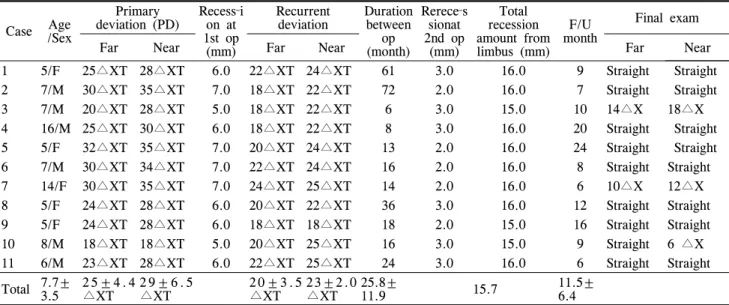
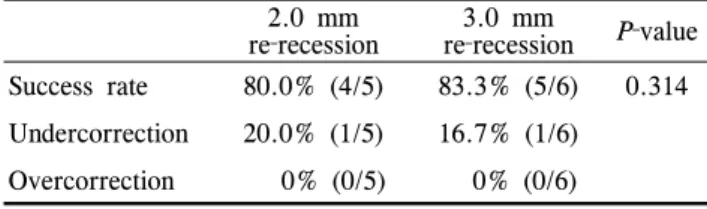
Results: In group A, BLR recessions was performed at the first surgery and BLR re‐recession was performed at the second surgery. In group B, BLR recession was performed at the first surgery and BMR resection at the second surgery. Success rates at the last follow‐up after the second operation were 81.9% in Group A and 83.3% in Group B, showing no statical difference between the two groups. In group A, no significant underaction of the BLR was noted. Success rates were not statistically different between the 2 mm re‐
recessed subgroup and 3 mm re‐recessed subgroup.
Conclusions: The results support the notion that BLR re‐recession successfully corrects recurrent exotropia without producing significant limitation of abduction.
Korean Journal of Ophthalmology 22(2):111-114, 2008
Key Words: Bilateral lateral rectus muscles re‐recession, Recurrent exotropia
The purpose of strabismus surgery is to realign the deviated eyeball. However, regardless of the application of the best surgical technique, strabismus always has a possibility to require resurgery.
1 After surgery, in cases with recurrent exotropia with time, if diplopia were developed, for the cases whose binocular vision could not be maintained or the deviation were severe to the level that strabismus were shown in appearance, resurgery is required.
2
For exotropia surgery, bilateral lateral rectus muscles recession or unilateral recession and resection has been generally used.
3 Upon recurrence of exotropia, surgical procedure of resurgery is determined depending on the first surgery procedure.
4 The patients who had bilateral lateral rectus muscles recession for the first surgery, primarily, medial rectus muscle resection is applied for the second surgery, and although rare, lateral rectus muscles re‐recession may be performed.
4 Lateral rectus muscles re‐recession has
the advantage that unoperated muscles could be conserved maximally. Nevertheless, reports on the re‐recession amount is rare, therefore, after excessive lateral rectus muscles re‐
recession, abduction impairment of the rectus muscles may be induced.
We compared the surgical outcome of patients who had bilateral lateral rectus muscles re‐recession with patients who had bilateral medial rectus muscles resection for exotropia recurred after the first bilateral lateral rectus muscles recession surgery, and assessed the successful re‐recession amount for procedure.
Materials and Methods
The medical records of patients with recurrent exotropia who underwent surgery for intermittent exotropia from January 2001 to December 2006 and followed up for more than 6 months were examined retrospectively. Patients with congenital exotropia, sensory exotropia or paralytic strabismus, patients with systemic diseases that may cause the impairment of the extraocular muscle, and other ophthalmic anomalies were excluded from the study.
A total of 23, patients received the second surgery for
recurrent exotropia after the first surgery for intermittent