Received: October 11, 2007 Accepted: April 2, 2008
Reprint requests to Joo Yeon Lee, MD., PhD. Department of Ophthal- mology, Hallym University Sacred Heart Hospital, 896 Pyungchon‐
dong, Anyang‐city, Gyeonggi‐do 431‐070, Korea. Tel: 82‐31‐380‐
3838, Fax: 82‐31‐380‐3837, E‐mail: [email protected]
* This paper was presented in part at the 94th annual meeting of the Korean Ophthalmological Society, October. 2005
Vertical Rectus Muscles Transposition in Large Exotropia with Medial Rectus Muscle Transection Following
Endoscopic Sinus Surgery
Yoonae A. Cho, MD, PhD
1, Sang Hoon Rah, MD, PhD
2, Myung Mi Kim, MD, PhD
3, Joo Yeon Lee, MD, PhD
4Department of Ophthalmology, Korea University College of Medicine, Anam Hospital
1, Seoul, Korea Department of Ophthalmology, Wonju Christian Hospital Yonsei University, Wonju College of Medicine
2, Wonju, Korea
Department of Ophthalmology, Yeungnam University College of Medicine
3, Daegu, Korea
Department of Ophthalmology, Hallym University College of Medicine, Hallym University Sacred Heart Hospital, Anyang ‐ city
4, Gyeonggi ‐ do, Korea
Purpose: To evaluate the effect of transposition procedures on the vertical rectus muscle (VRM) in the patients who underwent a medial rectus muscle (MR) transection after endoscopic sinus surgery (ESS).
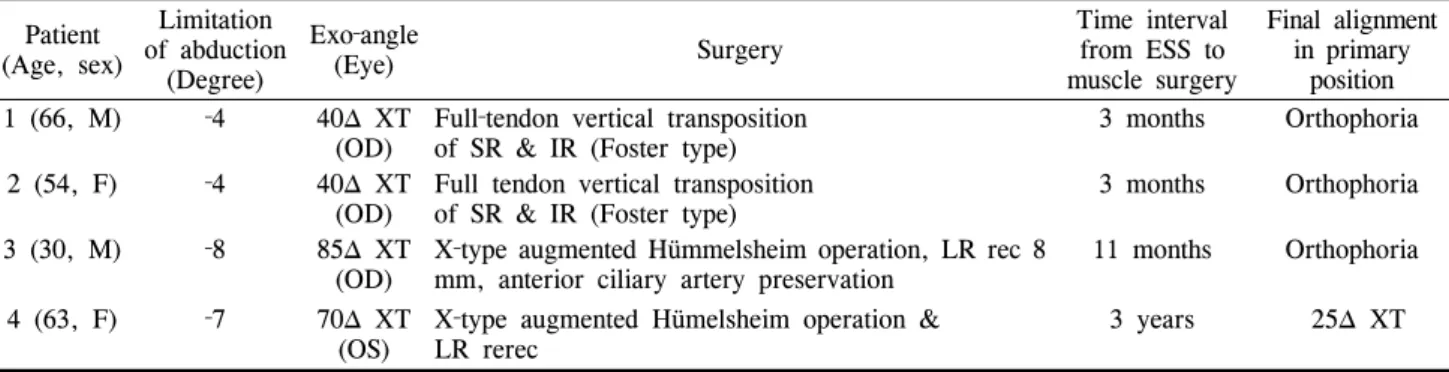
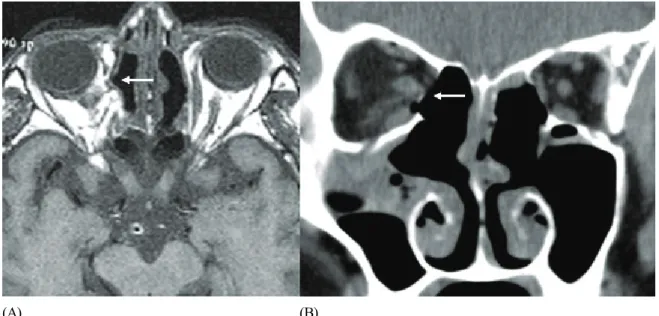
Methods: In 4 patients with exotropia (XT) and a lack of adduction after ESS, orbital CT or MRI revealed a complete transection of the midportion of the MR. Full‐tendon VRM transposition was performed within 3 months after injury (early surgery) in 2 patients with 40△ XT. Two patients with 70△ and 85△ XT underwent an X‐type augmented Hümmelsheim procedure, which involved pulling each half‐tendon and crossing it through the undersurface of the severed MR to the other end of the MR insertion, concurrently with an ipsilateral lateral rectus (LR) recession 11 months and 36 months after ESS, respectively. The adduction deficits were divided into ‐1 through to ‐8. The patients were followed up for more than than 1.5 years.
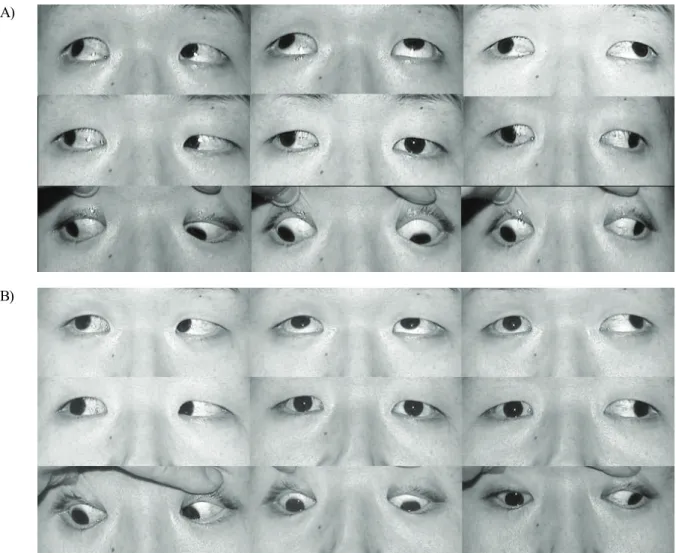
Results: Postoperatively, 3 patients showed orthophoria and no diplopia in the primary position. The adduction deficits improved to ‐3.5 or –4. One patient who underwent an X‐type augmented Hümmelsheim procedure showed a residual XT of 25△.
Conclusions: VRM transposition is effective in correcting a large XT secondary to a MR transection after ESS. When a longstanding large‐angle XT with severe contracture of the ipsilateral LR and massive scarring of the adjacent tissues is present, the X‐type augmented Hümmelsheim procedure coupled with an ipsilateral LR recession had an augmenting effect.
Korean Journal of Ophthalmology 22(2):104-110, 2008
Key Words: Endoscopic sinus surgery, Exotropia, Medial rectus muscle transection, Vertical rectus muscles transposition
Orbital complications associated with intranasal sinus surgery are well known in the field of otolaryngology.
1‐4During the past decade, endoscopic sinus surgery (ESS) has been developed, and improved the surgical technique for the chronic paranasal sinusitis.
5However, ESS can leads to a greater potential for damage
to the orbital tissues because it carries the risk of complications as a result of the narrow surgical field, difficulty in mastering the technique and the necessity of a practiced hand.
6The intimate anatomic relationship between the paranasal sinuses and the other structures including the cribriform plate, skull base and lamina papyracea, can increase the risk of injury to the periocular tissue during ESS.
7Orbital complications include periorbital ecchymosis with an injury of the lamina papyracea, retrobulbar hematoma, ocular motor defect with extraocular muscles (EOM) injury, optic nerve injury, nasolacrimal duct injury, orbital abscess or emphysema, etc.
4,8‐12Mark
13and Flynn
14reported exotropia (XT) with deficient eye movement after traditional intranasal sinus surgery.
Among the damage to the EOM, damage to the medial rectus
(MR), inferior rectus (IR) and superior oblique have been
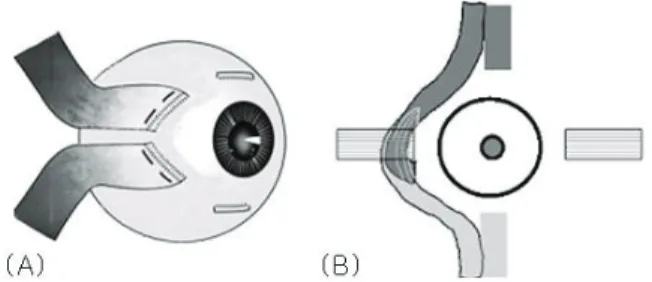
Fig. 1. The method of surgery used in this study. (A) Diagram of the full thickness vertical muscle transposition toward medial rectus muscle in patients 1 and 2. (B) Diagram of the X‐type augmented Hummelsheim operation in patients 3 and 4.
reported. The incidence of complications related to the MR, including muscle contusion, hematoma, the entrapment of bony defects, paralysis and transection, are most common.
8,12‐13,15‐17