http://crossmark.crossref.org/dialog/?doi=10.14474/ptrs.2016.5.4.198&domain=pdf&date_stamp=2016-12-25
Received: 21 November, 2016 Revised: 12 December, 2016 Accepted: 16 December, 2016 Corresponding author: Eun Jung Chung
Department of Physical Therapy, Andong Science College, 189 Seoseon-gil, Seohu-myeon, Andong 36616, Republic of Korea Tel: 82-54-851-3752 Fax: 82-54-851-3559 E-mail: [email protected]
This is an Open-Access article distributed under the terms of the Creative Commons Attribution Non-Commercial License (http://creativecommons.org/licens es/by-nc/4.0) which permits unrestricted non-commercial use, distribution, and reproduction in any medium, provided the original work is properly cited.
Copyright © 2016 Korean Academy of Physical Therapy Rehabilitation Science
https://doi.org/10.14474/ptrs.2016.5.4.198 pISSN 2287-7576
eISSN 2287-7584
Phys Ther Rehabil Sci 2016, 5 (4), 198-204 www.jptrs.org
The effect of hip joint exercise using an elastic band on dynamic balance, agility and flexibility in healthy subjects:
a randomized controlled trial
Dong Hyun Kang, Woo Hyung Lee, Song Lim, Yu Yeong Kim, Soung Wook An, Chang Gyeong Kwon, Gyeong Hee Lee, Nu Ri Choi, Na Yeong Lee, Bo Min Kim, Jae Hyeon Kim, Eun Jung Chung
Department of Physical Therapy, Andong Science College, Andong, Republic of Korea
Objective: The purpose of this study was to examine the effects of hip joint exercise using an elastic band on dynamic balance, agility, and flexibility in healthy subjects.
Design: Randomized controlled trial.
Methods: Thirty-five subjects (between 19 and 23 years) were randomly allocated to two groups: hip flexion exercise (HFE) group (n=17) and the hip abduction exercise (HAE) group (n=18). The HFE group participated in flexion exercise of the hip joint using an elastic band for 50 minutes a day, three days a week for four weeks, while the HAE group participated in abduction ex- ercises of the hip joint using an elastic band for the same period. Dynamic balance was measured using the timed up and go (TUG) test, agility was measured with the standing long jump, and flexibility was measured using the Schober’s test (5 cm, 10 cm).
Results: The HFE group showed significant differences in the TUG test, standing long jump, and the Schober’s test (10 cm) after training (p<0.05). The HAE group showed significant differences in the TUG test, standing long jump and the Schober’s test (5 cm, 10 cm) after training (p<0.05). However, there was no significant difference between the HFE group and the HAE group.
Conclusions: Flexion and abduction exercises of the hip joint using and elastic band increased dynamic balance, agility, and flexibility in healthy subjects. Additional research on hip joint exercises using an elastic band for improving dynamic balance, agility and flexibility are necessary.
Key Words: Dynamic balance, Elastic band, Hip joint exercise
Introduction
The hip joint is an essential joint for pelvic alignment in the horizontal plane, regulation of trunk rotation and spinal functions. Therefore, alteration of pelvic movement could be induced from hip muscle weakness [1]. Additionally, loss of hip joint stability could result in issues with muscle func- tion, which is crucial for activities of daily living (ADL) and purposeful activities [2]. Hip joint muscles play a role in pro- viding trunk stabilization during the stance phase and con- trol of the lower extremities during the swing phase. There- fore, hip joint muscle weakness may be the main cause of
gait abnormality. ADL activities such as standing for long period of time, gait, sitting, and standing are limited and pain is induced from hip joint muscle weakness [3]. Salbach et al.
[4] reported that lower extremity strength improvement from a gait enhancement program was effective for balance, velocity. Ferreira et al. [5] stated that the hip joint is a key factor for not only dynamic and static balance but also an im- portant factor for weight loading. Therefore dysfunction of the hip joint has a negative impact on the distribution of weight.
Isokinetic exercises, bridging exercises, sling exercises,
squats, and elastic band exercise are used to enhance the hip
Table 1. General characteristics of the subjects (N=35)
Variable HFE group (n=17) HAE group (n=18) t/χ2 p
Sex (male/female) 10/7 11/7 0.019 1.000
Age (y) 21.59 (1.54) 21.00 (1.37) 1.193 0.241
Height (cm) 168.24 (8.24) 170.48 (10.40) −0.704 0.486
Weight (kg) 67.82 (15.41) 63.67 (11.70) 0.902 0.374
Values are presented as number only or mean (SD).
HFE: hip flexion exercise, HAE: hip abduction exericse.
muscles [6], and among these exercises, the elastic band is capable of exercise level adjustments. If the elasticity of the band is slowly increased and the band is applied to a proper location, it may be considered as an appropriate strengthen- ing exercise. Thus, the muscles and joints are not overloaded by this exercise. The increase in flexibility, strength, endur- ance as a result of an increase of ROM is constantly reported in many types of research, and since exercises with an elastic band are relatively affordable compared to machine resistant programs, portable, simple, and used for multiple purposes, they are currently commonly applied in the rehabilitation program [7]. These properties of elastic bands may be more effective to ADL performance (multi-directional move- ment), which does not occur in a single plane since resist- ance is appropriately applied to movements occurring in many biomechanical movement directions. Nowadays re- sistance exercise using an elastic band is commonly applied in strength training, sport rehabilitation, and disability re- habilitation, and is reported that 8 weeks of elastic band ex- ercise increased muscle strength up to 14%-26% [8] In the advanced research, it is reported that not only strength, bal- ance, proprioception, and function are improved but it also has preventative effects on chronic pain and damage [9].
However, there are several advanced research about elastic bands, and the studies do not compare flexion and abduction hip joint exercises using an elastic band.
Therefore, the purpose of this study was to examine the effect of hip joint exercises using an elastic band on dynamic balance, agility, and flexibility in healthy subjects. We hy- pothesized that hip joint exercises using elastic band would result in significant improvement of dynamic balance, agil- ity, and flexibility.
Methods Subjects
Thirty-five healthy subjects participated in this study.
Subjects were randomized into two groups, hip flexion ex- ercise (HFE) group, and hip abduction exercise (HAE) group. The inclusion criteria was healthy, physically active volunteers between the ages 19 and 23 years, with no history of osteomyoarticular lesions or previous fracture or surgery to the hip joint, free of cardiovascular disease or neuro- logical injury at the time of the experiment, non- corrected vestibular, visual and/or hearing impairments, in addition to displaying no allergy to adhesive material [10,11].
Each member of the HFE group participated in hip flexion exercises using an elastic band for 50 minutes a day, three days a week for four weeks, while the HFA group partici- pated in hip abduction exercises using an elastic band for the same period.
General characteristics of the subjects are shown in Table 1.
There were 10 males and 7 females in the HFE group and 11 males and 7 females in the HAE group. The average age was 21.59 years in the HFE group and 21.00 years in the HAE group. The average height was 168.24 cm in the HFE group and 170.48 cm in the HAE group, and the average weight was 67.82 kg in the HFE group and 63.67 kg in the HAE group. This study was approved by the Sahmyook University’s institutional review board (2-1040781-AB-N- 01-2016048HR). All subjects signed a written informed consent prior to participation.
Procedures
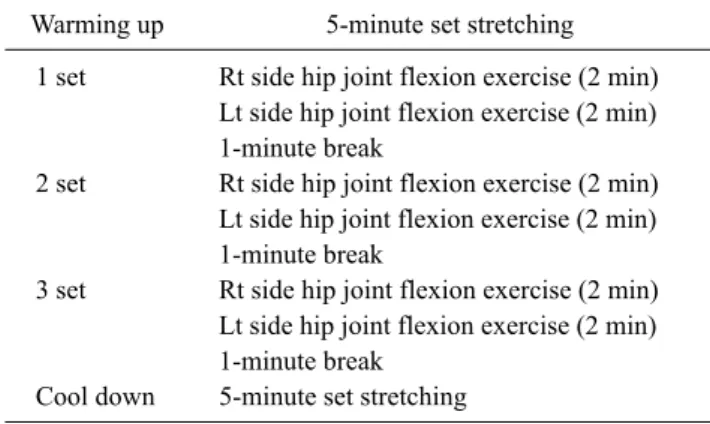
The HFE group participated in flexion exercises of the hip joint using an elastic band for three days a week for four weeks. The exercise program time was 50 minutes total with five minutes of stretching (warming up), 15-minutes of ex- ercise, and an additional five minutes of stretching (cool down) in the supine position (25 minutes) (Figure 1) and standing position (25 minutes) (Figure 2), respectively (Table 2).
The HAE group participated in hip joint abduction ex-
ercises using an elastic band for three days a week for four
weeks. The exercise program time was 50 minutes in total
Figure 1. Flexion exercise in supine position.
Figure 2. Flexion exercise in standing position.
Table 2. Flexion exercise of hip joint using elastic band (supine position and standing position, respectively)
Warming up 5-minute set stretching 1 set Rt side hip joint flexion exercise (2 min)
Lt side hip joint flexion exercise (2 min) 1-minute break
2 set Rt side hip joint flexion exercise (2 min) Lt side hip joint flexion exercise (2 min) 1-minute break
3 set Rt side hip joint flexion exercise (2 min) Lt side hip joint flexion exercise (2 min) 1-minute break
Cool down 5-minute set stretching Rt: right, Lt: left.
with five minutes of stretching (warming up), a 15-minutes of exercise, and an additional five 5 minutes of stretching (cool down) in the supine position (25 minutes) (Figure 3) and standing position (25 minutes) (Figure 4), respectively (Table 3).
All participants were trained according to their ability to adjust to the training intensity. One set of the elastic band ex- ercise was composed of left side exercise for 2 minutes, right side exercise for 2 minutes and a 1-minute break (total 5 mi- nutes) in the supine position and standing position, respec- tively. Subjects conducted training 1 set of the three times, and started and stopped at the same time with command.
Outcome measures
In this study, dynamic balance was measured using the
timed up and go (TUG) test, agility was measured using the
Figure 3. Abduction exercise in supine position.
Figure 4. Abduction exercise in stand- ing position.
Table 3. Abduction exercise of hip joint using elastic band (supine position and standing position, respectively)
Warming up 5-minute set stretching
1 set Rt side hip joint abduction exercise (2 min) Lt side hip joint abduction exercise (2 min) 1-minute break
2 set Rt side hip joint abduction exercise (2 min) Lt side hip joint abduction exercise (2 min) 1-minute break
3 set Rt side hip joint abduction exercise (2 min) Lt side hip joint abduction exercise (2 min) 1-minute break
Cool down 5-minute set stretching Rt: right, Lt: left.
standing long jump, and flexibility was measured using the Schober’s test.
For the TUG test, subjects were seated in a chair with armrests and then instructed to stand (using the armrests, if desired) and walk as quickly and safely as possible for a dis- tance of 3 m. The subjects then turned around, returned to the chair, and sat down. The time from the point at which their spine left the back of the chair until they returned to that same position was recorded using a stopwatch [12,13]. High intra-rater (intraclass correlation coefficient [ICC]=0.99) and inter-rater (ICC=0.99) reliability have been demon- strated using this measure [12].
For standing long jump measurement, a fiber-glass metric tape applied onto the floor was used. Subjects were in-
structed to use their arms to aid in the jump, positioning their feet shoulders-width apart and behind the zero point of the tape measure prior to jumping. Landing with the whole foot surface over the tape was measured between the zero point of the tape measure to the point at which the heel of the trial leg touched the ground. The highest jump distance of the three trials was used in subsequent analyses and expressed in centimeters (cm) [14].
For the Schober’s test, the examiner stood behind the sub- ject and made three marks; one mark behind the lumbosacral junction; a second mark on a spinous process 10 cm above the first mark (measured to the nearest millimetre) and a third mark 5 cm below the first mark. The distance between the most inferior and superior marks were measured, with
“0” at the inferior mark. Pressing the measuring tape against
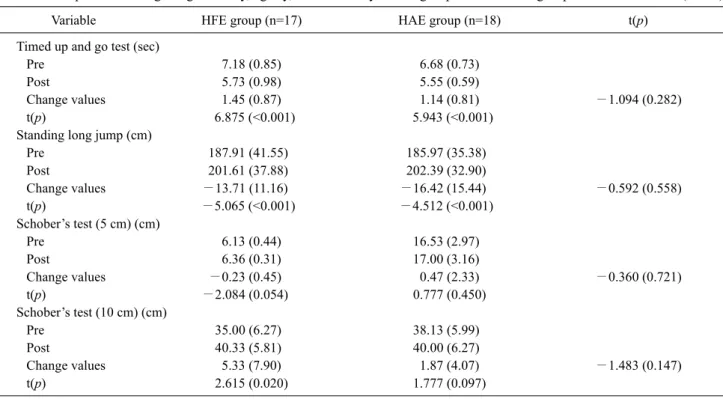
Table 4. Comparison of range of gait ability, agility, and flexibility within groups and between groups (N=35)
Variable HFE group (n=17) HAE group (n=18) t(p)
Timed up and go test (sec)
Pre 7.18 (0.85) 6.68 (0.73)
Post 5.73 (0.98) 5.55 (0.59)
Change values 1.45 (0.87) 1.14 (0.81) −1.094 (0.282)
t(p) 6.875 (<0.001) 5.943 (<0.001)
Standing long jump (cm)
Pre 187.91 (41.55) 185.97 (35.38)
Post 201.61 (37.88) 202.39 (32.90)
Change values −13.71 (11.16) −16.42 (15.44) −0.592 (0.558)
t(p) −5.065 (<0.001) −4.512 (<0.001)
Schober’s test (5 cm) (cm)
Pre 6.13 (0.44) 16.53 (2.97)
Post 6.36 (0.31) 17.00 (3.16)
Change values −0.23 (0.45) 0.47 (2.33) −0.360 (0.721)
t(p) −2.084 (0.054) 0.777 (0.450)
Schober’s test (10 cm) (cm)
Pre 35.00 (6.27) 38.13 (5.99)
Post 40.33 (5.81) 40.00 (6.27)
Change values 5.33 (7.90) 1.87 (4.07) −1.483 (0.147)
t(p) 2.615 (0.020) 1.777 (0.097)
Values are presented as mean (SD).
HFE: hip flexion exercise, HAE: hip abduction exericse.
subject’s lower back, subjects were instructed to bend for- ward keeping the knees straight, and the distance between the most superior and inferior marks at the end of the range of movement (ROM) was recorded. The ROM was assessed by measuring the difference in length from the beginning point (from the 15 cm mark) to the end of the range of motion point [15].
Statistical analysis
All statistical analyses were performed using PASW Statistics ver. 18.0 (IBM Co., Armonk, NY, USA). The gen- eral characteristics are presented as frequencies and percen- tages, with average and standard deviations also provided.
The paired t-test was used for analysis of changes in in- dependent variables before and after the training. The in- dependent t-test was used for analysis of changes in depend- ent variables between groups. The significance threshold was set at p<0.05.
Results
Differences in dynamic balance, agility, and flexibility af- ter the interventions are shown in Table 4. The flexion group showed significant differences in the TUG test, standing
long jump and Schober’s test (10 cm). The abduction group showed significant differences in the TUG test, standing long jump and Schober’s test (5 cm, 10 cm). However, there was no significant difference between the flexion group and the abduction groups.
Discussion
The hip joint is a ball and socket joint with the second largest amount of range of motion [16]. As a representing muscle of the hip abductors, the gluteus medius produces hip abduction, provides regulation of the hip joint, and controls the pelvic lateral dynamic stabilization. Therefore, selective gluteus medius enhancement is essential for functional low- er extremity movement [17]. The gluteus maximus is pri- marily a hip joint extensor and a lateral rotator, and the upper part of gluteus maximus is considered as a lateral rotator dur- ing gait. The lateral part of the hamstrings is primarily a hip joint extensor and secondly, it is a lateral rotator of the mus- cle [18]. Therefore, hip joint abductor and extensor muscle enhancement is essential to lumbar and pelvic stability [19].
An elastic band is a rubber band with elasticity and resist-
ance, and the velocity and intensity of the resistance of an
elastic band can be controlled. Elastic bands can be used in
various ways just as exercise can be performed in all direc- tions. Considering that exercises using elastic bands, are easy to carry, economical and safe, elastic bands can be used to improve muscular strength, flexibility, and balance con- trol [20,21].
Equilibrium is a state of no movement or a process of reg- ulation of center of gravity (COG) during movement of the base of support (BOS), and Bobath [22] stated that con- sistent postural control and adaptation processes are neces- sary to maintain postures and COG in the BOS. In this study, TUG test was used to assess changes in dynamic balance ability before and after intervention.
Mangione et al. [23] reported that TUG tests were de- creased after performing progressive resistant exercises us- ing an elastic band of older adults. Park et al. [24] reported that strengthening exercise programs in the rural elderly population resulted in a decrease in TUG scores (from 9.8 to 9.0 sec). In this study, the TUG results showed significant differences in the HFE group (from 7.18 to 5.73 sec) and the abduction group (from 6.68 to 5.55 sec, p<0.05). However, there was no significant difference between the HFE and the HAE group. We speculate that equilibrium has a close rela- tionship with strength and improvement of stability is a re- sult of flexion and abduction muscle enhancement from elastic band exercise performance.
Agility is an ability related to the accuracy, quickness, and ease of being able to change in direction during exercise of either the partial or the entire body [25], and in this study, agility was measured with the standing long jump to assess changes in agility before and after intervention. Asadi and Ramírez-Campillo [14] compared the effects of a 6-week cluster versus traditional plyometric training set on standing long jump. As a result, both groups (cluster group: from 201.2 to 213.7 cm, traditional group: from 192.0 to 204.7 cm) showed significant differences in standing long jump (p<0.05). In this study, there were significant differences in the standing long jump in the HFE group (from 187.91 to 201.61 cm) and the HAE group (from 185.97 to 202.39 cm,
p<0.05). However, there was no significant difference be-tween the HFE and the HAE group. Through hip joint flex- ion and abduction exercises, lower extremity strength was increased with increased muscle contraction velocities com- pared to the pre-experimental state. Thus, more energy was produced in a shorter period of time and agility was consid- ered to be increased.
Flexibility is an ability to move in the full range of motion.
Since aging begins earlier than other physical ability ele-
ments, and detraining starts rapidly, consistent training is needed. In this study, the Schober’s test was used to assess changes in flexibility before and after intervention. Delshad
et al. [26] reported that resistance training programs usingThera-Band tubing in elderly women during 12 weeks of in- tervention showed significant increases in trunk flexion (from 7.1 to 9.4 cm) and after four weeks of detraining, there were significant decreases in trunk flexion (from 9.4 to 9.0 cm). In this study, the Schober’s test 5 cm showed no sig- nificant differences in the HFE group (from 6.13 to 6.36 cm) but there were significant differences in the abduction group (from 6.16 to 6.45 cm, p<0.05). However, there was no sig- nificant difference between the HFE group and the HAE group. Schober’s test 10 cm showed significant differences in HFE group (from 14.86 to 15.23 cm) and abduction group (from 14.70 to 15.45 cm, p<0.05). However, there was no sig- nificant difference between the HFE group and the abduc- tion group. The conduction of both flexion and abduction exercise increased flexibility. ROM increases due to hip joint flexion and abduction exercises results in less limi- tations in ADL performance and flexion and abduction it- self, and therefore, it is considered that the exercise is effec- tive on flexibility improvement. As a result, both flexion and abduction exercises using an elastic band were effective ex- ercises for the hip joint because both flexion and abduction movement contribute to stabilization of hip joint.
There were several limitations to this study. First, due to a small sample size (HFE group: 10 males, 7 females, abduc- tion group: 11 males, 7 females), it is difficult to make any generalizations. Second, the experiment duration was short (only 12 times), and thus further studies are needed to inves- tigate the long-term intervention effects of hip joint ex- ercises using an elastic band. Third, this study did not identi- fy of the effect on strength using an elastic band. In further studies, a comparison of strength with flexion and abduction exercises of the hip joint need to be researched. The findings suggest that hip joint exercises using an elastic band in- creased dynamic balance, agility and flexibility in healthy subjects. We hope for the conduction of continuous research on the effect of hip joint exercises using an elastic band for improved dynamic balance, agility and flexibility.
Conflict of Interest
The authors declared no potential conflicts of interest
with respect to the authorship and/or publication of this
article.
References
1. Neumann DA. Kinesiology of the hip: a focus on muscular actions. J Orthop Sports Phys Ther 2010;40:82-94.
2. Horak FB, Henry SM, Shumway-Cook A. Postural perturba- tions: new insights for treatment of balance disorders. Phys Ther 1997;77:517-33.
3. Crosbie J, Vachalathiti R, Smith R. Patterns of spinal motion dur- ing walking. Gait Posture 1997;5:6-12.
4. Salbach NM, Mayo NE, Wood-Dauphinee S, Hanley JA, Richards CL, Côté R. A task-orientated intervention enhances walking distance and speed in the first year post stroke: a random- ized controlled trial. Clin Rehabil 2004;18:509-19.
5. Ferreira GE, Viero CC, Silveira MN, Robinson CC, Silva MF.
Immediate effects of hip mobilization on pain and baropodo- metric variables: a case report. Man Ther 2013;18:628-31.
6. Dolak KL, Silkman C, Medina McKeon J, Hosey RG, Lattermann C, Uhl TL. Hip strengthening prior to functional exercises re- duces pain sooner than quadriceps strengthening in females with patellofemoral pain syndrome: a randomized clinical trial. J Orthop Sports Phys Ther 2011;41:560-70.
7. Biscarini A. Determination and optimization of joint torques and joint reaction forces in therapeutic exercises with elastic resis- tance. Med Eng Phys 2012;34:9-16.
8. Damush TM, Damush JG Jr. The effects of strength training on strength and health-related quality of life in older adult women.
Gerontologist 1999;39:705-10.
9. Pages P, Ellenbecker TS. The scientific and clinical application of elastic resistance. Champaign (IL): Human Kinetics; 2003.
10. Park J, Choi W, Lee S. Effect of immediate unilateral whole body vibration on muscle performance and balance in young adults.
Phys Ther Rehabil Sci 2013;2:115-8.
11. Eom SY, Lee WJ, Lee JI, Lee EH, Lee HY, Chung EJ. The effect of ankle kinesio taping on range of motion and agility during ex- ercise in university students. Phys Ther Rehabil Sci 2014;3:63-8.
12. Podsiadlo D, Richardson S. The timed “Up and Go”: a test of ba- sic functional mobility for frail elderly persons. J Am Geriatr Soc 1991;39:142-8.
13. Chung EJ, Lee B. The effect of treadmill training on dynamic balance and gait function in stroke patient: a pilot randomized controlled trial. Phys Ther Rehabil Sci 2013;2:39-43.
14. Asadi A, Ramírez-Campillo R. Effects of cluster vs. traditional
plyometric training sets on maximal-intensity exercise perfor- mance. Medicina (Kaunas) 2016;52:41-5.
15. Rao R, Panghate A, Chandanwale A, Sardar I, Ghosh M, Roy M, et al. Clinical comparative study: efficacy and tolerability of tol- perisone and thiocolchicoside in acute low back pain and spinal muscle spasticity. Asian Spine J 2012;6:115-22.
16. Santaguida PL, McGill SM. The psoas major muscle: a three-di- mensional geometric study. J Biomech 1995;28:339-45.
17. Fredericson M, Cookingham CL, Chaudhari AM, Dowdell BC, Oestreicher N, Sahrmann SA. Hip abductor weakness in distance runners with iliotibial band syndrome. Clin J Sport Med 2000;
10:169-75.
18. Lyons K, Perry J, Gronley JK, Barnes L, Antonelli D. Timing and relative intensity of hip extensor and abductor muscle action dur- ing level and stair ambulation. An EMG study. Phys Ther 1983;
63:1597-605.
19. Akuthota V, Nadler SF. Core strengthening. Arch Phys Med Rehabil 2004;85:86-92.
20. Zion AS, De Meersman R, Diamond BE, Bloomfield DM. A home-based resistance-training program using elastic bands for elderly patients with orthostatic hypotension. Clin Auton Res 2003;13:286-92.
21. Kim TW, An DI, Lee HY, Jeong HY, Kim DH, Sung YH. Effects of elastic band exercise on subjects with rounded shoulder pos- ture and forward head posture. J Phys Ther Sci 2016;28:1733-7.
22. Bobath B. Adult hemiplegia: evaluation and treatment. 3rd ed.
Oxford, London: Butterworth-Heineman; 1990.
23. Mangione KK, Craik RL, McCormick AA, Blevins HL, White MB, Sullivan-Marx EM, et al. Detectable changes in physical performance measures in elderly African Americans. Phys Ther 2010;90:921-7.
24. Park SY, Kim JK, Lee SA. The effects of a community-centered muscle strengthening exercise program using an elastic band on the physical abilities and quality of life of the rural elderly. J Phys Ther Sci 2015;27:2061-3.
25. Johnson BL, Nelson JK. Practical measurement for evaluation in physical education. 4th ed. Minneapolis: Burgress Pub.; 1996.
26. Delshad M, Ghanbarian A, Mehrabi Y, Sarvghadi F, Ebrahim K.
Effect of strength training and short-term detraining on muscle mass in women aged over 50 years old. Int J Prev Med 2013;4:
1386-94.