2005, Vol. 16, No. 2, pp. 457∼465
Estimation on Exponential Model with Limited Replacements
Kil-Ho Cho1) Jang Sik Cho2) Seong-Hwa Jeong3)
Abstract
We consider the estimation of parameter in the exponential model in the case that the number of replacements of failed items is limited. And the desirable number of replacements to give the similar effect as unlimited case in terms of the mean square errors is proposed.
Keywords : Exponential Model, Limited replacement, Type I censoring scheme
1. Introduction
Suppose that a test equipment has n items and the failure times of the items are recorded until a fixed time t. If the failure times correspond to the occurrences of a Poisson process with mean rate 1/ θ, the number of failure in the test equipment, say r, follows the Poisson distribution with the probability mass function
g (r ) = 1 r! e
−nt
θ (nt
θ )r, r = 0, 1, .
Under the various censoring schemes with replacement or without replacement, the estimations of parameter in an exponential distribution have been proposed by 1) First Author : Professor, Department of Statistics, Kyungpook National University,
Taegu, 702-701,
E-mail : [email protected]
2) Associate Professor, Department of Statistical Information Science, Kyungsung University, Busan, 608-736, Korea
3) Research Assistant, Department of Preventive Dentistry, School of Dentistry, Kyungpook National University, Taegu, 700-412, Korea
some authors. Bartholomew(1957) gave the maximum likelihood estimator(MLE) of parameter in an exponential distribution under the type I censoring scheme with replacement or without replacement. Using the hybrid censored samples with replacement or without replacement, Ebrahimi(1986) derived point and interval estimators of parameters in the two parameter exponential distribution. Consul and Famoye(1989) considered MLE's in the truncated generalized Poisson distribution.
Childs and Balakrishnan(2000) developed the conditional inference procedures for the Laplace distribution based on the progressive censored samples.
In this paper, we consider the estimation of parameter in the exponential distribution in the case that the number of replacements of failed items is limited.
It is well known that a discrete probability model defined on the set of non-negative integers is naturally truncated in all real life situations because the sample size is always finite and the probabilities for large values of r become so small that they are unobservable. Therefore one may consider a truncated model rather than the non-truncated one. If we can get the comparable effects as unlimited case by using only limited replaceable items, it is desirable in aspect of being able to save time and cost. So we will give an estimator of parameter in an exponential distribution with limited replacements under type I censoring scheme.
Also, the desirable number of replacements to give the similar effect in terms of the mean square errors(MSE's) is proposed.
2. Estimation of parameter
We consider the estimation of parameter in the exponential distribution with limited replacements under type I censoring scheme.
Suppose that n items are under test and the experiment is terminated at a prescribed time t(>0 ). And suppose that all items are start at time 0. Let item 1, item 2, , item n be independently exponential lifetime distribution
f (x ) = 1 θie
1
θi, i = 1, 2, , n
with mean θi(> 0 ) and N1(t ), N2(t ), , Nn(t ) be the number of failures (or replacements) from item 1, item 2, , item n during the time interval [0, t ], respectively. Then N1(t ), N2(t ), , Nn(t ) are Poisson processes with mean rate 1/θi, respectively.
Lemma 1. Let N1(t ), t > 0 be a Poisson process with mean rate 1/θ1 and
N2(t ), t > 0 be a Poisson process with mean rate 1/θ2. Then the superposition
Poisson process is also a Poisson process with mean rate 1/θ = 1/θ1+ 1/θ2.
Lemma 2. Given that k events have occurred in Poisson process during [0, t ], then their successive times, S1, S2, , Sk, of occurrences have the joint distribution as the oder statistics in a sample of size k from the uniform distribution on [0, t ]. That is, if f (s1, s2, , sk | k ) denotes the conditional joint density of S1, S2, , Sk given that N (t ) = k, then it is given by
f (s1, s2, , sk | k ) = k!
tk, 0 s1 s2 sk t. (1) 2.1 The case of the same items
First, consider the estimation of parameter in the exponential distribution with unlimited replacement under type I censoring scheme. Suppose that n items are placed on the test at time 0 and the experiment is terminated at a prescribed time t (> 0 ).
Let N (t ) ≡
Σ
i = 1n Ni(t ) be the total number of failures for all items during [0, t ]. Then, from Lemma 1, N (t ) is a Poisson process with mean rate n/θ. Thus N (t ) = r, where r is a observed failure number during [0, t ], has the Poisson distribution with mean nt/θ. Now, let X(1 ), X(2 ), , X(r) be the successive failure times during [0, t ] in a Poisson process with mean rate n/θ. Then , from Lemma 2, the likelihood function of X(1 ), X(2 ), , X(r) and r is given byf (x(1 ), x(2 ), , x(r), r ) = f (x(1 ), x(2 ), , x(r)| r ) gn(r ) = r!
tr(nt θ )r e−
nt
θ 1
r!
= (n θ )r e−
nt
θ . (2)
From the equation (2), the MLE of parameter θ is given by
θ =
nt
r if r 1 undefined if r = 0
(3)
Next, we consider the estimator of parameter in the exponential distribution
under type I censoring scheme when the number of replacement is limited.
Theorem 1. Let N (t ) = r be the number of failures for n items during [0, t ] when the lifetimes are the exponential distribution with mean θ. And suppose that N (t ) = r is limited by m, that is, 1 r m, where 0 < m <∞. Then the likelihood equation is given by
d = 1
Σ
m r
d! (nt
θ )d − d = 1
Σ
m (d−11 )! (ntθ )d = 0.In this case, the likelihood equation is not easily solvable. Hence it is to be solved numerically by some iterative procedures.
2.2 The case of general items
Suppose that item 1, item 2, , item n are identically but mutually independent exponential lifetime distribution, respectively. That is, the mean lifetime to fail the ith item is θi. Also, suppose that n items are placed on the test at time 0 and the experiment is terminated at a prespecified time t (> 0 ).
Let N1(t ), N2(t ), , Nn(t ) denote the number of failures which occur in a given interval [0, t ] for item 1, item 2, , item n, respectively. Let X(i, j ) be the jth failure times of item i from exponential lifetime distribution with mean θi, where j = 1, 2, , ri, θi > 0, and i = 1, 2, , n.
Now, we can obtain the joint distribution of successive failure times and failure numbers of item iunder type I censoring scheme with unlimited replacement.
Then the likelihood distribution associated with item i becomes as follows;
f (x(i, 1 ), x(i, 2 ), , x(i, r
i), ri)
= f (x(i, 1 ), x(i, 2 ), , x(i, r
i) | ri) gr
i(ri) where ri= 1, 2, , for 0 x(i, 1) x(i,2) x(i,r
i) t, i = 1, 2, , n.
From Lemma 2,
f (x(i, 1 ), x(i, 2 ), , x(i, n ) | ri) = ri! tri , for ri= 1, 2, , 0 x(i, 1 ) x(i, 2 ) x(i, r
i) t, and
gn
i(ri) = 1
ri!e
(− t θi
)
( 1 θi )ri,
where ri= 1, 2, , θi>0, t > 0, i = 1, 2, , n. In general, the joint distribution of X(i, 1 ), X(i,2 ), , X(i,r
i) and ri is given by f (x(i, 1 ), x(i, 2 ), , x(i, r
i), ri) = f (x(i, 1 ), x(i, 2 ), , x(i, r
i) | ri) gr
i(ri)
= e
(− t θi)
(1 θi )ri where 0 x(i, 1 ) x(i, 2 ) x(i, r
i) t, θi>0, ri= 1, 2, , i = 1, 2, , n. Under the type I censoring scheme with unlimited replacement, the joint distribution of exponential lifetimes item 1, item 2, , item n is given by
f (x(1, 1 ), x(1, 2 ), , x(1,r
1), r1, , (n, 1 ), x(n, 2 ), , x(n,r
n), rn)
= e
(−Σi = 1n θti)
Π
i = 1 n
(1
θi )ri, (4)
since item 1, item 2, , item n are mutually independent exponential lifetime distribution with mean θi, i = 1, 2, , n, respectively.
Taking logarithm to the both sides of the equation (4), the log likelihood function is given by
log f (x(1, 1), x(1, 2 ), , x(1, r
1), r1, , (n, 1 ), x(n, 2), , x(n, r
n), rn)
= −
Σ
i = 1n θti −Σ
i = 1n ri log θi. (5)Differentiating equation (5) with respect to θi, i = 1, 2, , n, respectively, the likelihood equations are
∂
∂θilog f (x(1, 1 ), x(1, 2 ), , x(1, r1), r1, , (n, 1 ), x(n, 2 ), , x(n, rn), rn)
= t
θ2i − ri θi = 0 where θi>0, ri= 1, 2, , i = 1, 2, , n.
Therefore, the MLE's of θi, say θˆi, is
θi ˆ =
t
ri i ri 1 undefined i ri = 0
(6)
for t > 0, i = 1, 2, , n.
Now, we consider the estimation of parameter in the case that the number of replacements of failed items is limited. Suppose that item 1, item 2, , item n are mutually independent exponential lifetime distribution, respectively, and they are on the test under type I censoring scheme.
Theorem 2. Let Ni(t ) = ri be the number of failures for each item i during [0, t ] when the lifetimes are exponential distribution with mean θi>0, i = 1, 2, , n. And suppose that Ni(t ) = ri is limited by mi, that is, 1 ri mi, where 0 < mi<∞, i = 1, 2, , n. Then the likelihood equations are given by
d = 1
Σ
mi
( t
θi )d(ri−d )1
d! = 0
ri= 1, 2, , mi, θi>0, 0 < mi<∞, i = 1, 2, , n.
Also in this case, the above likelihood equations are not easily solvable. Hence we can solve the equation numerically by some iterative procedures.
3. Monte Carlo simulations
We get the MLE's of the mean lifetime θ for both limited replacement and unlimited replacement cases under type I censoring scheme through Mote Carlo simulations. And we compare the MSE's of the estimators for θ in the case of limited replacements with those in the case of unlimited replacement to get the effects of the limited replacement.
The simulation studies are considered for some combinations of exponential lifetime distributions, item numbers and various fixed times. Im general, any Poisson process with mean rate λ has a Poisson distribution with mean λt if time t is fixed.
We use the IMSL subroutines GGUBS and GGEXN to generate pseudo random numbers. And we get the estimated MSE's of the estimators for θ under the unlimited replacement and the limited replacement, and propose the number of replacements m. Also we get the absolute difference between two estimated MSE's(DMSE). The design of simulations is summarized in Table 1.
Table 1. The design of simulations
Lifetime Item number Fixed time
Exp(1.0) 1 3 2 6 Exp(2.0) 1 3 8 12
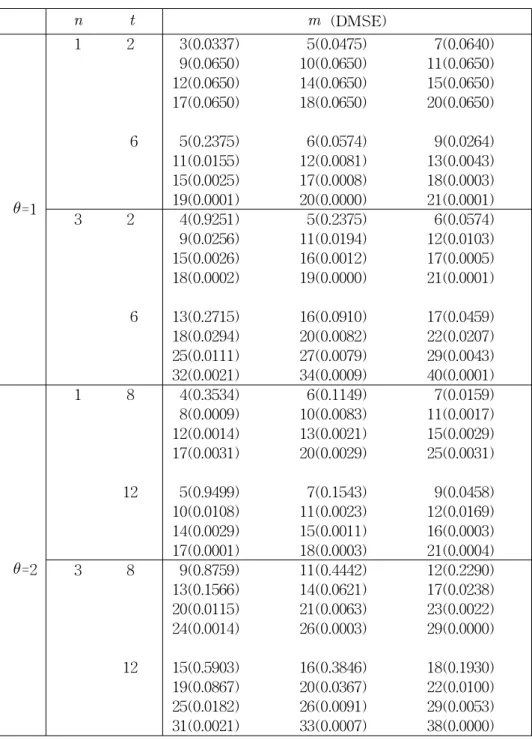
For combinations of item numbers(n) and fixed times(t) on the test, the MSE's of the estimators for θ under the limited replacements(LMSE) and the unlimited replacements(UMSE) are computed. Simulation results are tabulated in Table 2.
From Table 2, one can observe the following facts;
1. When the mean of occurrences during [0, t ] in a Poisson process is less than about 10, the MSE's of the estimator for θ in the case of limited replacements are similar to those in the case of unlimited replacements as the number of limited replacements is about three times of the mean of occurrences.
2. When the mean of occurrences during [0, t ] in a Poisson process is greater than about 10, the MSE's of the estimator for θ in the case of limited replacements are similar to those in the case of unlimited replacements as the number of limited replacements is about two times of the mean of occurrences.
3. As the number of limited replacements increases, the DMSE's of the estimator for θ in limited replacements and unlimited replacements have decreasing tendencies. But they are nearly constant after the previous proposed m.
Table 2. Number of limited replacement m and DMSE
n t m (DMSE)
θ=1
1 2
6
3(0.0337) 5(0.0475) 7(0.0640) 9(0.0650) 10(0.0650) 11(0.0650) 12(0.0650) 14(0.0650) 15(0.0650) 17(0.0650) 18(0.0650) 20(0.0650)
5(0.2375) 6(0.0574) 9(0.0264) 11(0.0155) 12(0.0081) 13(0.0043) 15(0.0025) 17(0.0008) 18(0.0003) 19(0.0001) 20(0.0000) 21(0.0001) 3 2
6
4(0.9251) 5(0.2375) 6(0.0574) 9(0.0256) 11(0.0194) 12(0.0103) 15(0.0026) 16(0.0012) 17(0.0005) 18(0.0002) 19(0.0000) 21(0.0001)
13(0.2715) 16(0.0910) 17(0.0459) 18(0.0294) 20(0.0082) 22(0.0207) 25(0.0111) 27(0.0079) 29(0.0043) 32(0.0021) 34(0.0009) 40(0.0001)
θ=2
1 8
12
4(0.3534) 6(0.1149) 7(0.0159) 8(0.0009) 10(0.0083) 11(0.0017) 12(0.0014) 13(0.0021) 15(0.0029) 17(0.0031) 20(0.0029) 25(0.0031)
5(0.9499) 7(0.1543) 9(0.0458) 10(0.0108) 11(0.0023) 12(0.0169) 14(0.0029) 15(0.0011) 16(0.0003) 17(0.0001) 18(0.0003) 21(0.0004) 3 8
12
9(0.8759) 11(0.4442) 12(0.2290) 13(0.1566) 14(0.0621) 17(0.0238) 20(0.0115) 21(0.0063) 23(0.0022) 24(0.0014) 26(0.0003) 29(0.0000)
15(0.5903) 16(0.3846) 18(0.1930) 19(0.0867) 20(0.0367) 22(0.0100) 25(0.0182) 26(0.0091) 29(0.0053) 31(0.0021) 33(0.0007) 38(0.0000)
References
1. Bartholomew, D. J. (1957). A problem in life testing. J. Amer. Statist.
Assoc, 52, 350-355.
2. Childs, A. and Balakrishnan, N. (2000). Conditional inference procedures for the laplace distribution when the observed samples are progressively censored, Metrika, 52, 253-265.
3. Consul, P. C. and Felix Famoye (1989). The truncated Generalized Poisson Distribution and its estimation. Commun. Statist-Theory Meth, 18, 3625-3648.
4. Lee, J. Bain (1978). Statistical Analysis of Reliability and Life-Testing Models, Theory and Methods. Marcel Dekker Inc., New York.
5. Nader Ebrahimi (1986). Estimating the parameters of an exponential distribution from a hybrid life test. Journal of Statistical Planning and Inference, 14, 255-261.
6. Richard E. Barlow and Frank Proschan (1975). Statistical Theory of Reliability and Life Testing Probability Models, Holt, Rinehart and Winston, Inc.
7. Rubinstein, R. Y. (1981). Simulations and the Monte Carlo Method. John Wiley & Sons, Inc., New York.
8. Sinha, S. K. (1986). Reliability and Life Testing. John Wiley & Sons, Inc., New York.
[ received date : Nov. 2004, accepted date May. 2005 ]