http://bx.doi.org/10.7783/KJMCS.2012.20.4.222
현초에서 분리된 페놀성 화합물들의 흰쥐 수정체 유래 알도즈 환원효소 및 갈락티톨 생성 억제 효과
최세진*·김진규**·장재만**·임순성*
,**
†*한림대학교 식품영양학과, **한림대학교 천연의약연구소
Inhibitory Effect of the Phenolic Compounds from Geranium thunbergii on Rat Lens Aldose Reductase and Galactitol Formation
Se Jin Choi * , Jin Kyu Kim ** , Jai Man Jang ** and Soon Sung Lim *,**
†
*Department of Food Science and Nutrition, Hallym University, Chuncheon 200-702, Korea.
**Institute of Natural Medicine, Hallym University, Chuncheon 200-702, Korea.
ABSTRACT : We evaluated the inhibitory effects of extracts and components of Geranium thunbergii on aldose reductase (AR) and galactitol formation in rat lenses with high levels of galactose as a part of our ongoing search of natural sources for therapeutic and preventive agents for diabetic complications. The inhibitory effects of water, methanol and ethanol extracts of G. thunbergii on rat lens AR (RLAR) were determined. Comparing inhibitory effects of various solvent extracts, ethanol extract showed RLAR inhibitory activity (IC
50values, 5.24 and 6.39
㎍/
㎖, respectively). The ethanol extract was fraction- ated to chloroform, ethyl acetate and water. Of these, the ethyl acetate fraction from ethanol extract of G. thunbergii exhib- ited RLAR inhibitory activity (IC
50value, 2.64
㎍/
㎖). In order to identify the bioactive components of ethyl acetate soluble fraction of ethanol extract from G. thunbergii , eight compounds, namely gallic acid (1), protocatechuic acid (2), p -hydroxy- benzoic acid (3), brevifolin carboxylic acid (4), geraniin (5), ellagic acid (6), kaempferol-3- O -arabinofuranosyl-7- O -rham- nopyranoside (7), kaempferitrin (8) were isolated. The isolates were subjected to in vitro bioassays to evaluate their inhibitory activity on RLAR and galactitol formation in rat lenses. The ellagic tannins (5, 6) and flavonoid (7) exhibited strong inhibitory effects on RLAR. Also, these three compounds (5, 6 and 7) suppressed galactitol accumulation in rat lens under high galactose conditions, demonstrating the potential to prevent galactitol accumulation exo vivo . These results sug- gest that the extracts and components of G. thunbergii are a promising agent in the prevention or treatment of diabetic com- plications.
Key Words : Geranium thunbergii , Aldose Reductase, Galactitol Accumulation, Ellagic Acid, Geraniin
서 언
당뇨병은신체내에서혈당조절에필요한인슐린의분비나 작용 부족으로 인해 발생된 고혈당을 특징으로하는 대사성 질환이다
.
당뇨병으로 인한만성적 고혈당은신체 각 기관의 손상과 기능 부전을 초래하게 된다.
특히,
망막,
신장,
신경,
심혈관계에심각한합병증을유발하게된다
(Choi et al ., 2008;
Jeon et al ., 2010).
고혈당으로 인한 합병증의 발생 원인으로는 당화반응
(glycation)
으로 알려진 비효소적 당화,
폴리올 경로(polyol pathway)
의활성화,
지질대사이상,
산화에의한손상증가등 이 거론되고있다(Kato et al. , 2009).
신경,
신장,
망막,
수정체 같은인슐린비의존형조직의경우에는혈액 내에존재하 는 포도당이세포 내로 이동하는과정에 인슐린이 관여하지 않으므로혈액중에존재하는높은농도의포도당은바로세 포내포도당의농도를증가시킨다
.
정상상태에서는세포내에존재하는 포도당은 헥소카이나제
(hexokinase)
에 의하여glucose-6-phosphate
로 변환되어 해당과정(glycolysis pathway)
으로 들어가게되지만
,
비정상적으로 세포내에 과다하게존 재하는 포도당은 헥소카이나제를 포화시켜 알도즈(aldose)
를 기질로 하는 알도즈 환원효소(aldose reductase; AR)
에 의해솔비톨
(sorbitol)
로 변환되어 폴리올 경로를 활성화 시킨다(Constantino et al ., 1999; Kim et al ., 2010).
솔비톨은솔비톨탈수소효소
(sorbitol dehydrogenase)
에의하†
Corresponding author: (Phone) +82-33-248-3075 (E-mail) [email protected]
Received 2012 May 8 / 1st Revised 2012 June 4 / 2nd 2012 July 18 / Accepted 2012 July 23
여 프룩토오스
(fructose)
로 변환되어 세포막의투과가 가능한형태로 전환되며 과다한 포도당에의해 생성된 폴리올은 그 활성이
AR
의5%
밖에되지않는솔비톨탈수소효소를포화시 키기때문에프룩토오스로변환되지못하고 세포내에축적되 며축적된폴리올은세포막을투과하지못하여세포내삼투 압을증가시킨다.
삼투압의증가에따라팽윤현상이일어나고세포막의안정성을파괴하여심한경우에는세포가사멸에까 지 이르게 된다
.
즉,
폴리올 경로의 활성화에 의해schwann
세포와모세혈관에솔비톨이과다축적되면삼투압증가로인 한 수초
(myelin sheath)
의 부종,
괴사 및 붕괴가 발생할 수 있고,
지속적으로증가한삼투압으로인하여수분이인입되어 당뇨합병증으로진행된다(Carper et al., 1995).
아직도 당뇨병성 합병증을 효과적으로 예방하거나 진행을 억제할수있는약제는개발되지않아천연물로부터당뇨합병 증예방 및치료물질을개발하려는연구가활발히진행되고 있다
(Corns, 2003; Tapsell et al ., 2006).
최근 보고에 의하면 고과( Momordica charania )
의열매추출물은당뇨병성백내장 진행억제효과를나타내었고,
한방에서진통제로쓰이는현호 색( Corydalis turtschaninovii )
의dehydrocorydalin
성분은AR
억제를통한항백내장효과가보고되는등다양한천연물소 재로부터당뇨합병증치료제개발이시도되고있다
(Srivastava et al ., 1988; Kubo et al ., 1994; Kim et al ., 2011).
이는천연물이당뇨합병증 예방에새로운후보물질로써의가능성 이큼을의미한다
.
현초
( Geranium thunbergii Sieb. et Zucc.)
는 쥐손이풀목(Geraniales)
쥐손이풀속(Geranium)
쥐손이풀과(Geraniaceae)
에 속하는다년생초본이다.
현초는고(
苦,)
신(
辛),
미온(
微溫)
의성 미를나타내며,
항돌연변이,
항염증및 항산화효과가있다고보고되어져 있다
(Ushio et al ., 1991).
현초의전초는tannin
과flavonoid
가 주성분이며tannin
은 잎에 약20%,
전초에 약5%
가함유되어있다.
현재까지현초의성분연구를보면tannin
계열과
flavonoid
계열화합물의분리와항산화및항균실험이 있다고보고되었을뿐(Liu et al ., 2006),
현초에대한 생리활 성이나당뇨합병증에대한연구는미미한상황이다.
본 연구진은 천연물로부터 당뇨 및 당뇨합병증억제 소재 개발을진행해왔으며
,
대표적으로감초( Glycyrrhiza urlensis )
의 뿌리로부터semilicoisoflavone B
를 분리하여AR
을 효과적으 로 억제함을확인하였다.
그 외에 상황버섯( Phellinus linteus )
의
davallialactone, hypholomine B, ellagic acid
성분이AR
억제효과를보인다는것을입증한바 있다
(Lee et al ., 2008, 2010, 2011).
이에 본연구는현초의당뇨합병증억제 활성물 질을 확인하기위해AR
의 억제 활성 및 당뇨병성 합병증의주요발현인자인수정체내의 폴리올생성억제활성에대한 연구를실시하고그활성화합물의화학적구조를규명하였다
.
재료 및 방법
1. 실험재료
본연구에사용 된현초는강원도춘천소재의대광약업사 에서 구입하여외부형태를비교 조사한후 사용하였다
.
실험 에사용된현초는한림대학교생명과학관5
층천연물화학실험실
(No. NP101130)
에 보관되어있다.
2. 시약 및 기기
본연구에서추출
,
분획및컬럼크로마토그래피용 용매,
즉dichloromethane (CH
2Cl
2), ethyl acetate (EtOAc), ethanol (EtOH), methanol (MeOH)
등은 국산제품을 사용하였다. HPLC
분석에 사용된acetonitrlie (MeCN), MeOH
은HPLC
급 으로Fisher scientific (Fair Lawn, NJ, USA)
으로부터, trifluoroacetic acid (TFA)
는HPLC
급으로Applichem GmbH (Darmstadt, Germany)
으로부터구입하여사용하였다.
물질분리 를 위한column chromatography
용RP-18
은Merck (LiChroprep RP-18, 40-63
㎛, Merck, Darmstadt, Germany)
사 에서구입하여 사용하였다. HPLC
는Thermo Electron Spectra HPLC system (Thermo Separation Products, San Jose, CA, USA)
을 사용하였으며, FT-IR
은JASCO FT/IR-4100 (Anthelie, SECOMAM, France)
를 사용하였다.
1H-NMR
및 13C-NMR spectra
는Brucker
의DPX-400
과AVANCE-600
을 이용하여 측정하였다. Bovine serum albumin (BSA),
β-nicotinamide adenosine nucleotide phosphate (NADPH, reduced form), quercetin dehydrate, dl-glyceraldehyde dimer
는Sigma- Aldrich (St. Louis, MO, USA)
로부터구입하여사용하였다.
3. 추출 및 분획
현초의 최적 추출용매를 확보하기 위해
MeOH, 95%
EtOH, H
2O
로 각각 추출하였다.
건조된 현초1.5
㎏을 분말(20-30 mesh)
로 만든후각용매15
ℓ를가하고H
2O
추출은100
℃에서MeOH
과95% EtOH
추출은50
℃에서3
시간 동안 온침한후여과하여여액과잔사를얻었고,
이잔사를동일한방법으로
2
회반복하여추출·여과하였다.
얻어진각 추출물들은감압농축 혹은동결건조하여
MeOH, 95% EtOH, H
2O
의각 용매별추출물을얻었다
.
각 추출물의생리활성실험을실시한결과
95% EtOH
추출물에서우수한 활성결과가확인되어
, 95% EtOH
추출물을증류수에완전히현탁시킨 후동량의
CH
2Cl
2과EtOAc
로극성에따라순차분획을실시하였고 얻어진각 분획물들을감압농축 혹은동결건조하여분석시 료로사용하였다(Fig 1).
4. EtOAc 분획물로부터 활성 성분의 분리
현초의
95% EtOH
추출물로부터 얻은EtOAc
분획물3 g
을
RP-18
을 충진 시킨 컬럼(36
×460
㎜, glass column)
에 로딩한 후, 5% aqueous acetic acid/MeCN
을 사용하여MeCN
비율(0%
→100% MeCN)
을 순차적으로 높여가며MPLC (medium pressure liquid chromatography)
를 실시하였다
.
용출액을약70
㎖씩나누어받았으며,
분리여부의판단은
HPLC chromatogram
양상을비교하여총8
개의화합물을 단리하였다.
이들화합물은MeOH
로재결정하여아래와같이 구조분석을위한이화학적,
광학적자료를확보하였다.
Compound 1 - EI-MS ( m/z ): 170 [M]
+, 153 [M-OH]
+, 125 [M-COOH]
+; IR max
㎝-1: 3238 (OH), 1693 (COOH), 1540, 1446 (C = C); UV (MeCN,
λmax
㎚): 223, 268;
1
H-NMR (400
㎒,
δ, DMSO- d
6): 6.91 (2H, s , H-2, 6);
13
C-NMR (100
㎒,
δ, DMSO- d
6): 167.5 (C-7), 145.5 (C-3, 5), 138.0 (C-4), 128.8 (C-1), 108.8 (C-2, 6).
Compound 2 - EI-MS ( m/z ): 154 [M]
+, 109 [M-COOH]
+; IR
νmax
㎝-1: 3240 (OH) and 1681 (COOH); UV (MeCN,
λ
max
㎚): 223, 258 (max), 293;
1H-NMR (600
㎒,
δ, DMSO- d
6): 7.34 (1H, d, J = 1.45
㎐, H-2), 7.28 (1H, dd , J = 8.2, 1.2
㎐, H-6), 6.78 (1H, d , J = 8.2
㎐, H-5);
13C- NMR (150
㎒,
δ, DMSO- d
6): 167.7 (-COOH), 150.4 (C-4), 145.3 (C-3), 122.3 (C-6), 122.0 (C-1), 116.9 (C-2), 115.5 (C-5).
Compound 3 - EI-MS ( m/z ): 138 [M]
+; IR max
㎝-1:
3381 (OH), 1671 (COOH), 1594 and 1509 (C = C); UV (MeCN,
λmax
㎚): 229, 254 (max);
1H-NMR (600
㎒,
δ, DMSO- d
6): 7.79 (1H, d , J = 8.5
㎐, H-2,6), 6.81 (1H, d, J = 8.5
㎐, H-3,5);
13C-NMR (150
㎒,
δ, DMSO- d
6): 172.2 (C-7), 167.6 (C-4), 131.9 (C-2,6), 121.8 (C-1), 115.6 (C-3,5).
Compound 4 - EI-MS ( m/z ) : 291 [M-H]
-, 247 [M- COOH]
-; IR
νmax
㎝-1: 3230 (OH), 1698, 1600 (
α,
β- unsaturated lactone moieties), 1391, 1903, 1198, 1088, 1032; UV (MeCN,
λmax
㎚): 225, 278 (max), 358;
1H- NMR (600
㎒,
δ, DMSO- d
6): d7.30 (1H, s , H-8), 4.37 (1H, d , J = 6.0, H-3´), 3.00 (1H, d , J = 18.6, H-2´), 2.42 (1H, d , J = 18.6, H-2´);
13C-NMR (150
㎒, d, DMSO- d
6):
193.3 (C-1´), 173.4 (C-4´), 160.2 (C-1), 149.5 (C-6), 145.7 (C-3), 143.9 (C-5), 140.2 (C-4), 139.0 (C-7), 115.1 (C-10), 113.0 (C-9), 108.0 (C-8), 42.5 (C-3´), 37.4 (C-2´).
Compound 5 - EI-MS ( m/z ): 951 [M-H]
-; IR
νmax
㎝-1: 3329 (OH), 1704 (C = O), 1606 (C = C), 1515, 1446, 1314, 1192, 1030, 968; UV (MeCN,
λmax
㎚): 229, 271;
1
H-NMR (600
㎒,
δ, DMSO- d
6): A type - 7.03 (1H, s , H-3). 7.01 (1H, s , H-Gal. 2,6), 6.76 (1H, s , H-HHDP3), 6.44 (1H, s , H-HHDP3´), 6.36 (1H, s , H-G1), 6.34 (1H, s , H-3´), 5.38 (1H, br s , H-G2 ), 5.33 (1H, br s , H-G4), 5.21 (1H, br s , H-G3), 4.87 (1H, s , H-1´), 4.63 (1H, m , H-G5), 4.68 (1H, m , H-G6) 4.34 (1H, d , J = 2.7 Hz , H- G6), B type - 7.10 (1H, s , H-3), 7.00 (1H, s , H-Gal.
2,6), 6.71 (1H, s , H-HHDP3), 6.42 (1H, s , H-HHDP3´), 6.34 (1H, s , H-G1), 6.14 (1H, s, H-3´), 5.38 (1H, br s , H-G2 ), 5.21 (1H, br s , H-G4), 5.31 (1H, br s , H-G3), 4.59 (1H, s , H-1´), 4.63 (1H, m , H-G5), 4.51 (1H, m , H- G6) 4.36 (1H, d , J = 2.7 Hz, H-G6);
13C-NMR (150 MHz, d, DMSO- d
6): A type - 191.85 (C-E4´), 168.13 (C- C7), 165.86 (C-B7), 164.89 (C-E7´), 164.67 (C-D7), 164.32 (C-A7), 152.85 (C-E2´), 146.17 (C-A3,5), 145.97 (C-D4), 145.47 (C-C4), 145.37 (C-B6), 144.75 (C-C6), 144.51 (C-B4), 143.39 (C-D6), 140.06 (C-A4), 138.93 (C- D5), 137.61 (C-B5), 135.76 (C-C5), 128.51 (C-E3´), 123.69 (C-C2), 123.01 (C-B2), 119.59 (C-A1), 119.51 (C- D2), 118.19 (C-B1), 115.37 (C-D1), 115.27 (C-C1), 112.10 (C-D3), 109.77 (C-A2,6), 108.64 (C-B3), 107.03 (C-C3), 96.22 (C-E5´), 92.18 (C-E6´), 91.48 (C-Glc-1), 72.99 (C- Glc-5), 70.95 (C-Glc-2), 65.89 (C-Glc-4), 63.83 (C-Glc-6), 62.61 (C-Glc-3), 45.46 (C-E1´), B-type d: 194.77 (C-E4´), 168.10 (C-C7), 165.70 (C-B7), 164.89 (C-E7´), 164.64 (C- D7), 164.32 (C-A7), 147.43 (C-E2´), 146.17 (C-A3,5), 147.10 (C-D4), 146.13 (C-C4), 145.47 (C-B6), 145.43 (C- Fig. 1. Work flow of the extraction and fractionation process
of Geranium thunbergii .
C6), 144.45 (C-B4), 147.10 (C-D6), 139.96 (C-A4), 136.76 (C-D5), 137.61 (C-B5), 135.76 (C-C5), 125.15 (C-E3´), 123.40 (C-C2), 122.72 (C-B2), 119.59 (C-A1), 116.65 (C- D2), 116.73 (C-B1), 119.59 (C-D1), 115.27 (C-C1), 112.07 (C-D3), 109.65 (C-A2,6), 108.64 (C-B3), 107.61 (C-C3), 91.88 (C-E5´), 91.88 (C-E6´), 91.65 (C-Glc-1), 74.15 (C- Glc-5), 72.19 (C-Glc-2), 67.12 (C-Glc-4), 63.09 (C-Glc-6), 60.99 (C-Glc-3), 51.35 (C-E1´).
Compound 6 - EI-MS ( m/z ): 302 [M]
+, 109 [M-COOH]
+; IR max
㎝-1: 3100 (OH), 1692 (C = O), 1616-1 (C = C);
UV (MeCN,
λmax
㎚): 251;
1H-NMR (300
㎒,
δ, DMSO- d
6): 7.5 (2H, s , H-5, and H-5);
13C-NMR (75
㎒,
δ, DMSO- d
6): 159.7 (C-7), 148.7 (C-4), 140.2 (C-3), 137.0 (C-2), 113.0 (C-1), 111.0 (C-5), 108.3 (C-6).
Compound 7 - EI-MS ( m/z ) 563 [M-H]
-; IR
νmax
㎝-1: 3330 (OH), 1651 (aromatic, C = O), 1594 (C = C), 1347 (CH
3), 1120-964 (C-O); UV (MeCN,
λmax
㎚): 260, 350;
1
H-NMR (600
㎒,
δ, CD
3OD): 7.94 (2H, d , J = 8.7
㎐, H- 2´, 6´),
δ6.91 (2H, d, J = 8.7
㎐, H-3´, 5´), 6.71 (1H, d, J = 2.0, H-8), 6.42 (
1H, d, J = 2.0, H-6), 5.56 (1H, s , H- 1´´´), 5.51 (1H, s , H-1´´);
13C-NMR (150
㎒,
δ, CD
3OD):
180.4 (C-4), 163.9 (C-7), 163.2 (C-5), 162.1 (C-4´), 160.2 (C-2), 158.4 (C-9), 135.7 (C-3), 132.5 (C-2´, 6´), 122.9 (C-1´), 116.9 (C-3´, 5´), 110.1 (C-1´), 107.7 (C-1´´), 101.0 (C-1´´´), 100.2 (C-6), 96.0 (C-8), 88.4 (C-4´´), 83.8 (C-2´´), 79.1 (C-3´´), 74.0 (C-4´´´), 72.5 (C-2´´´), 72.1 (C-3´´´), 71.7 (C-5´´´), 62.9 (C-5´´), 21.3 (C-6´´´), 18.51 (C-6´´´).
Compound 8 - EI-MS ( m/z ): 577 [M-H]
-; IR
νmax
㎝-1: 3383 (OH), 1658 (C = O), 1603 (C = C), 1347 (CH
3), 1204-916 (C-O); UV (MeCN,
λmax
㎚): 260, 347;
1H- NMR (600
㎒,
δ, CD
3OD): 7.79 (2H, d, J = 8.5
㎐, H-2´, 6´),
δ6.93 (2H, d, J = 8.5
㎐, H-3´, 5´), 6.73 (1H, s , H- 8), 6.46 (1H, s , H-6), 5.56 ( br, s ), 5.40 ( br, s );
13C-NMR (150
㎒,
δ, CD
3OD): 178.2 (C-4), 162.0 (C-7), 161.2 (C- 5), 160.5 (C-4´), 157.1 (C-9), 156.4 (C-2), 134.8 (C-3), 131.0 (C-2´, 6´), 120.6 (C-1´), 115.8 (C-3´, 5´), 106. (C- 10), 102.2 (C-1´´), 99.8 (C-1´´´), 98.7 (C-6), 94.9 (C-8), 71.9 (C-4´´), 71.4 (C-4´´´), 71.0 (C-3´´), 70.5 (C-2´´), 70.4 (C-2´´´), 70.6 (C-3´´´), 70.4 (C-5´), 70.1 (C-5´´´), 18.2 (C- 6´´), 17.8 (C-6´´´).
5. Rat lens aldose reductase (RLAR) 억제 활성
RLAR
실험은Hayman
의 실험을 변형하여 실시하였다(Hayman and Kinoshita, 1965; Lim et al ., 2006).
효소원의 조제는흰쥐의 수정체를적출하고,
그 습중량에따라10
배의phosphate buffer
를 가하고homogenizer
를 이용하여 균질화하였다
.
이를4
℃에서 원심 분리한 후 상등액을 취하고ammonium sulfate
용액으로40%
까지포화시키고,
다시 원심 분리하여 상등액을 얻었다.
얻어진 상등액은70%
가 되도록ammonium sulfate
용액으로 포화시킨후 원심분리하여 상등 액을 제거하고 고형물을 얻었다.
얻어진 고형물을 최소량의phosphate buffer
로현탁시키고24
시간동안투석을실시한후효소원으로 사용하였다
.
위에서 조제한 효소원과dl- glyceraldehyde
를 기질로하여 반응시키고340
㎚에서조효소 인NADPH
흡광감소율을측정하였다.
양성대조물로AR
억제 제로알려진quercetin
을사용하여효능을비교하였다.
6. exo vivo에서 수정체 내의 갈락티톨 생성 억제 활성 수정체 내의 갈락티톨
(galactitol)
생성 억제 활성을 측정하기 위해
10
주령의 수컷Wistar rat
을 구입하여수정체를적출하여사용하였다
.
적출한수정체는TC-199 medium
에15%
fetal bovine serum
과100 units/
㎖ 의penicillin, 0.1
㎎/
㎖ 의streptomycin
을 첨가한 후, 3
그룹으로나누어시료군과 대조 군에는5 mM
의 글루코오스와30 mM
의 갈락토오스를, blank
군에는
5 mM
의 글루코오스와30 mM
의 만니톨(mannitol)
을 첨가하여6
일동안5% CO
2조건에서배양하였다.
수정체내에 생성된 갈락티톨 측정은수정체를
PBS buffer
에 넣은 후homogenizer
를이용하여균질화시킨 후11,000
×g
에서10
분 동안 원심 분리하여 상등액을 얻고
,
그 상등액을benzoylation
시킨후HPLC
를사용하여288
㎚에서흡광도를 측정하였다.
대조군으로quercetin
을 사용하여 활성을 비교하 였다(Son et al ., 2005).
결과 및 고찰
1. 분리화합물들의 구조 결정
Compound 1
은EI-MS
에서m/z 170 [M]
+molecular ion peak
가 확인되었으며, m/z 153 [M-OH]
+, 125 [M-COOH]
+의ion peak
가 관찰되었다.
또한IR spectrum
에서3238
㎝-1에서hydroxy
기, 1693
㎝-1에서aromatic ring
의carbonyl
기에 기인한 흡수대와
1540
㎝-1, 1446
㎝-1에서aromatic C = C
의 흡수 대를 관측할 수 있었다.
1H-NMR
에서 δ6.91
에서singlet peak
가 나타났으며,
이는aromatic ring
에 존재하는 대칭되는 두개의proton
에기인한것으로추정된다.
13C-NMR spectrum
에서 δ
145.5 (C-3, 5), 108.8 (C-2, 6)
에서 단일signal
이 나타났다.
또한167.5 (C-7)
의carbonyl group signal
을 비롯 하여 총 다섯개의signal
이 관찰되었다.
또한, gallic acid
표준품과의
HPLC
비교에서 동일한UV
패턴과retention time
을 확인하였고
,
이와같은 모든spectral data
및기존에 보고 된 문헌(Saijo et al. , 1990)
과 비교하여compound 1
은 분자식
C
7H
6O
5를 갖는gallic acid (3, 4, 5-trihydroxybenzoic acid)
로동정하였다.
Compound 2
는EI-MS spectrum
에서m/z 154 [M]
+molecular ion peak
가 나타났으며, COOH
기가 제거된m/z 109
의ion peak
가 관찰되었다. IR spectrum
에서3240
㎝-1에 서OH
에 기인하는broad band
가 관찰되었으며, 1681
㎝-1에서의흡수로
COOH
존재가관찰되는것으로보아compound 2
는benzoic acid
계열 화합물임을 알 수 있었다.
1H-NMR spectrum
에서는 δ7.34 (1 H, d, J = 1.45
㎐, H-2), 7.28 (1H, dd, J = 8.2, 1.2 Hz, H-6), 6.78 (1 H, d, J = 8.2 Hz, H- 5)
에서 세 개의catechol
구조를 가지고 있는proton peak
를 관찰할수있었으며이것은전형적인방향족환proton
들의1, 3, 4
치환임을 알 수 있었다.
13C-NMR
에서는 δ167.7 (C-7)
에서
carbonyl carbon signal
과150.4 (C-4), 145.3 (C-3), 122.3 (C-6), 122.0 (C-1), 116.9 (C-2), 115.5 (C-5)
에서 여섯개의
aromatic carbon peak
가 관찰되었다.
이와같은모든spectral data
및 기존에 보고된문헌(Park et al. , 1993)
과 비 교하여compound 2
는 분자식C
7H
6O
4를 갖는protocatechuic acid
로 동정하였다.
Compound 3
은EI-MS
에서m/z 138 [M]
+의molecular ion peak
가 확인되었으며, IR spectrum
에서3380
㎝-1에서hydroxyl
기, 1671
㎝-1에서aromatic ring
의carbonyl
기에기인한 흡수대와
1594
㎝-1, 1509
㎝-1에서aromatic C = C
의 흡수 대가관측되어OH
기와C = O
기가존재하는aromatic
화합물 임을 알 수 있었다.
1H-NMR spectrum
에서 δ7.79,
δ6.81
에서 관측된
doublet peak
는J = 8.5
㎐로ortho coupling
하여H-2, 6
및H-3, 5
로 관찰되었다.
13C-NMR spectrum
에서는carbonyl
기의carbon
에 기인한peak
가 δ167.6
에서 관찰되었고
, benzene ring
에 기인한peak
가5
개 관측되어benzoic acid
유도체임을알 수 있었다.
이와 같은 모든spectral data
및 기존에 보고된 문헌
(Kwon et el ., 1999)
과 비교하여compound 3
은 분자식C
7H
6O
3를 갖는p -hydroxybenzoic acid
로 동정하였다.
Compound 4
는ESI-MS spectrum
에서m/z 291 [M]
-의molecular ion peak
가 확인되었으며, IR spectrum
에서3230
㎝-1의broad band
는hydrogen bonded OH
가 있음을 나타내며, 1698
㎝-1와1600
㎝-1에서의흡수로 α,
β-unsaturated lactone moieties
의 존재를 알 수 있었다.
또한 1H-NMR
에서 δ4.37 (1 H,
δ, J = 6.0, H-3´) peak
는 인접한 곳에carboxyl
기와
double bond
가 있음을 나타내고,
δ3.00 (1H, d, J = 18.6, H-2´)
와 δ2.42 (1 H, d, J = 18.6, H-2´)
의peak
는carbonyl group
에 인접한proton
으로 서로nonequivalent
한proton
의germinal coupling
을 하고 있음을 알 수 있었다.
한 편,
13C-NMR
에서13
개의carbon signal
이 관찰되었으며,
δ193, 173, 160
의3
개peak
는carbonyl
기의carbon
으로 추정되며
,
이중 δ193
의peak
는ketone group
의carbon,
δ173
의
peak
는carboxyl group
의carbon,
δ160
의peak
는ester group
의carbon
으로예상하였다.
또한aromatic
영역에phenol group
의6
개peak
외에 δ149.5
과 δ140.2
에 이중결합(C = O)
의
peak
가 나타남으로써benzene
핵에– C = C- group
이 결합 되어 있음을 추정하였다.
또한 δ40.76
의peak
는carboxylic acid
와olefine group
에 연결된carbon
으로 추정되며,
δ37.4
의
peak
는2´
위치에furan ring
의germinal proton
이 인접해 있음을 추정하였다.
이와 같은 모든spectral data
및 기존에 보고된 문헌(Kitagawa et al ., 1989)
과 비교하여compound 4
는 분자식
C
13H
8O
8을 갖는brevifolin carboxylic acid
로 동정 하였다.
Compound 5
는ESI-MS spectrum
에서m/z 951
의[M-H]
-molecular ion peak
가 확인되었으며, IR spectrum
에서3329
㎝-1(OH), 1704
㎝-1(C = O), 1606
㎝-1, 1515
㎝-1, 1446
㎝-1(aromatic C = C)
및1030
㎝-1(glycosidic C-)
에서 강한흡수대를관찰할수있어이 화합물은ellagitannin
계열 임을 추정할 수 있었다.
또한 이 화합물은 1H-NMR
과 13C- NMR spectrum
을 통해equilibration
에 의한structural transformation
을 한다는 것을 알 수 있었다.
1H-NMR spectrum
에서aliphatic filed
에 있어서1
개의hexose
에서 유래하는
proton signal
외에 δ4.87
에benzyl methine proton
및 δ
6.79
에서olefinic proton
의signal
을 나타내어 분자내에6
원환 및5
원환의hemiacetal
평형의DHHDP
기가 존재하는 것으로 추정할 수 있었으며,
δ6.36
에서glucose anomeric signal
이 나타났다.
이와같이compound 5
는glucose
에1
개의galloly
기, 1
개의HHDP
기, 1
개의DHHDP
기가ester
결합한 화합물로추정되었다.
13C-NMR spectrum
에서는equilibration
에서의 현상으로 각각의
carbon spectrum
이2
개의peak
로 관찰되었고
,
특히ring D
와E
의carbon resornance
의equilibration
으로chemical shift
가 변하는 것을 확인할 수 있 었다.
δ45.46
의A-type
의methine carbone peak
는equilibration
상태에서B-type
의51.35
로나타남이관찰되었고, A-type
에서3
개의ketone
중 하나는 δ191.85
에서, hydrated ketone (hemicatal)
의 두peak
는 각각 δ96.22
와92.88
에서나타났다
.
또한equilibration
상태에서의ring E
에서의C-6 carbon signal
의 δ92.18
에서109.65
로의large down field shift
는pyranose
에서furanose
로의transformation
과 관련됨을 추정할 수 있었다.
이와 같은 모든spectral data
및 기존에 보고된 문헌(Yisida et al ., 1992)
과 비교하여compound 5
는 분자식C
41H
28O
27을갖는geraniin
으로동정하였다.
Compound 6
은EI-MS spectrum
에서m/z 302 [M]
+의molecular ion peak
와m/z 109 [M-COOH]
+의ion peak
가 관찰되었다.
또한IR spectrum
에서3100
㎝-1에서의hydroxyl
기와
1692
㎝-1에서의흡수로carbonyl
가존재함을알수있었다
.
1H-NMR spectrum
에서aromatic field
위치인 δ7.47
에서
H-5, H-5´
의2
개의proton
이singlet
으로 나타났다.
13C- NMR spectrum
에서hydroxyl group
이 결합되어 있는C-4, 4´, C-3, 3´
의carbon
이 각각 δ148.0
과 δ139.48
에서catechol
형태의 구조로 나타났다.
또한,
δ159.05
에서ester
결합을하고있는
C-7, 7´
의signal
이나타났다.
이와같은모든
spectral data
및 기존에 보고된 문헌(Nawwar et al ., 1994)
과 비교하여compound 6
은 분자식C
14H
6O
8을 갖는ellagic acid
로확인동정하였다.
Compound 7
은ESI-MS
n분석에 의해m/z 563
의[M-H]
-molecular ion peak
가확인되었으며, m/z 563
을MS/MS
를 실 시한 결과m/z 431, 285
를 갖는fragment ion
이 관찰되었다.
이를 바탕으로 기존의 문헌과 비교해
kaempferol
에1
개의rhamnose
와1
개의pentose
가 결합되어있음을잠정적으로확인하였다
.
1H-NMR spectrum
에서meta-coupling
하는proton signals (
δ6.79,
δ6.42)
그리고A
2B
2type
의B-ring
의proton signals [
δ7.94 (2 H,
δ, J = 8.7
㎐, H-2´, 6´),
δ6.91 (2 H,
δ, J = 8.7
㎐, H-3´, 5´)
이 관찰되었다.
그리고 δ5.56 (1 H, s),
δ5.51 (1H, s)
에서 당의anomeric proton
이 관찰되어이 화합물은kaempferol
배당체로추정하였다.
또한13
C-NMR spectrum
에서 δ107.7 (C-1 ´´ ), 101.0 (C-1´´´)
에서2
개의anomeric carbon signal
이 나타났으며,
각각의signal
로부터
rhamnose
와arabinose
임을확인할수있었다.
그리고이들의구조를 명확히하기위해
HSQC, HMBC
를측정하였으며
, HMBC spectrum
에서 δ5.51 (H-1´´)
과135.7 (C-3)
의correlation
이 관찰되었고, 101.0 (C-1´´´)
과163.9 (C-7)
의correlation
이 관찰되어arabinose
는3
번위치에, rhamnose
는7
번 위치에 결합되어 있음을 확인하였다
.
이와 같은 모든spectral data
및 기존에 보고된 문헌(Yonekura-Sakakibara et al ., 2008)
과 비교하여compound 7
는 분자식C
26H
28O
14의kaempferol-3- O -arabinofuranosyl-7- O -rhamnopyranoside
로 동 정하였다.
Compound 8
의ESI-MS spectrum
에서 분자량577
의[M- H]
-ion peak
가 관찰되었으며, MS/MS
를 실시한 결과431 [M-rhamnosyl]
-, 285 [M-dirhamosyl]
-의fragment ion
이 관찰되어잠정적으로
kaempferol
에2
분자의rhamnose
가 결합되어 있음을 추정하였다.
단리된 화합물의IR spectrum
에서3383
㎝-1의broad band
는OH
기, 1658
㎝-1C = O, 1594
㎝-1C = C, 1347
㎝-1CH
3, 1204-916
㎝-1에서C-O
의 존재를확인 하였다.
또한,
1H-NMR
분석결과,
δ5.56 (br, s)
과 δ5.40 (br, s)
의anomeric proton signal 2
종과3H
분의methyl
기proton (
δ1.27,
δ, J = 6.0
㎐;
δ0.94,
δ, J = 6.0
㎐) 2
종이각각 관찰되었으며
,
δ4.23~3.37
에서 관찰된4H
분의signal
의분열패턴으로부터
2
분자의rhamnose
가함유되어있을가 능성이 시사되었다.
그리고 δ7.79 (2H,
δ, J = 8.5
㎐, H-2´,
6´)
와 δ6.93 (2H,
δ, J = 8.5 Hz, H-3´, 5´)
에 각각2H
분의등가
proton signal
및 δ6.73 (1H, s, H-8)
과 δ6.46 (1H, s, H-6)
의 각각1H
분의broad singlet
의sp 3
탄소proton
의chemical shift
및 분열패턴이kaempferol
일 가능성이 강하게 시사되었다.
또한 13C-NMR spectrum
에 있어서도a-L- rhamnose
에귀속되는6
종의signal
에더하여15
종의sp 2
탄소signal
이 관찰되었다.
이들 각각의signal
을HSQC
분석에의 해 귀속한 후HMBC
분석을 통하여 각proton
과 탄소간의 연결을 확인한 결과,
당의anomeric proton
으로부터kaempferol 3
과7
번 탄소에cross peak
가 관찰되었다.
이와같은 모든
spectral data
및 기존에 보고된문헌(Mulinacci et al. , 1995)
과 비교하여compound 8
은 분자식C
27H
30O
14의kaempferitrin (kaempferol-3,7- O -a-L-dirhamnopyranoside)
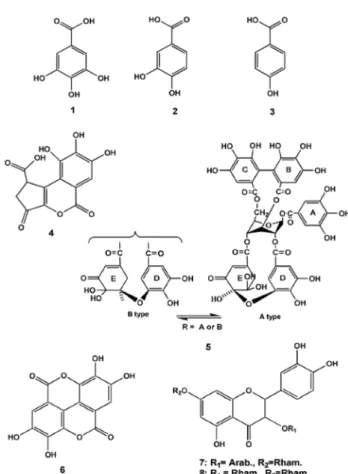
로 동 정하였다(Fig 2).
2. Rat lens aldose reductase (RLAR) 억제활성
현초의용매별추출물과
95% EtOH
추출물의순차적분획물의
RLAR
억제활성에 대한 결과를IC
50값으로 표현하여Table 1
에 나타내었다.
이때양성대조물로는AR
억제제로잘알려진
quercetin
을 사용하여 그 활성을 함께 비교하였다Fig. 2. The structures of the compounds isolated from ethyl
ace tate soluble fraction of Geranium thunbergii.
(Varma et al ., 1975).
현초의 용매별 추출물에 대한RLAR
억제활성 결과
,
현초MeOH
추출물은10
㎍/
㎖ 의농도에서34.49%
의 억제효과를보였고,
물, 95% EtOH
추출물은IC
50값이각각
5.24, 6.39
㎍/
㎖로 나타났다.
또한95% EtOH
추 출물을이용한순차적분획물 모두에서처리농도에따라농도 의존적으로RLAR
억제 활성이 증가함을 보였으며, EtOAc (2.64
㎍/
㎖) > CH
2Cl
2(8.69
㎍/
㎖) > H
2O ( > 10
㎍/
㎖)
의 순서로
RLAR
억제활성이 나타났다.
양성대조물로 사용된quercetin
의IC
50값이2.00
㎍/
㎖ 인것과비교했을때EtOAc
분획물이
quercetin
에 상응하는RLAR
억제 활성을갖는다는 것을확인하였다.
95% EtOH
추출물의EtOAc
분획물로부터 분리된8
개의 화합물에대한RLAR
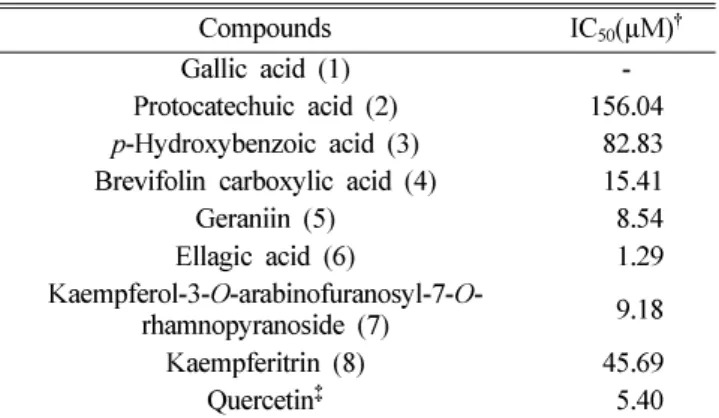
억제활성을측정하여Table 2
에나타내 었다. Ellagic acid (6)
의IC
50값이1.29 µM
로 양성대조물로사용한
querecetin
의IC
50값이5.40 µM
인 것과 비교했을 때ellagic acid
는 강력한RLAR
억제제로 확인 되었다. Lee
등(2008)
의연구에서상황버섯으로부터분리된화합물의RLAR
실험에서양성대조물로사용된
quercetin
의IC
50값이2.91 µM
이며
, ellagic acid
의IC
50값이0.63 µM
로 보고하였으며,
이는 본 실험과 유사한 경향이 나타남을 확인할 수 있었다.
또한geraniin (5)
과kaempferol-3- O -arabinofuranosyl-7- O - rhamnopyranoside (7)
도IC
50값이 각각8.54, 9.18 µM
로querecetin
과 비교될만한효능을갖는것으로나타났으며,
현 재까지geraniin
과kaempferol-3- O -arabinofuranosyl-7- O - rhamnopyranoside
의AR
억제 활성에 대해 보고된 바는 없 다.
이와 같이현초의 성분들은AR
에 대한 유력한억제활성 을가짐으로써 당뇨합병증예방 및치료를위한우수한소재 로서의가능성이입증되었다.
3. exo vivo에서 수정체내의 galactitol 생성 억제 활성
Fatmawati
등(2009)
의 연구에 따르면 갈락토오스는 글루코 오스보다AR
기질로서우수하며,
그이유로갈락토오스는조 직에서글루코오스보다 쉽게흡수되고AR
에 의해갈락티톨로 빠르게 전환되기때문이라고하였다
.
이렇게생성된 갈락티톨은 폴리올 경로의 두 번째 효소인 솔비톨탈수소효소의 기질로사용되지만이효소반응은비교적천천히 일어나기때 문에갈락티톨은조직에서솔비톨보다빠르게축적된다고보 고하였다
.
이처럼천연물 및 생약을이용한AR
억제에 대한 연구로는Shin
등(1994)
이 구릿대ether
추출물에서RLAR
활성을 억제하며 동시에 갈락토오스혈증
(galactosemic) rat
의백내장형성을억제함을보고한바있다
.
본연구 중
RLAR
억제실험에서현초95% EtOH
추출물 의EtOAc
분획물로부터분리된화합물 중geraniin (5), ellagic acid (6), kaempferol-3- O -arabinofuranosyl-7- O -rhamnopyranoside (7)
가AR
활성을현저히억제함을관찰하였다.
이러한결과를 토대로exo vivo
에서3
개의성분을이용하여당뇨병성백내장 의 주요발현인자인수정체내의 갈락티톨생성 억제효과를 양성대조물인quercetin
과100
㎍/
㎖의동일한농도에서비교측정하여
Table 3
에나타내었다. 100
㎍/
㎖의농도에서ellagic acid (6)
의 갈락티톨생성 억제효과는42.47%
로나타났으며, quercetin
은46.83%
의억제효과가나타났으며,
이를비교했을 때ellagic acid
는quercetin
과유사한효능이있음을확인할수 있었다.
또한, geraniin (5)
과kaempferol-3- O -arabinofuranosyl- 7- O -rhamnopyranoside (7)
도 마찬가지로각각39.87%, 39.86%
의갈락티톨의생성이억제되었다
.
포도당은에너지원으로서중요한물질로정상시에는 세포 내에 흡수된후에 대부분 해당과정으로대사되고
,
폴리올경 로를 거쳐 대사되는것은불과 수%
에 지나지 않는다.
그러 나 세포내로의포도당 유입은 인슐린 비의존형 조직의 경우 포도당의 세포막투과는 세포외의 포도당 농도에 의존하므로 당뇨병으로인해고혈당상태가 오래지속되면세포내포도당 농도는상승하고,
폴리올경로의핵심효소인AR
에의하여포도당대사가항진되어솔비톨이과잉생성되고
,
그 결과솔비Table 1.
Inhibitory effects of the crude extracts and fractions of Geranium thunbergii on rat lens aldose reductase.
Extracts and Fractions IC
50(
㎍/
㎖)
†H
2O ext. 5.24
MeOH ext. >10
EtOH ext. 6.39
CH
2Cl
2fr. 8.69
EtOAc fr. 2.64
H
2O fr. >10
Quercetin
‡2.00
†
The IC
50value was defined as the concentration of the 50%
inhibition.
‡
Positive control.
Table 2.
Inhibitory effects of the compounds (
1-8) isolated from ethyl acetate-soluble fractions of Geranium thunbergii extract on rat lens aldose reductase.
Compounds IC
50(µM)
†Gallic acid (1) -
Protocatechuic acid (2) 156.04
p
-Hydroxybenzoic acid (3) 082.83 Brevifolin carboxylic acid (4) 015.41
Geraniin (5) 008.54
Ellagic acid (6) 001.29
Kaempferol-3-
O-arabinofuranosyl-7-
O-
rhamnopyranoside (7) 009.18
Kaempferitrin (8) 045.69
Quercetin
‡005.40
†
The IC
50value was defined as the concentration of the 50%
inhibition.
‡
Positive control.
톨이 축적되는부위의발병증상에 따라서 당뇨성백내장
,
당 뇨성망막증,
당뇨성각막증,
당뇨성신경장애,
당뇨성신증등 의당뇨성합병증을일으키게된다(Dvornik et al ., 1973).
AR
이촉매하는포도당의폴리올로의환원반응은그평형에 서 역반응을 일으키지 않는다.
솔비톨 탈수소효소의 활성이AR
의활성보다낮기때문에솔비톨에서프룩토오스로의변환은 소량이며
,
결과적으로폴리올 경로의항진은 솔비톨을축 적시킨다(Collins and Corder, 1977).
당뇨병에의하여수정체 내의포도당농도가상승하면AR
에 의하여솔비톨의생성이 항진되고,
솔비톨의축적은세포내삼투압을상승시켜수정체 내로의수분유입을촉진하여 세포의팽화를 일으킨다.
이 팽화는수정체섬유세포의투과성을항진하고
, Na
+, Cl
-의유입과K
+,
아미노산,
단백질, ATP, myo-inisitol
등의 유출을 일으킨 다. Na
+이나K
+ 등의전해질의평형파괴는삼투압을더욱상 승시키고,
세포의 팽화를한층 촉진하여세포막은 정상을유 지할수없게된다.
그와동시에세포내단백질변성이진행되 어 수정체가 혼탁하게 되는데 이와 같이 수정체가 혼탁해져 나타나는백내장증상을당뇨병진행과정의한지표로사용한 다(Gabbay and O´Sullivan, 1968).
따라서 솔비톨의 생성을억제하는물질이당뇨병성백내장의발병을억제하게된다는 것이며
,
이론적으로는 솔비톨을생성하는효소인AR
을 저해 하므로써가능하게된다는것이다.
이처럼 본 실험의결과는
in vitro
수준에서현초의 성분이lens
의AR
에 대한 억제활성을 가짐을규명한 새로운 결과로 써,
현초의ellagic
산계열의탄닌류와플라보노이드성분은당 뇨합병증억제 효과를가진다는 것이확인되었으며,
향후 당뇨합병증에대한전임상효능연구와안전성 확보를통하여당 뇨합병증 예방 및 치료를 위한 신소재로의 가능성이 있다고 판단된다
.
감사의 글
이논문은
2011
년도정부(
교육과학기술부)
의 재원으로한국 연구재단의대학중점연구소지원사업으로수행된연구(2011- 0030750)
이며,
교육과학기술부의재원으로한국연구재단의지 원을받아 수행된광역경제권 선도산업인재양성사업의 일부 연구결과로이에감사를드립니다.
인용문헌
Carper DA, Hohman TC and Old SE. (1995). Residues affecting the catalysis and inhibition of rat lens aldose reductase.
Biochimica et Biophysica Acta. 1246:67-63.
Choi HJ, Jeong YK, Kang DO and Joo WH. (2008). Inhibitory effects of four solvent fractions of Alnus firma on a-amylase and a-glucosidase. Journal of Life Sciences. 18:1005-1010.
Collins JG and Corder CN. (1977). Aldose reductase and sorbitol dehydrogenase distribution in substructures of normal and diabetic rat lens. Investigative Ophthalmology Visual Science.
16:242-243.
Constantino L, Rastelli G, Vianello P, Cignarella G and Barlocco D. (1999). Diabetes complications and their potential prevention: aldose reductase inhibition and other approaches.
Medical Care Research Review. 19:3-23.
Corns CM. (2003). Herbal remedies and clinical biochemistry.
Annals of Clinical Biochemistry. 40:489-507.
Dvornik E, Simard-Duquesne N, Krami M, Sestanj K, Gabbay KH, Kinoshita JH, Varma SD and Merola LO. (1973).
Polyol accumulation in galactosemic and diabetic rats: control by an aldose reductase inhibitor. Science. 182:1146-1148.
Fatmawati S, Kurashiki K, Takeno S, Kim YU, Shimizu K, Sato M, Imaizumi K, Takahashi K, Kamiya S, Kaneko S and Kondo R. (2009). The inhibitory effect on aldose reductase by an extract of Ganoderma lucidum . Phytotherapy Research. 23:28-32.
Gabbay KH and O´Sullivan JB. (1968). The sorbitol pathway:
Enzyme localization and content in normal and diabetic nerve and cord. Diabetes. 17:239-243.
Hayman S and Kinoshita J. (1965). Isolation and properties of lens aldose reductase. Journal of Biological Chemistry. 240:877- Jeon YH, Moon JM, Kweon HJ, Jeoung YJ, An CS, Jin HL, 882.
Hur SJ and Lim BO. (2010). Effects of Lycii fructus and Astragalus membracaceus mixed extracts on immunomodulators and prevention of diabetic cataract and retinopathy in streptozotocin-induced diabetes rat model. Korean Journal of Medicinal Crop Science. 18:15-21.
Kato A, Yasuko H, Goto H, Hollinshead J, Nash RJ and Adachi I. (2009). Inhibitory effect of rhetsinine isolated from Evodia rutaecarpa on aldose reductase activity. Phytomedicine.
16:258-261.
Kim JK, Lee YS, Kim SH, Bae YS and Lim SS. (2011).
Inhibition of aldose reductase by phenylethanoid glycoside isolated from the seeds of Paulownia coreana. Biological Pharmaceutical Bulletin. 34:160-163.
Table 3.
Inhibitory effects of the phenolic compounds from the Geranium thunbergii extract on the galactitol accumulation in rat lenses incubated with high galactose.
Compounds Galactitol content [
㎍/lens wet weight
(g)]
†Inhibition (%)
Blank (galactose-free) - 100
Control 844.05 ± 20.29 0
Geraniin (5) 507.49 ± 23.17 39.87 Ellagic acid (6) 485.59 ± 33.71 42.47 Kaempferol-3-
O-
arabinofuranosyl
-7-
O-rhamnopyranoside (7) 504.64 ± 26.23 39.86 Quercetin
‡448.81 ± 26.41 46.83
†
Means of analysis (means ± standard deviation) of galactitol in the rat lenses (n = 5) with samples at the concentration of 100
㎍/
㎖.
‡