302
민들레와 두종의 엉겅퀴의 Rat lens aldose reductase 억제활성
정미정·허성일·왕명현*
강원대학교생명공학부
Rat Lens Aldose Reductase inhibitory of Taraxacum mongolicum
and two Cirsium species
Mee Jung Jung, Seong-Il Heo, and Myeong-Hyeon Wang*
School of Biotechnology, Kangwon National University, Chuncheon, Kangwon-do 200-701, Korea Received October 27, 2008; Accepted December 10, 2008
To evaluated active principles for diabetic compolications from the
Taraxacum mongolicum(
T. mon- golicum),
Cirsium japonicum(
C. japonicum), and
Cirsium setidens(
C. setidens) and its constituents, as well as silymarin tested for their effect on rat lens aldose reductase. As a result, the MeOH extract of
T. mongolicum(IC
508.71
µg/mL) have strong lens aldose reductase inhibition abilities.
Also, Aldose reductase inhibitory showed an isolated luteolin (IC
5020
µM) from the
T. mongolicumand sliymarin (IC
5013
µM).
Key words: Aldose reductase, Cirsium japonicum, Cirsium setidens, Silymarin, Taraxacum mongolicum
만성소모성질환의 하나인당뇨병은대표적인성인병의하 나로서전세계적으로 급증하고있고우리나라에서도 그환자 는 증가일로에있다. 또한당뇨병은그 자체보다는합병증이 더무서운데, 당뇨성합병증의형태는말초신경장해, 망막증,
신증 및 백내장 등으로 나타난다[Beyer-Mears et al., 1986;
Kador et al., 1985a; Kador et al., 1985b; Robinson Jr et al., 1983; Uede et al., 2004; Van-Heyningen, 1959]. 당뇨병 치료에있어서 최대목표중의하나는당뇨병 합병증의유발이 나진전을억제하는데있다. 당뇨병조절과합병증과의관계연
구에의하면강화된 insulin 치료로혈당을정상화시키면당뇨
병 합병증을 크게 감소시킬 수 있었다[Lee et al., 2004;
Seaquist et al., 1989].
Aldose reductase(EC 1.1.1.21)는 하나의 aldo-keto reductase
로 당뇨성 합병증 발증에 중요한 역할을 한다고 알려져 있는
glucose 대사경로인 polyol pathway의 촉매효소로서, NADPH
를조효소로이용한다[Lee et al., 2005; Maccari et al., 2005].
당뇨병에있어서고혈당이합병증을유발시키는기전으로 polyol pathway의 이상, oxidative stress, myo-inositol의 감소와 Na+, K+-ATPase 활성의 감소 등이 보고되어 있다[Greene et al., 1987; Williamson et al., 1993; Sato and Rifkin(1979)]. 정상
상태에서의 glucose는 생명을 유지하기위한 중요한 에너지원
으로 insulin에 의해세포내로유입된후대부분이해당계에서
대사되므로 polyol pathway를 통하여 대사되는것은약 3%에 불과하다[Greene et al., 1987]. 그러나신장세포, 신경세포, 수
정체, 망막세포와 적혈구 등은 glucose 유입에 있어 insulin에 의존하지 않고확산에의해유입되므로, 당뇨병에 의해고혈당
이유발되면 이러한세포내 glucose에의해 ROS가 생성되고,
이는 toxic aldehyde의 생성을 촉진시키고 또한 aldose reductase를활성화시켜정상상태의약 2-4배의 glucose가 polyol pathway를 거쳐 sorbitol과 fructose가 생성된다[Malone et al., 1980; Travis et al., 1974]. 축적된 sorbitol은세포내삼투압과 세포투과성을초래하여생체내대사장애, 즉당뇨병합병증을 가져오게된다. 따라서, aldose reductase 활성을저해시키는것
은 glucose가 sorbitol로진행되는과정을차단시켜당뇨병합병 증을예방하고치료하는것이다.
국화과(Asteraceae or Compositae)는국화목(Asterales)에속하 는식물로전세계적으로걸쳐자라고있다. 우리나라에서는민
들레속(Taraxacum), 돼기풀속(Ambrosia), 지느러미엉겅퀴속
(Carduus), 엉겅퀴속(Cirsium), 잇꽃속(Carthamus) 등이국화과에
속하는데, 이들식물속 중 민들레(Taraxacum mongolicum), 엉 겅퀴(Cirsium japonicum)는대표적인 식물로서식용혹은약용 으로 널리 이용되고 있다[Han, 2002; Heo and Wang, 2008;
Lee et al., 2003]. 또한고려엉겅퀴(Cirsium setidens)는 강원도 지역에서자생하는식물로서곤드레라고불리우며식용으로사 용되고있다[Lee et al., 2006]. 이들민들레, 엉겅퀴, 그리고고
*Corresponding author
Phone: +82-250-6486; Fax: +82-241-6480 E-mail: [email protected]
doi:10.3839/jabc.2008.047
려엉겅퀴에관한생리활성에관한연구는많이 진행되어왔으 나 당뇨병 합병증과관련된 aldose reductase저해에 관한연구
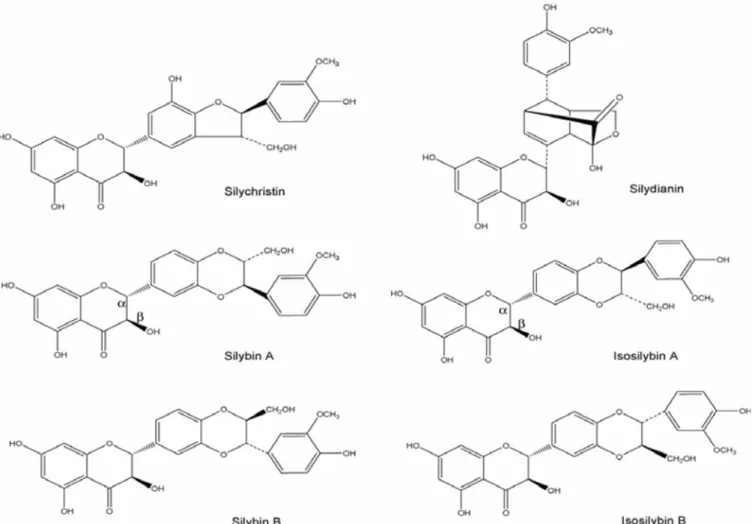
는아직밝혀지지않았다. 따라서본실험에서는 이들세식물 의부위별메탄올(MeOH) 및물(H2O)추출물을대상으로 aldose reductase 저해활성을살펴보고, 이들식물에서 분리된화합물 인 luteolin과 syringin 그리고 국화과식물에서 추출된 혼합물
로서상업적으로널리시판되고있는 silymarin(Fig. 1.)과비교 하여결과를도출하였다.
재료 및 방법
실험재료.본실험에서 사용한재료들은 2007년도에 강원도 춘천시에서 채집하였으며 분쇄 후 사용하였다. 시료의 감별은
강원대학교분자의생명공학과 식물분자생명공학실왕명현교수 에 의해감별하였으며, 시료의 표본또한강원대학교 분자의
생명공학과식물분자생명공학실에 보관하였다(No.20070411). 민 들레, 엉겅퀴, 그리고 고려엉겅퀴 각 부위별 분말 100 g씩을 100% 메탄올및증류수로 70oC 온도에서환류냉각기를사용 하여 3시간 동안 추출하여 여과하였다 그 후에 rotary
evaporator로감압농축하여각각의식물들의부위별메탄올추
출물및물추출물을얻어활성측정시료로사용하였다.
기구 및 시약. 기구로 선광도를 측정하는 Polarimeter는
Perkin-Elmer 341를 사용하였으며, UV spectra는 Varian Carry UV-visible spectrophotometer를 이용하였다. FAB-MS는
Autospec. M363 series mass spectrometer를이용하여측정하였
으며, 1H and 13C NMR spectra는 Bruker DPX 400(400 MHz for 1H, 100 MHz for 13C) spectrometer로 측정하였다.
화학적 이동치(chemical shifts)는 용매 peak(δH 2.50 and δC
39.5 for DMSO-d6)를 기준으로 하여 결정하였으며 DEPT, HMQC, 그리고 HMBC spectra 또한 Bruker DPX 400을이용 하여측정하였다. Column chromatography를시행하기위해 Si gel[Fuji silysia chemical Ltd., BW-820MH(S)], Sephadex LH- 20(GE Healthcare Bio-Sciences, 25-100 mm), MCI gel (Supelco, CHP20P) 그리고 RP-18 gel(YMC Co. LTD., 12 nm S-75 mm)을 사용하였다. TLC판은 Merck Kieselgel 60 F254 plate(0.25 mm)을이용하였으며, 발색제로 50% 황산(H2SO4)
을 사용하였다. NADPH, dl-glyceraldehyde는 Sigma Co.
(USA), sodium phosphate(monobasic, dibasic), potsssium phosphate(monobasic, dibasic)은 Shinyo Pure Chem. Co.
(Japan)에서 수입하여사용하였고, 유기용매는시판되는특급및 일급시약을사용하였다.
민들레 추출물로부터 화합물 1의 분리. 민들레 지상부 3 kg
Fig. 1. The main bioactive constituents in silymarin.
에 100% 메탄올을 첨가한다음 70oC 온도에서환류냉각기를 사용하여 3시간 동안 추출하여 여과하였다. 그 후에 rotary evaporator로 감압농축하여 이를메탄올 추출물로하였다. 얻
어진 메탄올 추출물(370.8 g)을 이동상 용매 디클로로메탄
(dichloromethane, CH2Cl2)-메탄올(MeOH)[CH2Cl2:MeOH(100:0- 0:100% gradient, v/v)]을사용하여 Si-gel column chromatography
를 시행하여 총 29개의 분획물을 얻었다. 이중 19번 분획물
(0.14 g)을 이동상 용매 물-메탄올[MeOH:H2O(100:0-0:100%
gradient, v/v)]을 사용하여 RP-18 gel column chromatography
를 시행하여화합물 1(luteolin, 20 mg)을 얻었다. 화합물의구 조 동정은 시판되는표준품과의 직접 비교및 분광학적분석 그리고참고문헌[Jung et al., 2004]을토대로결정하였다
Compound 1: 1H-NMR (400MHz, DMSO-d6) δ: Amorphous yellow powder; m.p. >320o (c 0.20, MeOH); EIMS (positive ion mode) m/z 286[M]+;12.97 (1H, s, OH-5), 10.80 (1H, s, OH-7), 9.90 (1H, s, OH-4'), 9.39 (1H, s, OH-3'), 7.41 (1H, dd, J=8.0, 2.0 Hz, H-6'), 7.39 (1H, d, J=2.0 Hz, H-2'), 6.88 (1H, d, J=8.0 Hz, H-5'), 6.66 (1H, s, H-3), 6.43 (1H, d, J
=2.0 Hz, H-8), 6.18 (1H, d, J=2.0 Hz, H-6); 13C-NMR (100 MHz, DMSO-d6) δ: 181.6 (C-4), 164.1 (C-7), 163.9 (C-2), 161.5 (C-5), 157.3 (C-9), 149.7 (C-4'), 145.7 (C-3'), 121.5 (C-1'), 119.0 (C-6'), 116.0 (C-5'), 113.4 (C-2'), 103.7 (C-3), 102.9 (C-10), 98.8 (C-6), 93.8 (C-8).
고려엉겅퀴 추출물로부터 화합물 2의 분리.고려엉겅퀴뿌리 분말(2.2 kg)을 메탄올로 80oC에서 3시간 추출하였다. 이 추출 물은여과한후 40oC에서감압 농축하여메탄올추출물(225. 7 g)을얻었다. 이메탄올추출물을이동상용매메탄올/물(0:100, 40:60, 60:40, 100:0, v/v)을 이용하여 MCI gel column chromatography를시행하여총 4개의분획물을얻었다. 이중분 획물 2번을(3.26 g)을 대상으로 Sephadex LH20(MeOH) column chromatography를시행하여화합물 2(syringin, 113 mg)을얻었 다. 화합물의구조동정은 시판되는표준품과의직접비교및 분광학적분석그리고참고문헌[Lee et al., 2004]을토대로결 정하였다.
Cmpound 2: Pale yellow-white amorphous powder; m.p.
185.8-186.0; [α]D20 −16.9o (c 0.23, MeOH); LR-FABMS (positive ion mode) m/z 395 [M+Na]+; 1H-NMR (400 MHz, DMSO-d6) δ: 6.75 (2H, s, H-3,5), 6.54 (1H, brd, J=15.9 Hz, H-7), 6.32 (1H, dt, J=5.6, 15.9 Hz, H-8), 4.85 (1H, d, J=7.8 Hz, Glc-1), 4.23 (2H, dd, J=1.3, 5.6 Hz, H-9), 3.85 (6H, s, OCH3), 3.77 (1H, dd, J=2.3, 12.0 Hz, Glc-6a), 3.67 (1H, dd, J=5.0, 12.0 Hz, Glc-6b), 3.48 (1H, ddd, J=2.7, 7.1 Hz, Glc-2), 3.42 (1H, d, J=2.3 Hz, Glc-4), 3.41 (1H, d, J=2.3 Hz, Glc-5), 3.20 (1H, m, Glc-3); 13C-NMR (100 MHz, DMSO-d6) δ: 153.3 (C-2, 6), 134.8 (C-1), 134.3 (C-4), 130.2 (C-7), 129.1 (C-8), 104.4 (C-3,5), 104.3 (Glc-1), 77.3 (Glc-3), 76.8 (Glc-5), 74.7 (Glc-2), 70.2 (Glc-4), 62.6 (C-9), 61.4 (Glc-6), 56.0 (OCH3).
실험동물.실험동물은계대 사육한순계 Sprague-Dawley(SD)
계웅성흰쥐를이용하였다.
Aldose Reductase 억제활성 측정. Aldose reductase 억제효 과를측정하기위한효소원의조제는 Hyman과 Kinoshita[1965]
가 사용한 방법을 수정하여 실시하였다. SD계 흰쥐의 수정체 를적출하고, 그습중량에따라일정량의 phosphate buffer를가
하여균질화하였다. 이를 4oC에서 원심분리한후 그 상등액을 취하여 ammonium sulfate로 40%까지 포화시키고 원심분리한
상등액을취하여 다시 70%가 되도록 ammonium sulfate를 첨 가하였다. 원심분리하여 얻어진 pellet을최소량의 buffer에현
탁하여투석을 1일정도한다음, 효소원으로하였다. 위에서조 제한효소원과 dl-glyceraldehyde를기질로하여반응시키고 340 nm에서 NADPH 흡광도의감소율을측정하였다.
결과 및 고찰
민들레와두종의엉겅퀴류인엉겅퀴와고려엉겅퀴부위별각 용매 추출물들의 항당뇨 활성을 검색하기 위해 흰쥐 수정체
aldose reductase 활성을측정하여 그 결과를 나타내었다(Table 1). 각각용매에따른식물들의 aldose reductase억제활성과용 매별로 따른 aldose reductase 억제활성을 살펴보면모든식물
에 있어서메탄올추출물이물 추출물에비해뛰어난억제활 성을보였으며, 추출물의억제활성순서를 보면민들레지상 부메탄올추출물>엉겅퀴 뿌리메탄올추출물>민들레뿌리메 탄올추출물>엉겅퀴지상부메탄올추출물>민들레지상부물 추출물>고려엉겅퀴뿌리메탄올추출물>엉겅퀴 뿌리물추출
Table 1. Inhibitory effects of Taraxacum mongolicum and two Cirsium species on aldose reductase activity
Samples Concentration
(µg/mL) Inhibition
(%) IC50
(µg/mL) T. mongolicum
MeOH ext. upper 100 97.56
8.71
10 58.54
5 26.83
root 10010 88.8911.11 55.11 H2O ext. upper 10010 72.7722.22 60.00
root 100 NA* -
C. japonicum
MeOH ext. upper 10010 75.7018.90 59.14 root 10010 82.9341.46 28.53
H2O ext. upper 100 46.34 -
root 10010 56.1026.83 81.13 C. setidens
MeOH ext. leaf 10010 57.3021.35 81.63 root 10010 64.0421.35 70.45
H2O ext. leaf 100 NA* -
root 100 13.48 -
*NA=not active.
물>고려엉겅퀴잎메탄올추출물 순서였다.
민들레지상부의메탄올추출물및 고려엉겅퀴뿌리메탄올 추출물을반복적인 Si gel, Sephadex LH-20, MCI gel, 그리고
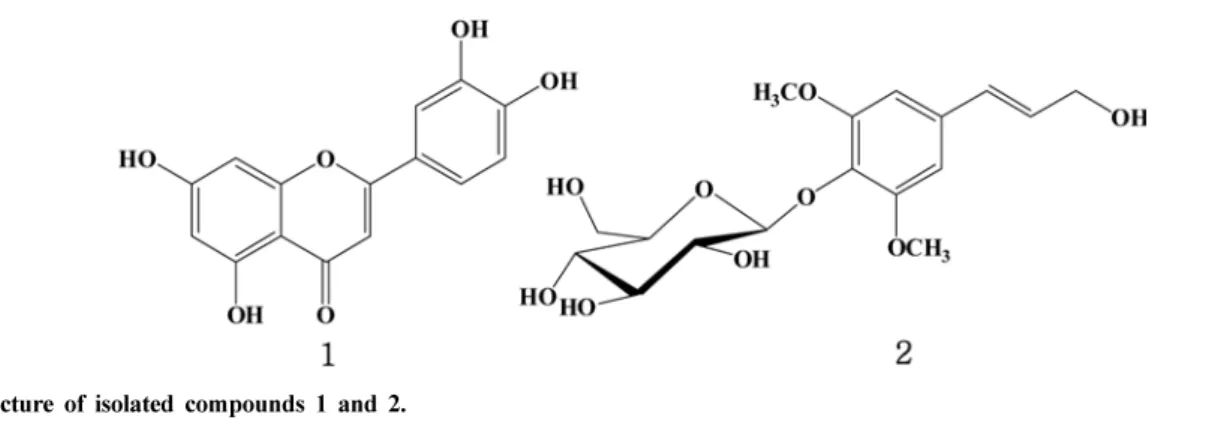
RP-18 gel 등의 chromatography를이용하여각각의추출물에서 화합물 1(luteolin)과 2(syringin)을분리하였다. 이들화합물들은
1D(1H- 및 13C-NMR)와 2D-NMR(HMQC 및 HMBC) 데이터
를통해구조를밝혔다(Fig. 2).
화합물 1(luteolin)과 2(syringin) 그리고 silymarin의 aldose reductase 저해 활성은 Table 2에나타내었다. Silymarin의경우
aldose reductase 저해 활성이 IC50 6.55µg/mL이며 몰 농도로
환산하면 13µM로서이는이미뛰어난 aldose reductase저해제 로 이미 밝혀져 있는 양성 대조군인 quercetin(IC50 10µM) [Lim et al., 2006]과유사한 활성을보여 aldose reductase저해 효과로당뇨병 합병증의치료제로서의가능성을확인할수있 었다. 또한화합물 1인 luteolin의 경우 quercetin 보다는 다소 약하나 aldose reductase저해 효과를 보였다. 그러나 화합물 2(syringin)의경우 100µg/mL의 고농도에서도 aldose reductase
저해활성이나타나지않았다. Silymarin의 경우플라보노리그
난으로 플라보노이드와 리그난 골격이 결합되어 있다[Woo, 1996]. 또한 lutolin의 경우 플라보노이드 화합물로 잘 알려져 있으며, 플라보노이드 화합물이 뛰어난 aldose reductase 저해
활성을가진다고밝혀졌다[Lim et al., 2006]. 그러나페놀성화 합물인 syringin은 활성을나타내지않았다.
초 록
국화과식물인 민들레, 엉겅퀴, 그리고고려엉겅퀴를대상으
로 항당뇨 활성 측정 방법 중 하나인 흰쥐 수정체 aldose
reductase 저해 활성을측정하였다. 여러부위별 추출물 중 민 들레 지상부메탄올 추출물이 IC50 8.71µg/mL로서뛰어난 저 해활성을보였다. 국화과식물에서 분리된대표적인화합물인
silymarin과 민들레에서분리한 luteolin(1) 그리고 고려엉겅퀴 에서분리된 syringin(2)을대상으로 aldose reductase 저해활성 을 측정한결과 silymarin과 luteolin은뛰어난 aldose reductase
저해활성을보였다.
Key words: Aldose reductase, Cirsium japonicum, Cirsium setidens, Silymarin, Taraxacum mongolicum
참고문헌
Beyer-Mears A, Cruz E, Edelist T, and Varagiannis E (1986) Diminished proteinuria in diabetes mellitus by sorbinil an aldose reductase inhibitor. Pharmacology 32, 52-60.
Greene DA, Lattimer SA, and Sima AF (1987) Sorbitol, phosphoinositides and sodium-potassium-ATPase in the pathogenesis of diabetic complication. New Eng J Med 316, 599-606.
Han YB (2002) Korea natural plant food source. Korea University Press, Seoul, Korea.
Hayman S and Kinoshita JH (1965) Isolation and properties of lens aldose reductase. J Biol Chem240, 877-882.
Heo SI and Wang MH (2008) Antioxidant activity and cytotoxicity effect of extracts from Taraxacum mongolicum H. Kor J Pharmacogn39, 255-259.
Jung MJ, Kang SS, Jung HA, Kim GJ, and Choi JS (2004) Isolation of flavonoids and cerebroside from the stem bark of Albizzia julibrission. Arch Pharm Res 27, 593-599.
Kador PF, Kinoshita JH, and Sharpless NE (1985) Aldose reductase inhibitors: a potential new class of agenta for the pharmacological control of certain diabetic complications. J Med Chem28, 841-849.
Kador PF, Robinson Jr WG, and Kinoshita JH (1985) The pharmacology of aldose reductase inhibitors. Ann Rev Fig. 2. Structure of isolated compounds 1 and 2.
Table 2. Inhibitory effects of silymarin and isolated compounds (1 and 2) from the T. mongolicum and C. setidens, respectively
Samples (Mw) Concentration
(µg/mL) Inhibition
(%) IC50
(µg/mL) (µM) Luteolin (286) 10 5 83.15±0.0246.07±0.04 5.51 20 Syringin (327) 100 19.78±0.05 -
Silymarin (482) 100 71.30±0.07
6.55 13
10 62.20±0.10 5 44.34±0.08 Quercetin (302) 10 83.80±0.03
2.94 10 5 70.30±0.06
1 32.40±0.07 Data are means±SD (n=3)
Pharmacol Toxicol 25, 691-714.
Lee HK, Kim JS, Kim NY, Kim MJ, Park SU, and Yu CY (2003) Antioxidant, antimutagenicity and anticancer activities of extracts from Cirsium japonicum var. ussuriense KITAMURA.
Korean J Medicinal Crop Sci11, 53-61.
Lee SH, Jin YS, Heo SI, Shin TH, Sa JH, Choi DS, and Wang MH (2006) Composition analysis and antioxidative activity from different organs of Cirsium setidens Nakai. J Food Sci Technol38, 571-576.
Lee SH, Son DW, Ryu JY, Lee YS, Jung SH, Kang JG, Lee SY, Kim HS, and Shin KH (2004) Anti-oxidant activities of Acnthopanax senticosus stems and their lignan components.
Arch Pharm Res 27, 106-110.
Lee YS, Lee SH, Kim BK, and Shin KH (2004) Screening for aldose reductase inhibitory activity of extracts of the marin plants from Korea. Algae 19, 349-352.
Lee YS, Lee SH, Lee HS, Kim BK, Ohuchi K, and Shin KH (2005) Inhibitory effects of isorhanmnetin-3-O-β-D-glucoside from Salicornia herbacea on rat lens aldose reductase and sorbitol accumulation in streptozotocin-induced diabetic rat tissues. Biol Pharm Bull28, 916-918.
Lim SS, Jung YJ, Hyun SK, Lee YS, and Choi JS (2006) Rat lens aldose reductase inhibitory constituents of Nelumbo nucifera Stamens. Phytother Res 20, 825-830.
Maccari R, Ottaná R, Curinga C, Vigorita MG, Rakowitz D, Steindl T, and Langer T (2005) Structure-activity relationships and molecular modeling of 5-arylidene-2,4-thiazolidinediones active as aldosse reductase inhibitors. Bioorg Med Chem 13, 2809-2823.
Malone JI, Knox G, Benford S, and Tedesco TA (1980) Red cell sorbitol. An indicator of diabetic control. Diabetes 29, 861-864.
Robinson Jr WG, kador PF, and Kinoshita JH (1983) Retinal capillaries: basement membrane thickening by galactosemia prevented with aldose reductase inhibitor. Science 221, 1177- 1179.
Sato Y and Rifkin DB (1979) Inhibition of endothelial cell movement by pericytes and smooth muscle cells: Activation of a latent transformation growth factor B1-like molecule by plasmin during coculture. J Cell Biol109, 309-315.
Seaquist ER, Goetz FC, Rich S, and Barbosa J (1989) Familial clustering of diabetic kidney disease: Evidence for genetic susceptibility to diabetic nephropathy. New Eng J Med 320, 1161-1165.
Travis SF, Morrison AD, Clements RSJr, Winegrad AI, and Oski FA (1974) The role of the polyol pathway in metahemoglobin reduction in human red cells. Br J Haematol 27, 597-605.
Ueda H, Kuroiwa E, Tachibana Y, Kawanishi K, Ayala F, and Moriyasu M (2004) Aldose reductase inhibitors from the leaves of Myrciaria dubia (H. B. &. K.) McVaugh. Phytomedicine11, 652-656.
Van-Heyningen R (1959) Formation of polyols by the lens of the rat with ‘sugar’ cataract. Nature184, 194-195.
Williamson JR, Chang K, Frangos M, Hasan KS, Ido Y, Kawamura T, Nyengard J R, Van Den Enden M, Kilo C, and Tilton RG (1993) Hyperglycemic pseudohypoxia and diabetic complication. Diabetes42, 801-813.
Woo WS (1996) Research of natural product (2nd ed.) Seoul National University Press, Seoul.