참외 추출물의 Quinone Reductase 유도활성 및 간암세포 증식 억제효과
김혜숙·구강모·서전규·강영화*
경북대학교농업생명과학대학원예학과
Quinone Reductase Inductive Activity and Growth Inhibitory Effect against Hepatoma Cell of Oriental Melon Extract
Hye Suk Kim, Kang Mo Ku, Jun Kyu Suh, and Young Hwa Kang
*Department of Horticulture, College of Agriculture and Life Science, Kyungpook National University, Daegu 702-701, Korea
Abstract.
This study was performed to elucidate anticancer activities of various parts, such as peel, flesh, placenta, seed, stalk and stem · leaf of oriental melon. Chemopreventive and anticancer effects of oriental melon extract were evaluated by detoxifying enzyme, quinone reductase (QR) inductive activity, cytotoxic- ity and growth inhibitory effect against hepatoma cell. Stalk and stem · leaf extracts of oriental melon showed the increment of QR inductive activity with dose-dependent manner and induced quinone reductase 3.9, 1.5-fold at 200
µg/mL respectively compared to control. The growth inhibitory effect of oriental melon extract against mouse hepatoma cell (Hepa1c1c7) was investigated by crystal violet (CV) assay. Stalk and stem · leaf of oriental melon showed potent growth inhibitory effect. Based on these result, the growth inhib- itory effects of stalk, stem · leaf at various concentration were examined in detail by MTT assay using human hepatoma cancer cell (HepG2). All of two parts showed growth inhibitory effects and expecially stalk exhibited inhibitory effect of 60.3% at maximum concentration. The above results suggest that stalk of oriental melon has a possibility as a source of natural cancer chemopreventive materials.
Key words :
anticancer, chemoprevention, MTT, QR
서 론
통계청이발표한
‘2008
년사망및사망원인통계자료
’
에따르면우리나라의사망률순위는암,
뇌혈관질 환,
심장질환 등으로 나타나 있다(National Statistical Office, 2008).
암은 대부분의나라에서 사망률1
위의질병이라는 점에서도 중요하지만
,
여러가지 의학 및 사회적인노력에도불구하고사망률이개선되지않는 질병이라는 점에서특히 그중요성이 부각되고있다.
암발생원인의
85%
는식생활,
흡연,
알코올등의생활습관과관련되어있으며
,
그중30~40%
가식습관이차지하고있다고알려져있다
(Doll, 1992).
암이발생하면수술
,
약물등을병행한치료법이행 하여진다.
현재사용되고있는항암제의독성및부작용이문제점으로대두되고있어
,
최근에는안정성있는 약물을개발하기위해 식품및천연물을이용한생리 활성 물질의검색 및 그작용기작에 관한 연구가활 발히 진행되고 있다(Fish, 1984; Hamada, 2005;
Sporn, 1998).
발암과정은 크게 개시단계(initiation),
촉진단계
(promotion),
진행단계(progression)
의세단계 로 이루어져 있으며 각발암단계를 유발하는 인자를 제어함으로써암을예방할수있는물질을찾고자하 는 연구가 활발히 전개되고 있다(Brenner, 2000).
그 항암기작중대표적인것으로quinone reductase(QR)
와glutathion S-transferase(GST)
및UDP-glucuronosyl
transferase
등의 해독효소계의활성 유도를들 수있다
(Prochaska
등, 1985).
이와같은해독효소는식생활,
*Corresponding author: [email protected]
*Received December 7, 2009; Revised December 15, 2009;
*Accepted December 23, 2009
흡연
,
환경등에서들어온발암물질을체내에서무독화 시켜 체외로신속하게배출시킴으로써발암과정의 개 시단계를차단시킨다(Talalay
와Benson, 1982).
QR
은간세포에서주로생성되는해독효소의 한종 류로quinone
을hydroquinone
으로환원시켜무독하게만들고세포내에유도되어여러돌연변이물질에의해 일어나는 돌연변이와 종양화 막아주는 역할을 한다
(Steinkellner
등, 2001; Wefers
등, 1984).
지금까지 천연물로부터QR
을 유도하는 활성 성분으로는sulforaphane, brassinin withanolides
을 비롯하여poly- cyclic aromatic hydrocarbons, diphenols, flavonoids, isothiocyanates, thiocarbamates
등 다양한 계통의 화 합물들이 보고되고 있다(Mehtaet
등, 1995; Kennelly
등
, 1997; Kinghorn
등, 2000; Talalay
등, 1995;
Zhang
등, 1994).
이러한QR
에대한연구는주로 한 약재를비롯한약용식물을중점으로진행되어왔으나 최근에는채소류,
과일류를포함한식용식물에대한연구가활발히이루어지고있다
.
식용식물로부터QR
유 도활성을통한암예방효과를검색한연구로는십자 화과 식물을비롯하여콩,
석류,
파프리카,
피자두등 에서QR
유도활성효과를확인하였다(Kim
등, 1996, 2004; Shim
등, 2001; Yu
등, 2006).
참외는박과류에속하는식물로원래중앙아시아의 고온건조한지역이원산지로알려져있으며
,
동의보감 에는참외가진해,
거담작용을하고풍담,
황달,
수종,
이뇨에도 효과가 있다고 전해지고 있다
(Park
등,
2004).
참외의 생리활성에 관한 연구로는Shin
등(2008a, 2008b)
이참외추출물의항산화,
항균저해활성 등에대해보고하였다.
그러나참외의암예방활성에대한연구는아직까지보고되지않은실정이다
.
본연구에 서는대표적암예방효소인quinone reductase
유도활 성과 간암세포주에대한증식 억제효과를측정하여 참외추출물의암예방및항암효과를조사하였다.
재료 및 방법
1. 실험 재료 및 추출
본실험에사용된참외는시중에가장널리보급되 어있는 오복꿀품종으로경상북도성주과채류시험장 으로부터선별된것을공급받아사용하였다
.
참외는껍 질,
과육,
태좌,
씨,
꼭지,
줄기와잎을합친 부분으로나누어
40
oC
에서3
일간건조하여수분을제거시킨뒤 분쇄기로분쇄한분말에에탄올을가하여3
시간동안3
반복 추출하였다.
추출액은Whatman No. 2
여과지 로여과하고여과액은회전식감압농축기를이용하여감 압농축하였다.
농축후동결건조를실시하였고 −20
oC
에서보관하면서실험에사용하였다
.
2. 암세포 배양
QR
유도활성을측정하기위해본실험에사용한세 포주로는쥐간암세포인Hepa1c1c7(murine hepatoma cell line)
으로10% FBS(fetal bovine serum), 1%
antibiotics(100unit/mL penicillin, 100
µg/mL strepto- mycin)
를 첨가한 α-MEM
배지를 이용하여, 5% CO
2및
37
oC
의 배양기에서 배양하였다.
그리고 간암세포증식억제활성을측정하기위해인간유래의간암세포 주인
HepG2(human hepatocellular carcinoma)
를10%
FBS
와1% antibiotics(100unit/mL penicillin, 100
µg/
mL streptomycin)
첨가한DMEM
배지를 사용하여37
oC, 5% CO
2 조건에서배양하였다.
3. Quinone reductase 유도 활성
QR
유도 활성은쥐 간암세포인hepa1c1c7
세포를 이용하여Prochaska
와Santamaria(1998)
의 방법을일 부 변형하여사용하였다. Hepa1c1c7
세포를96 well plate
에1 × 10
4cells/mL
농도로분주하여24
시간배양한 후시료를 각
well
에 첨가하고 다시48
시간 동안배양하였다
.
배양이완료되면배양액을제거하고, 0.8%
digitonin
용액을가하여10
분동안37
oC
에서방치하였 다.
실험 반응용기에 반응용액을가하고5
분동안교반기
(TITRAMAX 101, Heidolph)
를이용하여반응시 킨 후spectrophotometer(Power Wave XS, Biotech)
를이용하여
595nm
에서측정하였다.
QR specific activity
는 환원된MTT
와crystal violet
에의한흡광도로산출하였고
, QR
유도활성은시료를 처리하지않은대조군의QR
활성에대한 시료를처리 한QR
활성의비로측정하였다.
4. Crystal violet assay
참외의암세포억제활성을 측정하기위해
Drysdale
등
(2006)
의 방법에 따라CV assay
를 실시하였다.
Hepa1c1c7
세포를96 well plate
에1 × 10
4 농도로각
well
에 분주하고24
시간 후참외 추출물의 각 시 료를일정농도로가하고다시48
시간동안배양하였다.
배양 후 배지를 제거하고
0.2% crystal violet/2%
EtOH
용액을첨가하고10
분간염색후증류수로세척하고 각
well
에0.5% SDS/50% EtOH
을 가하여610nm
에서흡광도를측정하였다.
5. MTT assay
참외추출물의암세포증식에대한억제효과를측정 하기 위해
Martin(1993)
의 방법에 따라MTT[3-(4,5- dimethylthiazol-2-yl)-2,5-diphenyl terazolium bromide]
assay
를 실시하였다. MTT assay
는세포의 생육을측 정하는방법으로서황색수용물질인MTT
가미토콘드리아 내의 탈수소효소작용에 의하여
formazan
을생성하는 원리를 이용한다
. 96 well plate
에HepG2
는1 × 10
5농도로각well
에분주하고24
시간후각각의 시료를일정농도로첨가하고배양기에서48
시간동안다시 배양
(37
oC, 5% CO
2)
하였다.
여기에PBS
완충 용액에2mg/mL
농도로녹인MTT
용액을첨가하여4
시간 동안 동일한 조건에서배양시켜
formazan
을 형성시킨 후 배양액을 제거하고 각
well
에DMSO
(dimethyl sulfoxide)
를 첨가하여formazan
을 녹인 후540nm
에서microplate reader
를 이용하여 흡광도를 측정하였다.
대조군의 세포수를100%
로하여 상대적 인세포증식억제율을구하였다.
6. 총 페놀 함량 측정
총페놀 함량을측정하기위해
Folin-Ciocalteu
법을 변형하여 사용하였다(Maria
등, 2006). 96 well plate
에 시료와
Folin-Ciocalteu’s phenol
시약을 넣어 교 반기에서(100rpm)
를 이용하여3
분 동안 반응시켰다. Sodium carbonate
포화용액을 넣고1
시간 동안 반응 시키고760nm
에서 흡광도를 측정하였다. Gallic acid
를이용한표준곡선에따른검량선을작성하여총페 놀함량을계산하였다
.
7. 총 플라보노이드 함량
총 플라보노이드 함량은
96 well plate
에 시료,
증 류수, 5% NaNO
2 용액을 첨가한 후 교반기(100rpm)
에서
6
분 동안 반응시켰다. 6
분 후10% AlCl
3을 혼 합하고, 1N NaOH
넣고1
시간 반응시킨 후415nm
에서 흡광도를측정하였다
(Jia
등, 1999).
이때 총플 라보노이드함량은naringin
을이용하여작성한표준곡선으로부터함량을구하였다
.
8. 통계처리
본 실험 결과 자료는
SAS program(version 9.1.3)
을이용하여각항목에대해
3
회반복측정하여얻은 결과를평균(mean) ±
표준편차(S.D.)
값으로나타내었으 며,
각군의평균차에대한통계적유의성은다중범위 검정(Duncan’s multiple range test)
을 실시하여5%
수준에서검정하였다
.
결과 및 고찰
1. Quinone reductase 유도 활성
참외 부위별 추출물의
QR
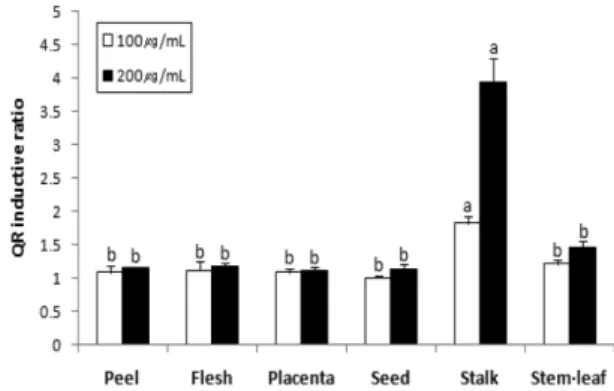
유도활성 측정 결과는Fig. 1
과 같다.
참외의 부위별추출물을100, 200
µg/
mL
의농도로처리하였을때꼭지와줄기·잎부위에 서 농도 의존적으로QR
유도활성이 증가하였다.
200
µg/mL
농도에서참외꼭지와줄기·잎부위는각각
3.9
배, 1.5
배의 높은QR
유도활성을 보였고, 100
µg/mL
의농도에서참외 꼭지부위는2.4
배의QR
유도활성을 보였다
. Yu
등(2006)
이 보고한 파프리카 추출물의EtOAc
분획층의200
µg/mL
농도에서의3.3
배와비슷한활성을나타내었다
.
참외꼭지와줄기·잎부위를제외한나머지부위에서는유의한
QR
유도활Fig. 1. Quinone reductase inductive activities of various parts from oriental melon. QR inductive ratio means the ratio of QR specific activity of sample to control. The results are the mean ± S.D. from three replication. Differ- ent letters indicate a significant difference by Duncan’s multiple range test at p < 0.05.
성이나타나지않았다
.
2. 암세포 증식 억제효과
참외추출물의암세포증식억제효과를살펴보기위 해
crystal violet assay
를실시하여 마우스유래의간암세포인
Hepa1c1c7
에서의증식 억제효과를측정한결과는
Fig. 2
와 같다. 200
µg/mL
농도에서 껍질,
과 육,
태좌,
씨부위 모두10%
정도의비교적낮은 암 세포 증식 억제효과를 보여주었고참외꼭지와 줄기·잎 부위는 각각
78.8%, 20.1%
의 높은 암 세포증식억제효과를보여주었다
.
이러한결과를토대로인체의간암세포주인
HepG2
에대한꼭지와줄기·잎추출물의암세포증식억제
효과를 농도별로 조사해본 결과
Fig. 3
과 같다. 25,
50, 100, 200
µg/mL
의농도로증가시키면서HepG2
에Fig. 2. Inhibitory effects of various parts of oriental melon against the proliferation of Hepa1c1c7 cell. The results are the mean ± S.D. from three replication. Different let- ters indicate a significant difference by Duncan’s multi- ple range test at p < 0.05.
Fig. 4. Total phenol contents of various parts of oriental melon. The results are the mean ± S.D. from three repli- cation. Different letters indicate a significant difference by Duncan’s multiple range test at p < 0.05.
Fig. 3. Inhibitory effects of various parts of oriental melon against the proliferation of HepG2. The results are the mean ± S.D. from three replication.
시료를 첨가 시 꼭지 부위에서
47.0, 54.1, 59.7,
60.3%
로농도의존적으로암세포증식억제효과를나타내었다
.
줄기·잎부위에서도마찬가지로농도가증 가함에따라8.1, 19.7, 24.7, 28.4%
로억제효과가증 가하였다.
최근에는식용식물로부터암을억제하는활성을탐색하는연구가활발히진행되고있다
. Bae
등(2009)
은곰취의메탄올추출물로부터암세포증식억제활성에 대해 보고하였고
Shim
등(2001)
과Kim
등(2009)
은석류와송이의HepG2
에서 세포증식억제활성을 보고하였는데
,
같은200
µg/mL
에서 석류의EtOAc
층은80%
의 암세포증식 억제효과를 보였고,
송이추출물에서는
30%
의암세포증식억제효과를보였 다.
이상의결과에서 참외꼭지 추출물은높은QR
활 성을유도하는것과동시에암세포의증식을억제함으 로천연항암제로의개발가능성을보여주었다.
3. 총 페놀 함량
참외의각부위별총페놀의함량은
Fig. 4
와같이꼭지부위에서
143.4mg/100g
으로함량이가장높았으며
,
껍질이134.5mg/100g,
태좌가94.1mg/100g,
줄 기·잎부분이64.2mg/100g,
과육이49.6mg/100g,
씨 가26.1mg/100g
의 순으로 나타났다.
꼭지의 활성을나타내는성분은페놀성물질일것으로생각된다
.
식용부위인 참외 과육 부위의 총 페놀 함량은
Kim
등(2008)
이 보고한 같은 여름철 과채류인 수박(7mg/
100g)
보다5
배 이상의 높은 함량을 보여주었고Hwang
등(2006)
이보고한 배의총페놀함량(23.3mg/
100g)
보다2
배이상높았다.
4. 총 플라보노이드 함량
식물에존재하는노란색계통의색소로다양한생리 활성을가진다고 보고된플라보노이드함량은
Fig. 5
와같다
.
껍질부위에서159.1mg/100g
으로가장높은 함량을보였고,
꼭지88.7mg/100g,
줄기·잎22.1mg/
100g,
씨18.8mg/100g,
태좌10.7mg/100g,
과육4.3mg/
100g
순으로나타났다.
참외 껍질의총플라보노이드의함량은대표적인기능성과채류로알려진사과껍 질
(306.1mg/100g)
에비해함량이낮았으나키위껍질(108.9mg/g)
에 비해 높은 함량을 나타내었다(Antonio
등
, 2009; Kelly
등, 2003).
적 요
본연구에서는참외추출물의항암활성에대해알아 보기위해참외를부위별로나누어
quinone reductase
유도활성과다양한간암세포에서의증식억제활성을조 사하였다
.
참외꼭지와참외 줄기·잎부위에서농도의존적으로
QR
유도활성이증가하였고, 200
µg/mL
농도에서는 각각
3.9, 1.5
배의 유도활성을 나타내었다.
암세포사멸활성측정법을통한항암활성평가실험 에서 마우스 유래의 간암세포인
Hepa1c1c7
세포에 대해서 조사한결과꼭지와 줄기·잎부위에서높은 암세포독성을보였다.
이러한결과를기초로인체유래 의암세포에대한항암활성을평가하기위해인체유래간암 세포주인
HepG2
에대한 세포 증식 억제활성을농도별로조사하였다
.
꼭지와줄기·잎부위모두인체유래간암세포에대해증식억제효과를보여주었지 만
,
특히꼭지부위는최고농도에서60.3%
의높은증 식억제효과를보였다.
그러나마우스유래의간암세포에 대한 활성보다 인체유래 간암세포에 대한 활성이 낮게나타났다
.
참외의꼭지추출물에서QR
유도활성 과항암활성을확인함으로써향후참외비가식부위의 기능성소재로의이용화에대한연구가필요할것으로 생각된다.
주제어 : 항암
,
화학적암예방, MTT, QR
인 용 문 헌
1. Antonio, F., B. D’abrosca, S. Pacifico, C. Mastellone, M. Scognamiglio, and P. Monaco. 2009. Identification and assessment of antioxidant capacity of phytochemi- cals from kiwi fruits. J. Agric. Food Chem.57:4148- 4155.
2. Bae, J.H., S.O. Yu, Y.M. Kim, S.U. Chon, B.W. Kim, and B.G. Heo. 2009. Physiological activity of metha- nol extracts from Ligularia fischeri and their hyperpla- sia inhibition ativity of cancer cell. J. Bio-Env. con.
18(1):67-73.
3. Brenner, D.E. 2000. Multiagent chemopreventive agent combinations. J. Cell Biochem. Suppl. 34:121-124.
4. Doll, R. 1992. The lessons of life. Cancer Research.
52:2024-2029.
5. Drysdale, B.E., C.M. Zacharchuk, M. Okajima, and H.S. Shin. 1986. Assay of a cytocidal protein excreted by activated macrophages. Method. Enzymol. 132:
549-55.
6. Fish, B. 1984. Clinical trials for the evaluation of can- cer therapy. Cancer Res. 54: 609-615.
7. Hamada, A. 2005. Development of an individualized therapy for establishing the optimal dosage by the pharmacokinetics profiles of anticancer agents. Yakugaku zasshi 125(8):631-637.
8. Hwang, I.G., K.S. Woo, T.M. Kim, D.J. Kim, M.H.
Yang, and H.S. Jeong. 2006. Change of physicochem- ical characteristics of korean pear (Pyrus pyrifolia Nakai) juice with heat treatment conditions. Kor. J.
Food Sci. Technol. 38(3):342-347.
9. Kelly, W., X. Wu, and R.H. Liu. 2003. Antioxidant activity of apple peels. J. Agric. Food Chem. 51(3):609- 10. Kennelly, E.J., C. Gerhauser, L.L. Song, J.G. Graham,614.
C.W.W. Beecher, J.M. Pezzuto, and A.D. Kinghorn.
Fig. 5. Total flavonoid contents of various parts of oriental melon. The results are the mean ± S.D. from three repli- cation. Different letters indicate a significant difference by Duncan’s multiple range test at p < 0.05.
1997. Induction of quinone reductase by withanolides isolated from Physalis philadelphica (tomatillos). J.
Agric. Food Chem. 45:3771-3777.
11. Kim, H.Y., K.S. Woo, I.G. Hwang, Y.R. Lee, and H.S.
Jeong. 2008. Effects of heat treatments on the antioxi- dant activities of fruits and vegetables. Korean J. Food Sci. Technol. 40(2):166-170.
12. Kim, J.S, Y.J. Nam, and T.W. Kwon. 1996. Induction of quinone reductase activity by genistein, soybean isoflavone. Food Sci. Biotechnol. 5(1):70-75.
13. Kim, H.J., M.H. Yu, S.O. Lee, J.H. Park, D.C. Park, and I.S. Lee. 2004. Effects of plum fruits extracts at different growth stages on quinone reductase induc- tion and growth inhibition on cancer cells. J. Korean Soc. Food Sci. Nutr. 33(9):1445-1450.
14. Kim, Y.E., J.W. Yang, C.H. Lee, and E.K. Kwon.
2009. ABTS radical scavenging and anti-tumor effects of Tricholoma matsutake Sing (pine mushroom). J.
Korean Soc. Food Sci. Nutr. 35(5):555-560.
15. Kinghorn, A.D., B. Cui, A. Ito, H.S. Chung, E.K. Seo, L. Long, and L.C. Chang. 2000. Fractionation of plants to discover substances to combat cancer. Biologically active natural products. Pharmaceuticals. CRC Press, Washington D.C., USA, pp. 17-24.
16. Martin, A. and M. Clynes. 1993. Comparison of 5 microplate colorimetric assays for in vitro cytotoxicity testing and cell proliferation assays. Cytotechnology 11(1):49-58.
17. Mehta, R.G., J. Liu, A. Constantinou, C.F. Thomas, M.
Hawthorne, M. You, C. Gerhauser, J.M. Pezzuto, R.C.
Moon, and R.M. Moriarty. 1995. Cancer chemopre- ventive activity of brassinin, a phytoalexin from cab- bage. Carcinogenesis 16:399-404.
18. National Statistical Office. 2008. Annual report on the cause of death statistics. Republic of Korea.
19. Park, S.D., Y.S. Shin, S.G. Bae, Y.J. Seo, I.K. Yeon, and H.W. Do. 2004. Colletion of cultivation of orien- tal melon. Jae-Tak Youn. Seong ju fruit vegetable experiment station. Korea, pp. 7-13.
20. Prochaska, H.J., M.J. De Long, and P. Talalay. 1985.
On the mechanism of induction of cancer protective enzymes; A unifying proposal. Proc. Natl. Acad. Sci.
USA 82(23):2832-2836.
21. Prochaska, H.J. and A.B. Santamaria. 1998. Direct measurement of NAD(P)H: quinone reductase from cells cultured in microtiter wells: a screening assay for anticarcinogenic enzyme inducers. Anal. Biochem.
169(2):328-36.
22. Shim, S.M., S.W. Choi, and S.J. Bae. 2001. Effects of punica granatum L. fractions on quinone reductase induction and growth inhibition on serveral cancer cells. J. Kor. Soc. Food Sci. Nutr. 30(1):80-85.
23. Shin, Y.S., J.E. Lee, I.K.Yeon, H.W. Do, J.D. Cheung, C.K. Kang, S.Y. Choi, S.J. Youn, J.G. Cho, and D.J.
Kwoen. 2008. Antioxidant and antimicrobial effects of extract with water and ethanol of oriental melon (Cucumis melo L. var makuwa Makino). J. Kor. Soc.
Appl. Biol. Chem. 51(3):194-199.
24. Shin, Y.S., J.E. Lee, I.K. Yeon, H.W. Do, J.D. Che- ung, C.K. Kang, S.Y. Choi, S.J. Youn, J.G. Cho, and D.J. Kwoen. 2008. Antioxidant effects and tyrosinase inhibition activity of oriental melon (Cucumis melo L.
var makuwa Makino) extracts. J. Life Scien. 18(7):
963-967.
25. Sporn, M.B. 1998. Carcinogenesis and cancer. Cancer Res. 51:6215-6218.
26. Steinkellner, H., S. Rabot, C. Freywald, E. Nobis, G.
Scharf, M. Chabicovsky, S. Knasmuller, and F. Kassie.
2001. Effects of cruciferous vegetables and their con- stituents on drug metabolizing enzymes involved in the bioactivation of DNA-reactive dietary carcino- gens. Mutat. Res. 1:480-481.
27. Talalay, P. and A.M. Benson. 1982. Elevation of quinone reductase activity by anticarcinogenic antioxi- dants. Adv. Enzyme Reg. 20:287-300.
28. Talalay, P., J.W. Fahey, W.D. Holtzclaw, T. Prestera, and Y. Zhang. 1995. Chemoprotection against cancer by phase 2 enzyme induction. Toxicol. Lett. 82(83):
173-179.
29. Wefers, H., T. Komai, P. Talalay, and H. Sies. 1984.
Protection against reactive oxygen species by NAD(P)H:
quinone reductase induced by the dietary antioxidant butylated hydroxyanisole (BHA). Decreased hepatic low-level chemiluminescence during quinone redox cycling. FEBS Lett. 169(1):63-66.
30. Yu, M.H., H.J. Lee, H.G. Im, S.O. Lee, and I.S. Lee.
2006. Induction of quinone reductase activity in hepatoma cells by paprika (Capsicum annuum L.).
Kor. J. Food Sci. Technol. 38(5):707-711.
31. Zhang, Y., T.W. Kensler, C.G. Cho, G.H. Posner, and P.
Talalay. 1994. Anticarcinogenic activities of sulforaphane and structurally related synthetic norbornyl isothiocy- anates. Proc. Natl. Acad. Sci. USA 91(8):3147-3150.