Screening of Antibacterial Activity Against to Staphylococcus aureus , Listeria monocytogens ,
Mannhemia haemolytica and Salmonella gallinarum using Different Plant Extracts
1)
Ham, Young-Joo*․Yang, Jin-Ho**․Na, Chong-Sam***
다양한 식물들을 이용한
Staphylococcus aureus
,Listeria monocytogens
,Mannhemia haemolytica
및Salmonella gallinarum
항균 추출물 탐색함영주․양진호․나종삼
Antibacterial activity is an important feature for the development of antibiotics alternatives. Plant extract is considered as a promising alternative for organic farming. In this study, a total of 11 plants were extracted using ethanol to deter- mine their antibacterial activities against to Staphylococcus aureus, Listeria mono- cytogens, Mannheimia haemolytica and Salmonella gallinarum. The synergistic interaction among plant extracts was also investigated. Plants used in this study were Carthamus nctoricus L. (pA), Poncirus trifollata Raf. (pB), Scutellaria bal- calensis Georgi (pC) Prunus sargentii (pD), Cucurbita moschata D
UCHLeaf (pE), Allium cepa L. peel (pF) Portulaca oleracea L. (pG), Xanthium strumarium L. (pH), Duchesnea chrysantha (pI), Cudrania tricuspidata (pJ) and Juniperus chinensis L.
(pK). The pB and pA had the most broad antibacterial spectrum and the highest activity against to Staph. aureus among plant extract, respectively. In the syner- gistic interaction, the mixtures of pA and pC as well as pA and pF had batter antibacterial activity against to Staph. Aureus compared with other mixtures.
Key words : antibacterial activity, plant extract, synergistic interaction, Staphylococcus aureus
* Department of Bioengineering, Konkuk University
** Department of Animal Science, Chonbuk National University
*** Corresponding author, Department of Animal Biotechnology, Chonbuk National University ([email protected])
연구보문
Ⅰ. Introduction
Antibiotics have played an important role in animal husbandry since the first development of penicillin in early 20
thcentury (Im et al., 2012). It has been used for the treatment and preven- tion of diseases and used under the purpose of increasing productivity. Antibiotics are known to increase nutrient uptake efficiency by decreasing enteric pathogenic bacteria that harmful to intestine wall, and its mode of action is highly related to the increment of animal productivity (Kayano et al., 2002). Not long ago, this collateral benefits from use of antibiotics became a main purpose of its use in animal husbandry. However, an important adverse effect of antibiotics use such as residence of antibiotics in meat and dairy products and the outbreak of drug resistance pathogenic bacteria has become to cause many social issues and the use of antibiotics for improving animal productivity is banned recently over the world. As a new current concern about antibiotics and animal husbandry, the need for alternative antibiotics that can reduce adverse effect of antibiotics and being essential for organic animal product production has been increased. Among these alternatives, natural plant extract is regarded as a promising agent and their effect on animal productivity has been investigated in numerous studies (Oliveira et al., 2010). Generally, plant extract contains various metabolites showing beneficial to animal produc- tivity such as increasing nutrient digestibility, stabilization of gut microbial balance between enteric pathogen and lactic acid bacteria, and improvement of intestine immune system (Cho et al., 2007). Particularly, antibacterial activity against to pathogenic bacteria is regarded as the most representative feature of plant extract in animal health. The present study prepared ethanol extracts using total 11 different plant, and their antibacterial activities against pathogenic bacteria - Staphylococcus aureus, Listeria monocytogenes, Mannhemia haemolytics, and Salmonella gallinarum - were investigated.
Ⅱ. Materials and Methods
1. Plant and preparation of ethanol extract
In this study, a total of 11 plants, Carthamus nctoricus L. (pA), Poncirus trifollata Raf. (pB),
Scutellaria balcalensis Georgi (pC) Prunus sargentii (pD), Cucurbita moschata D
UCHLeaf (pE)
Allium cepa L. peel (pF) Portulaca oleracea L. (pG), Xanthium strumarium L. (pH), Duchesnea
chrysantha (pI), Cudrania tricuspidata (pJ), and Juniperus chinensis L. (pK) were used. All
plants, except pE and pF, were purchased from Kyung-Dong Medicinal Herbs market located in Seoul, Korea. Plants of pE and pF were purchased from local market. Plant samples were finely ground using cutter miller (Philips HR2860, Netherlands). For the preparation of ethanol extraction from plant samples, 10 g of each plant sample was suspended into 100 mL of ethanol and then the extraction was performed for overnight at room temperature. After extraction, the mixture of ethanol and plant was filtered (Whatman No 541) and the filtrate was concentrated to 10 mL using a rotary evaporator (EYELA N-1110S, Japan).
2. Organic solvent extract fractions preparation
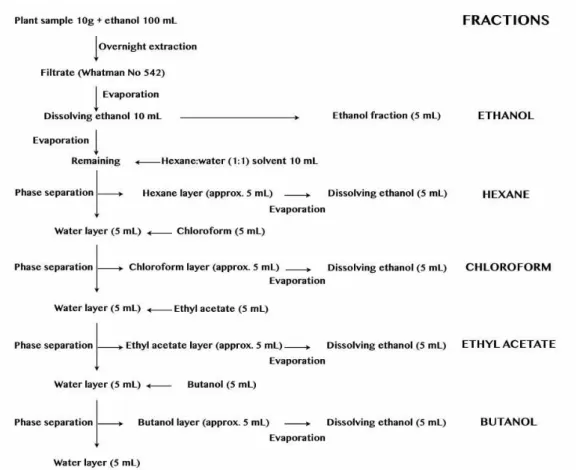
The selected plant extract for showing good antibacterial activity was fractionized using different organic solvents. A total of 5 organic solvents were successively applied in the order of ethanol, hexane, chloroform, ethyl acetate and butanol as described in Fig. 1. After extraction using different organic solvents, the used solvent was evaporated and remaining extracts were re-dissolved in ethanol and then used.
Fig. 1. Schematic diagram for organic solvent fraction preparation
3. Effect of combination among selected plant extracts
To screen the synergistic antibacterial activity among plant extracts and their organic solvent fractions, plant extracts were mixed and their antibacterial activities against to S. aureus were investigated.
4. Antibacterial activity
For pathogenic bacteria, Staph. aureus, L. monocytogenes, M. heamolytica, and Sal. gallinarum were used. All pathogens were maintained and enriched in LB broth (Difco, USA) for overnight at 37℃. Aliquot 0.1 mL of pathogen culture was added to 10 mL of water agar (0.8% Bacto agar solution), which was previously autoclaved and stored in 50℃ to prevent solidification. The pathogenic suspension in 0.8% agar solution was poured onto LB plate medium and then it was solidified at room temperature. Aliquot 50 uL of a plant extract was added to each paper disc (6 mm in diameter, sterilized), and the paper disc was dried for 30 min to eliminate organic solvent at room temperature. Then the prepared disc was carefully placed on the pathogen culture over-laid water agar plate. Antibacterial activity was determined by measuring appeared diameter of clear zone after overnight incubation of the prepared agar plate at 37℃.
Ⅲ. Results and discussion
In this study, we investigated antibacterial activities against to pathogenic bacteria using ethanol extracts of 11 different plants, Carthamus nctoricus L. (pA), Poncirus trifollata Raf.
(pB), Scutellaria balcalensis Georgi (pC) Prunus sargentii (pD), Cucurbita moschata D
UCHLeaf (pE) Allium cepa L. peel (pF) Portulaca oleracea L. (pG), Xanthium strumarium L. (pH), Duchesnea chrysantha (pI), Cudrania tricuspidata (pJ) and Juniperus chinensis L. (pK).
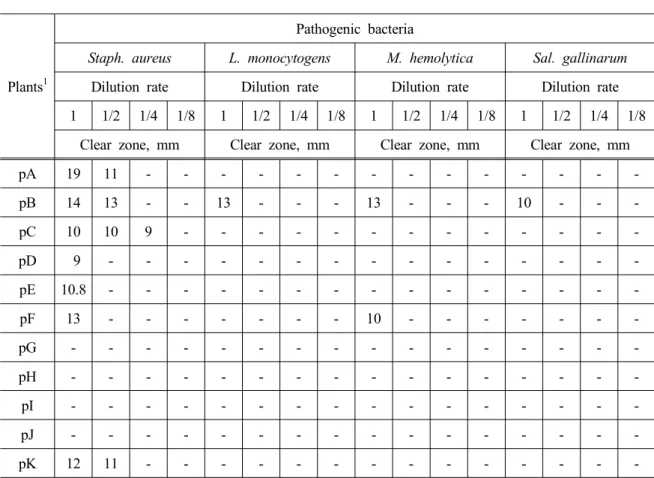
Antibacterial activity of each plant extract was summarized in Table 1. Against to Staph.
aureus, pA, pB, pC, pE and pF showed antibacterial activities. In diluted extracts, pA, pB and pC retained their activities. Only pB showed antibacterial activity against to L. monocytogens.
Plant extracts of pB and pF showed antibacterial activity against to M. haemolytica. Against to
Sal. gallinarium, only pB showed antibacterial activity. In the concern of spectrum, pB showed
the most broad activity against to all used pathogenic bacteria. For the strength of activity, the
largest clear zone diameter was found in pA.
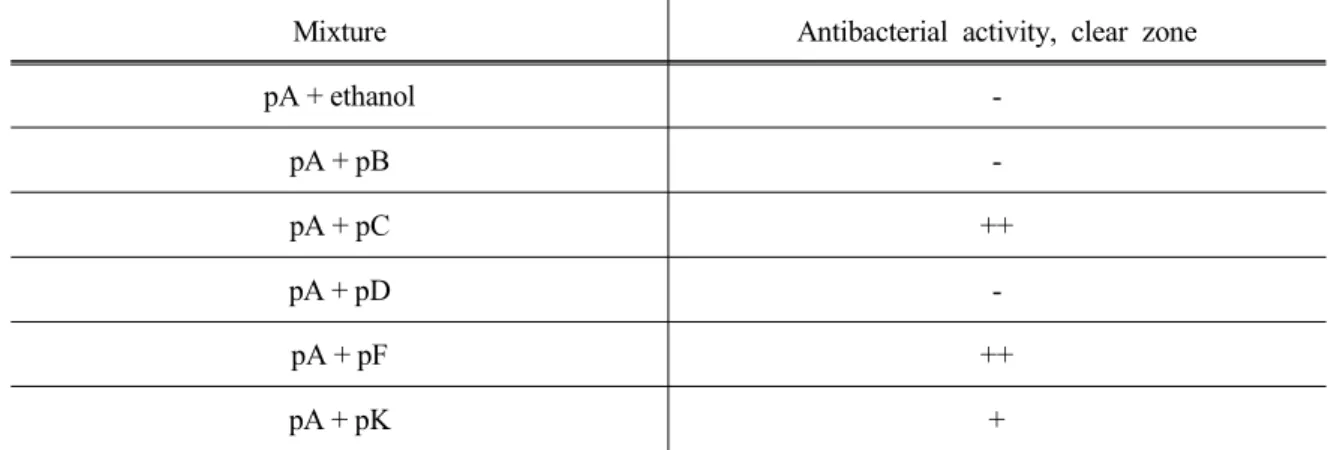
For the investigation of synergistic interaction on antibacterial activity among plant extracts, pA was selected as a fixed factor and remaining plant extracts were mixed with pA in equal volume. And then the mixture of plant extract was loaded on antibacterial activity assay plate containing the culture of Staph. aureus. The concentration of individual plant extract concentra- tion was quarter of the first antibacterial activity test. Antibacterial activities of various combina- tions were shown in Table 2. Good antibacterial activity was found in the combination of pA + pC and pA + pF. Organic solvent fractions of pA, pC and pF were prepared and each plant extract fraction in same organic solvents were mixed and then their antibacterial activities were measured against to Staph. aureus (Table 3). For pA + pC, hexane, ethyl acetate and butanol fractions showed higher activity than chloroform fraction. For pA + pF, the highest antibacterial activity was found in hexane fraction.
Table 1. Antibacterial activities of various plant extract against to different pathogenic bacteria
Plants
1Pathogenic bacteria
Staph. aureus L. monocytogens M. hemolytica Sal. gallinarum Dilution rate Dilution rate Dilution rate Dilution rate
1 1/2 1/4 1/8 1 1/2 1/4 1/8 1 1/2 1/4 1/8 1 1/2 1/4 1/8
Clear zone, mm Clear zone, mm Clear zone, mm Clear zone, mm
pA 19 11 - - - - - - - - - - - - - -
pB 14 13 - - 13 - - - 13 - - - 10 - - -
pC 10 10 9 - - - - - - - - - - - - -
pD 9 - - - - - - - - - - - - - - -
pE 10.8 - - - - - - - - - - - - - - -
pF 13 - - - - - - - 10 - - - - - - -
pG - - - - - - - - - - - - - - - -
pH - - - - - - - - - - - - - - - -
pI - - - - - - - - - - - - - - - -
pJ - - - - - - - - - - - - - - - -
pK 12 11 - - - - - - - - - - - - - -
1
pA, Carthamus nctoricus L.; pB, Poncirus trifollata Raf.; pC, Scutellaria balcalensis Georgi; pD, Prunus
sargentii; pE, Cucurbita moschata D
UCHLeaf; pF, Allium cepa L. peel; pG, Portulaca oleracea L.; pH,
Xanthium strumarium L.; pI, Duchesnea chrysantha (Zoll. & Mor.) Miq.; pJ, Cudrania tricuspidata; pK,
Juniperus chinensis L.
Table 2. Effect of extracts combination on antibacterial activity against to Staphylococcus aureus
Mixture Antibacterial activity, clear zone
pA + ethanol -
pA + pB -
pA + pC ++
pA + pD -
pA + pF ++
pA + pK +
Clear zone : -, not detected; +, 8~10 mm; ++, 10~12 mm.
Table 3. Antibacterial activities of different organic solvents mixture of Carthamus nctorius L. (A), Scutellaria baicalensis Georgi (D) and Allium capa L peel (G) against to Staphylococcus aureus
Fractions pA + pC pA + pF
Clear zone, mm
Hexane 14 12
Chloroform 13 11
Ethyl acetate 14 10
Butanol 14 10
Carthamus nctoricus L. is an annual plant involved in Compositae and it is widely cultivated
in Egypt, China, Japan and Korea. Its flower and seed are used in oriental medicines and known
to have functions of reducing pain, preventing osteoporosis, and treating gynecological bloodstasis
(Jang et al., 2012). Serotonin, lignan and flavonoid are known as representative active phenolic
compounds in C. nctoricus L. (Jang et al., 2012). Poncirus trifollata Raf. is a citrus fruit and its
common name is trifoliate orange. Generally, citrus fruit is regarded to possess various active
compounds such as ascorbic acid, flavanones, phenolics and pectins and known as antioxidant
and antibacterial agent (Kim et al., 2012). Skullcap is involved in Scutellaria baicalensis Georgi
and it is cultivated mainly in Korea, China and Japan. It has been reported to show features of
pain killing, anti-inflammation, anti-allergy, antibacterial activity and anti-cancer, and baicalein,
wogonin and baicalin were known as major effective compounds in skullcap (Jee et al., 2012).
Prunus sargentii is a tree involved in Rosaceae and it is widely used for afforestation, land- scaping and roadside trees. Its bark has been utilized as an oriental medicine for detoxification, the discharge of phlegm, anti-inflammation and the treatment for skin disorders. For active compounds, sakuranin, taxifolin, naringenin and pinostobin were reported and its primary biol- ogical functions were antioxidant and anti-bacterial activities (Yang et al., 2012). Cucurbita moschata D
UCHhas unique flavor and it is a favorite vegetable for Korean. It has lots of fatty acids and carotenoids. A compounds related to aglycone has been isolated from Cucurbita moschata D
UCHand was known to show antibacterial and anti-viral activities (Han et al., 1999).
Onion (Allium cepa L.) is a perennial plant and widely cultivated over the world. Antioxidant activity derived from quercetin is most representative feature of onion and its anti-bacterial, anti-tumoral and anti-mutagenic activities were also presented (Chang et al., 2010).
Portulaca oleracea L. is a very common plant growing wildly around road and garden. It is used for vegetable food and oriental medicine. As representative compounds, L-noradrenaline, dopamine and dopa were reported, and its effects on arthritis, cancer and cell aging through antioxidant activity were suggested. Recently, antibacterial activity of P. oleracea L. extract against to Helicobacter pylori was presented (Park et al., 2011). Xanthium sibiricum is an annual plant involved in Rosaceae and widely cultivated across Asia, Europe and North America. X.
sibiricum fruit was reported to have pharmacological features on tumor, pain killing, rhinitis, arthritis, eczema and neuralgia. It was known to show antibacterial activity against to Staph.
aureus. As active compounds, xanthanol, isoxanthanol, tomentosin, xanthatin, xanthumanol,
daucosterol, campesterol and tomesterol were reported (Shin et al., 2012). Duchesnea chrysanthe
is a perennial plant involved in Rosaceae and has yellow flower and red edible fruit. Ellagic
acid, gallic acid, brevifolin carboxylic acid, methyl caffeate, protocatechuric acid and pedun-
culagin were reported as representative compounds (Lee et al., 2010). Cudrania tricuspidata is
known as an important oriental medicine for the treatment of cancer in Korea by its antioxidant
and anti-inflammatory activities. A compound belong to xanthone family was reported as a
representative in C. tricuspodata (Lee et al., 2005). Juniperus chinensis is an evergreen tree
involved in Cupressaceae and distributed particularly in Asia region. Antioxidant, anti-cancer and
anti-obesity were reported as health benefit of J. chinensis. Cedrol, quercetin, isoquercetin,
naringenin, taxifolin, aromadendrin, deoxypodophyllotoxin, catechin, epicatechin, myricitrin and
hinokiflavone were presented as biologically active compounds. Ethanol, ethylacetate and
aqueous fraction of J. chinesis were recently reported to show anti-malarial activity (Lee et al.,
2012).
Acknowledgement
This work was supported by “Cooperative Research Program for Agriculture Science &
Technology Development (Project No. PJ907055)” Rural Development Administration, Republic of Korea.
[ 논문접수일 : 2013. 1. 19. 논문수정일 : 2013. 2. 25. 최종논문접수일 : 2013. 3. 16.]
Reference