J. Exp. Biomed. Sci. 13 (2007) 189–195
Antimicrobial Activity of Medicinal Plant Extracts against Methicillin-Resistant Staphylococcus aureus
Jinseong Eum† and Youngdoo Park
Department of Microbiology, College of Science and Technology, Mokwon University, Daejeon 320-729, Korea
This study was carried out to examine antimicrobial substances from medicinal plants, the ethanol extracts of 38 medicinal plants were tested for the antimicrobial activity against Staphylococcus aureus ATCC 25923 and methicillin- resistant Staphylococcus aureus ATCC 43300. The extracts of Glycyrrhiza uralensis, Sophora flavescens, Dryopteris crassirhizoma, and Pinas densiflora showed significant antimicrobial activities against both S. aureus ATCC 25923 and methicillin-resistant S. aureus ATCC 43300. The extract of Dryopteris crassirhizoma among these medical plants showed the highest antimicrobial activity. These results suggested that the extracts from Dryopteris crassirhizoma, Sophora flavescens, Pinas densiflora, and Glycyrrhiza uralensis could be the potential source of antimicrobial agents against methicillin-resistant S. aureus and S. aureus.
Key Words: Methicillin-resistant Staphylococcus aureus (MRSA), Antimicrobial activity, Glycyrrhiza uralensis, Pinus densiflora, Sophora flavescens, Dryopteris crassirhizoma
서 론
Staphylococcus aureus (S. aureus)는 자연계에 널리 분포 하고 있으며 인간의 피부에 집락을 형성하는 화농균으 로 인간의 생활과 매우 밀접한 관계가 있다. S. aureus는 그람양성세균으로 노란색소를 생성하며 종기, 여드름과 같은 피부병, 중이염, 방광염, 폐렴, 골수염, 뇌막염, 패혈 증 및 식중독 등 인체에 감염하는 중요한 병원균 중의 하나로 알려져 있다 (Anliffe, 1997; Lowy, 2000). 현재까지 S. aureus의 감염증 치료를 위하여 여러 항균제들이 사용 되고 있다. Penicillin계 항생제인 ampicillin이 세균 치료에 임상적 효능이 있는 것이 알려진 이후, 계속해서 개발 된 β-lactam계 항생제들은 이들 세균에 의한 감염증의 치 료에 광범위하게 사용되어 왔으나 항생제를 자주 사용하 게 되자 이에 내성을 가진 세균을 양산하는 결과를 가 져왔다 (Livermore, 1998). 1940년 penicillin이 사용될 당시 S. aureus는 5% 정도의 내성을 나타냈지만 5년 후에는
50%, 1995년도에는 전 세계적으로 90% 이상의 penicillin- resistant S. aureus (PRSA)가 발생하였다 (Hussain et al., 2000; Hiramatsu, 2001). 또한 penicillin에 내성을 가진 균이 발견되자 beta-lactamase에 영향을 받지 않는 methicillin이 1960년에 개발되어 주요 치료제로 사용되었으나 이 항 생제도 빈번한 사용으로 인하여 1961년에 내성을 갖는 methicillin-resistant S. aureus (MRSA)가 영국에서 발견되었 다 (Reischl et al., 2000; Jones et al., 2002). 1970년대에는 MRSA가 미국, 프랑스, 스위스, 덴마크 등지에 급속히 퍼져 심각한 병원내 감염균 (hosplital-acquired pathogen) 이 되었으며 현재에도 병원성 미생물 중 해결되기 어려 운 문제 중의 하나로 남아 있다. 미국에서 보고되는 S.
aureus의 10~50%가 MRSA이며, 프랑스의 경우도 30~
40%가 MRSA로서 유럽에서도 높은 비율의 methicillin에 대한 내성을 나타내고 있다 (Bertrand et al., 2000). 우리나 라에서는 1970년대 임상에서 분리된 S. aureus 중 MRSA 가 차지하는 비율은 10% 미만이었으나 1980년대에는 약 40~50%로 증가하였으며 그 후 계속 증가하여 최근 에는 60~80%나 된다 (Ha et al., 2003). 또한 MRSA가 임상 뿐 만이 아닌 식품에서도 분리되었다고 보고되고 있다 (Jones et al., 2002). 이와 같이 증가하고 있는 MRSA 의 치료에는 vancomycin이 개발되어 사용되고 있으나 1996년 일본에서 처음으로 vancomycin에 내성을 갖는
*논 문 접 수: 2007년 5월 27일 수정재접수: 2007년 6월 28일
†Corresponding author: Jinseong Eum, Department of Microbiology, College of Science and Technology, Mokwon University, Daejeon 320-729, Korea.
Tel: 82-42-829-7594, Fax: 82-42-829-7590 e-mail: [email protected]
vancomycin-resistant S. aureus (VRSA)균이 발견되었으며, 그 후 일본, 미국, 프랑스, 홍콩 등 5개국에서 6명의 감 염사례가 보고되었고 이 중 2명이 사망하였다 (Hiramatstu et al., 1997). 국내에서는 1997년 직장암 환자가 vanco- mycin으로 치료가 안 돼 패혈증으로 숨졌으며 원인균은 VRSA임이 밝혀졌다 (Kim et al., 2000). 이와 같이 항생제 내성균에 치료 효과가 있는 새로운 항생제들이 개발되고 있지만 세균들은 이들에 대한 내성을 빠르게 획득하여 새로운 항생제를 무력화시키고 있는 실정이다. 이 문제 를 해결하기 위한 방법의 하나로 여러 나라에서는 전통 적으로 감염질환의 치료에 사용되어 온 천연 약용식물 로부터 항균물질을 분리하기 위한 연구가 활발히 진행되 고 있다 (Stephen, 1999; Ross et al., 2001; Kim et al., 2004).
본 연구에서는 병원성 미생물의 성장을 저해하는 천연 약용식물을 찾기 위한 연구의 일환으로서 우리나라에서 오래 동안 사용되어 왔던 38종류의 약용식물로 부터 추 출물을 분리하여 농축하였다. 이를 이용하여 여드름 및 식중독 등을 유발하는 병원성 미생물인 S. aureus ATCC 25923과 methicillin에 내성을 갖는 MRSA ATCC 43300에 강한 항균활성을 나타내는 약용식물을 검색하였다.
재료 및 방법
1. 세균 및 재료
본 연구에 사용된 S. aureus ATCC 25923과 MRSA ATCC 43300은 국립보건원에서 분양받았다. 생약재료는 경동한방솔루션 제약회사로부터 구입하였으며 실험에 사용된 약용식물들은 갈근 (Pueraria thunbergiana), 감초 (Glycyrrhiza uralensis), 고삼 (Sophora flavescens), 관중 (Dryopteris crassirhizoma), 금은화 (Lonicera japonica), 대황 (Rheum officinale), 박하 (Mentha arvensis), 반하 (Pinellia ternata), 백선피 (Dictamnus dasycarpus), 백작약 (Paeonia lactiflora), 백지 (Angelica dahurica), 부평초 (Spirodela poly- rhiza), 삼백초 (Saururus chinensis), 선퇴 (Cryptotympana pustulata), 송절 (Pinus densiflora), 승마 (Cimicifuga hera- cleifolia), 시호 (Bupleurum falcatum), 신이화 (Magnolia kobus), 애엽 (Artemisia princeps), 어성초 (Houttuynia cordata), 연교 (Forsythia koreana), 우방자 (Arctium lappa), 율피 (Castanea crenata), 자완 (Aster tataricus), 정향 (Syzy- gium aromaticum), 진피 (Citrus unshiu), 천문동 (Asparagus cochinchinensis), 치자 (Gardenia jasminoides), 토복령 (Smilax china), 토원방풍 (Ledebouriella seseloides), 토황금
(Scutellaria baicalensis), 지구자 (Hovenia dulcis), 현삼 (Scrophularia buergeriana), 형개 (Schizonepeta tenuifolia) 화 피 (Prunus sargentii), 황기 (Astragalus membranaceus), 황 련 (Coptis chinensis), 황백 (Phellodendron amurense) 등 총 38종류이다.
2. 추출물 준비
건조된 약용식물 25 g을 증류수로 3번 세척한 후 증 류수 500 ml에 30분간 보관하였다. 증류수에 보관된 생 약 25 g에 70% ethanol (MERK, Germany) 500 ml을 넣어 냉각장치가 설치된 heating mental에 넣어서 3시간 동안 환류 가열, 추출시켰다. 환류 가열된 추출액은 실온에서 3시간 식힌 후 filteration 시키고, 여과액은 funnel에 넣어 rotary evaporator (EYELA)를 이용하여 45℃에서 약 1시간 동안 가온 감압 농축시켰다. 농축된 추출액은 freeze dryer (EYELA)를 이용하여 동결 건조시키고, 여기에서 얻은 건조 분말은 무게를 측정한 후 -70℃에서 보관하였다 (Chun et al., 2001; Sohn et al., 2004).
3. 항균활성 검사
각 약용식물의 항균활성도 측정은 디스크 확산법 (disk diffusion)을 사용하였다. 건조 분말 20 mg을 dimethyl sul- foxide (DMSO) 1 ml에 녹여서 20 µg/µl 농도로 준비하였 다. S. aureus ATCC 25923 또는 MRSA ATCC 43300이 접 종된 L-broth agar 배지 위에 생약 추출물이 첨가된 paper disk (8 mm, Advantec, Toyo Roshi Kaisha, Ltd.)를 올려놓고 37℃에서 24시간 배양한 뒤 생장억지대의 직경을 측정 하였다 (Do et al., 2002).
결과 및 고찰
세균은 크게 그람양성세균과 그람음성세균으로 분리하 며 병원성 그람양성세균은 균혈증, 심내막염, 수막염, 관 절염, 골수염 등을 유발하고, 병원성 그람음성세균은 요 로감염, 폐렴, 패혈증, 세균성 이질, 장티푸스, 페스트, 장 간막, 림프절염, 창상 감염 등을 일으킨다 (Anliffe, 1997).
S. aureus는 공기, 토양 등 자연계에 널리 분포하고 있는 그람양성세균이며 피부에 노란색소를 생성하는 화농균으 로서 종기, 여드름, 중이염, 방광염, 폐렴, 골수염, 뇌막염 및 식중독 등 각종 감염과 패혈증을 유발하는 주된 원인 균으로 알려져 있다 (Jung et al., 2005). Alexander Fleming 이 1928년에 페니실린을 발견하여 이러한 S. aureus의 감
염증을 치료한 이 후, 계속해서 개발된 β-lactam계 항생 제들은 이들 균에 의한 감염증의 치료에 광범위하게 사 용되어 왔다. 그러나 항생제의 빈번한 사용으로 인하여
병원성의 S. aureus 중 페니실린에 내성을 나타내는 PRSA 의 비율이 1945년에는 14%이었으나 1950년도에는 59%, 1995년에는 95%로 증가하였다 (Wahdan, 1998). 이들을 치
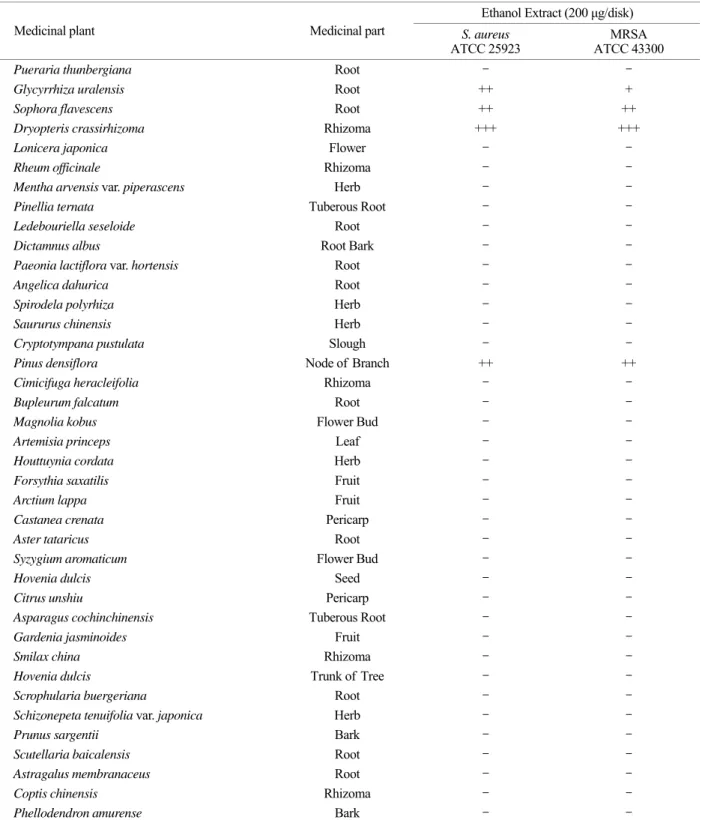
Table 1. Antimicrobial activity of medicinal plant extracts against S. aureus ATCC 25923 and MRSA ATCC 43300 Ethanol Extract (200 µg/disk) Medicinal plant Medicinal part S. aureus
ATCC 25923 MRSA ATCC 43300 Pueraria thunbergiana Root - -
Glycyrrhiza uralensis Root ++ +
Sophora flavescens Root ++ ++
Dryopteris crassirhizoma Rhizoma +++ +++
Lonicera japonica Flower - - Rheum officinale Rhizoma - - Mentha arvensis var. piperascens Herb - - Pinellia ternata Tuberous Root - - Ledebouriella seseloide Root - - Dictamnus albus Root Bark - - Paeonia lactiflora var. hortensis Root - -
Angelica dahurica Root - -
Spirodela polyrhiza Herb - -
Saururus chinensis Herb - -
Cryptotympana pustulata Slough - -
Pinus densiflora Node of Branch ++ ++
Cimicifuga heracleifolia Rhizoma - - Bupleurum falcatum Root - - Magnolia kobus Flower Bud - - Artemisia princeps Leaf - -
Houttuynia cordata Herb - -
Forsythia saxatilis Fruit - -
Arctium lappa Fruit - -
Castanea crenata Pericarp - -
Aster tataricus Root - -
Syzygium aromaticum Flower Bud - -
Hovenia dulcis Seed - -
Citrus unshiu Pericarp - -
Asparagus cochinchinensis Tuberous Root - - Gardenia jasminoides Fruit - -
Smilax china Rhizoma - -
Hovenia dulcis Trunk of Tree - - Scrophularia buergeriana Root - - Schizonepeta tenuifolia var. japonica Herb - -
Prunus sargentii Bark - -
Scutellaria baicalensis Root - - Astragalus membranaceus Root - - Coptis chinensis Rhizoma - - Phellodendron amurense Bark - -
The antimicrobial activity was represented as followed; -, no inhibitory effect; +, 8.1~10.0 mm; ++, 10.1~13.0 mm; +++, 13.1~16.0 mm; ++++, over 16.0 mm
료할 목적으로 개발된 항생제 methicillin도 항생제 남용 으로 인하여 MRSA가 발견되었다 (Jones et al., 2002). 이 후 그람양성세균에 가장 강력한 항생제로 알려진 vanco- mycin이 개발 사용되었으며 최근에는 이에 내성을 나타 내는 VRSA가 나타나고 있다. 이와 같은 내성균은 처음 에는 병원에 입원한 임상 환자에게 국한되었던 것이 항 생제 남용으로 인하여 전 세계의 여러 장소에서 환자 이 외의 식품 등에서도 항생제 내성균들이 흔하게 발견되고 있다 (Jones et al., 2002). 이와 같이 항생제 내성균에 효과 적으로 치료할 수 있는 새로운 항생제들이 개발되고 있 지만 병원성 세균들은 새로운 항생제에 대한 내성을 빠 르게 획득하여 이들 항생제를 무력화시키고 있다. 의료 계에서는 현재와 같은 속도로 병원성 세균들이 항생제에 내성을 갖게 된다면 앞으로는 내성균에 의한 감염질환을 치료할 수 없어서 작은 상처로 인한 균혈증 (bacteremia) 으로 인하여 환자가 사망하는 경우를 우려하고 있다 (Sin et al., 2006). 이에 따라 감염질환의 치료에 전통적으로 약효가 있다고 알려진 식물성 약제들의 사용가능성이 연 구되고 있다.
Table 1은 병원성 세균인 S. aureus ATCC 25923과 MRSA ATCC 43300에 대하여 38종류의 약용식물로부터 분리한 추출물들의 항균활성의 결과이다. S. aureus ATCC 25923 의 성장을 억제시키는 약용식물들은 감초, 고삼, 관중,
송절 등 4종류 이었으며, 이 중 관중에서 매우 높은 항 균활성이 나타났다. 또한 MRSA ATCC 43300의 성장을 억제시키는 약용식물들도 감초, 고삼, 관중, 송절 등 같 은 4종류이며, 이중 감초의 항균활성은 가장 낮았고 관 중에서는 매우 높은 항균활성이 나타났다. 이와 같이 병 원성 세균인 S. aureus ATCC 25923과 MRSA ATCC 43300 에 대한 항균활성을 나타내는 약용식물들은 공통적으로 감초, 고삼, 관중, 송절 등 4종류이며 이중에서 가장 높 은 항균활성을 나타내는 약용식물은 관중으로서 두 세 균 모두에서 항균활성의 결과가 일치하였다.
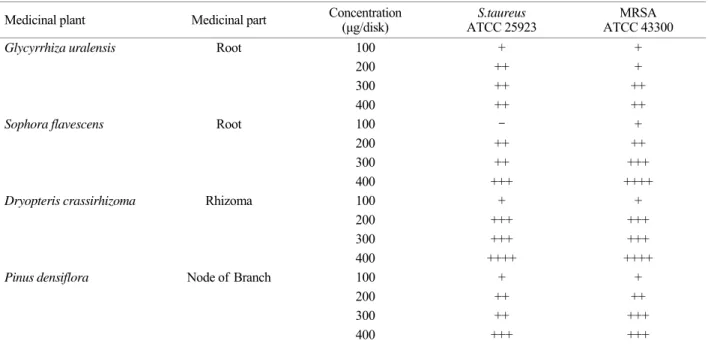
Table 2는 항균활성을 나타내는 감초, 고삼, 관중, 송절 등 4종류의 약용식물 추출물의 농도에 따른 S. aureus ATCC 25923과 MRSA ATCC 43300의 항균활성을 조사하 였다. S. aureus ATCC 25923에서는 감초의 추출물 200 µg, 300 µg, 400 µg 농도에서 비슷한 중간 항균활성을 나타냈 으며, 고삼과 송절의 추출물 200 µg, 300 µg에서는 중간 활성을, 400 µg 농도에서 높은 항균활성을 나타냈다 (Fig.
1, 2, and 4). 관중은 추출물 200 µg에서 부터 높은 항균활 성을 나타내고 400 µg에서는 최대의 항균활성을 나타냈 다 (Fig. 3). Table 2에서 보는 바와 같이 MRSA ATCC 43300에서는 감초의 경우 100 µg과 200 µg에서는 낮은 항균활성을, 300 µg과 400 µg에서는 중간활성을 나타냈 다 (Fig. 1). 고삼과 송절은 200 µg에서 중간활성을 나타 Table 2. Antimicrobial activity by different concentrations of medicinal plant extracts against S. aureus ATCC 25923 and MRSA ATCC
43300
Medicinal plant Medicinal part Concentration
(µg/disk) S.taureus
ATCC 25923 MRSA ATCC 43300
Glycyrrhiza uralensis Root 100 + +
200 ++ +
300 ++ ++
400 ++ ++
Sophora flavescens Root 100 - +
200 ++ ++
300 ++ +++
400 +++ ++++
Dryopteris crassirhizoma Rhizoma 100 + +
200 +++ +++
300 +++ +++
400 ++++ ++++
Pinus densiflora Node of Branch 100 + +
200 ++ ++
300 ++ +++
400 +++ +++
The antimicrobial activity was represented as followed; -, no inhibitory effect; +, 8.1~10.0 mm; ++, 10.1~13.0 mm; +++, 13.1~16.0 mm; ++++, over 16.0 mm
내며 농도의 증가에 따라 항균활성이 증가 되었다 (Fig.
2 and 4). 관중에서는 200 µg에서 부터 높은 활성을 나타 내고 400 µg에서는 최대의 항균활성을 나타냈다 (Fig. 3).
이와 같이 S. aureus ATCC 25923과 MRSA ATCC 43300의 항균활성에 효과적인 약용식물 추출물의 농도는 유사한 결과를 나타냈으며, 두 균주 모두 관중 400 µg 농도에서 가장 높은 항균활성을 나타냈다. 또한 항균활성 조사 실험시 disk당 약용식물 추출물의 농도를 각각 100 µg, 200 µg, 300 µg, 400 µg으로 달리하여 첨가하였을 때의 항 균활성의 결과를 근거로 하여 200 µg이 가장 적절한 것 으로 사료된다.
기원 전 부터 감염질환의 치료에 식물성 약재들이 사 용되어 왔으며 식물에서 항균활성물질을 추출하는 연구 는 전 세계적으로 진행되고 있고 최근 이에 대한 연구가 활발히 보고되고 있다 (Lee et al., 1997; Park et al., 1997;
Kim et al., 2001; Suk et al., 2004). 가장 오래된 약용식물은
마늘로서 기원 전 부터 감염질환의 치료에 사용되어 왔 으며 현재에도 이에 대한 연구가 계속 발표되고 있다 (Aydin et al., 2000; Ogara et al., 2000). 본 연구에 사용된 감초는 세계에서 가장 오래 사용된 약용식물의 하나로 서 고대 그리이스나 중국에서도 알려져 있는 다년생 초 본으로 지하경을 사용하였으며 성분으로는 glycyrrhizin, glycyrrhetinic acid, glycyrrhizic acid 등 triterpene saponin이 함유되어 있고 한방에서는 진통, 진경, 진해, 거담과 감 미료 등의 목적으로 많이 사용되고 있는 것으로 보고되 고 있다 (Lee et al., 2003). 관중은 우리나라와 중국 동북 부에 자생하는 다년생 대형의 양치류로서 생약으로는 엽 기 또는 근경을 사용한다. 성분으로는 phloroglucin 유도 체인 aspidin, albaspidin, dryocrassin 등이 함유되어 있으며 조충 및 십이지장충 등의 구제약에 사용되는 것으로 알 려져 있다 (Baek et al., 2001). 고삼은 우리나라, 시베리아, 중국 그리고 일본의 산과 들에 자생하는 다년생 초본으
S. aureus ATCC 25923 MRSA ATCC 43300 Fig. 1. Assay of antimicrobial activity by different concentrations of the extracts from Glycyrrhiza uralensis against S. aureus ATCC 25923 and MRSA ATCC 43300 (1, 100 µg/disk; 2, 200 µg/disk;
3, 300 µg/disk; 4, 400 µg/disk).
S. aureus ATCC 25923 MRSA ATCC 43300 Fig. 2. Assay of antimicrobial activity by different concentrations of the extract from Sophora flavescens against S. aureus ATCC 25923 and MRSA ATCC 43300 (1, 100 µg/disk; 2, 200 µg/disk; 3, 300 µg/disk; 4, 400 µg/disk).
S. aureus ATCC 25923 MRSA ATCC 43300 Fig. 3. Assay of antimicrobial activity by different concentrations of the extracts from Dryopteris crassirhizoma against S. aureus ATCC 25923 and MRSA ATCC 43300 (1, 100 µg/disk; 2, 200 µg/
disk; 3, 300 µg/disk; 4, 400 µg/disk).
S. aureus ATCC 25923 MRSA ATCC 43300 Fig. 4. Assay of antimicrobial activity by different concentrations of the extracts from Pinus densiflora against S. aureus ATCC 25923 and MRSA ATCC 43300 (1, 100 µg/disk; 2, 200 µg/disk; 3, 300 µg/disk; 4, 400 µg/disk).
로 생약으로는 뿌리를 사용하며 성분으로는 alkaloid로 matrine, oxymatrine, allomatrine 외에 flavonoid로 trifoli- rhizin 등이 함유되어 있으며 약효로는 고미건위, 해열, 지사약, 가려움이 있는 피부질환에 사용된다고 알려져 있다 (Park et al., 2001). 송절은 소나무 마디부위로서 α, β-pinene 등이 함유되어 있으며 피부약, 류마치스, 신경 통, 가려움증 등에 사용되는 것으로 알려져 있다 (Bae and Lee, 2002). 본 연구에서는 관중, 고삼, 송절, 감초의 추출물들이 병원성 세균인 S. aureus ATCC 25923과 MRSA ATCC 43300의 성장에 항균활성을 나타냈으며 이 중 관중은 매우 강한 항균활성을 나타냈다.
최근에는 S. aureus가 피부에 발생하는 아토피의 증상 을 악화시키고 가려움증을 유발하는 것으로 알려지고 있다 (Lee et al., 2001). 아토피 피부염 환자에서 분리된 S.
aureus의 반 이상에서 enterotoxin을 분비하며, 이 독소들 이 MHC II 분자에 결합하여 T 세포를 자극함으로써 T 세포를 활성화시키고 구형 단백질인 S. aureus의 독소는 allergen으로 작용하여 직접 IgE 생산을 자극하고 IgE 매 개성 histamine의 분비를 유발하여 아토피 피부염에서 소양증의 환을 형성한다 (Leung et al., 1993; Higaki et al., 1999). 최근 아토피 환자군에서 MRSA의 발생은 11%의 빈도를 보이며 증가추세에 있고 이러한 MRSA 발생의 증가는 항생제의 과도한 사용과 부정확한 선택이기 때문 에 MRSA의 증가를 예방하기 위해서는 항생제의 적절한 사용이 중요하다 (Klein et al., 1997; Lee et al., 2001).
이와 같은 관중, 고삼, 송절, 감초들의 항균활성의 결 과를 근거로 하여 앞으로 이들 추출물들에 대한 인체의 안정성 실험이 밝혀진다면 병원성 세균인 S. aureus 및 MRSA에 의해서 유발되는 여드름, 아토피 등의 피부병 및 식중독 등 여러 감염성 질환의 치료 및 예방에 이들 약용식물의 추출물들이 이용될 수 있을 것으로 사료된다.
REFERENCES
Anliffe GA. The progressive intercontinental spread of methicillin- resistant Staphylococcus aureus. Clin Infect Dis. 1997. 24: 74 -79.
Aydin A, Ersoz G, Tekesin O, Akcicek E, Tuncyurek M. Garlic oil and Helicobacter pylori infection. Am J Gastroenterol. 2000.
94: 1200-1202.
Bae MJ, Lee SH. Antimicrobial effects of Pinus densiflora sieb. et.
Zucc. ethanol extract on Listeria monocytogenes. J Kor Soc Food Sci Nutr. 2002. 31: 333-337.
Baek NI, Shin DH, Han JS. Isolation and antimicrobial action of growth inhibitory substance on food-borne microorganism from Dryopteris crassirhizoma naral. Kor J Food Sci. 2001.
33: 611-618.
Bertrand X, Thouverrez M, Talon D. Antibiotic susceptibility and genotypic characterization of methicillin-resistant Staphylo- coccus aureus strains in eastern France. J Hosp Infect. 2000.
46: 280-287.
Chun HJ, Choi EY, Yoon SC, Nam HW, Baek SH, Woo WH.
Inhibitory effects of ethanol extract of Atractylodis Rhizoma alba on melanin biosynthesis. Yakhak Hoeji 2001. 45: 269 -275.
Do DS, Lee SM, Na MK, Bae KH. Antimicrobial activity of medicinal plant extracts against a cariogenic bacterium, Streptococcus mutants OMZ 176. Kor J Pharmacog. 2002.
33: 319-323.
Ha DJ, Kim YC, Kim YJ. Management of infection for methicillin- resistant Staphylococcus aureus at an orthopaedic surgery deparetment. Kor J Orthop Assoc. 2003. 38: 34-38.
Higaki S, Morohashi M, Yamagishi T, Hasegawa Y. Comparative study of Staphylococci from the skin of atopic dermatitis patients and from healthy subjects. Int J Dermatol. 1999. 38:
265-269.
Hiramatsu K. Vancomycin-resistance Staphylococcus aureus: a new model of antibiotic resistance. Lancet Infet Dis. 2001. 1:
147-155.
Hiramastsu K, Aritaka N, Hanaki H, Kawasaki S, Hosoda Y, Hori S. Vancomycin-resistant Staphylococcus aureus: Dissemina- tion of heterogeneously resistant strains in Japanese hospital.
Lancet 1997. 350: 1670-1673.
Hussain Z, Stoakes L, Garrow S, Longo S, Fitzgerald V, Lannigan R. Rapid detection of mecA-positive and mecA-negative coagulase-negative Staphylococci by an anti-penicillin binding protein slide latex agglutination test. J Clin Microbiol. 2000.
38: 2051-2054.
Jones TF, Kellum ME, Porter SS, Bell M, Schaffner W. An outbreak of community-acquired foodborne illness caused by methicillin-resistant Staphylococcus aureus. Emerg Infect Dis. 2002. 8: 82-84.
Jung HJ, Cho JI, Park SH, Ha SD, Lee KH, Kim CH, Song ES, Chung DH, Kim MG, Kim KY, Kim KS. Genotypic and phenotypic characteristics of Staphylococcus aureus isolates from lettuces and raw milk. Kor J Food Sci Technol. 2005.
37: 134-141.
Kim JJ, Lee JS, Kim SY, Kim JA, Chung SR, Jang TS, Lee SH.
Inhibitory effect of hydrolysable tannins isolated from the Euphorbia helioscopia on Mushroom tyrosinase activity in vitro. 2001. Yakhak Hoeji 45: 214-219.
Kim JP, Chon IJ, Cho HK, Ham IH, Whang WK. The antioxidant and the antidiabetic effects of ethanol extract from bio- functional foods prescriptions. Kor J Pharmacog. 2004. 35:
98-103.
Klein PA, Greene WH, Fuhrer J, Clark RA. Prevalence of methicillin-resistant Staphylococcus aureus in outpatients with psoriasis, atopic dermatitis, or HIV infections. Arch Dermatol. 1997. 139: 13-16.
Lee DK, Cho MK, Son SJ, Jeong BK, Kim DJ. Bacterial culture using tape method in atopic dermatitis and non-atopic der- matitis. Kor J Dermatol. 2001. 39: 292-299.
Lee JS, Kim JA, Cho SH, Son AR, Jang TS, So MS, Chung SR, Lee SH. Tyrosinase inhibitors isolated from the roots of Glycyrrhiza glabra L. Kor J Parmacog. 34: 33-39.
Lee SH, Park JS, Lim SY, Kim JJ, Chung SR. The screening of the inhibitory compounds on tyrosinase activity from the natural product. Yakkak Hoeji 1997. 41: 456-461.
Leung DY, Harbeck R, Bina P, Reiser RF, Yang E, Norris DA.
Presence of IgE antibidies to staphylococcal exotoxins on the skin of patients with atopic dermatitis. J Clin Invest. 1999.
92: 1374-1380.
Livermore DM. Beta-lactamase-mediated resistance and oppor- tunities for its control. J Antimicrob Chemother. 1998. 41: 25 -41.
Lowy FD. Is Staphylococcus aureus an intracellular pathogen?
Trends microbiol. 2000. 8: 341-343.
OGara EA, Hill DJ, Maselin DJ. Activity of garlic oil, garlic powder and their dially constituents against Helicobacter pylori. Appl Environ Microbiol. 2000. 66: 2269-2273.
Park JH, Shin YG, Shin UK, Baek SK, Lee SK, Chung MH, Park YI. Tyrosinase inhibition activity of some herbal drugs.
Yakhak Hoeji 1997. 41: 518-523.
Park NK, Jeong SI, Kim YC, Baek SH. Isolation of antimicrobial compounds from the ethyl acetate extract of Sophora flave- scens. Yakhak Hoeji 2001. 45: 588-590.
Reischl U, Linde HJ, Metz M, Leppmeier B, Lehn N. Rapid iden- tification of methicillin-resistant Staphylococcus aureus and simultaneous species confirmation using real-time flurescence PCR. J Clin Microbiol. 2000. 38: 2429-2433.
Ross ZM, OGara EA, Hill DJ, Sleightholme HV, Maslin DJ.
Antimicrobial properties of garlic oil against human enteric bacteria evalution of methodologies and comparisons with garlic oil sulfides and garlic powder. Appl Environ Microbiol.
2001. 67: 475-480.
Sin SH, Seong IW. Antimicrobial activity of the extracts from Paeonia japonica against Methicillin-resistant Staphylococcus aureus. Kor J Microbiol. 2006. 42: 54-58.
Sohn HY, Kwon YS, Kim YS, Kwon HY, Kwon GS, Kim KJ, Kwon CS, Son KH. Screening of thrombin inhibitors from medicinal and wild plants. Kor J Pharmacog. 2004. 35: 52 -61.
Stephen HB. Herbal Antibiotics. 1999. pp. 1-17. Vermont. USA.
Suk KD, Lee SJ, Bae JM. Inhibitory effects of Cuscuta japonica extract and C. australis extract on Mushroom tyrosinase activity. Kor J Pharmacog. 2004. 35: 380-383.
Yoo YS, Park KM, Kim YB. Antimicrobial activity of some medical herbs and spices against streptococcus mutans. 1993.
Kor J Appl Microbial Biotechnol. 21: 187-191.
Wahdan HA. Causes of the antimicrobial activity of honey. In- fection 1998. 26: 26-31.