39(10), 1425~1432(2010) DOI: 10.3746/jkfn.2010.39.10.1425
하고초 부위별 용매추출물의 항균 및 항산화 활성
서종권1․강민정3․신정혜3․이수정4․정혜광2․성낙주4․정영철1†
1
한국국제대학교 식품과학부,
2충남대학교 약학대학
3
(재)남해마늘연구소,
4경상대학교 식품영양학과․농업생명과학연구원
Antibacterial and Antioxidant Activities of Solvent Extracts from Different Parts of Hagocho ( Prunella vulgaris )
Jong-Kwon Seo1, Min-Jung Kang3, Jung-Hye Shin3, Soo-Jung Lee4, Hey-Gwang Jeong2, Nak-Ju Sung4, and Young-Chul Chung1†
1Dept. of Food Science, International University of Korea, Gyeongnam 663-759, Korea
2Dept. of Toxicology, College of Pharmacy, Chungnam National University, Daejeon 305-764, Korea
3Namhae Garlic Research Institute, Gyeongnam 668-812, Korea
4Dept. of Food Science and Nutrition, Institute of Agriculture and Life Science, Gyeongsang National University, Gyeongnam 660-701, Korea
Abstract
This study was designed to investigate the effects of antioxidant and antibacterial activities of water, ethanol and methanol extracts from root, stem and flower stalk of Hagocho (Prunella vulgaris). The solvent extract yields from root were higher than those from stem and flower stalk, and water extract showed the highest extraction yield against ethanol and methanol extracts. The contents of total phenolic and flavonoid in ethanol extract were significantly higher in stem extract compared with those of root and flower stalk. In the case of water and methanol extracts, however, the contents were the highest in flower stalk. The electron donating ability and reducing power in all test groups were significantly increased in a dose-dependent manner, and antioxidant activities were the highest in methanol extract. In extracts from different parts of Hagocho, the antioxidant activity was the highest in flower stalk followed by stem and root. ABTS radical scavenging ability of water and methanol extracts was above 50% at 100 μg/mL concentration. Antibacterial activities did not show significant differences depending on parts of Hagocho. However, antibacterial activity of ethanol extract was higher than those of other extracts.
Key words: Hagocho (Prunella vulgaris), antibacterial activity, antioxidant activity
†
Corresponding author. E-mail: [email protected]
†
Phone: 82-55-751-8316, Fax: 82-55-751-8310
서 론
생체 내에서 발생하는 하이드록실라디칼(․OH), 슈퍼옥 사이드라디칼(․O
2-), 과산화수소(H
2O
2) 등과 같은 활성산 소 종(reactive oxygen species, ROS)에 의한 산화적 대사 부산물은 노화나 성인병의 원인으로 알려져 있으며(1), 생체 는 이들 물질을 제거하기 위한 자기방어 기작을 동시에 가지 고 있다. 식물체도 자외선에 의한 산화나 자동산화로부터 자신을 보호하기 위하여 polyphenol류의 항산화 물질을 세 포내에 함유하고 있으며, 특히 각종 과채류에 다량으로 존재 하는 flavonoid류와 산성 페놀화합물들은 대표적인 항산화 성 물질로 항알레르기성 및 항암 활성 등 다양한 생리활성을 가지고 있는 것으로 밝혀져 있다(2). 이외에도 식품 중에 존 재하는 대표적인 천연 항산화제로는 ascorbic acid 및 to-
copherol, phenol성 화합물, flavone 유도체, carotenoids, glutathione, 아미노산 등이 밝혀져 있다(3).
소위 성인병으로 불리는 각종 질환들은 생체 내 산화작용 과 상관성이 높으므로 천연 항산화제에 대한 중요성은 갈수 록 증가하고 있으며, 천연식품 소재로부터 항산화성분을 추 출, 분리하고자 하는 연구가 활발히 진행되고 있다. 천연식 물류는 과거로부터 섭취되어온 경험으로부터 미루어 볼 때 인체에 유해성이 낮으며, 체내에 잔류하지 않고 항산화 활성 뿐만 아니라 면역증진, 항균활성 등 생리활성물질을 다양하 게 함유하고 있어 많은 학자들이 관심을 가지고 연구하고 있다(4,5).
하고초(
Prunella vulgaris)는 꿀풀과에 속하는 여러해살
이풀로서 꿀풀(
Prunella vulgarisL. var. lilacina Nakai)의
지상부를 일컫는다. 하고초의 대표적인 성분으로는 ursolic
acid 및 caffeic acid(6), rutin, hyperoside, vitamin, carote- noid, tannin, 유기산(7,8) 등이 알려져 있는데, 지상부에는 sterol과 각종 ursan 및 oleane계 triterpenoid 성분들이 함유 되어 있다(9). 또한 하고초로부터 saponin계인 vulgarsa- ponin A와 vulgarsaponin B, triterpene계인 ursolic acid와 flavonoid계인 quercetin, hyperoside, ethyl caffeic acid 및 sterol, fatty acids 등을 분리 보고된 바 있다(10). 약리작용 에 대한 연구로는 급성독성 및 이뇨작용, 중추신경에 대한 작용(11)과 소염작용(12), 항알레르기 활성(13), 항염증활성 (14), 항산화활성(15,16), 항돌연변이 활성(17)에 대한 보고 가 있으며, 또한 하고초의 종류에 따른 지표물질(ursolic acid)의 함량 연구(18)와 하고초 꽃으로부터 ursolic acid 분 석에 대한 연구(19)가 보고되고 있으나, 하고초 꽃대, 전초, 뿌리를 구분하여 부위별 생물활성에 대한 연구는 본 연구팀 에서 앞서 발표한 연구결과(20)를 제외하고는 매우 미흡한 실정이다. 따라서 본 연구에서는 추출용매를 각각 달리하여 하고초 부위별 추출물의 항산화 활성 및 항균활성을 비교함 으로써 식물체의 사용부위에 따른 효율적인 상품화가 가능 하도록 기초 연구 자료를 제공하고자 하였다.
재료 및 방법
실험재료
본 실험에 사용한 하고초는 하고초꿀영농조합법인(경남 함양군 소재)에서 재배하고 있는 것을 2008년 6월에 채취하 여 뿌리 및 줄기, 꽃대로 분리한 후 5 cm 이내로 절단하고 부위별로 분류하여 열풍건조기(WOR-155, DAIHAN Sci- entific Co., Ltd., Seoul, Korea)를 이용해 건조하였다.
시료의 조제
열풍건조 한 하고초 뿌리, 줄기 및 꽃대는 각각 물, 에탄올 및 메탄올로 추출하였다. 이때 추출용매는 시료 중량에 대해 각각 10배를 사용하였으며 물 추출물은 100
oC에서 4시간 환 류 추출하였으며, 에탄올 추출물은 99.9% 특급시약을, 메탄 올은 95.0% 특급시약을 각각 사용하여 실온에서 72시간 침 지 추출하였다. 각 부위별 추출액은 여과하여 감압농축한 후 동결건조 하여 실험시료로 사용하였다.
추출수율과 pH
추출수율은 열풍건조한 각 부위별 추출물을 감압농축 하 여 동결건조한 후 회수된 분말을 각 건조시료에 대한 백분율 로 계산하였으며, pH는 pH meter(ISTEK Co., Ltd., Seoul, Korea)를 이용하여 측정하였다.
총 페놀화합물 및 플라보노이드 함량 측정
총 페놀화합물 함량은 Folin-Denis법(21)에 따라 각 추출 물 1 mL에 Foline-Ciocalteau 시약 및 10% Na
2CO
3용액을 각 1 mL씩 차례로 가한 다음 실온에서 1시간 정치한 후 700 nm에서 흡광도를 측정하였으며, caffeic acid(Sigma Co., St.
Louis, MO, USA)를 사용한 표준검량선으로부터 총 페놀화 합물 함량을 산출하였다. 총 플라보노이드는 Moreno 등(22) 의 방법에 따라 추출물 0.5 mL에 10% aluminum nitrate 0.1 mL, 1 M potassium acetate 0.1 mL 및 ethanol 4.3 mL를 차례로 가하여 혼합한 후 실온에서 40분간 정치한 다음 450 nm에서 흡광도를 측정하였으며, 표준물질로는 quercetin (Sigma Co.)을 사용하여 얻은 표준검량선으로부터 총 플라 보노이드 함량을 계산하였다.
DPPH에 대한 전자공여능 측정
전자공여능은 Blois(23)의 방법을 변형하여 1,1-diphenyl- 2-picrylhydrazyl(DPPH)에 대한 전자공여 효과로 시료의 환원력을 측정하였다. 즉, 일정 농도의 시료액에 DPPH 용액 을 가하여 혼합한 다음 실온에서 20분간 반응시킨 후 525 nm에서 흡광도를 측정하였으며, 전자공여 효과는 시료 첨 가구와 무첨가구의 흡광도 비로 나타내었다.
환원력 측정
환원력은 Oyaizu(24)의 방법에 준하여 하고초 추출물 1 mL에 인산 완충액 200 mM, pH 6.6과 1%(w/v) potassium ferricyanide 1 mL를 차례로 가하고 이 혼합물을 50
oC의 수 용액상에서 20분간 반응시킨 후, 10%(w/v) trichloroacetic acid(TCA) 용액 1 mL를 가하여 13,500×
g에서 15분간 원심 분리한 후 얻은 상징액 1 mL에 증류수와 ferric chloride를 각각 1 mL씩 가하여 혼합한 후 700 nm에서 흡광도를 측정 하였으며, 추출물의 환원력은 흡광도 값으로 나타내었다.
ABTS 라디칼 소거능 측정
ABTS 라디칼을 이용한 항산화능의 측정은 potassium persulfate와의 반응에 의해 생성된 ABTS 유리 라디칼이 추출물 내의 항산화 물질에 의해 제거되어 라디칼 특유의 색인 청록색이 탈색되는 것을 이용한 방법으로 Re 등(25)의 방법에 따라 7 mM ABTS 용액에 potassium persulfate를 2.4 mM이 되도록 용해시킨 다음 암실에서 12~16시간 동안 반응시켰다. 이를 414 nm에서 흡광도가 1.5가 되도록 증류 수로 조정한 후 3 mL를 취하여 추출물 1 mL를 가하여 실온 에서 10분간 반응시켜 414 nm에서 흡광도를 측정하여 시료 첨가구와 무첨가구의 흡광도 비로 나타내었다.
아질산염 소거능 측정
아질산염 소거능은 Kato 등(26)과 Kim 등(27)의 방법에 따라 1 mM NaNO
2용액 1 mL에 시료액 1 mL를 가하고 0.1 N HCl과 0.2 M 구연산 완충액으로 pH 2.5로 보정한 다음, 완충액을 가하여 총 부피를 10 mL로 하였다. 이 용액을 37
oC 에서 1시간 반응시킨 후 반응액 1 mL를 취하여 2% 초산용 액 3 mL와 30% 초산용액으로 용해한 Griess reagent(1%
sulfanilic acid : 1% naphthylamine=1:1) 0.4 mL를 차례로
가한 후 진탕 혼합하여 실온에서 15분간 정치한 후 520 nm
에서 흡광도를 측정하였다. 아질산염 소거능은 시료 무첨가
Table 1. Extraction yield and pH of solvent extracts from Prunella vulgaris
Solvent Used parts Yield (%) pH
Ethanol Root Stem Flower stalk
2.50 1.79 1.10
4.54 5.05 4.92
Methanol Root Stem Flower stalk
5.80 3.42 3.12
5.76 5.53 5.41
Water Root
Stem Flower stalk
27.37 11.44 13.07
5.52 5.53 5.46
cZ
bX
aY bX bY
aY
aX cY
bX
0 0.5 1 1.5 2 2.5 3 3.5 4 4.5
Root Stem Flower stalk
Root Stem Flower stalk
Root Stem Flower stalk
Ethanol Methanol Water
Samples
F la v o n o id c o n te n ts (m g /1 0 0 g ) .
cZ
bY
aX aX bY
aY aX cX bY
0 5 10 15 20 25 30 35 40
Root Stem Flower stalk
Root Stem Flower stalk
Root Stem Flower stalk
Ethanol Methanol Water
Samples
T o ta l p h e n o l c o n te n ts (m g /1 0 0 g ) .
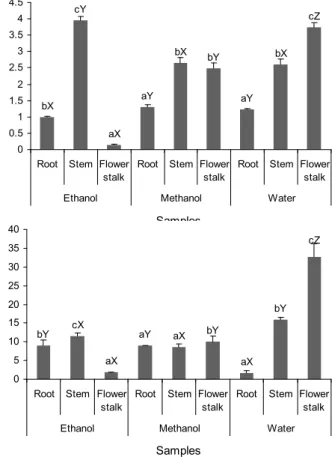
Fig. 1. Total phenolic and flavonoid contents of ethanol, methanol and water extracts from Prunella vulgaris.
a-cMean
± SD in the same solvent with different superscripts are signifi- cantly different at p<0.05.
X-ZMean±SD in the same sample of different solvent with different superscripts are significantly dif- ferent at p<0.05.
구에 대한 시료첨가구의 흡광도 비로 나타내었다.
항균활성 측정
항균활성 측정에 사용된 균주는 일반세균 1종(
Escherichia coli, KCTC 25922), 식품부패곰팡이 1종(
Candida albicans, ATCC 10231), 효모 1종(
Aspergillus flavus, KCTC 6961)을 선정하였으며, 세균의 seed culture에는 Tryptic Soy Broth (TSB, Difico, Detroit, MI, USA), disc diffusion법에 의한 항균활성 측정용 배지로
E. coli는 Luria Bertani Broth(LB, Difco),
C. albicans와
Asp. flavus는 Potato Dextrose Agar (PDA, Difico) 배지를 사용하여 37
oC에서 24시간 전배양 후 다시 상기 배지에 접종하여 600 nm에서 흡광도를 0.5로 조절 한 후 disc 확산법으로 측정하였다(28).
통계처리
각 실험은 5회 이상 반복실험을 통하여 결과를 얻어 SPSS 12.0을 사용하여 통계처리 하였으며, 각각의 시료에 대해 평 균±표준편차로 나타내었다. 각 시료군에 대한 유의차 검정 은 분산분석을 한 후 p<0.05 수준에서 Duncan's multiple test에 따라 분석하였다.
결과 및 고찰
추출수율과 pH
하고초 뿌리, 줄기 및 꽃대의 각 용매별 추출물의 수율과 pH를 측정한 결과는 Table 1과 같다. 추출 수율은 추출용매 와 하고초의 부위에 따라 차이를 나타내었다. 즉, 에탄올 추 출물의 경우 추출수율은 1.10~2.50%였고, 메탄올과 물 추 출물에서는 각각 3.12~5.80%와 11.44~27.37%로서 물 추출 물이 에탄올이나 메탄올 추출물에 비해 6~11배 더 수율이 높았다. 또한 하고초의 줄기와 꽃대는 추출 수율이 유사한 범위였으나 뿌리는 다른 부위에 비해 1.9~2.3배 더 높았다.
각 시료 추출물의 pH는 실험군 모두에서 4.5~5.8 범위를 보였으며, 시료 부위별, 추출 용매간의 유의적인 차이는 보 이지 않았다. Park 등(29)은 구지뽕나무의 잎, 열매, 줄기 및 뿌리 각각에서 생리활성 물질을 추출, 분리한 바 있으며, Kim 등(30)은 차조기 물 추출물과 에탄올 농도별 추출물의 수율을 비교한 결과 물 추출물의 수율이 우수하였다는 결과
를 보고한 바 있다. Ju 등(31)은 16종의 한약재를 대상으로 물 추출물의 수율을 측정한 결과 씨> 잎> 꽃> 줄기의 순으 로 수율이 높아, 식물류의 추출 시 시료의 사용부위에 따라 수율이 상이한 것으로 보고하였으며, 본 연구진이 수행한 하고초 전초, 꽃대 및 줄기의 메탄올 추출물 수율에서도 부 위별로 다소 차이를 나타낸 바 있다(20).
총 페놀 화합물 및 플라보노이드 함량
페놀화합물의 항산화 활성은 수산기를 통한 수소공여 작
용으로 라디칼들과 쉽게 공명으로 안정화될 수 있는 구조를
가지고 있어 항산화 작용을 가지는 것으로 보고(32)되고 있
으며, Ito 등(33)은 플라보노이드가 superoxide에 의해서 야
기되는 비효소적인 collagen 분해를 억제하고 xanthine oxi-
dase를 억제한다고 보고한 바 있다. 각 추출물의 총 페놀
화합물과 플라보노이드 함량을 측정한 결과 Fig. 1과 같이
에탄올 추출물에서는 줄기에서의 총 페놀화합물 함량이
11.62 mg/100 g으로 높았으며, 메탄올과 물 추출물에서는
꽃대의 함량이 각각 10.15 mg/100 g, 32.69 mg/100 g으로
유의적으로 높게 나타났다. 특히 물 추출물에서는 줄기와
꽃대의 총 페놀화합물 함량이 다른 추출용매에 비해 높게
검출되었으며, 플라보노이드는 뿌리에 비해 줄기와 꽃대에
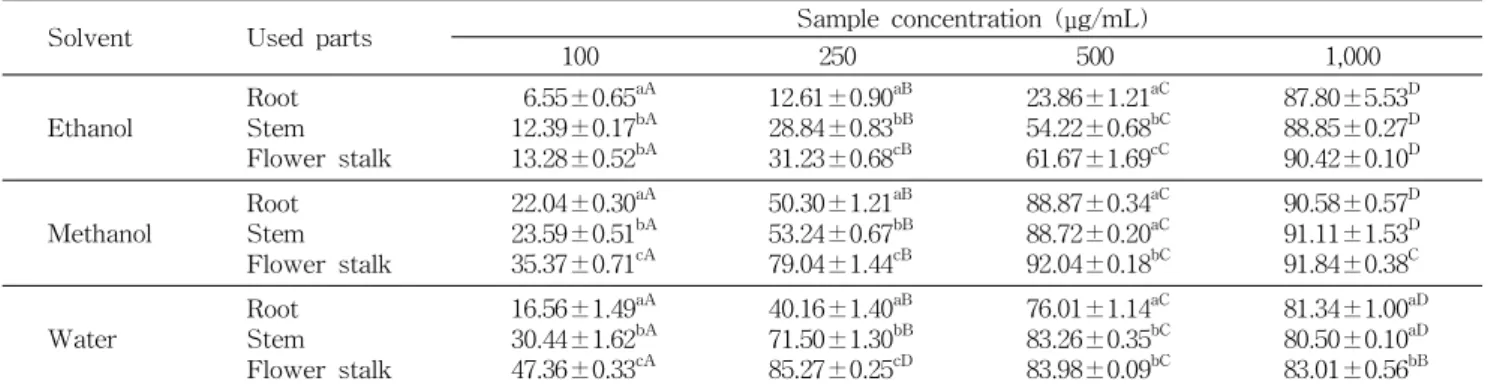
Table 2. Electron donating ability of ethanol, methanol and water extracts from Prunella vulgaris (%)
Solvent Used parts Sample concentration (μg/mL)
100 250 500 1,000
Ethanol Root
Stem Flower stalk
6.55±0.65
aA12.39±0.17
bA13.28±0.52
bA12.61±0.90
aB28.84±0.83
bB31.23±0.68
cB23.86±1.21
aC54.22±0.68
bC61.67±1.69
cC87.80±5.53
D88.85±0.27
D90.42±0.10
DMethanol Root Stem Flower stalk
22.04±0.30
aA23.59±0.51
bA35.37±0.71
cA50.30±1.21
aB53.24±0.67
bB79.04±1.44
cB88.87±0.34
aC88.72±0.20
aC92.04±0.18
bC90.58±0.57
D91.11±1.53
D91.84±0.38
CWater Root
Stem Flower stalk
16.56±1.49
aA30.44±1.62
bA47.36±0.33
cA40.16±1.40
aB71.50±1.30
bB85.27±0.25
cD76.01±1.14
aC83.26±0.35
bC83.98±0.09
bC81.34±1.00
aD80.50±0.10
aD83.01±0.56
bBa-c
Mean±SD in the same solvent and concentration with different superscripts are significantly different at p<0.05.
A-D
Mean±SD with different superscripts in the same row are significantly different at p<0.05.
서 유의적으로 높게 검출되었다. 이러한 결과는 본 연구진에 의해 수행된 하고초 메탄올 추출물의 총 페놀화합물이 꽃대 에서 유의적으로 높게 나타난 결과(20)와 유사하였지만, 그 함량에 있어서는 다소 차이를 보였는데 이는 시료의 채취 시기와 재배 토양의 차이에서 기인된 것으로 추측되었다.
또한 와송의 페놀화합물 함량이 잎, 줄기, 뿌리 순으로 높았 다는 보고(34)와 산초나무의 뿌리 및 줄기, 잎의 용매 분획별 추출물의 지질과산화 억제작용이 잎> 줄기> 뿌리의 순으로 활성이 높았다는 결과도 보고되어 있다(35). 이러한 결과는 페놀화합물이 항산화능에 크게 관여하기 때문인 것으로 알 려져 있다(36).
DPPH에 대한 전자공여능
각 추출물의 전자공여능을 측정한 결과는 Table 2와 같이 모든 실험군에서 농도 의존적으로 증가하였으며, 용매별 추 출물에서는 메탄올 추출물의 전자공여능이 가장 우수하였 다. 또한 하고초 부위별 추출물의 전자공여능은 꽃대> 줄 기> 뿌리의 순으로 높은 활성을 보였는데, 특히 250 μg/mL 이상의 농도를 첨가한 꽃대 메탄올 추출물에서는 79.04~
92.04%의 높은 활성을 보였다. 이러한 결과는 Jang 등(35)이 보고한 산초의 부위별 DPPH radical 소거작용 연구에서 잎> 줄기> 뿌리의 순으로 활성이 높았다는 보고와 유사한 경향이었다. 또한 Lee 등(37)은 아보카도 과육, 씨, 껍질 추출 물의 DPPH 소거활성을 측정한 결과 껍질 추출물에서 가장 우수한 항산화능을 보고한 바 있으며, 식물체는 대체적으로 줄기껍질> 열매> 뿌리 순으로 전자공여능에 차이를 보이는 데 이는 식물체 내의 페놀화합물 및 플라보노이드 함량에 의존적이라는 보고(38)도 있으며 이러한 결과들은 본 실험 의 결과와도 유사하였다.
환원력
시료에 존재하는 reductones이 제공하는 수소원자가 활 성 라디칼 사슬을 분해함으로써 나타나는 흡광도 수치를 측 정하여 환원력의 정도를 나타내며 이러한 환원력의 정도는 항산화활성과 관련이 있는 것으로 알려져 있다(39). 추출 용
매별, 시료 부위별 추출물의 환원력을 측정한 결과 Fig. 2와 같이 시료 농도가 증가할수록 환원력도 증가하는 경향을 보 였으며, 시료 부위별 환원력을 비교한 결과 추출용매 모두에 서 뿌리, 줄기, 꽃대 간의 유의적인 차이를 나타내었는데, 전반적으로 꽃대 추출물의 환원력이 높게 나타났다. 특히 메탄올 추출물 중에서 하고초 꽃대 추출물의 환원력은 뿌리 와 줄기 추출물에 비해 아주 높은 환원력을 보였다. Jeong 과 Shim(40)은 도라지 잎과 줄기 용매 분획물의 항산화활성 에 대한 연구에서 줄기의 부탄올 분획물 500 μg을 첨가하였 을 때 가장 높은 환원력을 보고한 바 있으며, Lee 등(34)의 연구에서는 와송의 부위별 추출물의 환원력을 측정한 결과 잎, 줄기, 뿌리 순으로 높은 환원력 보였다고 보고되었는데, 이는 본 실험에서 꽃대> 줄기> 뿌리 순으로 환원력이 높게 나타난 결과와도 유사하였다.
ABTS 라디칼 소거능
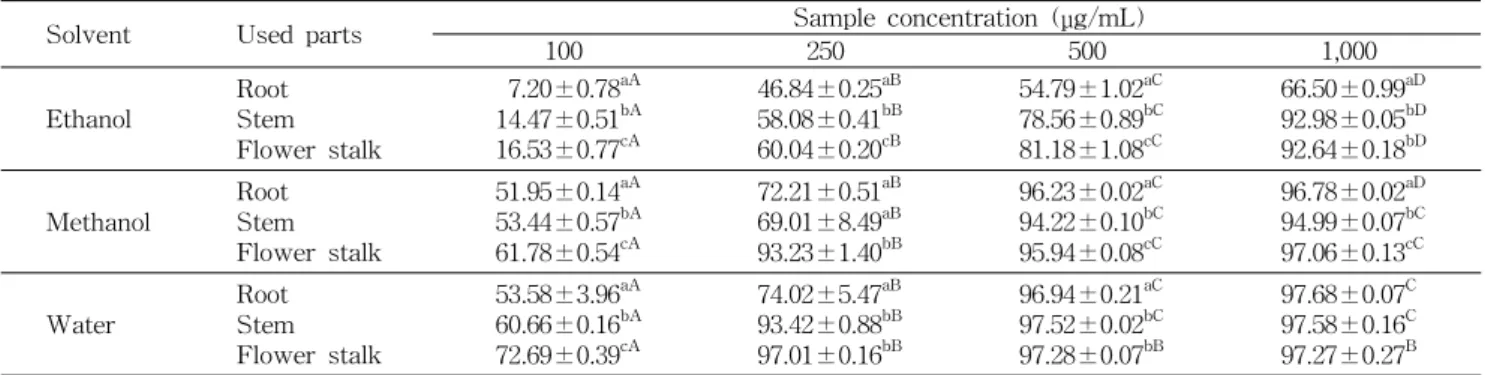
Table 3은 추출용매에 따른 하고초 부위별 추출물의
ABTS 라디칼 소거능을 측정한 결과이다. 실험군 모두 시료
농도가 증가할수록 ABTS 라디칼 소거능이 높게 나타났으
며, 특히 메탄올 추출물과 물 추출물에서는 100 μg/mL, 에탄
올 추출물에서는 250 μg/mL의 시료 농도에서도 50% 이상
의 높은 활성을 나타내었다. Kim 등(41)은 송이즙의 농도가
증가할수록 ABTS 라디칼 소거능을 측정한 결과 항산화능
이 증가하는 경향을 보고한 바 있으며, Kim 등(42)은 인삼
추출물의 2-amidinopropane dihydrochloride(AAPH)에 의
해 생성된 ABTS 라디칼 소거능을 실험한 결과 95% 에탄올
추출물은 50%의 소거능을 보였고 75% 에탄올 추출물은
40%의 소거능이 있음을 보고하였다. 또한 본 연구진에 의한
하고초 메탄올 추출물의 ABTS 라디칼 소거능 실험결과
(20)에서도 500 μg/mL 첨가 시 88.1~92.3%의 높은 활성을
나타낸 결과와도 일치하였으며, Choi 등(43)은 시판 다류 제
품의 열수 추출물에 대한 ABTS 라디칼 소거능은 전자공여
능과 상관관계가 높다고 보고한 바 있는데, 본 실험 결과에
서도 물 추출물과 메탄올 추출물에서 하고초 꽃대의 폴리페
aD
aC aA aB
bD
bC
bB bA
cD
cC
bB bA
0 0.2 0.4 0.6 0.8 1 1.2
100 250 500 1000
Concentrations (μg/mL)
O .D v a lu e ( a t 7 0 0 n m ) .
Ethanol - Root Ethanol - Stem Ethanol - Flower stalk
aD
aC
aB aA
aD
bC
bB aA
bD
cC
cB bA
0 0.5 1 1.5 2 2.5
100 250 500 1000
Concentrations (μg/mL)
O .D v a lu e ( a t 7 0 0 n m ) .
Methanol - Root Methanol - Stem Methanol - Flower stalk
aA
aB
aC
aD
aA
bB
bC
bD
bA cB
bC
cD
0 0.5 1 1.5 2 2.5
100 250 500 1000
Concentrations (μg/mL)
O .D v a lu e ( a t 7 0 0 n m ) .
Water - Root Water - Stem Water - Flower stalk
Fig. 2. Reducing power of ethanol, methanol and water extracts from Prunella ulgaris.
a-cMean±SD in the same concentration with different superscripts are significantly different at p<0.05.
A-DMean±SD in the same solvent with different superscripts are sig- nificantly different at p<0.05.
Table 3. ABTS radical scavenging ability of ethanol, methanol and water extracts from Prunella vulgaris (%)
Solvent Used parts Sample concentration (μg/mL)
100 250 500 1,000
Ethanol Root
Stem Flower stalk
7.20±0.78
aA14.47±0.51
bA16.53±0.77
cA46.84±0.25
aB58.08±0.41
bB60.04±0.20
cB54.79±1.02
aC78.56±0.89
bC81.18±1.08
cC66.50±0.99
aD92.98±0.05
bD92.64±0.18
bDMethanol Root Stem Flower stalk
51.95±0.14
aA53.44±0.57
bA61.78±0.54
cA72.21±0.51
aB69.01±8.49
aB93.23±1.40
bB96.23±0.02
aC94.22±0.10
bC95.94±0.08
cC96.78±0.02
aD94.99±0.07
bC97.06±0.13
cCWater Root
Stem Flower stalk
53.58±3.96
aA60.66±0.16
bA72.69±0.39
cA74.02±5.47
aB93.42±0.88
bB97.01±0.16
bB96.94±0.21
aC97.52±0.02
bC97.28±0.07
bB97.68±0.07
C97.58±0.16
C97.27±0.27
Ba-c
Mean±SD in the same solvent and concentration with different superscripts are significantly different at p<0.05.
A-D
Mean±SD with different superscripts in the same row are significantly different at p<0.05.
놀 화합물과 플라보노이드 함량이 높은 결과와도 상관관계 가 있을 것으로 추정되었다.
항균활성
하고초 각 부위별 추출물의 항균활성은 Table 4~6과 같 다. 대장균에 있어서는 열수 추출물을 제외한 에탄올과 메탄 올 추출물에서 clear zone을 관찰할 수 있었으며(Table 4),
C. albicans에 대한 항균활성은 대장균에 비해 비교적 낮게 나타났다(Table 5).
Asp. flavus에 대한 항균활성은 메탄올
과 열수 추출물에서는 항균활성을 보이지 않았으나 에탄올
추출물에서는 다소 높은 항균활성을 보였는데(Table 6), 특
히 에탄올 뿌리 추출물 1,000 μg/mL 농도에서는 유의적으로
높은 항균활성을 보였다. Lee 등(44)은 물, 메탄올 및 석유에
테르를 이용한 정향 추출물의 총 페놀화합물 함량과 항균활
성에 대한 연구에서 메탄올 추출물이 물 추출물이나 석유에
테르 추출물보다 항균력이 우수함을 보고하였는데, 이는 용
매별 정향 추출물의 총 페놀화합물 함량과 비교해 볼 때,
메탄올 추출물에서 가장 많은 함량을 나타내었으며 상대적
Table 4. Antimicrobial activity against Escherichia coli of ethanol, methanol and water extracts from Prunella vulgaris (diameter of clear zone, mm)
Solvent Used parts Sample concentration (μg/mL)
100 250 500 1,000
Ethanol Root
Stem Flower stalk
11.00±1.00
A11.33±0.58 12.00±0.00
AB11.33±0.58
A12.67±1.15 11.33±0.58
A11.33±0.58
aA12.67±0.58
b12.00±0.00
abAB13.67±1.53
B12.33±0.58 12.67±0.58
BMethanol Root Stem Flower stalk
11.33±0.58
b11.33±0.58
b10.00±0.00
a11.33±0.58 10.67±1.15 10.67±0.58
11.67±0.58 11.67±0.58 11.33±0.58
12.33±0.58 12.67±0.58 12.33±1.53
Water Root
Stem Flower stalk
ND
1)ND ND
ND ND ND
ND ND ND
ND ND ND
a-b
Mean±SD in the same solvent and concentration with different superscripts are significantly different at p<0.05.
A,B
Mean±SD with different superscripts in the same row are significantly different at p<0.05.
1)
ND: not detected.
Table 5. Antimicrobial activity against Candida albicans of ethanol, methanol and water extracts from Prunella vulgaris (diameter of clear zone, mm)
Solvent Used parts Sample concentration (μg/mL)
100 250 500 1,000
Ethanol Root
Stem Flower stalk
10.67±0.58
aB13.00±1.00
bB10.00±0.00
aB10.67±1.15
B11.33±0.58
AB10.33±1.15
B8.67±0.58
bA10.67±0.58
cAND
aA12.00±1.00
bB10.33±1.53
bAND
aAMethanol Root
Stem Flower stalk
9.33±0.58
B9.33±0.58
B9.00±0.00
B9.00±0.00
bBND
aA9.33±0.58
bB9.00±1.00
bBND
aAND
aAND
AND
AND
AWater Root
Stem Flower stalk
ND
1)ND ND
ND ND ND
ND ND ND
ND ND ND
a-c
Mean±SD in the same solvent and concentration with different superscripts are significantly different at p<0.05.
A,B
Mean±SD with different superscripts in the same row are significantly different at p<0.05.
1)
ND: not detected.
Table 6. Antimicrobial activity against Aspergillus flavus of ethanol, methanol and water extracts from the Prunella vulgaris (diameter of clear zone, mm)
Solvent Used parts Sample concentration (μg/mL)
100 250 500 1,000
Ethanol Root
Stem Flower stalk
11.33±0.58
b12.33±2.52
bND
a11.00±1.00
b11.67±1.15
bND
a13.00±1.00
b14.33±0.58
cND
a17.33±2.08
b15.67±3.21
bND
aMethanol Root
Stem Flower stalk
ND
1)ND ND
ND ND ND
ND ND ND
ND ND ND
Water Root
Stem Flower stalk
ND ND ND
ND ND ND
ND ND ND
ND ND ND
a-c
Mean±SD in the same solvent and concentration with different superscripts are significantly different at p<0.05.
1)
ND: not detected.
으로 총 페놀화합물 함량이 적은 석유 에테르 추출물에서는 항균효과를 보이지 않았다고 보고하였다. 또한 물 추출물에 대해서는 수용성 페놀 성분들이 추출되어 항균활성을 나타 낸 것으로 추정한 바 있어 본 실험에서 나타난 물 추출물의 항균활성 결과와는 다소 차이를 나타내었다. 그러나 Park과 Lee(45)는 솔잎 열수추출물의 경우 공시균주에 대한 clear
zone의 생성을 관찰할 수 없었으나, 솔잎 ethanol 추출물의
경우는 뚜렷한 clear zone을 형성하여 높은 항균활성을 보고
한 바 있어 본 실험과 유사한 결과를 보였다. 또한 Lee 등(46)
은 매실 착즙액의 식중독 유발균에 대한 항균작용을 보고한
바 있으며, Lim과 Lee(47)는 매실 열수추출액과 메탄올 추출
물의 항균활성 연구에서 가열에 의한 열수추출물보다 메탄
올 추출물의 항균활성이 높다고 보고한 바 있다. 이러한 결 과로 미루어 보아 총 페놀화합물 함량과 항균활성과는 상관 관계가 있는 것으로 사료되었으나, 상대적으로 총 페놀화합 물 함량은 높으나 항균활성이 낮은 물 추출물의 경우에는 가열에 의한 추출과정이 항균활성에 영향을 미친 것으로 사 료되며, 항균활성이 높게 나타난 에탄올 추출물 경우에는 대장균 오염 가능성이 있는 식품에 처리한다면 저장기간 연 장에 효과적일 수 있을 것으로 기대된다.
요 약
식물체의 부위별 및 추출용매에 따른 생리활성을 비교하 고자 하고초를 뿌리, 줄기 및 꽃대로 구분하고 에탄올, 메탄 올 및 물 추출물에 대한 항산화 및 항균 활성을 비교 분석하 였다. 추출 수율은 뿌리 추출물이 다소 높은 경향을 보였으 며, 물 추출물은 에탄올 및 메탄올 추출물에 비해 6~11배의 높은 수율을 나타내었다. 총 페놀화합물 함량은 에탄올 추출 물에서는 줄기에서, 메탄올과 물 추출물에서는 꽃대에서 유 의적으로 높게 나타났으며, 플라보노이드 함량은 뿌리에 비 해 줄기와 꽃대에서 전반적으로 높은 함량을 나타내었다.
각 추출물의 전자공여능 및 환원력은 모든 실험군에서 농도 의존적으로 증가하였고, 용매별 추출물에서는 메탄올 추출 물의 활성이 유의적으로 높게 나타났으며, 부위별 추출물에 서는 꽃대> 줄기> 뿌리의 순으로 높은 전자공여능 및 환원 력을 보였다. 또한 메탄올 추출물과 물 추출물의 ABTS 라 디칼 소거능은 100 μg/mL의 저농도에서도 꽃대, 줄기 및 뿌리에서 모두 50% 이상의 소거능을 보였다. 하고초 각 부 위별 추출물의 항균활성을 측정한 결과 꽃대, 줄기 및 뿌리 간의 유의적인 차이는 보이지 않았으나, 열수 추출물에 비해 에탄올 및 메탄올 추출물에서 다소 높은 항균활성이 관찰되 었는데, 특히 뿌리와 줄기의 1,000 μg/mL 농도에서는 유의 적으로 높은 항균활성이 확인되었다. 이상의 결과로 볼 때, 하고초의 꽃대를 이용한 에탄올 및 메탄올 추출물은 식품의 저장성 향상에 이용가치가 높을 것으로 기대된다.
감사의 글
본 연구는 농림수산식품부의 2008년 농림기술연구개발사 업(과제번호: 106011-03-1-SB010호) 연구비 지원으로 수행 되었으며 이에 감사드립니다.
문 헌