http://dx.doi.org/10.6111/JKCGCT.2016.26.4.150
Synthesis and characterization of potassium titanate whisker by flux method
Yeon-Bin Choi, Jeong-hun Son and Dong Sik Bae †
Department of Advanced Materials Science and Engineering, Changwon National University, Changwon 51140, Korea (Received June 9, 2016)
(Revised June 21, 2016) (Accepted July 22, 2016)
Abstract Method for synthesizing a K
2Ti
6O
13whisker is a solid-state method, hydrothermal synthesis method, calcination method, flux method, slow-cooling method, melting method, kneading-drying-calcination method, sol-gel method etc.
K
2Ti
6O
13whisker have been synthesized by a flux method. The average size and distribution of the synthesized K
2Ti
6O
13whisker can be controlled by a kind of potassium precursors and reaction temperature and time. The average size of the synthesized K
2Ti
6O
13whisker was about in the size range of 500 nm to 2 µm. The effect of synthesis parameters, such as the molar ratio of KOH to TiO
2, pH, reaction temperature and time, are discussed. The synthesized K
2Ti
6O
13whisker were characterized by x-ray diffraction analysis (XRD), field emission scanning electron microscopy (FE-SEM).
Key words Synthesis, Nanostructure, Potassium titanate, Microstructure
융제법을 이용한 티탄산칼륨 휘스커의 합성과 특성
최연빈, 손정훈, 배동식 †
창원대학교 신소재공학과, 창원, 51140 (2016년 6월 9일 접수)
(2016년 6월 21일 심사완료) (2016 년 7월 22일 게재확정)
요 약 K
2Ti
6O
13휘스커를 합성하는 방법은 고상법, 수열합성법, 소성법, 융제법, 서냉법, 용융법, KDC법, 졸-겔법 등이 있다. 융제법을 이용하여 K
2Ti
6O
13을 합성하는 연구를 진행하였다. 칼륨 전구체의 종류와 반응온도와 시간을 조절하여 합성 된 K
2Ti
6O
13의 입자크기와 분포를 제어하였고, 합성된 K
2Ti
6O
13의 평균입자 크기는 500 nm~2 µm였다. KOH와 TiO
2의 비율, pH(KOH 첨가량), 반응온도와 반응시간 등의 공정변수에 대해 연구를 진행하였다. 합성된 K
2Ti
6O
13은 X-선 회절분석기와 전계방사 주사전자현미경을 이용하여 특성평가를 실시하였다.
1. 서 론
티탄산칼륨 휘스커는 보통 μm 크기의 섬유형태의 형 상을 가지는 재료이다[1, 2]. 티탄산칼륨은 여러 가지 형 태로 존재하는데, K 2 O · nTiO 2 의 일반식으로 나타내며 n = 2 는 2티탄산칼륨(Poatssium dititanate, K 2 Ti 2 O 5 ), n = 4 는 4티탄산칼륨(Poatssium tetratitanate, K 2 Ti 4 O 9 ), n = 6 은 6티탄산칼륨(Poatssium hexatitanate, K 2 Ti 6 O 13 ), n = 8 은 8티탄산칼륨(Poatssium Octatitanate, K 2 Ti 8 O 17 ) 이다 [1, 3-13]. n = 2, 4 는 k + 이온이 TiO 2 결정내에서 쉽게 치환되는 성질이 있어서 이온교환 물질로 사용되고, n = 6, 8 은 k + 이온이 TiO 2 결정 내에 갇혀 있는 형태로써,
물리 화학적으로 안정한 상태여서 공업적으로 많이 활용 된다[5, 7, 10-12, 14, 15]. 여러 가지 형태의 티탄산칼 륨 중에서 6티탄산칼륨(K 2 Ti 6 O 13 ) 은 절연성과 내화학성, 내열성이 뛰어나다. 탄소섬유와 동등수준의 고강도, 고강 성 재료이며, 알루미나와 동등수준의 경도를 가지는 내 마모성이 우수한 특성을 지니기 때문에, 절연체, 강화복 합재료, 금속보강재, 단열재 및 마찰재료 등으로 응용되 고 있으며, 최근에는 광촉매 재료로도 활발히 연구가 진 행되고 있다[1, 5-7, 9, 11, 12, 16-20]. 티탄산칼륨의 합 성하는 방법은 고상법(Solid state method), 수열합성법 (Hydrothermal method), 소성법(Calcination method), 융 제법(Flux method), 서냉법(Slow-cooling method), 용융 법(Melting method), KDC법(Kneading-drying-calcination method), 졸-겔법(Sol-gel method) 등이 있다[1, 3-7, 8- 10, 15, 16, 21-23]. 이 중에서 수열합성법은 수열 반응
†
Corresponding author
†
E-mail: [email protected]
의 공정변수의 조정을 통해 합성된 입자의 크기를 제어 할 수 있고 양질의 휘스커를 합성할 수 있는 방법이지만, 합성조건이 복잡하고 공정이 연속적이지 못하여 실제 양 산에는 이용하기 힘든 방법이다. 하지만 융제법은 융제 의 양과 종류에 따라 비교적 간단한 방법으로 합성되는 티탄산칼륨 휘스커의 길이 제어가 용이하고, 장섬유의 성장에 보다 효과적이며, 상대적으로 대량생산에 적합한 공정이다. TiO 2 는 전이온도에 따라 아나타제(Anatase)상 과 루타일(Rutile)상을 가지는데 본 연구에서는 저온에서 용해도가 상대적으로 높아 K + 이온과 반응성이 우수한 아나타제(Anatase)상의 TiO 2 분말에 각종 융제(KOH, K 2 CO 3 , KNO 3 , KCl) 를 첨가하여 첨가되는 융제의 종류 에 따른 합성되는 K 2 Ti 6 O 13 의 특성을 연구하였다.
2. 실험 방법
융제법을 이용한 K 2 Ti 6 O 13 을 합성하는 방법을 Fig. 1 에 도식화하여 나타내었다. 0.479 g의 TiO 2 (Titanium(IV) oxide, Anatase, 99.8 %, SIGMA-ALDRICH) 분말에 1~
2 mM 농도의 KOH(Potassium hydroxide, 85 %, DEAJUNG), KNO 3 (Potassium nitrate, 96+%, SIGMA- ALDRICH), K 2 CO 3 (Potassium carbonate, 98 %, SIGMA- ALDRICH) 의 융제를 혼합하고, 수율을 향상시키기 위해 KCl(Potassium chloride, 99 %, DEAJUNG) 을 10 g 첨 가하였다. 혼합된 분말을 알루미나 유발을 이용하여 30 분간 고르게 핸드믹싱을 하였다. 혼련한 분말을 알루미 나 도가니에 담고, 박스로에 넣어 5 o C/min 의 승온속도로 850 o C 에서 2시간 동안 열처리 한 뒤, 증류수(D.I Water) 를 이용하여 5회 세척하여 KCl을 제거하였다. 그 후 100 o C 건조기에서 24시간 동안 건조 한 뒤 분쇄하여 K 2 Ti 6 O 13 분말을 회수하였다. K 2 Ti 6 O 13 의 결정구조는 X- 회절분석기(XRD)(Model MiniFlux II; Rigaku Co., Tokyo, Japan) 를 이용하여 확인하였고, 미세구조는 전계
Fig. 1. Experimental procedure for the synthesis of K
2Ti
6O
13nanoparticles by a flux method.
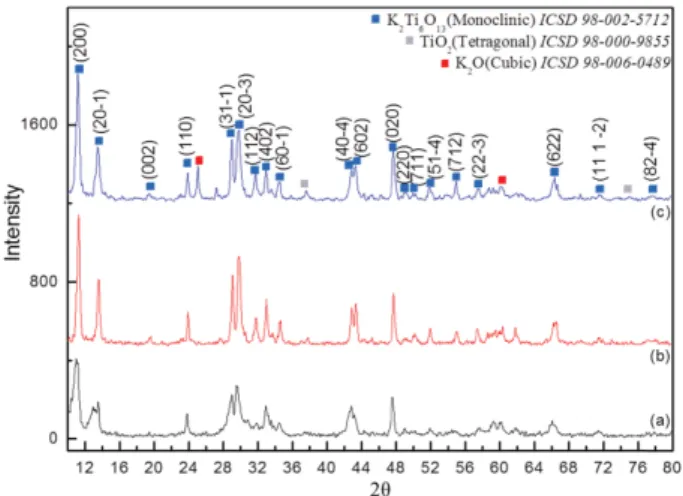
Fig. 2. XRD patterns of K
2Ti
6O
13nanoparticles synthesized by various molten mixture; (a) KOH, (b) KNO
3and (c) K
2CO
3.
Fig. 3. Scheme of chemical processes in the system TiO
2- molten mixture of KNO
3-KOH-K
2CO
3[15].
방사 주사전자현미경(FE-SEM)(MIRA II LMH)을 이용 하여 관찰하였다.
3. 결과 및 고찰
다른 종류의 융제를 첨가하여 K 2 Ti 6 O 13 를 합성하는 실
험을 진행하였다. Fig. 2는 합성된 K 2 Ti 6 O 13 의 결정성을
알아보기 위한 XRD 결과이다. 동일한 TiO 2 첨가량(6
mM) 과 열처리 온도(850 o C) 조건에서 융제를 Fig. 2(c)
K 2 CO 3 를 첨가하였을 때는 TiO 2 의 이차상의 Peak가 약
간 검출되었으나, Fig. 2(a) KOH와 Fig. 2(b) KNO 3 를
첨가하였을 때는 K 2 Ti 6 O 13 의 Peak가 확인되었고, Fig. 2
(b) KNO 3 를 융제로 첨가하였을 때 Peak의 강도가 강해
지면서 결정성이 증가하는 것을 확인할 수 있었다. 이것
은 성분원소들의 확산거리, 이온화도, 용해도, 과포화도,
점도, 핵 형성 조건 등이 결정의 성장에 영향을 미치는
데, Fig. 3과 같이 동일한 조건에서 첨가되는 융제의 종
류에 따라 TiO 2 와 OH − 이온과 O 2− 이온과의 반응성 차
이로 인해 중간반응물인(K 2 TiO 3 ) 생성에 차이가 생기고
최종적으로 중간반응물과 K + 이온과의 결정화 차이로
인한 결과로 추론된다[15,24]. Fig. 4는 합성된 K 2 Ti 6 O 13
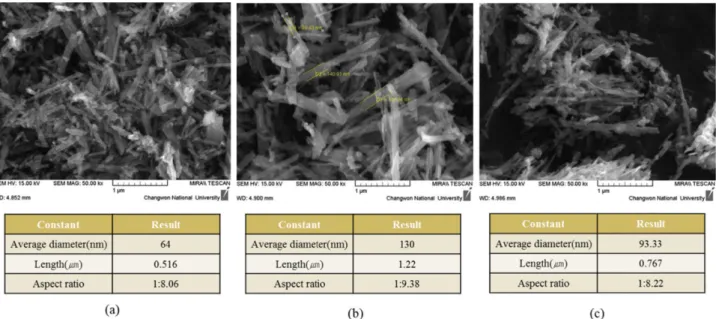
의 미세구조를 알아보기 위한 FE-SEM 결과이다. 합성
된 K 2 Ti 6 O 13 의 직경과 길이는 Linear intercept method 를 이용하여 계산하였다. Fig. 4(a) KOH를 융제로 첨가 하였을 때 길이는 평균 0.516 μm이고 직경은 64 nm이 며, 1 : 8.06의 종횡비 가졌고, Fig. 4(b) KNO 3 를 융제로 첨가하였을 때에는 길이는 평균 1.22 μm이고, 직경은 130
nm 이며, 1 : 9.38의 종횡비를 가졌으며, Fig. 4(c) K 2 CO 3 를 융제로 첨가하였을 때에는 길이는 평균 0.767 μm이 고 직경은 93.33 nm이며, 1 : 8.22의 종횡비를 가지는 K 2 Ti 6 O 13 가 합성된 것을 관찰할 수 있었다. Fig. 5는 합 성된 K 2 Ti 6 O 13 의 성분을 분석하기 위한 EDS 결과이다.
Fig. 4. FE-SEM image of K
2Ti
6O
13nanoparticles synthesized by various molten mixture; (a) KOH, (b) KNO
3and (c) K
2CO
3.
Fig. 5. Energy dispersive spectroscopy (EDS) results of K
2Ti
6O
13nanoparticles synthesized by various molten mixture; (a) KOH,
(b) KNO
3and (c) K
2CO
3.
합성을 위해 첨가하였던 K, Ti, O의 원소들이 검출되는 것을 확인할 수 있었다. 이론적인 정량비는 K : Ti : O의 비율은 1 : 3 : 6.5이다. 실제 EDS 분석된 성분비는 Fig.
5(a) 융제를 KOH 첨가하였을 때는 1 : 2.54 : 3.02이고, Fig. 5(b) 융제를 KNO 3 를 첨가하였을 때는 1 : 2.98 : 7.44 였으며, Fig. 5(c) 융제를 K 2 CO 3 를 첨가하였을 때는 1 : 3.14 : 5.7 이었다. 이것은 첨가되는 융제의 종류에 따 라 활성화 에너지가 달라서, Fig. 3에서 나타낸 것과 같 이 융제를 KNO 3 와 K 2 CO 3 를 첨가한 경우에는 반응이 (3) 으로 진행되고, 이때, TiO 3 − 을 생성하면서 산소의 비율 이 높아지게 되고, 융제를 KOH를 첨가한 경우에는 (1) → (5)의 반응으로 진행될 때 TiO 3 − 을 생성하는 단계 를 거치지 않고 K 2 TiO 3 를 바로 형성하기 때문에 산소의 비율이 상대적으로 낮기 때문으로 추론된다[15].
4. 결 론
융제법을 이용하여 K 2 Ti 6 O 13 를 합성하는 연구를 실시 하였다. 실험을 실시한 결과 첨가되는 융제의 종류에 따 라 합성된 K 2 Ti 6 O 13 의 결정성과 미세구조에 많은 영향을 미치는 것을 확인하였다. 융제로 K 2 CO 3 를 첨가하였을 때는 휘스커의 형태를 보이지만, XRD결과 이차상이 약 간 관찰되는 결과를 확인하였다. 융제로 KOH와 KNO 3
를 첨가하였을 때 K 2 Ti 6 O 13 의 결정구조를 나타내는 휘스 커를 합성하였고, KOH를 첨가하였을 때 보다 KNO 3 를 첨가하였을 때, 결정성이 증가하고 더욱 직경이 굵고 긴 섬유 형태의 K 2 Ti 6 O 13 가 합성되는 것을 확인하였다.
감사의 글
본 연구는 산업통상자원부와 한국산업기술진흥원의 지 역특화산업육성(R&D)기술개발사업으로 수행된 연구결 과입니다.
References