• 검색 결과가 없습니다.

The Effect of Cosmetics Curation Service Quality Attributes on Consumer's Intention to Use

N/A
N/A
Protected

Academic year: 2021

Share "The Effect of Cosmetics Curation Service Quality Attributes on Consumer's Intention to Use"

Copied!
13
0
0

로드 중.... (전체 텍스트 보기)

전체 글

(1)

ISSN 1229-3350(Print) ISSN 2288-1867(Online)

J. fash. bus. Vol. 22, No. 6:70-82, December. 2018 https://doi.org/

10.12940/jfb.2018.22.6.70

Attributes on Consumer’s Intention to Use

Sungmin Heo Woosuk Choi

Dept. of Business Administration, Seokyeong University, Korea

Corresponding author

Woosuk Choi Tel : +82-2-940-7122 Fax : +82-2-940-7873 E-mail: [email protected]

Keywords Abstract

cosmetics curation service, service quality attribute, intention to use, customer satisfaction, customer trust

This work is a part of doctoral dissertation.

In modern society, the means of sharing information has expanded from existing personal computers and mobile devices to a variety of smart devices rapidly increasing information production. Recently, curations have extended to online businesses. There has been wide use of curation services in the cosmetics curation market. In this study, focuses on factors which cosmetics curators have in mind. In relation to the impact of cosmetics curation quality properties on usability, the effects of the medium of satisfaction and confidence are to be verified. For this study, a survey of 378 women in their 20s and 40s who had experience with curations was done and the collected data were analyzed using SPSS 23.0 and AMOS 23.0 statistics programs. The results showed that information quality and personalization quality of cosmetics curation service were important factors affecting customer satisfaction.

Personalization quality also had a positive effect on trust. System quality has a

positive impact on trust and further influence on intention to use. This

indicates that the trust on the curation service depends on the stability of

system. However, design quality was found to have no significant effect on

satisfaction and trust. In future, the research related to application and

utilization of big data-based cosmetic curation will be further expanded.

(2)

I. Introduction

In modern society, the means of sharing information has expanded from existing personal computers to mobile devices, and information production is rapidly increasing with the use of a variety of smart devices. This means that information through blogs and social networks is being shared in real time, and that everyone can actively participate in the production, consumption, sharing and utilization of information, leaving this information virtually uncontrolled. The Web 3.0 era is an era of sorting through this immense amount of information in order to find the correct and useful information for the individual.

Within this vast amount of information, more companies are offering curation services based on big data solutions, that generate meaningful results through large amounts of information. Curation services emerged as a competitive force in the 4th Industrial Revolution era, aimed at providing exactly the information customers want, and provide personalized information by identifying user patterns.

Curation refers to the term commonly used in museums and art galleries that presents meaningful and valuable information in this age of information overload.

Curation service is used in marketing and entertainment fields to analyze personal tastes and recommend appropriate contents (Hankyung economic dictionary, 2014). Currently, consumers are more concerned about their tastes when purchasing products, and more and more research on curations is underway. Curation services that use big data to understand consumers' lifestyles and to provide recommended services based on individual interests and circumstances to improve marketing success and to secure customer loyalty will be key for future competitive businesses, by maximizing the selling effects of products and services. Prior research has been conducted on the study of service quality and the impact of online mobile service quality research on satisfaction, reliability, and intent to use cosmetics service. A lot of research has been done on the fashion industry, and in Kim(2018)’s research, curations helped

companies to select and optimize information for individual consumers while reducing information overload during the purchasing process.

Recently, curations have been extended to online businesses. As these curation services increase, they are also widely used in the cosmetics curation market.

In this study, we are going to focus on what factors cosmetics curation have in mind. In relation to the impact of cosmetics curation quality properties on usability, the effects of the medium of satisfaction and confidence are to be verified and the detailed objectives of the study are as follows.

First, it looks at the demographic characteristics of women who have used cosmetics curation services.

Second, it verifies reliability and validity of the restructured cosmetics curation service quality scale based on prior study.

Third, it checks the impact of quality properties of cosmetics curation service on use intention by controlling trust and satisfaction.

II. Theoretical Background 1. Cosmetic curation service

Curation is a word related to curator, who is the person that explains works in art galleries or museums. Curation has been extended to online business, and curation services refer to collecting, analyzing and recommending products that meet the needs of customers by collecting and analyzing customer information, just as curators collect, classify and manage works(Abdullah, Xu, &

Geva, 2013). As these curation services increase, they are also widely used in the cosmetics curation market.

Companies that use SNS to identify consumers' needs,

and use them to promote custom cosmetics, are growing

rapidly. As an example, Beauty Curation Broadcasting

'QNabada' and Beauty Products Recommendation Service

'MimiBox’, as well as makeup curation specifically for

individual people ‘Glossydays’. In Aekyung's skin care

brand 'FFLOW', they propose cosmetics considering the

lifestyle, skin condition and usage of the individual

(3)

through curation service based on online service.

2. Service quality

Quality of service is a subjective view based on the comparison and evaluation of the services consumers receive (Gr nroos, 1984). Therefore, quality of service is ö measured by consumer expectations and service provider performance comparisons, and the model typically used in measuring quality of service is the SERVQUAL model.

The SERVQUAL model should measure direct differences, not differences, by measuring two values in relation to the 'normal expectations – perceived performance' (Brown, Chuechill, & Peter, 1993).

The three-dimensional approach to quality of service includes physical quality, interaction quality, and company quality based on productivity factors, and the two-dimensional approach includes process quality, outcome quality (Lee & La, 2006).

Curation services have been conducted in recent years under the definition of curation services in Korea by measuring the quality of web services (Lee, 2013; Choi

& Yang, 2016; Lee, 2016). Among them, Lee(2016) studied the impact of fashion curations on satisfaction and found that personal customization is the most powerful predictor that affects satisfaction. Personalization refers to the provision of customized products and services to individual interests. Many scholars agree that the five factorial structures presented by Parasuraman, Zeithaml, and Berry(1988) are important dimensions of service quality (Brady & Cronin Jr, 2001). In this study, the dimensions of PZB(1988) were used as a lower level and added and supplemented by the dimensions used in the study on Internet service quality. Analysis of the online quality of service (e-SERVQUAL) measurement items of the preceding study shows that the following three factors are the most common factors for measuring quality of service: In this study, the quality of cosmetics curation service was selected as four categories:

information quality, system quality, design quality, and personal quality.

3. Trust

Confidence in the entity providing the curation services and the ability to perform the offerings accurately is the meaning of trust. Trust is a firm belief in the actions of the other party (Crosby, Evans, & Cowles, 1990) This means a tendency to believe what the other person says or does, and also to do what the other person is supposed to do (Dahlstrom & Nygard, 1995). Trust also means the belief that someone will act to meet their expectations without the control of the other person (Mayer, Davis, & Shoorman, 1995). Furthermore, trust is sometimes defined as an emotional state that means positive expectations of other people's actions (Lewicki, McAllister, & Bies, 1998).

Brand trust has been shown to be a positive influence product relationships with customers, brand relationships, company relationships and other customer relationships, as a positive influence on brand trust when perceived as an attitude to consumers.

4. Satisfaction

Satisfaction is the perceived difference between pre-purchase expectations of a product or service and the post-purchase result, or the overall assessment customers formed through the consumption and purchasing experience (kotler, 2000). If we look at prior studies related to satisfaction, Park(2013) said that customer satisfaction has a significant effect on customer behavior through an empirical analysis on the impact of SNS characteristics on customer satisfaction and usability.

Based on these preceding studies, satisfaction was set as a parameter of the Quality of Curation Service attribute to identify the impact relationship.

5. Intention to use

Usage is an important dependent variable that is used

extensively in empirical research in the marketing field,

defined as a conscious plan by individuals trying to

purchase a brand (Spears & Singh, 2004) and refers to

(4)

the use of cosmetics curation services in this study.

Utilization is a determinant of consumers' interest in purchasing and expectations as a direct influence on the decision-making process, and includes the intention of recommending to others (Ahn & Lee, 2002). Many studies explain the relationship between satisfaction and intent, and high satisfaction has a positive effect on usability (Choi, 2009).

III. Methods 1. Research hypothesis

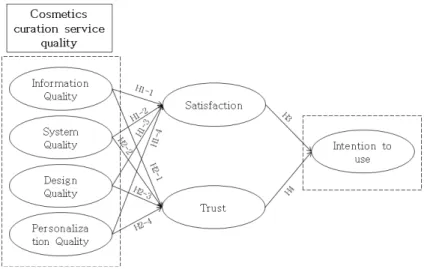
In this study, based on prior studies, we examined the impact of quality properties of cosmetics curation services on their intended use through the medium of trust and satisfaction.

Hypothesis 1. The quality of cosmetics curation service have a positive effect on satisfaction.

Hypothesis 1-1. Information quality have a positive (+) effect on satisfaction.

Hypothesis 1-2. System quality have a positive (+) effect on the satisfaction.

Hypothesis 1-3. Design quality have a positive (+) effect on satisfaction.

Figure 1. Research Model

Hypothesis 1-4. Personalization quality have a positive (+) effect on satisfaction.

Hypothesis 2. The quality of cosmetics curation service have a positive influence on reliability.

Hypothesis 2-1. Information quality have a positive (+) effect on trust.

Hypothesis 2-2. System quality have a positive (+) effect on reliability.

Hypothesis 2-3. Design quality have a positive (+) effect on reliability.

Hypothesis 2-4. Personalization Quality have a positive (+) effect on trust.

Hypothesis 3. Satisfaction have a positive (+) effect on the intended use.

Hypothesis 4. Trust have a positive (+) effect on the intended use.

2. Data collection

1) Instruments

The questionnaire consisted of verified statements based

on prior research and items modified and supplemented

for this study. Five panel members comprised of

cosmetics experts, beauty experts and research method

experts were tested for surface conformity. Based on

(5)

expert feedback, the wording was modified to ensure the validity of the survey's surface.

The quality of cosmetics curation service properties were measured using total of 22 questions. Information quality was measured by 5 questions (Liu & Arnett, 2000; Lee, 1997; Lee & La, 2006). Information quality items consisted of the latest product information, rich information and appropriate updates. System quality was measured by 5 questions (Delone & McLean, 2003; Lee

& Lee, 2001; Lee, 2000). System quality items consisted of fast screen switching and system stability. Design quality was measured by 6 questions (Kim & Lee, 2004;

Li, Wu & Lai, 2013; Yan, Zheng, & Wangd, 2013).

Design quality items consisted of the consistency of the screen configuration and the overall structure.

Personalization quality was measured by 6 questions (Jiang, Klein, & Crampton, 2000; Abdullah et al., 2013;

Reinartz, Dellaffer, Krafft, Kumard & Varadarajan, 2011). Personalization quality items consisted of personal preference and suitability of value. Trust was measured by 7 questions (Wu & Chang, 2005). Satisfaction was measured by 3 questions (Park, 2017). Intention to use was measured by 3 questions (Sung & Ko, 2013).

2) Research subjects and data collection

The purpose of this study is to investigate the causal relationship between quality attributes and use intention of cosmetics curation service. We surveyed the major customers using cosmetics curation service which they are purchased through the connection with e-commerce like

‘QNabada’ and ‘MimiBox’. According to the Internet Usage Survey conducted by the Korea Internet &

Security Agency, the rate of SNS usage by age group was 91.5% in their 20s, 83.9% in their 30s and 69.5%

in their 40s. Therefore, research subjects were limited to women aged from 20s to 40s who frequently use internet (Korea Internet Promotion Agency, 2017). Data was collected for 14 days from September 1, 2018 to September 14, 2018 through Four-research Co. Ltd., a mobile research company. Among the total 700 respondents, 380 respondents answered yes to screening questions asking whether they had used curation services.

Two respondents were excluded due to the inconsistent or inadequate responses. Data from 378 respondents were used for statistical analysis.

3) Data analyses

In this study, the data collected through questionnaires were analyzed using SPSS 23.0 and AMOS 23.0 statistical programs to empirically analyze and test hypotheses. For the validity of the measurement tools, exploratory factor analysis was performed and the Cronbach's α was calculated to verify the reliability.

Correlation analysis was performed to examine the correlation of each variable. Confirmatory factor analysis was performed to confirm convergent validity, discriminant validity, and reliability. Finally, structural equation modeling was conducted to verify the cause-and-effect relationship and mediated effect between constructs of the study model.

IV. Results 1. Sample characteristics

The purpose of this study was to investigate the relationship between the quality of cosmetics curation service and intention to use. Purposive sampling was used to collect data on women aged from 20s to 40s who are interested in cosmetics and purchase cosmetics.

Demographic characteristics of the subjects were shown

in Table 1. The 214 (56.6%) of respondents were in

their 20s, 153 (40.5%) were in their 30s and 11 (2.9%)

were in their 40s. The frequency of final education was

37 (9.8%) for high school , 241 (26.5%) for college and

university, and 241 (63.8%) for graduated or attended

graduate schools. The occupation was 123 (32.5%) for

students, 158 (41.8%) for office workers, 50 (13.2%) for

housewives, 17 (4.5%) for self-employed, 11 (2.9%) for

preparing for employment, and 19 (5.0%) for other. In

terms of monthly income, 26 (6.9%) earned less than 1

million won, 74 (19.6%) earned over 1 million won to

less than 2 million won, 71 (18.8%) earned over 2

million won to over 3 million won, 64 (16.9%) earned

(6)

Table 1. Sample Characteristics

Characteristics Type

Total(N=378) Frequency Percentage (%)

Age

20’s 214 56.6

30’s 153 40.5

40’s 11 2.9

Education

high school 37 9.8

college or university 100 26.5

graduate school or more 241 63.8

Occupation

student 123 32.5

office work 158 41.8

housewife 50 13.2

self-employed 17 4.5

Preparing for employment 11 2.9

other 19 5.0

Income

Less than ₩ 1,000,000 26 6.9

1,000,000-less than 2,000,000

₩ ₩ 74 19.6

2,000,000-less than 3,000,000

₩ ₩ 71 18.8

3,000,000-less than 4,000,000

₩ ₩ 64 16.9

More than ₩ 4,000,000 143 37.8

Average monthly cosmetics purchase amount

Less than ₩ 50,000 66 17.5

50,000- less than 100,000

₩ ₩ 156 41.3

100,000-less than 200,000

₩ ₩ 102 27.0

200,000-less than 400,000

₩ ₩ 42 11.1

More than ₩ 400,000 12 3.2

Internet usage time per day

Less than 1 hour 27 7.1

1 hour- less than 3 hour 118 31.2

3 hour- less than 5 hour 167 44.2

More than 5 hour 66 17.5

Purchase experience of Internet shopping mall in recent 1 year

yes 345 91.3

no 33 8.7

Purchase experience of social commerce shopping mall in recent 1

year

yes 332 87.8

no 46 12.2

Total 378 100

over 3 million won to over 4 million won, and 143 (37.8%) earned over 4 million won. In addition, the monthly average purchase amount of cosmetics was 66 (17.5%) for less than 50,000 won, 156 (41.3%) for less than 50,000~100,000 won, 102 (27%) for 100,000~200,000 won, 42(11.1%) for 200,000~400,000 won, and 12 (3.2%) for more than 400,000 won. The Internet usage time per day was 27 (7.1%) for less than

1 hour, 118 (31.2%) for 1~3 hours, 167 (44.2%) for 3~5 hours, and 66 (17.5%) for more than 5 hours.

345(91.3%) respondents have experienced the purchases

in the internet shopping mall recent 1 year, while 33

(8.7%) have not. 332 respondents (87.8%) have

experienced the purchases in the social commerce

shopping mall recent 1 year, while 46 (12.2%) have not.

(7)

2. Validity and reliability tests

In order to verify the validity of the measurement instrument, exploratory factor analysis was performed using Principal Component Analysis and the Berry Max rotation method. Variables were extracted by the number of factors with Eigen value of 1 or more. The cumulative explanatory power was set at 60% or more to ensure validity. The items with the factor loading of 0.5 or less were judged as lacking the validity and were eliminated. There is no absolute standard for factor loading, however, factor loadings larger than 0.4 is considered as a significant variable (Chae, 2001). The Cronbach's α coefficient larger than 0.7 was considered to secure the reliability for each factor.

According to the result of factor analysis of service quality attributes, information quality, system quality, design quality, and personalization quality were extracted.

The factor loadings of all four factors were 0.5 or more, and the cumulative explanatory power of the four factors was 65.33 %, indicating that the validity of the measurement instrument was verified. As a result of the reliability analysis, Cronbach's α of each factor ranged from 0.800 to 0.921, which is higher than the standard value of 0.7, confirming the internal consistency. As a result of exploratory factor analysis of satisfaction, trust, and intention to use, factor loadings of each item ranged from 0.540 to 0.818, and the cumulative explanatory power was 78.66%. Cronbach's α of satisfaction, trust, and reintegration intention were 0.793, 0.825, and 0.809, respectively, indicating that internal consistency was secured.

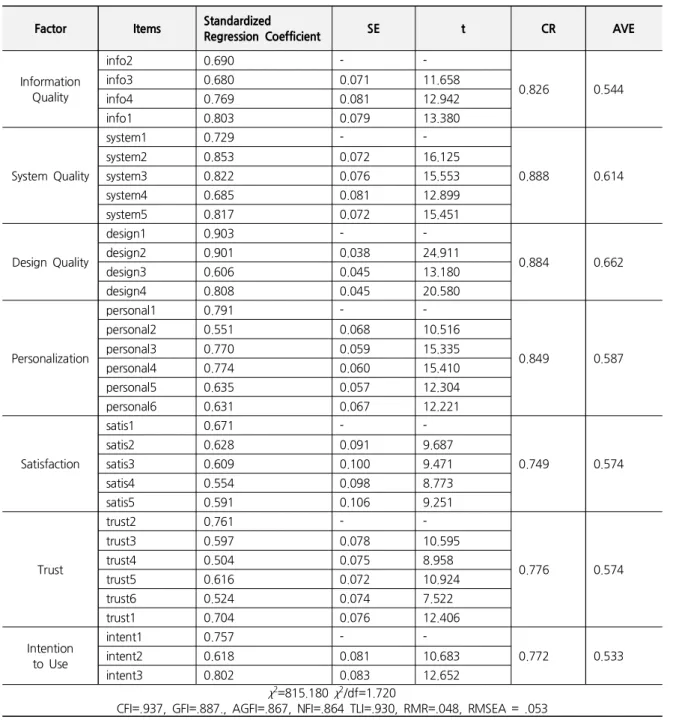
In addition to exploratory factor analysis, the confirmatory factor analysis were conducted to verify the intensiveness and validity of discrimination. The results of confirmatory factor analysis are shown in Table 2. The maximum likelihood method, which assumes multivariate normality, was used. The fit was evaluated to confirm constructs and variables. The fit of the model was χ

2

= 1140.132 ( df =637, p =0.000), CFI=0.920, NFI=0.836, TLI=0.911, GFI=0.867, AGFI=.846, RMR=.049, RMSEA=.053. Bagozzi & Dholakia(2002) and Kim(2010)

suggested that the model fit is considered suitable when GFI, AGFI, NFI and CFI are over 0.80~0.90, and RMR and RMSEA are less than 0.05 or 0.08. Therefore, the model fit of this study was found to be relatively suitable for analysis. In order to analyze the intrinsic validity of each variable, the conceptual reliability and average variance extracted (AVE) were calculated. The conceptual reliability of the variables ranged from 0.772 to 0.888 and AVE was 0.533~0.662 . Babin , Anderson, and Tatham (2006) and Kim (2010) suggested that the conceptual reliability higher 0.7 and AVE higher 0.50 is acceptable. Therefore, the constructs of this study fulfilled the convergent validity.

3. Correlation Matrix for Discriminant validity

Discriminant valid indicates that different constructs were distinguished. In case that a high correlation between conceptual constructs exists and independence and differentiation of constructs is low, the validity of discrimination is not secured (Woo, 2012). The discriminant validity is confirmed when the variance extraction index (AVE) is over 0.5 and AVE is higher than the square of the correlation coefficient between constructs (Woo, 2012). In this study, the square root of AVE was higher than the value of the correlation coefficients for each construct (Fornell & Larcker, 1981).

Therefore, the determined validity of the constructs was assured in this study Table 3.

4. Hypothesis test and discussion

To verify the relationship between the quality attributes of cosmetic curation, satisfaction, trust, and intention to use which were obtained through confirmatory factor analysis, the fit of structural equation model was estimated using the maximum likelihood method Table 4.

The fit of the model was χ ²= 815.180 ( df =474,

p=0.000), CFI=0.937, NFI=0.864, TLI=0.930, GFI=0.887,

AGFI=0.867, RMR=0.048, RMSEA=0.044. This result

was applicable to the fit indices established by scholars

(Bassellier, Benbasat, & Reich, 2003; Gefen., Straub, &

(8)

Table 2. Results of the Confirmatory Factor Analysis

Factor Items Standardized

Regression Coefficient SE t CR AVE

Information Quality

info2 0.690 - -

0.826 0.544

info3 0.680 0.071 11.658

info4 0.769 0.081 12.942

info1 0.803 0.079 13.380

System Quality

system1 0.729 - -

0.888 0.614

system2 0.853 0.072 16.125

system3 0.822 0.076 15.553

system4 0.685 0.081 12.899

system5 0.817 0.072 15.451

Design Quality

design1 0.903 - -

0.884 0.662

design2 0.901 0.038 24.911

design3 0.606 0.045 13.180

design4 0.808 0.045 20.580

Personalization

personal1 0.791 - -

0.849 0.587

personal2 0.551 0.068 10.516

personal3 0.770 0.059 15.335

personal4 0.774 0.060 15.410

personal5 0.635 0.057 12.304

personal6 0.631 0.067 12.221

Satisfaction

satis1 0.671 - -

0.749 0.574

satis2 0.628 0.091 9.687

satis3 0.609 0.100 9.471

satis4 0.554 0.098 8.773

satis5 0.591 0.106 9.251

Trust

trust2 0.761 - -

0.776 0.574

trust3 0.597 0.078 10.595

trust4 0.504 0.075 8.958

trust5 0.616 0.072 10.924

trust6 0.524 0.074 7.522

trust1 0.704 0.076 12.406

Intention to Use

intent1 0.757 - -

0.772 0.533

intent2 0.618 0.081 10.683

intent3 0.802 0.083 12.652

χ

2

=815.180 χ

2

/df=1.720

CFI=.937, GFI=.887., AGFI=.867, NFI=.864 TLI=.930, RMR=.048, RMSEA = .053

CFI(comparative fit index), GFI(goodness of fit index), AGFI(adjusted GFI), NFI(normed fit index),TLI(tucker-lewis index),RMR(root mean square residual), RMSEA(root mean square error of approximation)

Boudreau, 2000). Therefore, the research model was generally appropriate.

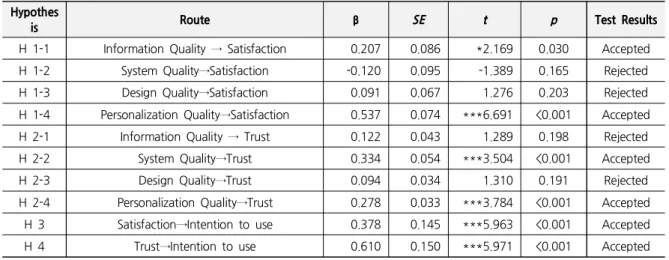
The results of the hypothesis test are shown in Table 5. In terms of the effects of quality factors on the

satisfaction of cosmetic curation service, information

quality ( =0.207, t=2.169*) and personalization quality β

( =0.537, t=6.691***) show significant effects on the β

satisfaction of cosmetic curation service. The hypothesis

(9)

Table 3. Correlation Matrix with AVE

factor Intent Design Info Trust Satis System Personal

Intent 0.730※            

Design 0.255 0.814※          

Info 0.311 0.581 0.737※        

Trust 0.531 0.365 0.431 0.612※      

Satis 0.330 0.370 0.430 0.362 0.612※    

System 0.448 0.520 0.687 0.481 0.324 0.784※  

Personal 0.265 0.422 0.488 0.319 0.601 0.502 0.698※

:

※  

Table 4. Goodness of Fit of the Research Model

²

χ df RMSEA χ ²/df NFI CFI TLI GFI AGFI RMR

815.180 474 .044 1.720 .864 .937 .930 .887 .867 .048

Table 5. Results of Hypothesis Testing Hypothes

is Route β SE t p Test Results

H 1-1 Information Quality → Satisfaction 0.207 0.086 *2.169 0.030 Accepted

H 1-2 System Quality Satisfaction → -0.120 0.095 -1.389 0.165 Rejected

H 1-3 Design Quality Satisfaction → 0.091 0.067 1.276 0.203 Rejected

H 1-4 Personalization Quality Satisfaction → 0.537 0.074 ***6.691 <0.001 Accepted

H 2-1 Information Quality → Trust 0.122 0.043 1.289 0.198 Rejected

H 2-2 System Quality Trust → 0.334 0.054 ***3.504 <0.001 Accepted

H 2-3 Design Quality Trust → 0.094 0.034 1.310 0.191 Rejected

H 2-4 Personalization Quality Trust → 0.278 0.033 ***3.784 <0.001 Accepted H 3 Satisfaction Intention to use → 0.378 0.145 ***5.963 <0.001 Accepted

H 4 Trust Intention to use → 0.610 0.150 ***5.971 <0.001 Accepted

1-1 and hypothesis 1-4 were accepted.

Hypotheses 2-1 to 2-4 were tested in regard with the effects of quality factors on the trust of cosmetic curation service. System quality ( =0.334, t=3.504***) β and personalization quality ( =0.278, t=3.784***) β affected significantly to the trust of cosmetic curation service. Hypotheses 2-2 and 2-4 were accepted, whereas

hypothesis 2-1 and Hypothesis 2-3 were rejected.

The effect of satisfaction on the intention to use was

significantly ( =0.378, t= 5.963***), and hypothesis 3 β

was accepted. The trust of cosmetic curation service

significantly affected to intention to use ( =0.610, β

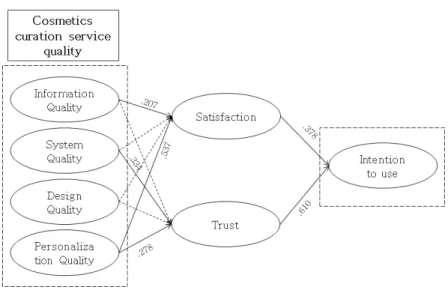
t=5.971), and hypothesis 4 was accepted. The results of

hypotheses test were summarized in Figure 2.

(10)

Figure 2. Results of Hypotheses Tests

Table 6. Results of Mediating Effects

Total (Direct, Indirect) Info Qual Sys Qual Design Qual Personalization

Qual Satisfaction Trust

Satisfaction .207*

(.207* .000) -.120 (-.120 .000)

.091 (.091 .000)

.537***

(.537* .000) Trust .122

(.122 .000)

.334***

(.334*** .000) .094 (.094 .000)

.278 (.278 .000) Intent to Use .109*

(.000 .109)

.010*

(.000 .010*)

.175 (.000 .175)

.162 * (.000 .162)

.378***

(.378***, 000)

.610***

(.610***, 000)

* : p<0.05, **: p<0.01, ***: p<0.001

5. Testing Results of Mediating Effects

In order to investigate the indirect effect of satisfaction and trust on the path of cosmetic curation service factors to intention to use, a bootstrap was used. The relationship between the variables in the structural equation model and the direct, indirect, and total effects are shown in Table. 6.

Personalization quality directly affected satisfaction and trust, and indirectly affected to intention to use (β

=0.162, p<0.05). Information quality has a direct effect on satisfaction and an indirect effect on intention to use ( =0.109, p <0.05). System quality has a positive effect β

on trust and indirect effect on use intention ( =0.010, β p<0.05).

V. Conclusion

The curation service industry through the utilization of

Big Data has become a core competitiveness factor for

enterprises. Continuous growth is possible by better

understanding consumers' tastes and promptly providing

products and services that consumers want. The purpose

of this study is to provide an empirical research data of

the quality factors of curation services, which have a

significant effect on consumers' intention to use of

(11)

curation service. This result could be useful when cosmetics companies introduce big data-based curation services.

The following conclusions were drawn through hypothesis tests.

First, Demographic characteristics of the subjects were as follows. Of the 378 respondents, 214 (56.6%) were in their 20s, 153 (40.5%) were in their 30s. Of all respondents, 32.5% indicated Students and 41.8%

indicated employees. Of all respondents, 37.8% indicated that they had a monthly income more 4 million KRW.

In addition, the monthly average purchase amount of cosmetics was 41.3% for less than 50,000~100,000 won.

The Internet usage time per day was 44.2% for 3~5 hours. 91.3% respondents have experienced the purchases in the internet shopping mall recent 1 year. 87.8%

respondents have experienced the purchases in the social commerce shopping mall recent 1 year.

Second, according to the result of factor analysis of service quality attributes, information quality, system quality, design quality, and personalization quality were extracted. The factor loadings of all four factors were 0.5 or more, and the cumulative explanatory power of the four factors was 65.33 %, indicating that the validity of the measurement instrument was verified. As a result of the reliability analysis, Cronbach's α of each factor ranged from 0.800 to 0.921, which is higher than the standard value of 0.7, confirming the internal consistency.

Third, information quality and personalization quality of cosmetics curation service were proved to be important factors affecting satisfaction, and personalization quality also had a positive effect on trust.

When cosmetics consumers use the curation services, the accuracy of the information and personalization significantly affected to satisfaction because they recognize the advantage the curation service. Consumers regard product information as the most important, and it is considered that information among such product information is highly evaluated as information tailored to individual taste. These findings suggest that the speciality and personalization of cosmetics should be emphasized and the product information should be provided to the

consumers in order to increase the satisfaction of the cosmetic curation services.

Forth, system quality has a positive impact on trust and indirect influence on intention to use. This indicates that th trust on the curation service depends on the stability of system. On a systematic level, the stable operation of a website positively affects customer's trust and improves the reliability of cosmetic curation services.

This result supports the fact that system quality emphasizes the effect of providing new information, giving the impression that the company is much more enthusiastic and reliable.

Fifth, design quality was found to have no significant effect on satisfaction and trust. This could be explained by information quality that customers want to have a product that suits their taste. Regardless of design quality, if customers have products that suit their taste, what they want to buy is natural purchasing behavior and consumer sentiment. This finding is in line with the results of previous study (Lee, 2016), which rejected the hypothesis that the design quality of the fashion curation website affects to satisfaction. This could be explained by the common characteristics of fashion and cosmetics.

This is judged to be due to the common characteristics of fashion and cosmetics, and in the case of Hedonic goods that help individual self-expression, it is suggested that consumer satisfaction is maximized when providing the most personalized services (Lee, 2017).

This study classified cosmetic curation service quality factors into information quality, system quality, design quality, and personalization quality according to previous research related to online service quality. In addition this study investigated the effect of quality factors on intention to use through the mediation of satisfaction and trust. It is meaningful that the specified quality factors which have a significant influence on the cosmetics curation service consumers is understood.

In this study, data was collected from the general

public who had an experience the cosmetics curation

services. Even if the survey respondent has experience,

they may not fully understand the characteristics of

curation services. The limit of this study is the fact that

(12)

the understanding of cosmetic curation service of research subject was not confirmed. In order to activate the cosmetic curation service, it is expect the marketing results to be improved by using the results of this research. In the future, the research related to application and utilization of big data-based cosmetic curation will be further expanded.
References

Abdullah, N., Xu, Y., & Geva, S. (2013). Integrating collaborative filtering and matching-based search for product recommendations. Journal of Theoretical and Applied Electronic Commerce Research, 8 (2), 34-48.

Ahn, K., & Lee, Y. (2002). The study of the influence of consumer`s shopping orientation on the relationship between store image variables and on-line consumer`s purchase intention. Journal of Consumer Studies, 13 (4) , 101-122.

Bagozzi, R. P., & Dholakia, U. M. (2002). Intentional social action in virtual communities. Journal of Interactive Marketing, 16 (2) , 2-21.

Bassellier, G., Benbasat, I. & Reich, B. H. (2003). The influence of business managers' IT competence on championing IT. I nformation Systems Research, 14 (4), 317-336.

Brady, M. K., & Cronin Jr, J. (2001). Customer orientation: Effects on customer service perceptions and outcome behaviors. Journal of service Research, 3 (3), 241-251.

Brown, T. J., Churchill, G. A., & Peter, J. P. (1993).

Research note: Improving the measurement of service quality. Journal of Retailing, 69 (1), 127-139.

Bum, K. (2008). A study on the relationship between online service quality, customer satisfaction and behavioral intention : Rocused on moderate effects of web site types (Unpublished doctor’s thesis) . Baejae University, Seoul, Korea.

Chae, S. (2001). Marketing Reaserch. Gyeonggi:

Hakhyunsa.

Choi, C., & Yang, H. (2016). The effect of E-commerce's curation characteristics on the customer

purchase intention: Focusing on the mediating effect of satisfaction. Journal of Digital Convergence, 14 (5) , 185-195.

Choi, H. (2009). Study of the effect of brand extrinsic cues on perceived quality, perceived risk and purchase intention : Focus on brand awareness, store image, perceived price of sport shoes (Unpublished doctor’s thesis) . Kyung Hee University, Seoul, Korea.

Crosby, L. A., Evans, K. R., & Cowles, D. (1990).

Relationship quality in services selling: an interpersonal influence perspective. The Journal of Marketing, 6 (1), 68-81.

Dahlstrom, R., & Nygaard, A. (1995). An exploratory investigation of interpersonal trust in new and mature market economies. Journal of retailing, 71 (4), 339-361.

Delone, W. H., & McLean, E. R. (2003). The DeLone and McLean model of information systems success: A ten-year update. Journal of Management Information Systems, 19 (3), 9-30.

Fornell, C., & Larcker, D. F.(1981). Evaluating structural equation models with unobservable variables and measurement error. Journal of Marketing Research, 18 (1), 39-50.

Gefen, D., Straub, D., & Boudreau, M. C. (2000).

Structural equation modeling and regression:

Guidelines for research practice. Communications of the association for information systems , 4 (1), 7-21.

Gr nroos, C. (1984). A service quality model and its ö marketing implications. European Journal of Marketing, 18 (4) , 36-44.

Hankyung economic dictionary. (2014). Curation.

Retrieved December 7, 2017, from

http://dic.hankyung.com

Jiang, J. J., Klein, G., & Crampton, S. M. (2000). A note on SERVQUAL reliability and validity in information system service quality measurement.

Decision Sciences, 31 (3), 725-744.

Kim, G. (2010). AMOS 18.0 structural equation modeling analysis. Gyenggi: Hannarae Academy.

Kim, H. (2018). The effect of personalization services for

fashion products on consumers’ happiness: Focusing

(13)

on customization and curation (Unpublished doctor’s thesis) . Seoul National University, Seoul, Korea.

Kim, J., & Lee, E. (2004). The influence of service quality, product quality, price on store patronage for apparel stores. Journal of the Korean Society of Clothing and Textiles, 28 (1), 12-21.

Korea Internet & Security Agency. (2017). Retrieved March 13, 2018, from https://www.kisa.or.kr

Kotler, P. (2000). Marketing management (10th ed.).

New Jersey: Prentice-Hall.

Lee, H. (1997). Determinants of perceived service quality.

Journal of Korean Business, 26 (1) , 139-154.

Lee, H. (2013). Study on social curation services:

Focused on analyzing content cases (Unpublished Master's thesis). Hongik University, Seoul, Korea.

Lee, H. (2017). A s tudy on influence of fashion social curation commerce perceived value on satisfation, search intention and use intention (Unpublished Master's thesis). Ewha Woman’s University, Seoul, Korea.

Lee, M.(2000). A causal model of perceived service quality, consumer attitude, and intention to repatronize. Asia Marketing Journal, 2 (3), 44-63.

Lee, S. (2016). The effects of fashion curation service attributes on satisfaction, trust and purchase intention (Unpublished master’s thesis). Yonsei University, Seoul, Korea.

Lee, Y., & La, S. (2006). Transition process of service quality evaluation system in korean companies.

Seoul:Seoul National University Press.

Lee, Y., & Lee, J. (2001). A reexamination of the measurement and consequences of service quality:

Development and application of the KS - SQI model.

Korean Marketing Review, 16 (1), 1-26.

Lewicki, R. J., McAllister, D. J., & Bies, R. J. (1998).

Trust and distrust: New relationships and realities.

Academy of management Review, 23 (3), 438-458.

Li, Y. M., Wu, C. T., & Lai, C. Y. (2013). A social recommender mechanism for ecommerce: Combining similarity, trust, and relationship. Journal of Decision Support Systems, 55 (3), 740-752.

Liu, C., & Arnett, K. P. (2000). Exploring the factors associated with web site success in the context of

electronic commerce. Information & management, 38 (1), 23-33.

Mayer, R. C., Davis, J. H., & Schoorman, F. D. (1995).

An integrative model of organizational trust. Academy of management review, 20 (3), 709-734.

Parasuraman, A., Zeithaml, V. A., & Berry, L. L. (1988).

Servqual. Journal of Retailing, 64 (1), 12-40.

Park, J. (2013). The effects of the characteristics of word of mouth information communicated through SNS’s on word of mouth effects. International Journal of Tourism Management and Sciences, 27 (6), 385-408.

Park, J. (2017). The effect of shopping characteristics and consumer characteristics on impulse buying and satisfaction (Unpublished doctor’s thesis). Daejeon University, Daejeon, Korea.

Reinartz, W., Dellaert, B., Krafft, M., Kumard, V., &

Varadarajan, R. (2011). Retailing innovations in a globalizing retail market environment. Journal of Retailing, 87 (2), 53-66.

Spears, N., & Singh, S. N. (2004). Measuring attitude toward the brand and purchase intentions. Journal of Current Issues & Research in Advertising, 26 (2), 53-66.

Sung H., & Ko J. (2013). The study of the effects of on-line social network service differences on customer satisfaction and intention of use: Focused on the extended technology acceptance model. Korea Journal of Tourism Research, 73 (2), 187-211.

Woo, J. (2012). Concept and Understanding fo Structural Equation Model. Seoul:Hannarae Academy.

Wu, J., & Chang, Y. (2005). Towards understanding members' interactivity, trust, and flow in online travel community. Industrial Management & Data Systems, 105 (7), 937-954.

Yan, S., Zheng, X., Chen, D., & Wangd, Y. (2013).

Exploiting two-faced web of trust for enhanced-quality recommendations. Journal of Expert Systems with Applications, 40 (1), 7080-7095.

Received (November 5, 2018)

Revised (December 7, 2018)

Accepted (December 11, 2018)

수치

Figure  1.  Research  Model
Table  1.  Sample  Characteristics   Characteristics Type   Total(N=378) Frequency Percentage  (%) Age 20’s 214 56.630’s15340.5 40’s 11 2.9 Education high  school 37 9.8college  or  university100 26.5
Table  2.  Results  of  the  Confirmatory  Factor  Analysis
Table  4.  Goodness  of  Fit  of  the  Research  Model
+2

참조

관련 문서

44 글의 첫 번째 문장인 The most important thing in the Boat Race is harmony and teamwork.을 통해 Boat Race에서 가장 중요한 것은 조 화와 팀워크임을

Chapter 3 Customers' Evaluation of Administrative Service Quality 1. Customer's Primary Concern in Administrative Service Quality 4. Prioritizing the

웹 표준을 지원하는 플랫폼에서 큰 수정없이 실행 가능함 패키징을 통해 다양한 기기를 위한 앱을 작성할 수 있음 네이티브 앱과

_____ culture appears to be attractive (도시의) to the

【판결요지】[1] [다수의견] 동일인의 소유에 속하는 토지 및 그 지상 건물에 관하여 공동저 당권이 설정된 후 그 지상 건물이 철거되고 새로 건물이 신축된 경우에는

- quadriceps tendon 이 슬개골 하연에서 tibial tuberocity에 부착.

In the chapters of Journey of Renewal that describe the Mission Accountability Framework there will be flashbacks to the story of Richmond Corps, showing clearly how

1 John Owen, Justification by Faith Alone, in The Works of John Owen, ed. John Bolt, trans. Scott Clark, &#34;Do This and Live: Christ's Active Obedience as the