• 검색 결과가 없습니다.

Cu<sub>2</sub>O Thin Film Photoelectrode Embedded with CuO Nanorods for Photoelectrochemical Water Oxidation

N/A
N/A
Protected

Academic year: 2021

Share "Cu<sub>2</sub>O Thin Film Photoelectrode Embedded with CuO Nanorods for Photoelectrochemical Water Oxidation"

Copied!
7
0
0

로드 중.... (전체 텍스트 보기)

전체 글

(1)

한국표면공학회지 J. Korean Inst. Surf. Eng.

Vol. 52, No. 5, 2019.

https://doi.org/10.5695/JKISE.2019.52.5.258

<연구논문>

ISSN 1225-8024(Print) ISSN 2288-8403(Online)

Cu 2 O Thin Film Photoelectrode Embedded with CuO Nanorods for Photoelectrochemical Water Oxidation

Soyoung Kim

a

and Hyojin Kim

b*

a

Graduate School of Advanced Circuit Substrate Engineering, Chungnam National University, Daejeon 34134, Republic of Korea

b

Department of Materials Science and Engineering, Chungnam National University, Daejeon 34134, Republic of Korea

(Received 24 October, 2019 ; revised 30 October, 2019 ; accepted 31 October, 2019)

Abstract

Assembling heterostructures by combining dissimilar oxide semiconductors is a promising approach to enhance charge separation and transfer in photoelectrochemical (PEC) water splitting. In this work, the CuO nanorods array/Cu

2

O thin film bilayered heterostructure was successfully fabricated by a facile method that involved a direct electrodeposition of the Cu

2

O thin film onto the vertically oriented CuO nanorods array to serve as the photoelectrode for the PEC water oxidation. The resulting copper-oxide-based heterostructure photoelectrode exhibited an enhanced PEC performance compared to common copper-oxide-based photo- electrodes, indicating good charge separation and transfer efficiency due to the band structure realignment at the interface. The photocurrent density and the optimal photocurrent conversion efficiency obtained on the CuO nanorods/Cu

2

O thin film heterostructure were 0.59 mA/cm

2

and 1.10% at 1.06 V vs. RHE, respectively.

These results provide a promising route to fabricating earth-abundant copper-oxide-based photoelectrode for visible-light-driven hydrogen generation using a facile, low-cost, and scalable approach of combining elec- trodeposition and hydrothermal synthesis.

Keywords: Copper oxide, Oxide heterostructure, photoelectrode, Photoelectrochemical water oxidation, Hydrogen production

1. Introduction

Harvesting sunlight to produce clean chemical fuels such as hydrogen is considered to be a desirable and sustainable method toward meeting future demands for energy with minimal environmental impact [1-3]. The development of advanced processes to generate hydrogen from the solar-driven splitting of water has been attempted through several different approaches. Among these methods [4-6], photoelectrochemical (PEC) water splitting is known to be one of the most

promising hydrogen production techniques in an eco-friendly and highly-efficient way. In general, solar-driven water splitting involves two half-cell reactions, (i) the oxygen evolution reaction or water oxidation and (ii) the hydrogen evolution reaction or water reduction, and thus it is necessary to separate each half-cell reaction [3].

One of the main reasons why PEC cells are widely used as solar-driven water splitting devices is that they spatially separate water oxidation and reduction reactions.

In a PEC cell system, the selection and design of the photocatalytic materials for the water oxidation and reduction photoelectrodes are critical, because the light absorption and carrier transport of the photoelectrodes largely determine the capability of the PEC cell for water splitting

* Corresponding Author: Hyojin Kim

Department of Materials Science and Engineering, Chungnam National University

Tel: +82-42-821-6636 ; Fax: +82-42-822-5850

E-mail: [email protected]

(2)

[7]. It has been shown that oxide semiconductors such as titanium dioxide (TiO

2

), hematite (Fe

2

O

3

), zinc oxide (ZnO), cuprous oxide (Cu

2

O), and cupric oxide (CuO) exhibit a promising potential as photoelectrodes for hydrogen generation [8-10].

Among them Cu2O and CuO, which have a direct bandgap of approximately 2.0 eV and 1.5 eV respectively [3], are attractive in terms of their great potential of earth-abundant, visible-light activated photoelectrodes for PEC water splitting owing to their direct bandgaps of small energies.

However, both unmodified Cu

2

O and CuO have significant electron-hole recombination rate and poor water splitting kinetics. To address these restrictions, various strategies including nanostructured control and elemental doping have been attempted [11]. In principle, constructing heterostructure is the most effective and direct way to promote the efficiency of charge separation in photoelectrodes [6]. Since both the conduction band (CB) and valence band (VB) edges of Cu

2

O are higher than those of CuO [12], the photoinduced electrons in the CB of Cu

2

O are supposed to be injected into that of CuO at the CuO/Cu

2

O interface under visible-light illumination, while the photoinduced holes in the VB of CuO are injected into that of Cu

2

O. As a result, for example, the CuO/Cu

2

O bilayered heterostructure has been shown to facilitate electron-hole separation and can improve photo-to- chemical energy conversion efficiency [3].

Meanwhile, as we have seen, p-type semiconductors Cu

2

O and CuO in the form of individual layer have been used as photocathode for hydrogen evolution reaction or water reduction [9]. On the contrary, as described above, the engineered CuO/

Cu

2

O electronic structure at the interface is expected to provide a copper-oxide-based heterostructure as an effective photoanode for PEC oxygen evolution reaction or water oxidation, which is the main point of this work.

In this work, we assemble Cu

2

O thin film photoelectrode embedded with CuO nanorods by directly electrodepositing Cu

2

O thin film onto the vertically oriented CuO nanorods array. As illustrated in Figure 1, the step-wise structure of energy levels constructed CuO/Cu

2

O heterostructure

is responsible for the mechanism of PEC photoanode. When CuO and Cu

2

O come into contact, an oxide semiconductor heterostructure forms at their interface by coupling dissimilar semiconductors. Consequently, there is a favorable energy band alignment for electron transport from the CB of Cu

2

O to the CB of CuO, and for hole transport from the VB of CuO to to the VB of Cu

2

O. Under the illumination, the photoinduced electrons and holes are supposed to be efficiently separated by the built-in space-charge-region potential due to the band structure realignment at the interface, which also lowering the electron- hole recombination rate [13], On the one hand, the electrons transport through each individual CuO nanorod and finally reach the ITO electrode to export the PEC electrical signals. On the other hand, the holes migrate through Cu

2

O film and subsequently take part in the water oxidation at the surface of Cu

2

O [14]. The nearly one- dimensional nature of CuO nanorods array is supposed to induce a significant increase in the interfacial area between CuO and Cu

2

O, and the introduction of CuO layer is expected to results in a marked improvement in the visible light absorption due to its narrower band gap.

Simultaneously, the engineered CuO/Cu

2

O heterostructure is presumed to ensure a faster carrier transportation rate inside the copper oxides, which benefits the PEC water oxidation. This work demonstrates the potential of the Cu

2

O thin film embedded with CuO nanorods as a photoanodic material for effective PEC water oxidation.

Fig. 1. Schematic diagram of the mechanism for the

photoelectrochemical water oxidation at CuO/Cu

2

O

heterostructure photoanode.

(3)

2. Experimental Details

The vertically ordered CuO nanorod array was prepared on a glass substrate coated with an indium tin oxide (ITO) electrode via a seed mediated hydrothermal technique with the use of a CuO nanoparticle seed layer formed via a two- step method [15]. To form the CuO seed layer, Cu metal film was first deposited on the ITO- coated glass substrate from a pure Cu metal target. The Cu film was deposited under an Ar atmosphere of 5 mTorr for 6 min at room temperature (RT) by using a radiofrequency magnetron sputtering system with power of 5 W.

Subsequently, the as-deposited Cu film was thermally oxidized in dry air at 400

o

C for 1 h by using a rapid thermal annealing system to form CuO nanoparticles, which acted as nucleation sites for CuO nanorods. Aligned CuO nanorods were prepared by dipping the CuO-deposited substrate into a solution which consisted of 25 mM Cu(NO

3

)

2

·3H

2

O and 25 mM C

6

H

12

N

4

in distilled water, and then heating it at 80

o

C for 2 h in an oven. Before the formation of an oxide heterostructure, the substrate covered with CuO nanorods was carefully cleaned with deionized (DI) water and dried under a high-purity nitrogen gas flow.

Next, we fabricated Cu

2

O thin film embedded with CuO nanorods by directly electrodepositing Cu

2

O thin film onto the CuO nanorods array. The electrodeposition of Cu

2

O thin film was conducted with a three-electrode system in water bath of 60

o

C [14]. Aqueous solution containing 0.05 M CuSO

4

·5H

2

O and 0.1 M lactic acid was prepared, and the pH value was adjusted to 11 through

dropwise adding NaOH. Afterward, the substrate covered with CuO nanorods array was immersed into the resulting solution under the current of 0.5 mA/cm

2

for 30 min. We used a calomel [Hg/

Hg

2

Cl

2

/KCl (3.5M)] as the reference electrode and a Pt sheet as the counter electrode. Finally, the fabricated CuO/Cu

2

O heterostructure was again rinsed with DI water for three times and dried in dry air.

The crystalline phases of the prepared CuO nanorods/Cu

2

O thin film heterostructure were characterized by X-ray diffraction (XRD) and Raman spectroscopy, and then its microstructures were analyzed by scanning electron microscopy (SEM). All the PEC measurements for the CuO/

Cu

2

O photoanode were performed in a three- electrode cell with our photoanode as the working electrode, a Pt sheet as counter electrode, and a calomel reference electrode with an aqueous 0.1 M Na

2

SO

4

solution pH-adjusted to 5.8 as the electrolyte. The area of the photoanode exposed to light was 0.5 cm

2

. The photoresponse was measured under a continuous irradiation from a 300 W Xe lamp, and the visible light intensity were calibrated to 1 mW/cm

2

for the incidence onto the photoanode.

3. Results and Discussion

Typical SEM images for the top-view morphologis of the hydrothermally synthesized CuO nanorods array and electrodeposited Cu

2

O thin film on the ITO-coated glass substrate are presented in Figure 2(a) and 2(b), respectively. It is clearly seen from Figure 1(a) that the CuO nanorods having an average diameter of ~30 nm

Fig. 2. Typical SEM images showing (a) top view of hydrothermally synthesized CuO nanorods array, (b) top view of

electrodeposited Cu

2

O thin film at pH 11, and (c) cross-sectional view of CuO nanorods/Cu

2

O thin film

heterostructure fabricated on an ITO-coated glass substrate.

(4)

are vertically grown. As shown in Figure 2(b), the electrodeposited Cu

2

O thin film from lactate- stabilized copper sulfate solution of pH 11 is composed of closely packed Cu

2

O nanocrystals that have an average grain size of ~500 nm. The average grain size of Cu

2

O was found to be easily adjusted by controlling the pH value of the electrolyte solution, but the most uniform and compact Cu

2

O thin film could be obtained at pH

= 11.

Figure 2(c) shows a typical SEM image for the cross-sectional morphology of the CuO nanorods/

Cu2O thin film heterostructure fabricated on the ITO-coated glass substrate. As clearly seen in this image, the surface of the distinct ITO layer is covered by vertically aligned CuO nanorods with a length of ~450 nm. Also, the Cu

2

O thin film with a thickness of ~250 nm is found to cover all over the CuO nanorods array. It is worth pointing out that an apparent blurred interface between the CuO nanorods and the Cu

2

O thin film indicates a permeation of the Cu

2

O crystalline particles into the CuO nanorods array, revealing the formation of a structure in which the CuO nanorods array is embedded in the Cu

2

O thin film.

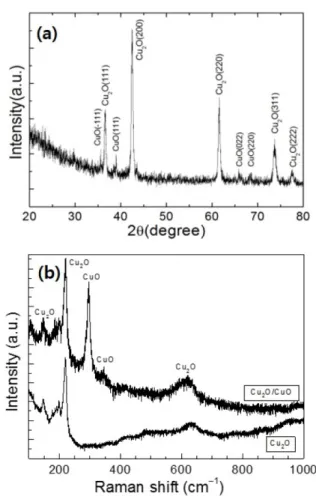
X-ray diffraction (XRD) was used to verify the formation of CuO and Cu

2

O crystalline phases.

Figure 3(a) shows a typical XRD pattern of the CuO nanorods/Cu

2

O thin film heterostructure fabricated on the ITO-coated glass substrate. The diffraction peaks simply corresponding to either monoclinic tenorite CuO phase (JCPDS card no, 80-1268) or cubic Cu

2

O phase (JCPDS card no, 78-2076) were detected. No diffraction peaks of second phases were found in the XRD pattern.

The formation of the CuO/Cu

2

O oxide heterostructure can be further confirmed by the Raman spectroscopy analysis. Figure 3(b) shows the Raman spectra of pristine Cu

2

O thin film and CuO/Cu2O heterostructure at room temperature. In these observed spectra, three distinct lines at 150, 220, and 625 cm

-1

correspond to the characteristic phonon frequencies of Cu

2

O crystalline phase while two distinct lines at 300 and 350 cm

-1

correspond to those of CuO crystalline phase [16- 18]. For the observed Raman lines from Cu

2

O phase, the most intensive line at 220 cm

-1

is

assigned to the phonon mode, and then the 150 and 625 cm

-1

lines are due to the and phonon modes, respectively [16,17]. On the other hand, for the Raman lines from CuO phase, the most intensive line at 300 cm

-1

is due to Ag phonon mode and the 350 cm

-1

line is assigned to Bg phonon mode [18]. Here, it is worth noting that no characteristic Raman lines from CuO phase can be found in the pristine Cu

2

O thin film, thus demonstrating the layer electrodeposited upon CuO nanorods array was that of pure Cu

2

O phase without Cu or CuO phases.

The PEC water oxidation performance of the fabricated Cu

2

O thin film photoelectrode embedded with CuO nanorods was characterized through the current density−potential (J−V) response curves measured using the linear sweep voltammetry in the dark and under light illumination. Figure 4(a) shows the (J−V) response curves of the CuO

12 Γ

12

Γ

15( )1

Γ

12

+ Γ

15+

Fig. 3. (a) X-ray diffraction pattern of CuO nanorods/

Cu

2

O thin film heterostructure, and (b) Raman spectra

of Cu

2

O thin film and CuO nanorods/Cu

2

O thin film

heterostructure.

(5)

nanorods/Cu

2

O thin film heterostructure photoelectrode in 0.1 M Na

2

SO

4

solution at pH 5.8 in the dark and under light illumination. In the dark, the photoelectrode is clearly seen to exhibit little photocurrent density. However, under light illumination, the CuO/Cu

2

O photelectrode exhibits a significantly enhanced oxidative photocurrent density, which is mainly ascribed to the PEC water oxidation. For instance, the observed difference in the photocurrent density at the applied potential of 0.5 V vs. calomel is estimated to be 0.59 mA/cm

2

.

The photocurrent conversion efficiency (PCE) for photoelectrochemical water oxidation of the photoanodes were estimated from our observed J−V characteristic data using the following equation [19]

Here, V

app

[V] is the applied external potential vs. a reversible hydrogen electrode (RHE), J [mA/

cm

2

] is the externally measured current density at V

app

, P

i

[mW/cm

2

] is the power density of the incident light, and 1.23 [V] is the potential for water splitting reaction. The potentials were measured vs. calomel [Hg/Hg

2

Cl

2

/KCl (3.5M)]

reference electrode and converted to the RHE scale using the Nernst function

Here, E

RHE

is the converted potential vs. RHE, E

Calomel

is the external potential measured against the calomel reference electrode, is the standard electrode potential of the calomel reference electrode (0.250 V vs. RHE at 25

o

C), and pH is the acidity of the solution. Figure 4(b) presents the change in PCE for the CuO nanorods/Cu

2

O thin film heterostructure photoelectrode under an applied potential vs.

calomel and RHE. The CuO/Cu

2

O photoelectrode exhibits the optimal photocurrent conversion efficiency of 1.10% at a potential of 1.06 V vs.

RHE (that is, ~0.5 V vs. calomel), which is several times higher than that of Cu

2

O of 0.12%

and that of CuO of 0.43% [3]. This electrochemical results convincingly demonstrate that the interlayer of the CuO nanorods array positively influenced the PEC water-splitting PCE % ( ) J 1.23 V × ( –

app

)

P

i

--- × 100

=

E

RHE

= E

Calomel

+ E

Calomel0

+ 0.059pH

E

Calomel0

Fig. 4. (a) Current density without and with visible-light

illumination, and (b) photocurrent conversion efficiency (PCE) of the CuO nanorods/Cu

2

O thin film heterostructure photoelectrode under an applied potential.

Fig. 5. Photocurrent density-time (J-T) curve

measured at 0.5 V versus counter electrode for the

the CuO nanorods/Cu

2

O thin film heterostructure

photoelectrode under visible-light illumination.

(6)

efficieny of the Cu

2

O-based photoelectrodes.

The long-term stability of the CuO/Cu

2

O heterostructure photoelectrode was tested by obtaining the photocurrent density-time (J−t) response curve. An initial photocurrent density of 0.794 mA/cm

2

, obtained by applying 0.5 V between working and counter electrodes, was found to decrease to that of 0.584 mA/cm

2

after 140 min, indicating a considerable decay of ~25%

after 140 min and suggest its long-term stability to be addressed.

4. Conclusion

In summary, the CuO nanorods array/CuO thin film bilayered heterostructure was successfully fabricated by a facile method that involved a direct electrodeposition of the Cu

2

O thin film onto the vertically oriented CuO nanorods array to serve as the photoelectrode for the PEC water oxidation. The proposed CuO/Cu

2

O photoelectrode provided an improved performance for the PEC water splitting, indicating good charge separation and transfer efficiency due to the band structure realignment at the interface. The photocurrent density and the optimal photocurrent conversion efficiency obtained on the CuO nanorods/Cu

2

O thin film heterostructure were 0.59 mA/cm

2

and 1.10% at 1.06 V vs. RHE, respectively, which were found to be higher than those of common copper-oxide-based photoelectrodes. This work demonstrate that the Cu

2

O thin film embedded with CuO nanorods could be a promising candidate as a photoanodic material for effective PEC water oxidation. Furthermore, the fabrication strategy of combining electrodeposition and hydrothermal synthesis provides a facile, low-cost, and scalable approach towards to preparing earth- abundant copper-oxide-based photoelectrodes for visible-light-driven hydrogen generation.

Acknowledgement

This research was supported by Basic Science Research Program through the National Research Foundation of Korea (NRF) funded by the Ministry of Education (NRF-2017R1D1A3B04030425).

References

[1] N.S. Lewis, D.G. Nocera, Powering the planet:

Chemical challenges in solar utilization, Proc. Natl.

Acad. Sci. USA 103 (2006) 15729-15735.

[2] P.V. Kamat, Meeting the clean energy demand:

Nanostructure architecture for sloar energy conversion, J. Phys. Chem. C 111 (2007) 2834- 2860.

[3] Y, Yang, D. Xu, Q. Wu, P. Diao, Cu2O/CuO bilayered composite as a high-efficiency photocathode for photoelectrochemical hydrogen evolution reaction, Sci. Rep. 6 (2016) 30158.

[4] A. Kudo, Y. Miseki, Heterogeneous photocatalyst materials for water splitting, Chem. Soc. Rev. 38 (2009) 253-278.

[5] F.E. Osterloch, Inorganic nanostructures for photoelectrochemical and photocatalytic water splitting, Chem, Soc. Rev. 42 (2013) 2294-2320.

[6] X. Chen, S. Chen, L. Guo, S.S. Mao, Semiconductor-based photocatalytic hydrogen generation, Chemical Reviews 110 (2010) 6503- 6570.

[7] Y. Liu, Y. Gu, X. Yan, Z. Kang, S. Lu, Y. Sun, Y. Zhang, Design of sandwich-structured ZnO/ZnS/

Au photoanode for enhanced efficiency of photoelectrochemical water splitting, Nano Res. 8 (2015) 2891-2900.

[8] R. van de Krol, M. Grätzel, Photoelectrochemical Hydrogen Production, Springer, New York (2012).

[9] M.G. Walter et al., Solar water splitting cells, Chem.

Rev. 110 (2010), 6446-6473.

[10] J.-H. Park, H. Kim, Photoelectrochemical properties of a vertically aligned zinc oxide nanorod photoelectrode, J. Korean Ins. Surf. Eng. 51 (2018), 237-242.

[11] H.M. Chen et al., Nano-architecture and material designs for water splitting photoelectrodes, Chem.

Soc. Rev. 41 (2012) 5654-5671.

[12] K. Rajeshwar, N.R. de Tacconi, G. Ghadimkhani, W. Chanmanee, C. Janáky, Tailoring copper oxide semiconductor nanorod arrays for photoelectrochemical reduction of carbon dioxide to methanol, ChemPhysChem 14 (2013) 2251- 2259.

[13] S.J.A. Moniz, S.A. Shevlin, D.J. Martin, Z.-X.

Guo, J. Tang, Visible-light driven heterojunction photocatalysts for water splitting—a critical review, Energy Environ. Sci. 8 (2015) 731-759.

[14] Z. Kang, X. Yan, Y. Wang, Z. Bai, Y. Liu, Z.

Zhang, P. Lin, X. Zhang, H. Yuen, X. Zhang, Y.

Zhang, Electric structure engineering of Cu2O film/

ZnO nanorods array all-oxide p-n heterostructure

(7)

for enhanced photoelectrochemical properties and self-powered biosensing application, Sci. Rep. 5 (2015), 7882.

[15] L. Liu, K. Hong, T. Hu, M. Xu, Synthesis of aligned copper oxide nanorod arrays by a seed mediated hydrothermal method, J. Alloys Compd.

511 (2012) 195-197.

[16] P.Y. Yu, Y.R. Shen, Y. Petroff, Resonance Raman scattering in Cu2O at the blue and indigo excitons, Solid State Commun. 12 (1973), 973-975.

[17] P.Y. Yu, Y.R. Shen, Resonance Raman studies in

Cu2O. I. The phonon-assisted 1s yellow excitonic absorption edge, Phys. Rev. B 12 (1975), 1377- 1394.

[18] H.F. Goldstein, D-s. Kim, P.Y. Yu, L.C. Bourne, J-P. Chaminade, L. Nganga, Raman study of CuO single crystal, Phys. Rev. B 41 (1990), 7192-7194.

[19] Z. Chen, H.N. Dinh, E. Miller,

Photoelectrochemical Water Splitting: Standards,

Experimental Methods, and Protocols, Springer,

New York (2013) 10.

수치

Fig. 1. Schematic diagram of the mechanism for the photoelectrochemical water oxidation at CuO/Cu 2 O heterostructure photoanode.
Fig. 2. Typical SEM images showing (a) top view of hydrothermally synthesized CuO nanorods array, (b) top view of electrodeposited Cu 2 O thin film at pH 11, and (c) cross-sectional view of CuO nanorods/Cu 2 O thin film heterostructure fabricated on an ITO
Fig. 3. (a) X-ray diffraction pattern of CuO nanorods/
Fig. 5. Photocurrent density-time (J-T) curve measured at 0.5 V versus counter electrode for the the CuO nanorods/Cu 2 O thin film heterostructure photoelectrode under visible-light illumination.

참조

관련 문서

We investigated the relation between the Cu-O bond length and the superconducting properties of BaSnO 3 (BSO)-added GdBa 2 Cu 3 O 7-x (GdBCO) thin films by

The green body was sintered in a furnace at 1400 o C for 1 h. Cu particles were dispersed in porous Al 2 O 3 by calcination and hydrogen reduction of Cu-nitrate. The

Al-based metal matrix composite (MMC) reinforced with submicron and micron sized Al 2 O 3 particles was successfully fabricated by sintering at 1000 o C for 2 h into Al-Mg

Effect of Freezing and Sintering Condition of CuO-SnO 2 /Camphene Slurries on the Pore Structure of Porous Cu-Sn.. Joo-Hyung Kim, Sung-Tag Oh, and Chang-Yong

Antibacterial test using fungus revealed that the porous Al 2 O 3 /1 vol% Cu composite showed antifungal property due to the dispersion of Cu particles.. The results are suggested

The size distribution, crystal structure, and chemical state of deposited Cu 2 O nanocubes are characterized using scanning electron microscopy, trans- mission electron

In the current study, a Cu 2 O/TiO 2 photoinduced nanocomposite materials prepared by ultrasonification method was evaluated the photocatalytic oxidation

The photocatalytic oxidation efficiencies of benzene, toluene, ethylbenzene, and o-xylene with Cu 2 O-TiO 2 were higher than those of P25 TiO 2 and undoped TiO 2..