pISSN 1229-3008 eISSN 2287-6251
Progress in Superconductivity and Cryogenics
Vol.18, No.4, (2016), pp.1~4 http://dx.doi.org/10.9714/psac.2016.18.4.001
```
1. INTRODUCTION
REBa2Cu3O7−δ (RE: rare earth)-coated conductors have been reported to have better superconducting performances in high magnetic fields than those of standard YBa2Cu3O7−δ (YBCO). Among them, GdBa2Cu3O7-d
(GdBCO) is considered as a promising candidate for power application due to its higher transition temperature Tc and higher critical current density Jc than those of YBCO [1, 2].
Power applications of GdBCO require the superconductor to be exposed to strong magnetic fields. The magnetic fields penetrate into the superconductor in the form of vortices that need to be pinned by pinning centers in order to have a high Jc. In order to improve the Jc of GdBCO, introducing impurities as artificial pinning centers (APCs) is known to be one of the most effective methods [3-6]. BaSnO3 (BSO) was selected as a dopant material because our previous study had shown that BSO provides a Jcimprovement via the formation of a BSO nanostructure [6-8]
In the application of superconductor, Tc is one of the properties as much important as Jc. Variation in Tc is reported to be related to the change in local structure, which is nowadays considered a key point for understanding mechanism of superconductivity. Researches on the relation between Tc of high-temperature superconductors and the Cu-O bond length have revealed that the
contraction in the Cu-O bond enhanced the values of Tc in YBCO [9] and in other cuprates with impurities [10, 11] .
In this work, we investigate the effect of BSO addition both on Tc and the local structure of GdBCO films with different thicknesses by using extended X-ray absorption fine structure (EXAFS) spectroscopy. EXAFS provides local structural information about a specific element in a compound. In contrast to X-ray diffraction (XRD), EXAFS spectroscopy has an advantage of not requiring long-range ordering of the material. This fundamental understanding will provide useful information on the structural phase variation in BSO-added GdBCO films and aid further development in improving the properties of GdBCO films through the addition of BSO for power application.
2. EXPERIMENT
4 wt. % BSO added GdBCO target prepared by the solid state reaction method was used to fabricate BSO added GdBCO films. A KrF excimer laser with a wavelength of 248 nm operated at an energy of 200 mJ was focused on targets.
The pure and BSO doped GdBCO films were deposited on the (100) SrTiO3 (STO) single crystal substrates. The substrate temperature and oxygen gas pressure were kept at 700 – 730 C and 400 mTorr, respectively. To obtain the films with different thickness from 0.2 to 1.0 m, the
Effect of BSO addition on Cu-O bond of GdBa
2Cu
3O
7-xfilms with varying thickness probed by extended x-ray absorption fine
structure
H. K. Jeona, J. K. Leea, D. S. Yangb, W. N. Kangc, and B. Kanga,*
a Department of Physics, Chungbuk National University, Cheongju, Korea
b Department of Physics Education, Chungbuk National University, Cheongju, Korea
c Department of Physics, Sungkyunkwan University, Suwon, Korea
(Received 1 December 2016; revised or reviewed 21 December 2016; accepted 22 December 2016)
Abstract
We investigated the relation between the Cu-O bond length and the superconducting properties of BaSnO3 (BSO)-added GdBa2Cu3O7-x (GdBCO) thin films by using extended x-ray absorption fine structure (EXAFS) spectroscopy. 4 wt.% BaSnO3
(BSO) added GdBa2Cu3O7-x (GdBCO) thin films with varying thickness from 0.2 μm to 1.0 μm were fabricated by using pulsed laser deposition (PLD) method. The transition temperature (Tc) and the residual resistance ratio (RRR) of the GdBCO films increased with increasing thickness up to 0.8 μm, where the crystalline BSO has the highest peak intensity, and then decreased. This uncommon behaviors of Tc and RRR are likely to be created by the addition of BSO, which may change the ordering of GdBCO atomic bonds. Analysis from the Cu K-edge EXAFS spectroscopy showed an interesting thickness dependence of ordering behavior of BSO-added GdBCO films. It is noticeable that the ordering of Cu-O bond and the transition temperature are found to show opposite behaviors in the thickness dependence. Based on these results, the growth of BSO seemingly have evident effect on the alteration of the local structure of GdBCO film.
Keywords : GdBCO, BSO, EXAFS, Cu-O bond length, Thickness dependence
* Corresponding author: [email protected]
Effect of BSO addition on Cu-O bond of GdBa2Cu3O7-x films with varying thickness probed by extended x-ray absorption fine structure
numbers of pulse were varied. After completing depositions, all the films were annealed at 500 C in 500 Torr oxygen for one hour and cooled to room temperature.
Cu K-edge (8979 eV) X-ray absorption spectra were measured using fluorescence mode at the 8C beamline of the Pohang Light Source (PLS) at room temperature. The incident X-ray energy was selected using a three-quarters tunes Si (111) double monochromator. EXAFS measurements were applied to horizontal direction where electric vector of X-ray was applied to perpendicularly to the c-axis of the GdBCO films.
The EXAFS data were analyzed by the interactive EXAFS data analysis IFEFFIT Athena and Artemis programs [12, 13].
The structure was determined by XRD and electrical property was measured using the standard four-probe technique. The thicknesses of the films were determined by using the cross-section scanning electron microscope (SEM).
3. RESULTS AND DISCUSSION
In Fig. 1, normalized resistance as a function of temperature of the samples is plotted. From the enlarged view, it is clear that the transition temperatures (Tc) vary from 85.8 to 88.5 K as GdBCO films thicken. With the increase of GdBCO thickness ranging from 0.2 to 1.0 m, the superconducting transition shifts to higher temperatures while 0.8 m-thick GdBCO filmhas the highest Tc and the lowest resistance values. The increased Tc shown here is
50 100 150 200 250
0.0 0.2 0.4 0.6 0.8 1.0
90 87 0.2 m
0.4 m 0.6 m 0.8 m 1.0 m
Temperature ( K )
84
0.0 0.2 0.4
R(T)/R(300 K)
Temperature ( K )
R(T)/R(300 K)
Fig. 1. The temperature dependence of the normalized resistance of BSO added GdBCO films with different thicknesses. Tc variation is observed with the thickness.
The inset shows an enlarged view near the superconducting transition temperature.
1.0 m 0.8 m 0.4 m
GdBCO (006)
2(degree)
Intensity (arb. unit) GdBCO (005) BSO (200) 0.2 m
36 38 40 42 44 46 48 50
Fig. 2. X-ray diffraction patterns of BSO-added GdBCO films with different thicknesses.
rather compelling, since it is common to see diminished values of Tc when the superconducting films being thicken.
The residual resistance ratio (RRR) of BSO-added GdBCO films are found to be increased with the increasing film thickness up to the 0.8 m thick film and then to be decreased. It is fairly common for superconducting film with increasing thickness to have the decreased values of RRR because misoriented grains and defects can enhance the electron scattering, and hence, the diminished RRR values. One of tenable reasons of RRR values continuously increase upon the increase in GdBCO thickness lies on the lower fraction of misoriented grains or defects probably due to the BSO addition, which has a self-assembled property.
XRD patterns (-2 scans) for BSO-added GdBCO films with different thicknesses are presented in Fig. 2. At the film deposition temperatures of 700 – 730 C, crystalline structures were formed not only in GdBCO but also in BSO. The observed (00l) peaks (where l ranges from 1 to 7, not all of them are shown here) of the GdBCO phase indicate that all of the films were highly c-axis oriented. The BSO (200) peak was also observed in all of the GdBCO films, suggesting an existence of a textured BSO phase inside the GdBCO matrix. The intensity of BSO (200) peak became strong as the thickness of GdBCO films grows up to 0.8 m and then weak for the 1.0 m-thick film.
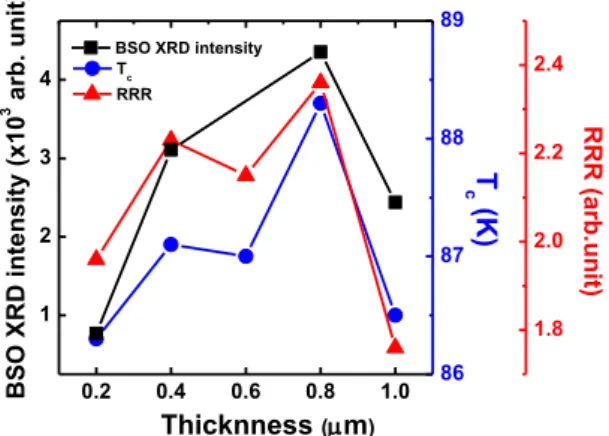
The XRD results appear to have a clear correlation with the results of Tc. From the transport measurements, it is confirmed that Tc of the films has a trend of increase with the film thickness and the highest Tc is owned by the 0.8
m-thick GdBCO film. Therefore, it is suggested that well-aligned growth of BSO is beneficial not only to Tc but also to the RRR value.
In Fig. 3, the variations of the XRD intensity of BSO peak are plotted as a function of the thickness of BSO-added GdBCO film. For comparison, the thickness dependence of Tc and the RRR values were also plotted.
Interestingly, a similar trend is observed among the XRD peak intensity, Tc,and the RRR values by increasing the BSO-added GdBCO thickness. This results indicate that the growth of BSO may be correlated to the Tc and RRR behaviors at different thickness.
86 87 88 89 Tc
RRR (arb.unit)
Tc (K)
1.8 2.0 2.2 2.4 RRR
0.2 0.4 0.6 0.8 1.0
1 2 3 4
BSO XRD intensity
BSO XRD intensity (x103 arb. unit)
Thicknness (m)
Fig. 3. The variation of BSO peak intensity of GdBCO films to the trends of Tc and RRR variations. All three show a similar trend with the film thickness.
2
H. K. Jeon, J. K. Lee, D. S. Yang, W. N. Kang, and B. Kang
In order to understand how the BSO addition affects the Tc values, we investigated the local structure of GdBCO films by performing interactive data analysis with IFEFFIT program. In Fig. 4, typical Fourier transforms (FTs) of the Cu K-edge EXAFS of BSO-added GdBCO with different thicknesses are shown. The radial distribution of neighbors of the absorbing atom can be observed by inspecting the peaks of the Fourier Transforms.
The first peaks are referring to the local structural ordering of Cu-O bonds and the amplitude of the FT peak represents the bond ordering in the local structure. As is evident from the Fig. 3, the thinnest GdBCO films of 0.2 μm shows the highest in amplitude than those of the other GdBCO films. This signifies that the ordering of Cu-O bond in 0.2 μm-thick GdBCO film is stronger than that of the other GdBCO films. Interestingly, the intensity of the amplitudes does not exhibit a monotonic decrease with thickness. The 2nd strongest peak belongs to the 0.8 μm-thick film which has the highest Tc and strongest BSO peak. The ordering of Cu-O bonds is weakened as GdBCO films thicken, while the lowest ordering of Cu-O bonds belong to the 0.4 μm-thick film which showed a double transition in Fig. 2. The inset shows a magnified view of the Cu-O bonds of BSO-added GdBCO. We expect that this trait somewhat related to the Tc feature discussed earlier.
The bond length (R) and Debye-Waller factors (2), which give the mean-square fluctuations in the distances, have been used as fitting parameters and the best fit results of the above parameters for all the films are summarized in
TABLE I
CU-O BOND LENGTH (R), AND DEBYE-WALLER FACTORS (2) OF THE
BSO-ADDED GDBCO FILMS WITH DIFFERENT THICKNESSES. Thickness (μm) R (Å ) σ2 (Å2)
0.2 2.068 0.0008
0.4 2.082 0.0005
0.6 2.060 0.0009
0.8 2.059 0.0007
1.0 2.096 0.0009
0 2 4 6 8 10
0.0 0.2 0.4
Fourier Transform (a.u.)
R (Å)
- 0.2 m - 0.4 m - 0.6 m - 0.8 m - 1.0 m
Cu-O
1.4 1.6 1.8 2.0 0.3
0.4
FT (a.u.)
R (Å)
Fig. 4. The Cu K-edge EXAFS for BSO-added GdBCO films with different thicknesses which represent the radial distribution of neighboring atoms around Cu-atom. The orderings of Cu–O bond diminish as the thicknesses of the films increase.
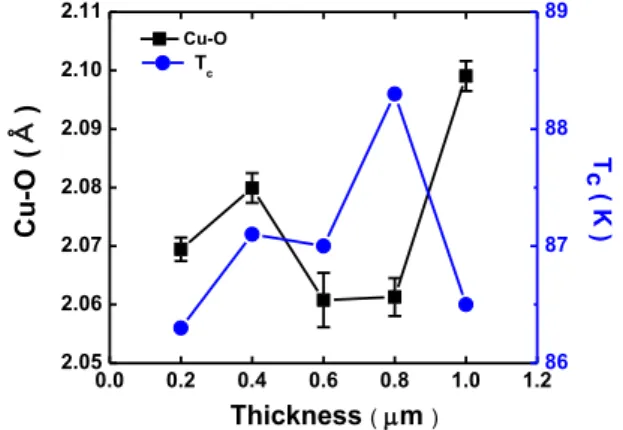
Table I. The Cu-O bond length systematically decreases with the film thickness only up to a thickness of 0.8 μm except for the 0.4 μm-thick film and beyond that thickness, the bond length increases. The random values of Debye-Waller factors could be resulted from various different aspects, such as thermal vibration and structural disorder of the atoms, incompleteness in the atomic bonding, etc.
In Fig. 5, the variations of Cu-O bond length as a function of thickness of BSO-added GdBCO films were presented. Interestingly, by increasing the film thickness, opposite behaviors are observed between the Cu-O bond lengths and the values of Tc. Despite an increase of the bond length at 0.4 m-thick-film, the Cu-O bonds might be correlated to the Tc behavior. Lattice contraction, by means of isotropic pressure, has been shown to increase Tc in cuprates [14]. Our results suggest that the formation of crystalline-BSO induced an effect of local lattice contraction in GdBCO films due to its self-assembled property.
4. CONCLUSION
We investigated the effect of 4 wt.% BSO addition on the superconducting properties and on the local structure of GdBCO films with varying thickness. From the shell analysis of EXAFS radial distribution functions, the existence of crystalline-BSO in GdBCO was found to affect the level of local ordering of Cu-O atomic bonds. We also observed that the Cu-O bond lengths are contracting when crystalline-BSO is well grown which may be closely related to the increased Tc values.
0.0 0.2 0.4 0.6 0.8 1.0 1.2
2.05 2.06 2.07 2.08 2.09 2.10 2.11
Cu-O
Cu-O(Å)
Thickness (m )
86 87 88 89 Tc
Tc ( K )
Fig. 5. The variation of Cu-O bond lengths of BSO-added GdBCO films to the trend of Tc variations.
These results help to establish the mechanism of BSO impurity in influencing the superconducting transition temperature and in affecting the local structure of GdBCO.
Consequently it would serve as an important reference for the investigation of the superconductive mechanism of GdBCO which is needed in the development of future power cable applications.
3
Effect of BSO addition on Cu-O bond of GdBa2Cu3O7-x films with varying thickness probed by extended x-ray absorption fine structure
ACKNOWLEDGMENT
This work was supported by the Basic Science Research Program through the National Research Foundation of Korea (NRF) funded by the Ministry of Education Science (NRF-2015R1D1A3A01019291).
REFERENCES
[1] Y. Xu, M. Izumi1, K. Tsuzuki, Y. Zhang, C. Xu, M. Murakami, N.
Sakai and I. Hirabayashi, "Flux pinning properties in a GdBa2Cu3O7−δ bulk superconductor with the addition of magnetic alloy particles," Supercond. Sci. Technol. vol. 22, pp. 095009, 2009.
[2] K. P. Ko, S. H. Moon, C. Park and S. I. Yoo, "High Jc GdBa2Cu3O7−δ coated conductor on CeO2-buffer IBAD MgO template fabricated by pulsed laser deposition," IEEE Trans. Appl.
Supercond., vol. 21, no. 3, pp. 2965-2968, 2011.
[3] T. Haugan, P. N. Barnes, R. Wheeler, F. Meisenkothen and M.
Sumption, "Addition of nanoparticle dispersions to enhance flux pinning of the YBa2Cu3O7-x superconductor," Nature, vol. 430, pp.
867-870, 2004.
[4] J. Hänisch, C. Cai, V. Stehr, R. Hühne, J. Lyubina, K. Nenkov, G.
Fuchs, L. Schultz and B. Holzapfel, "Formation and pinning properties of growth-controlled nanoscale precipitates in YBa2Cu3O7−δ/transition metal quasi-multilayers," Supercond. Sci.
Technol. vol. 19, pp. 534, 2006.
[5] N. Long, N. Strickland, B. Chapman, N. Ross, J. Xia, X. Li, W.
Zhang, T. Kodenkandath, Y. Huang and M. Rupich, "Enhanced in-field critical currents of YBCO second-generation (2G) wire by Dy additions," Supercond. Sci. Technol. vol.18 pp. S405, 2005.
[6] P. N. Barnes, J. W. Kell, B. C. Harrison, T. J. Haugan, C. V.
Varanasi, M. Rane, F. Ramos, "Minute doping with deleterious rare earths in YBa2Cu3O7−δ films for flux pinning enhancements," Appl.
Phys. Lett., vol. 89, pp. 012503, 2006.
[7] D. H. Tran, W. B. K. Putri, B. Kang, N. H. Lee, W. N. Kang, J. Y.
Lee and W. K. Seong, "Thickness dependence of critical current density in GdBa2Cu3O7−δ thin films with BaSnO3 addition," J. Appl.
Phys., vol.113, pp. 17E134, 2012.
[8] R. Kita, S. Kato, T. Nakamura, O. Miura, R. Teranishi, S. Yasunaga, H. Kai, M. Mukaida, A. Ichinose, K. Matsumoto, M. S. Horii and Y.
Yoshida, "Stability of barium oxides in REBa2Cu3Oy
superconductors," Physica C, vol. 468, pp. 1391, 2008.
[9] A. W. Hewat, P. Fischer, E. Kaldis, E. A. Hewat, E. Jilek, J.
Karpinski and S. Rusiecki, "Cu-O bond and Tc changes in 123, 124
& 247-superconductors," Journal of the Less-Common Metals, vol.
164 & 165, pp. 39-49, 1990
[10] K. Ohishi, Y. Syono, M. Kikuchi, N. Kobayashi, Y. Muto,
"Relation between Tc and Cu-O bond length within the basal plane of Ce0.15Nd1.85−xMxCuO4−y (M=La and Sm) and Ce0.15Pr1.85CuO4−y," Solid State Comm., vol. 73, pp. 341-343, 1990.
[11] S. Ohshima, N. Tanaka, S. Kambe and K. Okuyama, "Relationship between Tc and Cu Valence and Bond Lengths of Cu-Cu and Cu-O for Ba2-xEu1+xCu3O7-y Compounds," Jpn. J. Appl. Phys., vol. 33, pp.
1314-1319, 1994.
[12] B. Ravel and M. Newville, "ATHENA, ARTEMIS, HEPHAESTUS: data analysis for X-ray absorption spectroscopy using IFEFFIT," J. Synchrotron Rad., vol. 12, pp. 537-541, 2005 [13] M. Newville, "IFEFFIT: interactive XAFS analysis and FEFF
fitting," J. Synchrotron Rad., vol. 8, pp. 322-324, 2001.
[14] K. Horiuchi, M. Kanai, T. Kawai, and S. Kawai, “In-plain pressure effect in strained YBa2Cu3O7/La1.85Sr0.15CuO4 superlattices,” Phys.
Rev. B, vol. 45, pp.13152(R), 1992.
4