• 검색 결과가 없습니다.

UV/O<sub>3</sub> Process Time Effect on Electrical Characteristics of Sol-gel Processed CuO Thin Film Transistor

N/A
N/A
Protected

Academic year: 2021

Share "UV/O<sub>3</sub> Process Time Effect on Electrical Characteristics of Sol-gel Processed CuO Thin Film Transistor"

Copied!
5
0
0

로드 중.... (전체 텍스트 보기)

전체 글

(1)

1

UV/O 3 조사 시간에 따른 Sol-gel 공정 기반 CuO 박막 트랜지스터의 전기적 특성 변화

UV/O 3 Process Time Effect on Electrical

Characteristics of Sol-gel Processed CuO Thin Film Transistor

이 소 정 * , 장 봉 호 * , 김 태 균 * , 이 원 용 * , 장 재 원 * Sojeong Lee * , Bongho Jang * , Taegyun Kim * , Won-Yong Lee * , Jaewon Jang *

Abstract

In this research, sol-gel processed CuO p-type thin film transistors were fabricated with copper (II) acetate monohydrate precursors. After 500 ℃annealing process, the deposited thin films were fully converted into CuO.

We investigated UV/O 3 process time effect on electrical characteristics of sol-gel processed CuO thin film transistors. After 600 sec UV/O 3 process, the fabricated CuO thin film transistor delivered field effect mobility in saturation regime of 5 × 10 -3 cm 2 /V·s and on/off current ratio of ~10 2 .

요 약

Sol-gel 공법을 이용하여, p-형 CuO 박막 트랜지스터를 제작하였다. 제작된 CuO 박막 트랜지스터는 copper (II) acetate monohydrate 를 전구체로 사용하였다. 500

℃열처리 후에 형성된 전구체는 p-형 CuO 박막이 됨을 확인하였다. 또한 전

구체를 형성하기 전 기판표면의 UV/O 3 조사량에 따른 CuO 박막 트랜지스터의 전기적 특성변화에 대하여 연구하였

으며, 600 초동안 UV/O 3 를 조사한 경우 제작된 CuO 박막 트랜지스터는 5 × 10 -3 cm 2 /V·s 의 이동도와 약 10 2 의 온/오프 전류비를 보여주었다.

Key words : Sol-gel, CuO, UV/O 3 , p-type semiconductor, Thin film transistor

* School of Electronics Engineering, Kyungpook National University,

★ Corresponding author

E-mail:[email protected], Tel:+82-53-950-5534

※ Acknowledgment

This research was supported by Basic Science Research Program through the National Research Foundation of Korea (NRF) funded by the Ministry of Education

(NRF-2016R1D1A3B03930896)

Manuscript received Feb. 26, 2018; revised Mar. 18, 2018 ; accepted Mar. 20, 2018

This is an Open-Access article distributed under the terms of the Creative Commons Attribution Non-Commercial License (http://creativecommons.org/licenses/by-nc/3.0) which permits unrestricted non-commercial use, distribution, and reproduction in any medium, provided the original work is properly cited.

Ⅰ. 서론

최근 용액 공정 기반의 산화물 반도체에 대한

연구가 많은 관심을 받고 있다 [1]. 상대적으로 큰

밴드갭을 가지며, 우수한 전기적 특성을 보여주는

동시에 기존의 진공 증착 방법이 아닌 용액 공정

을 통하여 저비용으로 대면적 소자를 제작하는데

적합한 물질로 주목을 받고 있다 [2],[3]. 특히

ZnO, In 2 O 3 , 및 SnO 2 은 대표적인 n-형 반도체

물질로, 이를 이용한 다양한 방법의 고성능 투명

트랜지스터가 제작되기도 하였다. 일반적으로

n-type 산화물 반도체 기반의 트랜지스터의 경우

고전류, 고이동도, 및 높은 온/오프 전류비 등으로

인하여 차세대 투명 소자의 핵심 단위 소자로

(2)

고려되고 있다 [4]-[6]. 반면에 p/n 접합 소자 및 Complementary 회로를 제작하기 위해서는 n-형 반도체뿐만 아니라, p-형 반도체 및 성능향상이 동시에 요구된다. 용액 공정을 이용한 p-형 반도 체의 경우 최근에서야 연구가 진행되고 있다. 특 히, 다양한 p-형 반도체 중에서 Cu x O y 의 경우 상 대적으로 높은 정공 이동도와 우수한 광 특성, 구 조적 특성으로 주목받고 있다 [7, 8]. 또한, Cu x O y

는 독성이 없으며, 재료가 풍부하여 저렴한 재료 이기 때문에 경제적으로도 많은 장점이 있는 반 도체이다. 본 연구에서는 환경 친화적이며, 저비 용의 간단한 공정 등의 장점으로 Sol-gel 공정 기 반의 CuO 박막 트랜지스터를 제작했으며, UV/O 3

조사 시간별 전기적 특성을 분석하였다.

Ⅱ. 본론

1. 실험 방법

본 연구에 사용된 모든 시약은 Sigma-Aldrich에 서 구입하였으며, 추가적인 공정은 진행되지 않았 다. CuO 박막을 증착하기 위해 전구체 물질로서 Cu(CO 2 CH 3 )H 2 O 물질을 사용하였다. 0.001 mol 의 전구체를 9.5 mL 2-methoxyethanol 에 혼합하 였으며, Stabilizer 로는 0.5 mL ethanolamine 을 사용하였다. 투명하고 균일한 용액을 만들기 위해 초음파 세척기를 이용하여 5분 동안 용액을 섞어 주었다. 박막을 형성하기 위해 3000 rpm 에서 50 초 동안 spin coating 을 하였다. 이후 용액이 도 포된 기판을 hot plate 위에 120 ℃에서 10분 동안 열처리 하였다. 게이트 누설 전류를 막기 위해 증 착된 박막을 기계적으로 패터닝한 후 500 ℃에서 1시간 동안 공기중에서 열처리하였다.

제작된 박막트랜지스터 소자는 bottom 게이트 coplanar 구조이다. P-type 실리콘 기판위에 100 nm 두께의 SiO 2 절연막을 성장한 후 소스, 드레 인 전극을 e-beam evaporation 와 photolithography 공정을 이용하여 50 nm 두께의 Au 를 증착하였다. 소자의 채널 길이와 폭은 각각 100 um 과 1000 um 이다. 균일한 박막의 형성을 위하여 Spin coating 공정 전 기판을 UV/O 3 를 조 사하여, 불순물 제거하였다. 본 실험에서는 UV/O 3 조사 시간에 따른 박막트랜지스터의 전기 적 특성을 측정했다. 각각의 소자는 300초, 600초,

900초 동안 UV/O 3 를 조사하였다. 결정 구조는 Philips X’pert pro grazing incidence X-ray diffractometer 로 조사하였다. 박막의 표면 분석은 scanning probe microscope(SPM, Park NX20, tapping mode) 로 측정하였다. 박막트랜지스터의 전기적 특성은 Agilent 4155 반도체 parameter 분 석기로 측정하였으며, 누설전류 및 Fringe 효과를 최소화하기 위하여 소자의 채널영역을 기계적으 로 식각하였다.

2. 결과 및 고찰

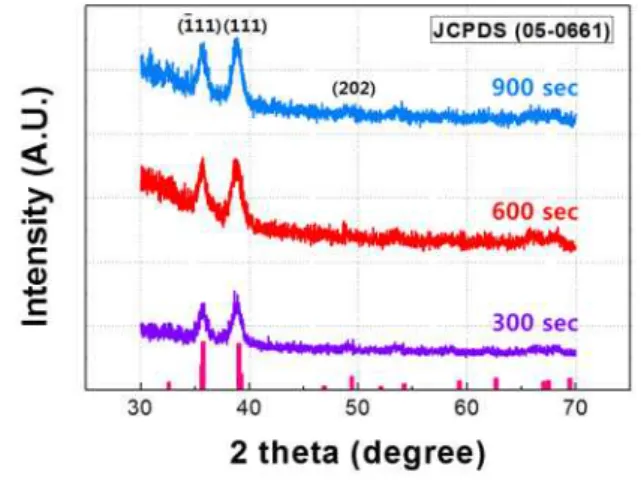
그림 1은 증착한 CuO 박막의 UV/O 3 조사 시간 별 GIXRD 스펙트럼이며 이를 통해 박막의 구조 적 특성을 확인했다. Diffraction peak인 35.5°, 38.7°를 기준으로 확인해 본 결과 제작된 박막의 GIXRD 스펙트럼은 표준 JCPDS 데이터의 (05-0661)와 일치하며, cubic 구조임을 확인하였 다. 또한, GIXRD 스펙트럼에서 Cu와 Cu 2 O peak 이 나타나지 않았으며, 이는 열처리 후 전구체가 박막 CuO 로 변환되었음을 확인할 수 있었다.

Fig. 1. XRD spectra obtained for each UV/O 3 sol-gel processed CuO films.

그림 1. 기판표면의 UV/O 3 조사 시간 별 용액공정으로 제 작된 CuO 박막의 XRD 스펙트럼

  cos  (1)

결정 크기는 Scherrer Equation (1)을 통해 알 수 있다. 는 형상 계수, 는 x-ray 파장, 는 최대 강도를 갖는 반치 폭, 는 bragg 각도이다. 각각 의 평균 결정 크기는 모두 대략 9 nm로 UV/O 3

조사 시간에 따른 차이는 보이지 않았다. 그림 2는

(3)

UV/O 3 조사 시간에 따른 SPM 이미지이다.

Fig. 2. SPM images obtained for each UV/O 3 sol-gel processed CuO films. a) 300 sec, b) 600 sec and c) 900 sec.

그림 2. 기판표면의 UV/O 3 조사 시간별 용액 공정으로 제 작된 CuO 박막의 SPM 이미지. a) 300 초, b) 600 초, c) 900 초

그림 3 에 따르면 조사 시간이 증가할수록 박막의 두께와 RMS (root mean square) 값이 증가함을 확인할 수 있었다. UV/O 3 조사 시간이 길수록 표면은 더욱 친수성으로 변하게 된다. 이는 표면 에너지 증가를 야기하며, 극성인 용액일 경우 표면 에 떨어트린 용액의 점착력을 증가시키게 된다.

[9, 10] 따라서 UV/O 3 조사 시간이 길수록 두께가

두꺼워 진다.

Fig. 3. Thickness and RMS values obtained for each UV/O 3 sol-gel processed CuO films.

그림 3. 기판표면의 UV/O 3 조사 시간별 용액 공정으로 제 작된 CuO 박막의 두께 및 RMS

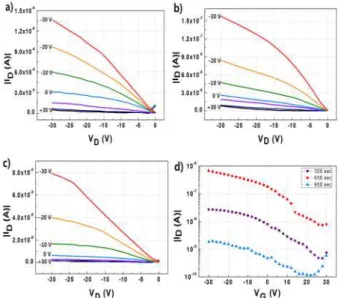
그림 4는 UV/O 3 조사 시간에 따른 CuO 박막 트랜지스터의 전기적인 특성을 보여준다. UV/O 3

공정을 300초 진행한 경우대비, 600초 조사하였을

때 이동도가 증가함을 확인하였다. 반도체 박막의

두께가 증가할수록 트랜지스터 내에서 채널이 형

성되었을 때 단위면적당 전자 농도가 증가하기

때문에 UV/O 3 조사 시간이 길수록 전도도가 증

가한다. 또한 증가된 전자 농도는 박막 트랜지스

터를 낮은 전압에서 채널을 형성 시키며, 이는 문

턱 전압 (V th ) 값을 통하여 확인 할 수 있었다. 그

러나 900초의 경우 RMS 값이 증가하여 박막의

균일도가 감소했음을 확인할 수 있었다.

(4)

Fig. 4. ID-VD characteristics obtained for each UV/O3 sol-gel processed CuO films. a) 300 sec, b) 600 sec, c) 900 sec and d) ID-VG curve UV/O3 sol-gel processed CuO films.

그림 4 기판표면의 UV/O 3 조사 시간 별 용액공정으로 제 작된 CuO 박막의 I D -V D 특성 a) 300 초, b) 600 초, c) 900 초, d) UV/O 3 조사 시간 별 용액공정으 로 제작된 CuO 박막의 I D -V G 특성

채널 두께가 균일하지 않은 박막의 경우, 두께 가 얇은 영역은 수직방향 전계가 강하게 작용한 다. 이는 전자의 산란을 일으켜 이동도를 저하시 킨다. 또한, 낮은 V D 전압에서 IV 곡선은 선형적 인 관계를 보여주지 않았으며, 이는 CuO 박막의 전자 친화도와 Au 전극의 일함수의 차이로 인해 발생함을 확인할 수 있었다. 600초 동안 UV/O 3 을 주사한 후 제작되어진 CuO 박막 트랜지스터의 경우 포화영역에서의 이동도는 5 × 10 -3 cm 2 /V·s 이였으며, 온/오프 전류비는 약 10 2 임을 확인하였 다. [그림 5]

Fig. 5. Mobility in saturation regime and on/off ratio values obtained for each UV/O 3 sol-gel processed CuO films.

그림 5. 기판표면의 UV/O 3 조사 시간별 용액 공정으로 제 작된 CuO 박막의 포화영역에서의 이동도 및 온/

오프 전류비

Ⅲ 결론

본 연구에서는 Sol-gel 공법을 이용하여, p-형 CuO 박막트랜지스터를 제작하였다. 또한 박막 형 성 전 진행된 UV/O 3 조사 시간에 따른 박막트랜 지스터의 전기적 특성 변화에 관하여 연구하였다.

UV/O 3 조사 시간이 길수록 두께가 두꺼워짐을

확인하였으나 동시에 조사 시간이 길어지면 표면 의 균일도가 감소하였다. 이는 채널영역의 수직방 향 전계에 영향을 미치며 전자 산란으로 인해 전 도도가 감소하는 것을 확인하였다. 600초 동안 UV/O 3 을 주사한 후 제작된 CuO 박막 트랜지스 터의 경우 포화영역에서의 이동도는 5 × 10 -3 cm 2 /V·s 이였으며, 온/오프 전류비는 약 10 2 임을 확인하였다.

References

[1] R. A. street, “Thin film transistor,”

Advanced Materials , vol.21. no.20, pp.2007-2022, 2009.DOI:10.1002/adma.200803211

[2] K. K. Song, D. J. Kim, X. S. Li, T. W. Jun, Y. M. Jeong and J. H. Moon, “Solution processed invisible all-oxide thin film transistors,” Journal of Material Chemistry, vol.19, no.46, pp.8881-8886, 2009.DOI:10.1039/B912554J

[3] G. Huang, L. Duan, G. Dong, D. Zhang and Y. Qiu, “High-mobility solution-processed tin oxide thin-film transistors with high-k alumina dielectric working in enhancement mode,” ACS Applied Material and Interfaces, 6(23), pp.

20786-20794. 2014.DOI:10.1021/am5050295

[4] K. Nomura, H, Ohta, A. Takagi, T. Kamiya, M. Hirano and H. hosono, “Room-temperature fabrication of transparent flexible thin-film transistors using amorphous oxide semiconductors,” nature, 432, pp. 488-492, Nov.

2004.DOI:10.1038/nature03090

[5] R. L. Hoffman, B. J. Norris and J. F.

Wager, “ZnO-based transparent thin-film

transistors,” Applied Physics Letters, vol.82,

no.5, pp.733-735, 2003.DOI:10.1063/1.1542677

[6] S. C. Wang, C. F. Yeh, C. K. Huang and

Y. T. Dai, “Device transfer technology by

backside etching (DTBE) for poly-Si thin-film

transistors on glass/plastic substrate,” J apanese

J ournal of Applied Physics, vol.42,

pp.1044-1046, 2003.DOI: 10.1143/JJAP.42.L1044

(5)

[7] Z. Wang, P. K. Nayak, J. A.

Caraveo-Frescas and H. N. Alshareef, “Recent developments in p-type Oxide Semiconductor materials and devices,” Advanced Materials, vol.28, no.20, pp. 3831-3892, 2016.DOI:10.1002/adma.201503080

[8] B. Balamurugan and B. R. Mehta, “Optical and structural properties of nanocrystalline copper oxide thin films prepared by activated reactive evaporation,” Thin Solid Films, Vol.396, no.1-2, pp.90-96,

2001.DOI:10.1016/S0040-6090(01)01216-0 [9] C. Gu and J. K. Lee, “Patterning of amorphous-InGaZnO thin-film transistors by stamping of surface-modified

polydimethylsiloxane,” RCS Advances, no.49, 2016.DOI:10.1039/C6RA06264D

[10] H. Tavana, N. Petong, A. Hennig, K.

Grundke and A. W. Neumann. “Contact angles and coating thickness,” The Journal of

Adhesion, vol.81, no.1,

2005.DOI:10.1080/00218460590904435

BIOGRAPHY

Sojeong Lee (Member)

2017 : B. S. Degree in School of Electronics Engineering,

Kyungpook National University.

2017 ~ : M. S. degree in School of Electronics Engineering, Kyungpook National University.

BonghoJang (Member)

2017 : B. S. Degree in School of Electronics Engineering,

Kyungpook National University.

2017 ~ : M. S. degree in School of Electronics Engineering, Kyungpook National University.

TaegyunKim (Member)

2015 : B. S. Degree in School of Electronics Engineering,

Kyungpook National University.

2016 ~ : M. S. degree in School of Electronics Engineering, Kyungpook National University.

Won-Yong Lee (Member)

2014 : B. S. Degree in School of Electronics Engineering,

Kyungpook National University.

2016 : M. S. Degree in School of Electronics Engineering,

Kyungpook National University.

2017 ~ : Ph. Degree in School of Electronics Engineering, Kyungpook National University.

Jaewon Jang(Member)

2006 : B. S. Degree in electrical engineering, Korea University 2008 : M.S. Degree in electrical engineering, Korea University 2013 : Ph. D degree in electrical engineering and conputer sciences, University of California at

Berkeley

2013~2015 : Post Doc. Researcher, University of California at Berkeley

2015~2016 : Researcher, Samsung Advanced Institute of Technology

2016~ : Assistant Prof. School of Electronics

Engineering, Kyungpook National University.

수치

Fig. 1. XRD spectra obtained for each UV/O 3 sol-gel processed CuO films.
그림 2. 기판표면의 UV/O 3 조사 시간별 용액 공정으로 제 작된 CuO 박막의 SPM 이미지. a) 300 초, b) 600 초, c) 900 초

참조

관련 문서

CO sensing thick film gas sensors using Co 3 O 4 powders prepared by hydrothermal reaction method, were fabricated, and their structural, electrical and CO

Abstract-In this paper, sol-gel-spin coated Pb(ZrTi)O 3 thin film with ZrO 2 buffer-layer and PbTiO 3 seed-layer was investigated for vibration MEMS

On the other hand, the boehmite (AlO(OH)) obtained by sol-gel process has exhibited a decrease in surface area during phase transformation due to a decline in surface active

When the RF power was 100 W and the treatment time was 120 sec in the O 2 plasma pretreatment process, the resistivity of the GZO films on the PEN substrate was 1.05 × 10 -3

Y 2 O 3 -doped ZrO 2 (YZ) films were coated on the etched aluminum foils by sol-gel dip coating, and the electrical properties of YZ-coated Al foils were characterized. The

The Treatment Properties of Heavy Metals in Acid Mine Drainage with Micro-bubble and UV/H 2 O 2 Oxidation Process.. Yong-Jun Jung *

Key words ε-Ga 2 O 3 , MOCVD, Structural properties, MSM photodetector, Photo-electric properties.. ε-Ga 2 O 3 박막 성장 및 MSM UV photodetector의