• 검색 결과가 없습니다.

FAR INFRARED ASTRONOMY AFTER SPICA

N/A
N/A
Protected

Academic year: 2021

Share "FAR INFRARED ASTRONOMY AFTER SPICA"

Copied!
5
0
0

로드 중.... (전체 텍스트 보기)

전체 글

(1)

2017. The Korean Astronomical Society. All rights reserved. c https://doi.org/10.5303/PKAS.2017.32.1.337

FAR INFRARED ASTRONOMY AFTER SPICA Bruce Swinyard

1,2

& Chris Pearson

2,3,4

1

Department of Physics and Astronomy, University College London, Gower Street, London, UK

2

RAL Space, STFC-Rutherford Appleton Laboratory, Harwell, Oxon, UK; [email protected]

3

The Open University, Milton Keynes, MK7 6AA, UK

4

Oxford Astrophysics, University of Oxford, Keble Rd, Oxford OX1 3RH, UK E-mail: [email protected]

(Received October 9, 2014; Revised October 25, 2016; Accepted October 25, 2016)

ABSTRACT

This paper reviews the requirements for far-infrared astronomy in the period following the SPICA satellite in the late 2020’s. We take a very long view of the state of FIR astronomy and what facilities will be required in a twenty year timeframe. We show that spatial resolution to match that of observatories operating in the optical and mid-infrared and the radio will be a necessity. Moreover this high spatial resolution must be combined with high spectral and photometric sensitivity to provide the data required to further our understanding of planetary formation mechanisms, the history of star formation through cosmic time and the feedback between active galactic nuclei and their host galaxies in controlling star formation. We review three possible conceptual mission scenarios and comment on the possibility of realising them in the coming deades.

Key words: Space; Missions; SPICA; Infrared

1. INTRODUCTION

Our view of the universe changed completely in the 1980’s when the first infrared survey of the cosmos re- vealed that half of the non-cosmological background ra- diation arises at wavelengths in the far infrared, 30-300 µm band (FIR). In the three decades since the IRAS satellite (Neugebauer et al., 1984) made this discovery we have made much progress in understanding the pro- cesses that lead to FIR emission through missions such as AKARI (Murakami et al., 2007), culminating in the Herschel mission (Pilbratt et al., 2010) which completed operations in 2013. Together these facilities have al- lowed us to probe the fundamental processes of star for- mation, trace stellar and galaxy evolution and reveal the complex chemistry present in a large variety of astro- physical environments. Observations in the FIR trace the coldest regions of the Universe with gas and dust temperatures typically of 10’s K. This very fact indicates immediately the difficult technical challenges involved in

http://pkas.kas.org

making these observations. The facilities have to be in space and both the collecting apertures and the instru- ments have to be cryogenically cooled. To date, some or all of this cooling has been achieved using expendable cryogens, making them complex pieces of engineering and limiting their operational lifetime. The startling progress in the 30 years between IRAS and Herschel shows what can be achieved and, with the knowledge gained from Herschel, we are in a good position to un- derstand what is needed to continue that progress.

In this paper we discuss the requirements for future

FIR facilities in the light of our current understanding

and briefly touch on how the proposed SPICA mission

(Swinyard et al., 2009) will fulfil some of those require-

ments. We illustrate the outstanding problems using a

set of four test case observational problems and describe

how these might be addressed by some mission concepts

under active consideration by a number of groups. We

conclude with some thoughts on the likelihood of a fu-

ture FIR mission being constructed and the technical

337

(2)

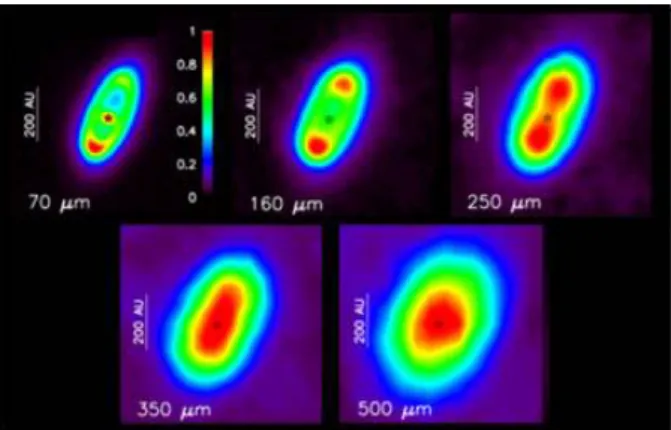
Figure 1. Herschel images of the dust ring around Formul- haut.

Figure 2. Two illustrations of confusion problems in identify- ing Herschel FIR galaxies.

roadmap that is needed to make it possible. In prepar- ing this paper we have used the work of the FIRI con- sortium which proposed that a large FIR mission be considered for the next European Space Agency L-class mission (see Ivison et al. 2013).

2. SCIENTIFIC PERSPECTIVE - HERSCHEL & SPICA Although it is rather too soon to give a full account of the historical impact of Herschel data on various topics, a number of tentative conclusions can already be drawn from the large number of papers published using those data. In the field of star formation large area photomet- ric surveys (Molinari et al., 2010) have shown the almost ubiquitous nature of filamentary dusty structures asso- ciated with the onset of star formation. Somewhat un- expectedly continuing work in this area seems to show that these filaments have a fixed width of ∼0.1 pc in- dependently of the environment where they are discov- ered, indicating that turbulence within the ISM prints a size structure onto the dust and gas (Arzoumanian et al., 2011). The discovery of the presence of water in proto-planetary discs (Hogerheijde et al., 2011), whilst perhaps unsurprising, tells us that ultimately the chem- istry of star formation leads to the chemistry of life itself.

This is confirmed by the indicative result that the water in comets has the same isotopic make up as that in the

Earth’s oceans (Hartogh et al., 2011).

In the distant Universe, we been able to resolve the Cosmic FIR background (CIRB) into its constituent galaxies (e.g.Oliver et al. 2012) and confirmed that there were more of the Ultra Luminous IR galaxies (ULIRGs) in earlier epochs of the universe than observed in the local universe. With Herschel spectroscopy, only the lo- cal Universe could properly be observed although some higher redshift objects were detected (e.g. Ivison et al.

2010). Further analysis of the data combined with ex- tensive ground based and mid infrared (from JWST) spectroscopic surveys will no doubt add to our knowl- edge. Even with SKA, ALMA and JWST we will not be able to access all the indicators of star formation over critical redshift ranges. In order to gain a full picture we need to access the far infrared from space and with suf- ficient sensitivity to see the normal objects rather than the biggest and brightest.

Similarly, whilst Herschel data, combined with those from ALMA and other ground based interferometers, are giving us a better understanding of star formation in our own galaxy, we have gained little information on the processes involved in planetary formation. Here both a lack of sufficiently sensitive spectrometers and a lack of spatial resolution has hampered attempts to really give a clear view of planetary formation from the thick, gas- rich proto-planetary disks phase to the dust and rubble of the final evolved systems. Only a few of the really nearby objects could be accessed and, although we have a more detailed picture of the processes in these objects, a comprehensive survey of many systems in a variety of stages of evolution and chemical and physical environ- ments is necessary. This will only be possible with much greater spectral sensitivity combined, eventually, with much higher spatial resolution.

The basic issue of sensitivity will be addressed by the

SPICA mission which will observe from at least 20 to 210

µm and will have a 3 m class mirror cooled to about 6

K. This mission envelope will provide an order of mag-

nitude increase in sensitivity in the FIR compared to

Herschel. The two areas where this capability will pro-

vide break though science are spectral surveys of the

Herschel galaxies, revealing their nature and giving us a

clear view of the mechanisms driving the star formation

history of the Universe, and planetary formation, where

we will obtain the first complete spectral view of oxygen

and water chemistry in a large sample of proto-planetary

disks. SPICA will also provide critical data for many

other science themes where sensitivity has been the lim-

(3)

iting factor notably the dust cycle in the ISM. SPICA, with much improved detectors and a cold solid dish is absolutely necessary in the next decade to continue the work of previous missions. However, one aspect will not change between Herschel and SPICA and that is the spa- tial resolution and really revolutionary progress in FIR observational astronomy will require a radical change in spatial resolution.

3. ILLUSTRATIVE CASES

It is impossible here to give a full justification of the case for high spatial resolution observations in the FIR (see Ivison et al. 2013 and references therein). We con- fine ourselves to four cases which highlight the need for high spatial resolution on spatial resolution scales of <1 arsec.

3.1. Planetary evolution

Figure 1 shows the Formulhaut debris disk as imaged by Herschel (Acke et al., 2012). This is one of a hand- ful of debris disks that were resolved by current FIR observations and even here we see that at the longer wavelengths we lose image fidelity. Understanding the nature of debris disks such as this is important in under- standing how the process of planetary formation plays out and gives us an insight into where the water, in the form of ice, is locked up in the final stages. Here the disk appears to be active in the sense that small body colli- sions are replenishing the dust in this relatively young system still undergoing rapid evolution. Many more of this type of object must be observed at this level of de- tail and over the full range from dense gas disks to fully formed planetary systems with Kuiper belt type dust disks. ALMA (in the sub-mm) and JWST (in the MIR) will add greatly to our knowledge, but they cannot ac- cess the crucial water emission features (whether solid or gaseous) or many of the solid state mineral features to characterise the dust. Only in the FIR does the full picture emerge and only with sub-arcsec imaging will we see a sufficient number of systems to form an unbiased view of planetary formation.

3.2. Massive Star Formation

The cartoon picture of star formation is well established from pre-stellar cores, through class 0 protostars to class III T-tauri type objects with large outflows. However, the conditions required for the formation and evolution of the most massive objects are not fully understood. In particular the energy balance between collapse and cool-

ing through emission lines, particularly water, is critical to the end point of the process. Data from the HIFI instrument on Herschel have given some insight into the problem (Van der Tak et al., 2013) revealing multiple ve- locity components in the direction of a number of high mass proto-stellar objects which can partially be disen- tangled using the extremely high spectral resolution of HIFI. However, the true nature of the sources and how the various components interact with each other can only be fully understood by spatial separation. ALMA will be the facility of choice for continuing this work but can only access part of the spectrum and only high energy (i.e. hot) water lines. The cooler envelope and winds which control much of the energy balance can only be fully imaged from space.

3.3. AGN Feedback

It is now an undisputed observable fact that the cos- mic star formation rate peaked at around z∼2 and has dropped exponentially since then. It also seems to be the case that the star formation rate within the ma- jority of galaxies is controlled by some complex inter- play between the massive black hole at the centre of the galaxy and its host. However, how this feedback occurs and the detailed mechanisms that control star formation at the galactic and galaxy cluster scale are not at all understood. Recent observations give hints that there are large outflows of gas present in some sources. This indicates that some form of expulsion of the gas that might otherwise form stars occurs at a certain epoch in a galaxy’s evolution; thus quenching star formation.

One example of the detection of such an outflow in the FIR is given by Sturm et al. (2011) who have detected a large outflow of OH from the active galaxy Mrk 231.

This outflow is seen in the absorption profile of the OH 79 µm line and is estimated to represent a mass loss of 1200 M

per year, an enormous rate. What is driving this phenomenon is not all clear and this question can only be properly resolved by probing directly into cen- tre of the galaxy through high spatial resolution. Again ALMA will shed some light of the situation but only in low lying transitions of molecules such as CO. The bulk of the mass loss may still be missed and it is only in the FIR that molecules such as OH can be seen.

3.4. Galaxies at high redshift

Herschel has discovered tens of thousands of FIR and

sub-mm bright galaxies (Oliver at al 2012). The identi-

fication of these sources and associating counterparts at

other wavelengths presents a major difficulty, however,

(4)

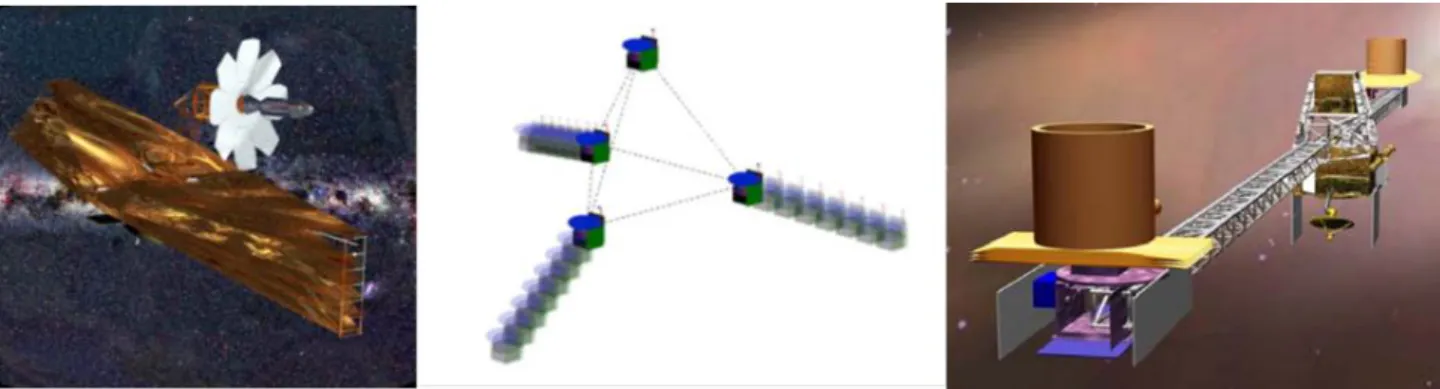
Figure 3. Examples of proposed future FIR space observatory concepts. From left to right (a) the SAFIR 10m cold dish concept (b) the heterodyne ESPRIT multispacecraft concept and (c) the SPIRIT structurally connected Michelson concept.

due the relatively large beam size of the Herschel tele- scope. Moreover, their redshift can only be confirmed using follow up spectroscopy from the ground (Casey et al., 2012) . This problem is especially acute when looking at the highest redshift objects which only ap- pear at the longest wavelengths with the largest beam size. This is illustrated in the left hand panel of Figure 2 where multiple candidates are seen at 24 µm for a sin- gle source in the Herschel 250 µm image. Also shown in Figure 2 (right hand panel) is an example of a complex source seemingly undergoing a merger (Fu et al., 2013).

Only with the spatial resolution offered by sub-mm and radio interferometers can we see its complex nature and even the presence of a bridge of material between the merging components.

4. FUTURE MISSION CONCEPTS

Having illustrated the case for high spatial resolution in the FIR we turn to how this might be achieved. The angular resolution of an optical system is governed by the maximum number of wavelengths across the pri- mary aperture: effectively λ/D, where D the distance across the aperture. In solid aperture telescopes, such as Herschel, all spatial frequencies are measured simultane- ously and an image is naturally formed with the highest spatial sampling given by λ/D and lowest by the field of view of the focal plane instrumentation. Other methods of achieving higher spatial resolution involve various im- plementations of sparse apertures which do not sample all spatial frequencies simultaneously and require the use of intermediate optics or phase sensitive detection to ensure the light from the separated apertures can be recombined in phase. There are three basic techniques that can be employed in the FIR which are illustrated by the three proposed space missions shown in Figure

3. In the first, which we might term a Fizeau interfer- ometer, the light from an arrangement of apertures is brought together at a combined focal plane. The dis- tributed aperture may be as shown in Figure 3a (Lester et al., 2005), may a be a ring like aperture (the TALC proposal, see Ivison et al. 2013) or could be arranged as separate telescopes with some form of phase correction system between them (Chung et al., 2004). The second possibility is essentially to place an ALMA or SMA type heterodyne interferometer in space. In the implementa- tion shown in Figure 3b (ESPRIT see Helmich et al.

2005) four space craft are used each with an identical set of receivers phase locked to one of the spacecraft.

The signals are correlated and different spatial frequen- cies are sampled by reconfiguring the spacecraft array in an exact analogy of the ground based systems. A third possibility is the more classical Michelson interferome- ter where the phase is directly measured between two apertures as the distance between them is varied. An implementation of this for the FIR has been extensively studied (Leisawitz et al. 2007, Figure 3b) which would use a double Fourier method to simultaneously measure both the spatial fringe visibilities and the spectral con- tent of the signals. This system requires cold apertures and high sensitivity detector arrays similar to those de- veloped for the SPICA mission.

The choice of system design depends to some extent on the scientific priorities. For instance: the narrow spectral window of a heterodyne system means that de- tecting and mapping broad band solid state is difficult;

a sparse aperture Fizeau interferometer has a very nar-

row field of view meaning extended sources are difficult

to image and both direct detection solutions have rather

lower spectral resolution than required for many science

topics. Technically all three systems are extremely chal-

(5)

lenging and costly. In principle a deployable system such as SAFIR will be proven with JWST, and most of the technology required for a heterodyne system has been demonstrated either on Herschel or in ground based sys- tems. However, given the $8.5 billion cost of JWST, the prospect of a larger, colder version does not seem possible within any reasonable timescale. A heterodyne based system faces fewer direct technological challenges but, given the nature of the detection technique, re- quires rather more collecting area to provide the nec- essary sensitivity, immediately raising the cost. Here the major problems are phase locking between space- craft, spacecraft station keeping and manoeuvring and the very large data rate between spacecraft and the ground needed for either on-board or ground based cor- relation. The Michelson solution perhaps has the great- est technical issues. A full scale system has not yet been demonstrated (although balloon borne systems are un- der construction); it relies for its sensitivity on cold mir- rors which have to move along a deployed boom and the system has to maintain structural stability to very high levels whilst undertaking complex configuration changes and spacecraft manoeuvres. None of these aspects has been demonstrated on an operational space mission.

Whichever system is finally chosen the implementa- tion will be expensive and will require co-operation be- tween a number of space agencies. Such a large un- dertaking cannot be envisaged for least another twenty years. In the meantime the community, with the assis- tance of the space agencies, must look first to imple- menting SPICA and then to developing the necessary technology through smaller, more sceintifically focussed, facilties either on balloon platforms or in space.

REFERENCES

Acke, B., Min, M., Dominik, C., et al., 2012, Herschel images of Fomalhaut A&A, 540, 125

Arzoumanian D., Andre, Ph., Didelon, P., et al., 2011 Char- acterizing interstellar filaments with Herschel in IC 5146, A&A 529, L6

Casey, C. M., Berta, S., Bethermin, M., et al., 2012, A redshift survey of Herschel far-infrared selected starbursts ApJ, 761, 140

Chung, S. -J., Miller, D. W., de Weck, O. L., 2004, ARGOS testbed: study of multidisciplinary challenges of future spaceborne interferometric arrays, Opt. Eng., 43, 2156 Fu, H., Cooray, A., Feruglio, C., et al., 2013, The rapid

assembly of an elliptical galaxy of 400 billion solar masses at a redshift of 2.3, Nature, 498, 338

Hartogh, P. Lis, D. C., Bocklee-Morvan, D., et al., 2011, Ocean-like water in the Jupiter-family comet 103P/Hartley 2, Nature, 478, 218

Helmich, F. P., Wild, W., van Langevelde, H. J., et al., 2005, ESPRIT Base line design document SRON- G/ESPRIT/BD/2005-002

Hogerheijde, M. R., Bergin, E. A., Brinch, C., et al., 2011, Detection of the Water Reservoir in a Forming Planetary System, Science, 334, 338

Ivison, R. J., Swinbank, A. M., Swinyard, B., 2010, Her- schel and SCUBA-2 imaging and spectroscopy of a bright, lensed submillimetre galaxy at z = 2.3, A&A, 518, 35 Ivison, R., Helmich, F., Sauvage, M., 2013, Sub-arcsecond

far-infrared space observatory: a science imperative, www.firi.eu

Leisawitz, D., Baker, C., Barger, A., et al., 2007, The Space Infrared Interferometric Telescope (SPIRIT): High resolu- tion imaging and spectroscopy in the far-infrared, J. Adv.

Space Res., 40, 689

Lester, D. Benford, D., Blain, A., et al., 2005, Design Study for SAFIR, NASA Report NRA-03-OSS-01-VM

Molinari. S, Swinyard, B., Bally, J., et al., 2010, Clouds, filaments, and protostars: The Herschel Hi-GAL Milky Way, A&A, 518, L100

Murakami, H., Baba, H., Barthel, P., et al., 2007, The In- frared Astronomical Mission AKARI, PASJ, 58, S369 Neugebauer, G., Habing, H., van Duinen, R., et al, 1984,

The Infrared Astronomical Satellite (IRAS) mission, ApJ, 278, L1

Oliver, S.J., Bock, J., Altieri, B., et al, 2012, The Her- schel Multi-tiered Extragalactic Survey: HerMES, MN- RAS 424, 1614

Pilbratt, G. Riedinger, J. R., Passvogel, T., et al., 2010, Her- schel Space Observatory. An ESA facility for far-infrared and submillimetre astronomy, A&A, 518, L1

Sturm, E., Gonzalez-Alfonso , E., Veilleux, S., et al., 2011, Massive molecular outflows and negative feedback in ULIRG observed by Herschel-PACS, ApJ Let, 733, L16 Swinyard, B. M. & Nakagawa, T., 2009, The space infrared telescope for cosmology and astrophysics: SPICA A joint mission between JAXA and ESA, Exp A., 23, 193 van der Tak, F., Chavarra, L. ,Herpin, F., et al., 2013, Water

in star-forming regions with Herschel (WISH), A&A, 554,

83

수치

Figure 1. Herschel images of the dust ring around Formul- Formul-haut.
Figure 3. Examples of proposed future FIR space observatory concepts. From left to right (a) the SAFIR 10m cold dish concept (b) the heterodyne ESPRIT multispacecraft concept and (c) the SPIRIT structurally connected Michelson concept.

참조

관련 문서

In this study, the reliability of high efficiency air conditioning compressor applied with high vacuum local pressure die casting technique is to be analyzed through

Moreover, it describes how this education should be oriented with referring to studies and literature based on the understanding of reading book

This work builds inversely a base performance model of a turboprop engine to be used for a high altitude operation UAV using measured performance data,

INTRODUCTION Various kinds of optical polymers with a high refractive index (high-n) and a low birefringence (Dn) combined with good optical transparency and high thermal

The aim of this study is to explain difficulties of Korean high school students' use of English relative pronouns by the error analysis and then provide English teachers

Generally urban freeway is the principal arterial corridor that is intended to provide for high levels of safety and efficiency in the movement of

After the vehicle has become a large-formation and high-speed, loud noise from an express highway is coming to be higher and the number of large-scale

The purpose of this study was to analyze the domestic preliminary researches on the effect of far infrared hyperthermia(far infrared ray is 8 ~ 16 m (micron) μ which is